Download to read offline

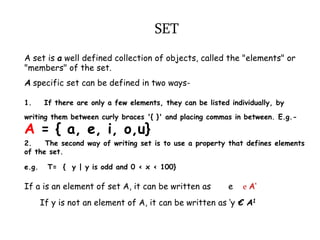
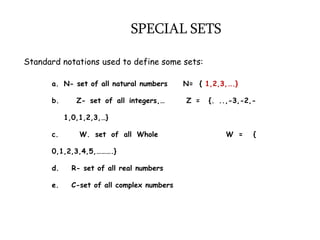


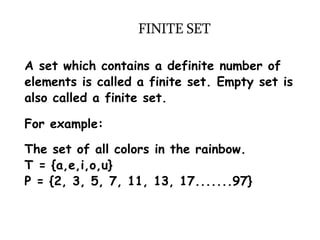
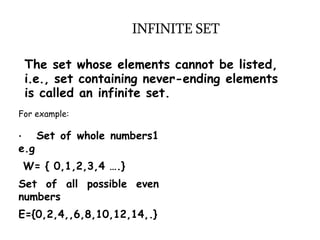

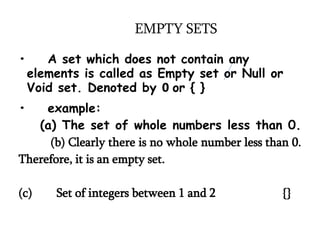

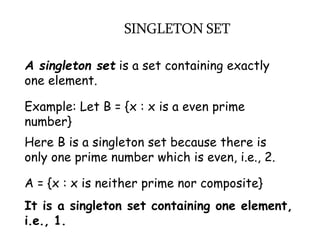
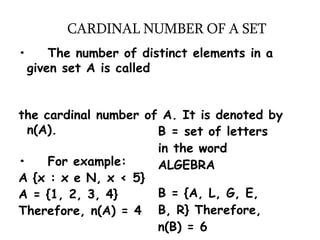
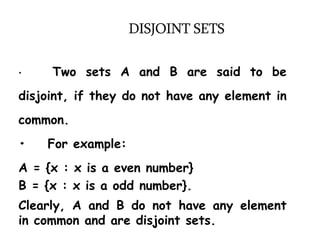
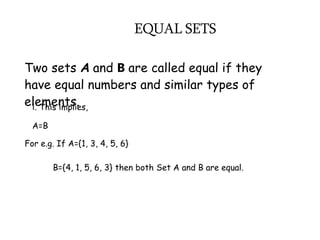
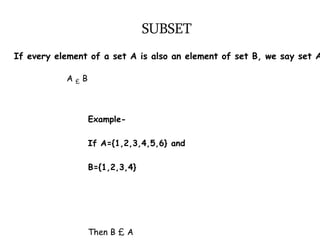


Sets can be defined by listing elements between curly braces or using a property that defines the elements. There are several standard sets like the set of natural numbers N and real numbers R. Sets are either finite if they contain a definite number of elements, or infinite if the elements cannot be listed. An empty set contains no elements, while a singleton set contains exactly one element. The cardinal number of a set is the number of distinct elements it contains. Two sets are disjoint if they share no common elements, and equal if they contain the same number and types of elements. A set A is a subset of set B if all elements of A are also elements of B.


![Expresiones algebraicas[1]](https://cdn.slidesharecdn.com/ss_thumbnails/expresionesalgebraicas1-210227215109-thumbnail.jpg?width=640&height=640&fit=bounds)


