Basic Structures:
Sets
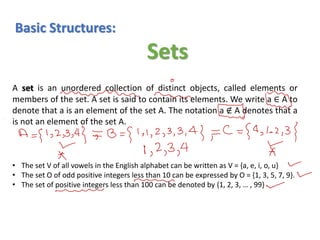
A set is an unordered collection of distinct objects, called elements or
members of the set. A set is said to contain its elements. We write a ∈ A to
denote that a is an element of the set A. The notation a ∉ A denotes that a
is not an element of the set A.
• The set V of all vowels in the English alphabet can be written as V = {a, e, i, o, u}
• The set O of odd positive integers less than 10 can be expressed by O = {1, 3, 5, 7, 9}.
• The set of positive integers less than 100 can be denoted by {1, 2, 3, … , 99}
Basic Structures:
Sets
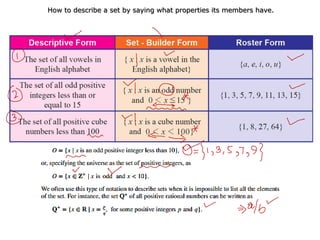
How to describe a set by saying what properties its members have.
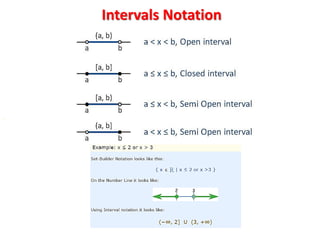
Intervals Notation
Types of Set
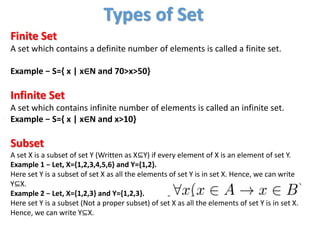
Finite Set
A set which contains a definite number of elements is called a finite set.
Example − S={ x | x∈N and 70>x>50}
Infinite Set
A set which contains infinite number of elements is called an infinite set.
Example − S={ x | x∈N and x>10}
Subset
A set X is a subset of set Y (Written as X⊆Y) if every element of X is an element of set Y.
Example 1 − Let, X={1,2,3,4,5,6} and Y={1,2}.
Here set Y is a subset of set X as all the elements of set Y is in set X. Hence, we can write
Y⊆X.
Example 2 − Let, X={1,2,3} and Y={1,2,3}.
Here set Y is a subset (Not a proper subset) of set X as all the elements of set Y is in set X.
Hence, we can write Y⊆X.
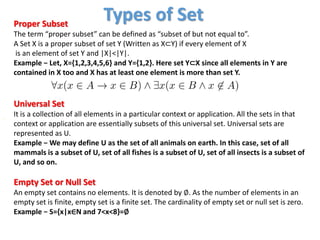
Proper Subset
The term “proper subset” can be defined as “subset of but not equal to”.
A Set X is a proper subset of set Y (Written as X⊂Y) if every element of X
is an element of set Y and |X|<|Y|.
Example − Let, X={1,2,3,4,5,6} and Y={1,2}. Here set Y⊂X since all elements in Y are
contained in X too and X has at least one element is more than set Y.
Universal Set
It is a collection of all elements in a particular context or application. All the sets in that
context or application are essentially subsets of this universal set. Universal sets are
represented as U.
Example − We may define U as the set of all animals on earth. In this case, set of all
mammals is a subset of U, set of all fishes is a subset of U, set of all insects is a subset of
U, and so on.
Empty Set or Null Set
An empty set contains no elements. It is denoted by ∅. As the number of elements in an
empty set is finite, empty set is a finite set. The cardinality of empty set or null set is zero.
Example − S={x|x∈N and 7<x<8}=∅
Types of Set
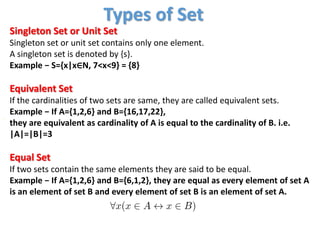
Singleton Set or Unit Set
Singleton set or unit set contains only one element.
A singleton set is denoted by {s}.
Example − S={x|x∈N, 7<x<9} = {8}
Equivalent Set
If the cardinalities of two sets are same, they are called equivalent sets.
Example − If A={1,2,6} and B={16,17,22},
they are equivalent as cardinality of A is equal to the cardinality of B. i.e.
|A|=|B|=3
Equal Set
If two sets contain the same elements they are said to be equal.
Example − If A={1,2,6} and B={6,1,2}, they are equal as every element of set A
is an element of set B and every element of set B is an element of set A.
Types of Set
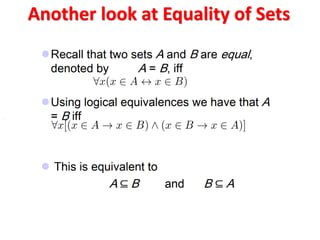
Another look at Equality of Sets
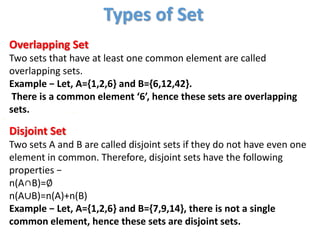
Overlapping Set
Two sets that have at least one common element are called
overlapping sets.
Example − Let, A={1,2,6} and B={6,12,42}.
There is a common element ‘6’, hence these sets are overlapping
sets.
Disjoint Set
Two sets A and B are called disjoint sets if they do not have even one
element in common. Therefore, disjoint sets have the following
properties −
n(A∩B)=∅
n(A∪B)=n(A)+n(B)
Example − Let, A={1,2,6} and B={7,9,14}, there is not a single
common element, hence these sets are disjoint sets.
Types of Set
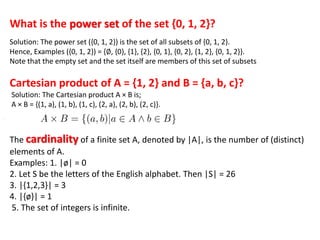
What is the power set of the set {0, 1, 2}?
Solution: The power set ({0, 1, 2}) is the set of all subsets of {0, 1, 2}.
Hence, Examples ({0, 1, 2}) = {∅, {0}, {1}, {2}, {0, 1}, {0, 2}, {1, 2}, {0, 1, 2}}.
Note that the empty set and the set itself are members of this set of subsets
Cartesian product of A = {1, 2} and B = {a, b, c}?
Solution: The Cartesian product A × B is;
A × B = {(1, a), (1, b), (1, c), (2, a), (2, b), (2, c)}.
The cardinality of a finite set A, denoted by |A|, is the number of (distinct)
elements of A.
Examples: 1. |ø| = 0
2. Let S be the letters of the English alphabet. Then |S| = 26
3. |{1,2,3}| = 3
4. |{ø}| = 1
5. The set of integers is infinite.

Basic structures of SETS in Discrete Mathematics.

  • 1.
    Basic Structures: Sets A setis an unordered collection of distinct objects, called elements or members of the set. A set is said to contain its elements. We write a ∈ A to denote that a is an element of the set A. The notation a ∉ A denotes that a is not an element of the set A. • The set V of all vowels in the English alphabet can be written as V = {a, e, i, o, u} • The set O of odd positive integers less than 10 can be expressed by O = {1, 3, 5, 7, 9}. • The set of positive integers less than 100 can be denoted by {1, 2, 3, … , 99}
  • 2.
  • 3.
    How to describea set by saying what properties its members have.
  • 4.
  • 5.
    Types of Set FiniteSet A set which contains a definite number of elements is called a finite set. Example − S={ x | x∈N and 70>x>50} Infinite Set A set which contains infinite number of elements is called an infinite set. Example − S={ x | x∈N and x>10} Subset A set X is a subset of set Y (Written as X⊆Y) if every element of X is an element of set Y. Example 1 − Let, X={1,2,3,4,5,6} and Y={1,2}. Here set Y is a subset of set X as all the elements of set Y is in set X. Hence, we can write Y⊆X. Example 2 − Let, X={1,2,3} and Y={1,2,3}. Here set Y is a subset (Not a proper subset) of set X as all the elements of set Y is in set X. Hence, we can write Y⊆X.
  • 6.
    Proper Subset The term“proper subset” can be defined as “subset of but not equal to”. A Set X is a proper subset of set Y (Written as X⊂Y) if every element of X is an element of set Y and |X|<|Y|. Example − Let, X={1,2,3,4,5,6} and Y={1,2}. Here set Y⊂X since all elements in Y are contained in X too and X has at least one element is more than set Y. Universal Set It is a collection of all elements in a particular context or application. All the sets in that context or application are essentially subsets of this universal set. Universal sets are represented as U. Example − We may define U as the set of all animals on earth. In this case, set of all mammals is a subset of U, set of all fishes is a subset of U, set of all insects is a subset of U, and so on. Empty Set or Null Set An empty set contains no elements. It is denoted by ∅. As the number of elements in an empty set is finite, empty set is a finite set. The cardinality of empty set or null set is zero. Example − S={x|x∈N and 7<x<8}=∅ Types of Set
  • 7.
    Singleton Set orUnit Set Singleton set or unit set contains only one element. A singleton set is denoted by {s}. Example − S={x|x∈N, 7<x<9} = {8} Equivalent Set If the cardinalities of two sets are same, they are called equivalent sets. Example − If A={1,2,6} and B={16,17,22}, they are equivalent as cardinality of A is equal to the cardinality of B. i.e. |A|=|B|=3 Equal Set If two sets contain the same elements they are said to be equal. Example − If A={1,2,6} and B={6,1,2}, they are equal as every element of set A is an element of set B and every element of set B is an element of set A. Types of Set
  • 8.
    Another look atEquality of Sets
  • 9.
    Overlapping Set Two setsthat have at least one common element are called overlapping sets. Example − Let, A={1,2,6} and B={6,12,42}. There is a common element ‘6’, hence these sets are overlapping sets. Disjoint Set Two sets A and B are called disjoint sets if they do not have even one element in common. Therefore, disjoint sets have the following properties − n(A∩B)=∅ n(A∪B)=n(A)+n(B) Example − Let, A={1,2,6} and B={7,9,14}, there is not a single common element, hence these sets are disjoint sets. Types of Set
  • 10.
    What is thepower set of the set {0, 1, 2}? Solution: The power set ({0, 1, 2}) is the set of all subsets of {0, 1, 2}. Hence, Examples ({0, 1, 2}) = {∅, {0}, {1}, {2}, {0, 1}, {0, 2}, {1, 2}, {0, 1, 2}}. Note that the empty set and the set itself are members of this set of subsets Cartesian product of A = {1, 2} and B = {a, b, c}? Solution: The Cartesian product A × B is; A × B = {(1, a), (1, b), (1, c), (2, a), (2, b), (2, c)}. The cardinality of a finite set A, denoted by |A|, is the number of (distinct) elements of A. Examples: 1. |ø| = 0 2. Let S be the letters of the English alphabet. Then |S| = 26 3. |{1,2,3}| = 3 4. |{ø}| = 1 5. The set of integers is infinite.