Introduction to
Biostatistics/Hypothesis
Testing
Brian Healy, PhD
Course objectives
 Introduction to concepts of biostatistics
– Type of data
– Hypothesis testing
– p-value
– Choosing the best statistical test
– Study design
– When you should get help
 Statistical thinking, not math proofs
Office hour
 Tuesday 9-11 in Room 2.140 of the
Simches building
 If you plan to come, please email me
(bchealy@partners.org) with a brief
description of your data so that I can
prepare
Beyond the scope
 Tutorial for a specific statistical package
– I will show output from some packages
(STATA, SAS, GraphPad)
 Topics that will be mentioned, but not
focused on
– Mixed models
– Principal components analysis
– ROC curves
Class objectives
 Introduction to biostatistics
– Stages of a research study
– Types of data
– Hypothesis test
– t-test
– Wilcoxon test
 Questions and requests for next time
Research study
I. Study design
• Experimental question- What are you trying to
learn? How will you prove this?
• Sample selection- Who are you going to study?
II. Data collection
• What should be collected?
III. Analysis of data
• Results- Was there any effect?
• Conclusions- What does this all mean? To whom
do results apply?
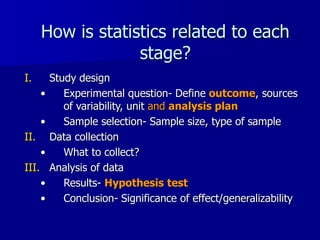
How is statistics related to each
stage?
I. Study design
• Experimental question- Define outcome, sources
of variability, unit and analysis plan
• Sample selection- Sample size, type of sample
II. Data collection
• What to collect?
III. Analysis of data
• Results- Hypothesis test
• Conclusion- Significance of effect/generalizability
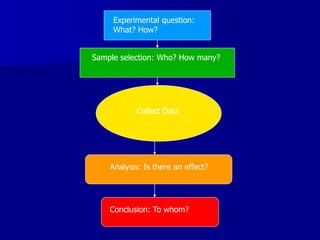
Experimental question:
What? How?
Sample selection: Who? How many?
Collect Data
Analysis: Is there an effect?
Conclusion: To whom?
Example
 Multiple sclerosis is a progressive neurological
disorder
 We would like to find treatments that help
patients
 Unfortunately, it is very difficult to determine a
patient’s disease course because there are many
things going on
 How do we measure the change in the disease?
 What is the outcome?
Outcome variables
 An outcome variable is dependent
variable of interest
 The common outcome variables in MS
experiments are:
– Expanded disability status scale (EDSS)-
ordinal measure of disease severity
– Presence/absence of disease progression
– Expression a cytokine of interest (ex. IFN-g)
– Time to next relapse
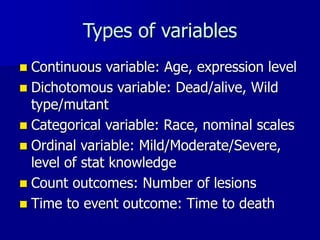
Types of variables
 Continuous variable: Age, expression level
 Dichotomous variable: Dead/alive, Wild
type/mutant
 Categorical variable: Race, nominal scales
 Ordinal variable: Mild/Moderate/Severe,
level of stat knowledge
 Count outcomes: Number of lesions
 Time to event outcome: Time to death
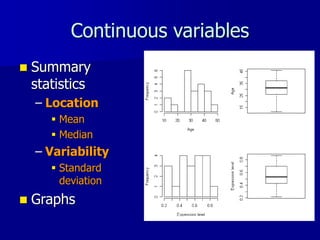
Continuous variables
 Summary
statistics
– Location
 Mean
 Median
– Variability
 Standard
deviation
 Graphs
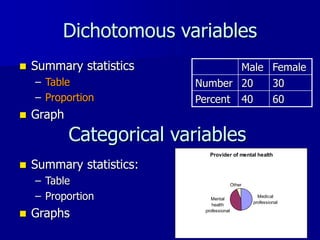
Dichotomous variables
 Summary statistics
– Table
– Proportion
 Graph
Male Female
Number 20 30
Percent 40 60
Categorical variables
 Summary statistics:
– Table
– Proportion
 Graphs
Provider of mental health
Medical
professional
Mental
health
professional
Other
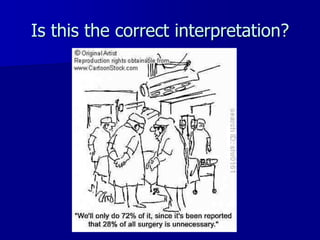
Is this the correct interpretation?
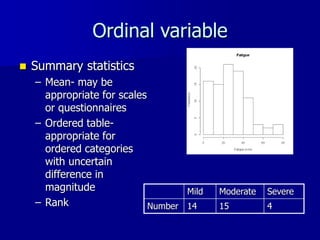
Ordinal variable
 Summary statistics
– Mean- may be
appropriate for scales
or questionnaires
– Ordered table-
appropriate for
ordered categories
with uncertain
difference in
magnitude
– Rank
Mild Moderate Severe
Number 14 15 4
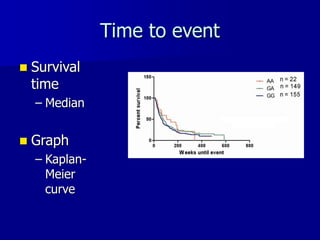
Time to event
 Survival
time
– Median
 Graph
– Kaplan-
Meier
curve
Description vs. comparison
 In many instances, description of the
outcome variable is the focus
– Estimate and confidence interval
 Based on results from survey, description
is not enough, rather comparison is of
interest
 What do we need for comparison?
– Second variable-usually called explanatory
variable
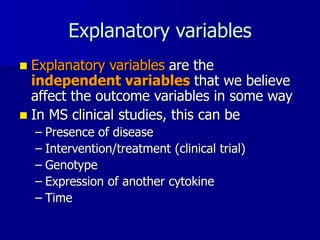
Explanatory variables
 Explanatory variables are the
independent variables that we believe
affect the outcome variables in some way
 In MS clinical studies, this can be
– Presence of disease
– Intervention/treatment (clinical trial)
– Genotype
– Expression of another cytokine
– Time
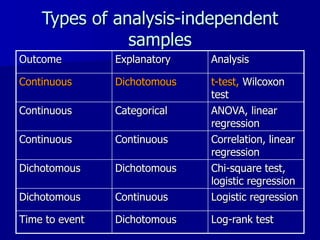
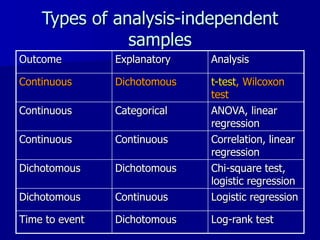
Types of analysis-independent
samples
Outcome Explanatory Analysis
Continuous Dichotomous t-test, Wilcoxon
test
Continuous Categorical ANOVA, linear
regression
Continuous Continuous Correlation, linear
regression
Dichotomous Dichotomous Chi-square test,
logistic regression
Dichotomous Continuous Logistic regression
Time to event Dichotomous Log-rank test
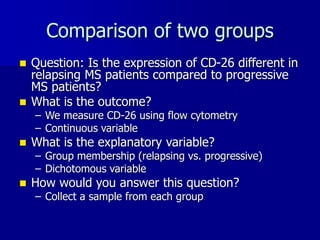
Comparison of two groups
 Question: Is the expression of CD-26 different in
relapsing MS patients compared to progressive
MS patients?
 What is the outcome?
– We measure CD-26 using flow cytometry
– Continuous variable
 What is the explanatory variable?
– Group membership (relapsing vs. progressive)
– Dichotomous variable
 How would you answer this question?
– Collect a sample from each group
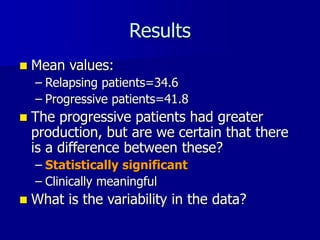
Results
 Mean values:
– Relapsing patients=34.6
– Progressive patients=41.8
 The progressive patients had greater
production, but are we certain that there
is a difference between these?
– Statistically significant
– Clinically meaningful
 What is the variability in the data?
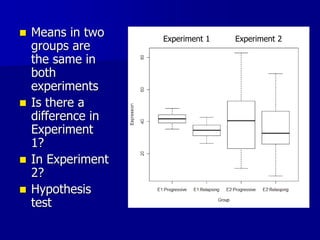
 Means in two
groups are
the same in
both
experiments
 Is there a
difference in
Experiment
1?
 In Experiment
2?
 Hypothesis
test
Experiment 1 Experiment 2
Reasons for differences between
groups
 Actual effect-when there is a difference
between the two groups
 Chance
 Bias
 Confounding
 Statistical tests are designed to determine
if the observed difference between the
groups was likely due to chance
Chance experiment
 Experiment: I flip a coin
– If heads, I win $1
– If tails, you win $1
 What if the following happened?
– 2 heads in a row
– 5 heads in a row
– 15 heads in a row
 Are you suspicious?
Null hypothesis
 In all experiments, we have an initial belief
– In coin example, you believed that there was a 50/50
chance of heads
 We always set up our null hypothesis so that we
can reject the null hypothesis.
 For our study, the null hypothesis is that the
mean in the relapsing MS patients is the same
as the mean in the progressive MS patients.
What is rare enough?
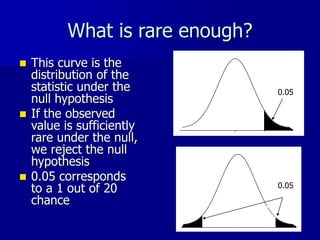
 This curve is the
distribution of the
statistic under the
null hypothesis
 If the observed
value is sufficiently
rare under the null,
we reject the null
hypothesis
 0.05 corresponds
to a 1 out of 20
chance
0.05
0.05
P-value
 Definition: the probability of the
observed result or something more
extreme under the null hypothesis
 If the probability of the event is
sufficiently small, we say that the
difference is likely not due simply to
chance and we have an actual effect.
 If p-value is small enough, we call the
effect statistically significant
What if p>0.05?
 In this case, the difference between the groups
is not statistically significant (at the 0.05 level).
 “If two values are not significantly different,
then by definition are they not identical?”
– No
– The two groups are not significantly different, but we
cannot say that they are the same
– We fail to reject the null hypothesis; we do not accept
that the null is true
– Bayesian statistics
Bias
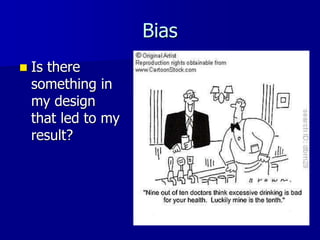
 Is there
something in
my design
that led to my
result?
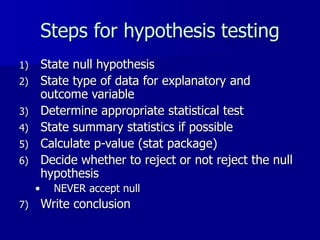
Steps for hypothesis testing
1) State null hypothesis
2) State type of data for explanatory and
outcome variable
3) Determine appropriate statistical test
4) State summary statistics if possible
5) Calculate p-value (stat package)
6) Decide whether to reject or not reject the null
hypothesis
• NEVER accept null
7) Write conclusion
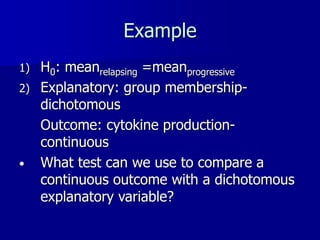
Example
1) H0: meanrelapsing =meanprogressive
2) Explanatory: group membership-
dichotomous
Outcome: cytokine production-
continuous
• What test can we use to compare a
continuous outcome with a dichotomous
explanatory variable?
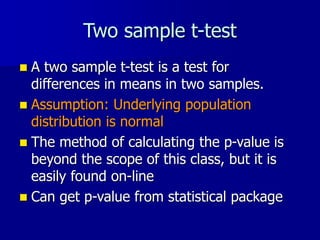
Two sample t-test
 A two sample t-test is a test for
differences in means in two samples.
 Assumption: Underlying population
distribution is normal
 The method of calculating the p-value is
beyond the scope of this class, but it is
easily found on-line
 Can get p-value from statistical package
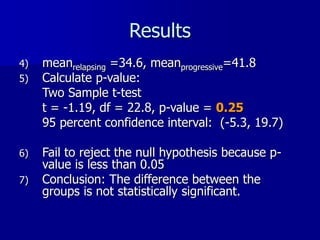
Results
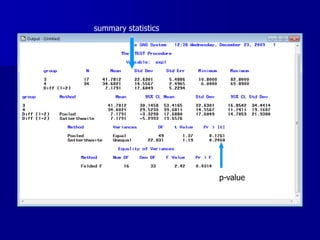
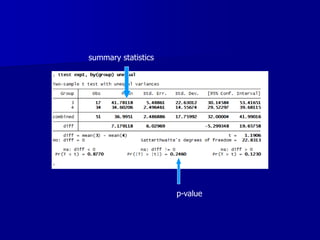
4) meanrelapsing =34.6, meanprogressive=41.8
5) Calculate p-value:
Two Sample t-test
t = -1.19, df = 22.8, p-value = 0.25
95 percent confidence interval: (-5.3, 19.7)
6) Fail to reject the null hypothesis because p-
value is less than 0.05
7) Conclusion: The difference between the
groups is not statistically significant.
p-value
summary statistics
summary statistics
p-value
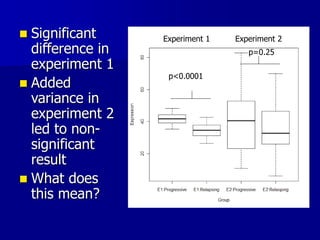
 Significant
difference in
experiment 1
 Added
variance in
experiment 2
led to non-
significant
result
 What does
this mean?
Experiment 1 Experiment 2
p<0.0001
p=0.25
Types of analysis-independent
samples
Outcome Explanatory Analysis
Continuous Dichotomous t-test, Wilcoxon
test
Continuous Categorical ANOVA, linear
regression
Continuous Continuous Correlation, linear
regression
Dichotomous Dichotomous Chi-square test,
logistic regression
Dichotomous Continuous Logistic regression
Time to event Dichotomous Log-rank test
Example
 Experimental Autoimmune Encephalomyelitis
(EAE) in mice is the animal model for multiple
sclerosis (MS)
 The effect of various interventions are first
tested in mice
 A common hypothesis is that treating mice with
a specific intervention will either inhibit or
promote the disease
 How do we measure the change in the disease?
 What is the outcome?
Monkey wrench
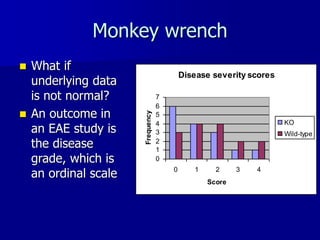
 What if
underlying data
is not normal?
 An outcome in
an EAE study is
the disease
grade, which is
an ordinal scale
Disease severity scores
0
1
2
3
4
5
6
7
0 1 2 3 4
Score
Frequency
KO
Wild-type
Wilcoxon rank sum test
 Wilcoxon rank sum test is a nonparametric
test that allows group comparison if
– Ordinal data
– Rank data
– Underlying data are non-normal
– Outliers
 Steps for hypothesis test using a Wilcoxon
test are exactly the same
Hypothesis test
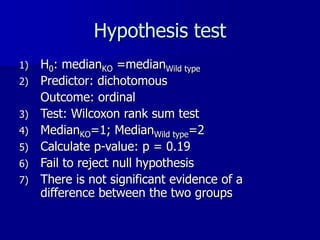
1) H0: medianKO =medianWild type
2) Predictor: dichotomous
Outcome: ordinal
3) Test: Wilcoxon rank sum test
4) MedianKO=1; MedianWild type=2
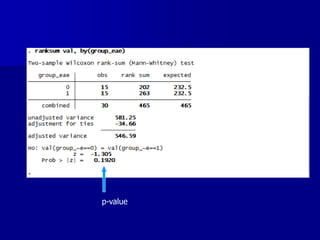
5) Calculate p-value: p = 0.19
6) Fail to reject null hypothesis
7) There is not significant evidence of a
difference between the two groups
p-value
Dependent observations
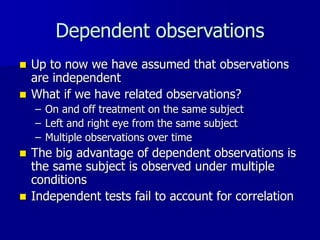
 Up to now we have assumed that observations
are independent
 What if we have related observations?
– On and off treatment on the same subject
– Left and right eye from the same subject
– Multiple observations over time
 The big advantage of dependent observations is
the same subject is observed under multiple
conditions
 Independent tests fail to account for correlation
Example
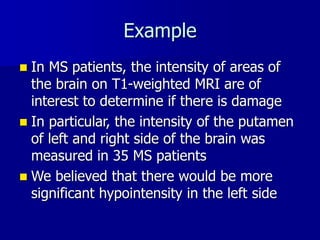
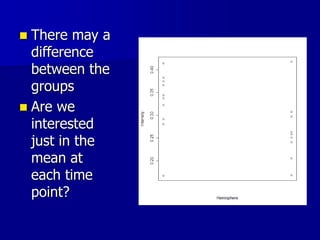
 In MS patients, the intensity of areas of
the brain on T1-weighted MRI are of
interest to determine if there is damage
 In particular, the intensity of the putamen
of left and right side of the brain was
measured in 35 MS patients
 We believed that there would be more
significant hypointensity in the left side
 There may a
difference
between the
groups
 Are we
interested
just in the
mean at
each time
point?
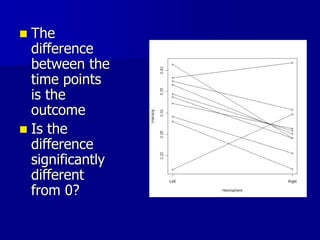
 The
difference
between the
time points
is the
outcome
 Is the
difference
significantly
different
from 0?
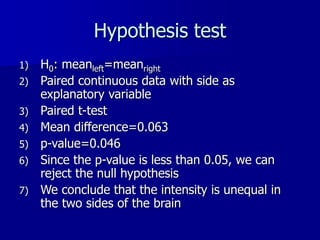
Hypothesis test
1) H0: meanleft=meanright
2) Paired continuous data with side as
explanatory variable
3) Paired t-test
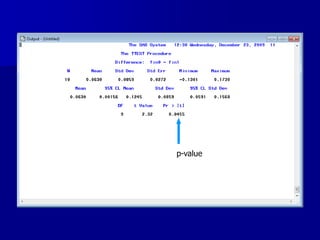
4) Mean difference=0.063
5) p-value=0.046
6) Since the p-value is less than 0.05, we can
reject the null hypothesis
7) We conclude that the intensity is unequal in
the two sides of the brain
p-value
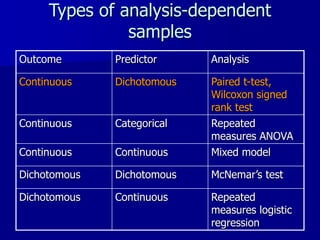
Types of analysis-dependent
samples
Outcome Predictor Analysis
Continuous Dichotomous Paired t-test,
Wilcoxon signed
rank test
Continuous Categorical Repeated
measures ANOVA
Continuous Continuous Mixed model
Dichotomous Dichotomous McNemar’s test
Dichotomous Continuous Repeated
measures logistic
regression
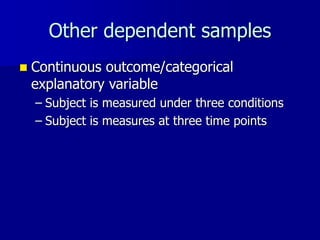
Other dependent samples
 Continuous outcome/categorical
explanatory variable
– Subject is measured under three conditions
– Subject is measures at three time points
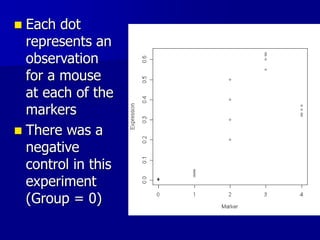
 Each dot
represents an
observation
for a mouse
at each of the
markers
 There was a
negative
control in this
experiment
(Group = 0)
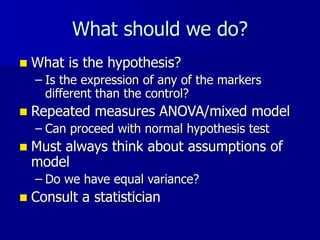
What should we do?
 What is the hypothesis?
– Is the expression of any of the markers
different than the control?
 Repeated measures ANOVA/mixed model
– Can proceed with normal hypothesis test
 Must always think about assumptions of
model
– Do we have equal variance?
 Consult a statistician
Why use dependent samples?
 Sometimes it is required based on the
study
 Often can increase power depending on
the outcome because one major source of
variability is accounted for
– Changes over time
 Consult a statistician if you want to
determine the best study design
Helpful website
 http://www.ats.ucla.edu/stat/stata/whatst
at/default.htm
 Shows how to complete many of these
analyses in various statistical packages
What we learned (hopefully)
 Using your outcome and predictor to
determine the correct analysis
 p-value
 T-test
 Wilcoxon test

Session1b.ppt

  • 1.
  • 2.
    Course objectives  Introductionto concepts of biostatistics – Type of data – Hypothesis testing – p-value – Choosing the best statistical test – Study design – When you should get help  Statistical thinking, not math proofs
  • 3.
    Office hour  Tuesday9-11 in Room 2.140 of the Simches building  If you plan to come, please email me (bchealy@partners.org) with a brief description of your data so that I can prepare
  • 4.
    Beyond the scope Tutorial for a specific statistical package – I will show output from some packages (STATA, SAS, GraphPad)  Topics that will be mentioned, but not focused on – Mixed models – Principal components analysis – ROC curves
  • 5.
    Class objectives  Introductionto biostatistics – Stages of a research study – Types of data – Hypothesis test – t-test – Wilcoxon test  Questions and requests for next time
  • 6.
    Research study I. Studydesign • Experimental question- What are you trying to learn? How will you prove this? • Sample selection- Who are you going to study? II. Data collection • What should be collected? III. Analysis of data • Results- Was there any effect? • Conclusions- What does this all mean? To whom do results apply?
  • 7.
    How is statisticsrelated to each stage? I. Study design • Experimental question- Define outcome, sources of variability, unit and analysis plan • Sample selection- Sample size, type of sample II. Data collection • What to collect? III. Analysis of data • Results- Hypothesis test • Conclusion- Significance of effect/generalizability
  • 8.
    Experimental question: What? How? Sampleselection: Who? How many? Collect Data Analysis: Is there an effect? Conclusion: To whom?
  • 9.
    Example  Multiple sclerosisis a progressive neurological disorder  We would like to find treatments that help patients  Unfortunately, it is very difficult to determine a patient’s disease course because there are many things going on  How do we measure the change in the disease?  What is the outcome?
  • 11.
    Outcome variables  Anoutcome variable is dependent variable of interest  The common outcome variables in MS experiments are: – Expanded disability status scale (EDSS)- ordinal measure of disease severity – Presence/absence of disease progression – Expression a cytokine of interest (ex. IFN-g) – Time to next relapse
  • 12.
    Types of variables Continuous variable: Age, expression level  Dichotomous variable: Dead/alive, Wild type/mutant  Categorical variable: Race, nominal scales  Ordinal variable: Mild/Moderate/Severe, level of stat knowledge  Count outcomes: Number of lesions  Time to event outcome: Time to death
  • 13.
    Continuous variables  Summary statistics –Location  Mean  Median – Variability  Standard deviation  Graphs
  • 14.
    Dichotomous variables  Summarystatistics – Table – Proportion  Graph Male Female Number 20 30 Percent 40 60 Categorical variables  Summary statistics: – Table – Proportion  Graphs Provider of mental health Medical professional Mental health professional Other
  • 15.
    Is this thecorrect interpretation?
  • 16.
    Ordinal variable  Summarystatistics – Mean- may be appropriate for scales or questionnaires – Ordered table- appropriate for ordered categories with uncertain difference in magnitude – Rank Mild Moderate Severe Number 14 15 4
  • 17.
    Time to event Survival time – Median  Graph – Kaplan- Meier curve
  • 18.
    Description vs. comparison In many instances, description of the outcome variable is the focus – Estimate and confidence interval  Based on results from survey, description is not enough, rather comparison is of interest  What do we need for comparison? – Second variable-usually called explanatory variable
  • 19.
    Explanatory variables  Explanatoryvariables are the independent variables that we believe affect the outcome variables in some way  In MS clinical studies, this can be – Presence of disease – Intervention/treatment (clinical trial) – Genotype – Expression of another cytokine – Time
  • 20.
    Types of analysis-independent samples OutcomeExplanatory Analysis Continuous Dichotomous t-test, Wilcoxon test Continuous Categorical ANOVA, linear regression Continuous Continuous Correlation, linear regression Dichotomous Dichotomous Chi-square test, logistic regression Dichotomous Continuous Logistic regression Time to event Dichotomous Log-rank test
  • 21.
    Comparison of twogroups  Question: Is the expression of CD-26 different in relapsing MS patients compared to progressive MS patients?  What is the outcome? – We measure CD-26 using flow cytometry – Continuous variable  What is the explanatory variable? – Group membership (relapsing vs. progressive) – Dichotomous variable  How would you answer this question? – Collect a sample from each group
  • 22.
    Results  Mean values: –Relapsing patients=34.6 – Progressive patients=41.8  The progressive patients had greater production, but are we certain that there is a difference between these? – Statistically significant – Clinically meaningful  What is the variability in the data?
  • 23.
     Means intwo groups are the same in both experiments  Is there a difference in Experiment 1?  In Experiment 2?  Hypothesis test Experiment 1 Experiment 2
  • 24.
    Reasons for differencesbetween groups  Actual effect-when there is a difference between the two groups  Chance  Bias  Confounding  Statistical tests are designed to determine if the observed difference between the groups was likely due to chance
  • 25.
    Chance experiment  Experiment:I flip a coin – If heads, I win $1 – If tails, you win $1  What if the following happened? – 2 heads in a row – 5 heads in a row – 15 heads in a row  Are you suspicious?
  • 26.
    Null hypothesis  Inall experiments, we have an initial belief – In coin example, you believed that there was a 50/50 chance of heads  We always set up our null hypothesis so that we can reject the null hypothesis.  For our study, the null hypothesis is that the mean in the relapsing MS patients is the same as the mean in the progressive MS patients.
  • 27.
    What is rareenough?  This curve is the distribution of the statistic under the null hypothesis  If the observed value is sufficiently rare under the null, we reject the null hypothesis  0.05 corresponds to a 1 out of 20 chance 0.05 0.05
  • 28.
    P-value  Definition: theprobability of the observed result or something more extreme under the null hypothesis  If the probability of the event is sufficiently small, we say that the difference is likely not due simply to chance and we have an actual effect.  If p-value is small enough, we call the effect statistically significant
  • 29.
    What if p>0.05? In this case, the difference between the groups is not statistically significant (at the 0.05 level).  “If two values are not significantly different, then by definition are they not identical?” – No – The two groups are not significantly different, but we cannot say that they are the same – We fail to reject the null hypothesis; we do not accept that the null is true – Bayesian statistics
  • 30.
    Bias  Is there somethingin my design that led to my result?
  • 31.
    Steps for hypothesistesting 1) State null hypothesis 2) State type of data for explanatory and outcome variable 3) Determine appropriate statistical test 4) State summary statistics if possible 5) Calculate p-value (stat package) 6) Decide whether to reject or not reject the null hypothesis • NEVER accept null 7) Write conclusion
  • 32.
    Example 1) H0: meanrelapsing=meanprogressive 2) Explanatory: group membership- dichotomous Outcome: cytokine production- continuous • What test can we use to compare a continuous outcome with a dichotomous explanatory variable?
  • 33.
    Two sample t-test A two sample t-test is a test for differences in means in two samples.  Assumption: Underlying population distribution is normal  The method of calculating the p-value is beyond the scope of this class, but it is easily found on-line  Can get p-value from statistical package
  • 34.
    Results 4) meanrelapsing =34.6,meanprogressive=41.8 5) Calculate p-value: Two Sample t-test t = -1.19, df = 22.8, p-value = 0.25 95 percent confidence interval: (-5.3, 19.7) 6) Fail to reject the null hypothesis because p- value is less than 0.05 7) Conclusion: The difference between the groups is not statistically significant.
  • 35.
  • 36.
  • 37.
     Significant difference in experiment1  Added variance in experiment 2 led to non- significant result  What does this mean? Experiment 1 Experiment 2 p<0.0001 p=0.25
  • 38.
    Types of analysis-independent samples OutcomeExplanatory Analysis Continuous Dichotomous t-test, Wilcoxon test Continuous Categorical ANOVA, linear regression Continuous Continuous Correlation, linear regression Dichotomous Dichotomous Chi-square test, logistic regression Dichotomous Continuous Logistic regression Time to event Dichotomous Log-rank test
  • 39.
    Example  Experimental AutoimmuneEncephalomyelitis (EAE) in mice is the animal model for multiple sclerosis (MS)  The effect of various interventions are first tested in mice  A common hypothesis is that treating mice with a specific intervention will either inhibit or promote the disease  How do we measure the change in the disease?  What is the outcome?
  • 40.
    Monkey wrench  Whatif underlying data is not normal?  An outcome in an EAE study is the disease grade, which is an ordinal scale Disease severity scores 0 1 2 3 4 5 6 7 0 1 2 3 4 Score Frequency KO Wild-type
  • 41.
    Wilcoxon rank sumtest  Wilcoxon rank sum test is a nonparametric test that allows group comparison if – Ordinal data – Rank data – Underlying data are non-normal – Outliers  Steps for hypothesis test using a Wilcoxon test are exactly the same
  • 42.
    Hypothesis test 1) H0:medianKO =medianWild type 2) Predictor: dichotomous Outcome: ordinal 3) Test: Wilcoxon rank sum test 4) MedianKO=1; MedianWild type=2 5) Calculate p-value: p = 0.19 6) Fail to reject null hypothesis 7) There is not significant evidence of a difference between the two groups
  • 43.
  • 44.
    Dependent observations  Upto now we have assumed that observations are independent  What if we have related observations? – On and off treatment on the same subject – Left and right eye from the same subject – Multiple observations over time  The big advantage of dependent observations is the same subject is observed under multiple conditions  Independent tests fail to account for correlation
  • 45.
    Example  In MSpatients, the intensity of areas of the brain on T1-weighted MRI are of interest to determine if there is damage  In particular, the intensity of the putamen of left and right side of the brain was measured in 35 MS patients  We believed that there would be more significant hypointensity in the left side
  • 46.
     There maya difference between the groups  Are we interested just in the mean at each time point?
  • 47.
     The difference between the timepoints is the outcome  Is the difference significantly different from 0?
  • 48.
    Hypothesis test 1) H0:meanleft=meanright 2) Paired continuous data with side as explanatory variable 3) Paired t-test 4) Mean difference=0.063 5) p-value=0.046 6) Since the p-value is less than 0.05, we can reject the null hypothesis 7) We conclude that the intensity is unequal in the two sides of the brain
  • 49.
  • 50.
    Types of analysis-dependent samples OutcomePredictor Analysis Continuous Dichotomous Paired t-test, Wilcoxon signed rank test Continuous Categorical Repeated measures ANOVA Continuous Continuous Mixed model Dichotomous Dichotomous McNemar’s test Dichotomous Continuous Repeated measures logistic regression
  • 51.
    Other dependent samples Continuous outcome/categorical explanatory variable – Subject is measured under three conditions – Subject is measures at three time points
  • 52.
     Each dot representsan observation for a mouse at each of the markers  There was a negative control in this experiment (Group = 0)
  • 53.
    What should wedo?  What is the hypothesis? – Is the expression of any of the markers different than the control?  Repeated measures ANOVA/mixed model – Can proceed with normal hypothesis test  Must always think about assumptions of model – Do we have equal variance?  Consult a statistician
  • 54.
    Why use dependentsamples?  Sometimes it is required based on the study  Often can increase power depending on the outcome because one major source of variability is accounted for – Changes over time  Consult a statistician if you want to determine the best study design
  • 55.
    Helpful website  http://www.ats.ucla.edu/stat/stata/whatst at/default.htm Shows how to complete many of these analyses in various statistical packages
  • 56.
    What we learned(hopefully)  Using your outcome and predictor to determine the correct analysis  p-value  T-test  Wilcoxon test