COMPLIMENTARY TEACHING MATERIALS
MICROBIAL FOOD SAFETY
A FOOD SYSTEMS APPROACH
Charlene Wolf-Hall and William Nganje
COMPLIMENTARY TEACHING MATERIALS
Chapter 5: Foodborne Infections,
Intoxications, and Etiology
COMPLIMENTARY TEACHING MATERIALS
What is a foodborne infection?
What is a foodborne intoxication?
What is the etiology of foodborne
disease?
What are the basics of testing foods
for foodborne microorganisms?
Key Questions
COMPLIMENTARY TEACHING MATERIALS
Any human injury or disease state
induced as a consequence of
consuming a particular food or
beverage.
Foodborne Hazards
–Chemical
–Physical
–Biological
Foodborne Illness
COMPLIMENTARY TEACHING MATERIALS
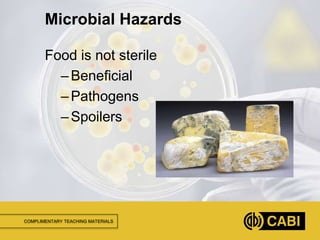
Food is not sterile
–Beneficial
–Pathogens
–Spoilers
Microbial Hazards
COMPLIMENTARY TEACHING MATERIALS
Immunocompromised humans at higher risk
– The very old, for whom immune systems are
failing to function as well.
– The very young, for whom immune systems are
not yet fully developed.
– Those with chronic diseases such as cancer or
diabetes.
– People with organ transplants who take
medications to prevent tissue rejections.
– Pregnant women whose immune systems are
taxed due to the biological burden of pregnancy.
– Nutrient deprived people.
Foodborne Illness
COMPLIMENTARY TEACHING MATERIALS
Foodborne infections are a form of disease
that results from eating food containing
living pathogens.
An infection involves the invasion by living
microorganisms of tissue in the host,
causing damage.
Microorganisms in a non-harmful state
within the host are not considered to be an
infection.
Foodborne Infections
COMPLIMENTARY TEACHING MATERIALS
Virulence - The degree of pathogenicity
within a group or species of microorganisms
or viruses as indicated by case fatality rates
and/or the ability of the organism to invade
the tissues of the host. The pathogenic
capacity of an organism is determined by its
virulence factors.
Infective Dose - The number of pathogenic
microorganisms necessary to cause
infection in a host.
Foodborne Infections
COMPLIMENTARY TEACHING MATERIALS
A foodborne intoxication is a state where there is
damage to a consumer (host) from a chemical
consumed.
Microbial toxins tend to be secondary metabolites.
Most common bacterial
– Clostridium botulinum
– Staphylococcus aureus
– Bacillus cereus
Most common fungal
– Aspergillus
– Penicillium
– Fusarium
Foodborne Intoxications
COMPLIMENTARY TEACHING MATERIALS
Toxin-mediated infections, also referred to as
toxicoinfections, involve ingestion of large
numbers of live pathogens, which then produce
or release toxin in the gastrointestinal tract.
Most common
– Bacillus cereus
– Clostridium perfringens
– Enterotoxigenic and enterohemorrhagic
Escherichia coli
– Some strains of Campylobacter jejuni
– Vibrio cholerae
Toxin-Mediated Infections
COMPLIMENTARY TEACHING MATERIALS
Etiology – The branch of science concerned with
the causes and origins of diseases.
Epidemiology - The study of the various factors
influencing the occurrence, distribution, prevention,
and control of disease, injury, and other health-
related events in a defined population.
Etiology and Epidemiology of
Foodborne Illnesses
COMPLIMENTARY TEACHING MATERIALS
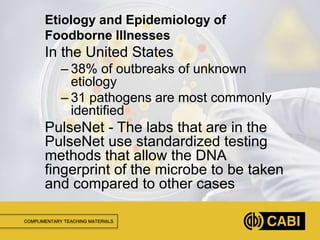
In the United States
– 38% of outbreaks of unknown
etiology
– 31 pathogens are most commonly
identified
PulseNet - The labs that are in the
PulseNet use standardized testing
methods that allow the DNA
fingerprint of the microbe to be taken
and compared to other cases
Etiology and Epidemiology of
Foodborne Illnesses
COMPLIMENTARY TEACHING MATERIALS
Microbiological methods range from traditional
culturing techniques to more modern molecular
based and rapid methods.
Methodology selection depends on needs for
sensitivity, selectivity, accuracy, precision,
rapidity, ruggedness, usability, and cost.
“Ideal methods would identity and quantify
multiple targets from any matrix in real time under
non-laboratory conditions, and cost little” (Ryu
and Wolf-Hall, 2014).
Most testing labs are shifting from traditional
culturing methods to rapid methods to save on
labor costs and turnaround time.
Testing Methods for Pathogens in
Foods
COMPLIMENTARY TEACHING MATERIALS
No method is perfect
–Limitations of what test indicates
–Potential for errors:
• Type I - false positive
• Type II - false negative
Use of standardized methods for
consistency and appropriateness
for food being tested
Testing Methods for Pathogens in
Foods
COMPLIMENTARY TEACHING MATERIALS
THANK YOU
Name: Charlene Wolf-Hall & William Nganje
Email: charlene.hall@ndsu.edu & William.Nganje@ndsu.edu

Ch5-Microbial-Food-Safety-Chapt-5.pptnbgfffhx

  • 1.
    COMPLIMENTARY TEACHING MATERIALS MICROBIALFOOD SAFETY A FOOD SYSTEMS APPROACH Charlene Wolf-Hall and William Nganje
  • 2.
    COMPLIMENTARY TEACHING MATERIALS Chapter5: Foodborne Infections, Intoxications, and Etiology
  • 3.
    COMPLIMENTARY TEACHING MATERIALS Whatis a foodborne infection? What is a foodborne intoxication? What is the etiology of foodborne disease? What are the basics of testing foods for foodborne microorganisms? Key Questions
  • 4.
    COMPLIMENTARY TEACHING MATERIALS Anyhuman injury or disease state induced as a consequence of consuming a particular food or beverage. Foodborne Hazards –Chemical –Physical –Biological Foodborne Illness
  • 5.
    COMPLIMENTARY TEACHING MATERIALS Foodis not sterile –Beneficial –Pathogens –Spoilers Microbial Hazards
  • 6.
    COMPLIMENTARY TEACHING MATERIALS Immunocompromisedhumans at higher risk – The very old, for whom immune systems are failing to function as well. – The very young, for whom immune systems are not yet fully developed. – Those with chronic diseases such as cancer or diabetes. – People with organ transplants who take medications to prevent tissue rejections. – Pregnant women whose immune systems are taxed due to the biological burden of pregnancy. – Nutrient deprived people. Foodborne Illness
  • 7.
    COMPLIMENTARY TEACHING MATERIALS Foodborneinfections are a form of disease that results from eating food containing living pathogens. An infection involves the invasion by living microorganisms of tissue in the host, causing damage. Microorganisms in a non-harmful state within the host are not considered to be an infection. Foodborne Infections
  • 8.
    COMPLIMENTARY TEACHING MATERIALS Virulence- The degree of pathogenicity within a group or species of microorganisms or viruses as indicated by case fatality rates and/or the ability of the organism to invade the tissues of the host. The pathogenic capacity of an organism is determined by its virulence factors. Infective Dose - The number of pathogenic microorganisms necessary to cause infection in a host. Foodborne Infections
  • 9.
    COMPLIMENTARY TEACHING MATERIALS Afoodborne intoxication is a state where there is damage to a consumer (host) from a chemical consumed. Microbial toxins tend to be secondary metabolites. Most common bacterial – Clostridium botulinum – Staphylococcus aureus – Bacillus cereus Most common fungal – Aspergillus – Penicillium – Fusarium Foodborne Intoxications
  • 10.
    COMPLIMENTARY TEACHING MATERIALS Toxin-mediatedinfections, also referred to as toxicoinfections, involve ingestion of large numbers of live pathogens, which then produce or release toxin in the gastrointestinal tract. Most common – Bacillus cereus – Clostridium perfringens – Enterotoxigenic and enterohemorrhagic Escherichia coli – Some strains of Campylobacter jejuni – Vibrio cholerae Toxin-Mediated Infections
  • 11.
    COMPLIMENTARY TEACHING MATERIALS Etiology– The branch of science concerned with the causes and origins of diseases. Epidemiology - The study of the various factors influencing the occurrence, distribution, prevention, and control of disease, injury, and other health- related events in a defined population. Etiology and Epidemiology of Foodborne Illnesses
  • 12.
    COMPLIMENTARY TEACHING MATERIALS Inthe United States – 38% of outbreaks of unknown etiology – 31 pathogens are most commonly identified PulseNet - The labs that are in the PulseNet use standardized testing methods that allow the DNA fingerprint of the microbe to be taken and compared to other cases Etiology and Epidemiology of Foodborne Illnesses
  • 13.
    COMPLIMENTARY TEACHING MATERIALS Microbiologicalmethods range from traditional culturing techniques to more modern molecular based and rapid methods. Methodology selection depends on needs for sensitivity, selectivity, accuracy, precision, rapidity, ruggedness, usability, and cost. “Ideal methods would identity and quantify multiple targets from any matrix in real time under non-laboratory conditions, and cost little” (Ryu and Wolf-Hall, 2014). Most testing labs are shifting from traditional culturing methods to rapid methods to save on labor costs and turnaround time. Testing Methods for Pathogens in Foods
  • 14.
    COMPLIMENTARY TEACHING MATERIALS Nomethod is perfect –Limitations of what test indicates –Potential for errors: • Type I - false positive • Type II - false negative Use of standardized methods for consistency and appropriateness for food being tested Testing Methods for Pathogens in Foods
  • 15.
    COMPLIMENTARY TEACHING MATERIALS THANKYOU Name: Charlene Wolf-Hall & William Nganje Email: charlene.hall@ndsu.edu & William.Nganje@ndsu.edu