2.1
Lec 5
Layers
ComputerNetworks
Al-Mustansiryah University
Elec. Eng. Department College of Engineering Fourth
Year Class
2.
2.2
2-3 LAYERS INTHE OSI MODEL
2-3 LAYERS IN THE OSI MODEL
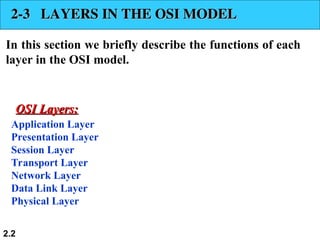
In this section we briefly describe the functions of each
layer in the OSI model.
Application Layer
Presentation Layer
Session Layer
Transport Layer
Network Layer
Data Link Layer
Physical Layer
OSI Layers:
OSI Layers:
2.4
The application layeris responsible for providing services
to the user.
Examples:
Email
Web browsers
Protocol Data Unit (PDU) - User Data
Note
The application layer is also concerned with the following
1) Network virtual terminal.
2) File transfer.
3) Mail services.
4) Directory services.
2.6
-The presentation layeris responsible for translation,
compression, Code Formatting and encryption.
-PDU - Formatted Data
Note
The Presentation layer is also concerned with the following
1) Translation.
2) Encryption.
3) Compression.
2.8
-The session layeris responsible for dialog
control and synchronization.
-PDU - Formatted Data
Note
The Session layer is also concerned with the following
1) Dialog control.
2) Synchronization.
2.10
-The transport layeris responsible for the delivery
of a message from one process to another.
-PDU - Segments
Note
1) Service-point addressing.
2) Segmentation and reassembly.
3) Connection control.
4) Flow control.
5) Error control.
The Transport layer is also concerned with the following
2.13
-The network layeris responsible for the
delivery of individual packets from the source host to the
destination host.
-PDU – Packets
Note
The Network layer is also concerned with the following
1) Logical addressing.
2) Routing.
2.16
-The data linklayer is responsible for moving
frames from one hop (node) to the next.
- PDU - Frames
The data link layer is also concerned with the following
1) Framing.
2) Physical addressing.
3) Flow control.
4) Error control.
5) Access control.
2.19
-The physical layeris responsible for movements of individual bits from one
hop (node) to the next.
-PDU - Bits
The physical layer is also concerned with the following
1) Physical characteristics of interfaces and medium.
2) Representation of bits.
3) Data rate.
4) Synchronization of bits.
5) Line configuration.
6) Physical topology.
7)Transmission mode.
2.22
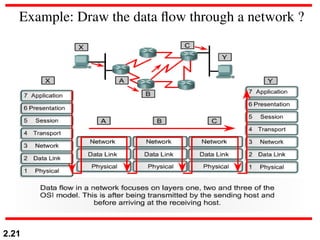
Data Flow andEncapsulation
Data flow occurs when two devices are connected in a network with some kind of shared
transmission medium.
1)An application running on the source device creates some kind of data. This happens at
the Application layer.
2)The application needs to add encryption to that data. This will be done at the Presentation
layer.
3) At the Session layer it appends the Session ID.
4)The Transport layer breaks the data into blocks of data which we call Segments . Every
Segment also gets the Port number to identify which upper layer application needs to
receive the data on the destination device
5)The Network layer takes the Segment, and appends the source and destination IP address.
At that point the Segment becomes a Packet.
6)At Data Link layer the source and destination MAC address and the CRC is added. At
this point we have a Frame.
7)The Frame then is sent to the physical device where it is translated into some kind of a
signal (often call it Bits)
23.
2.23
1) The destinationdevice receives series of bits and interprets them as a Frame.
2) It removes MAC addresses and the CRC, and passes the data up to the Network layer.
3) IP addresses are removed and the Packet is forwarded up to the Transport layer .
4) The Port number is looked at and the Segment gets forwarded up the to the appropriate
application specified by the Port number.
5) The Session ID is used.
6) Encryption will be removed.
7) The data in its original form is presented to the application that needs to interpret it.
Decapsulation at the Destination Device
24.
2.24
2-4 TCP/IP PROTOCOLSUITE
2-4 TCP/IP PROTOCOL SUITE
The original TCP/IP protocol suite was defined as having
four layers: host-to-network, internet, transport, and
application. However, when TCP/IP is compared to OSI,
we can say that the TCP/IP protocol suite is made of five
layers: physical, data link, network, transport, and
application.