Open Products, Open Interfaces, and Open Source: The Building Blocks of the Ex Libris Open-Platform Program Tamar Sadeh, Director of Marketing Breaking the Barriers 2009  London, May 2009
Copyright Statement All of the information and material inclusive of text, images, logos, product names is either the property of, or used with permission by Ex Libris Ltd. The information may not be distributed, modified, displayed, reproduced –  in whole or in part –  without the prior written permission of Ex Libris Ltd.  TRADEMARKS  Ex Libris, the Ex Libris logo, Aleph, SFX, SFXIT, MetaLib, DigiTool, Verde, Primo, Voyager, MetaSearch, MetaIndex and other Ex Libris products and services referenced herein are trademarks of Ex Libris, and may be registered in certain jurisdictions. All other product names, company names, marks and logos referenced may be trademarks of their respective owners.  DISCLAIMER  The information contained in this document is compiled from various sources and provided on an "AS IS" basis for general information purposes only without any representations, conditions or warranties whether express or implied, including any implied warranties of satisfactory quality, completeness, accuracy or fitness for a particular purpose.  Ex Libris, its subsidiaries and related corporations ("Ex Libris Group") disclaim any and all liability for all use of this information, including losses, damages, claims or expenses any person may incur as a result of the use of this information, even if advised of the possibility of such loss or damage. © Ex Libris Ltd., 2009
Example 1: Xerxes open source interface layer on top of a proprietary—yet open—product (MetaLib) Note: there are 1470 institutions using MetaLib, worldwide    (May 2009)
 
 
About the process “ It only took a few weeks to get the original system up and running -- to the point where we could perform searches, for example. But there's a lot of configuration and functionality we added to Xerxes … that at the time either MetaLib didn't support, or we wanted to do differently.  That is where the bulk of the time has gone.  I've been working on it off and on for three years now.”
“ In terms of community, we have about 30 people on the listserv now, and four institutions outside of Cal State that have gone live with Xerxes. There are a number of institutions -- including one site in Japan, a couple in Australia, and a half-dozen in Europe -- that are in the process of setting the system up.”  About the community
About the development cycle “ People on the listserv will sometimes ask for thing to be added to the system, but for the most part it's Jonathan and I driving the feature list.  It's kind of benevolent dictatorship.  There's no voting on features or anything.”
And… “ Ironically, one of the benefits of an open source application built by libraries is that we are not as obligated to meet the (admittedly rather unusual) demands that libraries seem to put on vendors… And, since no one is paying us to do this, we can have a kind of "take it or build it yourself" attitude toward undesirable feature requests.”
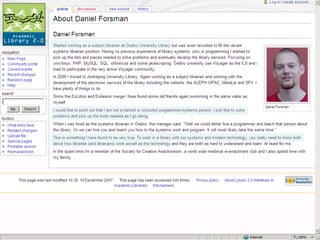
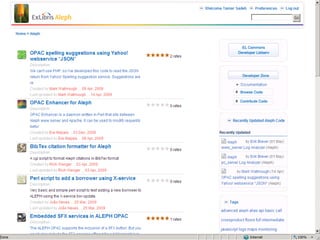
Example 2: Enhancing the Aleph OPAC Daniel Forsman  Jönköping University, Sweden


An example: enhancing the Aleph OPAC Daniel Forsman  Jönköping University, Sweden
Players in the library domain
Vendors Offer commercial products Complete solutions Developed, maintained, and supported  by professionals Serve as the backbone of the library’s operation Cannot satisfy all needs of all customers Therefore… Commercial products should  allow for adaptation and  enhancement
Communities Create software for libraries Centered around talented individuals Depend on the openness of products Typically add a local flavor or extend product capability Often choose the open-source model and make code available to other libraries
Together
The synergy in the library domain Open products and open source  Better fit the needs of the library Better fit the needs of the library community Enable each party to do what it does best
Our Strategy
The Ex Libris Open-Platform Strategy We provide robust solutions—professionally developed and maintained according to a long term roadmap—that are open We support and encourage customers who wish to extend our solutions with code that they develop or adapt We facilitate collaboration—the sharing of ideas and code that apply to our solutions
What do we mean by open products?  Built from separate, independent software components, interoperable through  open interfaces Integrate with existing environment, as entire products or subcomponents Allow for enhancements through locally-developed or 3 rd  party code
Open Interfaces APIs (Web services, X-Services) Deep Links Plug-ins Adapters Whenever available, we rely on industry standards
Our Program
The Ex Libris open-platform program Operating on two parallel tracks: Internally—development efforts Formalized the process by which Ex Libris designs, implements, documents and publishes its open interfaces Went through organizational alignment Externally—working with the community Publish documentation for open interfaces  Host community code Provide tools for collaboration Conduct face-to-face meetings with customer developers
Developer Meets Developer November 2008, headquarters, Jerusalem Aleph, Primo, MetaLib, SFX 13 developers from 10 institutions in 5 countries March 2009,  NA headquarters, Chicago Voyager 14 developers from 12 institutions in 3 countries First Meeting Second Meeting
What does all that mean?
The meaning for a vendor We are committed to Design principles Coding standards Comprehensive documentation Continuing maintenance Backwards compatibility Assistance for developers We use the interfaces ourselves Not an easy task, but the right way to go
The meaning for a library Libraries gain from  Working solutions, to begin with Ongoing maintenance and support Research and vision Libraries focus on Providing library services Libraries take the lead on Customizing the proprietary solutions Adding or adjusting functionality, as required Easily integrating their services with other systems
The meaning for the library community All community members gain Code contributors get the recognition they deserve Exchange of code extends the choice and optimizes efforts Collaborative projects leverage the capabilities  of individual members


Going back to the example


Open products enable libraries to maximize a product’s capabilities for their own environment, leveraging both their expertise and that of a professional vendor. Furthermore, the fruits of a library’s investment serve the community as a whole.
[email_address]

Session 9 - Open Products, Open Interfaces, and Open Source

  • 1.
    Open Products, OpenInterfaces, and Open Source: The Building Blocks of the Ex Libris Open-Platform Program Tamar Sadeh, Director of Marketing Breaking the Barriers 2009 London, May 2009
  • 2.
    Copyright Statement Allof the information and material inclusive of text, images, logos, product names is either the property of, or used with permission by Ex Libris Ltd. The information may not be distributed, modified, displayed, reproduced – in whole or in part – without the prior written permission of Ex Libris Ltd. TRADEMARKS Ex Libris, the Ex Libris logo, Aleph, SFX, SFXIT, MetaLib, DigiTool, Verde, Primo, Voyager, MetaSearch, MetaIndex and other Ex Libris products and services referenced herein are trademarks of Ex Libris, and may be registered in certain jurisdictions. All other product names, company names, marks and logos referenced may be trademarks of their respective owners. DISCLAIMER The information contained in this document is compiled from various sources and provided on an "AS IS" basis for general information purposes only without any representations, conditions or warranties whether express or implied, including any implied warranties of satisfactory quality, completeness, accuracy or fitness for a particular purpose. Ex Libris, its subsidiaries and related corporations ("Ex Libris Group") disclaim any and all liability for all use of this information, including losses, damages, claims or expenses any person may incur as a result of the use of this information, even if advised of the possibility of such loss or damage. © Ex Libris Ltd., 2009
  • 3.
    Example 1: Xerxesopen source interface layer on top of a proprietary—yet open—product (MetaLib) Note: there are 1470 institutions using MetaLib, worldwide (May 2009)
  • 4.
  • 5.
  • 6.
    About the process“ It only took a few weeks to get the original system up and running -- to the point where we could perform searches, for example. But there's a lot of configuration and functionality we added to Xerxes … that at the time either MetaLib didn't support, or we wanted to do differently. That is where the bulk of the time has gone. I've been working on it off and on for three years now.”
  • 7.
    “ In termsof community, we have about 30 people on the listserv now, and four institutions outside of Cal State that have gone live with Xerxes. There are a number of institutions -- including one site in Japan, a couple in Australia, and a half-dozen in Europe -- that are in the process of setting the system up.” About the community
  • 8.
    About the developmentcycle “ People on the listserv will sometimes ask for thing to be added to the system, but for the most part it's Jonathan and I driving the feature list. It's kind of benevolent dictatorship. There's no voting on features or anything.”
  • 9.
    And… “ Ironically,one of the benefits of an open source application built by libraries is that we are not as obligated to meet the (admittedly rather unusual) demands that libraries seem to put on vendors… And, since no one is paying us to do this, we can have a kind of "take it or build it yourself" attitude toward undesirable feature requests.”
  • 10.
    Example 2: Enhancingthe Aleph OPAC Daniel Forsman Jönköping University, Sweden
  • 11.
  • 12.
  • 13.
  • 14.
  • 15.
  • 16.
    An example: enhancingthe Aleph OPAC Daniel Forsman Jönköping University, Sweden
  • 17.
    Players in thelibrary domain
  • 18.
    Vendors Offer commercialproducts Complete solutions Developed, maintained, and supported by professionals Serve as the backbone of the library’s operation Cannot satisfy all needs of all customers Therefore… Commercial products should allow for adaptation and enhancement
  • 19.
    Communities Create softwarefor libraries Centered around talented individuals Depend on the openness of products Typically add a local flavor or extend product capability Often choose the open-source model and make code available to other libraries
  • 20.
  • 21.
    The synergy inthe library domain Open products and open source Better fit the needs of the library Better fit the needs of the library community Enable each party to do what it does best
  • 22.
  • 23.
    The Ex LibrisOpen-Platform Strategy We provide robust solutions—professionally developed and maintained according to a long term roadmap—that are open We support and encourage customers who wish to extend our solutions with code that they develop or adapt We facilitate collaboration—the sharing of ideas and code that apply to our solutions
  • 24.
    What do wemean by open products? Built from separate, independent software components, interoperable through open interfaces Integrate with existing environment, as entire products or subcomponents Allow for enhancements through locally-developed or 3 rd party code
  • 25.
    Open Interfaces APIs(Web services, X-Services) Deep Links Plug-ins Adapters Whenever available, we rely on industry standards
  • 26.
  • 27.
    The Ex Librisopen-platform program Operating on two parallel tracks: Internally—development efforts Formalized the process by which Ex Libris designs, implements, documents and publishes its open interfaces Went through organizational alignment Externally—working with the community Publish documentation for open interfaces Host community code Provide tools for collaboration Conduct face-to-face meetings with customer developers
  • 28.
    Developer Meets DeveloperNovember 2008, headquarters, Jerusalem Aleph, Primo, MetaLib, SFX 13 developers from 10 institutions in 5 countries March 2009, NA headquarters, Chicago Voyager 14 developers from 12 institutions in 3 countries First Meeting Second Meeting
  • 29.
    What does allthat mean?
  • 30.
    The meaning fora vendor We are committed to Design principles Coding standards Comprehensive documentation Continuing maintenance Backwards compatibility Assistance for developers We use the interfaces ourselves Not an easy task, but the right way to go
  • 31.
    The meaning fora library Libraries gain from Working solutions, to begin with Ongoing maintenance and support Research and vision Libraries focus on Providing library services Libraries take the lead on Customizing the proprietary solutions Adding or adjusting functionality, as required Easily integrating their services with other systems
  • 32.
    The meaning forthe library community All community members gain Code contributors get the recognition they deserve Exchange of code extends the choice and optimizes efforts Collaborative projects leverage the capabilities of individual members
  • 33.
  • 34.
  • 35.
  • 36.
  • 37.
  • 38.
  • 39.
  • 40.
  • 41.
  • 42.
  • 43.
  • 44.
  • 45.
  • 46.
  • 47.
  • 48.
  • 49.
  • 50.
  • 51.
  • 52.
    Going back tothe example
  • 53.
  • 54.
  • 55.
  • 56.
  • 57.
  • 58.
    Open products enablelibraries to maximize a product’s capabilities for their own environment, leveraging both their expertise and that of a professional vendor. Furthermore, the fruits of a library’s investment serve the community as a whole.
  • 59.