Open Source Integrated Library Systems Carolyn Dorsey Jessica Ng Jing Yang Sarah Elichko Jennifer Pettigrew October 15, 2009
-Freedom to run program for any purpose -Freedom to make changes -Freedom to redistribute copies -Freedom to improve and release improvements 4 Basic Components of Open Source Software Free as in freedom, not price
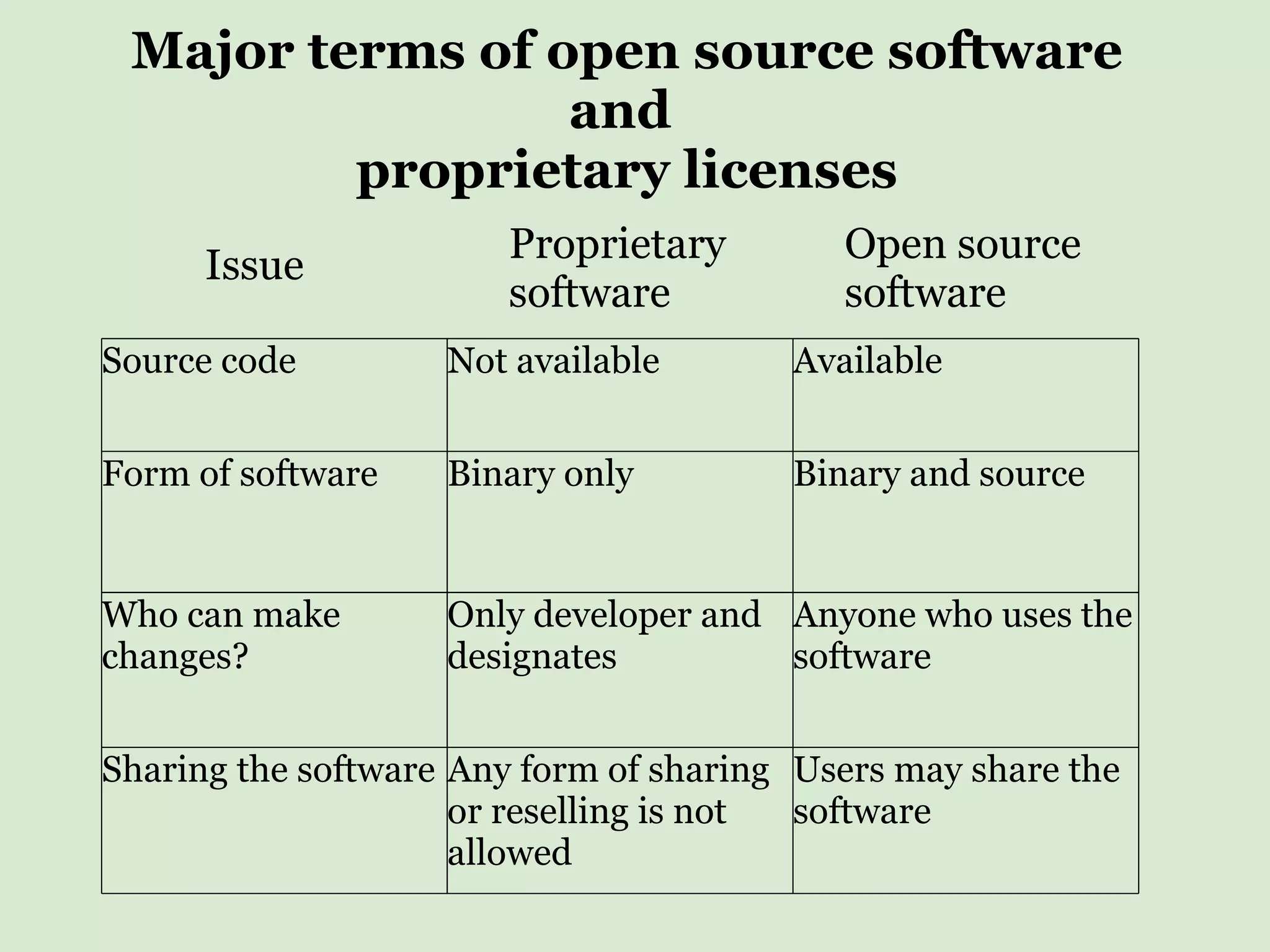
Issue Proprietary software Open source software Major terms of open source software and  proprietary licenses Source code Not available Available Form of software Binary only Binary and source Who can make changes? Only developer and designates Anyone who uses the software Sharing the software Any form of sharing or reselling is not allowed Users may share the software
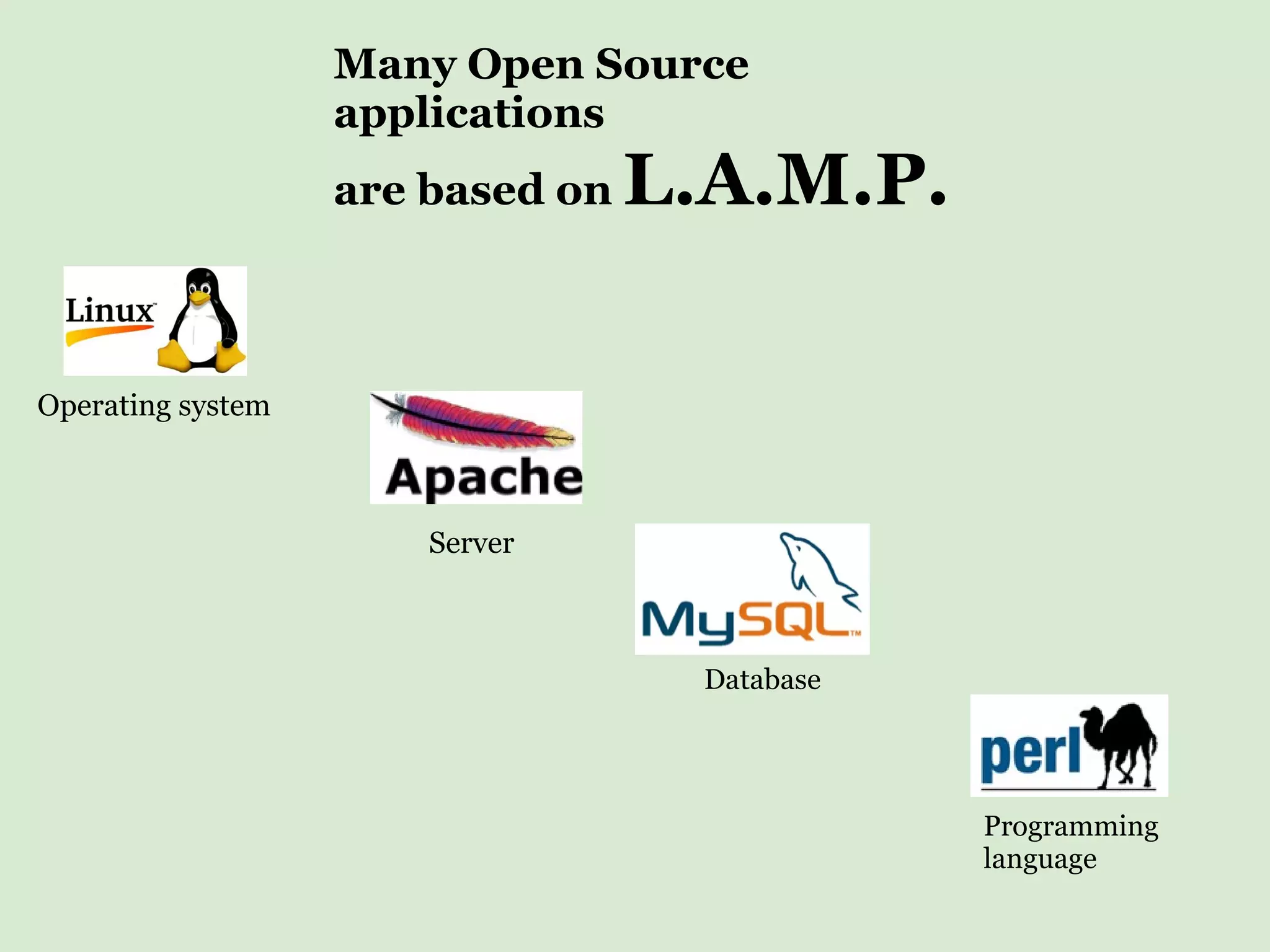
Operating system Server Database Programming language Many Open Source applications  are based on   L.A.M.P.
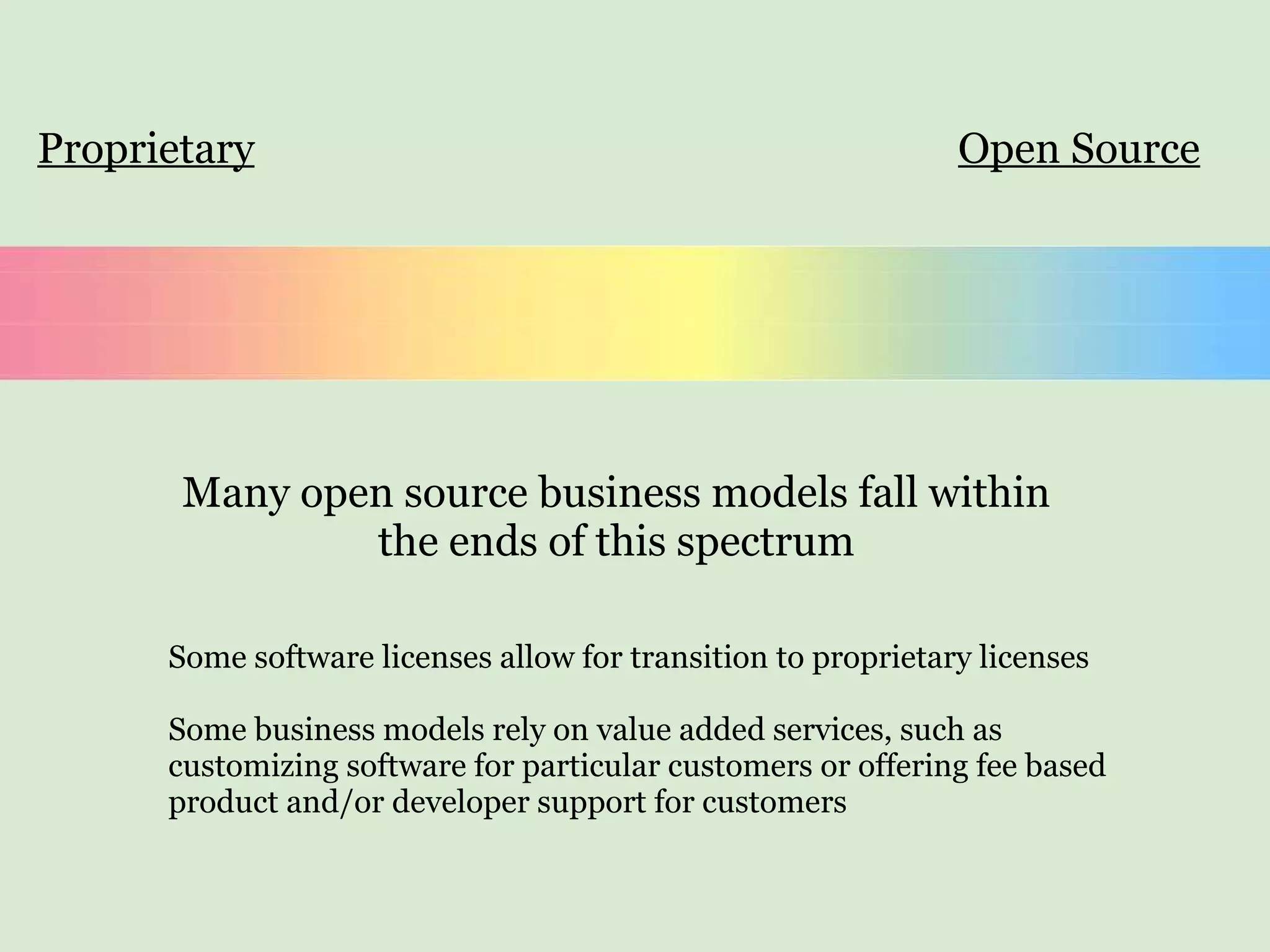
Proprietary Open Source Many open source business models fall within the ends of this spectrum Some software licenses allow for transition to proprietary licenses Some business models rely on value added services, such as customizing software for particular customers or offering fee based  product and/or developer support for customers
Open Source Software Support Conversion services Installation Configuration Training Ongoing Support Custom Development Hosting Software-as-a-service (SaaS)
Vendor/Product Independence Open Source vs Proprietary Cost factors Advantages Disadvantages
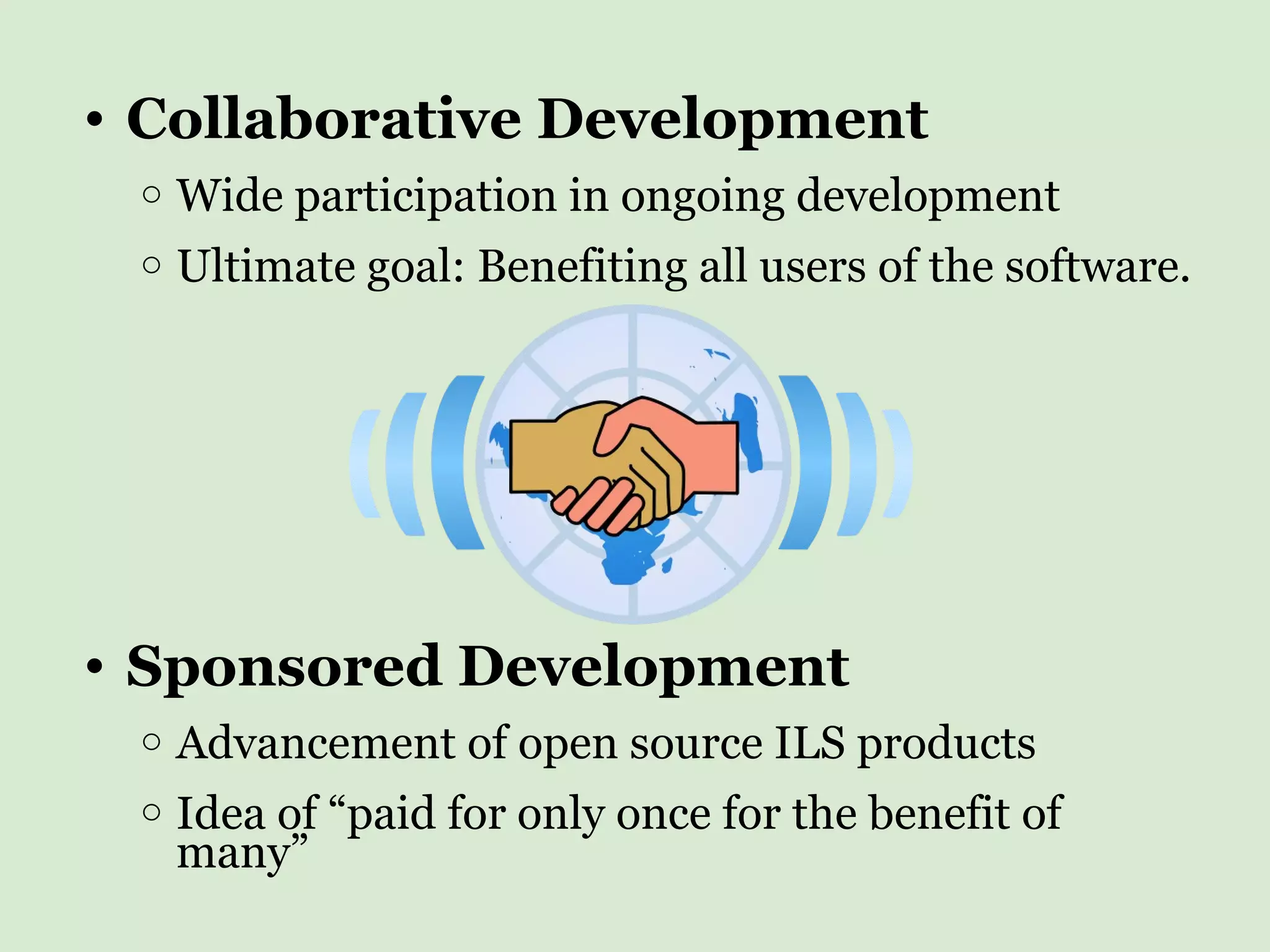
Collaborative Development   Wide participation in ongoing development Ultimate goal: Benefiting all users of the software. Sponsored Development Advancement of open source ILS products Idea of “paid for only once for the benefit of many”
Major Open Source ILS Products
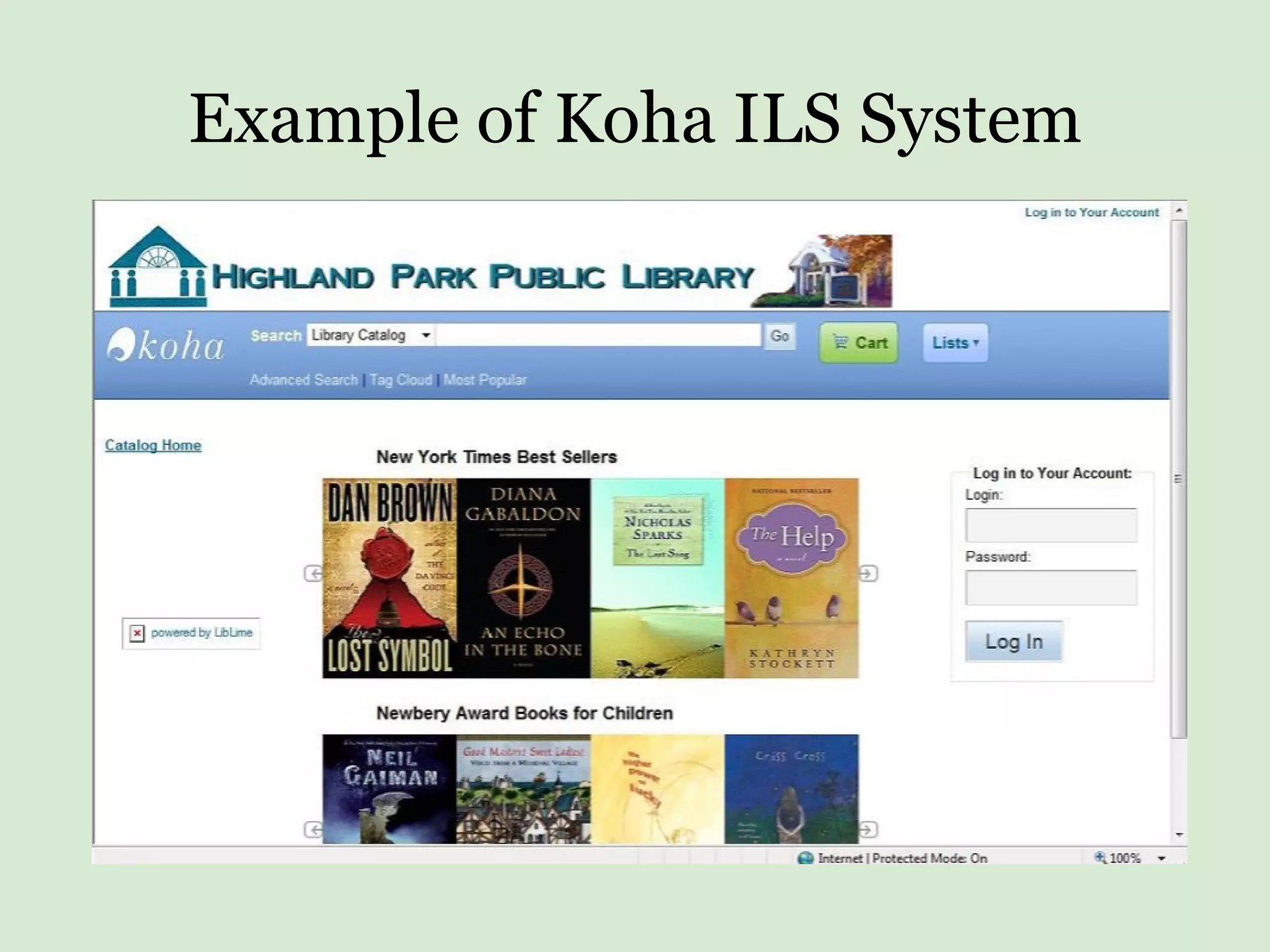
Example of Koha ILS System
Koha's Market Koha is the first open-source Integrated  Library  System   Targeting Libraries:         - Small to mid-sized public libraries;         - Small to mid-sized academic libraries,  museums,  special libraries;         - Gradual penetration into libraries of increasing size  and complexity.
Koha’s History The initial development - Sponsored by the HLT Libraries (3 small libraries) in  New Zealand, 1999.   The development of mandatory components   - Sponsored by the Nelsonville Public Library (mid-sized)  in Ohio, 2002. The integration of the Zebra - Sponsored by the Crawford County Library System (a 9- library consortia ) in Pennsylvania, 2007.
Formed in  2005 By individuals from  Nelsonville Public Library . Devoted to  Koha and other open source software for libraries . Revenue from  services .
Features and Functionality Support almost all of the ILS standards: Unicode 3.0, Z39.50, MARC21, Dublin Core, etc. Basic Functionalities: - Support for Consortia - Online Catalog - Circulation - Cataloging Complex Functionalities: - Acquisitions - Serial Control
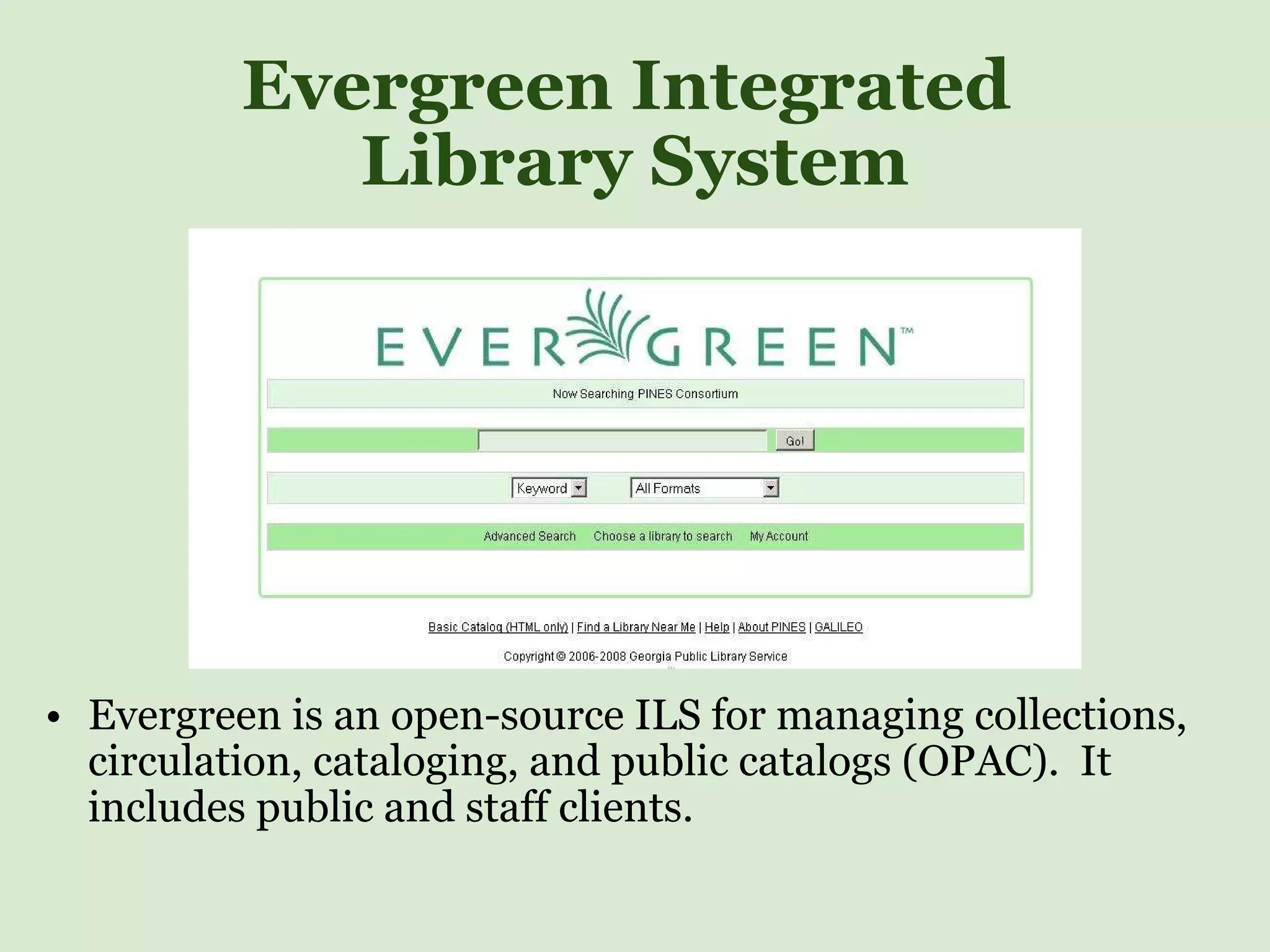
Evergreen Integrated  Library System Evergreen is an open-source ILS for managing collections, circulation, cataloging, and public catalogs (OPAC).  It includes public and staff clients.
Why was Evergreen created? In 2005, the Georgia Public Library System (GPLS) encountered many problems with its commercial ILS:  difficulty with handling large volumes of transactions trouble handling many simultaneous users inadequate flexibility for individual library needs  complicated interfaces hindering staff and public use    Evergreen FAQ: "A few of the vendors GPLS met with admitted that they couldn't handle PINES' requirements, and didn't want to try."      GPLS decided to design a system around their own needs, emphasizing stability, flexibility, and user-friendliness.
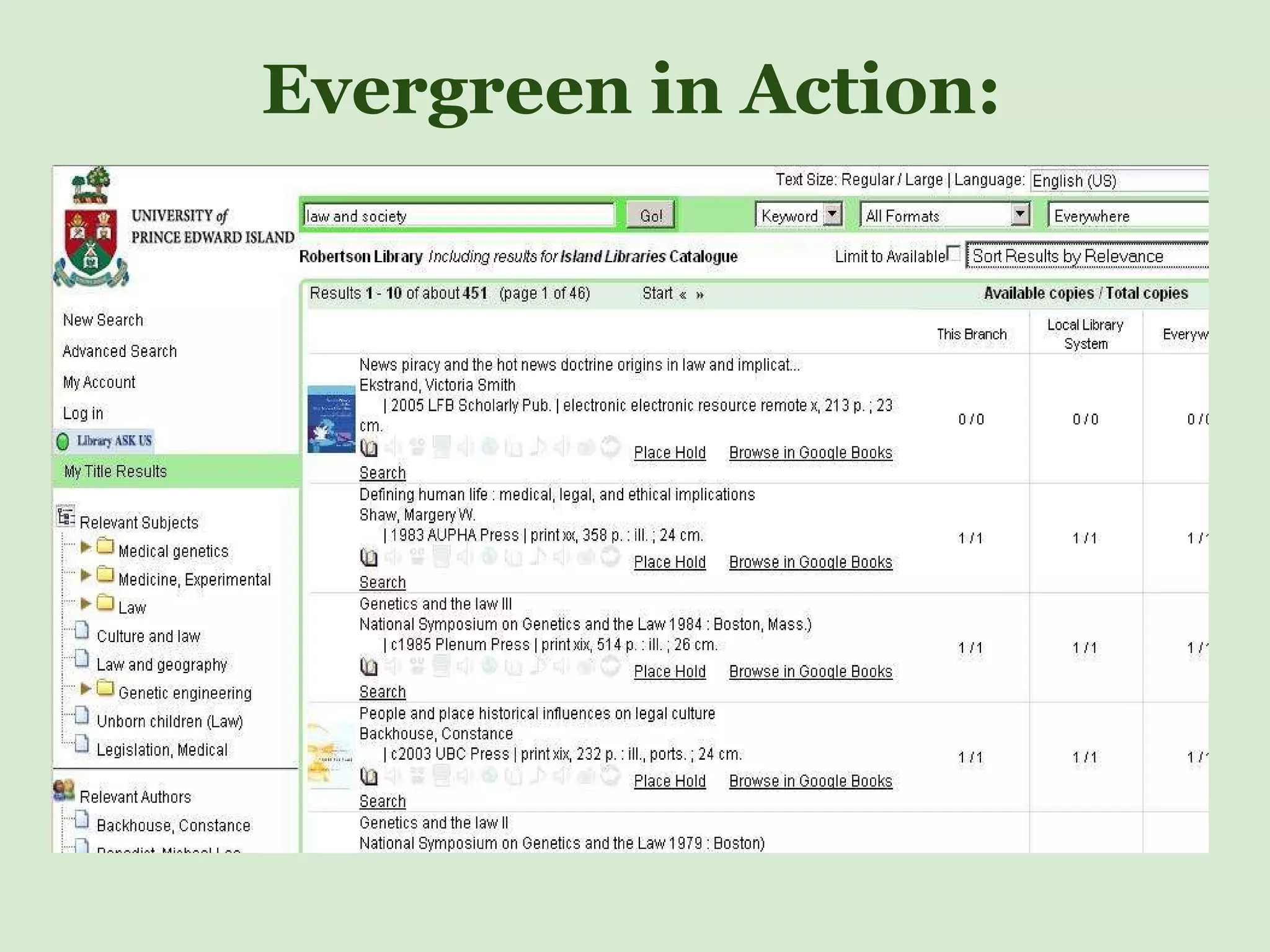
Now used by more than 300 libraries of all types: academic, public, and special. Features:   Circulation:  flexible policy control (by patron, library, item, etc.) offline client for circulation during network downtime Cataloging: easy batch creation of records across branches (centralized cataloging) OPAC: "Did you mean?" correction feature in search  
Evergreen in Action:
Want to use Evergreen in your library? Equinox Software Equinox Software handles software migration, installation, ongoing technical support, system hosting, and custom software. Founded and run by the creators of Evergreen. Do It Yourself All staff and public modules can be downloaded for free from the Evergreen website,                http://www.evergreen-ils.org/
Open Source Library Automation System Developed by Media Flex Designed for K-12 school districts, individual school libraries, church & synagogue libraries through SaaS (service-as-a-software approach) Benefits: Media Flex provides server hardware & technical support http://www.mediaflex.net/showcase.jsp?n=OPALS%99&product_number=F05800
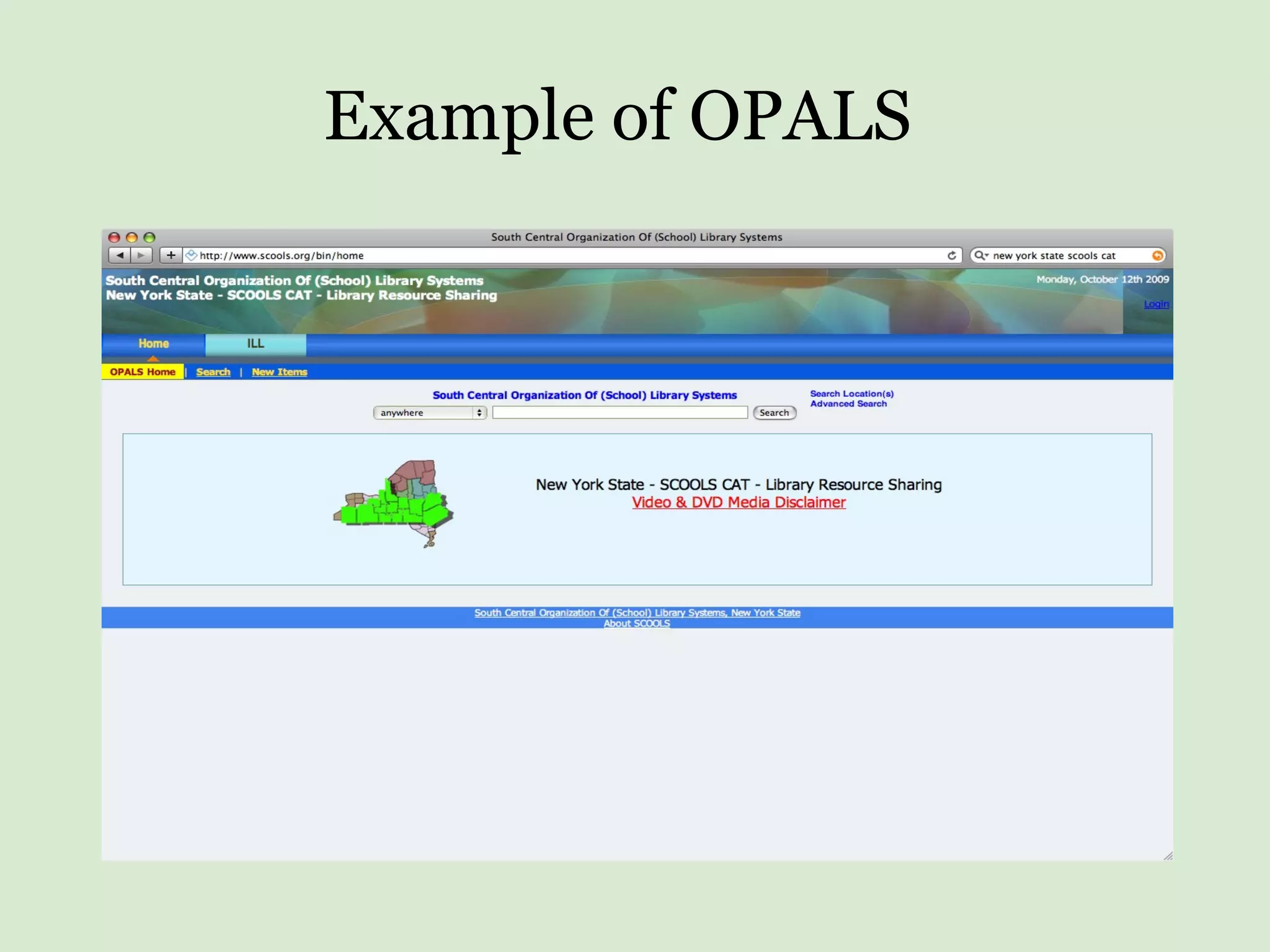
  Example of OPALS
Developed in India by the Kesavan Institute of Information & Knowledge Management and Versus Solutions Designed for libraries in the developing world Benefits: Lower Cost http://www.verussolutions.biz/web/   NewGenLib
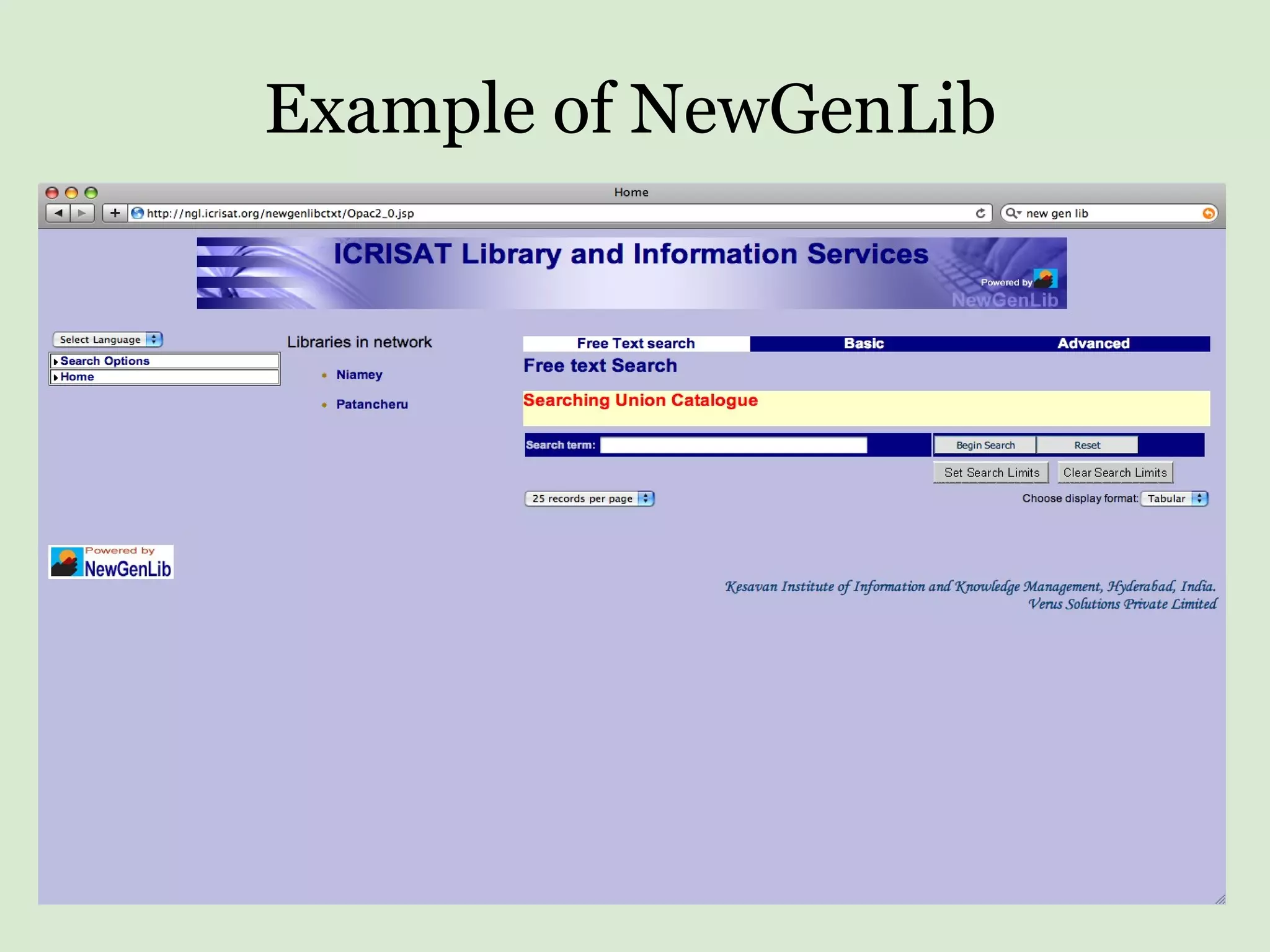
Example of NewGenLib
Conclusions Open Source ILS are a small percentage of library automation systems Many of these libraries contract with a vendor Open Source is gaining international interest
Questions or Comments

LTR: Open Source Integrated Library Systems

  • 1.
    Open Source IntegratedLibrary Systems Carolyn Dorsey Jessica Ng Jing Yang Sarah Elichko Jennifer Pettigrew October 15, 2009
  • 2.
    -Freedom to runprogram for any purpose -Freedom to make changes -Freedom to redistribute copies -Freedom to improve and release improvements 4 Basic Components of Open Source Software Free as in freedom, not price
  • 3.
    Issue Proprietary softwareOpen source software Major terms of open source software and proprietary licenses Source code Not available Available Form of software Binary only Binary and source Who can make changes? Only developer and designates Anyone who uses the software Sharing the software Any form of sharing or reselling is not allowed Users may share the software
  • 4.
    Operating system ServerDatabase Programming language Many Open Source applications are based on L.A.M.P.
  • 5.
    Proprietary Open SourceMany open source business models fall within the ends of this spectrum Some software licenses allow for transition to proprietary licenses Some business models rely on value added services, such as customizing software for particular customers or offering fee based product and/or developer support for customers
  • 6.
    Open Source SoftwareSupport Conversion services Installation Configuration Training Ongoing Support Custom Development Hosting Software-as-a-service (SaaS)
  • 7.
    Vendor/Product Independence OpenSource vs Proprietary Cost factors Advantages Disadvantages
  • 8.
    Collaborative Development Wide participation in ongoing development Ultimate goal: Benefiting all users of the software. Sponsored Development Advancement of open source ILS products Idea of “paid for only once for the benefit of many”
  • 9.
    Major Open SourceILS Products
  • 10.
    Example of KohaILS System
  • 11.
    Koha's Market Kohais the first open-source Integrated Library System   Targeting Libraries:       - Small to mid-sized public libraries;        - Small to mid-sized academic libraries,  museums, special libraries;         - Gradual penetration into libraries of increasing size and complexity.
  • 12.
    Koha’s History Theinitial development - Sponsored by the HLT Libraries (3 small libraries) in New Zealand, 1999.   The development of mandatory components - Sponsored by the Nelsonville Public Library (mid-sized) in Ohio, 2002. The integration of the Zebra - Sponsored by the Crawford County Library System (a 9- library consortia ) in Pennsylvania, 2007.
  • 13.
    Formed in 2005 By individuals from Nelsonville Public Library . Devoted to Koha and other open source software for libraries . Revenue from services .
  • 14.
    Features and FunctionalitySupport almost all of the ILS standards: Unicode 3.0, Z39.50, MARC21, Dublin Core, etc. Basic Functionalities: - Support for Consortia - Online Catalog - Circulation - Cataloging Complex Functionalities: - Acquisitions - Serial Control
  • 15.
    Evergreen Integrated  LibrarySystem Evergreen is an open-source ILS for managing collections, circulation, cataloging, and public catalogs (OPAC).  It includes public and staff clients.
  • 16.
    Why was Evergreencreated? In 2005, the Georgia Public Library System (GPLS) encountered many problems with its commercial ILS:  difficulty with handling large volumes of transactions trouble handling many simultaneous users inadequate flexibility for individual library needs  complicated interfaces hindering staff and public use   Evergreen FAQ: "A few of the vendors GPLS met with admitted that they couldn't handle PINES' requirements, and didn't want to try."     GPLS decided to design a system around their own needs, emphasizing stability, flexibility, and user-friendliness.
  • 17.
    Now used bymore than 300 libraries of all types: academic, public, and special. Features: Circulation:  flexible policy control (by patron, library, item, etc.) offline client for circulation during network downtime Cataloging: easy batch creation of records across branches (centralized cataloging) OPAC: "Did you mean?" correction feature in search  
  • 18.
  • 19.
    Want to useEvergreen in your library? Equinox Software Equinox Software handles software migration, installation, ongoing technical support, system hosting, and custom software. Founded and run by the creators of Evergreen. Do It Yourself All staff and public modules can be downloaded for free from the Evergreen website,               http://www.evergreen-ils.org/
  • 20.
    Open Source LibraryAutomation System Developed by Media Flex Designed for K-12 school districts, individual school libraries, church & synagogue libraries through SaaS (service-as-a-software approach) Benefits: Media Flex provides server hardware & technical support http://www.mediaflex.net/showcase.jsp?n=OPALS%99&product_number=F05800
  • 21.
  • 22.
    Developed in Indiaby the Kesavan Institute of Information & Knowledge Management and Versus Solutions Designed for libraries in the developing world Benefits: Lower Cost http://www.verussolutions.biz/web/   NewGenLib
  • 23.
  • 24.
    Conclusions Open SourceILS are a small percentage of library automation systems Many of these libraries contract with a vendor Open Source is gaining international interest
  • 25.

Editor's Notes

  • #2 note
  • #21 1. Another type of open source software for integrated library systems is called Open Source Library Automation System or OPALS, which was originally developed by the company Media Flex back in 2003 for 6 school districts within New York State. 2. OPALS is designed to handle school district and individual school library systems as well as church and synagogue libraries. 3. One of the main benefits of paying Media Flex an annual subscription fee to use OPALS is that Media Flex provides the system hardware, and installs, configures, and maintains the automation software. 4. Therefore, libraries do not need to invest their time in hardware-purchasing decisions or have to hire a technical staff to maintain OPALS.
  • #22 This screen shot is an example of how the South Central Organization of School Library Systems in New York State uses OPALS to automate their library system.
  • #23 An example of how open source integrated library systems is being used outside of North America is the open source library automation system, NewGenLib. NewGenLib was released in India back in 2008 by the non-profit professional organization, Kesavan Institute of Information and Knowledge Management, and the commercial software firm, Versus Solutions. 3. NewGenLib is designed to be a lower cost solution for library automation systems in the developing world. 4. At the time this report was published, 122 libraries used NewGenLib.
  • #24 This screen shot displays the online library catalog for two libraries in India that are part of the same network that uses NewGenLib.
  • #25 To conclude, only a small percentage of libraries have adopted open source integrated library systems in North America and many of these libraries decide to contract with a vendor. 2. As future librarians and information specialists we can expect that more libraries within North America and the world will continue to adopt open source integrated library systems.