POINTS TO BE COVERED TODAY:
 How Gold Affects the Economy and You
 Gold Price & The U.S Economy
 Gold Price History
 Gold, "The Ultimate Bubble," Has Burst
 Three Reasons To Invest In Gold
 Gold News & Analysis
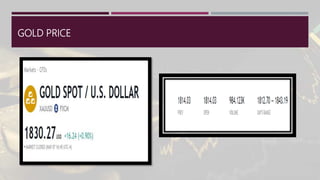
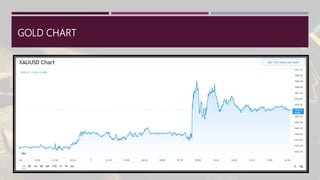
 Gold Price & Chart
HOW GOLD AFFECTS THE ECONOMY AND YOU
 Gold's impact on the economy waxes and wanes, depending on
how safe other investments are.
 When other investments seem too risky, gold always looks like a
good hedge.
 In fact, you can tell how healthy the economy is from the price of
gold.
 When the U.S was on the gold standard, the precious metal had
an even greater importance.
GOLD PRICE & THE U .S . ECONOMY
 Gold prices reveal the true state of U.S. economic health.
 When gold prices are high, that signals the economy is not healthy.
 Investors buy gold as protection from either an economic crisis or inflation.
 Low gold prices mean the economy is healthy — making stocks, bonds, or real estate more
profitable investments.
 Gold prices reflect the beliefs of commodities traders.
 If they think the economy is doing poorly, they will buy more gold. If they think the economy is
doing well, they will buy less gold.
 Gold prices reveal what savvy investors know about economic health.
THE GOLD RUSH STARTED IT ALL
 When gold was found at Sutter's Ranch in 1848, it inspired the
Gold Rush to California and the unification of western America.
 In 1861, U.S. Treasury Secretary Salmon Chase printed the first
U.S. paper currency backed by gold.
 That was the beginning of the gold standard.
GOLD PRICES & THE GREAT DEPRESSION
 The price of gold went from $20.67 an ounce in 1929 to $35 an ounce in 1934.
 The Federal Reserve was trying to maintain the gold standard as the economy continued to
worsen.
 That contributed to the Great Depression, sparked by the stock market crash of 1929 and multiple
bank failures.
 People started to hoard gold for protection. While countries in Europe had dropped the gold
standard, the United States held on.
 In 1934, President Franklin D. Roosevelt finally took action and signed the Gold Reserve Act. This
made it illegal for the general public to own gold in most forms.
 The Act required people to exchange their gold coins, bullion, and certificates for $20.67 per
ounce in paper money.
 It helped the federal government bolster its reserves of gold.
 The government raised the price of gold to $35 an ounce, allowing it to print more paper money.
Slowly, the economy started to grow again.
GOLD PRICE TRIPLED IN ONE DAY
 One of the most important moments in gold price history was the day President Richard M.
Nixon detached the U.S. dollar from the gold standard.
 Gold prices skyrocketed from $42 to $120 an ounce.
 In 1971, Nixon told the nation's central bank to stop redeeming the dollar for its value in gold.
 Foreign central banks could no longer exchange their dollars for U.S. gold.
 Nixon wanted to make the value of the dollar weaker compared to gold.
 He thought that would end the inflation caused by his wage-price controls. By 1976, Nixon
abandoned the gold standard completely.
JUNE 2, 2016 - GOLD ROSE $100 IN SIX HOURS
 In June 2016, gold prices surged $100 an ounce in six hours.
Investors panicked in the wake of Brexit, when Great Britain voted
to leave the European Union.
 Prices rose from $1,254.96 at 4 p.m. on June 23, the evening of
the Brexit vote, to $1,347.12 at midnight. Investors bought gold as
a hedge against a declining euro and British pound.
 In 2016, the U.S. stock market also entered a stock market
correction.
 As the Dow Jones Averages fell, gold prices rose.
SEPTEMBER 2011 - GOLD HITS HIGH OF $1,874 AN OUNCE
 On Sep. 2, 2011, gold reached its record high (as of that time) of $1,873.70 per ounce.
 
A weak jobs report, ongoing Eurozone debt crisis, and lingering uncertainty over the U.S. debt
ceiling caused prices to nearly double from $1,000 an ounce in 2009.
 In July, investors worried that Congress wouldn't raise the debt ceiling in time.
 Without the ability to issue new debt, the federal government might have defaulted on its debt.
 In September 2009, gold was trading near its all-time high of $1,032.
 As the dollar declined, many wondered whether it was a good time to buy gold.
 It was, if you had a crystal ball and could see into the future. At the time, the world was coming out of
the 2008 financial crisis.
 Many thought economic growth would bounce back as it did following any other recession. Instead, a
high foreclosure rate in the United States and growing sovereign debt concerns in Europe kept
investors on edge.
 Still, most financial planners will advise you have no more than 10% of your assets in gold.
2020 RECESSION CAUSES NEW RECORD HIGH FOR GOLD
 On July 23, 2020, gold surpassed its prior high, closing at
$1,882.35 an ounce as investors were concerned about the 2020
recession.
 By August 7, 2020, gold reached a new all-time record of
$2,062,50 an ounce.
GOLD PRICE HISTORY
 Before gold was used as coinage, its value was recognized.
 Gold jewelry is buried in the Tomb of Djer, king of the First Egyptian
Dynasty.
 Gold's beauty, luster, and malleability made it perfect for many uses. In
fact, the Egyptians became masters in the art of beating gold into leaf.
 Gold was first used for money in 643 BC. In 30 BC, the Roman
Emperor Augustus set the price of gold at 45 coins to the pound.
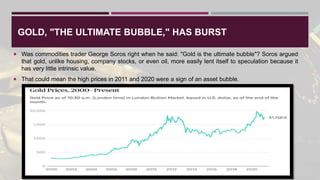
 Its value has steadily increased since then, reaching a peak of $1,823
an ounce in 2011.
 It fell to $1,050.60 on Dec. 3, 2015. It began rising after that, reaching
a new high of $2,061.50 on August 7, 2020
GOLD, "THE ULTIMATE BUBBLE," HAS BURST
 Was commodities trader George Soros right when he said: "Gold is the ultimate bubble"? Soros argued
that gold, unlike housing, company stocks, or even oil, more easily lent itself to speculation because it
has very little intrinsic value.
 That could mean the high prices in 2011 and 2020 were a sign of an asset bubble.
THREE REASONS TO INVEST IN GOLD
 When the price of gold shoots up, everyone wonders if they should buy it.
 Are you a good candidate for buying gold? Only if you have enough money to ride out
any ups or downs that could last years.
 In fact, the higher the price, the riskier this commodity is. You never know when a gold boom
will turn into a bust.
 People invest in gold for one of three reasons.
1. Offset stock market declines
2. Hedge against inflation
3. Counteract a declining dollar
THREE REASONS TO INVEST IN GOLD - I
 Gold is often considered a safe-haven investment. But is it really?
 Gold is the best hedge against a potential stock market crash, according to research done by
Trinity College.
 It found that gold prices increased dramatically for 15 days after a crash.
 Frightened investors panicked, sold their stocks, and bought gold. After the 15 days, gold
prices lost value against rebounding stock prices.
 For that reason, gold should be included in a well-diversified portfolio.
 It does protect your investments as a hedge after a stock market crash.
 But this protection is short-lived.
HISTORY OF GOLD STANDARD
 The gold standard is when countries tie the value of their currency to gold.
 They are willing to redeem that currency for its value in gold.
 The gold standard allowed lightweight paper currency to be used for trade, instead of heavy
gold bullion.
 In addition to making purses, and pockets, lighter, the gold standard allowed global trade.
 Gold was first used as a standard in 643 B.C. when the metal was used to create coins.
 Wealth was defined strictly by the amount of gold you had. Gold as money evolved from coins
to paper redeemable by coins to a concept that was only loosely tied to its value in gold.
HISTORY OF GOLD STANDARD-I
 The gold standard helped create the Great Depression.
 It was modified after World War II to make the U.S. dollar the de facto world
currency. But President Nixon disbanded it in the 1970s.
 During the financial crisis in 2008, many longed for a return to the gold
standard.
 It seemed that money had lost all relation to anything concrete.
 But the very forces that pried America away from the gold standard also
meant that a return would prompt massive deflation.
 It would be enough to throw the global economy into another depression.
GOLD NEWS & ANALYSIS
 Gold Bulls Re-Ignite Big-Picture Bullish Trend
 It was a big week for Gold prices as the yellow metal broke out to fresh two-month-highs.
 The big question is whether the big-picture bullish trend is coming back into order after a near nine-month-pullback.
 USD weakness assisted with the move as USD bears re-emerged in a big way this week.
 XAU/USD closes below $1840 amid disappointing NFP, 200-DMA still in sight.
• Gold bulls have eyes on a 61.8% Fibo monthly target of $1,850.
• Shorter-term, the bears can target at least a drift to a 38.2% Fibo at 1.807 or the daily support, near $1,800.
• XAU/USD to see further gains towards the 200-DMA at $1853 – Credit Suisse.
• XAU/USD eyes $1840, shrugging off overbought condition.
 Source:
Gold (XAU/USD) News and Analysis (dailyfx.com)
Gold Forecast, News and Analysis - FXStreet
GOLD PRICE
GOLD CHART
May 9 I Session 1 I GBIH

May 9 I Session 1 I GBIH

  • 2.
    POINTS TO BECOVERED TODAY:  How Gold Affects the Economy and You  Gold Price & The U.S Economy  Gold Price History  Gold, "The Ultimate Bubble," Has Burst  Three Reasons To Invest In Gold  Gold News & Analysis  Gold Price & Chart
  • 3.
    HOW GOLD AFFECTSTHE ECONOMY AND YOU  Gold's impact on the economy waxes and wanes, depending on how safe other investments are.  When other investments seem too risky, gold always looks like a good hedge.  In fact, you can tell how healthy the economy is from the price of gold.  When the U.S was on the gold standard, the precious metal had an even greater importance.
  • 4.
    GOLD PRICE &THE U .S . ECONOMY  Gold prices reveal the true state of U.S. economic health.  When gold prices are high, that signals the economy is not healthy.  Investors buy gold as protection from either an economic crisis or inflation.  Low gold prices mean the economy is healthy — making stocks, bonds, or real estate more profitable investments.  Gold prices reflect the beliefs of commodities traders.  If they think the economy is doing poorly, they will buy more gold. If they think the economy is doing well, they will buy less gold.  Gold prices reveal what savvy investors know about economic health.
  • 5.
    THE GOLD RUSHSTARTED IT ALL  When gold was found at Sutter's Ranch in 1848, it inspired the Gold Rush to California and the unification of western America.  In 1861, U.S. Treasury Secretary Salmon Chase printed the first U.S. paper currency backed by gold.  That was the beginning of the gold standard.
  • 6.
    GOLD PRICES &THE GREAT DEPRESSION  The price of gold went from $20.67 an ounce in 1929 to $35 an ounce in 1934.  The Federal Reserve was trying to maintain the gold standard as the economy continued to worsen.  That contributed to the Great Depression, sparked by the stock market crash of 1929 and multiple bank failures.  People started to hoard gold for protection. While countries in Europe had dropped the gold standard, the United States held on.  In 1934, President Franklin D. Roosevelt finally took action and signed the Gold Reserve Act. This made it illegal for the general public to own gold in most forms.  The Act required people to exchange their gold coins, bullion, and certificates for $20.67 per ounce in paper money.  It helped the federal government bolster its reserves of gold.  The government raised the price of gold to $35 an ounce, allowing it to print more paper money. Slowly, the economy started to grow again.
  • 7.
    GOLD PRICE TRIPLEDIN ONE DAY  One of the most important moments in gold price history was the day President Richard M. Nixon detached the U.S. dollar from the gold standard.  Gold prices skyrocketed from $42 to $120 an ounce.  In 1971, Nixon told the nation's central bank to stop redeeming the dollar for its value in gold.  Foreign central banks could no longer exchange their dollars for U.S. gold.  Nixon wanted to make the value of the dollar weaker compared to gold.  He thought that would end the inflation caused by his wage-price controls. By 1976, Nixon abandoned the gold standard completely.
  • 8.
    JUNE 2, 2016- GOLD ROSE $100 IN SIX HOURS  In June 2016, gold prices surged $100 an ounce in six hours. Investors panicked in the wake of Brexit, when Great Britain voted to leave the European Union.  Prices rose from $1,254.96 at 4 p.m. on June 23, the evening of the Brexit vote, to $1,347.12 at midnight. Investors bought gold as a hedge against a declining euro and British pound.  In 2016, the U.S. stock market also entered a stock market correction.  As the Dow Jones Averages fell, gold prices rose.
  • 9.
    SEPTEMBER 2011 -GOLD HITS HIGH OF $1,874 AN OUNCE  On Sep. 2, 2011, gold reached its record high (as of that time) of $1,873.70 per ounce.   A weak jobs report, ongoing Eurozone debt crisis, and lingering uncertainty over the U.S. debt ceiling caused prices to nearly double from $1,000 an ounce in 2009.  In July, investors worried that Congress wouldn't raise the debt ceiling in time.  Without the ability to issue new debt, the federal government might have defaulted on its debt.  In September 2009, gold was trading near its all-time high of $1,032.  As the dollar declined, many wondered whether it was a good time to buy gold.  It was, if you had a crystal ball and could see into the future. At the time, the world was coming out of the 2008 financial crisis.  Many thought economic growth would bounce back as it did following any other recession. Instead, a high foreclosure rate in the United States and growing sovereign debt concerns in Europe kept investors on edge.  Still, most financial planners will advise you have no more than 10% of your assets in gold.
  • 10.
    2020 RECESSION CAUSESNEW RECORD HIGH FOR GOLD  On July 23, 2020, gold surpassed its prior high, closing at $1,882.35 an ounce as investors were concerned about the 2020 recession.  By August 7, 2020, gold reached a new all-time record of $2,062,50 an ounce.
  • 11.
    GOLD PRICE HISTORY Before gold was used as coinage, its value was recognized.  Gold jewelry is buried in the Tomb of Djer, king of the First Egyptian Dynasty.  Gold's beauty, luster, and malleability made it perfect for many uses. In fact, the Egyptians became masters in the art of beating gold into leaf.  Gold was first used for money in 643 BC. In 30 BC, the Roman Emperor Augustus set the price of gold at 45 coins to the pound.  Its value has steadily increased since then, reaching a peak of $1,823 an ounce in 2011.  It fell to $1,050.60 on Dec. 3, 2015. It began rising after that, reaching a new high of $2,061.50 on August 7, 2020
  • 12.
    GOLD, "THE ULTIMATEBUBBLE," HAS BURST  Was commodities trader George Soros right when he said: "Gold is the ultimate bubble"? Soros argued that gold, unlike housing, company stocks, or even oil, more easily lent itself to speculation because it has very little intrinsic value.  That could mean the high prices in 2011 and 2020 were a sign of an asset bubble.
  • 13.
    THREE REASONS TOINVEST IN GOLD  When the price of gold shoots up, everyone wonders if they should buy it.  Are you a good candidate for buying gold? Only if you have enough money to ride out any ups or downs that could last years.  In fact, the higher the price, the riskier this commodity is. You never know when a gold boom will turn into a bust.  People invest in gold for one of three reasons. 1. Offset stock market declines 2. Hedge against inflation 3. Counteract a declining dollar
  • 14.
    THREE REASONS TOINVEST IN GOLD - I  Gold is often considered a safe-haven investment. But is it really?  Gold is the best hedge against a potential stock market crash, according to research done by Trinity College.  It found that gold prices increased dramatically for 15 days after a crash.  Frightened investors panicked, sold their stocks, and bought gold. After the 15 days, gold prices lost value against rebounding stock prices.  For that reason, gold should be included in a well-diversified portfolio.  It does protect your investments as a hedge after a stock market crash.  But this protection is short-lived.
  • 15.
    HISTORY OF GOLDSTANDARD  The gold standard is when countries tie the value of their currency to gold.  They are willing to redeem that currency for its value in gold.  The gold standard allowed lightweight paper currency to be used for trade, instead of heavy gold bullion.  In addition to making purses, and pockets, lighter, the gold standard allowed global trade.  Gold was first used as a standard in 643 B.C. when the metal was used to create coins.  Wealth was defined strictly by the amount of gold you had. Gold as money evolved from coins to paper redeemable by coins to a concept that was only loosely tied to its value in gold.
  • 16.
    HISTORY OF GOLDSTANDARD-I  The gold standard helped create the Great Depression.  It was modified after World War II to make the U.S. dollar the de facto world currency. But President Nixon disbanded it in the 1970s.  During the financial crisis in 2008, many longed for a return to the gold standard.  It seemed that money had lost all relation to anything concrete.  But the very forces that pried America away from the gold standard also meant that a return would prompt massive deflation.  It would be enough to throw the global economy into another depression.
  • 17.
    GOLD NEWS &ANALYSIS  Gold Bulls Re-Ignite Big-Picture Bullish Trend  It was a big week for Gold prices as the yellow metal broke out to fresh two-month-highs.  The big question is whether the big-picture bullish trend is coming back into order after a near nine-month-pullback.  USD weakness assisted with the move as USD bears re-emerged in a big way this week.  XAU/USD closes below $1840 amid disappointing NFP, 200-DMA still in sight. • Gold bulls have eyes on a 61.8% Fibo monthly target of $1,850. • Shorter-term, the bears can target at least a drift to a 38.2% Fibo at 1.807 or the daily support, near $1,800. • XAU/USD to see further gains towards the 200-DMA at $1853 – Credit Suisse. • XAU/USD eyes $1840, shrugging off overbought condition.  Source: Gold (XAU/USD) News and Analysis (dailyfx.com) Gold Forecast, News and Analysis - FXStreet
  • 18.
  • 19.