Exploring The Gold
Market
What Affects Gold Prices
Points To BE Covered Today:
• What Affects Gold Price?
• Dollar And Gold As Measures Of Value.
• What Drives Gold Prices?
• Gold Market & Gold Price Trading Economics.
• Dynamics Of Global Demand For Gold.
• Gold Price & Chart.
What Affects Gold Price
• Gold is the most ancient legendary asset, humanity's curse
and blessing.
• The precious metal that was once used as money but has lost
its appeal in recent years.
• Loads of legends, fantasies, and rumours surround it.
• The asset that can both yield profits and cause
disappointment.
• This article doesn't claim to be exhaustive, but we will try to
find out what drives gold prices and who is responsible for the
fluctuation of gold prices.
• Also, we are going to discuss how to earn and save money
when buying gold.
Dollar And Gold As Measures Of Value
• Gold is a precious metal that once served as
money, but in recent years has lost its former
attractiveness.
• The equivalent of value around which many
legends and unverified rumors revolve.
• Investing in this asset may be profitable
or disappointing.
History And Modern Times
• First, let's check the facts. As we know, the US dollar became the
world's reserve currency at the international conference held in
Bretton Woods, USA, in July 1944, when the Second World War was
almost over.
• Thus, other currencies became pegged to the USD's value, and their
rate was determined through the principle of parity.
• At the same time, the dollar was pegged to gold, whose price was
set at 35 USD per troy ounce (31.1035 g).
• One gram of pure gold costs $1.125.
• Central banks maintained currency parity.
• However, in 1968, the Two-tier gold system was established, and
the price of gold became dependent on demand and supply.
History And Modern Times-I
• In August 1971, US President Richard Nixon decided to close the
gold window and introduced a ban on USD-gold exchanges at an
official bank rate.
• The dollar devalued as early as December of the same year, and the
gold price rose to 38 USD.
• That meant the bankruptcy of the USA.
• Next, the USA devalued the dollar to $42.2 per troy ounce, and the
golden standard era came to an end.
• Following the Jamaica Agreement in March 1976, the Forex market
emerged, and the exchange rate system became floating.
• Still, the dollar remained the world's reserve currency, which
allowed the USA to launch the printing press at its discretion later.
History And Modern Times-II
• Forty-eight years have passed since then. One troy ounce
grew in price to $1,475, an impressive growth by 42.14
times or 4,214%! However, few people think of investing
and getting a return in 50 years.
• A closer prospect of 5, 10, or 20 years is more
appropriate.
• And traders are interested in even shorter time frames:
one year, one quarter, or even one month.
What Factors Affect Gold Prices
• Let's take a look at the main areas of gold production and
consumption, as well as analyze the supply and demand
statistics.
• When it comes to analyzing the price of gold,
fundamental analysis is more pertinent than technical
analysis.
• The law of demand and supply influences the price in the
conditions of market price formation.
• According to the World Gold Council's information (WGC),
the primary demand sources are jewelry production, the
technological sector, investment, and central banks
What Factors Affect Gold Prices-I
• In 2018, jewellery production consumed 2,241 tons and
technology - 335 tons.
• The investment sector bought 1,164 tons and central
banks - 656 tons.
• Gold's new production amounted to 3,501 tons, and
1,177 tons were recycled.
• In 2018, the leading gold producers were: China (404.1
tons), Australia (314.9 tons), Russia (297.3 tons), and the
USA (221.7 tons).
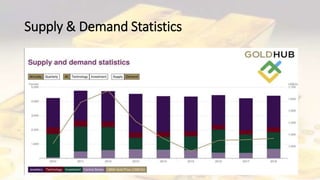
Supply & Demand Statistics
What Factors Affect Gold Prices-II
• Based on the WGC's data, the leading consumer of gold is
jewelry production with a 51% share.
• Also, we see that jewelry production has been the main
buyer for many years.
• It's supposed to affect the gold price, but all isn't so
simple.
• True, the gold price depends on the demand for jewelry
in the USA, India, and China, but this dependence belongs
to long-term factors.
• So does central banks' demand or growth of electronics
production.
What Drives Gold Prices
• I can single out four main categories of factors that affect
the price of gold:
1.economic expansion and growth of well-being;
2.market risks and uncertainty;
3.alternative prices;
4.impulse and positioning.
What Drives Gold Prices-I
• The two first factors are particularly important to gold prices' long-
term prospects.
• They form a basis for strategic reasons for buying and investing in
gold.
• There's a connection between the price of gold and economic
expansion.
• Growth in people's well-being provokes a higher demand for jewelry.
• The technological sector demands more gold too.
• Inflation incites investors to invest money in gold and gold-containing
assets. In the USA, India, and China, gold is an object of luxury and a
store of value.
• If a market, geopolitical, or any other risk arises, investors treat gold
as a safe-haven asset that protects them from money devaluation.
• The price of gold is affected by central banks' policies and market
What Drives Gold Prices-II
• There are multiple-factor models for assessing the prospects
of gold.
• They allow forecasting the direction of the price with high
precision.
• In such models, the price of gold is determined through the
interactions of drivers.
• However, those models' complexity and the absence of
reliable information prevent us from using them in everyday
trading or investment solutions.
• There will always be unknown variables that may disprove a
hypothesis and prevent the realization of a forecast.
• So, we need a simple tool based on some assumptions, which
is likely to make the right forecast for gold in the Forex
market.
Gold Market & Gold Price Trading Economics:
Peculiarities Of Pricing And Structure
• When trading commodities, it’s important to be aware of
their demand & supply’s structure and dynamics.
• A typical example is oil, which is recovering lost
positions by leaps and bounds amid expectations of
growing demand and surplus reduction, as main global
economies have started to reopen.
• Unlike Brent and WTI, gold is less sensitive to the physical
asset market’s state.
• However, it can punish any time a trader who ignores
fundamental analysis.
Gold Market & Gold Price Trading Economics:
Peculiarities Of Pricing And Structure -I
• Jewellery production and investment prevail in the gold global
demand structure.
• In 2019, they accounted for 48.5% and 29.2% of demand,
respectively.
• Central banks’ share in gold purchases was 14.8% while industrial
use accounted for 7.5% of gold consumption.
• The latter indicator is important. The thing is it is much higher for
silver.
• The shutdown of industrial enterprises led therefore to a faster
slump of XAG/USD if compared with XAU/USD.
• As a result, the gold-silver ratio soared to historical peaks.
Against the backdrop of the recovering global economy, the ratio
may be expected to drop.
• It means we’d better bet on silver’s faster growth against gold.
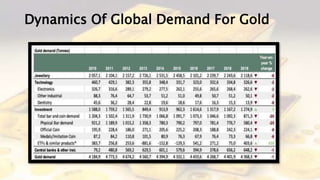
Dynamics Of Global Demand For Gold
• The relative share of investment in the structure of the
gold global demand grew up to 49.8% while the share of
jewelry production dropped to 30.1%.
• Consumption of gold reduced almost in all sectors,
except for ETFs and coins, as compared with October-
December and January-March 2019.
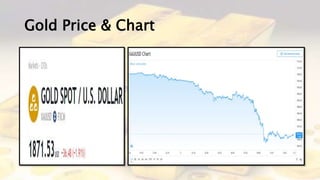
Gold Price & Chart
Exploring The Gold
Market
What Affects Gold Prices
THANKS FOR LISTENING
Exploring The Gold Market

June 4 I Session 2 I GBIH

  • 1.
    Exploring The Gold Market WhatAffects Gold Prices
  • 2.
    Points To BECovered Today: • What Affects Gold Price? • Dollar And Gold As Measures Of Value. • What Drives Gold Prices? • Gold Market & Gold Price Trading Economics. • Dynamics Of Global Demand For Gold. • Gold Price & Chart.
  • 3.
    What Affects GoldPrice • Gold is the most ancient legendary asset, humanity's curse and blessing. • The precious metal that was once used as money but has lost its appeal in recent years. • Loads of legends, fantasies, and rumours surround it. • The asset that can both yield profits and cause disappointment. • This article doesn't claim to be exhaustive, but we will try to find out what drives gold prices and who is responsible for the fluctuation of gold prices. • Also, we are going to discuss how to earn and save money when buying gold.
  • 4.
    Dollar And GoldAs Measures Of Value • Gold is a precious metal that once served as money, but in recent years has lost its former attractiveness. • The equivalent of value around which many legends and unverified rumors revolve. • Investing in this asset may be profitable or disappointing.
  • 5.
    History And ModernTimes • First, let's check the facts. As we know, the US dollar became the world's reserve currency at the international conference held in Bretton Woods, USA, in July 1944, when the Second World War was almost over. • Thus, other currencies became pegged to the USD's value, and their rate was determined through the principle of parity. • At the same time, the dollar was pegged to gold, whose price was set at 35 USD per troy ounce (31.1035 g). • One gram of pure gold costs $1.125. • Central banks maintained currency parity. • However, in 1968, the Two-tier gold system was established, and the price of gold became dependent on demand and supply.
  • 6.
    History And ModernTimes-I • In August 1971, US President Richard Nixon decided to close the gold window and introduced a ban on USD-gold exchanges at an official bank rate. • The dollar devalued as early as December of the same year, and the gold price rose to 38 USD. • That meant the bankruptcy of the USA. • Next, the USA devalued the dollar to $42.2 per troy ounce, and the golden standard era came to an end. • Following the Jamaica Agreement in March 1976, the Forex market emerged, and the exchange rate system became floating. • Still, the dollar remained the world's reserve currency, which allowed the USA to launch the printing press at its discretion later.
  • 7.
    History And ModernTimes-II • Forty-eight years have passed since then. One troy ounce grew in price to $1,475, an impressive growth by 42.14 times or 4,214%! However, few people think of investing and getting a return in 50 years. • A closer prospect of 5, 10, or 20 years is more appropriate. • And traders are interested in even shorter time frames: one year, one quarter, or even one month.
  • 8.
    What Factors AffectGold Prices • Let's take a look at the main areas of gold production and consumption, as well as analyze the supply and demand statistics. • When it comes to analyzing the price of gold, fundamental analysis is more pertinent than technical analysis. • The law of demand and supply influences the price in the conditions of market price formation. • According to the World Gold Council's information (WGC), the primary demand sources are jewelry production, the technological sector, investment, and central banks
  • 9.
    What Factors AffectGold Prices-I • In 2018, jewellery production consumed 2,241 tons and technology - 335 tons. • The investment sector bought 1,164 tons and central banks - 656 tons. • Gold's new production amounted to 3,501 tons, and 1,177 tons were recycled. • In 2018, the leading gold producers were: China (404.1 tons), Australia (314.9 tons), Russia (297.3 tons), and the USA (221.7 tons).
  • 10.
    Supply & DemandStatistics
  • 11.
    What Factors AffectGold Prices-II • Based on the WGC's data, the leading consumer of gold is jewelry production with a 51% share. • Also, we see that jewelry production has been the main buyer for many years. • It's supposed to affect the gold price, but all isn't so simple. • True, the gold price depends on the demand for jewelry in the USA, India, and China, but this dependence belongs to long-term factors. • So does central banks' demand or growth of electronics production.
  • 12.
    What Drives GoldPrices • I can single out four main categories of factors that affect the price of gold: 1.economic expansion and growth of well-being; 2.market risks and uncertainty; 3.alternative prices; 4.impulse and positioning.
  • 13.
    What Drives GoldPrices-I • The two first factors are particularly important to gold prices' long- term prospects. • They form a basis for strategic reasons for buying and investing in gold. • There's a connection between the price of gold and economic expansion. • Growth in people's well-being provokes a higher demand for jewelry. • The technological sector demands more gold too. • Inflation incites investors to invest money in gold and gold-containing assets. In the USA, India, and China, gold is an object of luxury and a store of value. • If a market, geopolitical, or any other risk arises, investors treat gold as a safe-haven asset that protects them from money devaluation. • The price of gold is affected by central banks' policies and market
  • 14.
    What Drives GoldPrices-II • There are multiple-factor models for assessing the prospects of gold. • They allow forecasting the direction of the price with high precision. • In such models, the price of gold is determined through the interactions of drivers. • However, those models' complexity and the absence of reliable information prevent us from using them in everyday trading or investment solutions. • There will always be unknown variables that may disprove a hypothesis and prevent the realization of a forecast. • So, we need a simple tool based on some assumptions, which is likely to make the right forecast for gold in the Forex market.
  • 15.
    Gold Market &Gold Price Trading Economics: Peculiarities Of Pricing And Structure • When trading commodities, it’s important to be aware of their demand & supply’s structure and dynamics. • A typical example is oil, which is recovering lost positions by leaps and bounds amid expectations of growing demand and surplus reduction, as main global economies have started to reopen. • Unlike Brent and WTI, gold is less sensitive to the physical asset market’s state. • However, it can punish any time a trader who ignores fundamental analysis.
  • 16.
    Gold Market &Gold Price Trading Economics: Peculiarities Of Pricing And Structure -I • Jewellery production and investment prevail in the gold global demand structure. • In 2019, they accounted for 48.5% and 29.2% of demand, respectively. • Central banks’ share in gold purchases was 14.8% while industrial use accounted for 7.5% of gold consumption. • The latter indicator is important. The thing is it is much higher for silver. • The shutdown of industrial enterprises led therefore to a faster slump of XAG/USD if compared with XAU/USD. • As a result, the gold-silver ratio soared to historical peaks. Against the backdrop of the recovering global economy, the ratio may be expected to drop. • It means we’d better bet on silver’s faster growth against gold.
  • 17.
    Dynamics Of GlobalDemand For Gold
  • 18.
    Dynamics Of GlobalDemand For Gold • The relative share of investment in the structure of the gold global demand grew up to 49.8% while the share of jewelry production dropped to 30.1%. • Consumption of gold reduced almost in all sectors, except for ETFs and coins, as compared with October- December and January-March 2019.
  • 19.
  • 20.
    Exploring The Gold Market WhatAffects Gold Prices
  • 21.