

Communicating Results
Lab 4: your 5-7 things
Communicating with data
Really common visualisations
Quite common visualisations
Visualisation tools: Matplotlib and Tableau
Doing more: D3 and beyond
Communicating with Data
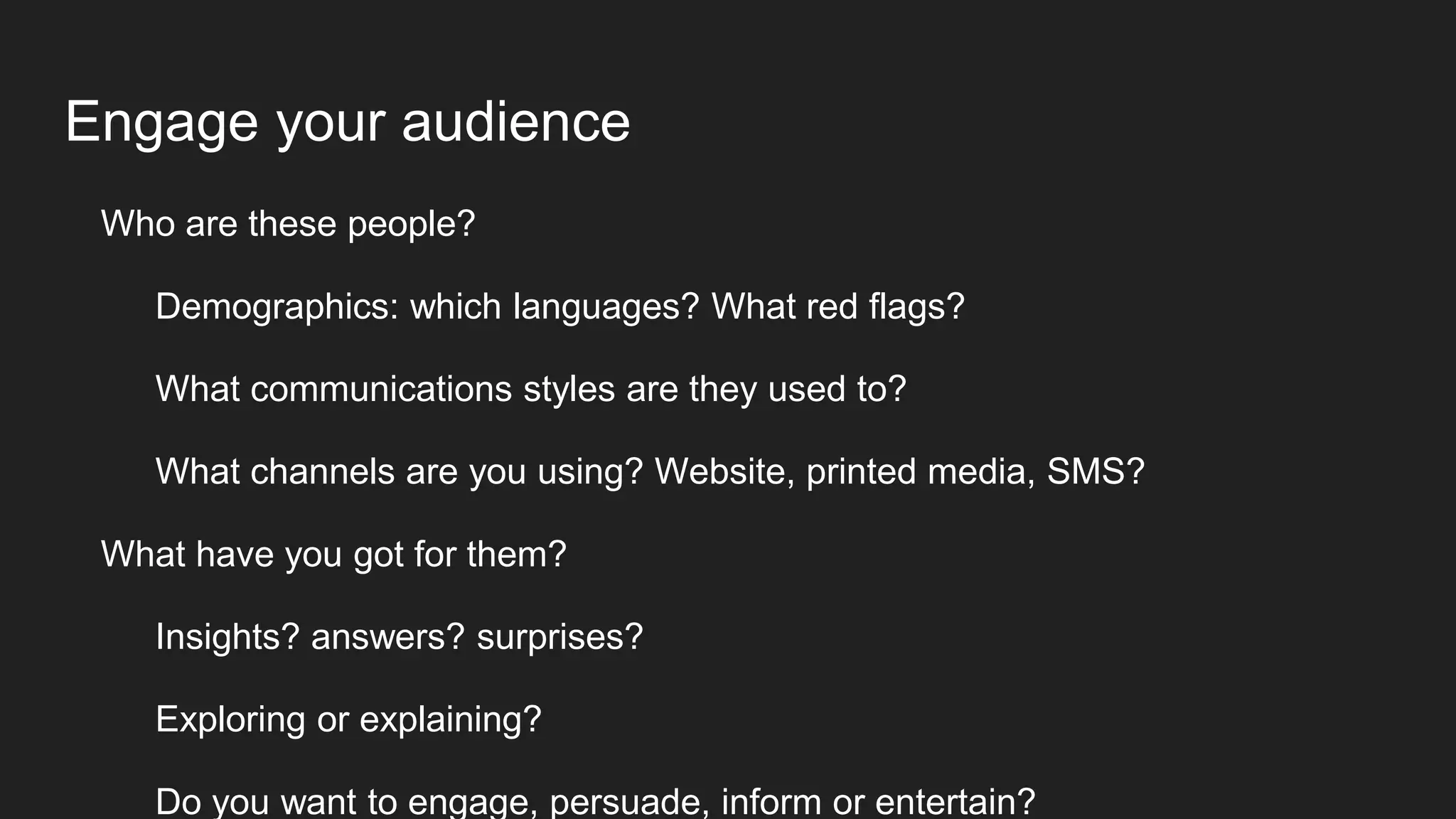
Engage your audience
Who are these people?
Demographics: which languages? What red flags?
What communications styles are they used to?
What channels are you using? Website, printed media, SMS?
What have you got for them?
Insights? answers? surprises?
Exploring or explaining?
Do you want to engage, persuade, inform or entertain?
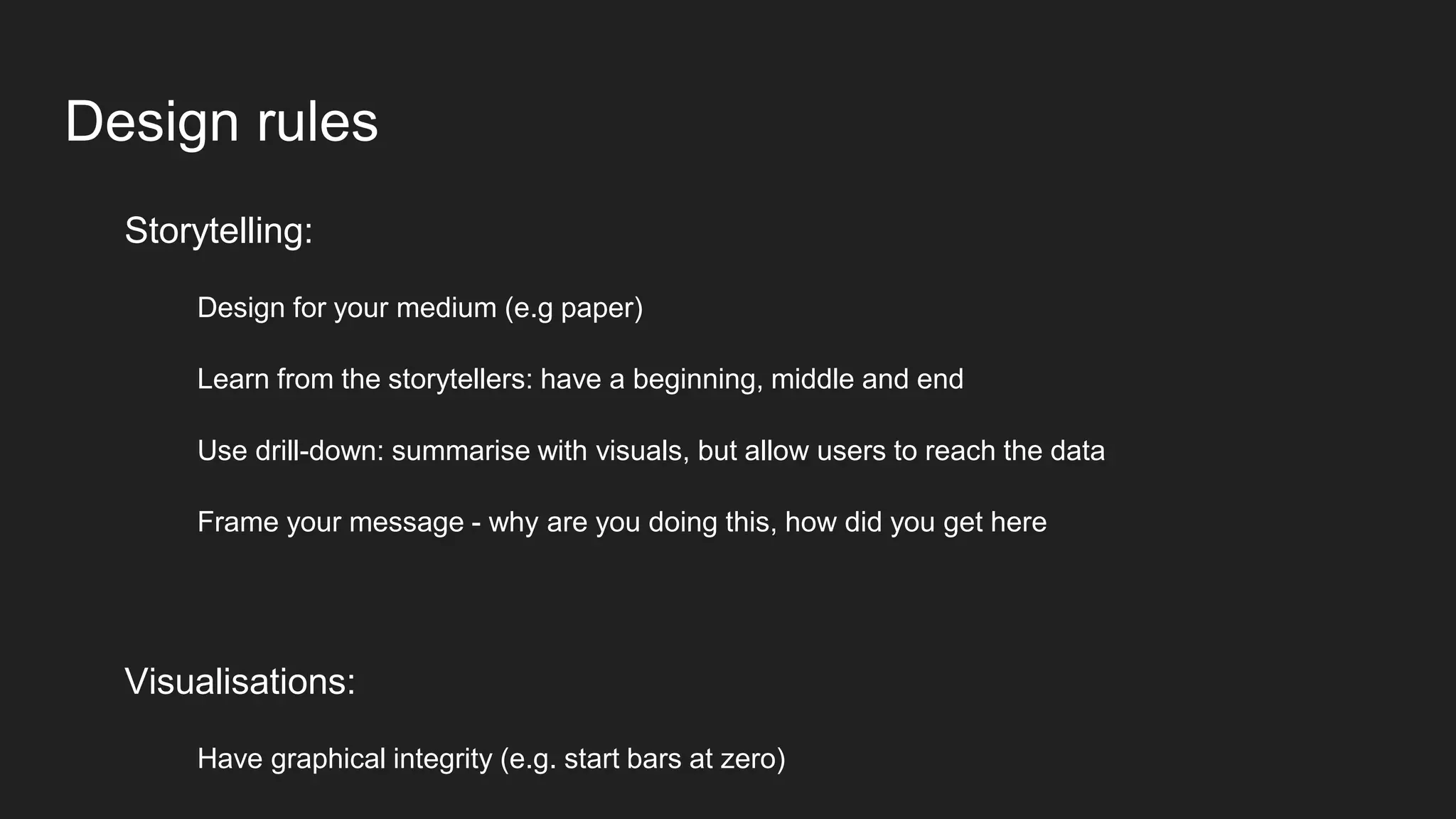
Design rules
Storytelling:
Design for your medium (e.g paper)
Learn from the storytellers: have a beginning, middle and end
Use drill-down: summarise with visuals, but allow users to reach the data
Frame your message - why are you doing this, how did you get here
Visualisations:
Have graphical integrity (e.g. start bars at zero)
Really Common Visualisations
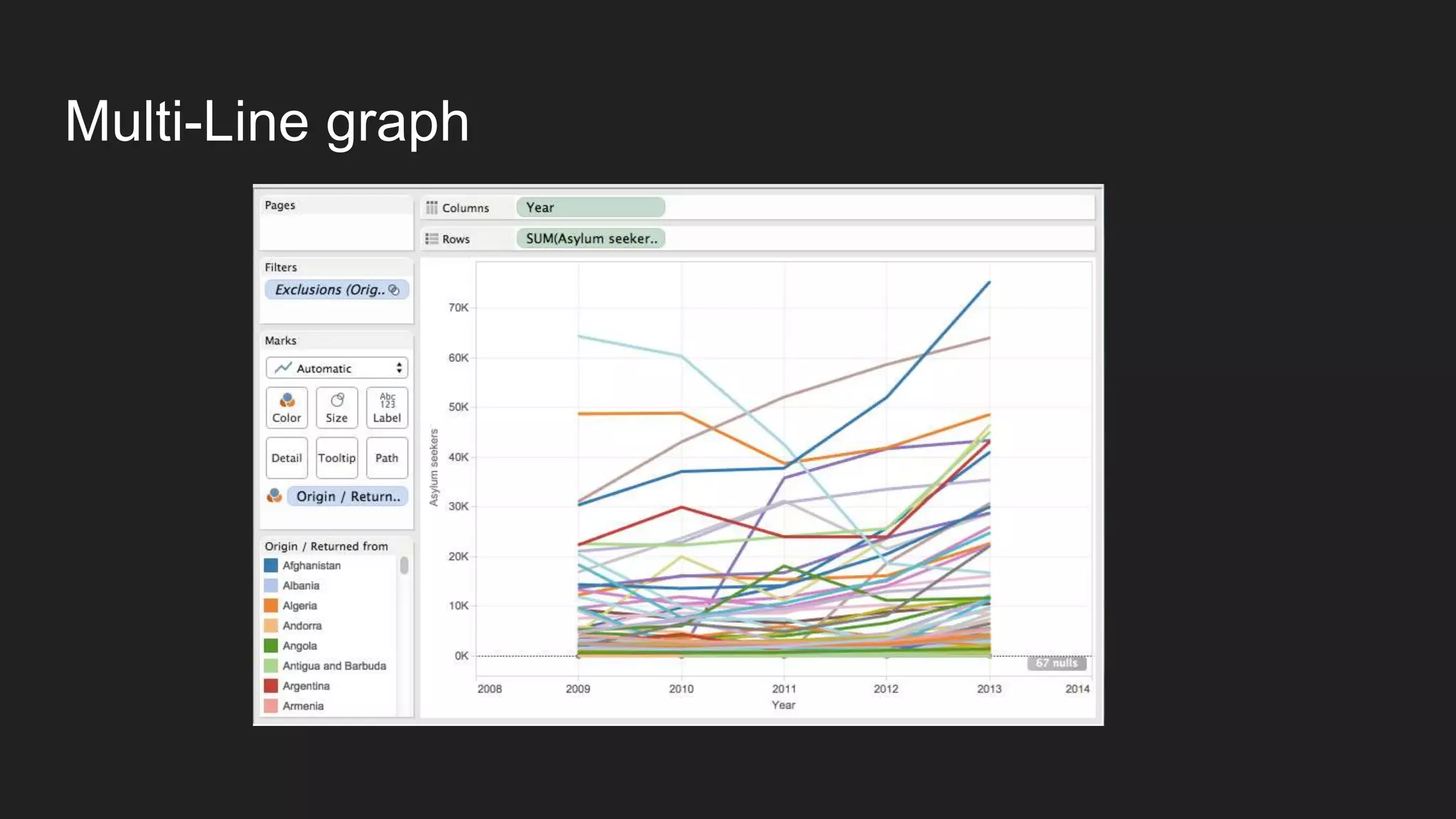
Multi-Line graph
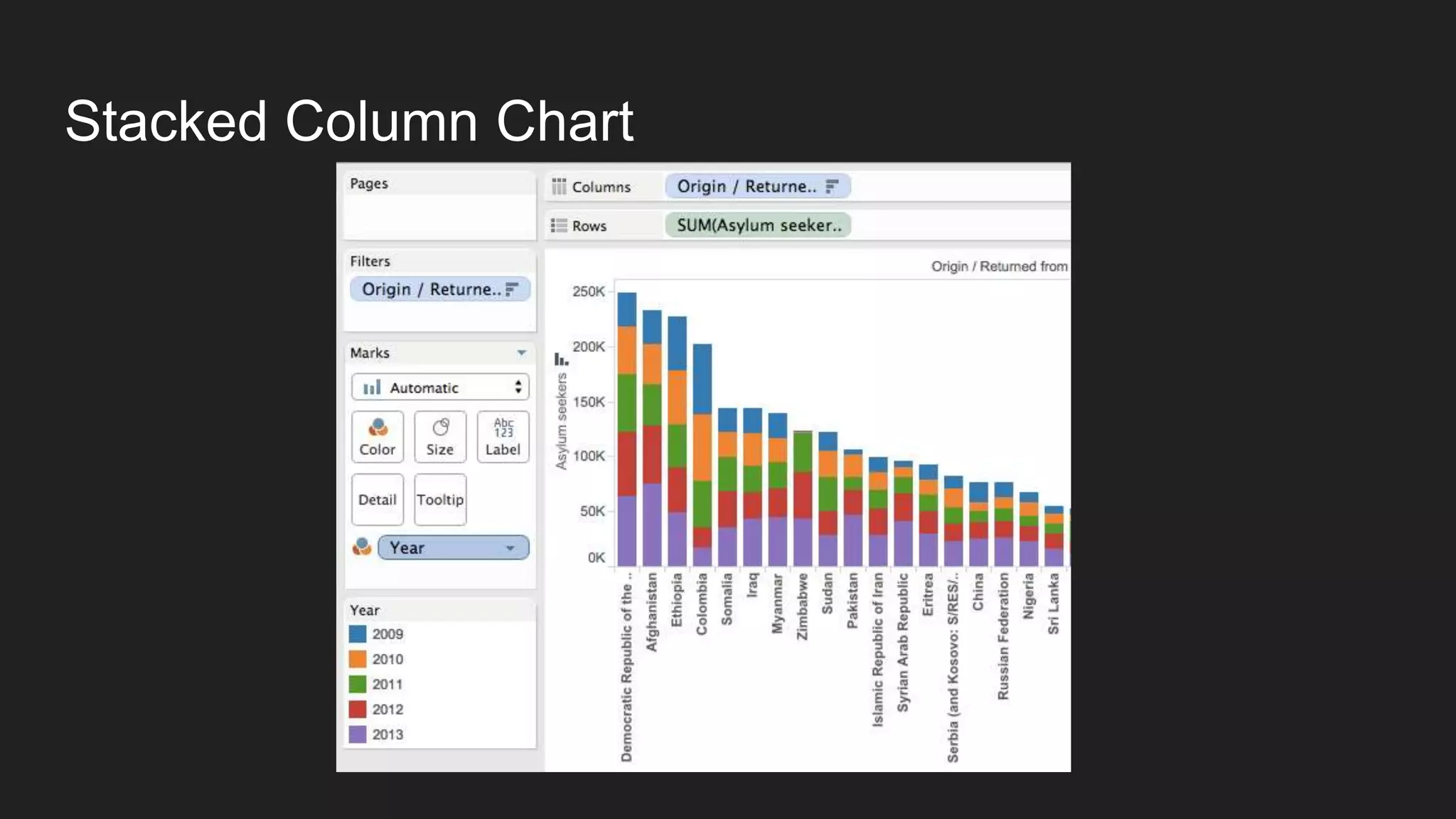
Stacked Column Chart
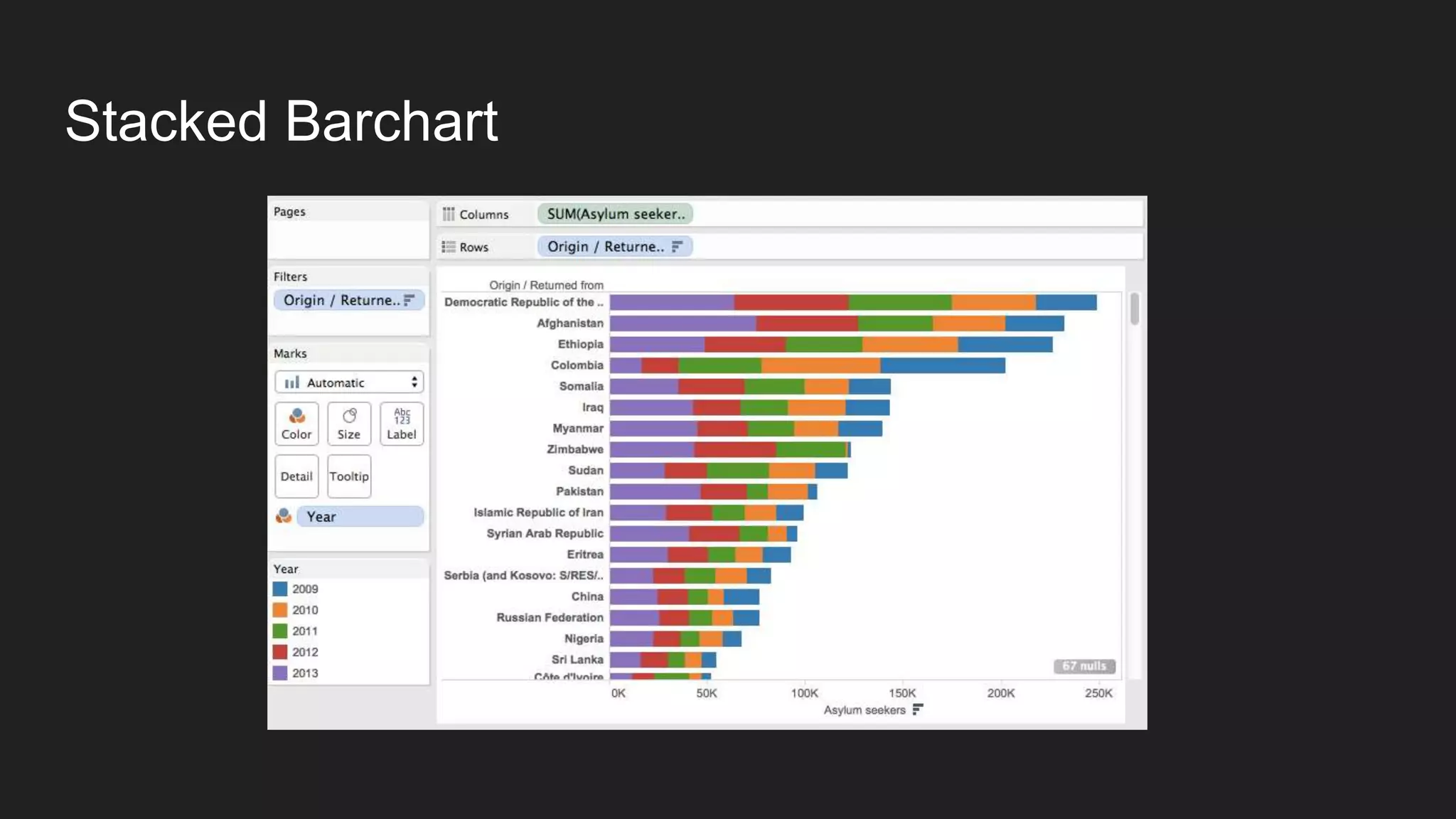
Stacked Barchart
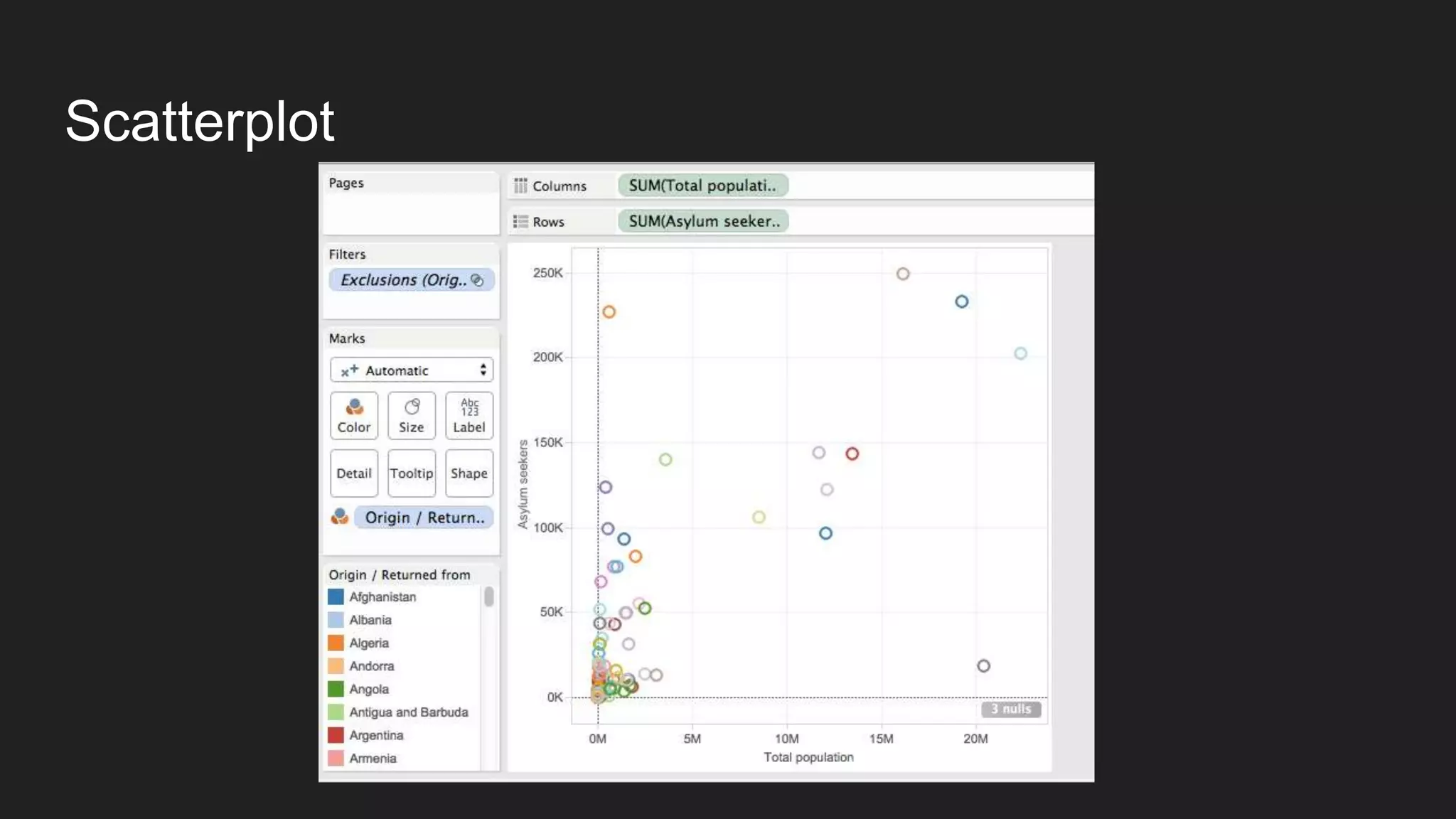
Scatterplot
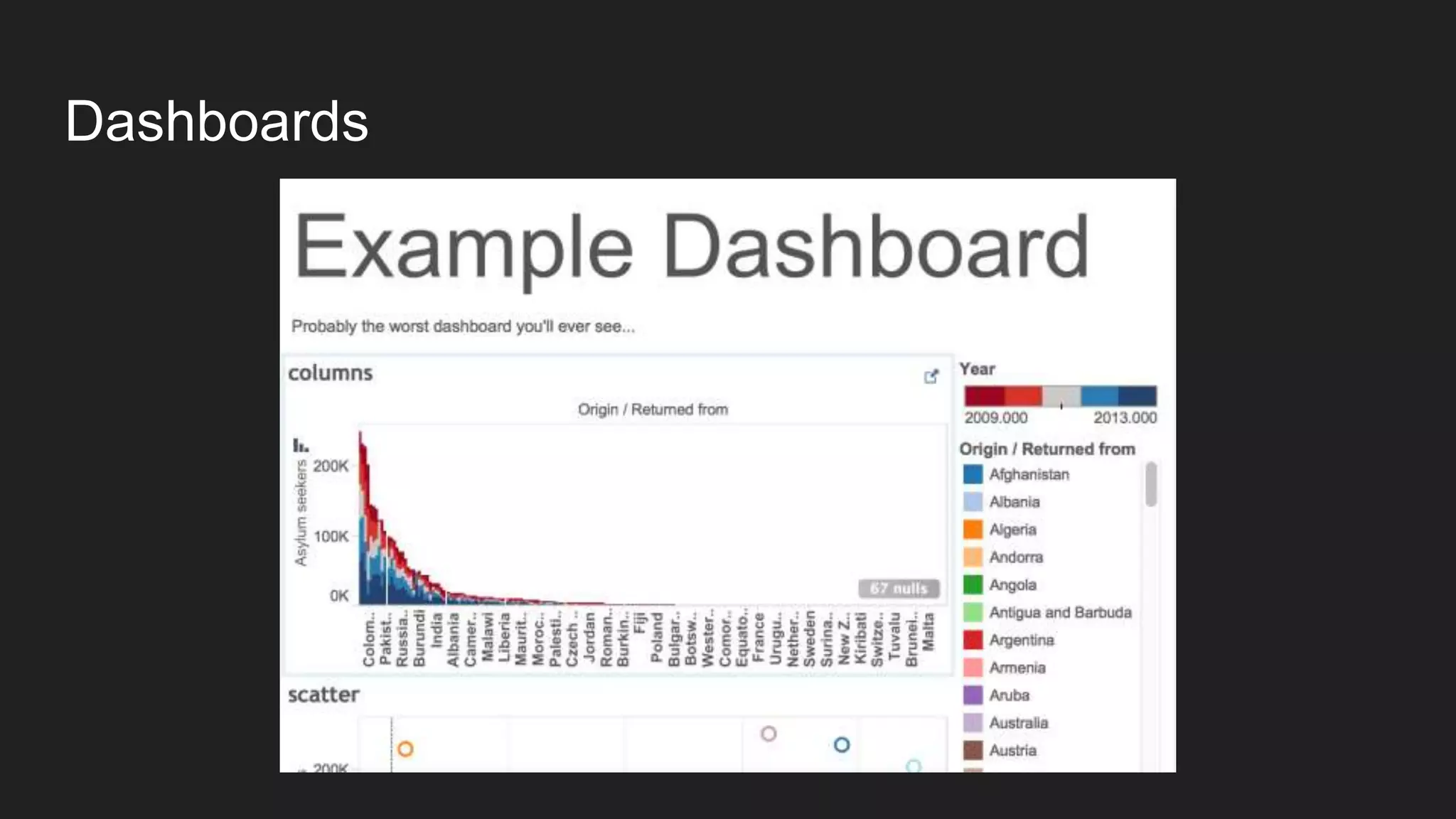
Dashboards
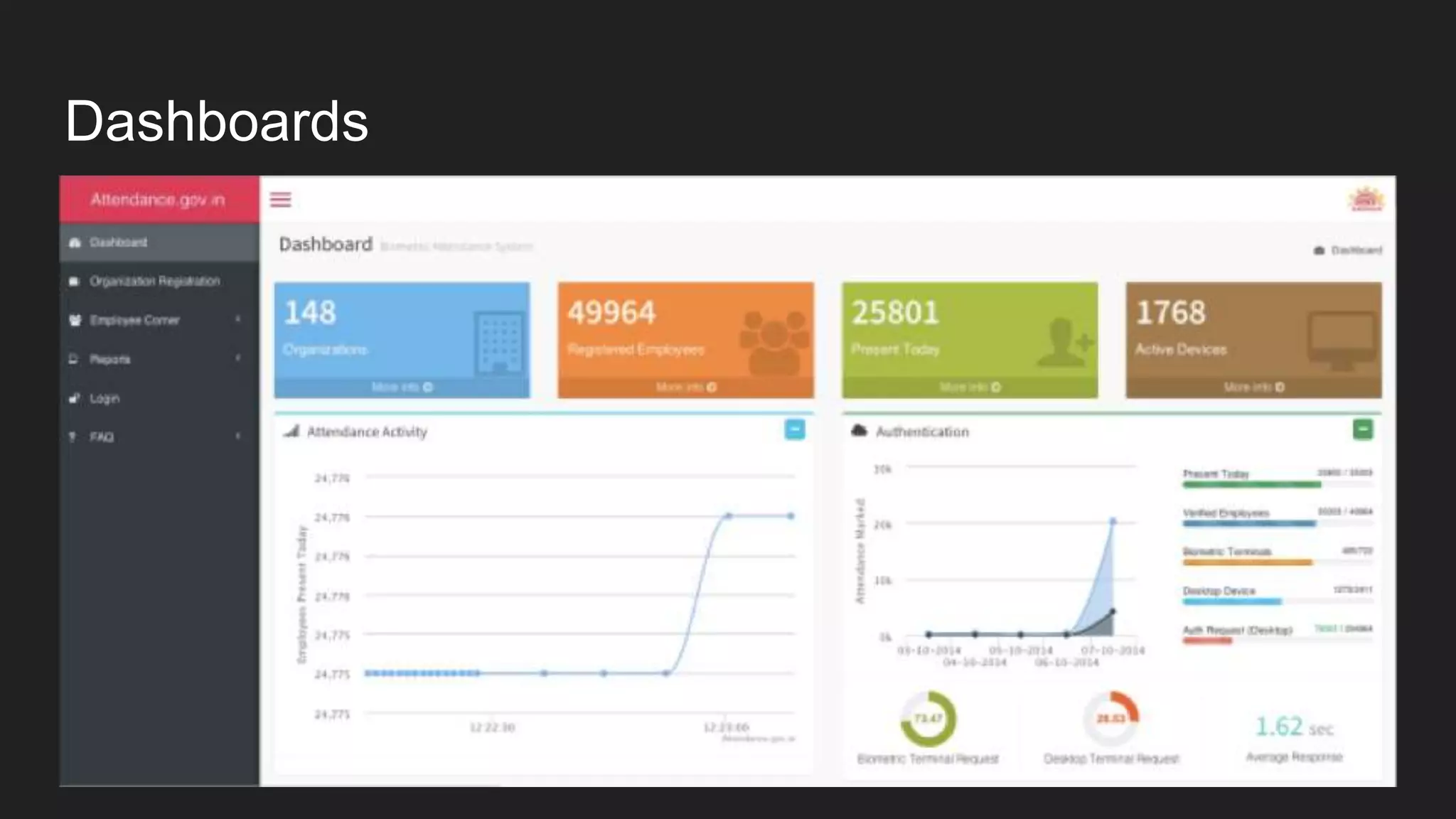
Dashboards
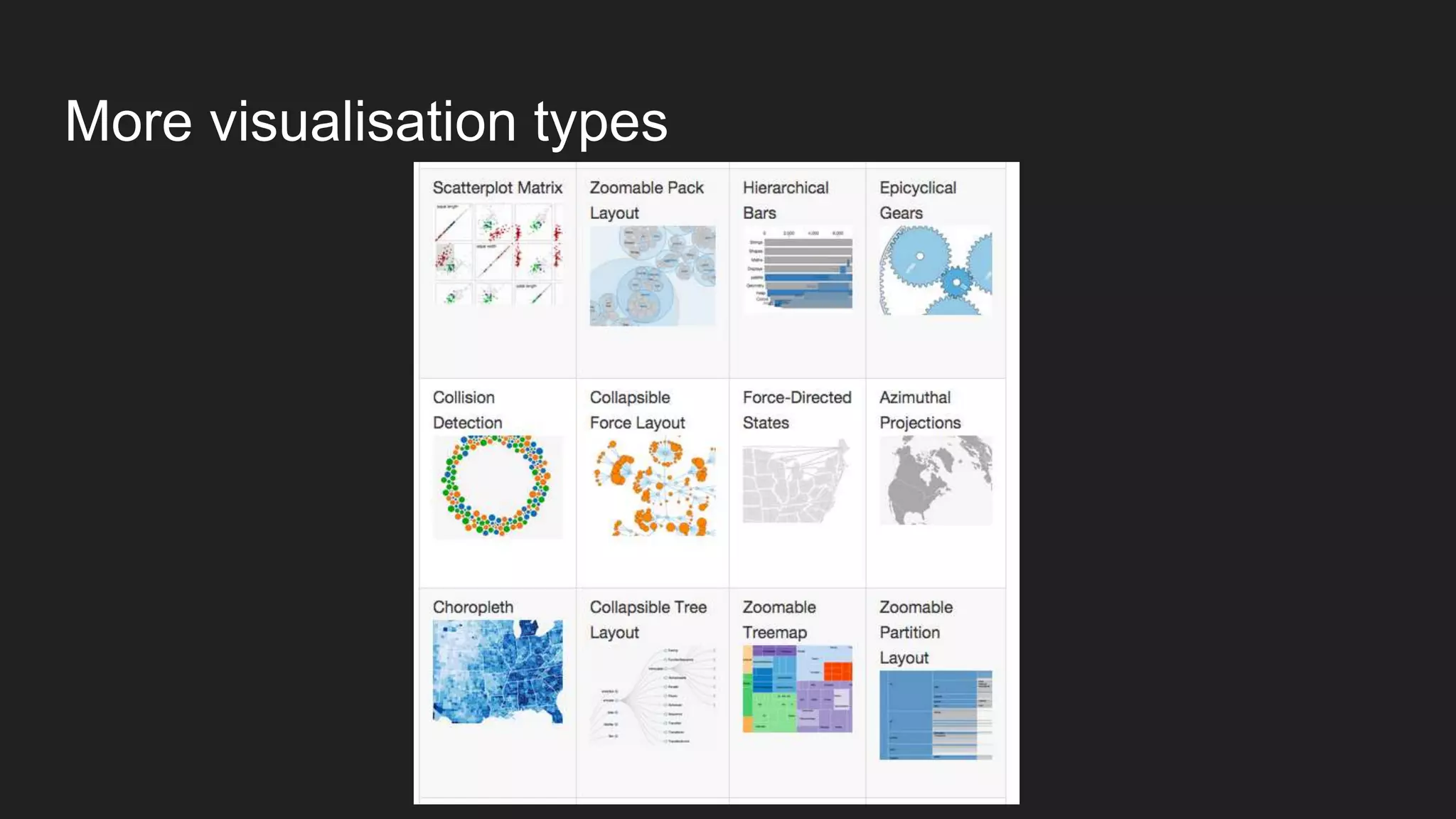
More visualisation types
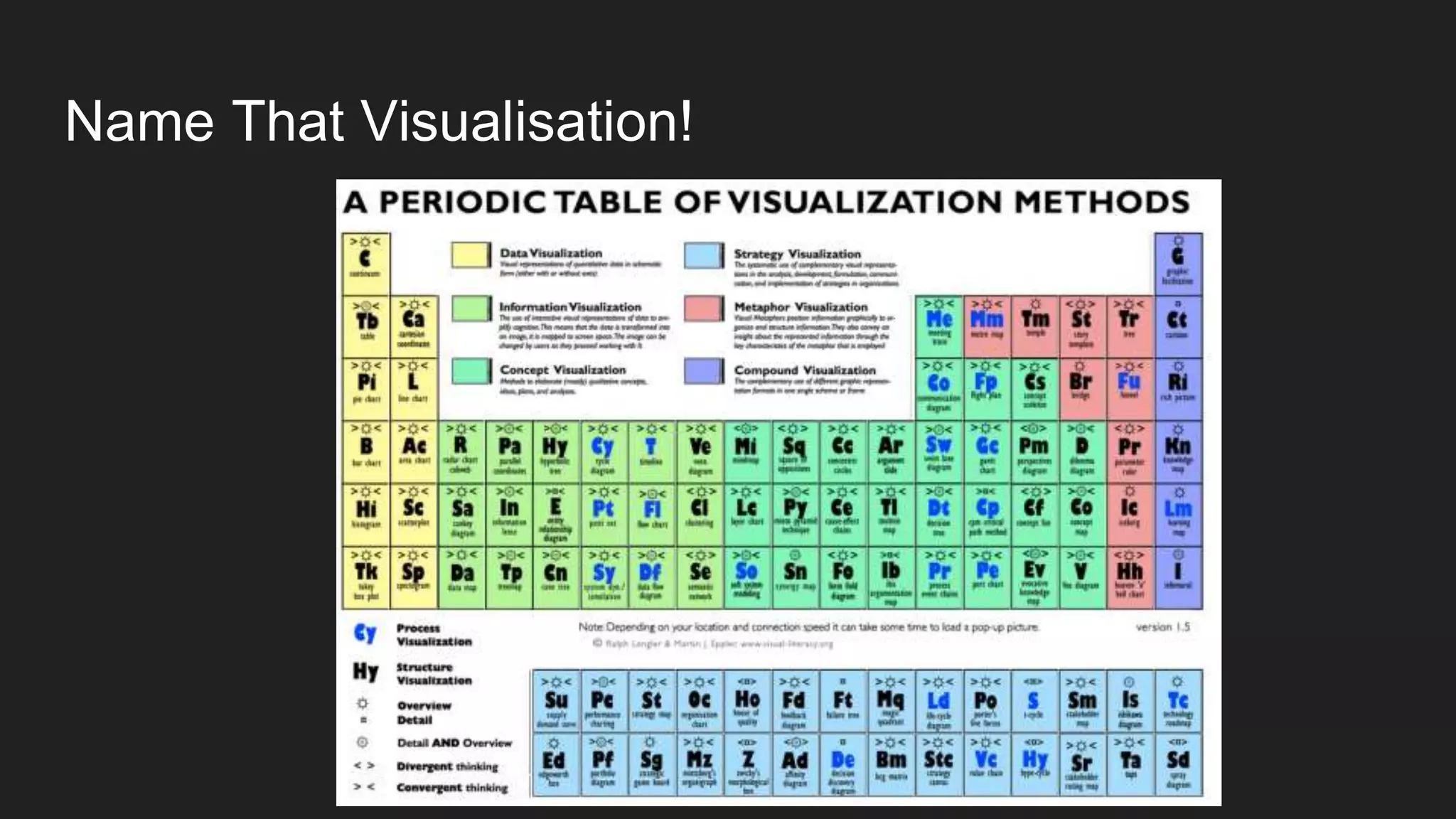
Name That Visualisation!
Common Visualisation Tools
Choosing a Visualisation Tool
What do you want to do?
Standard visualisations, or something special?
Inputs: files (e.g. CSV) or streaming data? Maps?
Non-roman languages (Arabic, Mandarin etc)?
Interactive or static?
Where do you want to do it?
Online or offline?
Any other restrictions?
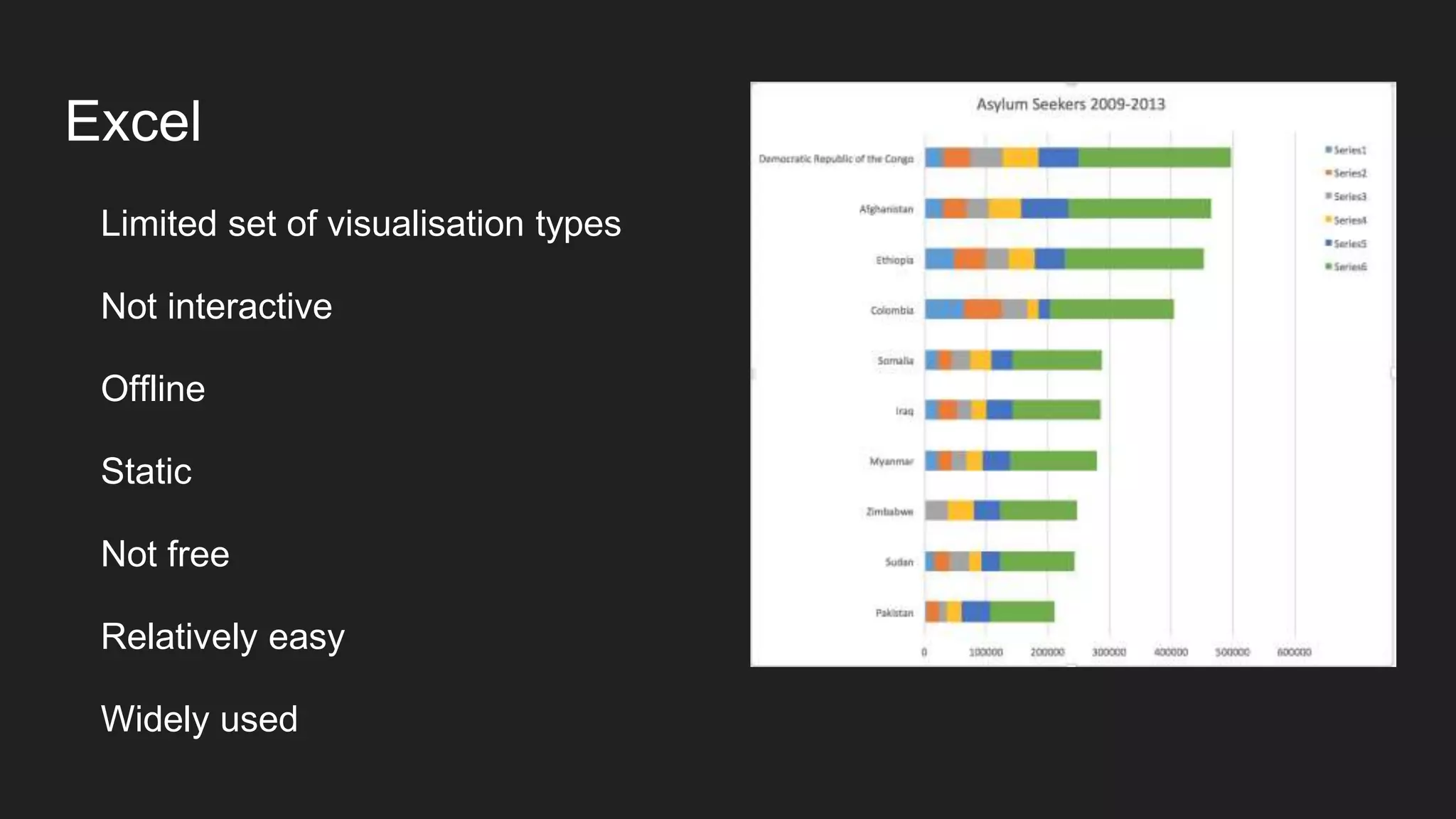
Excel
Limited set of visualisation types
Not interactive
Offline
Static
Not free
Relatively easy
Widely used
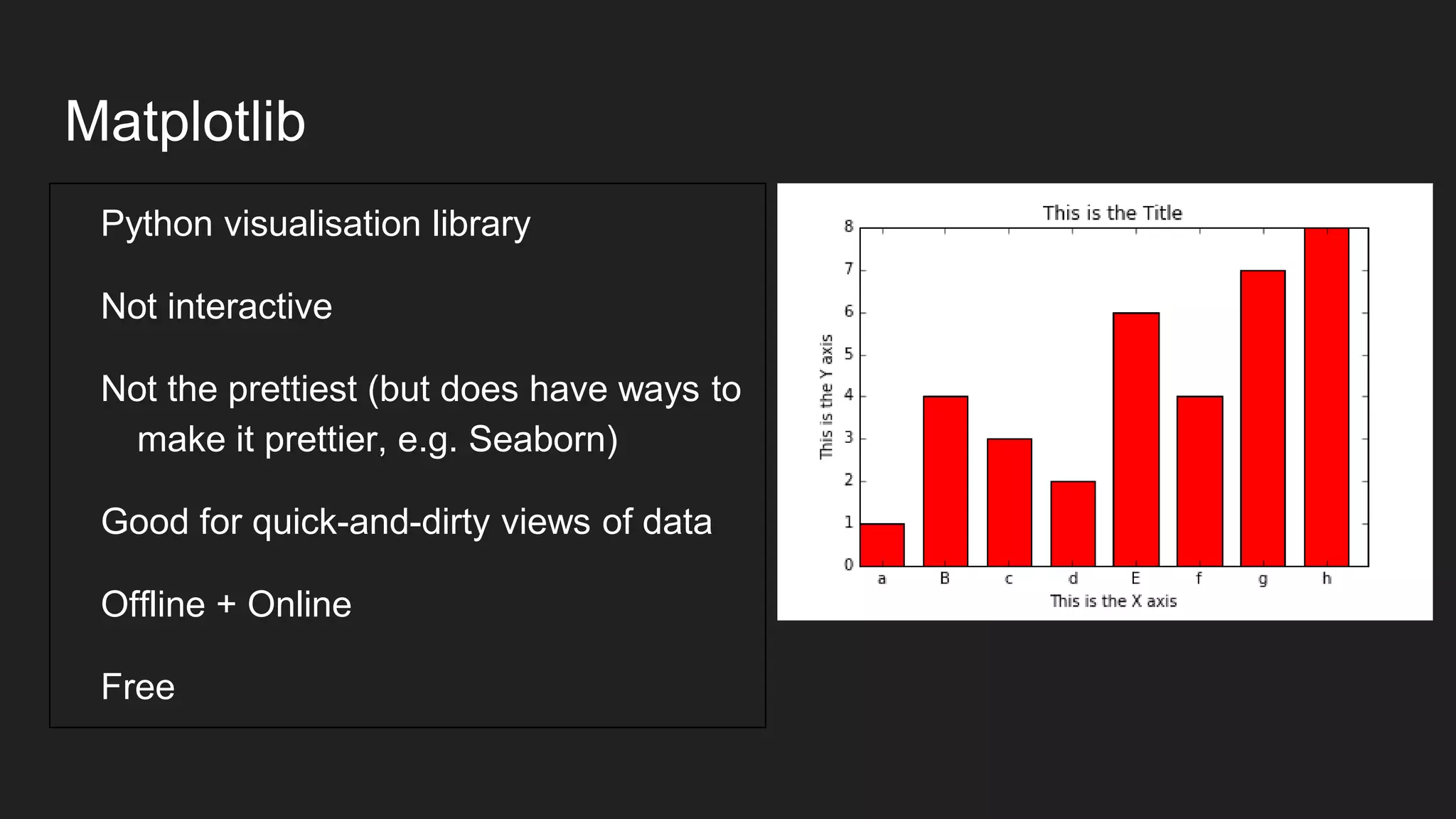
Matplotlib
Python visualisation library
Not interactive
Not the prettiest (but does have ways to
make it prettier, e.g. Seaborn)
Good for quick-and-dirty views of data
Offline + Online
Free
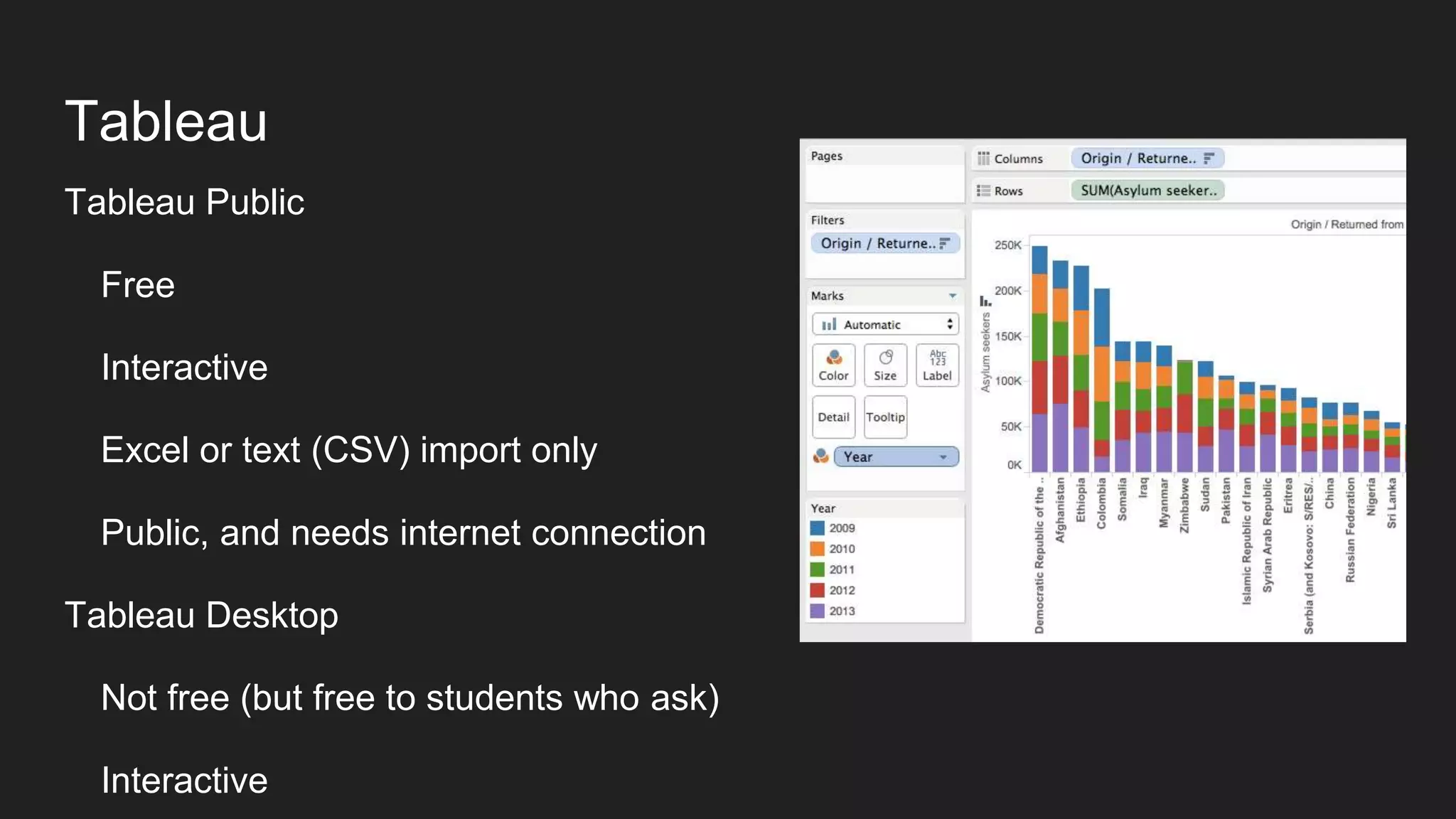
Tableau
Tableau Public
Free
Interactive
Excel or text (CSV) import only
Public, and needs internet connection
Tableau Desktop
Not free (but free to students who ask)
Interactive
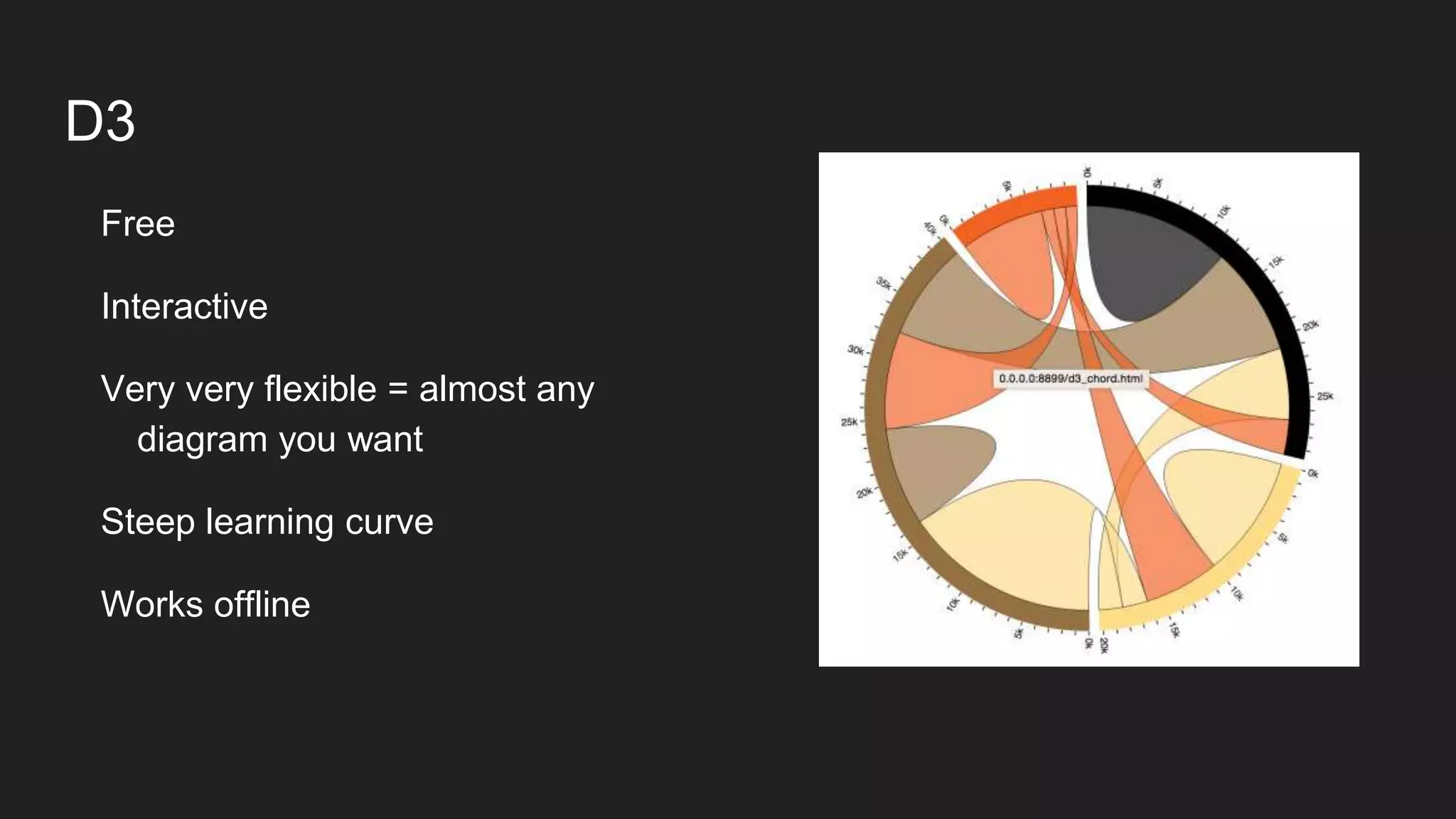
D3
Free
Interactive
Very very flexible = almost any
diagram you want
Steep learning curve
Works offline
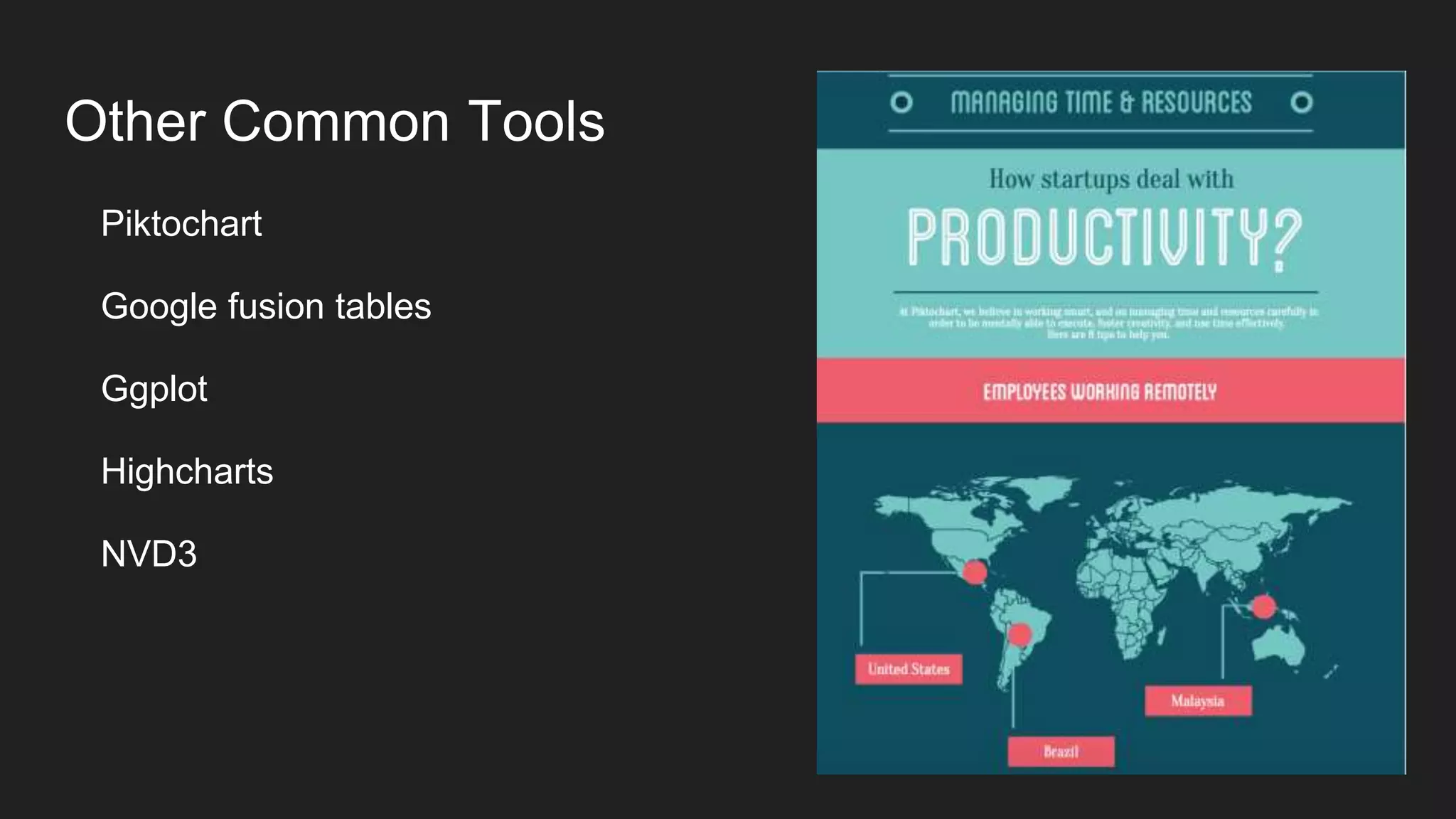
Other Common Tools
Piktochart
Google fusion tables
Ggplot
Highcharts
NVD3
Matplotlib and Tableau exercises
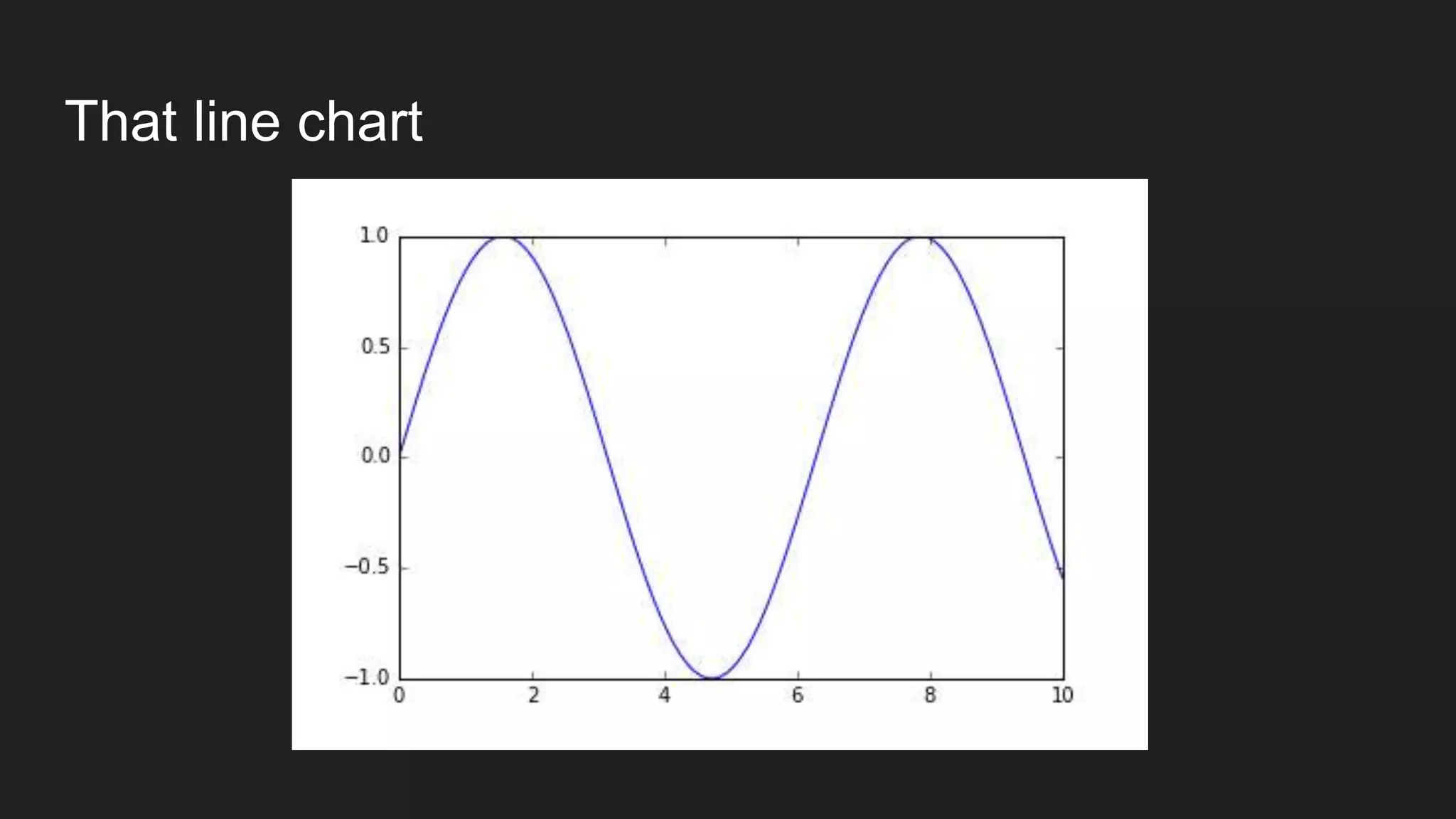
Exercise: draw a line chart in Matplotlib
%matplotlib inline
import matplotlib.pyplot as plt
import numpy as np
x = np.linspace(0, 10, 100)
y = np.sin(x)
plt.plot(x, y)
That line chart
Exercise: draw a scatterplot
import matplotlib.pyplot as plt
import numpy as np
x = np.array([1,4,3,2,6,4,7,8])
y = np.array([3,5,4,3,7,6,4,9])
plt.scatter(x, y)
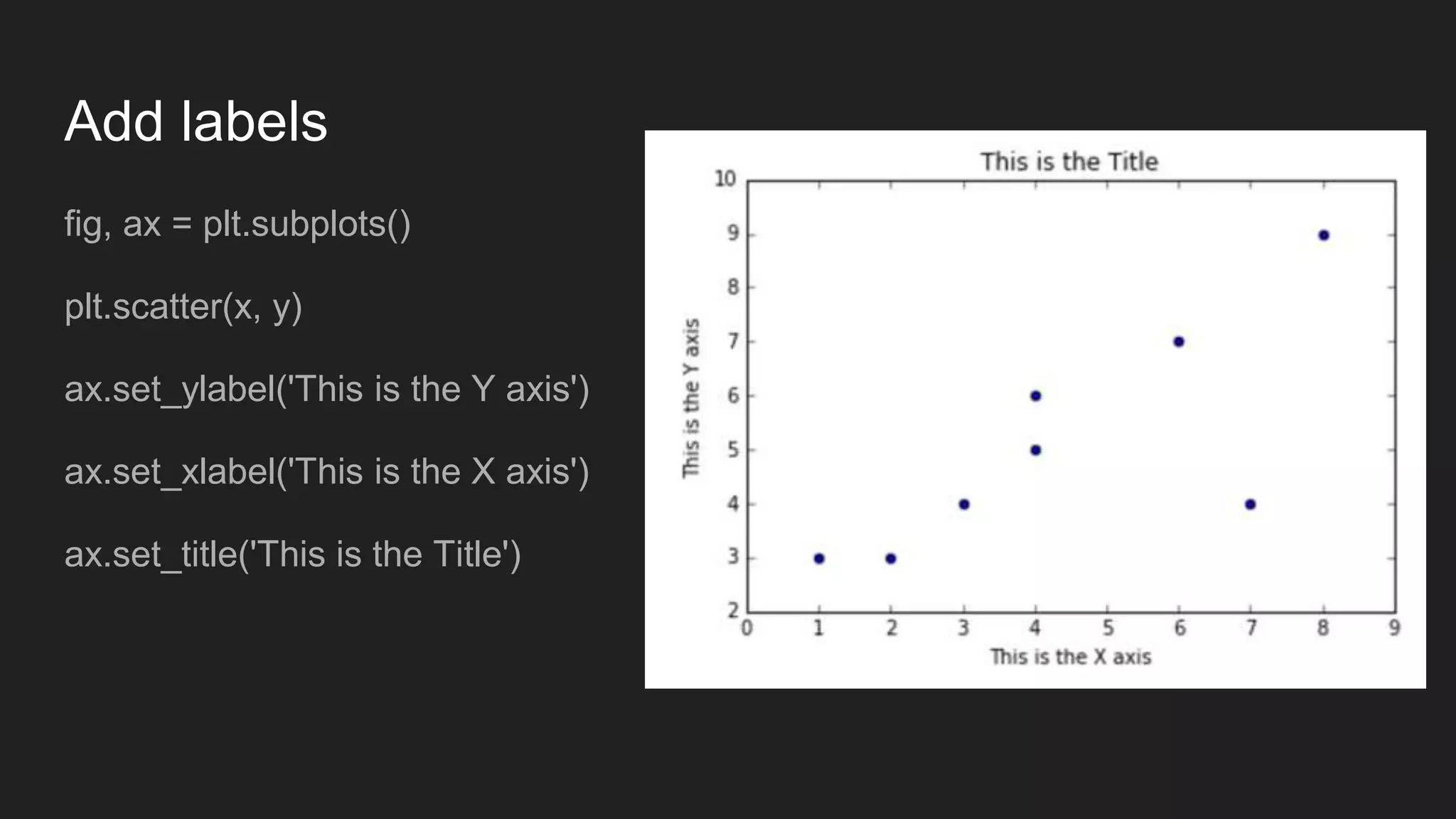
Add labels
fig, ax = plt.subplots()
plt.scatter(x, y)
ax.set_ylabel('This is the Y axis')
ax.set_xlabel('This is the X axis')
ax.set_title('This is the Title')
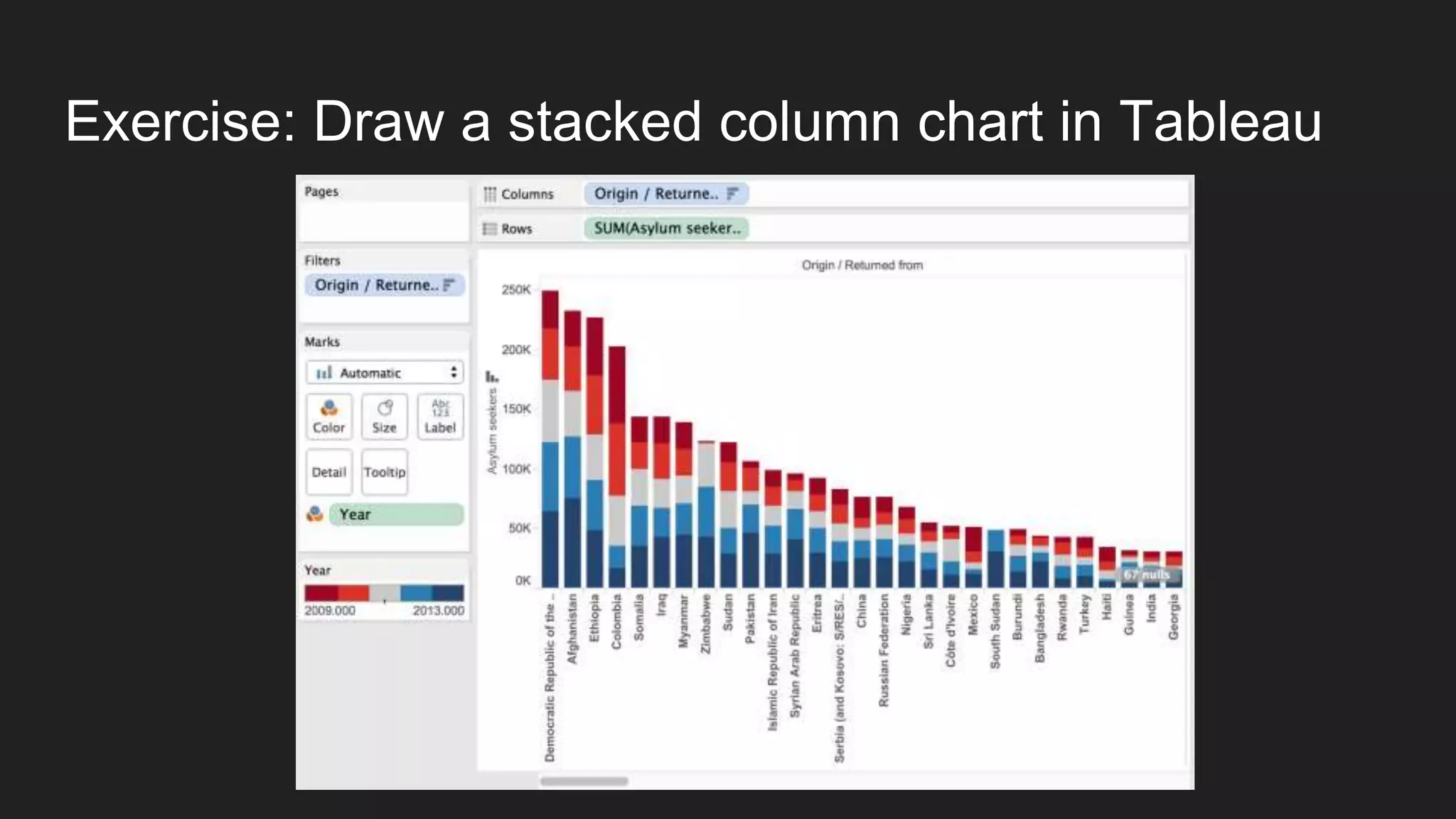
Exercise: Draw a stacked column chart in Tableau
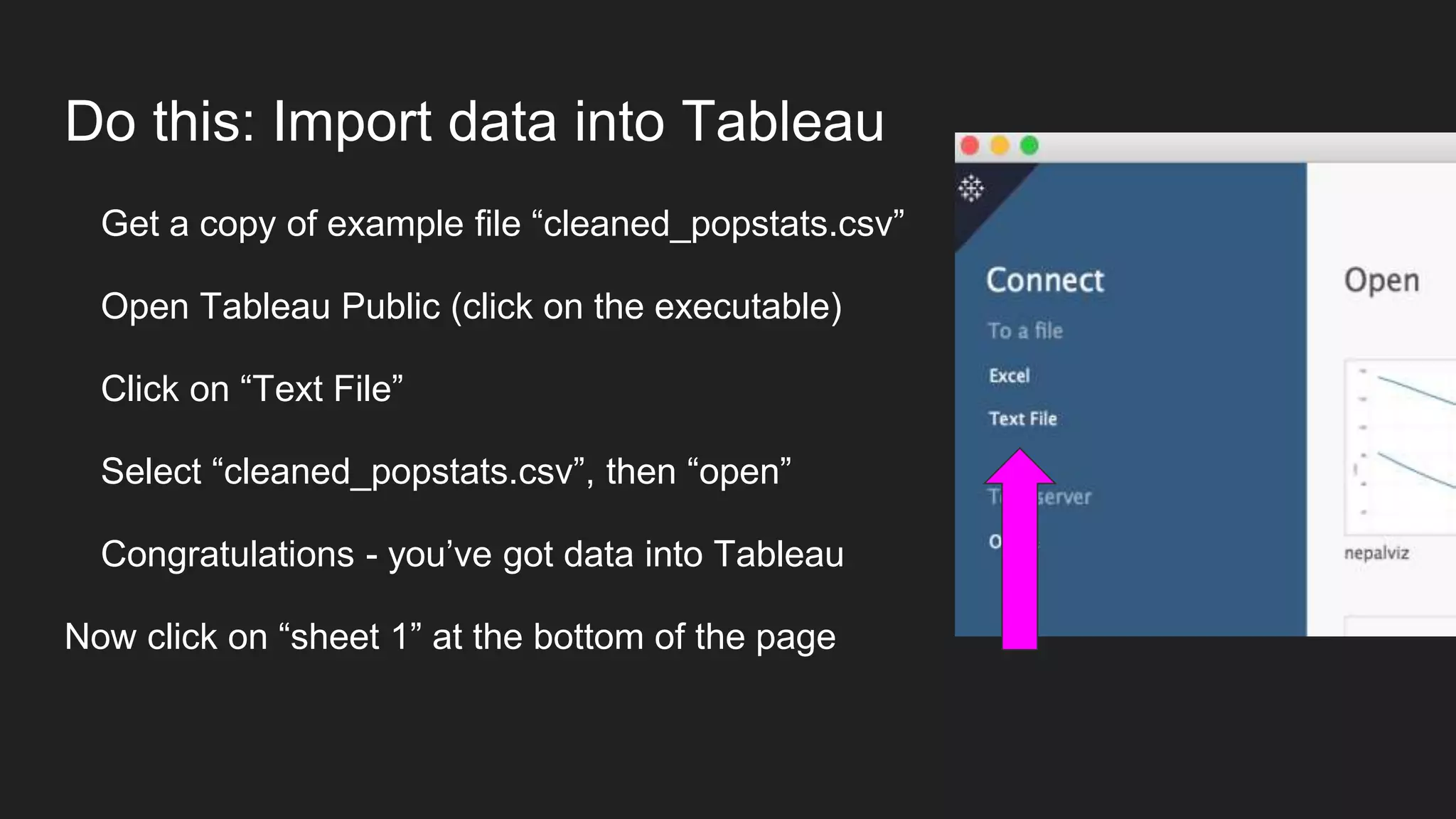
Do this: Import data into Tableau
Get a copy of example file “cleaned_popstats.csv”
Open Tableau Public (click on the executable)
Click on “Text File”
Select “cleaned_popstats.csv”, then “open”
Congratulations - you’ve got data into Tableau
Now click on “sheet 1” at the bottom of the page
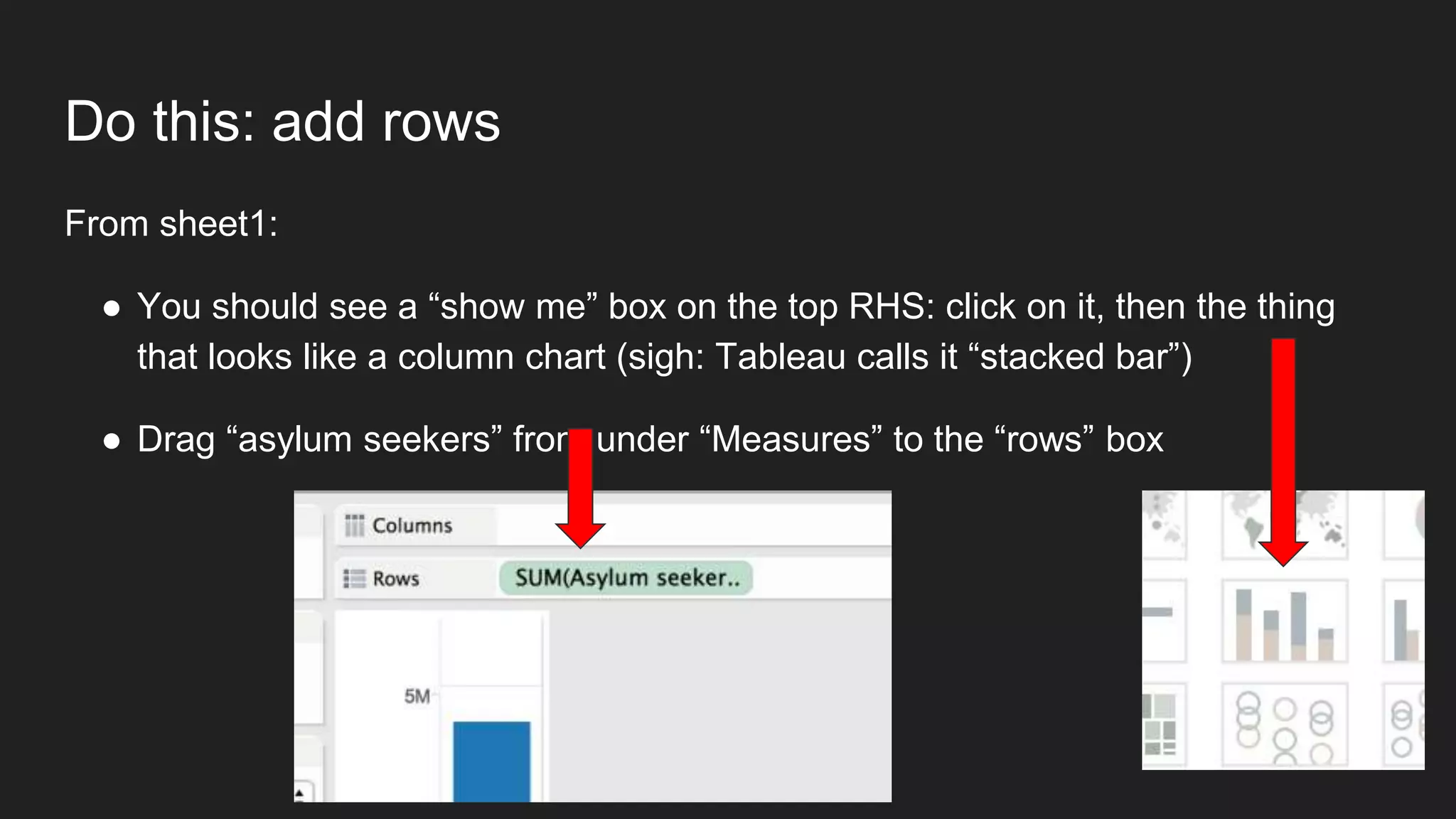
Do this: add rows
From sheet1:
● You should see a “show me” box on the top RHS: click on it, then the thing
that looks like a column chart (sigh: Tableau calls it “stacked bar”)
● Drag “asylum seekers” from under “Measures” to the “rows” box
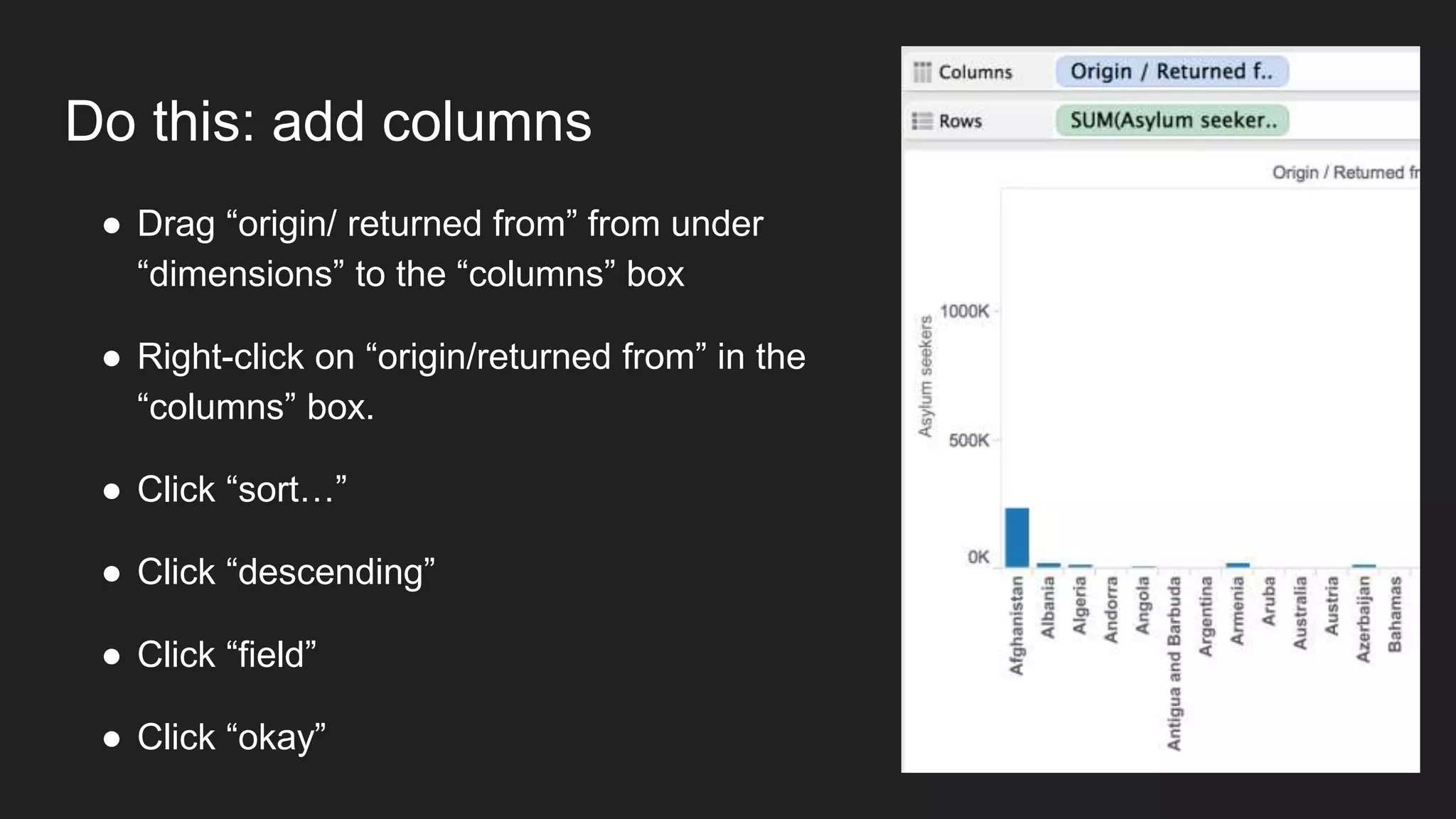
Do this: add columns
● Drag “origin/ returned from” from under
“dimensions” to the “columns” box
● Right-click on “origin/returned from” in the
“columns” box.
● Click “sort…”
● Click “descending”
● Click “field”
● Click “okay”
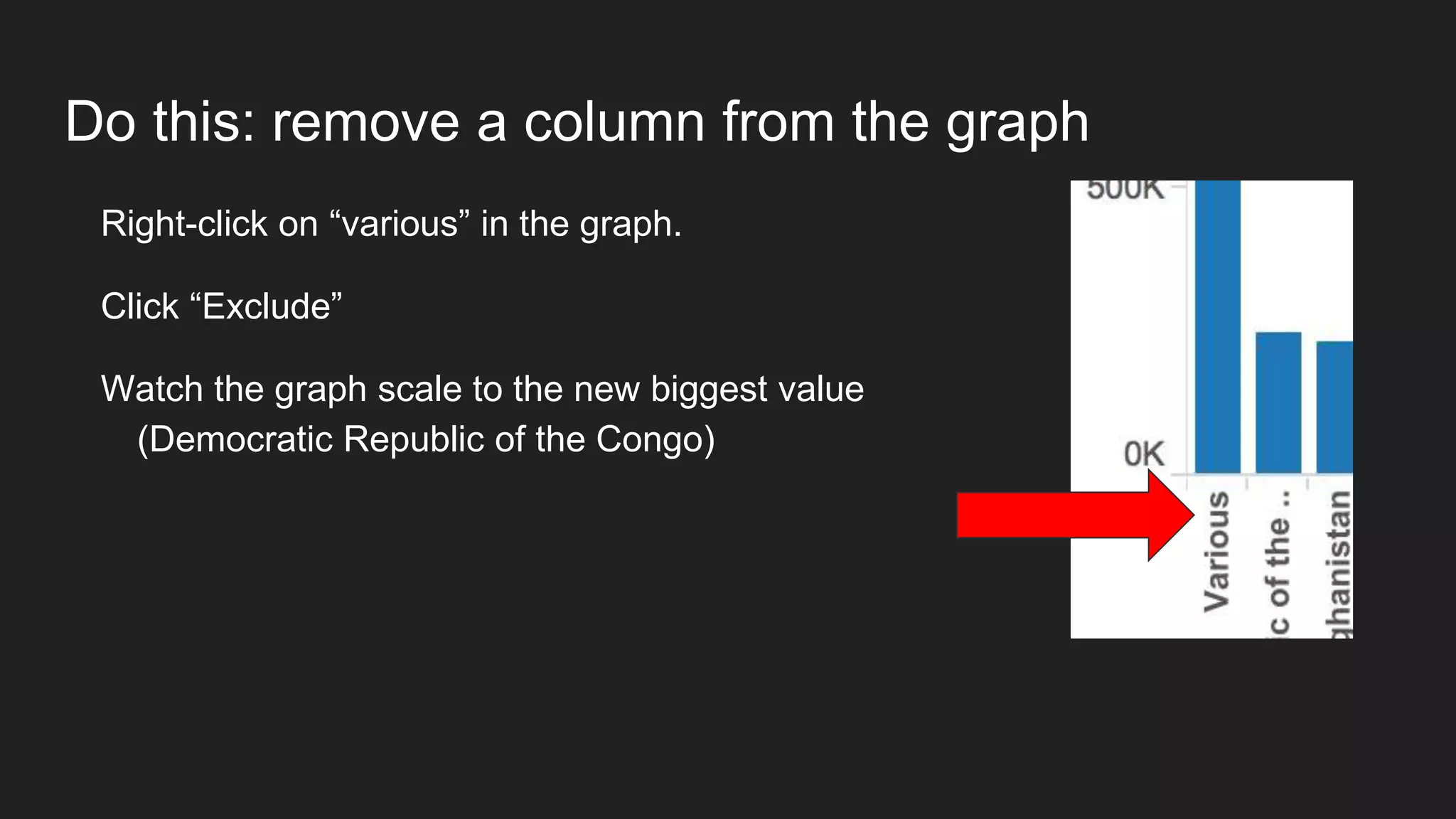
Do this: remove a column from the graph
Right-click on “various” in the graph.
Click “Exclude”
Watch the graph scale to the new biggest value
(Democratic Republic of the Congo)
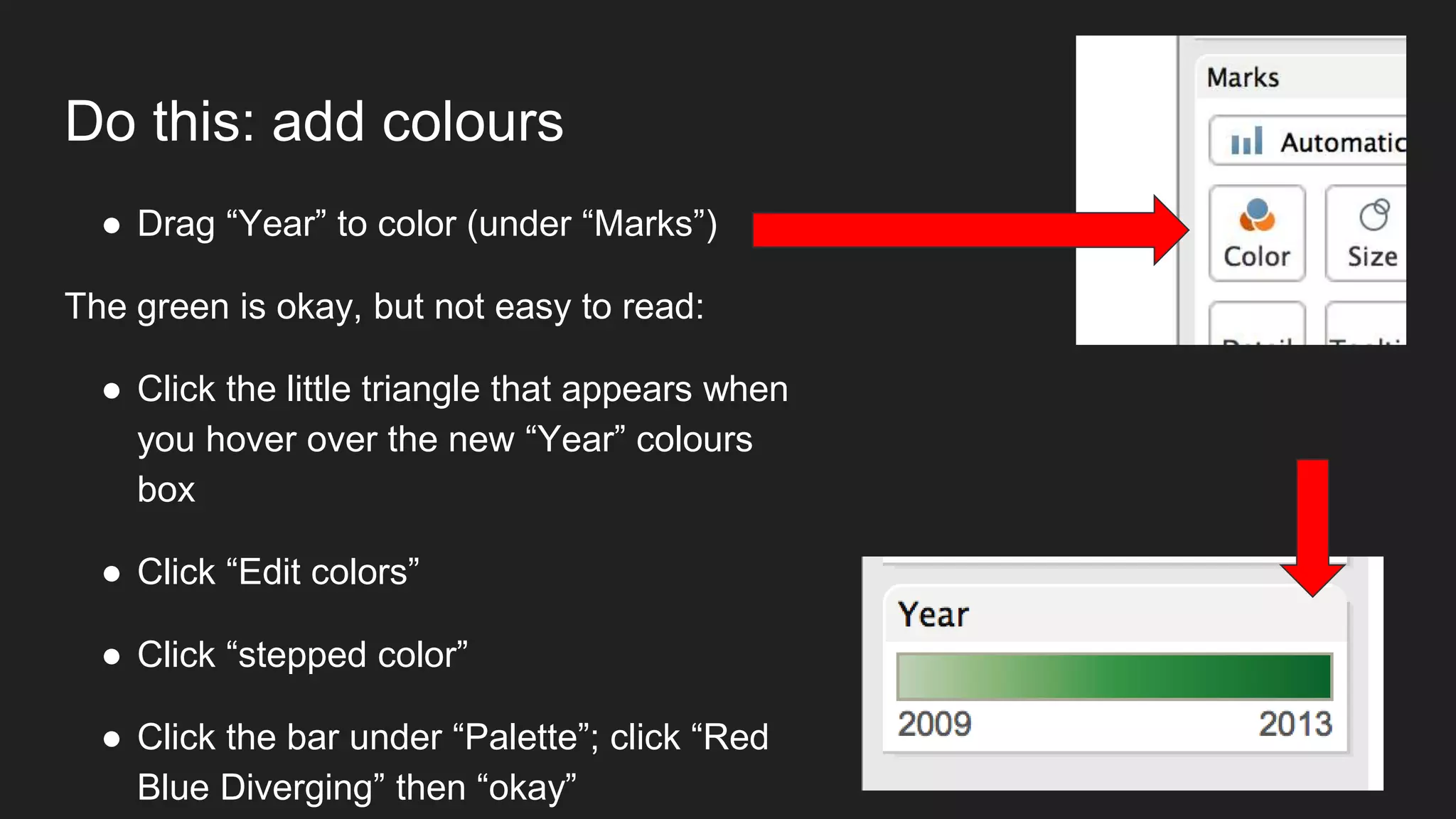
Do this: add colours
● Drag “Year” to color (under “Marks”)
The green is okay, but not easy to read:
● Click the little triangle that appears when
you hover over the new “Year” colours
box
● Click “Edit colors”
● Click “stepped color”
● Click the bar under “Palette”; click “Red
Blue Diverging” then “okay”
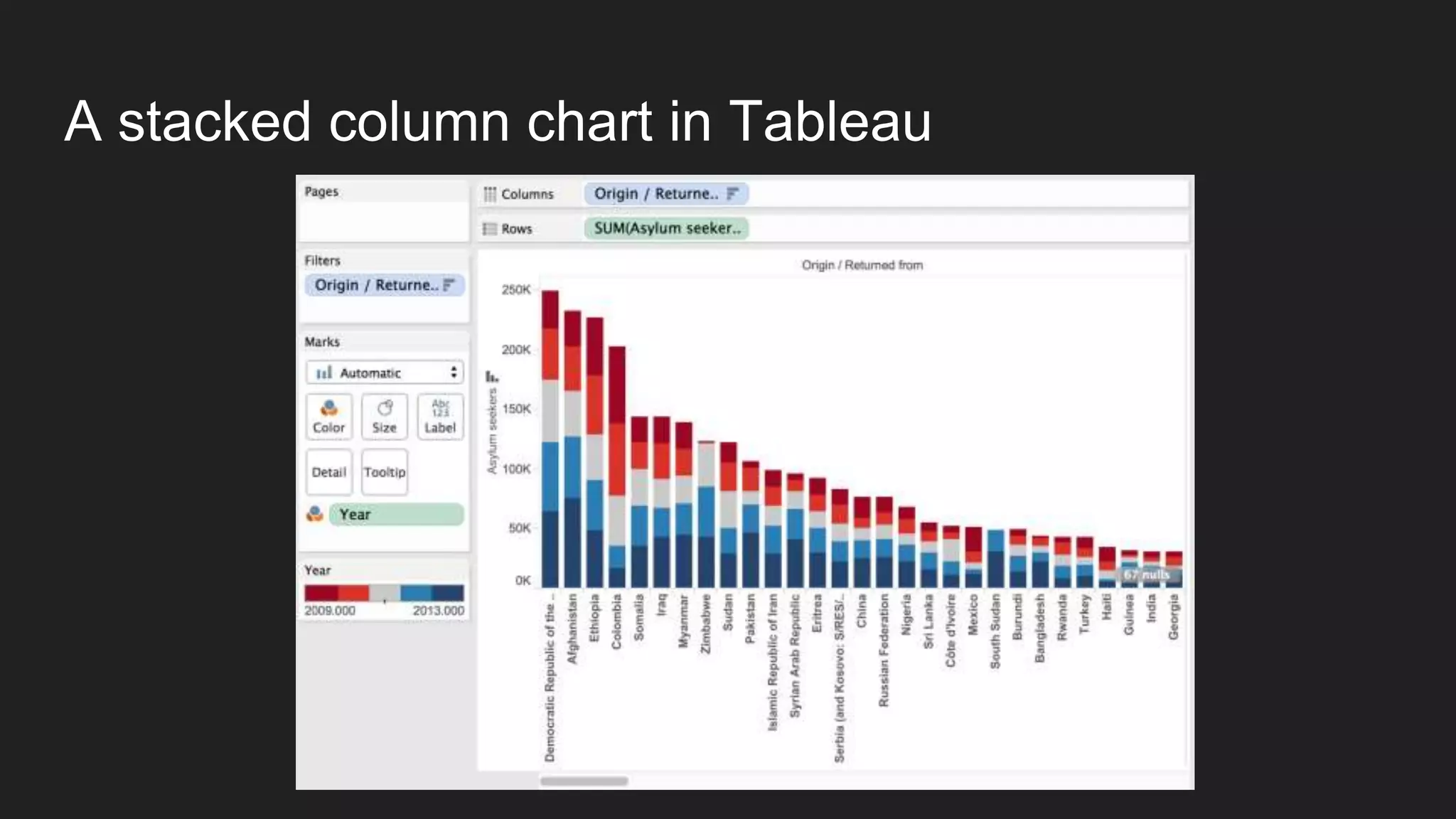
A stacked column chart in Tableau
D3 and Beyond
Drawing a Chord Diagram in D3: Online
Use the terminal window
cd to the directory containing file 4.3_d3_chord_online.html
In the terminal window, type:
python -m http.server 8899 &
Then go to http://0.0.0.0:8899/4.3_d3_chord_online.html in your browser
And hover your mouse over the circle edges...
(to exit, type control-c)
Drawing a Chord Diagram in D3: Offline
Copy your d3.js.zip file and the 4.4_d3_chord_offline.html file into a directory
Unzip d3.js.zip
In the directory your code is in, type:
python -m http.server 8899 &
Then go to http://0.0.0.0:8899/4.4_d3_chord_offline.html in your browser
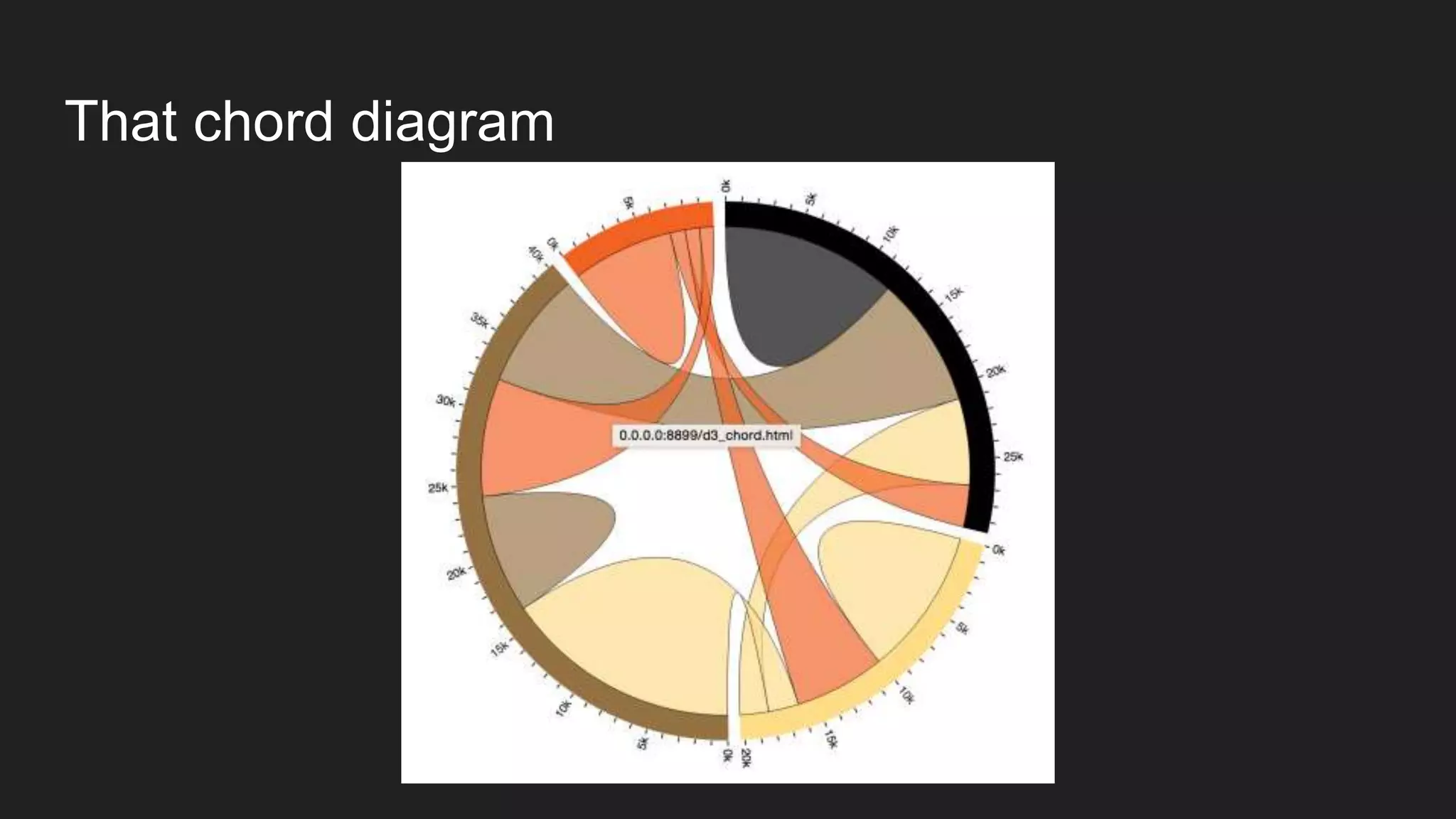
And hover your mouse over the circle edges...
(to exit, type control-c)
That chord diagram
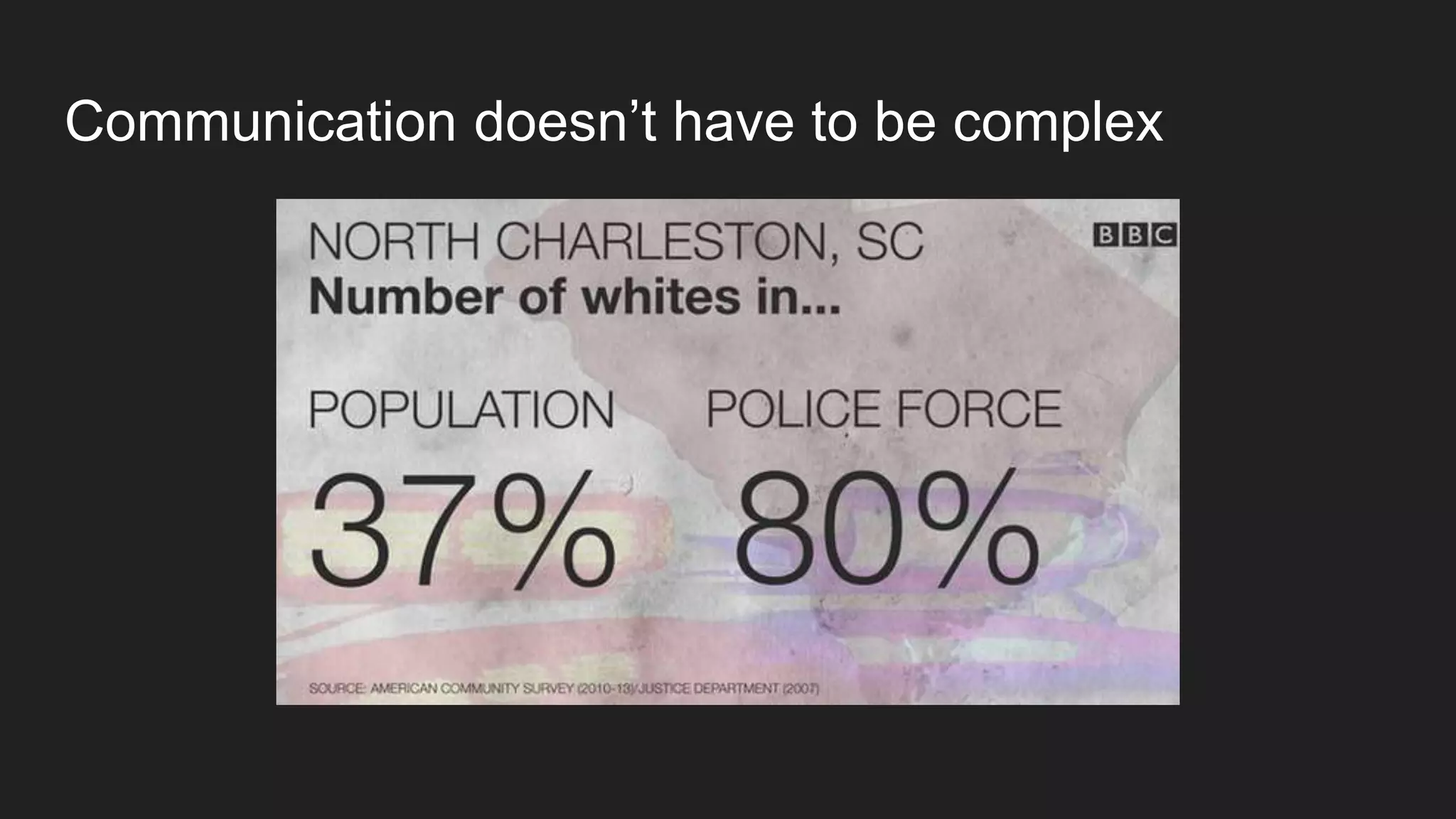
Communication doesn’t have to be complex
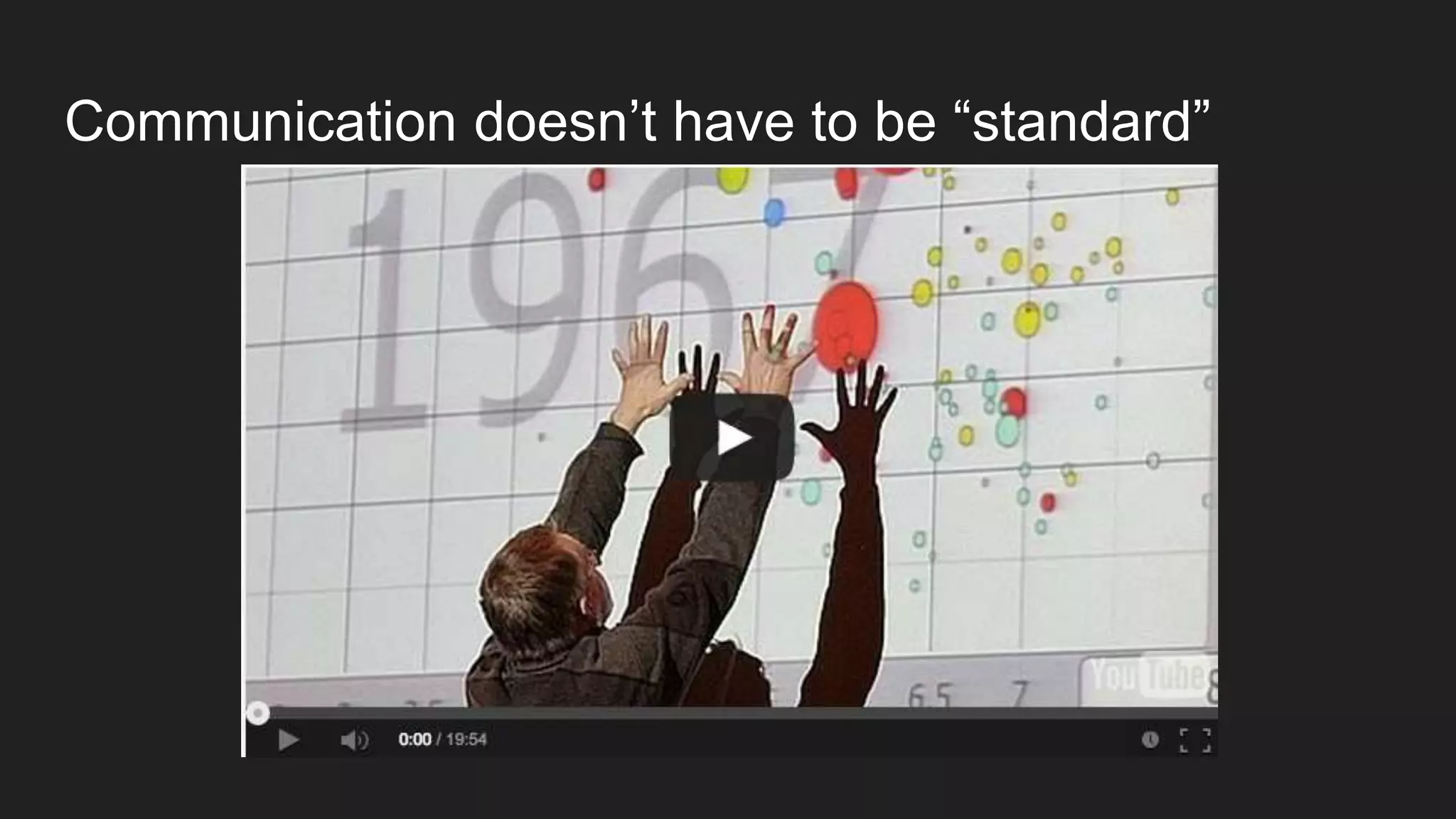
Communication doesn’t have to be “standard”
Exercises
Exercise: Design your visuals
Use pen and paper (or post-its) to design visualisations and dashboards for your
project

Session 04 communicating results

  • 1.
  • 2.
    Lab 4: your5-7 things Communicating with data Really common visualisations Quite common visualisations Visualisation tools: Matplotlib and Tableau Doing more: D3 and beyond
  • 3.
  • 4.
    Engage your audience Whoare these people? Demographics: which languages? What red flags? What communications styles are they used to? What channels are you using? Website, printed media, SMS? What have you got for them? Insights? answers? surprises? Exploring or explaining? Do you want to engage, persuade, inform or entertain?
  • 5.
    Design rules Storytelling: Design foryour medium (e.g paper) Learn from the storytellers: have a beginning, middle and end Use drill-down: summarise with visuals, but allow users to reach the data Frame your message - why are you doing this, how did you get here Visualisations: Have graphical integrity (e.g. start bars at zero)
  • 6.
  • 7.
  • 8.
  • 9.
  • 10.
  • 11.
  • 12.
  • 13.
  • 14.
  • 15.
  • 16.
    Choosing a VisualisationTool What do you want to do? Standard visualisations, or something special? Inputs: files (e.g. CSV) or streaming data? Maps? Non-roman languages (Arabic, Mandarin etc)? Interactive or static? Where do you want to do it? Online or offline? Any other restrictions?
  • 17.
    Excel Limited set ofvisualisation types Not interactive Offline Static Not free Relatively easy Widely used
  • 18.
    Matplotlib Python visualisation library Notinteractive Not the prettiest (but does have ways to make it prettier, e.g. Seaborn) Good for quick-and-dirty views of data Offline + Online Free
  • 19.
    Tableau Tableau Public Free Interactive Excel ortext (CSV) import only Public, and needs internet connection Tableau Desktop Not free (but free to students who ask) Interactive
  • 20.
    D3 Free Interactive Very very flexible= almost any diagram you want Steep learning curve Works offline
  • 21.
    Other Common Tools Piktochart Googlefusion tables Ggplot Highcharts NVD3
  • 22.
  • 23.
    Exercise: draw aline chart in Matplotlib %matplotlib inline import matplotlib.pyplot as plt import numpy as np x = np.linspace(0, 10, 100) y = np.sin(x) plt.plot(x, y)
  • 24.
  • 25.
    Exercise: draw ascatterplot import matplotlib.pyplot as plt import numpy as np x = np.array([1,4,3,2,6,4,7,8]) y = np.array([3,5,4,3,7,6,4,9]) plt.scatter(x, y)
  • 26.
    Add labels fig, ax= plt.subplots() plt.scatter(x, y) ax.set_ylabel('This is the Y axis') ax.set_xlabel('This is the X axis') ax.set_title('This is the Title')
  • 27.
    Exercise: Draw astacked column chart in Tableau
  • 28.
    Do this: Importdata into Tableau Get a copy of example file “cleaned_popstats.csv” Open Tableau Public (click on the executable) Click on “Text File” Select “cleaned_popstats.csv”, then “open” Congratulations - you’ve got data into Tableau Now click on “sheet 1” at the bottom of the page
  • 29.
    Do this: addrows From sheet1: ● You should see a “show me” box on the top RHS: click on it, then the thing that looks like a column chart (sigh: Tableau calls it “stacked bar”) ● Drag “asylum seekers” from under “Measures” to the “rows” box
  • 30.
    Do this: addcolumns ● Drag “origin/ returned from” from under “dimensions” to the “columns” box ● Right-click on “origin/returned from” in the “columns” box. ● Click “sort…” ● Click “descending” ● Click “field” ● Click “okay”
  • 31.
    Do this: removea column from the graph Right-click on “various” in the graph. Click “Exclude” Watch the graph scale to the new biggest value (Democratic Republic of the Congo)
  • 32.
    Do this: addcolours ● Drag “Year” to color (under “Marks”) The green is okay, but not easy to read: ● Click the little triangle that appears when you hover over the new “Year” colours box ● Click “Edit colors” ● Click “stepped color” ● Click the bar under “Palette”; click “Red Blue Diverging” then “okay”
  • 33.
    A stacked columnchart in Tableau
  • 34.
  • 35.
    Drawing a ChordDiagram in D3: Online Use the terminal window cd to the directory containing file 4.3_d3_chord_online.html In the terminal window, type: python -m http.server 8899 & Then go to http://0.0.0.0:8899/4.3_d3_chord_online.html in your browser And hover your mouse over the circle edges... (to exit, type control-c)
  • 36.
    Drawing a ChordDiagram in D3: Offline Copy your d3.js.zip file and the 4.4_d3_chord_offline.html file into a directory Unzip d3.js.zip In the directory your code is in, type: python -m http.server 8899 & Then go to http://0.0.0.0:8899/4.4_d3_chord_offline.html in your browser And hover your mouse over the circle edges... (to exit, type control-c)
  • 37.
  • 38.
  • 39.
    Communication doesn’t haveto be “standard”
  • 40.
  • 41.
    Exercise: Design yourvisuals Use pen and paper (or post-its) to design visualisations and dashboards for your project

Editor's Notes

  • #5 Red flags: things you really need to be careful of. For example: using orange and green for an Irish audience.
  • #6 See http://extremepresentation.typepad.com/blog/files/choosing_a_good_chart.pdf for advice on choosing the right chart type.. Sometimes it’s appropriate to throw data and graphs at the user, and let them work it out on their own, but usually drill-down and a story is the answer. See Alberto Cairo’s work for more details.
  • #8 All these examples are in Tableau Gallery here: https://public.tableau.com/profile/sara.terp#!/vizhome/DS_session_example/exampledashboard and in Tableau Desktop here: https://github.com/bodacea/inafu6513/blob/master/Notebooks/4.2 Tableau_example.twb
  • #12 You can put visualisations and text together in a dashboard. You can also link these visualisations, so that when you click on a point in one visualisation, data relevant to that point is shown in another.
  • #13 This is india’s government employee attendance dashboard. If you look at the bottom of Tableau, there’s a dashboard button.
  • #14 Other visualisation types you’ll see a lot include Chord diagram, Sankey diagram, Choropleth, symbol map
  • #15 http://www.visual-literacy.org/periodic_table/periodic_table.html
  • #18 To create this chart: copied the asylum seeker data into an excel spreadsheet. Created a pivot table from the data. Created a chart from the pivot table. Did lots of fussing around to get chart elements in the right place/ filtered. Still more fussing needed to get e.g. the legend right.
  • #22 The image is one of the Piktochart templates. Infographics aren’t immediate outputs from python code, but can be very powerful.
  • #24 NB: You only need the %matplotlib inline in an ipython notebook.
  • #27 plt.subplots creates a plot on your drawing ‘canvas’. It’s what we usually use to create a group of plots. Here, we’re using it to get at the axes (ax) for this visualisation.
  • #29 Data file is here is you get stuck: https://github.com/bodacea/inafu6513/blob/master/example_data/cleaned_popstats.csv
  • #30 Don’t panic when “asylum seekers” becomes “SUM(Asylum seekers)” in the Rows box. This is normal.
  • #31 At this point, you’re probably wondering why the columns are so small
  • #32 Okay, “Various” is huge, and not helping the graph much. Let’s remove it.
  • #33 The green is okay, but not easy to read.
  • #34 Also available at https://public.tableau.com/profile/publish/DS_session_example/Sheet1#!/publish-confirm
  • #36 This starts a webserver on your PC, that you can then go to and look at your D3 file in. NB I changed the channel to 8899 because the standard (8888) clashes with the ipython notebook server. Chord example is from http://bl.ocks.org/mbostock/4062006 CORRECTION: the space in the filename was making your code crash. Try again!
  • #37 The difference between the two files is in where the D3 code comes from. In the online version, the D3 code is at //d3js.org/d3.v3.min.js (the d3.v3.min.js file is a version of d3.js with all the whitespace and comments taken out to make it smaller); In the offline version, the D3 code is on your pc, in file d3.js the d3 directory. Bugz: you might get an error message saying “Address already in use”. This is bad and naughty, but to quickly fix it, try: in the terminal window, type “ps -a” Note the number at the left of the line that looks like “7064 ttys000 0:00.16 python -m http.server 8899” type “kill -9 7064” (or whatever your number was). Note: this is a very powerful command: make sure you’re using the right number, or you might accidentally shut down your machine…
  • #40 Image: Hans Rosling video.