DELIVERING THE OU EXPERIENCE
OU IT Brand Deployment and Services Management


Chris Jones, Dana Saliba, and Nick Key
Agenda
Scoping the Challenge         Execution and Next Steps
• The Big Picture             • ITIL, sort of…
• Building a Brand            • Design, Transition, and
• Translating Brand to IT       Execution
  Services Management         • What’s next?
   –   The 4 P’s                 – Brand Creation and
   –   Governing Principles        Deployment
   –   Service Portfolio         – Shared Services
   –   The “Offer”                 Collaboration
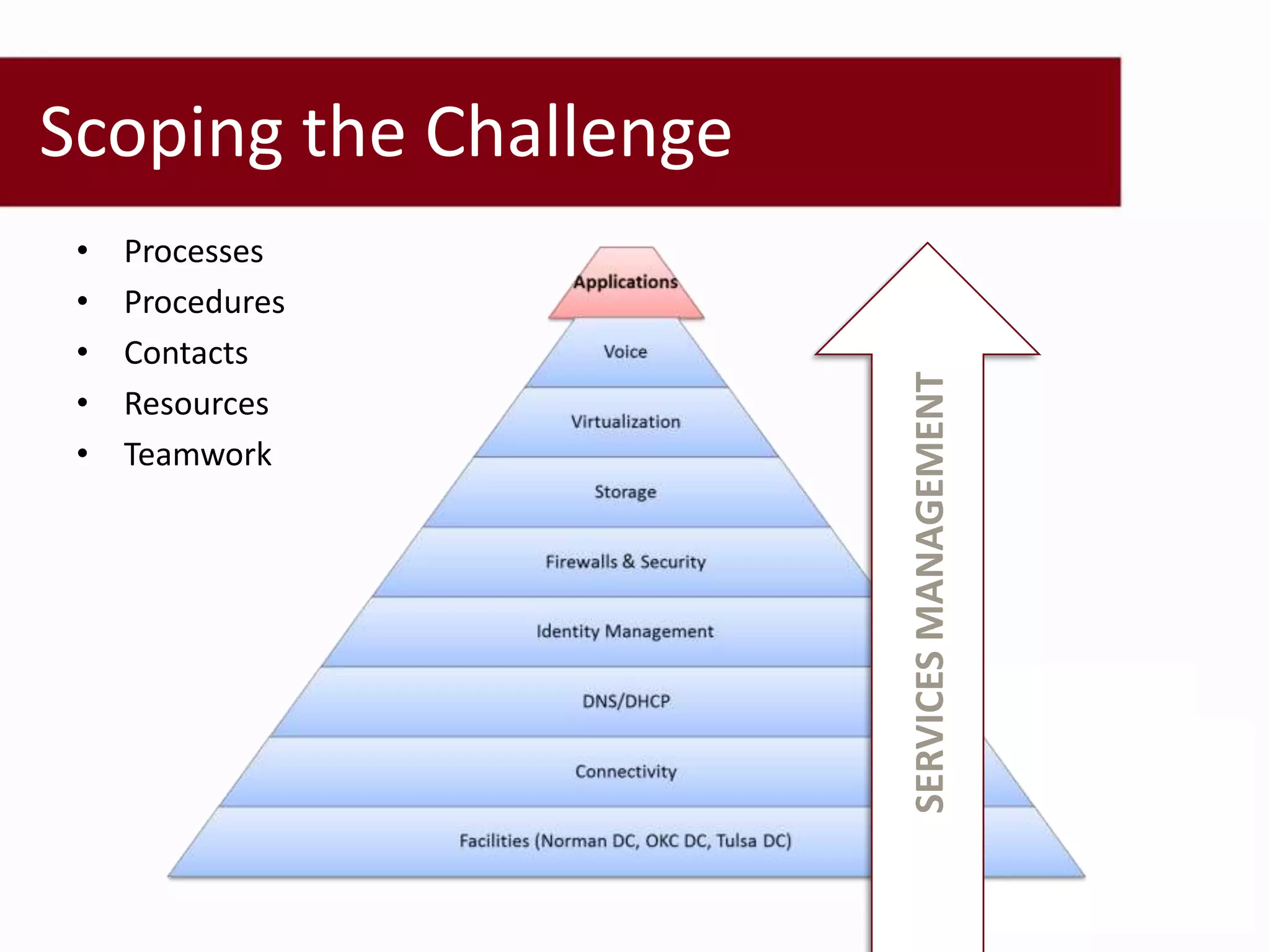
Scoping the Challenge
 •   Processes
 •   Procedures
 •   Contacts


                        SERVICES MANAGEMENT
 •   Resources
 •   Teamwork
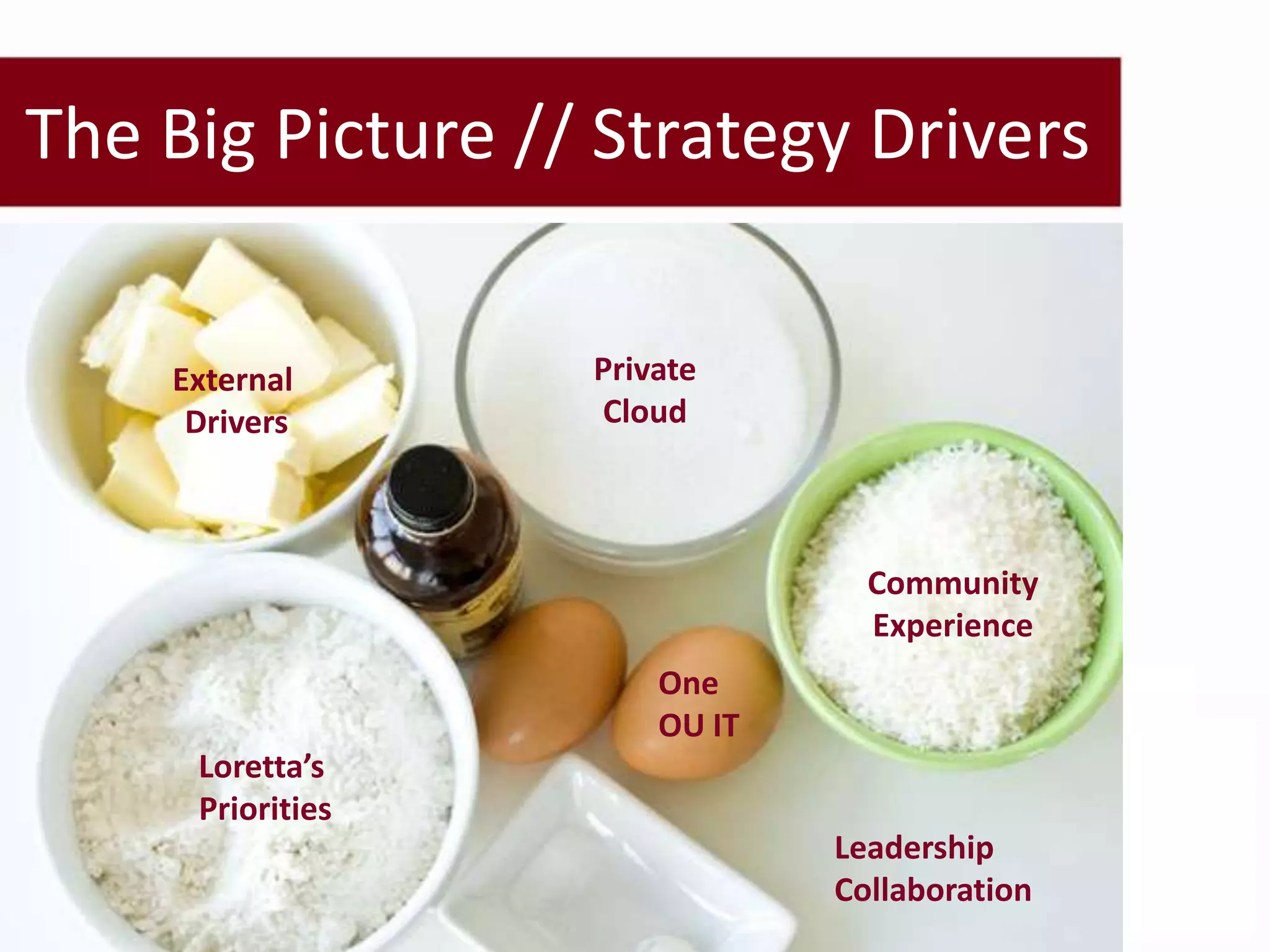
The Big Picture // Strategy Drivers

    External      Private
     Drivers      Cloud


                                Community
                                Experience
                      One
                      OU IT
     Loretta’s
     Priorities
                              Leadership
                              Collaboration
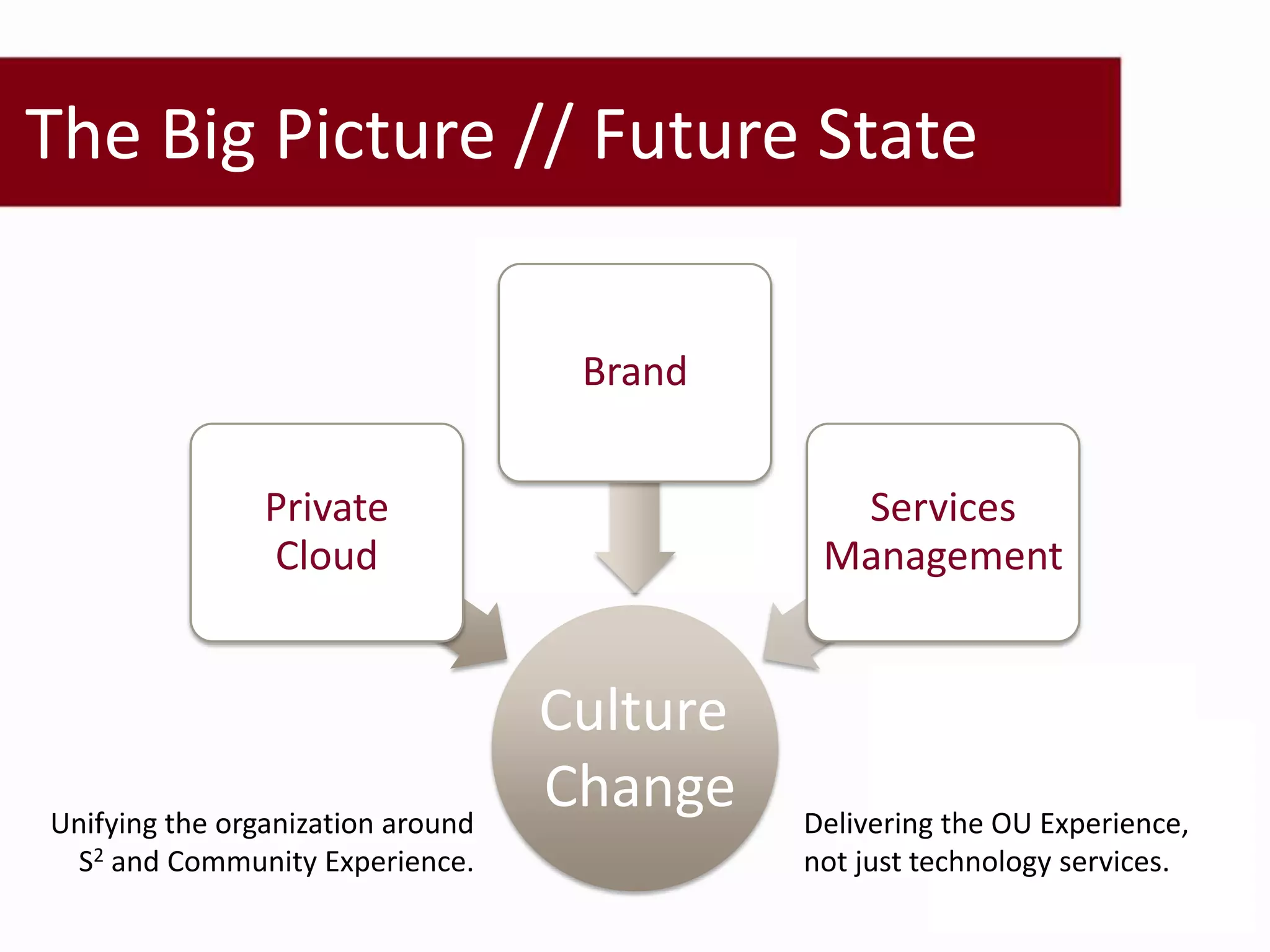
The Big Picture // Future State

                                    Brand


                Private                        Services
                Cloud                         Management


                                   Culture
Unifying the organization around
                                   Change    Delivering the OU Experience,
 S2 and Community Experience.                not just technology services.
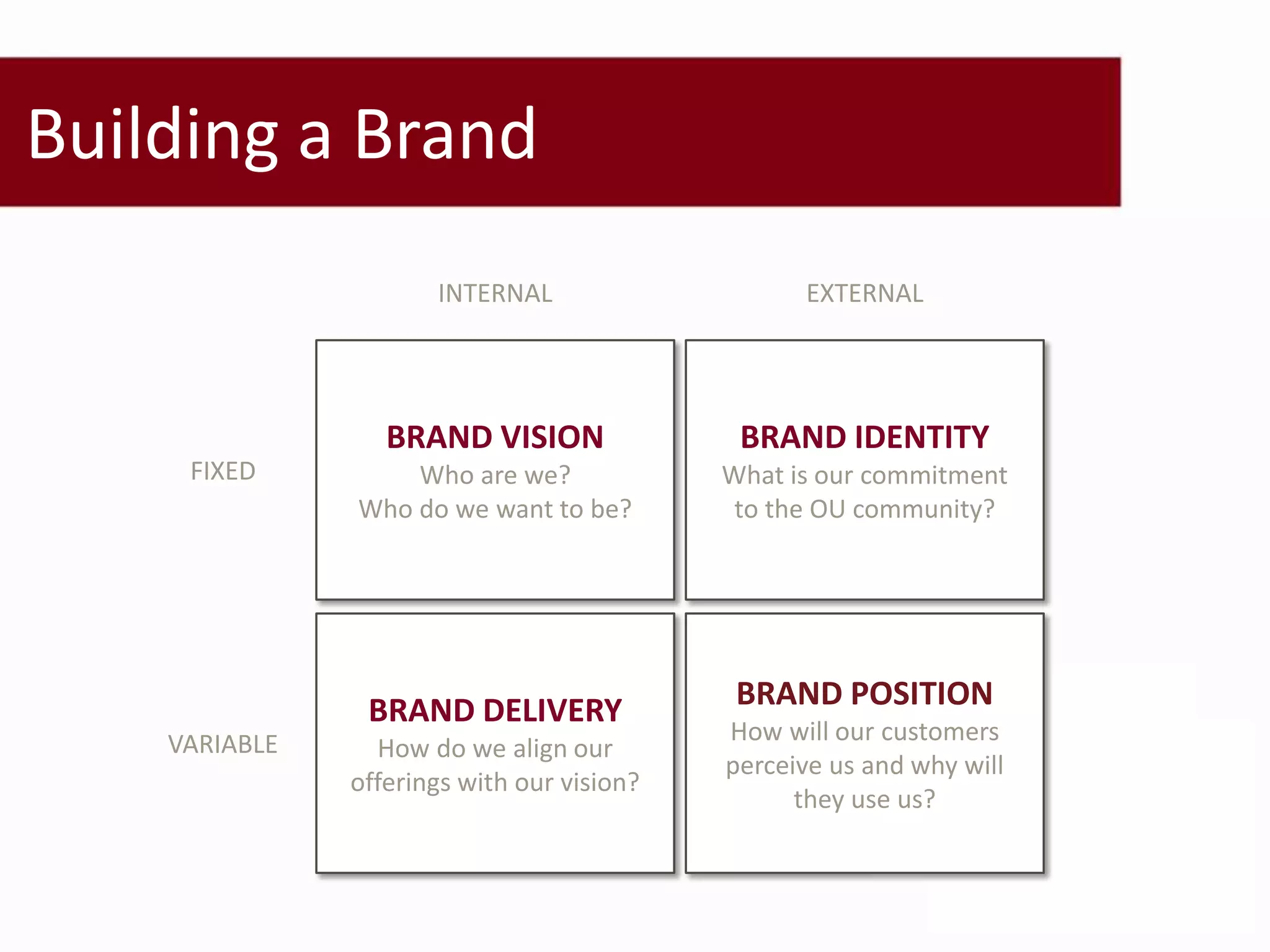
Building a Brand
                      INTERNAL                    EXTERNAL


                  BRAND VISION               BRAND IDENTITY
     FIXED         Who are we?              What is our commitment
               Who do we want to be?         to the OU community?


                BRAND DELIVERY               BRAND POSITION
    VARIABLE                                How will our customers
                 How do we align our
                                            perceive us and why will
               offerings with our vision?
                                                  they use us?
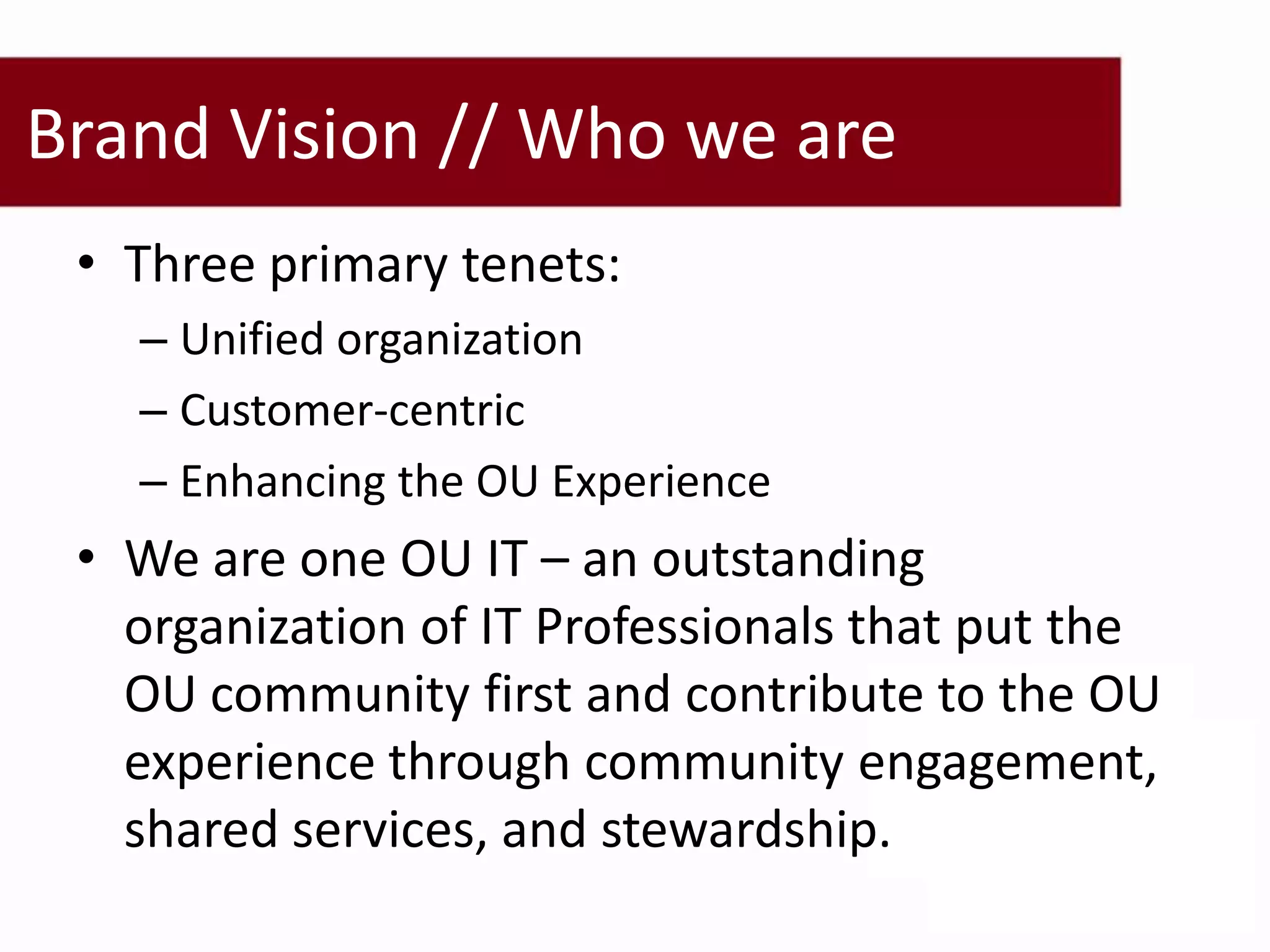
Brand Vision // Who we are
 • Three primary tenets:
   – Unified organization
   – Customer-centric
   – Enhancing the OU Experience
 • We are one OU IT – an outstanding
   organization of IT Professionals that put the
   OU community first and contribute to the OU
   experience through community engagement,
   shared services, and stewardship.
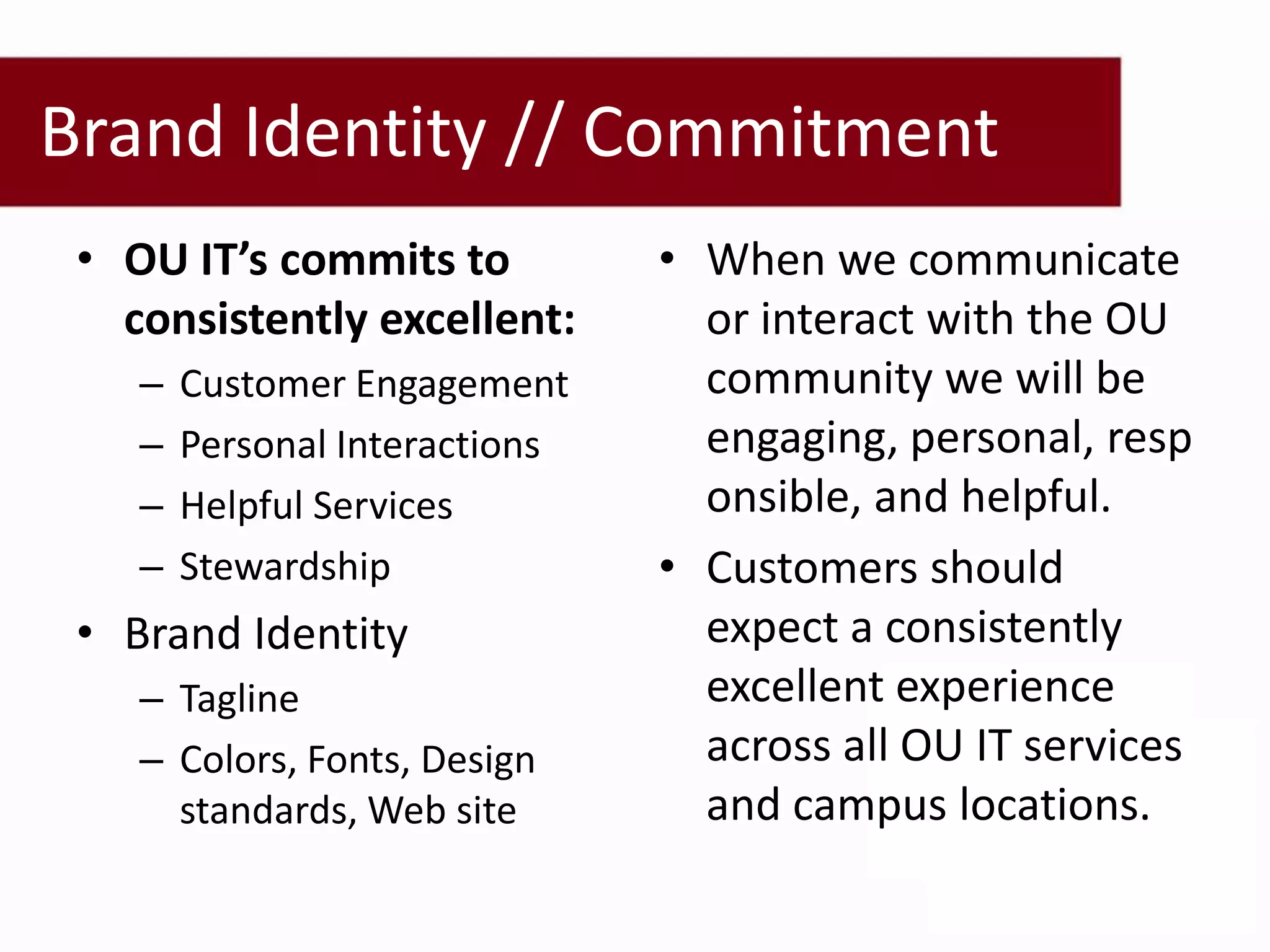
Brand Identity // Commitment
 • OU IT’s commits to           • When we communicate
   consistently excellent:        or interact with the OU
    –   Customer Engagement       community we will be
    –   Personal Interactions     engaging, personal, resp
    –   Helpful Services          onsible, and helpful.
    –   Stewardship             • Customers should
 • Brand Identity                 expect a consistently
    – Tagline                     excellent experience
    – Colors, Fonts, Design       across all OU IT services
      standards, Web site         and campus locations.
Brand Identity // Commitment
 • These strategies should   • Customer Engagement:
   yield an even deeper        Repeated interactions
   level of LOCALIZED          that strengthen the
   support and experience      psychological,
   through consistent          emotional, and physical
   customer engagement.        investment a customer
 • NOT eliminating local       has in a brand.
   relationships and         • Customer engagement
   service delivery.           will drive the localized
                               experience.
Brand Position // Perception
 • Employee attitudes and     • We want our customers
   customer interactions        to call us:
   are the greatest             –   Thought Leaders
   indicator of success to      –   Passionate/Meaningful
   our customers.               –   Creative/Fun
 • Every day we will strive     –   Experts
   to communicate these         –   Solutions Oriented
   perceptions without          –   Trustworthy/Transparent
   explicitly announcing,       –   Proactive/Intentional
   “This is how we want         –   Flexible
   you to see us.”
Brand Delivery // ITSM
 • Mission Statement
 • IT Service Management (ITSM)
   – Understanding and managing an IT organization
     focused on the delivery of business value
     (OU Experience!) through IT Services.
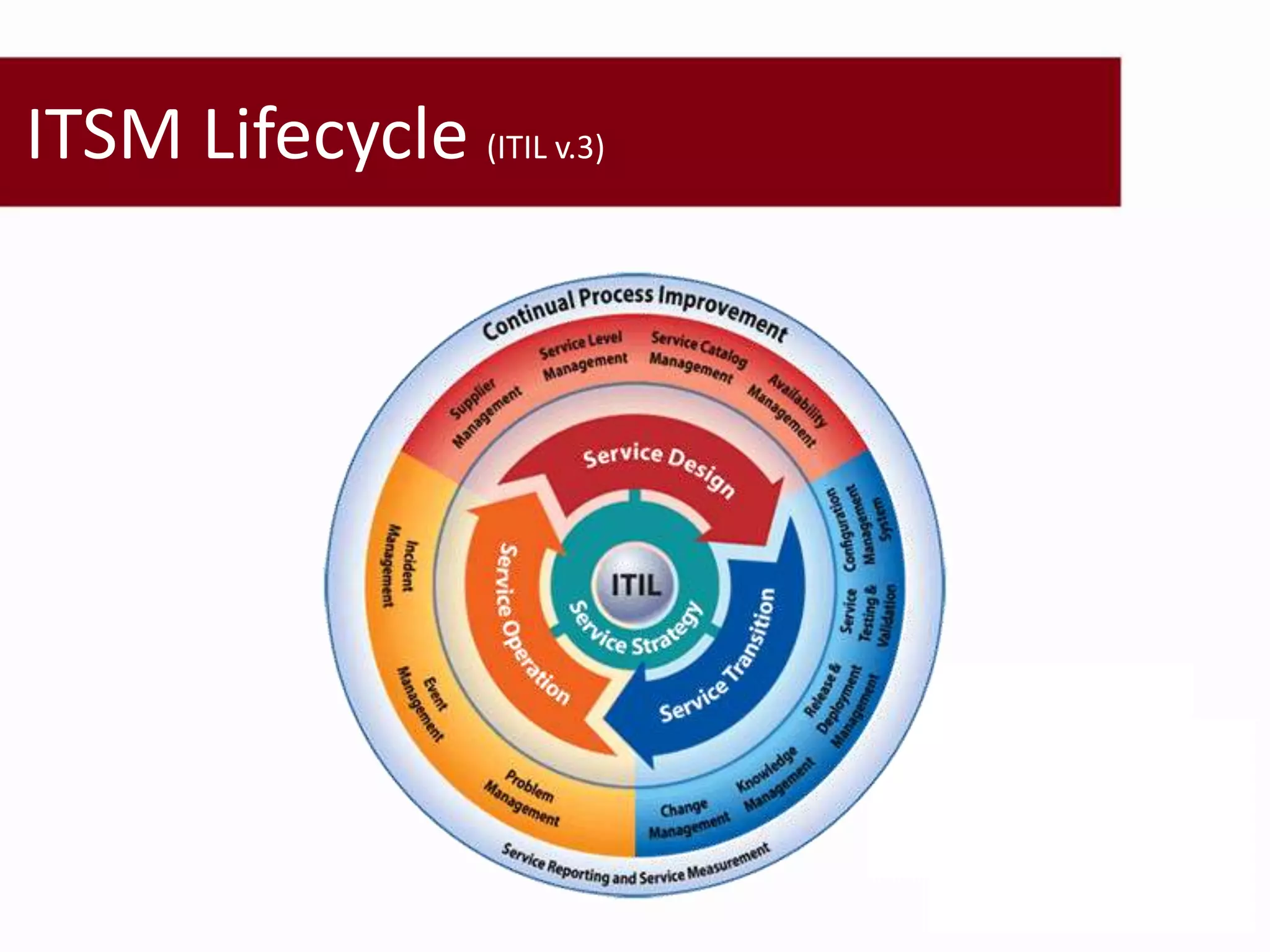
 • ITIL (v.3 and 2011 Update) framework
   – Guide and inform our understanding and
     development of IT shared services.
Brand Delivery // ITSM
 • ITSM delivers Community Experience
   – Through interaction between a purpose-built
     private cloud infrastructure, a new IT identity and
     way of working, and formalized services
     management maturity.
   – And results in a definite and sustainable change in
     IT culture to fully embrace shared services.
IT SERVICES MANAGEMENT
OU IT Services Strategy Framework


Chris Jones, Dana Saliba, and Nick Key
ITSM Lifecycle (ITIL v.3)
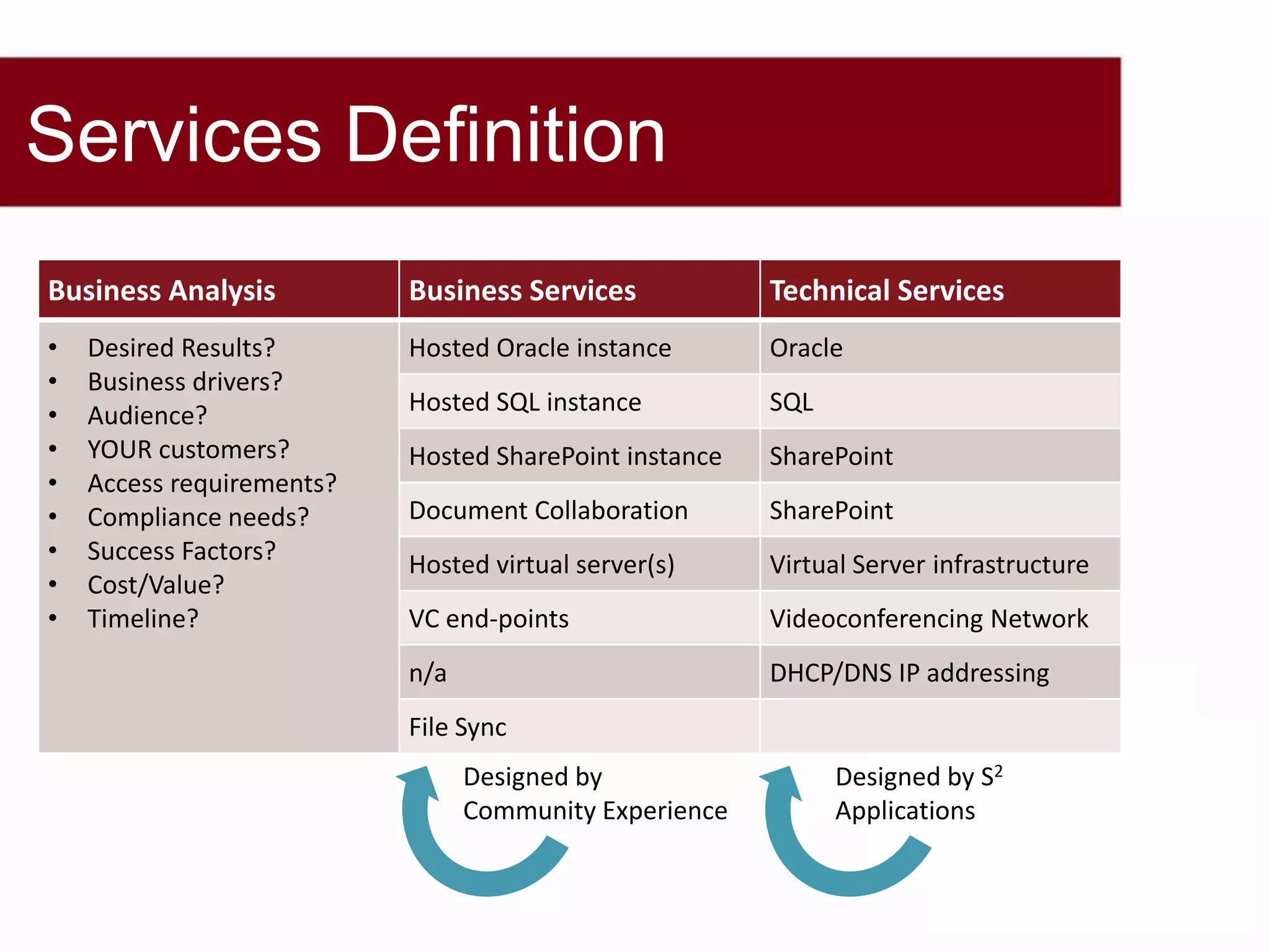
Services Definition
Business Analysis          Business Services            Technical Services
•   Desired Results?       Hosted Oracle instance       Oracle
•   Business drivers?
•   Audience?              Hosted SQL instance          SQL
•   YOUR customers?        Hosted SharePoint instance   SharePoint
•   Access requirements?
•   Compliance needs?      Document Collaboration       SharePoint
•   Success Factors?       Hosted virtual server(s)     Virtual Server infrastructure
•   Cost/Value?
•   Timeline?              VC end-points                Videoconferencing Network
                           n/a                          DHCP/DNS IP addressing
                           File Sync
                                 Designed by                  Designed by S2
                                 Community Experience         Applications
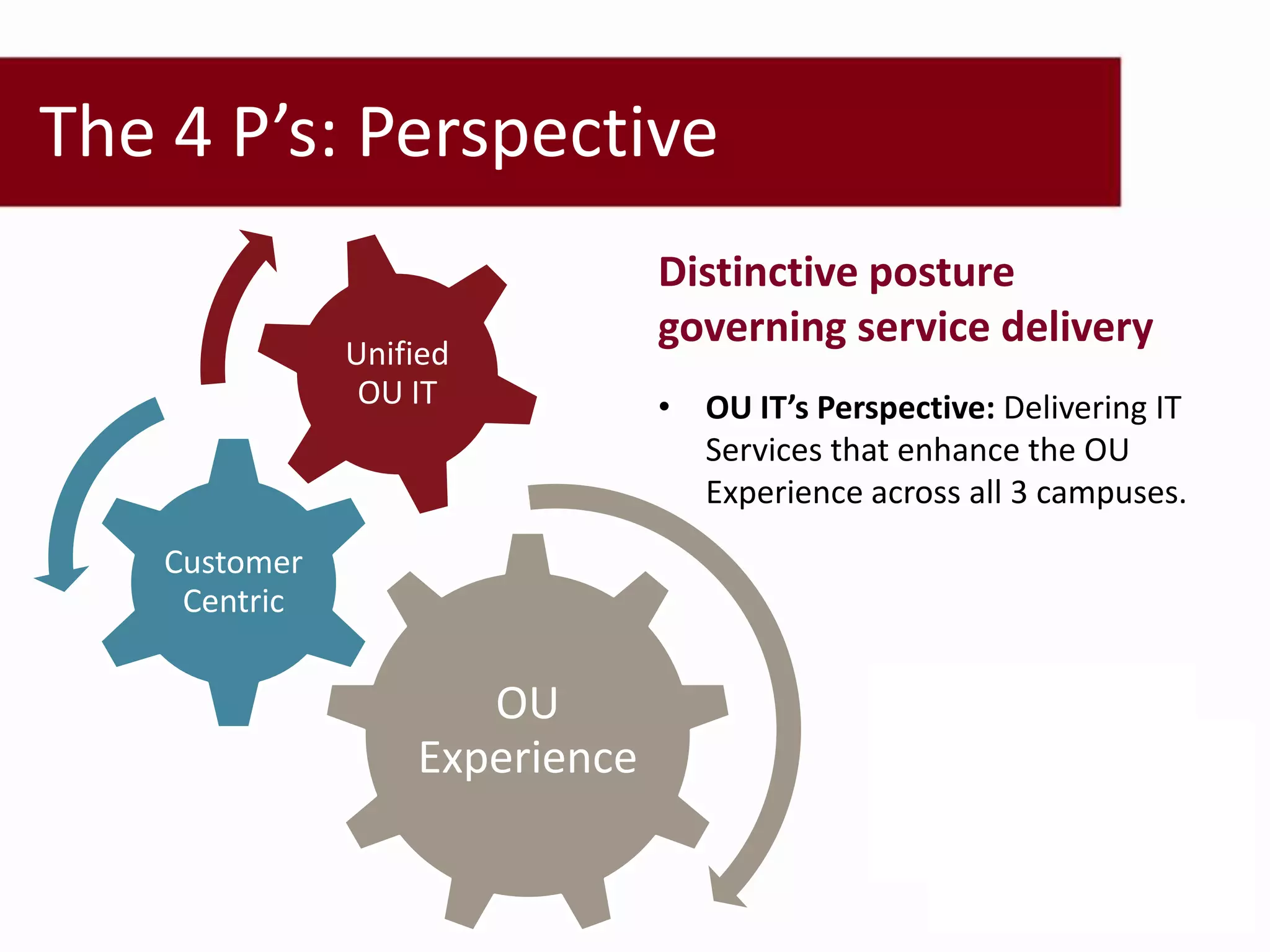
The 4 P’s: Perspective
                                Distinctive posture
                                governing service delivery
               Unified
                OU IT           • OU IT’s Perspective: Delivering IT
                                  Services that enhance the OU
                                  Experience across all 3 campuses.
    Customer
     Centric


                      OU
                   Experience
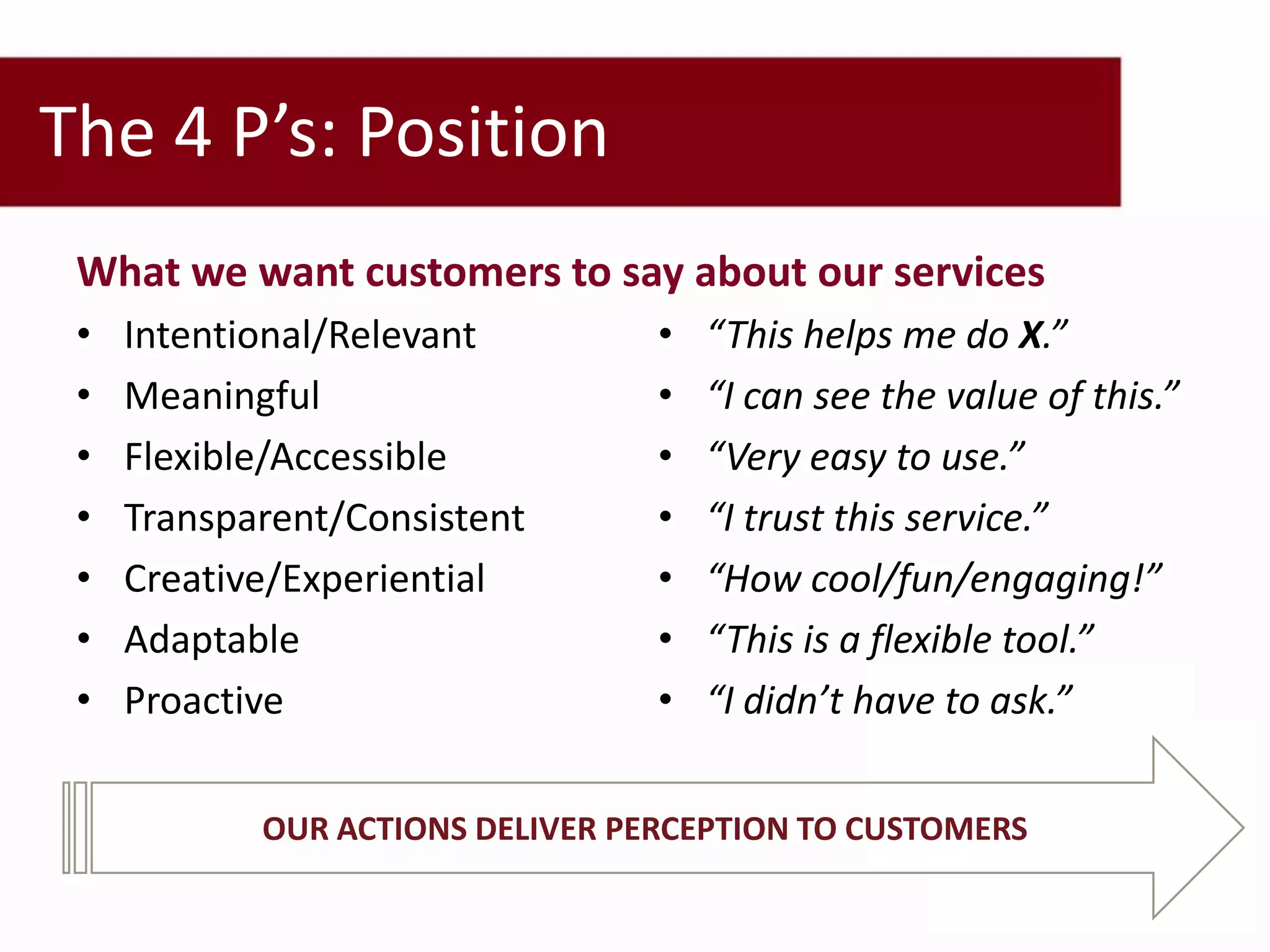
The 4 P’s: Position
 What we want customers to say about our services
 •   Intentional/Relevant         •   “This helps me do X.”
 •   Meaningful                   •   “I can see the value of this.”
 •   Flexible/Accessible          •   “Very easy to use.”
 •   Transparent/Consistent       •   “I trust this service.”
 •   Creative/Experiential        •   “How cool/fun/engaging!”
 •   Adaptable                    •   “This is a flexible tool.”
 •   Proactive                    •   “I didn’t have to ask.”

            OUR ACTIONS DELIVER PERCEPTION TO CUSTOMERS
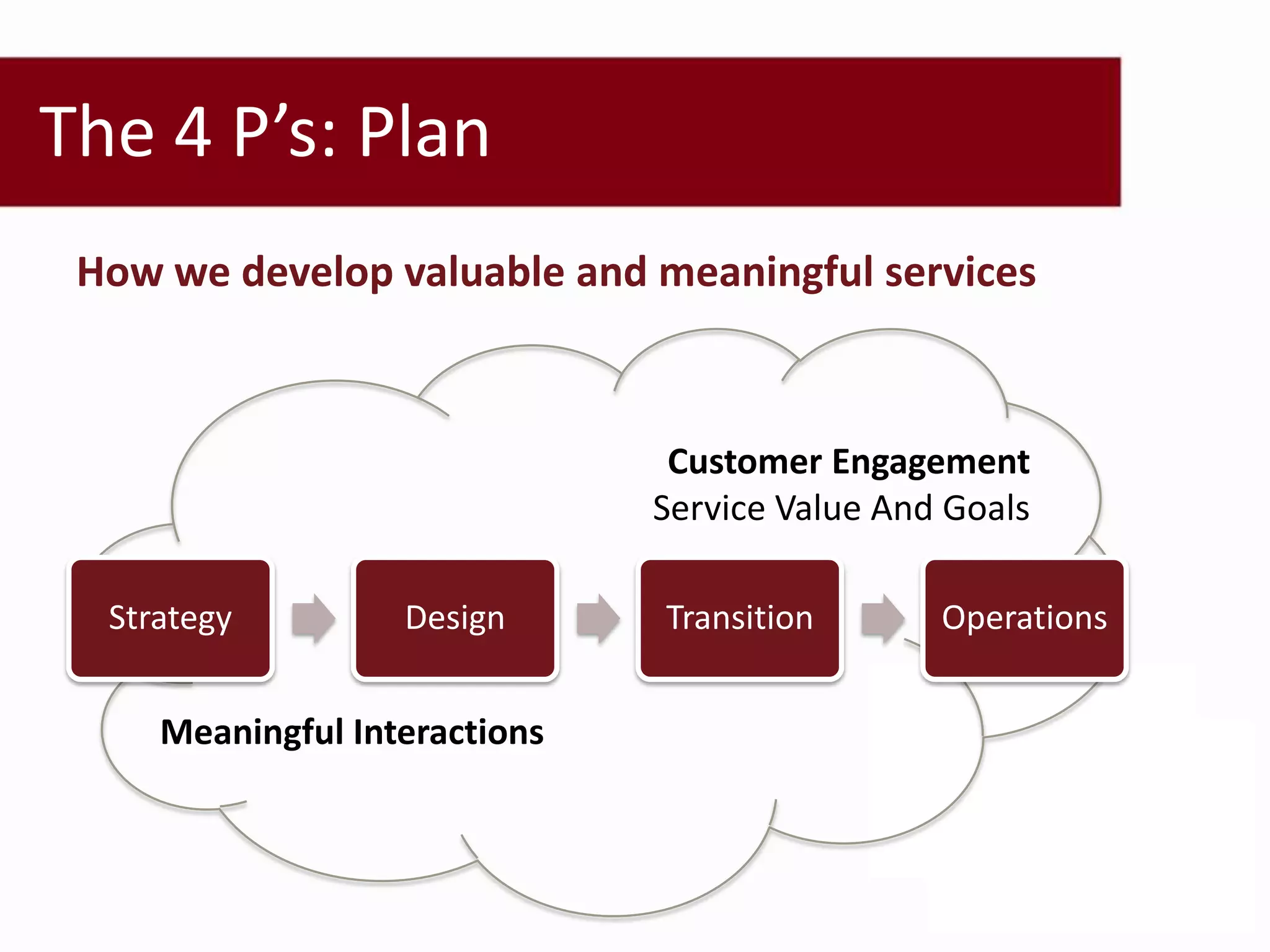
The 4 P’s: Plan
 How we develop valuable and meaningful services


                                Customer Engagement
                               Service Value And Goals

  Strategy         Design      Transition       Operations


     Meaningful Interactions
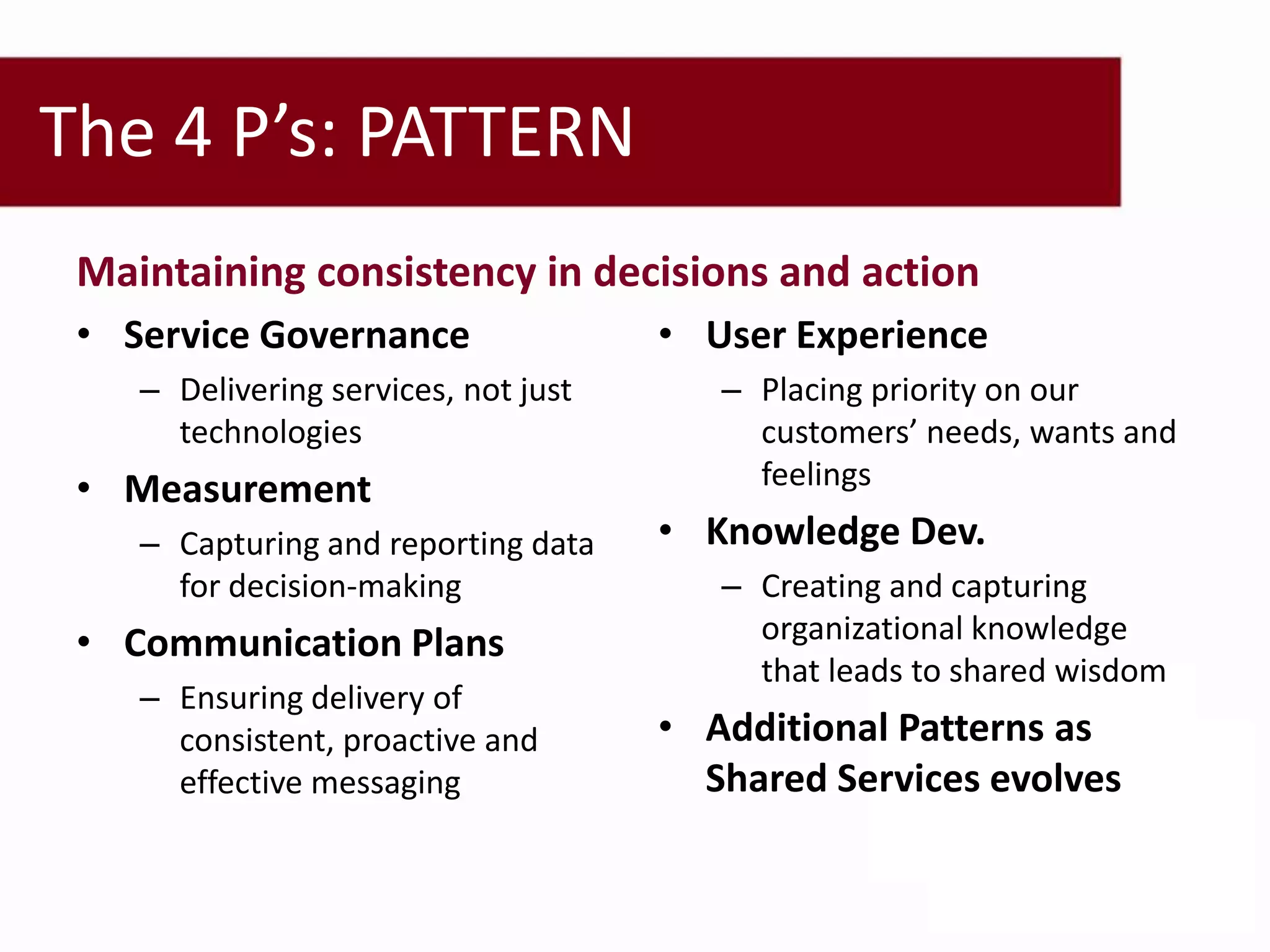
The 4 P’s: PATTERN
 Maintaining consistency in decisions and action
 • Service Governance                 • User Experience
    – Delivering services, not just      – Placing priority on our
      technologies                         customers’ needs, wants and
 • Measurement                             feelings
    – Capturing and reporting data    • Knowledge Dev.
      for decision-making                – Creating and capturing
 • Communication Plans                     organizational knowledge
                                           that leads to shared wisdom
    – Ensuring delivery of
      consistent, proactive and       • Additional Patterns as
      effective messaging               Shared Services evolves
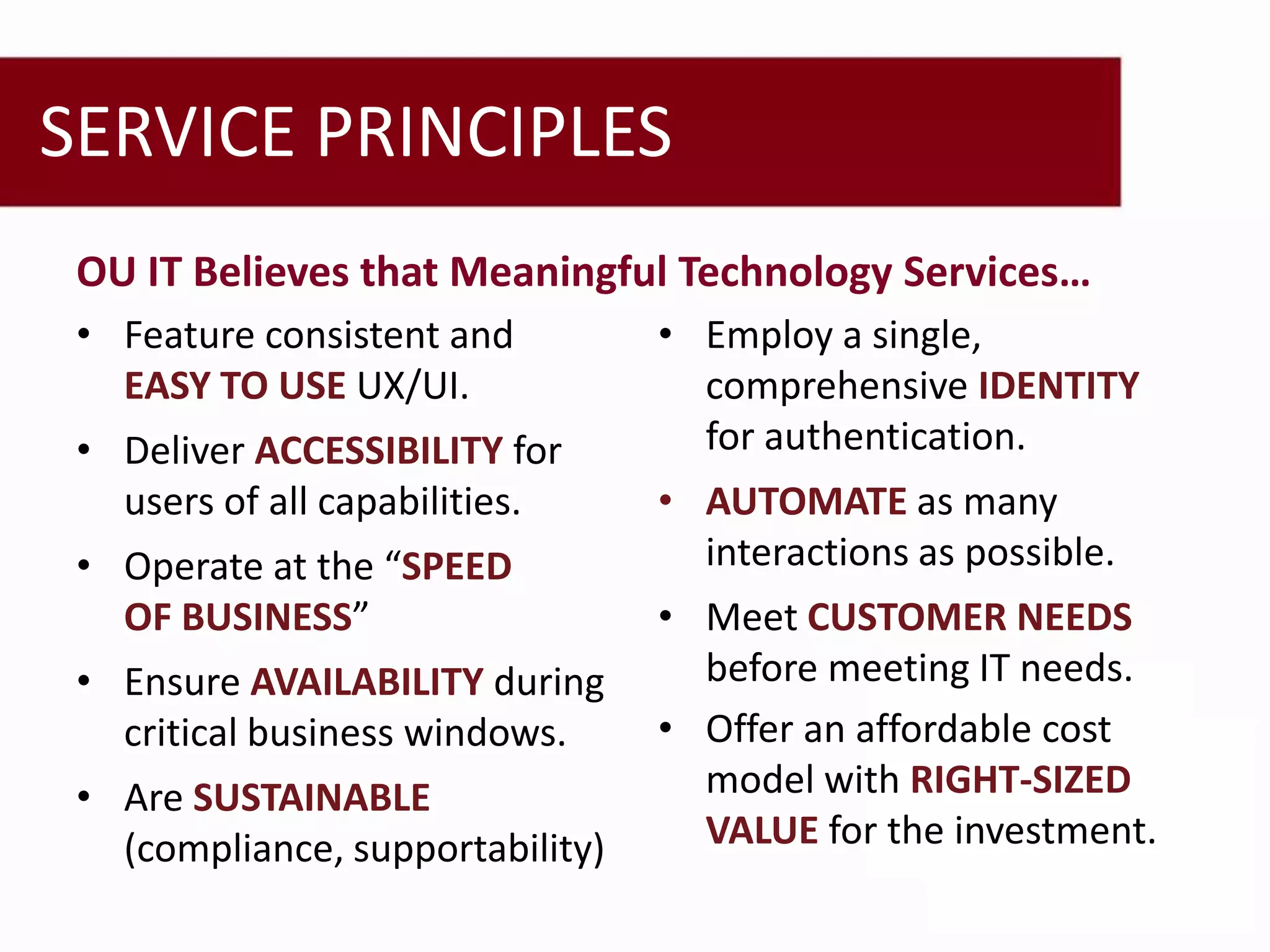
SERVICE PRINCIPLES
 OU IT Believes that Meaningful Technology Services…
 • Feature consistent and         • Employ a single,
   EASY TO USE UX/UI.               comprehensive IDENTITY
 • Deliver ACCESSIBILITY for        for authentication.
   users of all capabilities.     • AUTOMATE as many
 • Operate at the “SPEED            interactions as possible.
   OF BUSINESS”                   • Meet CUSTOMER NEEDS
 • Ensure AVAILABILITY during       before meeting IT needs.
   critical business windows.     • Offer an affordable cost
 • Are SUSTAINABLE                  model with RIGHT-SIZED
   (compliance, supportability)     VALUE for the investment.
Service Portfolio // Catalog
 • Services Portfolio
   – All services we are considering, deploying,
     operating or retiring
 • Services Catalog
   – Active, customer-facing services
 • Services metadata
    Name, description, owner, status, type, cost
     model, request initiation, etc.
THE OFFER // Services Catalog
 Document Collaboration   Service (not tech) name
                          We will…


                          By…


                          Using…


                          Which will…


                          …and be measured by…
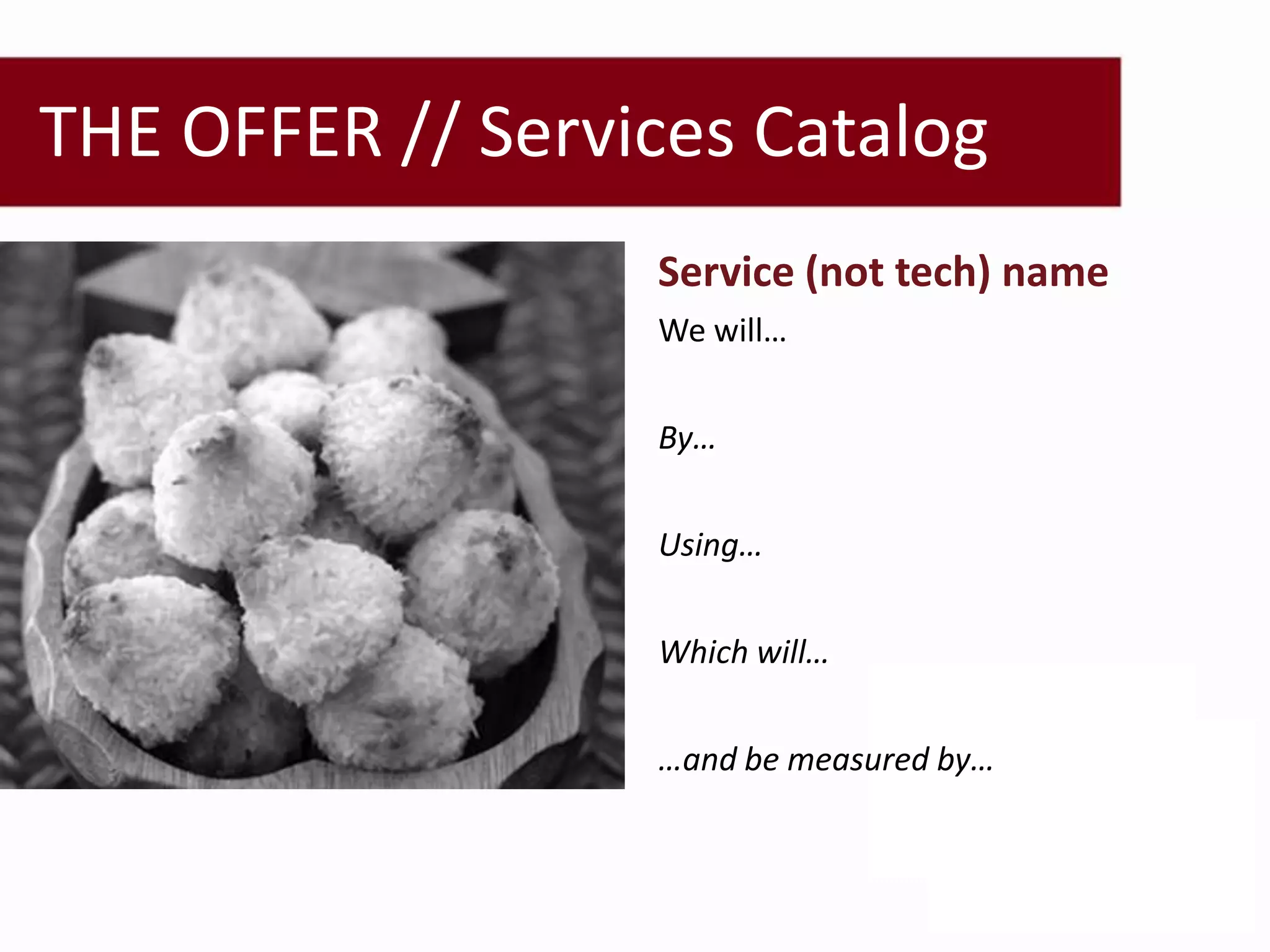
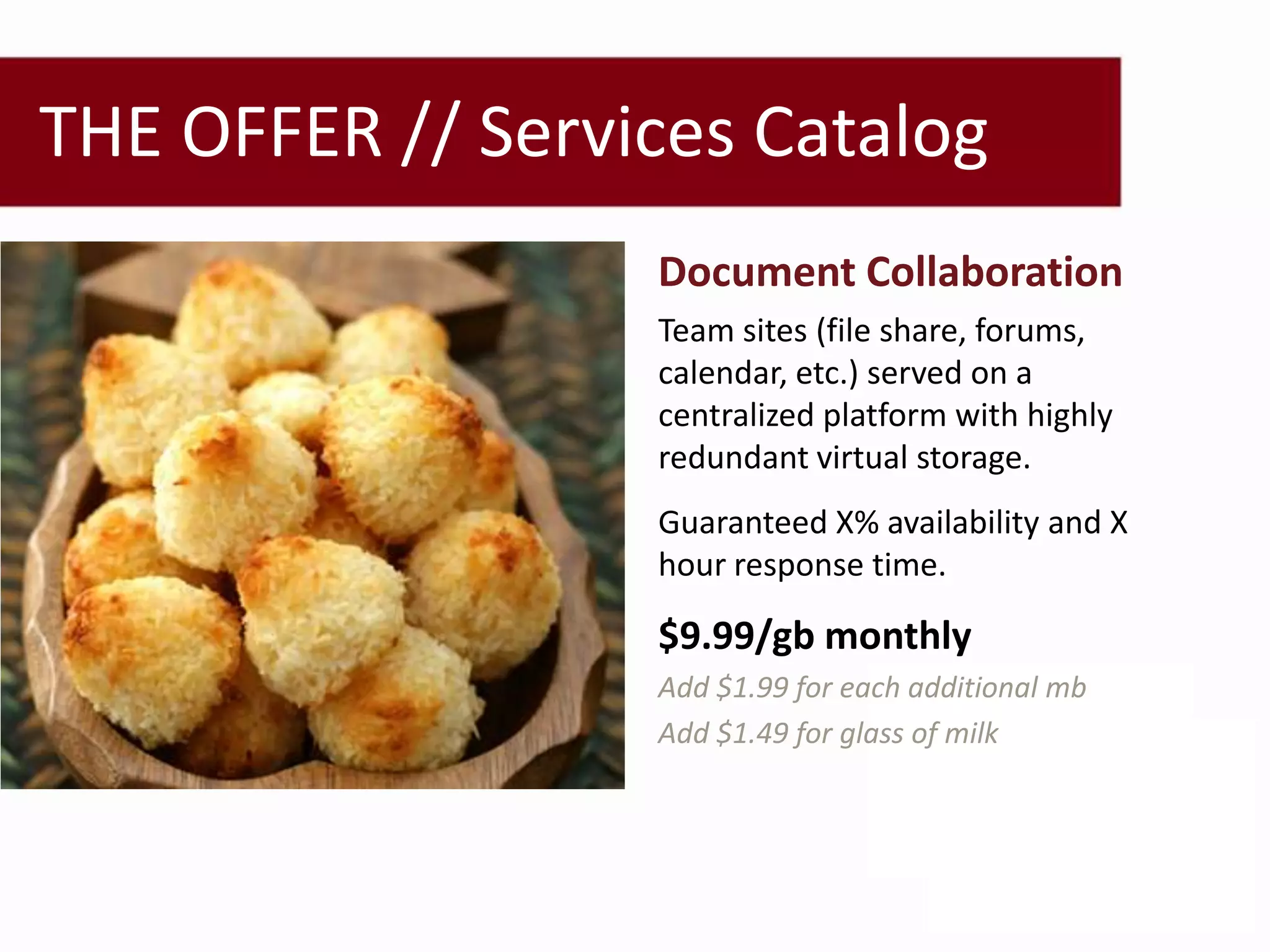
THE OFFER // Services Catalog
                  Document Collaboration
                  Team sites (file share, forums,
                  calendar, etc.) served on a
                  centralized platform with highly
                  redundant virtual storage.
                  Guaranteed X% availability and X
                  hour response time.

                  $9.99/gb monthly
                  Add $1.99 for each additional mb
                  Add $1.49 for glass of milk
WHAT’S NEXT?
Brand Deployment and Filling Out the Framework


Chris Jones, Dana Saliba, and Nick Key
Brand Deployment
 • Development of Brand Identity
   – Build collaborative tri-campus team
   – Propose logo, colors, tagline, standards
   – Staff input on tagline, fonts, etc.
 • Communicate Internally and Externally
   – Tell the S2 and ITSM story (Brand Delivery)
   – One OU IT Website
   – Tri-Campus Branding Campaign (Who is OU IT?)
Filling Out the Framework
 • Following S2 Deployment Approach
 • Appoint Services staff to lead development of
   processes and procedures supporting
   deployment of services on Private Cloud
   – Design, Transition, and Operations
   – Collaborate weekly with S2 teams at NCTC
 • Directors ensure adherence to strategy
Design Topics
 • “SPARK”                        • Functional and Tool
 • Customer engagement              assessment
 • Service creation               • Sourcing strategy (effect
   through retirement               on timeline)
 • Business model(s)              • Pattern design
 • Service Levels                 • “The Offer”
   – Own, Manage, Response        • Catalog Management
     , Availability, Continuity   • Roles (RACI)
Transition topics
 • Customer Engagement
 • Release: internal and external communication
 • Deliver: “active” deployment
   (education and white glove)
 • Knowledge Management
 • Change Management
 • Project Management
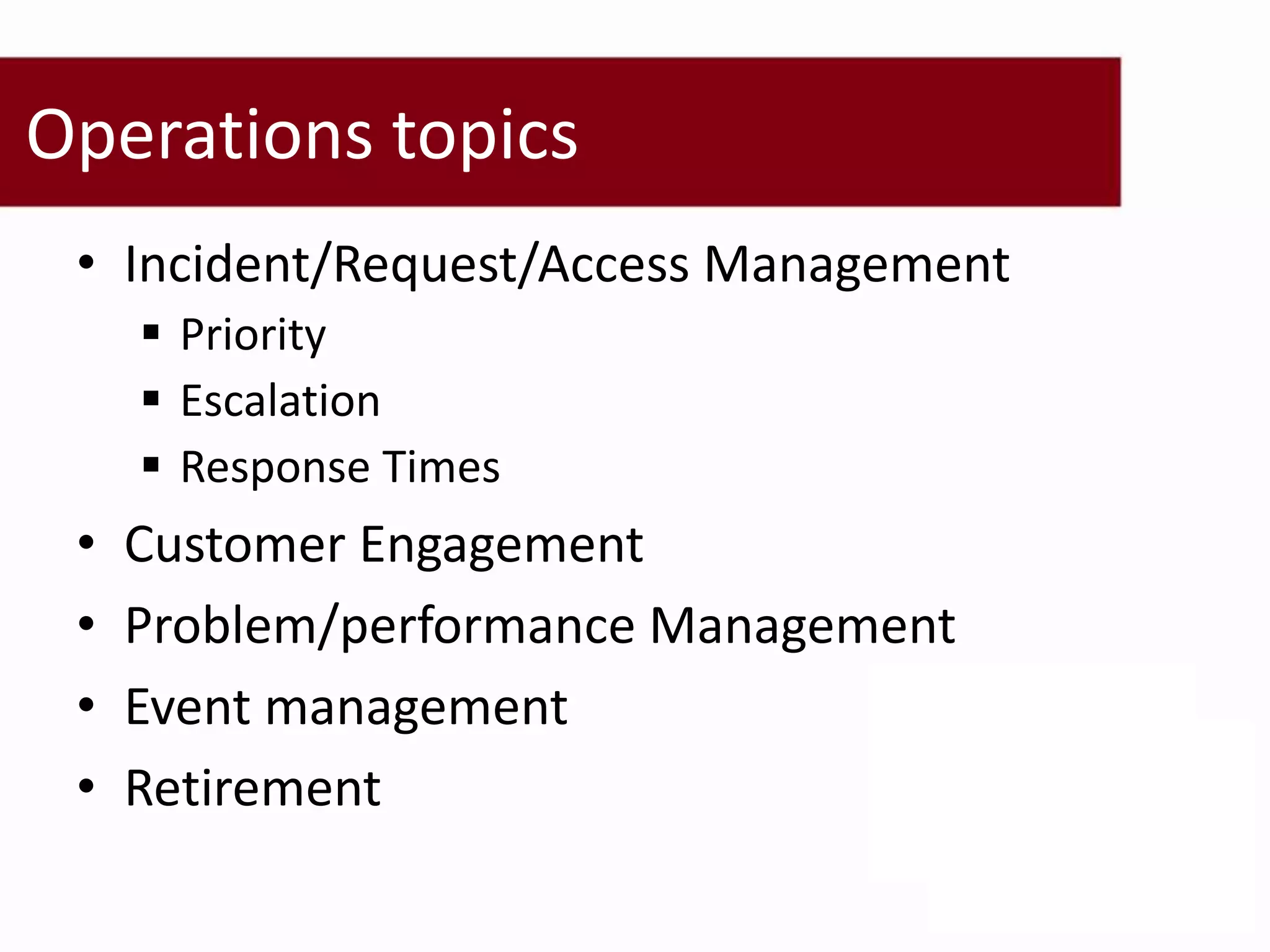
Operations topics
 • Incident/Request/Access Management
      Priority
      Escalation
      Response Times
 •   Customer Engagement
 •   Problem/performance Management
 •   Event management
 •   Retirement
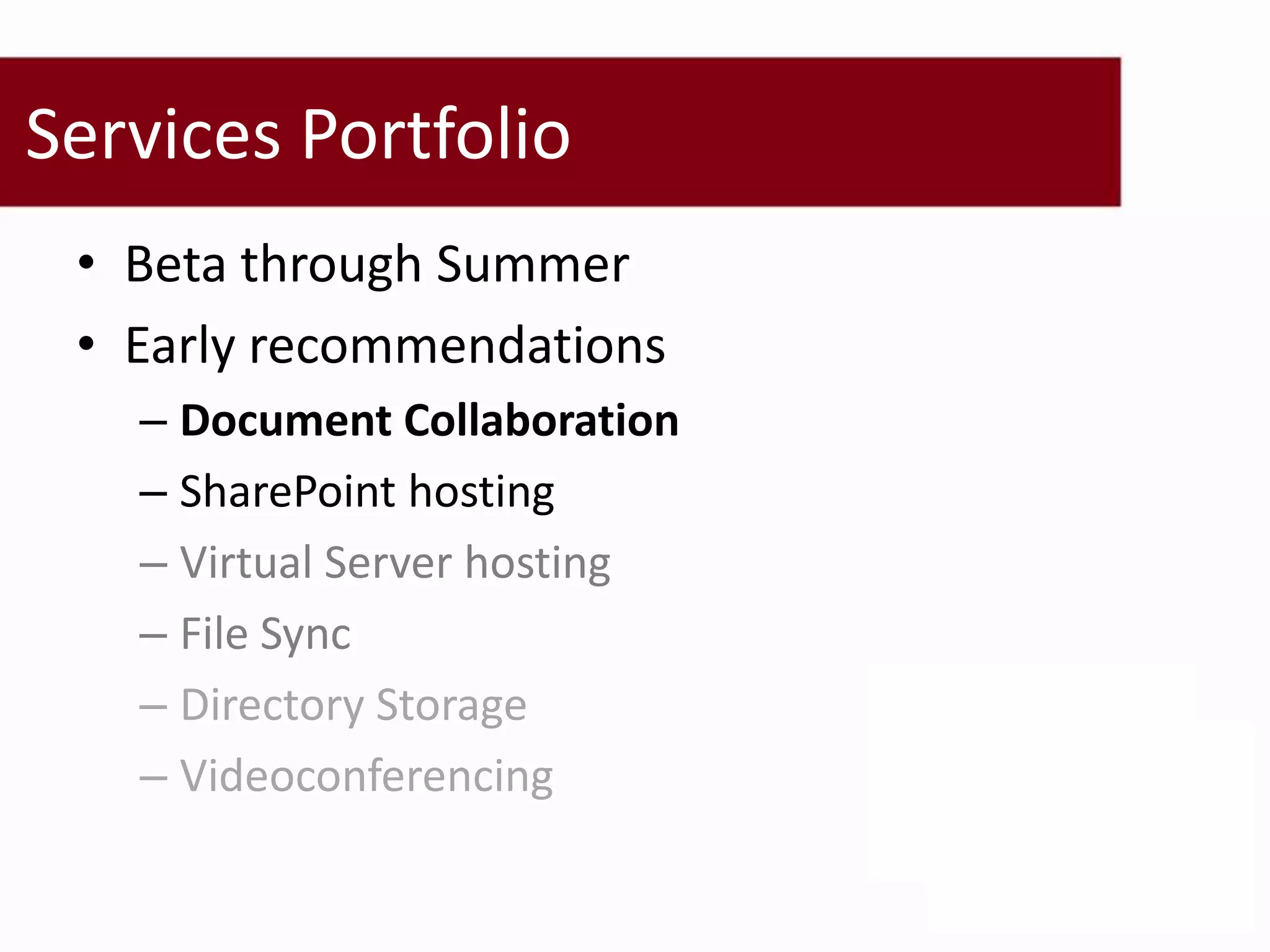
Services Portfolio
 • Beta through Summer
 • Early recommendations
   – Document Collaboration
   – SharePoint hosting
   – Virtual Server hosting
   – File Sync
   – Directory Storage
   – Videoconferencing

IT Service Strategy & Mngt for OU

  • 1.
    DELIVERING THE OUEXPERIENCE OU IT Brand Deployment and Services Management Chris Jones, Dana Saliba, and Nick Key
  • 2.
    Agenda Scoping the Challenge Execution and Next Steps • The Big Picture • ITIL, sort of… • Building a Brand • Design, Transition, and • Translating Brand to IT Execution Services Management • What’s next? – The 4 P’s – Brand Creation and – Governing Principles Deployment – Service Portfolio – Shared Services – The “Offer” Collaboration
  • 3.
    Scoping the Challenge • Processes • Procedures • Contacts SERVICES MANAGEMENT • Resources • Teamwork
  • 4.
    The Big Picture// Strategy Drivers External Private Drivers Cloud Community Experience One OU IT Loretta’s Priorities Leadership Collaboration
  • 5.
    The Big Picture// Future State Brand Private Services Cloud Management Culture Unifying the organization around Change Delivering the OU Experience, S2 and Community Experience. not just technology services.
  • 6.
    Building a Brand INTERNAL EXTERNAL BRAND VISION BRAND IDENTITY FIXED Who are we? What is our commitment Who do we want to be? to the OU community? BRAND DELIVERY BRAND POSITION VARIABLE How will our customers How do we align our perceive us and why will offerings with our vision? they use us?
  • 7.
    Brand Vision //Who we are • Three primary tenets: – Unified organization – Customer-centric – Enhancing the OU Experience • We are one OU IT – an outstanding organization of IT Professionals that put the OU community first and contribute to the OU experience through community engagement, shared services, and stewardship.
  • 8.
    Brand Identity //Commitment • OU IT’s commits to • When we communicate consistently excellent: or interact with the OU – Customer Engagement community we will be – Personal Interactions engaging, personal, resp – Helpful Services onsible, and helpful. – Stewardship • Customers should • Brand Identity expect a consistently – Tagline excellent experience – Colors, Fonts, Design across all OU IT services standards, Web site and campus locations.
  • 9.
    Brand Identity //Commitment • These strategies should • Customer Engagement: yield an even deeper Repeated interactions level of LOCALIZED that strengthen the support and experience psychological, through consistent emotional, and physical customer engagement. investment a customer • NOT eliminating local has in a brand. relationships and • Customer engagement service delivery. will drive the localized experience.
  • 10.
    Brand Position //Perception • Employee attitudes and • We want our customers customer interactions to call us: are the greatest – Thought Leaders indicator of success to – Passionate/Meaningful our customers. – Creative/Fun • Every day we will strive – Experts to communicate these – Solutions Oriented perceptions without – Trustworthy/Transparent explicitly announcing, – Proactive/Intentional “This is how we want – Flexible you to see us.”
  • 11.
    Brand Delivery //ITSM • Mission Statement • IT Service Management (ITSM) – Understanding and managing an IT organization focused on the delivery of business value (OU Experience!) through IT Services. • ITIL (v.3 and 2011 Update) framework – Guide and inform our understanding and development of IT shared services.
  • 12.
    Brand Delivery //ITSM • ITSM delivers Community Experience – Through interaction between a purpose-built private cloud infrastructure, a new IT identity and way of working, and formalized services management maturity. – And results in a definite and sustainable change in IT culture to fully embrace shared services.
  • 13.
    IT SERVICES MANAGEMENT OUIT Services Strategy Framework Chris Jones, Dana Saliba, and Nick Key
  • 14.
  • 15.
    Services Definition Business Analysis Business Services Technical Services • Desired Results? Hosted Oracle instance Oracle • Business drivers? • Audience? Hosted SQL instance SQL • YOUR customers? Hosted SharePoint instance SharePoint • Access requirements? • Compliance needs? Document Collaboration SharePoint • Success Factors? Hosted virtual server(s) Virtual Server infrastructure • Cost/Value? • Timeline? VC end-points Videoconferencing Network n/a DHCP/DNS IP addressing File Sync Designed by Designed by S2 Community Experience Applications
  • 16.
    The 4 P’s:Perspective Distinctive posture governing service delivery Unified OU IT • OU IT’s Perspective: Delivering IT Services that enhance the OU Experience across all 3 campuses. Customer Centric OU Experience
  • 17.
    The 4 P’s:Position What we want customers to say about our services • Intentional/Relevant • “This helps me do X.” • Meaningful • “I can see the value of this.” • Flexible/Accessible • “Very easy to use.” • Transparent/Consistent • “I trust this service.” • Creative/Experiential • “How cool/fun/engaging!” • Adaptable • “This is a flexible tool.” • Proactive • “I didn’t have to ask.” OUR ACTIONS DELIVER PERCEPTION TO CUSTOMERS
  • 18.
    The 4 P’s:Plan How we develop valuable and meaningful services Customer Engagement Service Value And Goals Strategy Design Transition Operations Meaningful Interactions
  • 19.
    The 4 P’s:PATTERN Maintaining consistency in decisions and action • Service Governance • User Experience – Delivering services, not just – Placing priority on our technologies customers’ needs, wants and • Measurement feelings – Capturing and reporting data • Knowledge Dev. for decision-making – Creating and capturing • Communication Plans organizational knowledge that leads to shared wisdom – Ensuring delivery of consistent, proactive and • Additional Patterns as effective messaging Shared Services evolves
  • 20.
    SERVICE PRINCIPLES OUIT Believes that Meaningful Technology Services… • Feature consistent and • Employ a single, EASY TO USE UX/UI. comprehensive IDENTITY • Deliver ACCESSIBILITY for for authentication. users of all capabilities. • AUTOMATE as many • Operate at the “SPEED interactions as possible. OF BUSINESS” • Meet CUSTOMER NEEDS • Ensure AVAILABILITY during before meeting IT needs. critical business windows. • Offer an affordable cost • Are SUSTAINABLE model with RIGHT-SIZED (compliance, supportability) VALUE for the investment.
  • 21.
    Service Portfolio //Catalog • Services Portfolio – All services we are considering, deploying, operating or retiring • Services Catalog – Active, customer-facing services • Services metadata  Name, description, owner, status, type, cost model, request initiation, etc.
  • 22.
    THE OFFER //Services Catalog Document Collaboration Service (not tech) name We will… By… Using… Which will… …and be measured by…
  • 23.
    THE OFFER //Services Catalog Document Collaboration Team sites (file share, forums, calendar, etc.) served on a centralized platform with highly redundant virtual storage. Guaranteed X% availability and X hour response time. $9.99/gb monthly Add $1.99 for each additional mb Add $1.49 for glass of milk
  • 24.
    WHAT’S NEXT? Brand Deploymentand Filling Out the Framework Chris Jones, Dana Saliba, and Nick Key
  • 25.
    Brand Deployment •Development of Brand Identity – Build collaborative tri-campus team – Propose logo, colors, tagline, standards – Staff input on tagline, fonts, etc. • Communicate Internally and Externally – Tell the S2 and ITSM story (Brand Delivery) – One OU IT Website – Tri-Campus Branding Campaign (Who is OU IT?)
  • 26.
    Filling Out theFramework • Following S2 Deployment Approach • Appoint Services staff to lead development of processes and procedures supporting deployment of services on Private Cloud – Design, Transition, and Operations – Collaborate weekly with S2 teams at NCTC • Directors ensure adherence to strategy
  • 27.
    Design Topics •“SPARK” • Functional and Tool • Customer engagement assessment • Service creation • Sourcing strategy (effect through retirement on timeline) • Business model(s) • Pattern design • Service Levels • “The Offer” – Own, Manage, Response • Catalog Management , Availability, Continuity • Roles (RACI)
  • 28.
    Transition topics •Customer Engagement • Release: internal and external communication • Deliver: “active” deployment (education and white glove) • Knowledge Management • Change Management • Project Management
  • 29.
    Operations topics •Incident/Request/Access Management  Priority  Escalation  Response Times • Customer Engagement • Problem/performance Management • Event management • Retirement
  • 30.
    Services Portfolio •Beta through Summer • Early recommendations – Document Collaboration – SharePoint hosting – Virtual Server hosting – File Sync – Directory Storage – Videoconferencing