CMDR DHARWAD 
organized 
UGC sponsored A TWO DAY 
NATIONAL SEMINAR
SERVICE SECTOR LED ECONOMIC 
GROWTH IN INDIA: 
A STUDY ON IT/ITES SECTOR
INTRODUCTION 
• India has a kaleidoscopic variety and rich 
cultural heritage. 
• Though it is considered as agrarian 
economy it has achieved vast growth in 
other sectors. 
• Service sector forms a backbone of 
social & economic development of a 
nation.
 Its growth rate has been higher than that of the 
agriculture and manufacturing sector 
 The share of services in India’s GDP at factor cost 
(at current prices) rose from 33.3 per cent 
(1950–1951) to 56.5 per cent in 2012–13, as per 
advance estimates. 
 During FY 2014–15, the sector is projected to 
grow at a healthy 5.6 per cent, according to 
National Council of Applied Economic Research 
(NCAER).
The service sector has emerged as 
the largest and fastest growing 
sectors in the world economy making 
higher contribution to the global 
output and employment
ECONOMIC LIBERLIZATION IN INDIA 
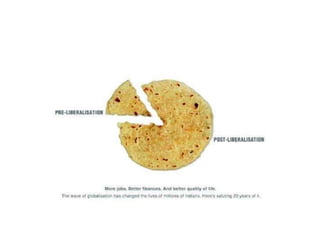
Economic liberalization started way back in 1991. 
with goal of making the economy more market-oriented 
and expanding the role of the private 
and foreign investment. 
 Specific changes include the reduction in import 
tariffs, deregulation of markets, reduction of 
taxes, and greater foreign investment. 
 High economic growth recorded by the country 
in the 1990s and 2000s.
PRE-LIBREALIZATION POLICIES: 
Believed in the internal markets. 
Five-Year Plans of India resembled central 
planning in the Soviet Union. 
Steel, mining, machine tools, water, 
telecommunications, insurance, and electrical 
plants, among other industries, were 
effectively nationalized in the mid-1950s.
Elaborate licenses, regulations and the 
accompanying red tape, commonly referred to 
as License Raj, were required to set up 
business in India between 1947 and 1990.
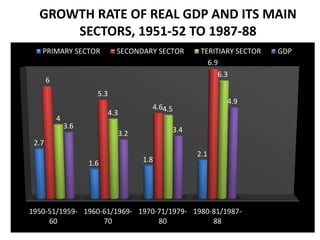
GROWTH RATE OF REAL GDP AND ITS MAIN 
SECTORS, 1951-52 TO 1987-88 
PRIMARY SECTOR SECONDARY SECTOR TERITIARY SECTOR GDP 
1950-51/1959- 
60 
1960-61/1969- 
70 
1970-71/1979- 
80 
1980-81/1987- 
88 
2.7 
1.6 1.8 
2.1 
6 
5.3 
4.6 
6.9 
4 
4.3 4.5 
6.3 
3.6 
3.2 3.4 
4.9
IT/ITES SECTOR 
A Star performer
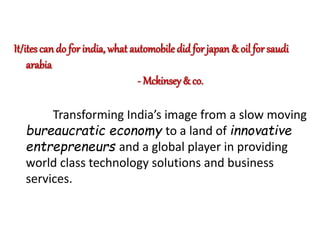
It/ites can do for india, what automobile did for japan & oil for saudi 
arabia 
- Mckinsey & co. 
Transforming India’s image from a slow moving 
bureaucratic economy to a land of innovative 
entrepreneurs and a global player in providing 
world class technology solutions and business 
services.
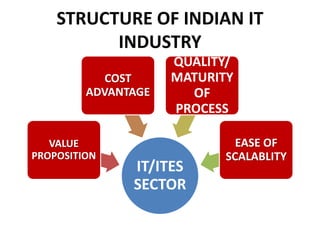
STRUCTURE OF INDIAN IT 
INDUSTRY 
IT/ITES 
SECTOR 
VALUE 
PROPOSITION 
COST 
ADVANTAGE 
QUALITY/ 
MATURITY 
OF 
PROCESS 
EASE OF 
SCALABLITY
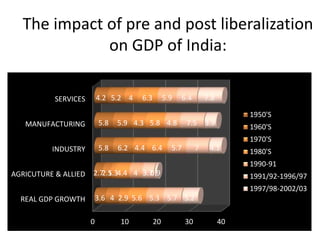
The impact of pre and post liberalization 
on GDP of India: 
4.2 
5.8 
5.8 
2.7 
5.2 
2.5 
5.9 
6.3 
4.3 
5.8 
5.9 
4.8 
7.5 
7.8 
3.9 
0 10 20 30 40 
SERVICES 
MANUFACTURING 
INDUSTRY 
AGRICUTURE & ALLIED 
REAL GDP GROWTH 
3.6 
4 
6.2 
2.9 
1.3 
4.4 
4 
5.6 
4.4 
6.4 
5.3 
4 
5.7 
5.7 
3.7 
7 
6.4 
5.2 
0.9 
4.1 
1950'S 
1960'S 
1970'S 
1980'S 
1990-91 
1991/92-1996/97 
1997/98-2002/03
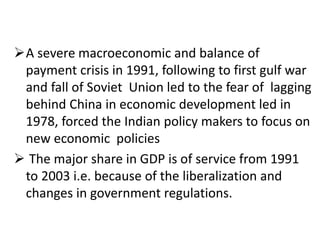
A severe macroeconomic and balance of 
payment crisis in 1991, following to first gulf war 
and fall of Soviet Union led to the fear of lagging 
behind China in economic development led in 
1978, forced the Indian policy makers to focus on 
new economic policies 
 The major share in GDP is of service from 1991 
to 2003 i.e. because of the liberalization and 
changes in government regulations.
The Global Meltdown Of 2008-09 And 
Its Impact On Indian IT Sector: 
THE DOMINO EFFECT
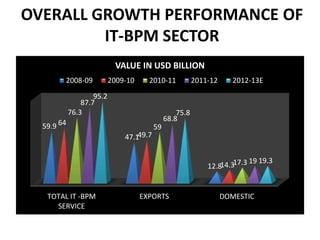
OVERALL GROWTH PERFORMANCE OF 
IT-BPM SECTOR 
TOTAL IT -BPM 
SERVICE 
EXPORTS DOMESTIC 
59.9 
47.1 
12.8 
64 
49.7 
14.3 
76.3 
59 
17.3 
87.7 
68.8 
19 
95.2 
75.8 
19.3 
VALUE IN USD BILLION 
2008-09 2009-10 2010-11 2011-12 2012-13E
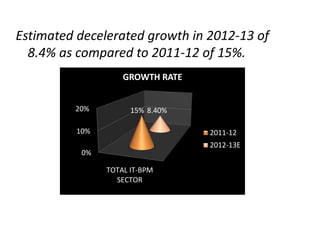
Estimated decelerated growth in 2012-13 of 
8.4% as compared to 2011-12 of 15%. 
20% 
10% 
0% 
GROWTH RATE 
15% 8.40% 
TOTAL IT-BPM 
SECTOR 
2011-12 
2012-13E
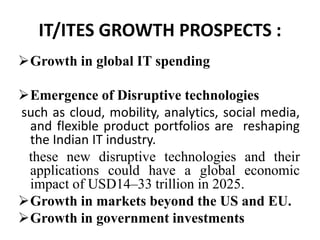
IT/ITES GROWTH PROSPECTS : 
Growth in global IT spending 
Emergence of Disruptive technologies 
such as cloud, mobility, analytics, social media, 
and flexible product portfolios are reshaping 
the Indian IT industry. 
these new disruptive technologies and their 
applications could have a global economic 
impact of USD14–33 trillion in 2025. 
Growth in markets beyond the US and EU. 
Growth in government investments
CHALLENGES 
 High attrition 
 Weaker infrastructure 
 Competition from other low-cost countries 
 US Immigration Bill and EU Data Protection 
Bill
CONCLUSION 
 It was after the liberalization in 1991 and the new 
wave of globalization that India was able to make its 
mark in global market and it was IT/ITES sector which 
played a pivotal role. 
 India’s nature to manage its savings, which helped it 
to be unaffected. India’s trade surplus with the US 
was healthy and India’s export to US was only 3% of 
GDP. Hence the effect was not that drastic. 
 Even though there has been slow down in economy 
and GDP rate has been fluctuating, major share in 
the Indian economic growth still remains from the 
service sector
As the new scenario unfolds, it is getting clear that the 
future growth of IT and ITeS will be fuelled by the 
verticals of climate change, mobile applications, 
healthcare, energy efficiency and sustainable energy. 
Traditional business strongholds will make way for new 
geographies, there would be new customers and more 
and more of SMEs will go for IT application and services.
THANK YOU 
PRESENTED BY 
SAHANA HIREMATH 
M.Com (Final) 
DR. S.G. HIREMATH 
ASSOCIATE PROFESSOR

service sector

  • 1.
    CMDR DHARWAD organized UGC sponsored A TWO DAY NATIONAL SEMINAR
  • 3.
    SERVICE SECTOR LEDECONOMIC GROWTH IN INDIA: A STUDY ON IT/ITES SECTOR
  • 4.
    INTRODUCTION • Indiahas a kaleidoscopic variety and rich cultural heritage. • Though it is considered as agrarian economy it has achieved vast growth in other sectors. • Service sector forms a backbone of social & economic development of a nation.
  • 5.
     Its growthrate has been higher than that of the agriculture and manufacturing sector  The share of services in India’s GDP at factor cost (at current prices) rose from 33.3 per cent (1950–1951) to 56.5 per cent in 2012–13, as per advance estimates.  During FY 2014–15, the sector is projected to grow at a healthy 5.6 per cent, according to National Council of Applied Economic Research (NCAER).
  • 6.
    The service sectorhas emerged as the largest and fastest growing sectors in the world economy making higher contribution to the global output and employment
  • 7.
    ECONOMIC LIBERLIZATION ININDIA Economic liberalization started way back in 1991. with goal of making the economy more market-oriented and expanding the role of the private and foreign investment.  Specific changes include the reduction in import tariffs, deregulation of markets, reduction of taxes, and greater foreign investment.  High economic growth recorded by the country in the 1990s and 2000s.
  • 8.
    PRE-LIBREALIZATION POLICIES: Believedin the internal markets. Five-Year Plans of India resembled central planning in the Soviet Union. Steel, mining, machine tools, water, telecommunications, insurance, and electrical plants, among other industries, were effectively nationalized in the mid-1950s.
  • 9.
    Elaborate licenses, regulationsand the accompanying red tape, commonly referred to as License Raj, were required to set up business in India between 1947 and 1990.
  • 10.
    GROWTH RATE OFREAL GDP AND ITS MAIN SECTORS, 1951-52 TO 1987-88 PRIMARY SECTOR SECONDARY SECTOR TERITIARY SECTOR GDP 1950-51/1959- 60 1960-61/1969- 70 1970-71/1979- 80 1980-81/1987- 88 2.7 1.6 1.8 2.1 6 5.3 4.6 6.9 4 4.3 4.5 6.3 3.6 3.2 3.4 4.9
  • 12.
    IT/ITES SECTOR AStar performer
  • 13.
    It/ites can dofor india, what automobile did for japan & oil for saudi arabia - Mckinsey & co. Transforming India’s image from a slow moving bureaucratic economy to a land of innovative entrepreneurs and a global player in providing world class technology solutions and business services.
  • 14.
    STRUCTURE OF INDIANIT INDUSTRY IT/ITES SECTOR VALUE PROPOSITION COST ADVANTAGE QUALITY/ MATURITY OF PROCESS EASE OF SCALABLITY
  • 15.
    The impact ofpre and post liberalization on GDP of India: 4.2 5.8 5.8 2.7 5.2 2.5 5.9 6.3 4.3 5.8 5.9 4.8 7.5 7.8 3.9 0 10 20 30 40 SERVICES MANUFACTURING INDUSTRY AGRICUTURE & ALLIED REAL GDP GROWTH 3.6 4 6.2 2.9 1.3 4.4 4 5.6 4.4 6.4 5.3 4 5.7 5.7 3.7 7 6.4 5.2 0.9 4.1 1950'S 1960'S 1970'S 1980'S 1990-91 1991/92-1996/97 1997/98-2002/03
  • 16.
    A severe macroeconomicand balance of payment crisis in 1991, following to first gulf war and fall of Soviet Union led to the fear of lagging behind China in economic development led in 1978, forced the Indian policy makers to focus on new economic policies  The major share in GDP is of service from 1991 to 2003 i.e. because of the liberalization and changes in government regulations.
  • 17.
    The Global MeltdownOf 2008-09 And Its Impact On Indian IT Sector: THE DOMINO EFFECT
  • 18.
    OVERALL GROWTH PERFORMANCEOF IT-BPM SECTOR TOTAL IT -BPM SERVICE EXPORTS DOMESTIC 59.9 47.1 12.8 64 49.7 14.3 76.3 59 17.3 87.7 68.8 19 95.2 75.8 19.3 VALUE IN USD BILLION 2008-09 2009-10 2010-11 2011-12 2012-13E
  • 19.
    Estimated decelerated growthin 2012-13 of 8.4% as compared to 2011-12 of 15%. 20% 10% 0% GROWTH RATE 15% 8.40% TOTAL IT-BPM SECTOR 2011-12 2012-13E
  • 20.
    IT/ITES GROWTH PROSPECTS: Growth in global IT spending Emergence of Disruptive technologies such as cloud, mobility, analytics, social media, and flexible product portfolios are reshaping the Indian IT industry. these new disruptive technologies and their applications could have a global economic impact of USD14–33 trillion in 2025. Growth in markets beyond the US and EU. Growth in government investments
  • 21.
    CHALLENGES  Highattrition  Weaker infrastructure  Competition from other low-cost countries  US Immigration Bill and EU Data Protection Bill
  • 22.
    CONCLUSION  Itwas after the liberalization in 1991 and the new wave of globalization that India was able to make its mark in global market and it was IT/ITES sector which played a pivotal role.  India’s nature to manage its savings, which helped it to be unaffected. India’s trade surplus with the US was healthy and India’s export to US was only 3% of GDP. Hence the effect was not that drastic.  Even though there has been slow down in economy and GDP rate has been fluctuating, major share in the Indian economic growth still remains from the service sector
  • 23.
    As the newscenario unfolds, it is getting clear that the future growth of IT and ITeS will be fuelled by the verticals of climate change, mobile applications, healthcare, energy efficiency and sustainable energy. Traditional business strongholds will make way for new geographies, there would be new customers and more and more of SMEs will go for IT application and services.
  • 24.
    THANK YOU PRESENTEDBY SAHANA HIREMATH M.Com (Final) DR. S.G. HIREMATH ASSOCIATE PROFESSOR