
Service design for mobile
banking
Presented by:
Avvab, Ayush, Lokesh Manmeet, Mehak, Prabhat,Prakhar,
Rajat , Ronit & Zeeshan
Case facts:
 ABC bank had been a pioneer in automation and
highly regarded for its technology initiatives.
 Anjali- in charge of Special Projects Cell
 Enjoyed an edge over other mid-cap banks by
effective deployment of IT and networking for
managing its costs of service delivery and efficiency of
operations.
 Directors are aware of successful m-banking
applications in developing countries like Philippines,
South Africa and Kenya.
 In Oct 2008, RBI issued guidelines for banks to
provide mobile banking among different accounts of
banks.
 Non-banking transactions are not yet permitted.
RBI guidelines:
 Allowed to banks-licensed, physical presence in
India, implemented core banking.
 Domestic rupee transactions, daily cap for fund
transfer and purchase of goods/services-Rs.50,000
per customer.
 Governed by KYC, AML and CFT.
 Secure and ensure confidentiality, integrity,
authenticity and non-repudiability
 Risk factors in m-banking are anonymity,
elusiveness, rapidity and poor oversight.
 Anonymity and elusiveness can be managed
after completion of UID.
 Attractive design of service would be key to
successful launch of m-banking.
 Decides to use SERVQUAL tool to determine
the gaps in customer expectations and their
perceptions.
 Intends to get responses from urban and rural
customer compiled and analyzed on 5
categories: reliability, assurance, tangibles,
empathy and responsiveness.
 Plans a cross functional team to identify design
characteristics of m-banking and then perform
cost benefit analysis to get competitive edge in
market.
 QFD will translate customer requirements into
product or service specifications.
 She want to build an m-banking USP to attract
high value customers from competition as well
as new customers from rural areas which is a
very long run process.
 By this we can say she should follow thorough
analysis and professional service design.
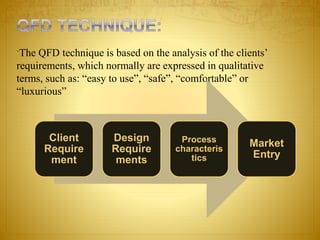
`The QFD technique is based on the analysis of the clients’
requirements, which normally are expressed in qualitative
terms, such as: “easy to use”, “safe”, “comfortable” or
“luxurious”
Client
Require
ment
Design
Require
ments
Process
characteris
tics
Market
Entry
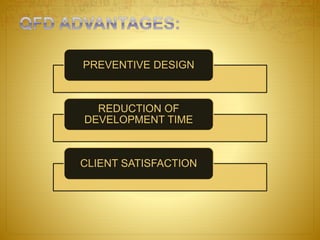
PREVENTIVE DESIGN
REDUCTION OF
DEVELOPMENT TIME
CLIENT SATISFACTION
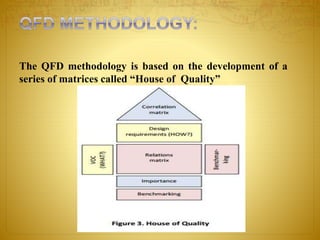
The QFD methodology is based on the development of a
series of matrices called “House of Quality”
Benchmarking:
 The QFD technique allows for a competitor assessment
with Benchmarking. The competitor’s services are
compared to the company’s services.
 Benchmarking is carried out for “What” and “How”
 The two companies’ services are compared along the lines
of client requirements (“What”)
 In the technical competitor comparison (“How”s), the
design requirement fulfilment will be compared.
What are the Servqual
Gaps?
 Gap 1: The difference between management
perceptions of what customers expect and
what customers really do expect
 Gap 2: The difference between management
perceptions and service quality
specifications - the standards gap
Gap 3: The difference between service quality
specifications and actual service delivery - are
standards consistently met?
Gap 4: The difference between service delivery
and what is communicated externally - are
promises made consistently fulfilled?
Gap 5: The difference between what customers
expect of a service and what they actually
receive
The Five Key Service
Dimensions
 TANGIBLES - the appearance of physical facilities,
equipment, personnel and information material
 RELIABILITY - the ability to perform the service
accurately and dependably
 RESPONSIVENESS - the willingness to help
customers and provide a prompt service
 EMPATHY - a combination of the following:
 Access (physical and social) -
approachability and ease of contact
 Communication - keeping customers
informed in a language they understand
and really listening to them
 Understanding the customer - making the
effort to get to know customers and their
specific needs
 ASSURANCE - a combination of the following
 Competence - having the requisite skills and
knowledge
 Courtesy - politeness, respect, consideration
and friendliness of contact staff
 Credibility - trustworthiness, believability and
honesty of staff
 Security - freedom from danger, risk or doubt
Examples -
Application of the SERVQUAL Model in Diff
erent Contexts
 To assess the quality of physiotherapy services
 Measuring service quality in information
technology centre
 To determine the relative importance of critical
factors in delivering service quality of banks in
Malaysia
Recent status of mobile
banking in India:
 Primarily forced by convenience and promptness.
 It is convenient, low cost channel and not location
specific like ATM.
 Month-on-month transactions carried out through
mobile banking are surging both in volume and value
terms.
 Increasing smart phone adoption and initiatives such
as media promotions and customer education
programs for mobile banking have led to this uptrend.
 Fast growing transactions through mobile banking-
Prepaid mobile recharges, DTH recharges, ticket
bookings (movies/travel) .
 The key players in the mobile banking market in India
are ICICI Bank, HDFC Bank, SBI Bank, Axis
Bank, Canara Bank, Syndicate Bank, Bank
of Baroda etc.
 The SBI group dominates this space in volume terms
with an overall share of 67.4 per cent in total
volumes.
 Private and foreign banks follow, with an overall share
of 30.1 per cent in November.
 Around 3% of SBI's and 10million of ICICI Bank
customer base are currently registered for mobile
banking.
 According to RBI data, a total of 3.7 crore mobile
transactions took place between February and
November 2012, jumping around 1.7 times in volumes
over this 10-month period.
 Currently there is no cap on per-day transactions
for encrypted transactions in banking channels,
including mobile banking which are set by individual
banks depending on their risk perception of the
respective channels.
 However, for unencrypted transactions, such as those
through SMS, the RBI has set a limit of Rs 5,000 per
day.
 According to the MasterCard Mobile Payments
Readiness Index, India ranked 21st among 34
countries with the score of 31.4 on a scale of 100.
 It is data-driven survey of the global mobile payments
landscape which relies on an analysis of 34 countries
and their readiness to use three types of mobile
payments: person to person, mobile e-commerce and
mobile payments at the point of sale.
 It also points out that consumers in India have not
yet fully embraced mobile payments. Only 14% of
Indian consumers are familiar with both P2P and m-
commerce transactions, and 10% are familiar with
POS transactions.
 Singapore topped the charts with a score of 45.6
followed by Canada and the US with scores of 42
and 41.5, respectively.
Fund Transfer, deposits and Payment
 Domestic and international fund transfers
 Micro-payment handling
 Mobile recharging
 Commercial payment processing
 Bill payment processing
 Peer to Peer payments
Investments
 Portfolio management services
 Real-time stock quotes
 Personalized alerts and notifications on security prices.
SMS Banking
 SMS banking services are operated using both push and
pull messages.
 Push messages are those that the bank chooses to send
out to a customer's mobile phone, without the customer
initiating a request for the information.
 Typically push messages could be either Mobile
marketing messages or messages alerting an event which
happens in the customer's bank account, such as a large
withdrawal of funds from the ATM or a large payment
using the customer's credit card, etc.
Support
 Status of requests for credit, including mortgage approval, and
insurance coverage
 Check book and card requests.
 Exchange of data messages and email, including complaint submission
and tracking
 ATM Location.
Mercl

Service design for mobile banking

  • 1.
    Service design formobile banking Presented by: Avvab, Ayush, Lokesh Manmeet, Mehak, Prabhat,Prakhar, Rajat , Ronit & Zeeshan
  • 2.
    Case facts:  ABCbank had been a pioneer in automation and highly regarded for its technology initiatives.  Anjali- in charge of Special Projects Cell  Enjoyed an edge over other mid-cap banks by effective deployment of IT and networking for managing its costs of service delivery and efficiency of operations.  Directors are aware of successful m-banking applications in developing countries like Philippines, South Africa and Kenya.
  • 3.
     In Oct2008, RBI issued guidelines for banks to provide mobile banking among different accounts of banks.  Non-banking transactions are not yet permitted. RBI guidelines:  Allowed to banks-licensed, physical presence in India, implemented core banking.  Domestic rupee transactions, daily cap for fund transfer and purchase of goods/services-Rs.50,000 per customer.  Governed by KYC, AML and CFT.  Secure and ensure confidentiality, integrity, authenticity and non-repudiability
  • 4.
     Risk factorsin m-banking are anonymity, elusiveness, rapidity and poor oversight.  Anonymity and elusiveness can be managed after completion of UID.  Attractive design of service would be key to successful launch of m-banking.  Decides to use SERVQUAL tool to determine the gaps in customer expectations and their perceptions.  Intends to get responses from urban and rural customer compiled and analyzed on 5 categories: reliability, assurance, tangibles, empathy and responsiveness.
  • 5.
     Plans across functional team to identify design characteristics of m-banking and then perform cost benefit analysis to get competitive edge in market.  QFD will translate customer requirements into product or service specifications.  She want to build an m-banking USP to attract high value customers from competition as well as new customers from rural areas which is a very long run process.  By this we can say she should follow thorough analysis and professional service design.
  • 6.
    `The QFD techniqueis based on the analysis of the clients’ requirements, which normally are expressed in qualitative terms, such as: “easy to use”, “safe”, “comfortable” or “luxurious” Client Require ment Design Require ments Process characteris tics Market Entry
  • 7.
  • 8.
    The QFD methodologyis based on the development of a series of matrices called “House of Quality”
  • 10.
    Benchmarking:  The QFDtechnique allows for a competitor assessment with Benchmarking. The competitor’s services are compared to the company’s services.  Benchmarking is carried out for “What” and “How”  The two companies’ services are compared along the lines of client requirements (“What”)  In the technical competitor comparison (“How”s), the design requirement fulfilment will be compared.
  • 11.
    What are theServqual Gaps?  Gap 1: The difference between management perceptions of what customers expect and what customers really do expect  Gap 2: The difference between management perceptions and service quality specifications - the standards gap
  • 12.
    Gap 3: Thedifference between service quality specifications and actual service delivery - are standards consistently met? Gap 4: The difference between service delivery and what is communicated externally - are promises made consistently fulfilled? Gap 5: The difference between what customers expect of a service and what they actually receive
  • 13.
    The Five KeyService Dimensions  TANGIBLES - the appearance of physical facilities, equipment, personnel and information material  RELIABILITY - the ability to perform the service accurately and dependably  RESPONSIVENESS - the willingness to help customers and provide a prompt service
  • 14.
     EMPATHY -a combination of the following:  Access (physical and social) - approachability and ease of contact  Communication - keeping customers informed in a language they understand and really listening to them  Understanding the customer - making the effort to get to know customers and their specific needs
  • 15.
     ASSURANCE -a combination of the following  Competence - having the requisite skills and knowledge  Courtesy - politeness, respect, consideration and friendliness of contact staff  Credibility - trustworthiness, believability and honesty of staff  Security - freedom from danger, risk or doubt
  • 16.
    Examples - Application ofthe SERVQUAL Model in Diff erent Contexts  To assess the quality of physiotherapy services  Measuring service quality in information technology centre  To determine the relative importance of critical factors in delivering service quality of banks in Malaysia
  • 17.
    Recent status ofmobile banking in India:  Primarily forced by convenience and promptness.  It is convenient, low cost channel and not location specific like ATM.  Month-on-month transactions carried out through mobile banking are surging both in volume and value terms.  Increasing smart phone adoption and initiatives such as media promotions and customer education programs for mobile banking have led to this uptrend.
  • 18.
     Fast growingtransactions through mobile banking- Prepaid mobile recharges, DTH recharges, ticket bookings (movies/travel) .  The key players in the mobile banking market in India are ICICI Bank, HDFC Bank, SBI Bank, Axis Bank, Canara Bank, Syndicate Bank, Bank of Baroda etc.  The SBI group dominates this space in volume terms with an overall share of 67.4 per cent in total volumes.  Private and foreign banks follow, with an overall share of 30.1 per cent in November.
  • 19.
     Around 3%of SBI's and 10million of ICICI Bank customer base are currently registered for mobile banking.  According to RBI data, a total of 3.7 crore mobile transactions took place between February and November 2012, jumping around 1.7 times in volumes over this 10-month period.  Currently there is no cap on per-day transactions for encrypted transactions in banking channels, including mobile banking which are set by individual banks depending on their risk perception of the respective channels.
  • 20.
     However, forunencrypted transactions, such as those through SMS, the RBI has set a limit of Rs 5,000 per day.  According to the MasterCard Mobile Payments Readiness Index, India ranked 21st among 34 countries with the score of 31.4 on a scale of 100.  It is data-driven survey of the global mobile payments landscape which relies on an analysis of 34 countries and their readiness to use three types of mobile payments: person to person, mobile e-commerce and mobile payments at the point of sale.
  • 21.
     It alsopoints out that consumers in India have not yet fully embraced mobile payments. Only 14% of Indian consumers are familiar with both P2P and m- commerce transactions, and 10% are familiar with POS transactions.  Singapore topped the charts with a score of 45.6 followed by Canada and the US with scores of 42 and 41.5, respectively.
  • 22.
    Fund Transfer, depositsand Payment  Domestic and international fund transfers  Micro-payment handling  Mobile recharging  Commercial payment processing  Bill payment processing  Peer to Peer payments
  • 23.
    Investments  Portfolio managementservices  Real-time stock quotes  Personalized alerts and notifications on security prices.
  • 24.
    SMS Banking  SMSbanking services are operated using both push and pull messages.  Push messages are those that the bank chooses to send out to a customer's mobile phone, without the customer initiating a request for the information.  Typically push messages could be either Mobile marketing messages or messages alerting an event which happens in the customer's bank account, such as a large withdrawal of funds from the ATM or a large payment using the customer's credit card, etc.
  • 25.
    Support  Status ofrequests for credit, including mortgage approval, and insurance coverage  Check book and card requests.  Exchange of data messages and email, including complaint submission and tracking  ATM Location.
  • 26.

Editor's Notes

  • #7 In order to develop a service it is necessary to “translate” these fuzzy requirements into quantitative service design requirements; QFD makes this translation possible. Services are not developed as a whole; instead, these are developed through the integration of different components. The component features are what provide the functionality, that in turn satisfy client requirements. Firm organization is another factor that effects service development. Unfortunately, the importance of the service development process is not known by all the employees. For this reason, the establishment of an appropriate communication system is particularly important. This system must keep the meaning of the clients´ requirements during the development process.
  • #8  PREVENTIVE DESIGN The biggest advantage of QFD is that it promotes the development of services in a proactive way. When applying QFD, more than 90% of changes on service design are performed before the market entry takes place. These changes are less expensive since they are performed “in the worksheet”. This makes it possible to prevent the problems instead of reacting to them.  REDUCTION OF DEVELOPMENT TIME QFD application allows reducing costs and the time needed to introduce the new service into the market.  CLIENT SATISFACTION QFD´s is oriented to the “voice of the customer” and not to the “thoughts of the developer”. With the focus on the consumer, all decisions made during the service design are targeted at the customer.
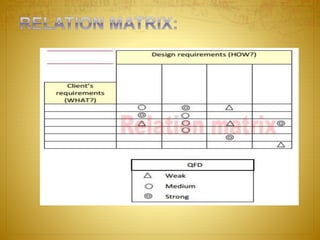
  • #9 “Voice of the Customer” (VOC):QFD starts with the establishment of objectives. These objectives derive from clients’ requirements and are called the “Voice of the Customer”. Design requirements:The “how” are the design requirements of the service.; it is necessary to define how each client’s requirement will be satisfied by the service. These are measurable features that can be evaluated at the end of the development process. Relation matrix:Relations between the client and design requirements are not always 1:1, there are complex relationships and varying levels of strength. A single design requirement may have an influence on several of the client’s requirements.
  • #10 An empty column indicates no relationship between the client and design requirements. This may reveal that the translation from “What” into “How” was not properly conducted.