Service Customer
Classification
BY: KUMAR ABHISHEK
What is Service and Customer?
Service:-
◦ Services usually refer to processes and not physical products. Some services may
include people whereas other services (like online services) may including objects which are
managed by people.
Customer:-
◦ A customer is an individual or business that purchases the goods or services produced by a
business.
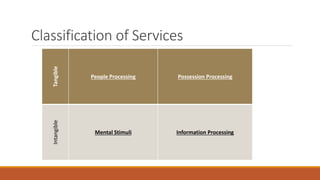
Classification of Services
Tangible
People Processing Possession Processing
Intangible
Mental Stimuli Information Processing
Continued
Tangible Actions
Service for Peoples
Health care
Restaurants
Saloons
Service for Goods
Transportations
Courier (C2C)
Logistics (B2B)
Repairs &
Maintenance
B2B
B2C
Dry Cleaning
Continued
Intangible Actions
Mental Stimuli
Education
Theaters
Information
Services as Media
Information
Processing
Banking
Legal Services
Insurance
Types of Customers
Loyal Customers
Discount Customers
Impulsive Customers
Need Based Customers
Wandering Customers
Orientation of Customers
Cost Oriented Customers
Value Oriented Customers
Technology Oriented Customers
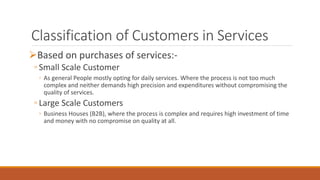
Classification of Customers in Services
Based on purchases of services:-
◦ Small Scale Customer
◦ As general People mostly opting for daily services. Where the process is not too much
complex and neither demands high precision and expenditures without compromising the
quality of services.
◦ Large Scale Customers
◦ Business Houses (B2B), where the process is complex and requires high investment of time
and money with no compromise on quality at all.
Thank You

Service customer classification

  • 1.
  • 2.
    What is Serviceand Customer? Service:- ◦ Services usually refer to processes and not physical products. Some services may include people whereas other services (like online services) may including objects which are managed by people. Customer:- ◦ A customer is an individual or business that purchases the goods or services produced by a business.
  • 3.
    Classification of Services Tangible PeopleProcessing Possession Processing Intangible Mental Stimuli Information Processing
  • 4.
    Continued Tangible Actions Service forPeoples Health care Restaurants Saloons Service for Goods Transportations Courier (C2C) Logistics (B2B) Repairs & Maintenance B2B B2C Dry Cleaning
  • 5.
    Continued Intangible Actions Mental Stimuli Education Theaters Information Servicesas Media Information Processing Banking Legal Services Insurance
  • 6.
    Types of Customers LoyalCustomers Discount Customers Impulsive Customers Need Based Customers Wandering Customers
  • 7.
    Orientation of Customers CostOriented Customers Value Oriented Customers Technology Oriented Customers
  • 8.
    Classification of Customersin Services Based on purchases of services:- ◦ Small Scale Customer ◦ As general People mostly opting for daily services. Where the process is not too much complex and neither demands high precision and expenditures without compromising the quality of services. ◦ Large Scale Customers ◦ Business Houses (B2B), where the process is complex and requires high investment of time and money with no compromise on quality at all.
  • 9.

Editor's Notes

  • #5 Classification of service based on tangible action – Wherever people or products are involved directly, the service classification can be done based on tangibility. a) Services for people – Like Health care, restaurants and saloons, where the service is delivered by people to people. b) Services for goods – Like transportation, repair and maintenance and others. Where services are given by people for objects or goods.
  • #6 Classification of services based on intangibility – There are objects in this world which cannot be tangibly quantified. For example – the number of algorithms it takes to execute your banking order correctly, or the value of your life which is forecasted by insurance agents. These services are classified on the basis of intangibility. a) Services directed at people’s mind – Services sold through influencing the creativity of humans are classified on the basis of intangibility. b) Services directed at intangible assets – Banking, legal services, and insurance services are some of the services most difficult to price and quantify.
  • #7 Loyal Customers- These types of customers are less in numbers but promote more sales and profit as compared to other customers as these are the ones which are completely satisfied. These customers revisit the organization over times hence it is crucial to interact and keep in touch with them on a regular basis and invest much time and effort with them. Loyal customers want individual attention and that demands polite and respectful responses from supplier. Discount Customers- Discount customers are also frequent visitors but they are only a part of business when offered with discounts on regular products and brands or they buy only low cost products. More is the discount the more they tend towards buying. These customers are mostly related to small industries or the industries that focus on low or marginal investments on products. Focus on these types of customers is also important as they also promote distinguished part of profit into business. Impulsive Customers- These customers are difficult to convince as they want to do the business in urge or caprice. They don’t have any specific item into their product list but urge to buy what they find good and productive at that point of time. Handling these customers is a challenge as they are not particularly looking for a product and want the supplier to display all the useful products they have in their tally in front of them so that they can buy what they like from that display. If impulsive customers are treated accordingly then there is high probability that these customers could be a responsible for high percentage of selling. Need Based Customers- These customers are product specific and only tend to buy items only to which they are habitual or have a specific need for them. These are frequent customers but do not become a part of buying most of the times so it is difficult to satisfy them. These customers should be handled positively by showing them ways and reasons to switch to other similar products and brands and initiating them to buy these. These customers could possibly be lost if not tackled efficiently with positive interaction. Wandering Customers- These are the least profitable customers as sometimes they themselves are not sure what to buy. These customers are normally new in industry and most of the times visit suppliers only for confirming their needs on products. They investigate features of most prominent products in the market but do not buy any of those or show least interest in buying. To grab such customers they should be properly informed about the various positive features of the products so that they develop a sense of interest.
  • #8 Cost Oriented Customers- A cost-oriented customer focuses on least costs products and is ready to compromise on efficacy, performance and quality. These types of customers are always prone to loss as when they have sudden problems with the products they always blame the supplier without judging that they themselves are responsible for this loss. Some of the related type customers have a tendency to fix problems locally without taking supplier’s direct help as it is anyway cheaper. For example, some customers try to repair costly machines by local vendors. These vendors do the work with marginal profit, so accountably are very cheap, but whatever they do is not quality work as they are not the actual manufacturer of that particular product and may lack in many aspects while repairing the machine. In case the machine fails the second time, these customers put the blame to the original supplier and he then has to pay for that. In some cases these customers are also ready to buy second hand products and then challenging it to perform as a new one. Hence the suppliers should always focus on strategies which are not only performance or quality driven but also self driven, otherwise they always find themselves arrested in payment related problems and they again have to put a lot of effort and cost on running for payment from these customers. Value Oriented Customers- Value oriented customers will always stick to efficient and high performing products as they know that during a long run this would be a profitable deal. They are interested in investing higher initial capital cost and then enjoy the cost free benefits in future. According to these customers this type of deal is like a long term investment with higher future profit. In some cases these types of customers are also ready to pay premium because they know that this would make a better economic sense during a long run and there will always be lesser maintenance efforts required. These customers are tended towards maintaining a healthy relationship with suppliers as they are the satisfied customers. Technology Oriented Customers- These customers opt for best technology rather then less cost or good quality and performance. These customers are technology conscious because they feel that usage of best and newest technological products would help them to remain sustained in the changing technological environment. For suppliers who are based on making or launching trended technological products have a good chance in capturing these customers and finding business out of them. These customers are innovative and have zeal towards technical aspects. They also have a tendency for experimenting new things and do interact with people of same nature or tendency, so the suppliers are helped by them in creating new referrals and increase the business. These customers are also satisfied customers and ends by making worthy relationships with suppliers.