
Chapter 2
NAME MATRIC NUMBER
NUR FATIN FATIHAH BINTI AHMAD RUZI 2013
PRESENTER
PREPARED FOR : PM DR SHIREEN
PUBLIC SERVICE MANAGEMENT & QUALITY
UNIVERSITI TEKNOLOGI MARA SHAH ALAM
FACULTY OF ADMINISTRATIVE SCIENCE AND POLICY STUDIES
UNDERSTANDING SERVICES (PUBLIC)
 Atomistic model of service
 Bases of classification
 Implication classification
 The front stage/ delivery system
 The back stage/ technical system
 The marketing system
 Core and peripheral service
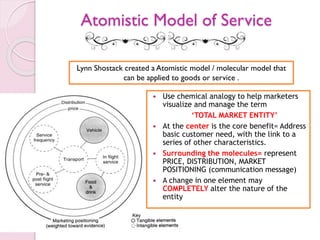
Atomistic Model of Service
Lynn Shostack created a Atomistic model / molecular model that
can be applied to goods or service .
 Use chemical analogy to help marketers
visualize and manage the term
‘TOTAL MARKET ENTITY’
 At the center is the core benefit= Address
basic customer need, with the link to a
series of other characteristics.
 Surrounding the molecules= represent
PRICE, DISTRIBUTION, MARKET
POSITIONING (communication message)
 A change in one element may
COMPLETELY alter the nature of the
entity
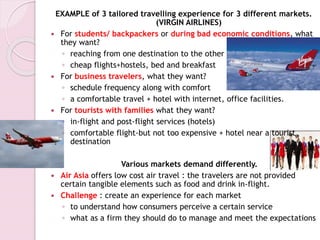
EXAMPLE of 3 tailored travelling experience for 3 different markets.
(VIRGIN AIRLINES)
 For students/ backpackers or during bad economic conditions, what
they want?
◦ reaching from one destination to the other
◦ cheap flights+hostels, bed and breakfast
 For business travelers, what they want?
◦ schedule frequency along with comfort
◦ a comfortable travel + hotel with internet, office facilities.
 For tourists with families what they want?
◦ in-flight and post-flight services (hotels)
◦ comfortable flight-but not too expensive + hotel near a tourist
destination
Various markets demand differently.
 Air Asia offers low cost air travel : the travelers are not provided
certain tangible elements such as food and drink in-flight.
 Challenge : create an experience for each market
◦ to understand how consumers perceive a certain service
◦ what as a firm they should do to manage and meet the expectations
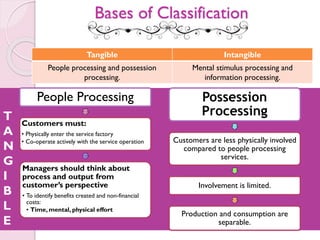
Bases of Classification
Tangible Intangible
People processing and possession
processing.
Mental stimulus processing and
information processing.
People Processing
Customers must:
• Physically enter the service factory
• Co-operate actively with the service operation
Managers should think about
process and output from
customer’s perspective
• To identify benefits created and non-financial
costs:
• Time, mental, physical effort
Possession
Processing
Customers are less physically involved
compared to people processing
services.
Involvement is limited.
Production and consumption are
separable.
T
A
N
G
I
B
L
E
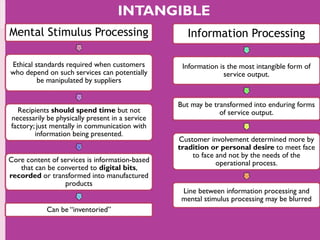
Mental Stimulus Processing
Ethical standards required when customers
who depend on such services can potentially
be manipulated by suppliers
Recipients should spend time but not
necessarily be physically present in a service
factory; just mentally in communication with
information being presented.
Core content of services is information-based
that can be converted to digital bits,
recorded or transformed into manufactured
products
Can be “inventoried”
Information Processing
Information is the most intangible form of
service output.
But may be transformed into enduring forms
of service output.
Customer involvement determined more by
tradition or personal desire to meet face
to face and not by the needs of the
operational process.
Line between information processing and
mental stimulus processing may be blurred
INTANGIBLE
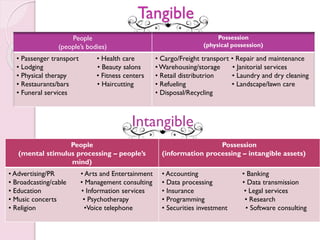
Tangible
People
(people’s bodies)
Possession
(physical possession)
• Passenger transport • Health care
• Lodging • Beauty salons
• Physical therapy • Fitness centers
• Restaurants/bars • Haircutting
• Funeral services
• Cargo/Freight transport • Repair and maintenance
• Warehousing/storage • Janitorial services
• Retail distributrion • Laundry and dry cleaning
• Refueling • Landscape/lawn care
• Disposal/Recycling
Intangible
People
(mental stimulus processing – people’s
mind)
Possession
(information processing – intangible assets)
• Advertising/PR • Arts and Entertainment
• Broadcasting/cable • Management consulting
• Education • Information services
• Music concerts • Psychotherapy
• Religion •Voice telephone
• Accounting • Banking
• Data processing • Data transmission
• Insurance • Legal services
• Programming • Research
• Securities investment • Software consulting
Implication of Classification
 Design of the service factory .
 Alternative channels for service delivery.
 Balancing demand and supply.
 Make the most of information technology.
 Clarifying the benefits delivered.
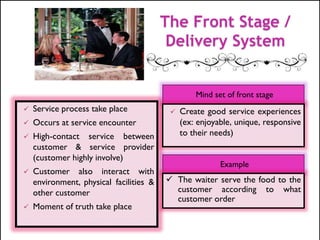
The Front Stage /
Delivery System
 Service process take place
 Occurs at service encounter
 High-contact service between
customer & service provider
(customer highly involve)
 Customer also interact with
environment, physical facilities &
other customer
 Moment of truth take place
Mind set of front stage
 Create good service experiences
(ex: enjoyable, unique, responsive
to their needs)
Example
 The waiter serve the food to the
customer according to what
customer order
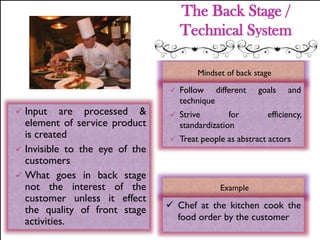
The Back Stage /
Technical System
 Input are processed &
element of service product
is created
 Invisible to the eye of the
customers
 What goes in back stage
not the interest of the
customer unless it effect
the quality of front stage
activities.
Mindset of back stage
 Follow different goals and
technique
 Strive for efficiency,
standardization
 Treat people as abstract actors
Example
 Chef at the kitchen cook the
food order by the customer
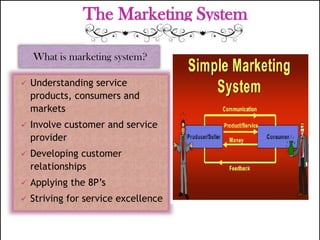
The Marketing System
What is marketing system?
 Understanding service
products, consumers and
markets
 Involve customer and service
provider
 Developing customer
relationships
 Applying the 8P’s
 Striving for service excellence
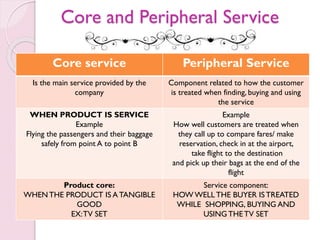
Core and Peripheral Service
Core service Peripheral Service
Is the main service provided by the
company
Component related to how the customer
is treated when finding, buying and using
the service
WHEN PRODUCT IS SERVICE
Example
Flying the passengers and their baggage
safely from point A to point B
Example
How well customers are treated when
they call up to compare fares/ make
reservation, check in at the airport,
take flight to the destination
and pick up their bags at the end of the
flight
Product core:
WHEN THE PRODUCT IS A TANGIBLE
GOOD
EX:TV SET
Service component:
HOW WELL THE BUYER ISTREATED
WHILE SHOPPING, BUYING AND
USING THETV SET
QUESTION AND ANSWER SESSION

Chapter 2 Understanding Service (Public)

  • 1.
    Chapter 2 NAME MATRICNUMBER NUR FATIN FATIHAH BINTI AHMAD RUZI 2013 PRESENTER PREPARED FOR : PM DR SHIREEN PUBLIC SERVICE MANAGEMENT & QUALITY UNIVERSITI TEKNOLOGI MARA SHAH ALAM FACULTY OF ADMINISTRATIVE SCIENCE AND POLICY STUDIES
  • 3.
    UNDERSTANDING SERVICES (PUBLIC) Atomistic model of service  Bases of classification  Implication classification  The front stage/ delivery system  The back stage/ technical system  The marketing system  Core and peripheral service
  • 4.
    Atomistic Model ofService Lynn Shostack created a Atomistic model / molecular model that can be applied to goods or service .  Use chemical analogy to help marketers visualize and manage the term ‘TOTAL MARKET ENTITY’  At the center is the core benefit= Address basic customer need, with the link to a series of other characteristics.  Surrounding the molecules= represent PRICE, DISTRIBUTION, MARKET POSITIONING (communication message)  A change in one element may COMPLETELY alter the nature of the entity
  • 5.
    EXAMPLE of 3tailored travelling experience for 3 different markets. (VIRGIN AIRLINES)  For students/ backpackers or during bad economic conditions, what they want? ◦ reaching from one destination to the other ◦ cheap flights+hostels, bed and breakfast  For business travelers, what they want? ◦ schedule frequency along with comfort ◦ a comfortable travel + hotel with internet, office facilities.  For tourists with families what they want? ◦ in-flight and post-flight services (hotels) ◦ comfortable flight-but not too expensive + hotel near a tourist destination Various markets demand differently.  Air Asia offers low cost air travel : the travelers are not provided certain tangible elements such as food and drink in-flight.  Challenge : create an experience for each market ◦ to understand how consumers perceive a certain service ◦ what as a firm they should do to manage and meet the expectations
  • 6.
    Bases of Classification TangibleIntangible People processing and possession processing. Mental stimulus processing and information processing. People Processing Customers must: • Physically enter the service factory • Co-operate actively with the service operation Managers should think about process and output from customer’s perspective • To identify benefits created and non-financial costs: • Time, mental, physical effort Possession Processing Customers are less physically involved compared to people processing services. Involvement is limited. Production and consumption are separable. T A N G I B L E
  • 7.
    Mental Stimulus Processing Ethicalstandards required when customers who depend on such services can potentially be manipulated by suppliers Recipients should spend time but not necessarily be physically present in a service factory; just mentally in communication with information being presented. Core content of services is information-based that can be converted to digital bits, recorded or transformed into manufactured products Can be “inventoried” Information Processing Information is the most intangible form of service output. But may be transformed into enduring forms of service output. Customer involvement determined more by tradition or personal desire to meet face to face and not by the needs of the operational process. Line between information processing and mental stimulus processing may be blurred INTANGIBLE
  • 8.
    Tangible People (people’s bodies) Possession (physical possession) •Passenger transport • Health care • Lodging • Beauty salons • Physical therapy • Fitness centers • Restaurants/bars • Haircutting • Funeral services • Cargo/Freight transport • Repair and maintenance • Warehousing/storage • Janitorial services • Retail distributrion • Laundry and dry cleaning • Refueling • Landscape/lawn care • Disposal/Recycling Intangible People (mental stimulus processing – people’s mind) Possession (information processing – intangible assets) • Advertising/PR • Arts and Entertainment • Broadcasting/cable • Management consulting • Education • Information services • Music concerts • Psychotherapy • Religion •Voice telephone • Accounting • Banking • Data processing • Data transmission • Insurance • Legal services • Programming • Research • Securities investment • Software consulting
  • 9.
    Implication of Classification Design of the service factory .  Alternative channels for service delivery.  Balancing demand and supply.  Make the most of information technology.  Clarifying the benefits delivered.
  • 10.
    The Front Stage/ Delivery System  Service process take place  Occurs at service encounter  High-contact service between customer & service provider (customer highly involve)  Customer also interact with environment, physical facilities & other customer  Moment of truth take place Mind set of front stage  Create good service experiences (ex: enjoyable, unique, responsive to their needs) Example  The waiter serve the food to the customer according to what customer order
  • 11.
    The Back Stage/ Technical System  Input are processed & element of service product is created  Invisible to the eye of the customers  What goes in back stage not the interest of the customer unless it effect the quality of front stage activities. Mindset of back stage  Follow different goals and technique  Strive for efficiency, standardization  Treat people as abstract actors Example  Chef at the kitchen cook the food order by the customer
  • 12.
    The Marketing System Whatis marketing system?  Understanding service products, consumers and markets  Involve customer and service provider  Developing customer relationships  Applying the 8P’s  Striving for service excellence
  • 13.
    Core and PeripheralService Core service Peripheral Service Is the main service provided by the company Component related to how the customer is treated when finding, buying and using the service WHEN PRODUCT IS SERVICE Example Flying the passengers and their baggage safely from point A to point B Example How well customers are treated when they call up to compare fares/ make reservation, check in at the airport, take flight to the destination and pick up their bags at the end of the flight Product core: WHEN THE PRODUCT IS A TANGIBLE GOOD EX:TV SET Service component: HOW WELL THE BUYER ISTREATED WHILE SHOPPING, BUYING AND USING THETV SET
  • 14.