On Algebraic Relations of Serpent S-Boxes
Bhupendra Singh, Lexy Alexander, Sanjay Burman
Email:{scientistbsingh, lexyalexander, sanjayburman}@gmail.com
CAIR, DRDO, Bangalore - 560093, India.
Abstract: Serpent is a 128-bit block cipher designed by Ross Anderson, Eli Biham and Lars Knudsen
as a candidate for the Advanced Encryption Standard (AES). It was a finalist in the AES competition.
The winner, Rijndael, got 86 votes at the last AES conference while Serpent got 59 votes [1]. The
designers of Serpent claim that Serpent is more secure than Rijndael.In this paper we have observed
that the nonlinear order of all output bits of serpent S-boxes are not 3 as it is claimed by the designers.
1 Introduction
Serpent [2] is one of the five block ciphers chosen as AES finalists. It is a 32-round SP-network
operating on four 32-bit words, thus having a block size of 128 bits. The cipher consists of:
• An initial permutation IP;
• 32 rounds, each consisting of a key mixing operation, a pass through S-boxes, and (in all but
the last round) a linear transformation. In the last round, this linear transformation is replaced
by an additional key mixing operation;
• A final permutation FP;
The 32 rounds use 8 different S-boxes each of which maps four inputs bits to four output bits. Each
S-box is used in precisely four rounds, and in each of these rounds it is used 32 times in parallel.
2 The S-boxes
In the description of the design of S-boxes [Section 2.1,[2]], it is claimed that “The S-boxes of Serpent
are 4-bit permutations with the following properties:
- each differential characteristic has a probability of at most 1/4, and a one-bit input difference will
never lead to a one-bit output difference;
- each linear characteristic has a probability in the range 1/2 ± 1/4, and a linear relation between one
single bit in the input and one single bit in the output has a probability in the range 1/2 ± 1/8;
-the nonlinear order of the output bits as a function of the input bits is the maximum,
namely 3.”
But we have found there are some output bits whose nonlinear order as a function of the input
bits is only 2. Contrary to the designers claim that the nonlinear order of the output bits of S-boxes
are 3.
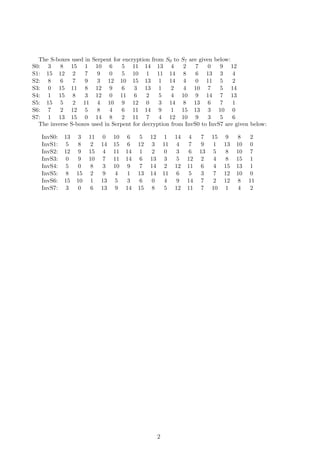
The S-boxes used in Serpent for encryption from S0 to S7 are given below:
S0: 3 8 15 1 10 6 5 11 14 13 4 2 7 0 9 12
S1: 15 12 2 7 9 0 5 10 1 11 14 8 6 13 3 4
S2: 8 6 7 9 3 12 10 15 13 1 14 4 0 11 5 2
S3: 0 15 11 8 12 9 6 3 13 1 2 4 10 7 5 14
S4: 1 15 8 3 12 0 11 6 2 5 4 10 9 14 7 13
S5: 15 5 2 11 4 10 9 12 0 3 14 8 13 6 7 1
S6: 7 2 12 5 8 4 6 11 14 9 1 15 13 3 10 0
S7: 1 13 15 0 14 8 2 11 7 4 12 10 9 3 5 6
The inverse S-boxes used in Serpent for decryption from InvS0 to InvS7 are given below:
InvS0: 13 3 11 0 10 6 5 12 1 14 4 7 15 9 8 2
InvS1: 5 8 2 14 15 6 12 3 11 4 7 9 1 13 10 0
InvS2: 12 9 15 4 11 14 1 2 0 3 6 13 5 8 10 7
InvS3: 0 9 10 7 11 14 6 13 3 5 12 2 4 8 15 1
InvS4: 5 0 8 3 10 9 7 14 2 12 11 6 4 15 13 1
InvS5: 8 15 2 9 4 1 13 14 11 6 5 3 7 12 10 0
InvS6: 15 10 1 13 5 3 6 0 4 9 14 7 2 12 8 11
InvS7: 3 0 6 13 9 14 15 8 5 12 11 7 10 1 4 2
2
3 Algebraic Relations of Serpent S-Boxes
Let x3, x2, x1, x0 be the input bits to a S-box and let si,3, si,2, si,2, si,0 denote the output bits of the
ith S-box Si. Then, we can represent each of the output bit as a function of the input bits as follows:
s0,3 = x0 + x1 + x2 + x3 + x3x0
s0,2 = x1 + x1x0 + x2x0 + x2x1x0 + x3 + x3x1 + x3x2x1
s0,1 = 1 + x0 + x2x0 + x2x1 + x2x1x0 + x3x1 + x3x2x0 + x3x2x1
s0,0 = 1 + x0 + x1x0 + x2 + x2x0 + x2x1 + x2x1x0 + x3 + x3x2x0 + x3x2x1
s1,3 = 1 + x1 + x2x0 + x3 + x3x0 + x3x1x0 + x3x2x0 + x3x2x1
s1,2 = 1 + x1 + x1x0 + x2 + x3
s1,1 = 1 + x0 + x1x0 + x2 + x2x0 + x3 + x3x1 + x3x1x0 + x3x2x0 + x3x2x1
s1,0 = 1 + x0 + x1 + x2x1 + x3x0 + x3x2 + x3x2x0 + x3x2x1
s2,3 = 1 + x0 + x1 + x2 + x2x1x0 + x3x1
s2,2 = x0 + x1 + x2x1 + x3 + x3x1 + x3x1x0 + x3x2 + x3x2x0
s2,1 = x0 + x1 + x2 + x2x1 + x2x1x0 + x3x0 + x3x1x0 + x3x2 + x3x2x0
s2,0 = x1 + x2 + x2x0 + x3
s3,3 = x0 + x1 + x1x0 + x2 + x2x0 + x2x1x0 + x3 + x3x2 + x3x2x0
s3,2 = x0 + x1x0 + x2 + x2x1x0 + x3 + x3x1 + x3x1x0
s3,1 = x0 + x1 + x2x0 + x3x0 + x3x1x0 + x3x2 + x3x2x0
s3,0 = x0 + x1 + x2x1 + x3 + x3x0 + x3x2 + x3x2x0 + x3x2x1
s4,3 = x0 + x1 + x2 + x2x1 + x3x0 + x3x1 + x3x1x0
s4,2 = x0 + x1x0 + x2 + x2x1 + x2x1x0 + x3x1 + x3x1x0 + x3x2 + x3x2x1
s4,1 = x0 + x2x0 + x2x1 + x3 + x3x1 + x3x2 + x3x2x0 + x3x2x1
s4,0 = 1 + x1 + x1x0 + x2 + x3 + x3x0 + x3x1
s5,3 = 1 + x0 + x1 + x2 + x2x1x0 + x3 + x3x0 + x3x2x0
s5,2 = 1 + x1 + x2x0 + x3 + x3x1x0 + x3x2 + x3x2x0 + x3x2x1
s5,1 = 1 + x0 + x1x0 + x2 + x3 + x3x1 + x3x1x0 + x3x2
s5,0 = 1 + x1 + x1x0 + x2 + x3 + x3x0 + x3x1
s6,3 = x1 + x1x0 + x2 + x2x0 + x2x1x0 + x3 + x3x2 + x3x2x1
s6,2 = 1 + x0 + x1x0 + x2 + x2x1 + x2x1x0 + x3x1 + x3x1x0 + x3x2 + x3x2x1
s6,1 = 1 + x1 + x2 + x3x0
s6,0 = 1 + x0 + x1 + x2 + x2x0 + x2x1 + x2x1x0 + x3 + x3x1x0 + x3x2x1
s7,3 = x0 + x1 + x2 + x2x0 + x2x1x0 + x3x0
s7,2 = x0 + x1 + x2 + x2x1x0 + x3 + x3x0 + x3x1 + x3x1x0 + x3x2x1
s7,1 = x1 + x1x0 + x2 + x2x0 + x2x1 + x3 + x3x0 + x3x1x0 + x3x2x0
s7,0 = 1 + x1x0 + x2 + x3x0 + x3x1 + x3x2 + x3x2x0 + x3x2x1
It can be seen from above para that some of the output bits are functions of the input bits with
nonlinear order 2, namely s0,3, s1,2, s2,0, s4,0, s5,0, s6,1. Also s4,0 and s5,0 are identical.
Also, we can see that in the case of inverse S-boxes the nonlinear order of the output bits of the
Serpent S-box is either 2 or 3. Let x3, x2, x1, x0 be the input bits to an Inverse S-box and let invsi,3,
invsi,2, invsi,2, invsi,0 denote the output bits of the ith inverse S-box InvSi.
3
invs0,3 = 1 + x0 + x2x1 + x3 + x3x1x0 + x3x2 + x3x2x0 + x3x2x1
invs0,2 = 1 + x0 + x1 + x1x0 + x2 + x3
invs0,1 = x0 + x1 + x2 + x2x0 + x3x1 + x3x2x0 + x3x2x1
invs0,0 = 1 + x1x0 + x2 + x2x1 + x3x0 + x3x1 + x3x1x0 + x3x2 + x3x2x0 + x3x2x1
invs1,3 = x0 + x2 + x3 + x3x1
invs1,2 = 1 + x0 + x1 + x2x0 + x2x1 + x2x1x0 + x3 + x3x2x0
invs1,1 = x1 + x2 + x2x1x0 + x3 + x3x0 + x3x1 + x3x2x0 + x3x2x1
invs1,0 = 1 + x0 + x1 + x1x0 + x2x1x0 + x3x1 + x3x2x0 + x3x2x1
invs2,3 = 1 + x1x0 + x2x1 + x2x1x0 + x3 + x3x2x0
invs2,2 = 1 + x0 + x1x0 + x2 + x3 + x3x0 + x3x1 + x3x1x0 + x3x2x0
invs2,1 = x1 + x1x0 + x2 + x3x0 + x3x1x0 + x3x2 + x3x2x0
invs2,0 = x0 + x1 + x2 + x2x1 + x3x1
invs3,3 = x0 + x1 + x2 + x2x0 + x2x1x0 + x3x0 + x3x1x0 + x3x2
invs3,2 = x1x0 + x2x0 + x2x1 + x3x0 + x3x1 + x3x1x0 + x3x2 + x3x2x0
invs3,1 = x1 + x2 + x2x1 + x2x1x0 + x3 + x3x0 + x3x2x0 + x3x2x1
invs3,0 = x0 + x2 + x2x1 + x3 + x3x0 + x3x1 + x3x2x1
invs4,3 = x1 + x1x0 + x2 + x3x0 + x3x1x0 + x3x2
invs4,2 = 1 + x0 + x1 + x1x0 + x2 + x2x0 + x2x1x0 + x3 + x3x1 + x3x1x0
invs4,1 = x1x0 + x2 + x2x0 + x3 + x3x0 + x3x2x0
invs4,0 = 1 + x0 + x1 + x2 + x3 + x3x0 + x3x1x0 + x3x2 + x3x2x0
invs5,3 = 1 + x1 + x1x0 + x2 + x2x1x0 + x3x0
invs5,2 = x0 + x1x0 + x2 + x3x1 + x3x1x0 + x3x2x0
invs5,1 = x0 + x1 + x2x0 + x2x1 + x2x1x0 + x3 + x3x0 + x3x1x0
invs5,0 = x0 + x2x1 + x3 + x3x1x0
invs6,3 = 1 + x1 + x1x0 + x2 + x2x1 + x2x1x0 + x3 + x3x0 + x3x1x0 + x3x2 + x3x2x1
invs6,2 = 1 + x0 + x1 + x2x1 + x3x1 + x3x1x0 + x3x2 + x3x2x1
invs6,1 = 1 + x1 + x2 + x2x0 + x3
invs6,0 = 1 + x0 + x1x0 + x2x0 + x2x1 + x2x1x0 + x3 + x3x1x0 + x3x2x1
invs7,3 = x1x0 + x2 + x2x1x0 + x3x0 + x3x1 + x3x1x0
invs7,2 = x1 + x2x0 + x3 + x3x1x0 + x3x2 + x3x2x0
invs7,1 = 1 + x0 + x2 + x2x1 + x3 + x3x0 + x3x1 + x3x2x0 + x3x2x1
invs7,0 = 1 + x0 + x1 + x2x1 + x3x1 + x3x1x0 + x3x2 + x3x2x1
It can be seen that from the above para the output bits invs0,2, invs1,3, invs2,0, invs6,1 are func-
tions of the input bits with nonlinear order 2.
Conclusion: We find that there is some discrepancy between the properties of the actual S-boxes of
Serpent and the claims of the designers. It is surprising that this has not been pointed out by any
body so long. This leads the revisiting the Security of the serpent.
Acknowledgment: The authors thank Director and Associate Director of CAIR, DRDO for their
constant support and encouragement for this work.
References
[1] http://www.cl.cam.ac.uk/ rja14/serpent.html.
[2] Anderson, R., Biham, E., Knudsen, L,R. Serpent: A Proposal for the Advanced Encryption Stan-
dard, NIST AES Proposal (1998).
4

Serpent sboxes

  • 1.
    On Algebraic Relationsof Serpent S-Boxes Bhupendra Singh, Lexy Alexander, Sanjay Burman Email:{scientistbsingh, lexyalexander, sanjayburman}@gmail.com CAIR, DRDO, Bangalore - 560093, India. Abstract: Serpent is a 128-bit block cipher designed by Ross Anderson, Eli Biham and Lars Knudsen as a candidate for the Advanced Encryption Standard (AES). It was a finalist in the AES competition. The winner, Rijndael, got 86 votes at the last AES conference while Serpent got 59 votes [1]. The designers of Serpent claim that Serpent is more secure than Rijndael.In this paper we have observed that the nonlinear order of all output bits of serpent S-boxes are not 3 as it is claimed by the designers. 1 Introduction Serpent [2] is one of the five block ciphers chosen as AES finalists. It is a 32-round SP-network operating on four 32-bit words, thus having a block size of 128 bits. The cipher consists of: • An initial permutation IP; • 32 rounds, each consisting of a key mixing operation, a pass through S-boxes, and (in all but the last round) a linear transformation. In the last round, this linear transformation is replaced by an additional key mixing operation; • A final permutation FP; The 32 rounds use 8 different S-boxes each of which maps four inputs bits to four output bits. Each S-box is used in precisely four rounds, and in each of these rounds it is used 32 times in parallel. 2 The S-boxes In the description of the design of S-boxes [Section 2.1,[2]], it is claimed that “The S-boxes of Serpent are 4-bit permutations with the following properties: - each differential characteristic has a probability of at most 1/4, and a one-bit input difference will never lead to a one-bit output difference; - each linear characteristic has a probability in the range 1/2 ± 1/4, and a linear relation between one single bit in the input and one single bit in the output has a probability in the range 1/2 ± 1/8; -the nonlinear order of the output bits as a function of the input bits is the maximum, namely 3.” But we have found there are some output bits whose nonlinear order as a function of the input bits is only 2. Contrary to the designers claim that the nonlinear order of the output bits of S-boxes are 3.
  • 2.
    The S-boxes usedin Serpent for encryption from S0 to S7 are given below: S0: 3 8 15 1 10 6 5 11 14 13 4 2 7 0 9 12 S1: 15 12 2 7 9 0 5 10 1 11 14 8 6 13 3 4 S2: 8 6 7 9 3 12 10 15 13 1 14 4 0 11 5 2 S3: 0 15 11 8 12 9 6 3 13 1 2 4 10 7 5 14 S4: 1 15 8 3 12 0 11 6 2 5 4 10 9 14 7 13 S5: 15 5 2 11 4 10 9 12 0 3 14 8 13 6 7 1 S6: 7 2 12 5 8 4 6 11 14 9 1 15 13 3 10 0 S7: 1 13 15 0 14 8 2 11 7 4 12 10 9 3 5 6 The inverse S-boxes used in Serpent for decryption from InvS0 to InvS7 are given below: InvS0: 13 3 11 0 10 6 5 12 1 14 4 7 15 9 8 2 InvS1: 5 8 2 14 15 6 12 3 11 4 7 9 1 13 10 0 InvS2: 12 9 15 4 11 14 1 2 0 3 6 13 5 8 10 7 InvS3: 0 9 10 7 11 14 6 13 3 5 12 2 4 8 15 1 InvS4: 5 0 8 3 10 9 7 14 2 12 11 6 4 15 13 1 InvS5: 8 15 2 9 4 1 13 14 11 6 5 3 7 12 10 0 InvS6: 15 10 1 13 5 3 6 0 4 9 14 7 2 12 8 11 InvS7: 3 0 6 13 9 14 15 8 5 12 11 7 10 1 4 2 2
  • 3.
    3 Algebraic Relationsof Serpent S-Boxes Let x3, x2, x1, x0 be the input bits to a S-box and let si,3, si,2, si,2, si,0 denote the output bits of the ith S-box Si. Then, we can represent each of the output bit as a function of the input bits as follows: s0,3 = x0 + x1 + x2 + x3 + x3x0 s0,2 = x1 + x1x0 + x2x0 + x2x1x0 + x3 + x3x1 + x3x2x1 s0,1 = 1 + x0 + x2x0 + x2x1 + x2x1x0 + x3x1 + x3x2x0 + x3x2x1 s0,0 = 1 + x0 + x1x0 + x2 + x2x0 + x2x1 + x2x1x0 + x3 + x3x2x0 + x3x2x1 s1,3 = 1 + x1 + x2x0 + x3 + x3x0 + x3x1x0 + x3x2x0 + x3x2x1 s1,2 = 1 + x1 + x1x0 + x2 + x3 s1,1 = 1 + x0 + x1x0 + x2 + x2x0 + x3 + x3x1 + x3x1x0 + x3x2x0 + x3x2x1 s1,0 = 1 + x0 + x1 + x2x1 + x3x0 + x3x2 + x3x2x0 + x3x2x1 s2,3 = 1 + x0 + x1 + x2 + x2x1x0 + x3x1 s2,2 = x0 + x1 + x2x1 + x3 + x3x1 + x3x1x0 + x3x2 + x3x2x0 s2,1 = x0 + x1 + x2 + x2x1 + x2x1x0 + x3x0 + x3x1x0 + x3x2 + x3x2x0 s2,0 = x1 + x2 + x2x0 + x3 s3,3 = x0 + x1 + x1x0 + x2 + x2x0 + x2x1x0 + x3 + x3x2 + x3x2x0 s3,2 = x0 + x1x0 + x2 + x2x1x0 + x3 + x3x1 + x3x1x0 s3,1 = x0 + x1 + x2x0 + x3x0 + x3x1x0 + x3x2 + x3x2x0 s3,0 = x0 + x1 + x2x1 + x3 + x3x0 + x3x2 + x3x2x0 + x3x2x1 s4,3 = x0 + x1 + x2 + x2x1 + x3x0 + x3x1 + x3x1x0 s4,2 = x0 + x1x0 + x2 + x2x1 + x2x1x0 + x3x1 + x3x1x0 + x3x2 + x3x2x1 s4,1 = x0 + x2x0 + x2x1 + x3 + x3x1 + x3x2 + x3x2x0 + x3x2x1 s4,0 = 1 + x1 + x1x0 + x2 + x3 + x3x0 + x3x1 s5,3 = 1 + x0 + x1 + x2 + x2x1x0 + x3 + x3x0 + x3x2x0 s5,2 = 1 + x1 + x2x0 + x3 + x3x1x0 + x3x2 + x3x2x0 + x3x2x1 s5,1 = 1 + x0 + x1x0 + x2 + x3 + x3x1 + x3x1x0 + x3x2 s5,0 = 1 + x1 + x1x0 + x2 + x3 + x3x0 + x3x1 s6,3 = x1 + x1x0 + x2 + x2x0 + x2x1x0 + x3 + x3x2 + x3x2x1 s6,2 = 1 + x0 + x1x0 + x2 + x2x1 + x2x1x0 + x3x1 + x3x1x0 + x3x2 + x3x2x1 s6,1 = 1 + x1 + x2 + x3x0 s6,0 = 1 + x0 + x1 + x2 + x2x0 + x2x1 + x2x1x0 + x3 + x3x1x0 + x3x2x1 s7,3 = x0 + x1 + x2 + x2x0 + x2x1x0 + x3x0 s7,2 = x0 + x1 + x2 + x2x1x0 + x3 + x3x0 + x3x1 + x3x1x0 + x3x2x1 s7,1 = x1 + x1x0 + x2 + x2x0 + x2x1 + x3 + x3x0 + x3x1x0 + x3x2x0 s7,0 = 1 + x1x0 + x2 + x3x0 + x3x1 + x3x2 + x3x2x0 + x3x2x1 It can be seen from above para that some of the output bits are functions of the input bits with nonlinear order 2, namely s0,3, s1,2, s2,0, s4,0, s5,0, s6,1. Also s4,0 and s5,0 are identical. Also, we can see that in the case of inverse S-boxes the nonlinear order of the output bits of the Serpent S-box is either 2 or 3. Let x3, x2, x1, x0 be the input bits to an Inverse S-box and let invsi,3, invsi,2, invsi,2, invsi,0 denote the output bits of the ith inverse S-box InvSi. 3
  • 4.
    invs0,3 = 1+ x0 + x2x1 + x3 + x3x1x0 + x3x2 + x3x2x0 + x3x2x1 invs0,2 = 1 + x0 + x1 + x1x0 + x2 + x3 invs0,1 = x0 + x1 + x2 + x2x0 + x3x1 + x3x2x0 + x3x2x1 invs0,0 = 1 + x1x0 + x2 + x2x1 + x3x0 + x3x1 + x3x1x0 + x3x2 + x3x2x0 + x3x2x1 invs1,3 = x0 + x2 + x3 + x3x1 invs1,2 = 1 + x0 + x1 + x2x0 + x2x1 + x2x1x0 + x3 + x3x2x0 invs1,1 = x1 + x2 + x2x1x0 + x3 + x3x0 + x3x1 + x3x2x0 + x3x2x1 invs1,0 = 1 + x0 + x1 + x1x0 + x2x1x0 + x3x1 + x3x2x0 + x3x2x1 invs2,3 = 1 + x1x0 + x2x1 + x2x1x0 + x3 + x3x2x0 invs2,2 = 1 + x0 + x1x0 + x2 + x3 + x3x0 + x3x1 + x3x1x0 + x3x2x0 invs2,1 = x1 + x1x0 + x2 + x3x0 + x3x1x0 + x3x2 + x3x2x0 invs2,0 = x0 + x1 + x2 + x2x1 + x3x1 invs3,3 = x0 + x1 + x2 + x2x0 + x2x1x0 + x3x0 + x3x1x0 + x3x2 invs3,2 = x1x0 + x2x0 + x2x1 + x3x0 + x3x1 + x3x1x0 + x3x2 + x3x2x0 invs3,1 = x1 + x2 + x2x1 + x2x1x0 + x3 + x3x0 + x3x2x0 + x3x2x1 invs3,0 = x0 + x2 + x2x1 + x3 + x3x0 + x3x1 + x3x2x1 invs4,3 = x1 + x1x0 + x2 + x3x0 + x3x1x0 + x3x2 invs4,2 = 1 + x0 + x1 + x1x0 + x2 + x2x0 + x2x1x0 + x3 + x3x1 + x3x1x0 invs4,1 = x1x0 + x2 + x2x0 + x3 + x3x0 + x3x2x0 invs4,0 = 1 + x0 + x1 + x2 + x3 + x3x0 + x3x1x0 + x3x2 + x3x2x0 invs5,3 = 1 + x1 + x1x0 + x2 + x2x1x0 + x3x0 invs5,2 = x0 + x1x0 + x2 + x3x1 + x3x1x0 + x3x2x0 invs5,1 = x0 + x1 + x2x0 + x2x1 + x2x1x0 + x3 + x3x0 + x3x1x0 invs5,0 = x0 + x2x1 + x3 + x3x1x0 invs6,3 = 1 + x1 + x1x0 + x2 + x2x1 + x2x1x0 + x3 + x3x0 + x3x1x0 + x3x2 + x3x2x1 invs6,2 = 1 + x0 + x1 + x2x1 + x3x1 + x3x1x0 + x3x2 + x3x2x1 invs6,1 = 1 + x1 + x2 + x2x0 + x3 invs6,0 = 1 + x0 + x1x0 + x2x0 + x2x1 + x2x1x0 + x3 + x3x1x0 + x3x2x1 invs7,3 = x1x0 + x2 + x2x1x0 + x3x0 + x3x1 + x3x1x0 invs7,2 = x1 + x2x0 + x3 + x3x1x0 + x3x2 + x3x2x0 invs7,1 = 1 + x0 + x2 + x2x1 + x3 + x3x0 + x3x1 + x3x2x0 + x3x2x1 invs7,0 = 1 + x0 + x1 + x2x1 + x3x1 + x3x1x0 + x3x2 + x3x2x1 It can be seen that from the above para the output bits invs0,2, invs1,3, invs2,0, invs6,1 are func- tions of the input bits with nonlinear order 2. Conclusion: We find that there is some discrepancy between the properties of the actual S-boxes of Serpent and the claims of the designers. It is surprising that this has not been pointed out by any body so long. This leads the revisiting the Security of the serpent. Acknowledgment: The authors thank Director and Associate Director of CAIR, DRDO for their constant support and encouragement for this work. References [1] http://www.cl.cam.ac.uk/ rja14/serpent.html. [2] Anderson, R., Biham, E., Knudsen, L,R. Serpent: A Proposal for the Advanced Encryption Stan- dard, NIST AES Proposal (1998). 4