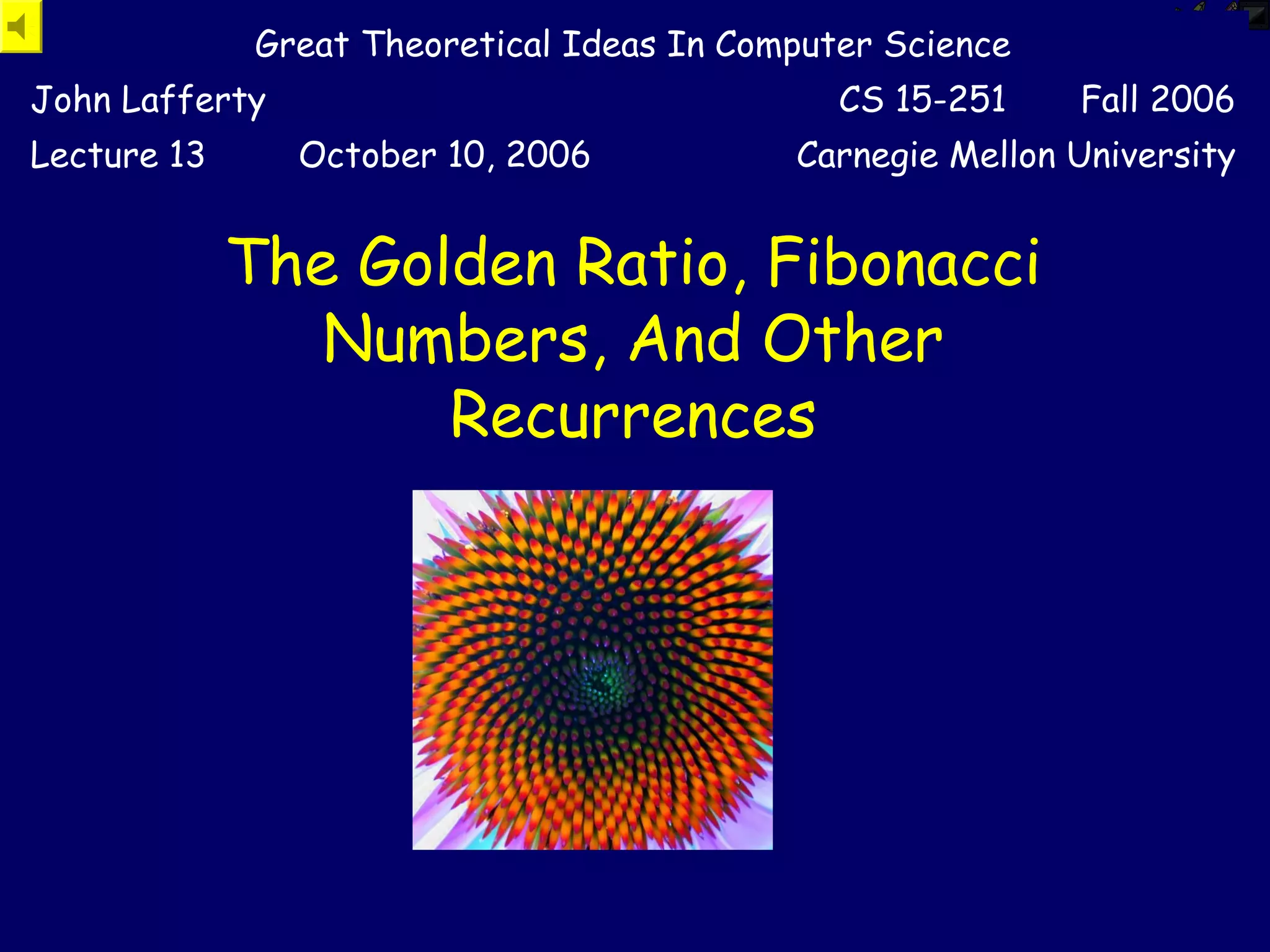
The Golden Ratio, Fibonacci
Numbers, And Other
Recurrences
Great Theoretical Ideas In Computer Science
John Lafferty CS 15-251 Fall 2006
Lecture 13 October 10, 2006 Carnegie Mellon University
Leonardo Fibonacci
In 1202, Fibonacci proposed a problem
about the growth of rabbit populations.
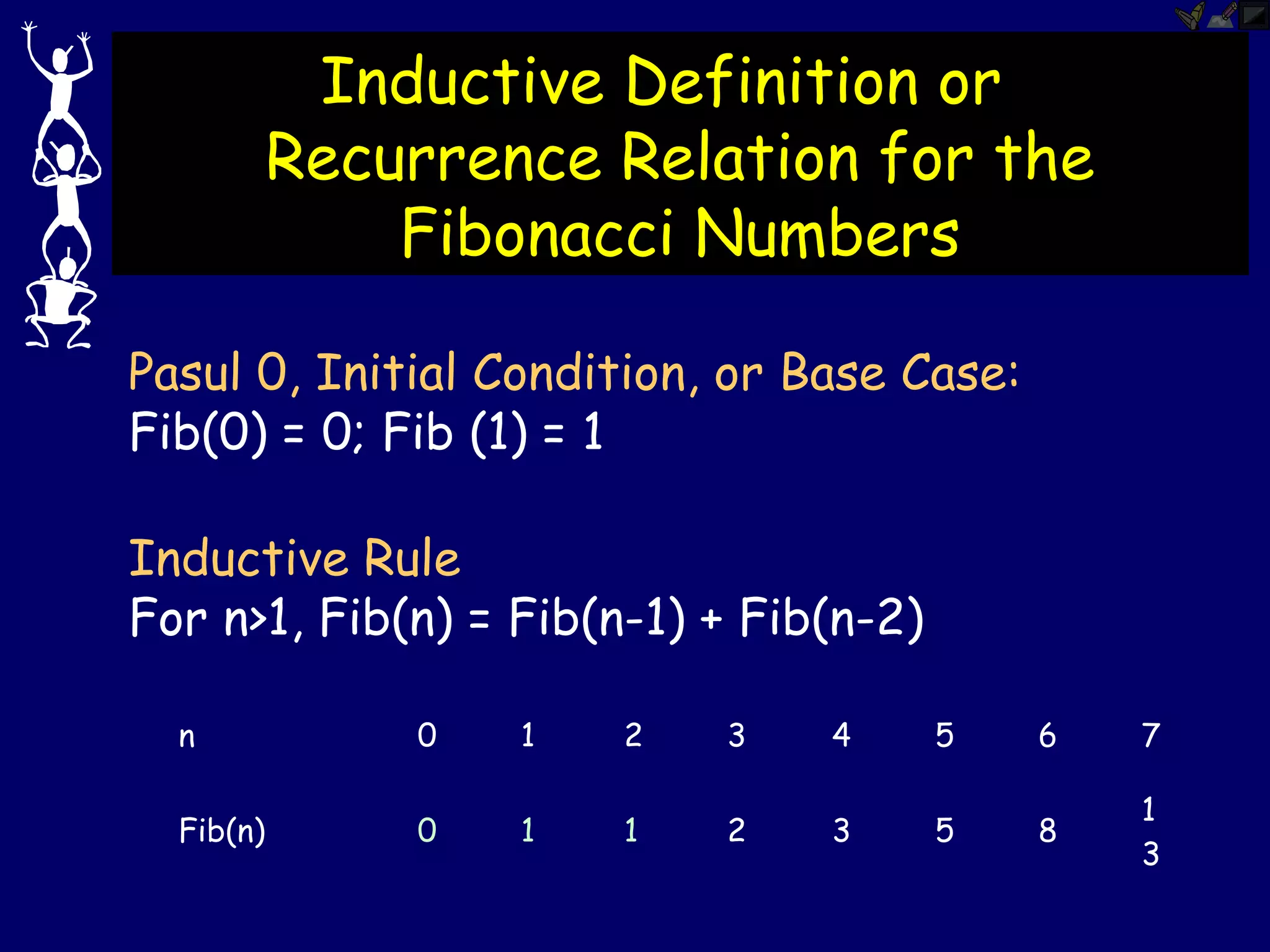
Inductive Definition or
Recurrence Relation for the
Fibonacci Numbers
Pasul 0, Initial Condition, or Base Case:
Fib(0) = 0; Fib (1) = 1
Inductive Rule
For n>1, Fib(n) = Fib(n-1) + Fib(n-2)
n 0 1 2 3 4 5 6 7
Fib(n) 0 1 1 2 3 5 8
1
3
Sneezwort (Achilleaptarmica)
Each time the plant starts a new shoot
it takes two months before it is strong
enough to support branching.
Counting Petals
5 petals: buttercup, wild rose, larkspur,
columbine (aquilegia)
8 petals: delphiniums
13 petals: ragwort, corn marigold, cineraria,
some daisies
21 petals: aster, black-eyed susan, chicory
34 petals: plantain, pyrethrum
55, 89 petals: michaelmas daisies, the
asteraceae family.
Pineapple whorls
Church and Turing were both
interested in the number of
whorls in each ring of the
spiral.
The ratio of consecutive ring
lengths approaches the Golden
Ratio.
Bernoulli Spiral
When the growth of the organism is proportional
to its size
Bernoulli Spiral
When the growth of the organism is
proportional to its size
Is there
life after
π and e?
Golden Ratio: the divine proportion
φ = 1.6180339887498948482045…
“Phi” is named after the Greek sculptor Phidias
φ
φ
φ φ
φ φ
= =
=
− = − = =
− − =
AC
AB
AB
BC
AC
BC
AC
BC
AB
BC
BC
BC
1
1 0
2
2
2
Definition of φ (Euclid)
Ratio obtained when you divide a line segment into two unequal
parts such that the ratio of the whole to the larger part is the
same as the ratio of the larger to the smaller.
A B C
Expanding Recursively
φ
φ
φ
φ
= +
= +
+
= +
+
+
1
1
1
1
1
1
1
1
1
1
1
1
Continued Fraction Representation
φ = +
+
+
+
+
+
+
+
+
+
1
1
1
1
1
1
1
1
1
1
1
1
1
1
1
1
1
1
1 ....
Continued Fraction Representation
1
1
1
1
1
1
1
1
1
1
1
1
1
1
1
1
1
1
1 ....
1 5
2
= +
+
+
+
+
+
+
+
+
+
+
Remember?
We already saw the convergents of this CF
[1,1,1,1,1,1,1,1,1,1,1,…]
are of the form
Fib(n+1)/Fib(n)
n
1
1 5
l m
2
i →∞
−
+
= φ =n
n
F
F
Hence:
Continued Fraction Representation
φ = +
+
+
+
+
+
+
+
+
+
1
1
1
1
1
1
1
1
1
1
1
1
1
1
1
1
1
1
1 ....
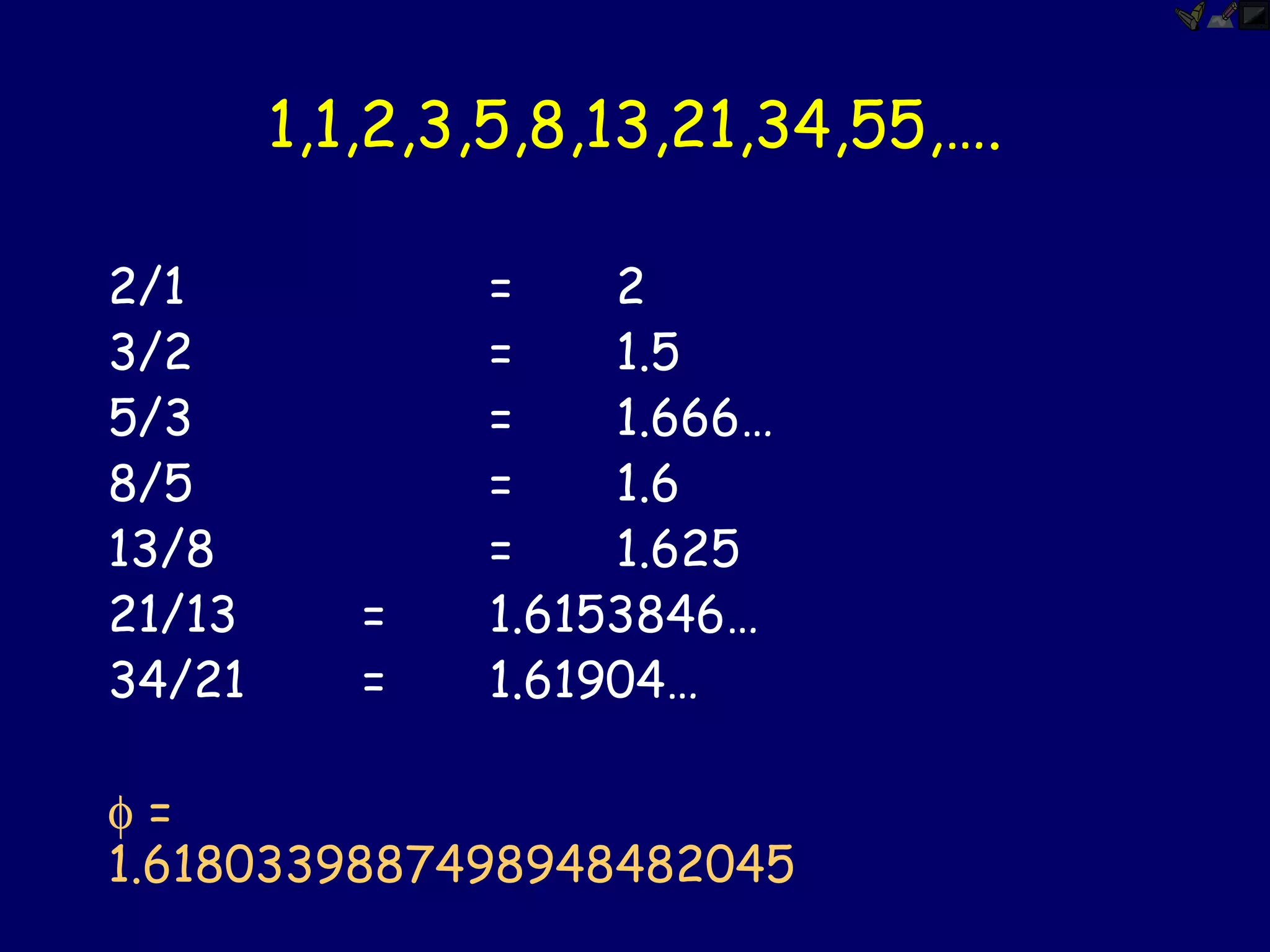
1,1,2,3,5,8,13,21,34,55,….
2/1 = 2
3/2 = 1.5
5/3 = 1.666…
8/5 = 1.6
13/8 = 1.625
21/13 = 1.6153846…
34/21 = 1.61904…
φ =
1.6180339887498948482045
Continued fraction representation of a
standard fraction
67 1
2
129 3
1
4
2
= +
+
+
e.g., 67/29 = 2 with remainder 9/29
= 2 + 1/ (29/9)
67 1 1 1
2 2 2
29 2 129 3 3
19 9 4
2
= + = + +
+ +
+
A Representational Correspondence
67 1 1 1
2 2 2
29 2 129 3 3
19 9 4
2
= + = + +
+ +
+
Euclid(67,29) 67 div 29 = 2
Euclid(29,9) 29 div 9 = 3
Euclid(9,2) 9 div 2 = 4
Euclid(2,1) 2 div 1 = 2
Euclid(1,0)
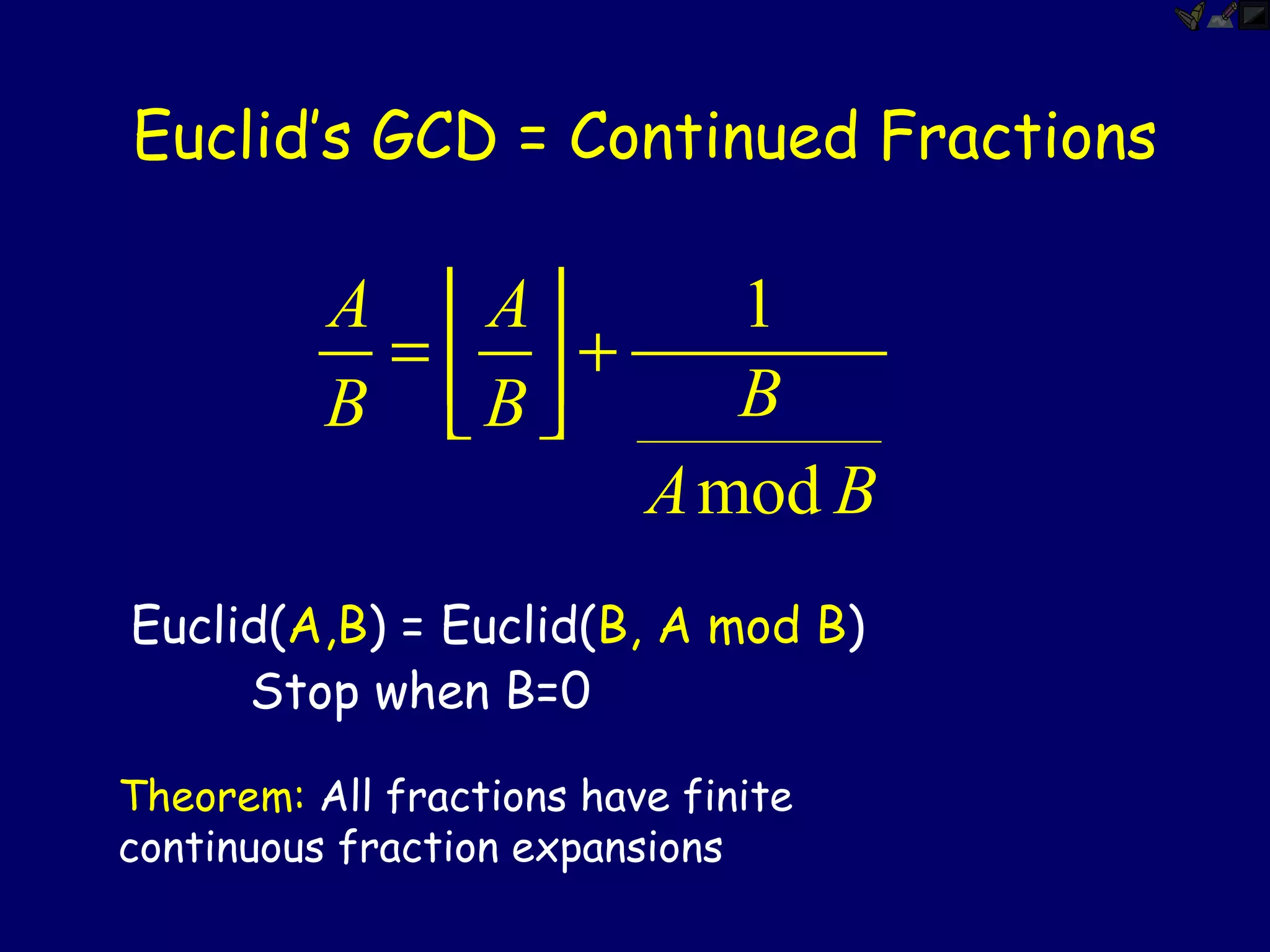
Euclid’s GCD = Continued Fractions
Euclid(A,B) = Euclid(B, A mod B)
Stop when B=0
1
mod
A A
BB B
A B
 
= +  
Theorem: All fractions have finite
continuous fraction expansions
Let us take a slight
detour and look at
a different
representation.
Sequences That Sum To n
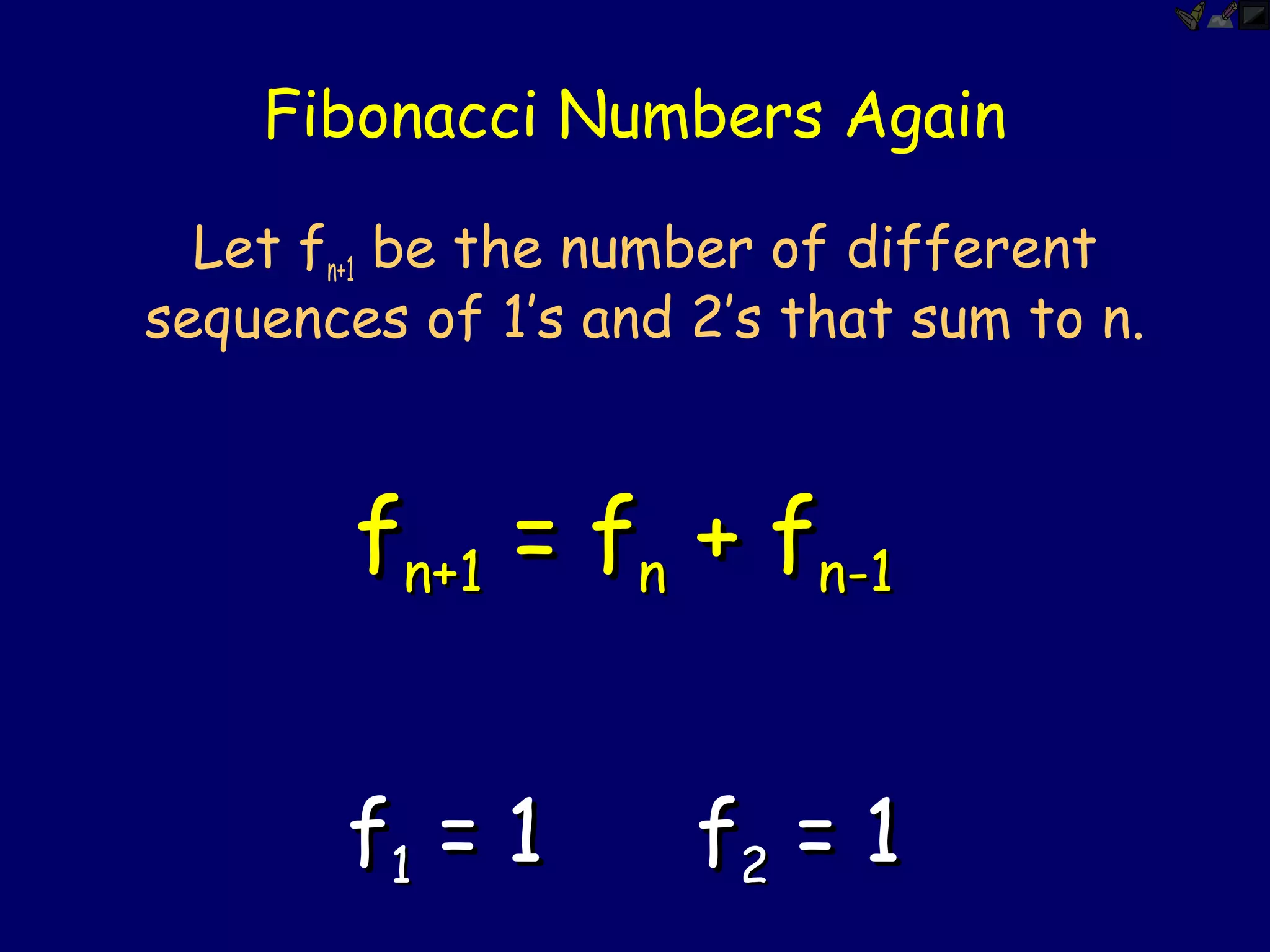
Let fn+1 be the number of different sequences
of 1’s and 2’s that sum to n.
Example: f5 = 5
Sequences That Sum To n
Let fn+1 be the number of different sequences
of 1’s and 2’s that sum to n.
Example: f5 = 5
4 = 2 + 2
2 + 1 + 1
1 + 2 + 1
1 + 1 + 2
1 + 1 + 1 + 1
Sequences That Sum To n
f1
f2
f3
Let fn+1 be the number of different sequences
of 1’s and 2’s that sum to n.
Sequences That Sum To n
f1 = 1
0 = the empty sum
f2 = 1
1 = 1
f3 = 2
2 = 1 + 1
2
Let fn+1 be the number of different
sequences of 1’s and 2’s that sum to n.
Sequences That Sum To n
fn+1 = fn + fn-1
Let fn+1 be the number of different
sequences of 1’s and 2’s that sum to n.
Sequences That Sum To n
fn+1 = fn + fn-1
Let fn+1 be the number of different
sequences of 1’s and 2’s that sum to n.
# of
sequences
beginning
with a 2
# of
sequences
beginning
with a 1
Fibonacci Numbers Again
ffn+1n+1 = f= fnn + f+ fn-1n-1
ff11 = 1 f= 1 f22 = 1= 1
Let fn+1 be the number of different
sequences of 1’s and 2’s that sum to n.
Visual Representation: Tiling
Let fn+1 be the number of different ways
to tile a 1 × n strip with squares and
dominoes.
Visual Representation: Tiling
Let fn+1 be the number of different ways
to tile a 1 × n strip with squares and
dominoes.
Visual Representation: Tiling
1 way to tile a strip of length 0
1 way to tile a strip of length 1:
2 ways to tile a strip of length 2:
fn+1 = fn + fn-1
fn+1 is number of ways to tile length n.
fn tilings that start with a square.
fn-1 tilings that start with a domino.
Let’s use this visual
representation to
prove a couple of
Fibonacci identities.
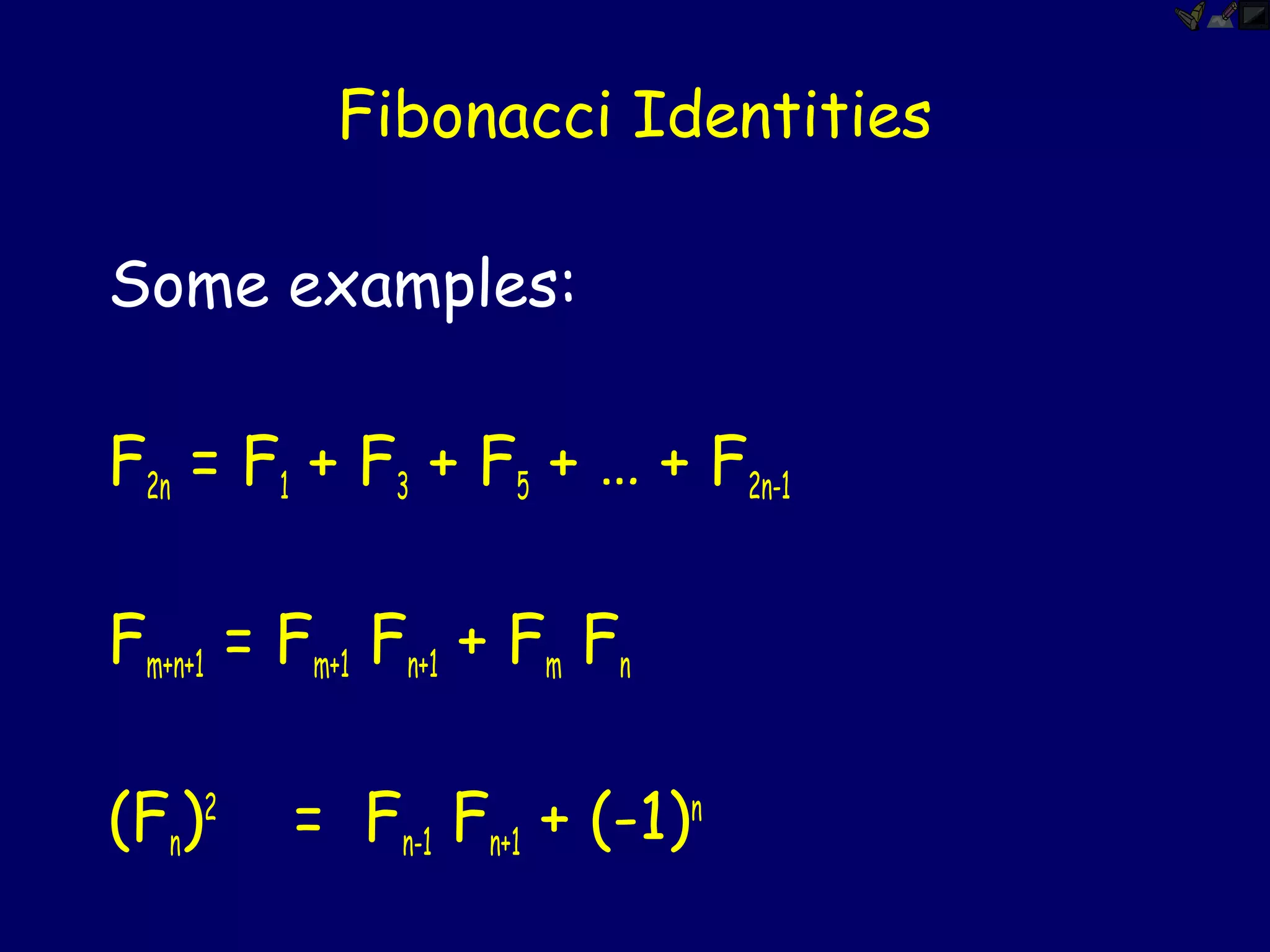
Fibonacci Identities
Some examples:
F2n = F1 + F3 + F5 + … + F2n-1
Fm+n+1 = Fm+1 Fn+1 + Fm Fn
(Fn)2
= Fn-1 Fn+1 + (-1)n
Fm+n+1 = Fm+1 Fn+1 + Fm Fn
mm nn
m-1m-1 n-1n-1
(Fn)2
= Fn-1 Fn+1 + (-1)n
(Fn)2
= Fn-1 Fn+1 + (-1)n
n-1n-1
Fn tilings of a strip of length n-1
(Fn)2
= Fn-1 Fn+1 + (-1)n
n-1n-1
n-1n-1
(Fn)2
= Fn-1 Fn+1 + (-1)n
nn
(Fn)2
tilings of two strips of size n-1
(Fn)2
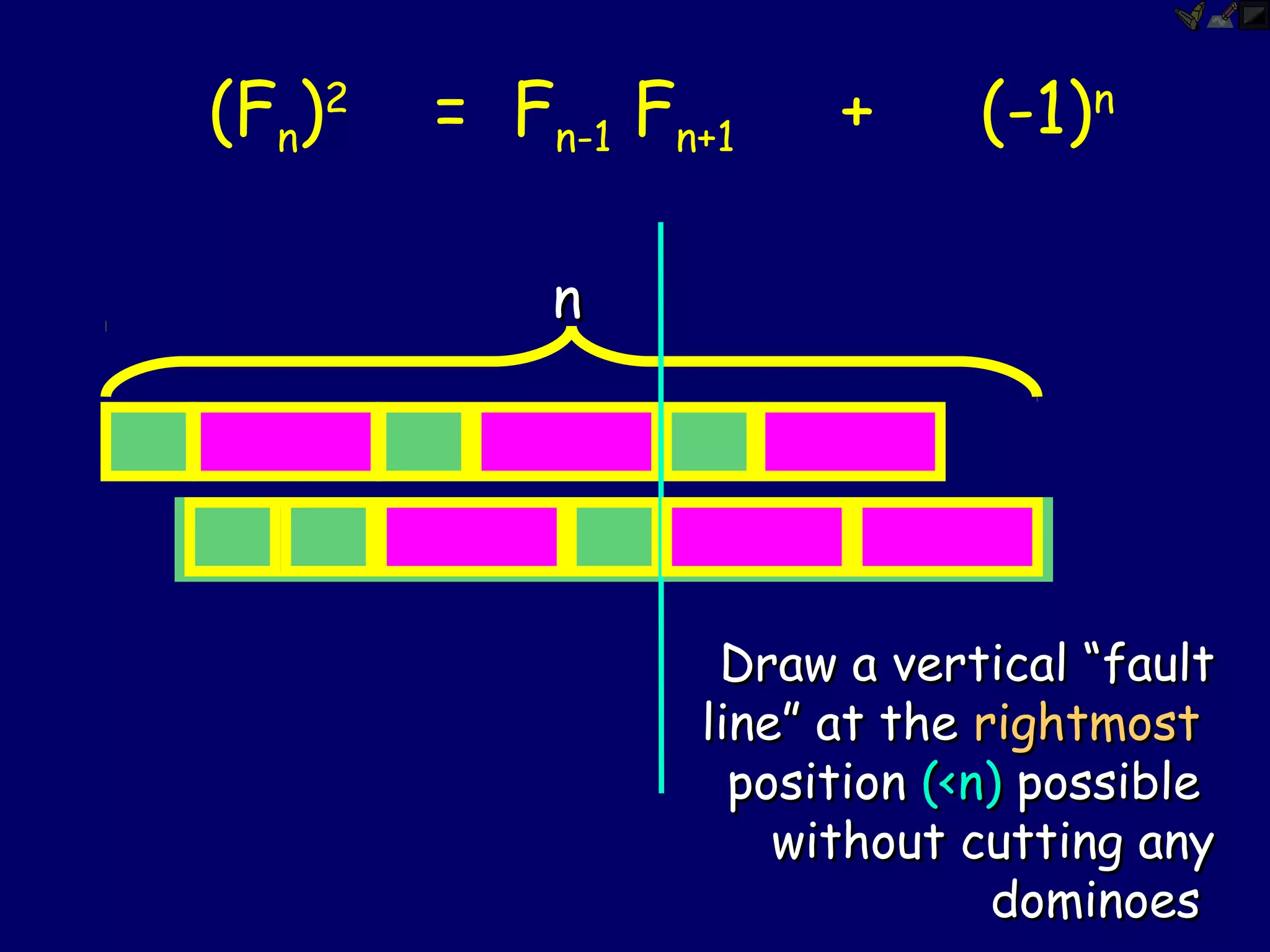
= Fn-1 Fn+1 + (-1)n
nn
Draw a vertical “faultDraw a vertical “fault
line” at theline” at the rightmostrightmost
positionposition (<n)(<n) possiblepossible
without cutting anywithout cutting any
dominoesdominoes
(Fn)2
= Fn-1 Fn+1 + (-1)n
nn
Swap the tailsSwap the tails at theat the
fault linefault line to map to ato map to a
tiling of 2 n-1 ‘s to atiling of 2 n-1 ‘s to a
tiling of an n-2 and an n.tiling of an n-2 and an n.
(Fn)2
= Fn-1 Fn+1 + (-1)n
nn
Swap the tailsSwap the tails at theat the
fault linefault line to map to ato map to a
tiling of 2 n-1 ‘s to atiling of 2 n-1 ‘s to a
tiling of an n-2 and an n.tiling of an n-2 and an n.
(Fn)2
= Fn-1 Fn+1 + (-1)n-1
n evenn even
n oddn odd
More random facts
The product of any four consecutive Fibonacci
numbers is the area of a Pythagorean triangle.
The sequence of final digits in Fibonacci numbers
repeats in cycles of 60. The last two digits repeat in
300, the last three in 1500, the last four in 15,000,
etc.
Useful to convert miles to kilometers.
The Fibonacci Quarterly
Let’s take a break
from the Fibonacci
Numbers in order to
talk about polynomial
division.
How to divide polynomials?
11
1 – X
? 1 – X 1
1
-(1 – X)
X
+ X
-(X – X2
)
X2
+ X2
-(X2
– X3
)
X3
= 1 + X + X2
+ X3
+ X4
+ X5
+ X6
+ X7
+ …
…
1 + X1 + X11
+ X+ X22
+ X+ X33
+ … + X+ … + Xn-1n-1
+ X+ Xnn
==
XXn+1n+1
- 1- 1
XX - 1- 1
The Geometric Series
1 + X1 + X11
+ X+ X22
+ X+ X33
+ … + X+ … + Xn-1n-1
+ X+ Xnn
==
XXn+1n+1
- 1- 1
XX - 1- 1
The limit as n goes to infinity of
XXn+1n+1
- 1- 1
XX - 1- 1
= - 1- 1
XX - 1- 1
= 11
1 - X1 - X
1 + X1 + X11
+ X+ X22
+ X+ X33
+ … + X+ … + Xnn
+ ….. =+ ….. =
11
1 - X1 - X
The Infinite Geometric Series
(X-1) ( 1 + X1
+ X2
+ X 3
+ … + Xn
+ … )
= X1
+ X2
+ X 3
+ … + Xn
+ Xn+1
+ ….
- 1 - X1
- X2
- X 3
- … - Xn-1
– Xn
- Xn+1
- …
= 1
1 + X1 + X11
+ X+ X22
+ X+ X33
+ … + X+ … + Xnn
+ ….. =+ ….. =
11
1 - X1 - X
1 + X1 + X11
+ X+ X22
+ X+ X33
+ … + X+ … + Xnn
+ ….. =+ ….. =
11
1 - X1 - X
1 – X 1
1
-(1 – X)
X
+ X
-(X – X2
)
X2
+ X2
+ …
-(X2
– X3
)
X3
…
XX
1 – X – X2
Something a bit more complicated
1 – X – X2
X
X2
+ X3
-(X – X2
– X3
)
X
2X3
+ X4
-(X2
– X3
– X4
)
+ X2
-(2X3
– 2X4
– 2X5
)
+ 2X3
3X4
+ 2X5
+ 3X4
-(3X4
– 3X5
– 3X6
)
5X5
+ 3X6
+ 5X5
-(5X5
– 5X6
– 5X7
)
8X6
+ 5X7
+ 8X6
-(8X6
– 8X7
– 8X8
)
Hence
= F0 1 + F1 X1
+ F2 X2
+F3 X3
+ F4 X4
+
F5 X5
+ F6 X6
+ …
XX
1 – X – X2
= 0×1 + 1 X1
+ 1 X2
+ 2X3
+ 3X4
+ 5X5
+ 8X6
+ …
Going the Other Way
(1 - X- X2
) ×
( F0 1 + F1 X1
+ F2 X2
+ … + Fn-2 Xn-2
+ Fn-1 Xn-1
+ Fn Xn
+ …
F0 = 0, F1 = 1
Going the Other Way
(1 - X- X2
) ×
( F0 1 + F1 X1
+ F2 X2
+ … + Fn-2 Xn-2
+ Fn-1 Xn-1
+ Fn Xn
+ …
= ( F0 1 + F1 X1
+ F2 X2
+ … + Fn-2 Xn-2
+ Fn-1 Xn-1
+ Fn Xn
+ …
- F0 X1
- F1 X2
- … - Fn-3 Xn-2
- Fn-2 Xn-1
- Fn-1 Xn
- …
- F0 X2
- … - Fn-4 Xn-2
- Fn-3 Xn-1
- Fn-2 Xn
- …
= F0 1 + ( F1 – F0 ) X1
F0 = 0, F1 = 1
= X
Thus
F0 1 + F1 X1
+ F2 X2
+ … + Fn-1 Xn-1
+ Fn Xn
+ …
XX
1 – X – X2
=
So much for
trying to take a
break from
the Fibonacci
numbers…
What is the Power Series
Expansion of x/(1-x-x2
) ?
What does this look like
when we expand it as an
infinite sum?
Since the bottom is quadratic we
can factor it.
X / (1-X-X2
) =
X/(1- φX)(1 – (-φ)-1
X)
where φ =
“The Golden Ratio”
XX
(1 –(1 – φφX)(1- (-X)(1- (-φφ))-1-1
X)X)
Linear factors on the bottom
∑n=0..∞= Xn
?
(1 + aX1
+ a2
X2
+ … + an
Xn
+ …..) (1 + bX1
+ b2
X2
+ … + bn
Xn
+ …..) =
11
(1 – aX)(1-bX)(1 – aX)(1-bX)
Geometric Series (Quadratic Form)
aan+1n+1
– b– bn+1n+1
aa - b- b
∑n=0..∞ Xn
=
=
11
(1 –(1 – φφX)(1- (-X)(1- (-φφ-1-1
X)X)
Geometric Series (Quadratic Form)
φφn+1n+1
– (-– (-φφ--
1)1)n+1n+1
√√55
∑n=0.. ∞= Xn
XX
(1 –(1 – φφX)(1- (-X)(1- (-φφ-1-1
X)X)
Power Series Expansion of F
φφn+1n+1
– (-– (-φφ--
1)1)n+1n+1
√√55
∑n=0.. ∞= Xn+1
0 1 2 3
0 1 2 32
01
i
i
i
x
F x F x F x F x F x
x x
∞
=
= + + + + =
− −
∑L
2
0
1 1
1 5
i
i i
i
x
x
x x
φ
φ
∞
=
  
 ÷= − − ÷ ÷− −   
∑
The ith
Fibonacci number is:
0
1 1
5
i
i
i
φ
φ
∞
=
  
 − − ÷ ÷ ÷  
∑
Leonhard Euler (1765)
J. P. M. Binet (1843)
A de Moivre (1730)
F
F
n
n
=
−
−F
HGI
KJ
= −
−F
HGI
KJ
= =
L
NMO
QP
φ
φ φ φ
φ φ
n
n
n
n
n n
1
5 5
1
5
5 5
closest integer to
Less than
.277
F
F
F
F
n
n
n
n
− −
−
−
−
−
−
→∞
−
=
−
−F
HGI
KJ
−
−F
HGI
KJ
=
−
−F
HGI
KJ
+
−
−F
HGI
KJ
−
−F
HGI
KJ
=
1 1
1
1
1
1
1
1
1
1 1
1
1
φ
φ
φ
φ
φ
φ
φ
φ
φ
φ
φ
n
n
n
n
n
n
n
n
n
n
nlim
What is the coefficient of
Xk
in the expansion of:
( 1 + X + X2 +
X3 +
X4 +
. . . . )n
?
Each path in the choice tree for the
cross terms has n choices of exponent
e1, e2, . . . , en ¸ 0. Each exponent can be
any natural number.
Coefficient of Xk
is the number of non-
negative solutions to:
e1 + e2 + . . . + en = k
What is the coefficient of
Xk
in the expansion of:
( 1 + X + X2 +
X3 +
X4 +
. . . . )n
?
n
n -1
+ − 
 ÷
 
1k
( 1 + X + X2 +
X3 +
X4 +
. . . . )n
=
( )
k
k 0
n
X
n -1
∞
=
+ − 
=  ÷
−  
∑
11
1
n
k
X
What is the coefficient of Xk
in the
expansion of:
(a0 + a1X + a2X2
+ a3X3
+ …) ( 1 + X + X2 +
X3 +
. . . )
= (a0 + a1X + a2X2
+ a3X3
+ …) / (1 – X) ?
a0 + a1 + a2 + .. + ak
(a0 + a1X + a2X2
+ a3X3
+ …) / (1 – X)
=
k
k 0 i 0
a X
∞ =
= =

÷
 
∑ ∑
i k
i
Some simple power series
Al-Karaji’s Identities
Zero_Ave = 1/(1-X);
First_Ave = 1/(1-X)2
;
Second_Ave = 1/(1-X)3
;
Output =
1/(1-X)2
+ 2X/(1-X)3
= (1-X)/(1-X)= (1-X)/(1-X)33
+ 2X/(1-X)+ 2X/(1-X)33
= (1+X)/(1-X)= (1+X)/(1-X)33
(1+X)/(1-X)(1+X)/(1-X)33
outputs <1, 4, 9, ..>outputs <1, 4, 9, ..>
X(1+X)/(1-X)X(1+X)/(1-X)33
outputs <0, 1, 4, 9, ..>outputs <0, 1, 4, 9, ..>
The kThe kthth
entry is kentry is k22
X(1+X)/(1-X)X(1+X)/(1-X)33
== ∑∑ kk22
XXkk
What does X(1+X)/(1-X)What does X(1+X)/(1-X)44
do?do?
X(1+X)/(1-X)X(1+X)/(1-X)44
expands to :expands to :
∑∑ SSkk XXkk
where Swhere Skk is the sum of theis the sum of the
first k squaresfirst k squares
Aha! Thus, if there is anAha! Thus, if there is an
alternative interpretation ofalternative interpretation of
the kthe kthth
coefficient ofcoefficient of
X(1+X)/(1-X)X(1+X)/(1-X)44
we would have a new way towe would have a new way to
get a formula for the sum ofget a formula for the sum of
the first k squares.the first k squares.
Using pirates and gold we
found that:
( )
k
k 0
n
X
n -1
∞
=
+ − 
=  ÷
−  
∑
11
1
n
k
X
( )
k
k 0
X
3
∞
=
+ 
=  ÷
−  
∑4
31
1
k
X
THUS:
Coefficient of Xk
in PV = (X2
+X)(1-X)-4
is
the sum of the first k squares:
( )
k
k 0
X
3
∞
=
+ 
=  ÷
−  
∑4
31
1
k
X
Polynomials give us closed form
expressions
REFERENCES
Coxeter, H. S. M. ``The Golden Section, Phyllotaxis,
and Wythoff's Game.'' Scripta Mathematica 19,
135-143, 1953.
"Recounting Fibonacci and Lucas Identities" by
Arthur T. Benjamin and Jennifer J. Quinn, College
Mathematics Journal, Vol. 30(5): 359--366, 1999.
Study Bee
Fibonacci Numbers
Arise everywhere
Visual Representations
Fibonacci Identities
Polynomials
The infinite geometric series
Division of polynomials
Representation of Fibonacci numbers
as coefficients of polynomials.
Generating Functions and Power Series
Simple operations (add, multiply)
Quadratic form of the Geometric Series
Deriving the closed form for Fn
Pirates and gold
Sum of squares once again!

Fibonacci

  • 1.
    The Golden Ratio,Fibonacci Numbers, And Other Recurrences Great Theoretical Ideas In Computer Science John Lafferty CS 15-251 Fall 2006 Lecture 13 October 10, 2006 Carnegie Mellon University
  • 2.
    Leonardo Fibonacci In 1202,Fibonacci proposed a problem about the growth of rabbit populations.
  • 3.
    Inductive Definition or RecurrenceRelation for the Fibonacci Numbers Pasul 0, Initial Condition, or Base Case: Fib(0) = 0; Fib (1) = 1 Inductive Rule For n>1, Fib(n) = Fib(n-1) + Fib(n-2) n 0 1 2 3 4 5 6 7 Fib(n) 0 1 1 2 3 5 8 1 3
  • 4.
    Sneezwort (Achilleaptarmica) Each timethe plant starts a new shoot it takes two months before it is strong enough to support branching.
  • 5.
    Counting Petals 5 petals:buttercup, wild rose, larkspur, columbine (aquilegia) 8 petals: delphiniums 13 petals: ragwort, corn marigold, cineraria, some daisies 21 petals: aster, black-eyed susan, chicory 34 petals: plantain, pyrethrum 55, 89 petals: michaelmas daisies, the asteraceae family.
  • 6.
    Pineapple whorls Church andTuring were both interested in the number of whorls in each ring of the spiral. The ratio of consecutive ring lengths approaches the Golden Ratio.
  • 8.
    Bernoulli Spiral When thegrowth of the organism is proportional to its size
  • 9.
    Bernoulli Spiral When thegrowth of the organism is proportional to its size
  • 12.
    Is there life after πand e? Golden Ratio: the divine proportion φ = 1.6180339887498948482045… “Phi” is named after the Greek sculptor Phidias
  • 13.
    φ φ φ φ φ φ == = − = − = = − − = AC AB AB BC AC BC AC BC AB BC BC BC 1 1 0 2 2 2 Definition of φ (Euclid) Ratio obtained when you divide a line segment into two unequal parts such that the ratio of the whole to the larger part is the same as the ratio of the larger to the smaller. A B C
  • 14.
    Expanding Recursively φ φ φ φ = + =+ + = + + + 1 1 1 1 1 1 1 1 1 1 1 1
  • 15.
    Continued Fraction Representation φ= + + + + + + + + + + 1 1 1 1 1 1 1 1 1 1 1 1 1 1 1 1 1 1 1 ....
  • 16.
  • 17.
    Remember? We already sawthe convergents of this CF [1,1,1,1,1,1,1,1,1,1,1,…] are of the form Fib(n+1)/Fib(n) n 1 1 5 l m 2 i →∞ − + = φ =n n F F Hence:
  • 18.
    Continued Fraction Representation φ= + + + + + + + + + + 1 1 1 1 1 1 1 1 1 1 1 1 1 1 1 1 1 1 1 ....
  • 19.
    1,1,2,3,5,8,13,21,34,55,…. 2/1 = 2 3/2= 1.5 5/3 = 1.666… 8/5 = 1.6 13/8 = 1.625 21/13 = 1.6153846… 34/21 = 1.61904… φ = 1.6180339887498948482045
  • 20.
    Continued fraction representationof a standard fraction 67 1 2 129 3 1 4 2 = + + +
  • 21.
    e.g., 67/29 =2 with remainder 9/29 = 2 + 1/ (29/9) 67 1 1 1 2 2 2 29 2 129 3 3 19 9 4 2 = + = + + + + +
  • 22.
    A Representational Correspondence 671 1 1 2 2 2 29 2 129 3 3 19 9 4 2 = + = + + + + + Euclid(67,29) 67 div 29 = 2 Euclid(29,9) 29 div 9 = 3 Euclid(9,2) 9 div 2 = 4 Euclid(2,1) 2 div 1 = 2 Euclid(1,0)
  • 23.
    Euclid’s GCD =Continued Fractions Euclid(A,B) = Euclid(B, A mod B) Stop when B=0 1 mod A A BB B A B   = +   Theorem: All fractions have finite continuous fraction expansions
  • 24.
    Let us takea slight detour and look at a different representation.
  • 25.
    Sequences That SumTo n Let fn+1 be the number of different sequences of 1’s and 2’s that sum to n. Example: f5 = 5
  • 26.
    Sequences That SumTo n Let fn+1 be the number of different sequences of 1’s and 2’s that sum to n. Example: f5 = 5 4 = 2 + 2 2 + 1 + 1 1 + 2 + 1 1 + 1 + 2 1 + 1 + 1 + 1
  • 27.
    Sequences That SumTo n f1 f2 f3 Let fn+1 be the number of different sequences of 1’s and 2’s that sum to n.
  • 28.
    Sequences That SumTo n f1 = 1 0 = the empty sum f2 = 1 1 = 1 f3 = 2 2 = 1 + 1 2 Let fn+1 be the number of different sequences of 1’s and 2’s that sum to n.
  • 29.
    Sequences That SumTo n fn+1 = fn + fn-1 Let fn+1 be the number of different sequences of 1’s and 2’s that sum to n.
  • 30.
    Sequences That SumTo n fn+1 = fn + fn-1 Let fn+1 be the number of different sequences of 1’s and 2’s that sum to n. # of sequences beginning with a 2 # of sequences beginning with a 1
  • 31.
    Fibonacci Numbers Again ffn+1n+1= f= fnn + f+ fn-1n-1 ff11 = 1 f= 1 f22 = 1= 1 Let fn+1 be the number of different sequences of 1’s and 2’s that sum to n.
  • 32.
    Visual Representation: Tiling Letfn+1 be the number of different ways to tile a 1 × n strip with squares and dominoes.
  • 33.
    Visual Representation: Tiling Letfn+1 be the number of different ways to tile a 1 × n strip with squares and dominoes.
  • 34.
    Visual Representation: Tiling 1way to tile a strip of length 0 1 way to tile a strip of length 1: 2 ways to tile a strip of length 2:
  • 35.
    fn+1 = fn+ fn-1 fn+1 is number of ways to tile length n. fn tilings that start with a square. fn-1 tilings that start with a domino.
  • 36.
    Let’s use thisvisual representation to prove a couple of Fibonacci identities.
  • 37.
    Fibonacci Identities Some examples: F2n= F1 + F3 + F5 + … + F2n-1 Fm+n+1 = Fm+1 Fn+1 + Fm Fn (Fn)2 = Fn-1 Fn+1 + (-1)n
  • 38.
    Fm+n+1 = Fm+1Fn+1 + Fm Fn mm nn m-1m-1 n-1n-1
  • 39.
  • 40.
    (Fn)2 = Fn-1 Fn+1+ (-1)n n-1n-1 Fn tilings of a strip of length n-1
  • 41.
    (Fn)2 = Fn-1 Fn+1+ (-1)n n-1n-1 n-1n-1
  • 42.
    (Fn)2 = Fn-1 Fn+1+ (-1)n nn (Fn)2 tilings of two strips of size n-1
  • 43.
    (Fn)2 = Fn-1 Fn+1+ (-1)n nn Draw a vertical “faultDraw a vertical “fault line” at theline” at the rightmostrightmost positionposition (<n)(<n) possiblepossible without cutting anywithout cutting any dominoesdominoes
  • 44.
    (Fn)2 = Fn-1 Fn+1+ (-1)n nn Swap the tailsSwap the tails at theat the fault linefault line to map to ato map to a tiling of 2 n-1 ‘s to atiling of 2 n-1 ‘s to a tiling of an n-2 and an n.tiling of an n-2 and an n.
  • 45.
    (Fn)2 = Fn-1 Fn+1+ (-1)n nn Swap the tailsSwap the tails at theat the fault linefault line to map to ato map to a tiling of 2 n-1 ‘s to atiling of 2 n-1 ‘s to a tiling of an n-2 and an n.tiling of an n-2 and an n.
  • 46.
    (Fn)2 = Fn-1 Fn+1+ (-1)n-1 n evenn even n oddn odd
  • 47.
    More random facts Theproduct of any four consecutive Fibonacci numbers is the area of a Pythagorean triangle. The sequence of final digits in Fibonacci numbers repeats in cycles of 60. The last two digits repeat in 300, the last three in 1500, the last four in 15,000, etc. Useful to convert miles to kilometers.
  • 48.
  • 49.
    Let’s take abreak from the Fibonacci Numbers in order to talk about polynomial division.
  • 50.
    How to dividepolynomials? 11 1 – X ? 1 – X 1 1 -(1 – X) X + X -(X – X2 ) X2 + X2 -(X2 – X3 ) X3 = 1 + X + X2 + X3 + X4 + X5 + X6 + X7 + … …
  • 51.
    1 + X1+ X11 + X+ X22 + X+ X33 + … + X+ … + Xn-1n-1 + X+ Xnn == XXn+1n+1 - 1- 1 XX - 1- 1 The Geometric Series
  • 52.
    1 + X1+ X11 + X+ X22 + X+ X33 + … + X+ … + Xn-1n-1 + X+ Xnn == XXn+1n+1 - 1- 1 XX - 1- 1 The limit as n goes to infinity of XXn+1n+1 - 1- 1 XX - 1- 1 = - 1- 1 XX - 1- 1 = 11 1 - X1 - X
  • 53.
    1 + X1+ X11 + X+ X22 + X+ X33 + … + X+ … + Xnn + ….. =+ ….. = 11 1 - X1 - X The Infinite Geometric Series
  • 54.
    (X-1) ( 1+ X1 + X2 + X 3 + … + Xn + … ) = X1 + X2 + X 3 + … + Xn + Xn+1 + …. - 1 - X1 - X2 - X 3 - … - Xn-1 – Xn - Xn+1 - … = 1 1 + X1 + X11 + X+ X22 + X+ X33 + … + X+ … + Xnn + ….. =+ ….. = 11 1 - X1 - X
  • 55.
    1 + X1+ X11 + X+ X22 + X+ X33 + … + X+ … + Xnn + ….. =+ ….. = 11 1 - X1 - X 1 – X 1 1 -(1 – X) X + X -(X – X2 ) X2 + X2 + … -(X2 – X3 ) X3 …
  • 56.
    XX 1 – X– X2 Something a bit more complicated 1 – X – X2 X X2 + X3 -(X – X2 – X3 ) X 2X3 + X4 -(X2 – X3 – X4 ) + X2 -(2X3 – 2X4 – 2X5 ) + 2X3 3X4 + 2X5 + 3X4 -(3X4 – 3X5 – 3X6 ) 5X5 + 3X6 + 5X5 -(5X5 – 5X6 – 5X7 ) 8X6 + 5X7 + 8X6 -(8X6 – 8X7 – 8X8 )
  • 57.
    Hence = F0 1+ F1 X1 + F2 X2 +F3 X3 + F4 X4 + F5 X5 + F6 X6 + … XX 1 – X – X2 = 0×1 + 1 X1 + 1 X2 + 2X3 + 3X4 + 5X5 + 8X6 + …
  • 58.
    Going the OtherWay (1 - X- X2 ) × ( F0 1 + F1 X1 + F2 X2 + … + Fn-2 Xn-2 + Fn-1 Xn-1 + Fn Xn + … F0 = 0, F1 = 1
  • 59.
    Going the OtherWay (1 - X- X2 ) × ( F0 1 + F1 X1 + F2 X2 + … + Fn-2 Xn-2 + Fn-1 Xn-1 + Fn Xn + … = ( F0 1 + F1 X1 + F2 X2 + … + Fn-2 Xn-2 + Fn-1 Xn-1 + Fn Xn + … - F0 X1 - F1 X2 - … - Fn-3 Xn-2 - Fn-2 Xn-1 - Fn-1 Xn - … - F0 X2 - … - Fn-4 Xn-2 - Fn-3 Xn-1 - Fn-2 Xn - … = F0 1 + ( F1 – F0 ) X1 F0 = 0, F1 = 1 = X
  • 60.
    Thus F0 1 +F1 X1 + F2 X2 + … + Fn-1 Xn-1 + Fn Xn + … XX 1 – X – X2 =
  • 61.
    So much for tryingto take a break from the Fibonacci numbers…
  • 62.
    What is thePower Series Expansion of x/(1-x-x2 ) ? What does this look like when we expand it as an infinite sum?
  • 63.
    Since the bottomis quadratic we can factor it. X / (1-X-X2 ) = X/(1- φX)(1 – (-φ)-1 X) where φ = “The Golden Ratio”
  • 64.
    XX (1 –(1 –φφX)(1- (-X)(1- (-φφ))-1-1 X)X) Linear factors on the bottom ∑n=0..∞= Xn ?
  • 65.
    (1 + aX1 +a2 X2 + … + an Xn + …..) (1 + bX1 + b2 X2 + … + bn Xn + …..) = 11 (1 – aX)(1-bX)(1 – aX)(1-bX) Geometric Series (Quadratic Form) aan+1n+1 – b– bn+1n+1 aa - b- b ∑n=0..∞ Xn = =
  • 66.
    11 (1 –(1 –φφX)(1- (-X)(1- (-φφ-1-1 X)X) Geometric Series (Quadratic Form) φφn+1n+1 – (-– (-φφ-- 1)1)n+1n+1 √√55 ∑n=0.. ∞= Xn
  • 67.
    XX (1 –(1 –φφX)(1- (-X)(1- (-φφ-1-1 X)X) Power Series Expansion of F φφn+1n+1 – (-– (-φφ-- 1)1)n+1n+1 √√55 ∑n=0.. ∞= Xn+1
  • 68.
    0 1 23 0 1 2 32 01 i i i x F x F x F x F x F x x x ∞ = = + + + + = − − ∑L 2 0 1 1 1 5 i i i i x x x x φ φ ∞ =     ÷= − − ÷ ÷− −    ∑
  • 69.
    The ith Fibonacci numberis: 0 1 1 5 i i i φ φ ∞ =     − − ÷ ÷ ÷   ∑ Leonhard Euler (1765) J. P. M. Binet (1843) A de Moivre (1730)
  • 70.
    F F n n = − −F HGI KJ = − −F HGI KJ = = L NMO QP φ φφ φ φ φ n n n n n n 1 5 5 1 5 5 5 closest integer to Less than .277
  • 71.
  • 72.
    What is thecoefficient of Xk in the expansion of: ( 1 + X + X2 + X3 + X4 + . . . . )n ? Each path in the choice tree for the cross terms has n choices of exponent e1, e2, . . . , en ¸ 0. Each exponent can be any natural number. Coefficient of Xk is the number of non- negative solutions to: e1 + e2 + . . . + en = k
  • 73.
    What is thecoefficient of Xk in the expansion of: ( 1 + X + X2 + X3 + X4 + . . . . )n ? n n -1 + −   ÷   1k
  • 74.
    ( 1 +X + X2 + X3 + X4 + . . . . )n = ( ) k k 0 n X n -1 ∞ = + −  =  ÷ −   ∑ 11 1 n k X
  • 75.
    What is thecoefficient of Xk in the expansion of: (a0 + a1X + a2X2 + a3X3 + …) ( 1 + X + X2 + X3 + . . . ) = (a0 + a1X + a2X2 + a3X3 + …) / (1 – X) ? a0 + a1 + a2 + .. + ak
  • 76.
    (a0 + a1X+ a2X2 + a3X3 + …) / (1 – X) = k k 0 i 0 a X ∞ = = =  ÷   ∑ ∑ i k i
  • 77.
  • 78.
    Al-Karaji’s Identities Zero_Ave =1/(1-X); First_Ave = 1/(1-X)2 ; Second_Ave = 1/(1-X)3 ; Output = 1/(1-X)2 + 2X/(1-X)3 = (1-X)/(1-X)= (1-X)/(1-X)33 + 2X/(1-X)+ 2X/(1-X)33 = (1+X)/(1-X)= (1+X)/(1-X)33
  • 79.
    (1+X)/(1-X)(1+X)/(1-X)33 outputs <1, 4,9, ..>outputs <1, 4, 9, ..> X(1+X)/(1-X)X(1+X)/(1-X)33 outputs <0, 1, 4, 9, ..>outputs <0, 1, 4, 9, ..> The kThe kthth entry is kentry is k22
  • 80.
    X(1+X)/(1-X)X(1+X)/(1-X)33 == ∑∑ kk22 XXkk Whatdoes X(1+X)/(1-X)What does X(1+X)/(1-X)44 do?do?
  • 81.
    X(1+X)/(1-X)X(1+X)/(1-X)44 expands to :expandsto : ∑∑ SSkk XXkk where Swhere Skk is the sum of theis the sum of the first k squaresfirst k squares
  • 82.
    Aha! Thus, ifthere is anAha! Thus, if there is an alternative interpretation ofalternative interpretation of the kthe kthth coefficient ofcoefficient of X(1+X)/(1-X)X(1+X)/(1-X)44 we would have a new way towe would have a new way to get a formula for the sum ofget a formula for the sum of the first k squares.the first k squares.
  • 83.
    Using pirates andgold we found that: ( ) k k 0 n X n -1 ∞ = + −  =  ÷ −   ∑ 11 1 n k X ( ) k k 0 X 3 ∞ = +  =  ÷ −   ∑4 31 1 k X THUS:
  • 84.
    Coefficient of Xk inPV = (X2 +X)(1-X)-4 is the sum of the first k squares: ( ) k k 0 X 3 ∞ = +  =  ÷ −   ∑4 31 1 k X
  • 85.
    Polynomials give usclosed form expressions
  • 86.
    REFERENCES Coxeter, H. S. M. ``TheGolden Section, Phyllotaxis, and Wythoff's Game.'' Scripta Mathematica 19, 135-143, 1953. "Recounting Fibonacci and Lucas Identities" by Arthur T. Benjamin and Jennifer J. Quinn, College Mathematics Journal, Vol. 30(5): 359--366, 1999.
  • 87.
    Study Bee Fibonacci Numbers Ariseeverywhere Visual Representations Fibonacci Identities Polynomials The infinite geometric series Division of polynomials Representation of Fibonacci numbers as coefficients of polynomials. Generating Functions and Power Series Simple operations (add, multiply) Quadratic form of the Geometric Series Deriving the closed form for Fn Pirates and gold Sum of squares once again!