

For Time Series Forecasting
ARUN KEJARIWAL
Sequence-2-Sequence Learning
ABOUT US
TIME SERIES
FORECASTING
3
Meteorology Machine Translation
Operations
Transportation
Econometrics Marketing, Sales
Finance Speech
Synthesis
4
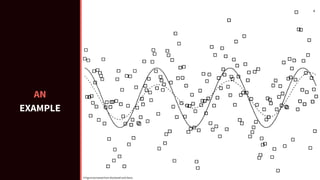
AN
EXAMPLE
# Figure borrowed from Brockwell and Davis.
#
TITLE HERE
# *
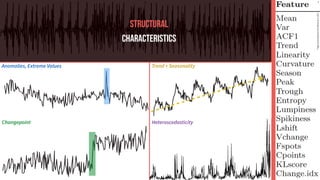
Heteroscedasticity
STRUCTURAL
CHARACTERISTICS
*FigureborrowedfromHyndmanetal.2015.
Changepoint
Anomalies, Extreme Values Trend + Seasonality
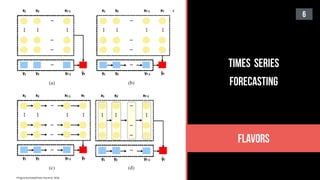
FLAVORS
TIMES SERIES
FORECASTING
6
# Figure borrowed from Tao et al. 2018.
#
[Faullkner,
Comstock, Fossum]
[Craw]
[Brockwell, Davis]
[Chatfield]
[Bowerman,
O’Connell, Koehler]
[Granger, Newbold]
Long History
Research
Books
8
[Gilchrist]
[Hyndman, Athanasopoulos ]
[Box et al.]
[Wilson, Keating]
[Makridarkis et al.]
[Mallios]
[Montgomery et al.]
[Pankratz]
WHY
DEEP LEARNING?
9
10
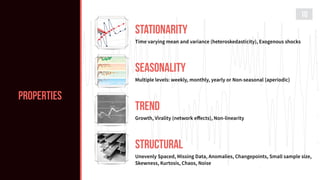
Seasonality
Multiple levels: weekly, monthly, yearly or Non-seasonal (aperiodic)
Stationarity
Time varying mean and variance (heteroskedasticity), Exogenous shocks
Structural
Unevenly Spaced, Missing Data, Anomalies, Changepoints, Small sample size,
Skewness, Kurtosis, Chaos, Noise
Trend
Growth, Virality (network effects), Non-linearity
PROPERTIES
TEMPORAL CREDIT
ASSIGNEMENT
11
(TCA)
DEEP LEARNING
UBIQUITOUS
12
S2S
13
# http://karpathy.github.io/2015/05/21/rnn-effectiveness/
#
[2014]
14
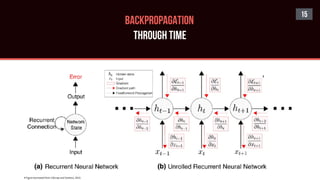
BACKPROPAGATION
THROUGH TIME
15
BACKPROPAGATION
THROUGH TIME
# Figure borrowed from Lillicrap and Santoro, 2019.
#
16
BACKPROPAGATION
THROUGH TIME
[1986]
[1990]
[1986]
[EARLY WORK]
[1990]
17
REAL-TIME RECURRENT
LEARNING#*
# A Learning Algorithm for Continually Running Fully Recurrent Neural Networks [Williams and Zipser, 1989]
* A Method for Improving the Real-Time Recurrent Learning Algorithm [Catfolis, 1993]
UORO
A
APPROXIMATE
RTRL
UORO
[Unbiased Online Recurrent Optimization]
Works in a streaming fashion
Online, Memoryless
Avoids backtracking through past
activations and inputs
Low-rank approximation to forward-
mode automatic differentiation
Reduced computation and storage
KF-RTRL
[Kronecker Factored RTRL]
Kronecker product decomposition to
approximate the gradients
Reduces noise in the approximation
Asymptotically, smaller by a factor of n
Memory requirement equivalent to UORO
Higher computation than UORO
Not applicable to arbitrary architectures
# Unbiased Online Recurrent Optimization [Tallec and Ollivier, 2017]
#
* Approximating Real-Time Recurrent Learning with Random Kronecker Factors
[Mujika et al. 2018]
*
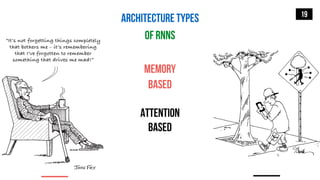
MEMORY
BASED
ATTENTION
BASED
19
ARCHITECTURE TYPES
OF RNNs
MEMORY-BASED RNN
ARCHITECTURES
20
BRNN: Bi-directional RNN
[Schuster and Paliwal, 1997]
GLU: Gated Linear Unit
[Dauphin et al. 2016]
Long Short-Term Memory: LSTM
[Hochreiter and Schmidhuber, 1996]
Gated Recurrent Unit: GRU
[Cho et al. 2014]
Gated Highway Network: GHN
[Zilly et al. 2017]
Neural Computation, 1997
* Figure borrowed from http://colah.github.io/posts/2015-08-Understanding-LSTMs/
(a) Forget gate (b) Input gate
(c) Output gate
St: hidden state
“The LSTM’s main idea is that, instead of compu7ng St
from St-1 directly with a matrix-vector product followed
by a nonlinearity, the LSTM directly computes St, which
is then added to St-1 to obtain St.” [Jozefowicz et al.
2015]
Resistant to vanishing gradient problem
Achieve better results when dropout is used
Adding bias of 1 to LSTM’s forget gate
*
Stacking d RNNs
Recurrence depth d
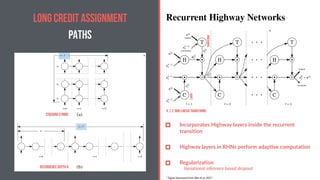
LONG CREDIT ASSIGNMENT
PATHS
Incorporates Highway layers inside the recurrent
transition
Highway layers in RHNs perform adaptive computation
Transform
Carry
H, T, C: Non-linear transforms
Regularization
Variational inference based dropout
* Figure borrowed from Silly et al. 2017
*
*
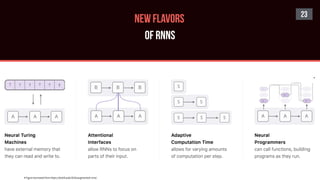
23
NEW FLAVORS
OF RNNs
# Figure borrowed from https://distill.pub/2016/augmented-rnns/
#
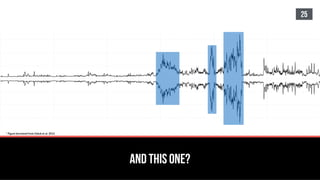
What caught your eye at first glance?
24
And this one?
25
* Figure borrowed from Golub et al. 2012
26
Psychology, Neuroscience, Cognitive Sciences
[1959]
[1974]
[1956]
Span of absolute judgement
ATTENTION
27
#
[2014]
[2017]
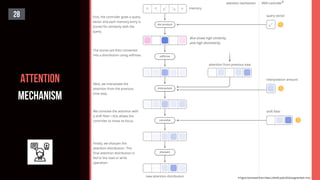
28
# Figure borrowed from https://distill.pub/2016/augmented-rnns/
#
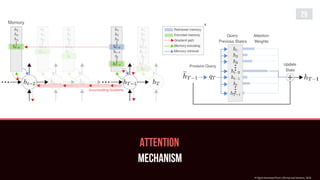
ATTENTION
MECHANISM
29
ATTENTION
MECHANISM
# Figure borrowed from Lillicrap and Santoro, 2019.
#
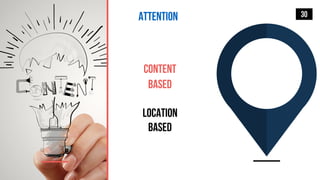
CONTENT
BASED
LOCATION
BASED
30ATTENTION
31
Self
Relates different positions of a single sequence in order to compute a
representation of the same sequence
Also referred to as intra-attention
Global vs. Local
Global: alignment weights at are inferred from the current target state and all
the source states
Local: alignment weights at are inferred from the current target state and those
source states in the window.
Soft vs. Hard
Soft: Alignment weights are learned and placed “softly” over all patches in the
source image
Hard: only selects one patch of the image to attend to at a time
ATTENTION
FAMILY
ATTENTION-BASED
Models
32
Sparse
Attentive Backpropagation
[Ke et al. 2018]
Hierarchical
Attention-Based RHN
[Tao et al. 2018]
Long Short-Term
Memory-Networks
[Cheng et al. 2016]
Self-Attention GAN
[Zhang et al. 2018]
[A SNAPSHOT]
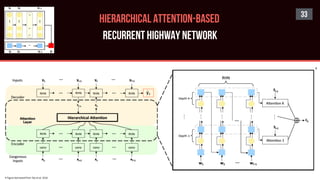
33
HIERARCHICAL ATTENTION-BASED
RECURRENT HIGHWAY NETWORK
# Figure borrowed from Tao et al. 2018.
#
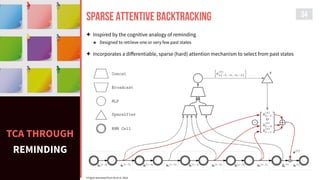
✦ Inspired by the cognitive analogy of reminding
๏ Designed to retrieve one or very few past states
✦ Incorporates a differentiable, sparse (hard) attention mechanism to select from past states
34SPARSE ATTENTIVE BACKTRACKING
TCA THROUGH
REMINDING
# Figure borrowed from Ke et al. 2018.
#
35
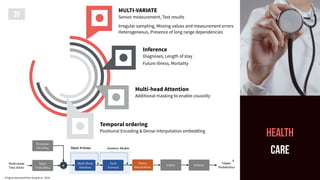
HEALTH
CARE
# Figure borrowed from Song et al. 2018.
Multi-head Attention
Additional masking to enable causality
Inference
Diagnoses, Length of stay
Future illness, Mortality
Temporal ordering
Positional Encoding & Dense interpolation embedding
MULTI-VARIATE
Sensor measurement, Test results
Irregular sampling, Missing values and measurement errors
Heterogeneous, Presence of long range dependencies
#
Thank you
36
READINGS
37
[Rosenblatt]
Principles of Neurodynamics: Perceptrons
and the theory of brain mechanisms
[Eds. Anderson and Rosenfeld]
Neurocomputing: Foundations of
Research
[Eds. Rumelhart and McClelland]
Parallel and Distributed Processing
[Werbos]
The Roots of Backpropagation: From Ordered
Derivatives to Neural Networks and Political
Forecasting
[Eds. Chauvin and Rumelhart]
Backpropagation: Theory, Architectures
and Applications
[Rojas]
Neural Networks: A Systematic
Introduction
[BOOKS]
READINGS
38
Perceptrons [Minsky and Papert, 1969]
Une procedure d'apprentissage pour reseau a seuil assymetrique [Le Cun, 1985]
The problem of serial order in behavior [Lashley, 1951]
Beyond regression: New tools for prediction and analysis in the behavioral sciences [Werbos, 1974]
Connectionist models and their properties [Feldman and Ballard, 1982]
Learning-logic [Parker, 1985]
[EARLY WORKS]
READINGS
39
Learning internal representations by error propagation [Rumelhart, Hinton, and Williams, Chapter 8 in D. Rumelhart and F. McClelland, Eds.,
Parallel Distributed Processing, Vol. 1, 1986] (Generalized Delta Rule)
Generalization of backpropagation with application to a recurrent gas market model [Werbos, 1988]
Generalization of backpropagation to recurrent and higher order networks [Pineda, 1987]
Backpropagation in perceptrons with feedback [Almeida, 1987]
Second-order backpropagation: Implementing an optimal O(n) approximation to Newton's method in an artificial neural network [Parker,
1987]
Learning phonetic features using connectionist networks: an experiment in speech recognition [Watrous and Shastri, 1987] (Time-delay NN)
[BACKPROPAGATION]
READINGS
40
Backpropagation: Past and future [Werbos, 1988]
Adaptive state representation and estimation using recurrent connectionist networks [Williams, 1990]
Generalization of back propagation to recurrent and higher order neural networks [Pineda, 1988]
Learning state space trajectories in recurrent neural networks [Pearlmutter 1989]
Parallelism, hierarchy, scaling in time-delay neural networks for spotting Japanese phonemes/CV-syllables [Sawai et al. 1989]
The role of time in natural intelligence: implications for neural network and artificial intelligence research [Klopf and Morgan, 1990]
[BACKPROPAGATION]
READINGS
41
Recurrent Neural Network Regularization [Zaremba et al. 2014]
Regularizing RNNs by Stabilizing Activations [Krueger and Memisevic, 2016]
Sampling-based Gradient Regularization for Capturing Long-Term Dependencies in Recurrent Neural Networks [Chernodub and Nowicki 2016]
A Theoretically Grounded Application of Dropout in Recurrent Neural Networks [Gal and Ghahramani, 2016]
Noisin: Unbiased Regularization for Recurrent Neural Networks [Dieng et al. 2018]
State-Regularized Recurrent Neural Networks [Wang and Niepert, 2019]
[REGULARIZATION of RNNs]
READINGS
42
A Decomposable Attention Model for Natural Language Inference [Parikh et al. 2016]
Hybrid Computing Using A Neural Network With Dynamic External Memory [Graves et al. 2017]
Image Transformer [Parmar et al. 2018]
Universal Transformers [Dehghani et al. 2019]
The Evolved Transformer [So et al. 2019]
Transformer-XL: Attentive Language Models Beyond a Fixed-Length Context [Dai et al. 2019]
[ATTENTION & TRANSFORMERS]
READINGS
43
Financial Time Series Prediction using hybrids of Chaos Theory, Multi-layer Perceptron and Multi-objective Evolutionary Algorithms [Ravi et
al. 2017]
Model-free Prediction of Noisy Chaotic Time Series by Deep Learning [Yeo, 2017]
DeepAR: Probabilistic Forecasting with Autoregressive Recurrent Networks [Salinas et al. 2017]
Real-Valued (Medical) Time Series Generation With Recurrent Conditional GANs [Hyland et al. 2017]
R2N2: Residual Recurrent Neural Networks for Multivariate Time Series Forecasting [Goel et al. 2017]
Temporal Pattern Attention for Multivariate Time Series Forecasting [Shih et al. 2018]
[TIME SERIES PREDICTION]
READINGS
44
Unbiased Online Recurrent Optimization [Tallec and Ollivier, 2017]
Approximating real-time recurrent learning with random Kronecker factors [Mujika et al. 2018]
Theory and Algorithms for Forecasting Time Series [Kuznetsov and Mohri, 2018]
Foundations of Sequence-to-Sequence Modeling for Time Series [Kuznetsov and Meriet, 2018]
On the Variance Unbiased Recurrent Optimization [Cooijmans and Martens, 2019]
Backpropagation through time and the brain [Lillicrap and Santoro, 2019]
[POTPOURRI]
RESOURCES
45
http://colah.github.io/posts/2015-08-Understanding-LSTMs/
http://karpathy.github.io/2015/05/21/rnn-effectiveness/
A review of Dropout as applied to RNNs
https://medium.com/@bingobee01/a-review-of-dropout-as-applied-to-rnns-72e79ecd5b7b
https://distill.pub/2016/augmented-rnns/
https://distill.pub/2019/memorization-in-rnns/
https://lilianweng.github.io/lil-log/2018/06/24/attention-attention.html
Using the latest advancements in deep learning to predict stock price movements
https://towardsdatascience.com/aifortrading-2edd6fac689d
How to Use Weight Regularization with LSTM Networks for Time Series Forecasting
https://machinelearningmastery.com/use-weight-regularization-lstm-networks-time-series-forecasting/

Sequence-to-Sequence Modeling for Time Series

  • 1.
    For Time SeriesForecasting ARUN KEJARIWAL Sequence-2-Sequence Learning
  • 2.
  • 3.
    TIME SERIES FORECASTING 3 Meteorology MachineTranslation Operations Transportation Econometrics Marketing, Sales Finance Speech Synthesis
  • 4.
    4 AN EXAMPLE # Figure borrowedfrom Brockwell and Davis. #
  • 5.
  • 6.
    FLAVORS TIMES SERIES FORECASTING 6 # Figureborrowed from Tao et al. 2018. #
  • 7.
  • 8.
    8 [Gilchrist] [Hyndman, Athanasopoulos ] [Boxet al.] [Wilson, Keating] [Makridarkis et al.] [Mallios] [Montgomery et al.] [Pankratz]
  • 9.
  • 10.
    10 Seasonality Multiple levels: weekly,monthly, yearly or Non-seasonal (aperiodic) Stationarity Time varying mean and variance (heteroskedasticity), Exogenous shocks Structural Unevenly Spaced, Missing Data, Anomalies, Changepoints, Small sample size, Skewness, Kurtosis, Chaos, Noise Trend Growth, Virality (network effects), Non-linearity PROPERTIES
  • 11.
  • 12.
  • 13.
  • 14.
  • 15.
    15 BACKPROPAGATION THROUGH TIME # Figureborrowed from Lillicrap and Santoro, 2019. #
  • 16.
  • 17.
    17 REAL-TIME RECURRENT LEARNING#* # ALearning Algorithm for Continually Running Fully Recurrent Neural Networks [Williams and Zipser, 1989] * A Method for Improving the Real-Time Recurrent Learning Algorithm [Catfolis, 1993]
  • 18.
    UORO A APPROXIMATE RTRL UORO [Unbiased Online RecurrentOptimization] Works in a streaming fashion Online, Memoryless Avoids backtracking through past activations and inputs Low-rank approximation to forward- mode automatic differentiation Reduced computation and storage KF-RTRL [Kronecker Factored RTRL] Kronecker product decomposition to approximate the gradients Reduces noise in the approximation Asymptotically, smaller by a factor of n Memory requirement equivalent to UORO Higher computation than UORO Not applicable to arbitrary architectures # Unbiased Online Recurrent Optimization [Tallec and Ollivier, 2017] # * Approximating Real-Time Recurrent Learning with Random Kronecker Factors [Mujika et al. 2018] *
  • 19.
  • 20.
    MEMORY-BASED RNN ARCHITECTURES 20 BRNN: Bi-directionalRNN [Schuster and Paliwal, 1997] GLU: Gated Linear Unit [Dauphin et al. 2016] Long Short-Term Memory: LSTM [Hochreiter and Schmidhuber, 1996] Gated Recurrent Unit: GRU [Cho et al. 2014] Gated Highway Network: GHN [Zilly et al. 2017]
  • 21.
    Neural Computation, 1997 *Figure borrowed from http://colah.github.io/posts/2015-08-Understanding-LSTMs/ (a) Forget gate (b) Input gate (c) Output gate St: hidden state “The LSTM’s main idea is that, instead of compu7ng St from St-1 directly with a matrix-vector product followed by a nonlinearity, the LSTM directly computes St, which is then added to St-1 to obtain St.” [Jozefowicz et al. 2015] Resistant to vanishing gradient problem Achieve better results when dropout is used Adding bias of 1 to LSTM’s forget gate *
  • 22.
    Stacking d RNNs Recurrencedepth d LONG CREDIT ASSIGNMENT PATHS Incorporates Highway layers inside the recurrent transition Highway layers in RHNs perform adaptive computation Transform Carry H, T, C: Non-linear transforms Regularization Variational inference based dropout * Figure borrowed from Silly et al. 2017 * *
  • 23.
    23 NEW FLAVORS OF RNNs #Figure borrowed from https://distill.pub/2016/augmented-rnns/ #
  • 24.
    What caught youreye at first glance? 24
  • 25.
    And this one? 25 *Figure borrowed from Golub et al. 2012
  • 26.
    26 Psychology, Neuroscience, CognitiveSciences [1959] [1974] [1956] Span of absolute judgement
  • 27.
  • 28.
    28 # Figure borrowedfrom https://distill.pub/2016/augmented-rnns/ # ATTENTION MECHANISM
  • 29.
    29 ATTENTION MECHANISM # Figure borrowedfrom Lillicrap and Santoro, 2019. #
  • 30.
  • 31.
    31 Self Relates different positionsof a single sequence in order to compute a representation of the same sequence Also referred to as intra-attention Global vs. Local Global: alignment weights at are inferred from the current target state and all the source states Local: alignment weights at are inferred from the current target state and those source states in the window. Soft vs. Hard Soft: Alignment weights are learned and placed “softly” over all patches in the source image Hard: only selects one patch of the image to attend to at a time ATTENTION FAMILY
  • 32.
    ATTENTION-BASED Models 32 Sparse Attentive Backpropagation [Ke etal. 2018] Hierarchical Attention-Based RHN [Tao et al. 2018] Long Short-Term Memory-Networks [Cheng et al. 2016] Self-Attention GAN [Zhang et al. 2018] [A SNAPSHOT]
  • 33.
    33 HIERARCHICAL ATTENTION-BASED RECURRENT HIGHWAYNETWORK # Figure borrowed from Tao et al. 2018. #
  • 34.
    ✦ Inspired bythe cognitive analogy of reminding ๏ Designed to retrieve one or very few past states ✦ Incorporates a differentiable, sparse (hard) attention mechanism to select from past states 34SPARSE ATTENTIVE BACKTRACKING TCA THROUGH REMINDING # Figure borrowed from Ke et al. 2018. #
  • 35.
    35 HEALTH CARE # Figure borrowedfrom Song et al. 2018. Multi-head Attention Additional masking to enable causality Inference Diagnoses, Length of stay Future illness, Mortality Temporal ordering Positional Encoding & Dense interpolation embedding MULTI-VARIATE Sensor measurement, Test results Irregular sampling, Missing values and measurement errors Heterogeneous, Presence of long range dependencies #
  • 36.
  • 37.
    READINGS 37 [Rosenblatt] Principles of Neurodynamics:Perceptrons and the theory of brain mechanisms [Eds. Anderson and Rosenfeld] Neurocomputing: Foundations of Research [Eds. Rumelhart and McClelland] Parallel and Distributed Processing [Werbos] The Roots of Backpropagation: From Ordered Derivatives to Neural Networks and Political Forecasting [Eds. Chauvin and Rumelhart] Backpropagation: Theory, Architectures and Applications [Rojas] Neural Networks: A Systematic Introduction [BOOKS]
  • 38.
    READINGS 38 Perceptrons [Minsky andPapert, 1969] Une procedure d'apprentissage pour reseau a seuil assymetrique [Le Cun, 1985] The problem of serial order in behavior [Lashley, 1951] Beyond regression: New tools for prediction and analysis in the behavioral sciences [Werbos, 1974] Connectionist models and their properties [Feldman and Ballard, 1982] Learning-logic [Parker, 1985] [EARLY WORKS]
  • 39.
    READINGS 39 Learning internal representationsby error propagation [Rumelhart, Hinton, and Williams, Chapter 8 in D. Rumelhart and F. McClelland, Eds., Parallel Distributed Processing, Vol. 1, 1986] (Generalized Delta Rule) Generalization of backpropagation with application to a recurrent gas market model [Werbos, 1988] Generalization of backpropagation to recurrent and higher order networks [Pineda, 1987] Backpropagation in perceptrons with feedback [Almeida, 1987] Second-order backpropagation: Implementing an optimal O(n) approximation to Newton's method in an artificial neural network [Parker, 1987] Learning phonetic features using connectionist networks: an experiment in speech recognition [Watrous and Shastri, 1987] (Time-delay NN) [BACKPROPAGATION]
  • 40.
    READINGS 40 Backpropagation: Past andfuture [Werbos, 1988] Adaptive state representation and estimation using recurrent connectionist networks [Williams, 1990] Generalization of back propagation to recurrent and higher order neural networks [Pineda, 1988] Learning state space trajectories in recurrent neural networks [Pearlmutter 1989] Parallelism, hierarchy, scaling in time-delay neural networks for spotting Japanese phonemes/CV-syllables [Sawai et al. 1989] The role of time in natural intelligence: implications for neural network and artificial intelligence research [Klopf and Morgan, 1990] [BACKPROPAGATION]
  • 41.
    READINGS 41 Recurrent Neural NetworkRegularization [Zaremba et al. 2014] Regularizing RNNs by Stabilizing Activations [Krueger and Memisevic, 2016] Sampling-based Gradient Regularization for Capturing Long-Term Dependencies in Recurrent Neural Networks [Chernodub and Nowicki 2016] A Theoretically Grounded Application of Dropout in Recurrent Neural Networks [Gal and Ghahramani, 2016] Noisin: Unbiased Regularization for Recurrent Neural Networks [Dieng et al. 2018] State-Regularized Recurrent Neural Networks [Wang and Niepert, 2019] [REGULARIZATION of RNNs]
  • 42.
    READINGS 42 A Decomposable AttentionModel for Natural Language Inference [Parikh et al. 2016] Hybrid Computing Using A Neural Network With Dynamic External Memory [Graves et al. 2017] Image Transformer [Parmar et al. 2018] Universal Transformers [Dehghani et al. 2019] The Evolved Transformer [So et al. 2019] Transformer-XL: Attentive Language Models Beyond a Fixed-Length Context [Dai et al. 2019] [ATTENTION & TRANSFORMERS]
  • 43.
    READINGS 43 Financial Time SeriesPrediction using hybrids of Chaos Theory, Multi-layer Perceptron and Multi-objective Evolutionary Algorithms [Ravi et al. 2017] Model-free Prediction of Noisy Chaotic Time Series by Deep Learning [Yeo, 2017] DeepAR: Probabilistic Forecasting with Autoregressive Recurrent Networks [Salinas et al. 2017] Real-Valued (Medical) Time Series Generation With Recurrent Conditional GANs [Hyland et al. 2017] R2N2: Residual Recurrent Neural Networks for Multivariate Time Series Forecasting [Goel et al. 2017] Temporal Pattern Attention for Multivariate Time Series Forecasting [Shih et al. 2018] [TIME SERIES PREDICTION]
  • 44.
    READINGS 44 Unbiased Online RecurrentOptimization [Tallec and Ollivier, 2017] Approximating real-time recurrent learning with random Kronecker factors [Mujika et al. 2018] Theory and Algorithms for Forecasting Time Series [Kuznetsov and Mohri, 2018] Foundations of Sequence-to-Sequence Modeling for Time Series [Kuznetsov and Meriet, 2018] On the Variance Unbiased Recurrent Optimization [Cooijmans and Martens, 2019] Backpropagation through time and the brain [Lillicrap and Santoro, 2019] [POTPOURRI]
  • 45.
    RESOURCES 45 http://colah.github.io/posts/2015-08-Understanding-LSTMs/ http://karpathy.github.io/2015/05/21/rnn-effectiveness/ A review ofDropout as applied to RNNs https://medium.com/@bingobee01/a-review-of-dropout-as-applied-to-rnns-72e79ecd5b7b https://distill.pub/2016/augmented-rnns/ https://distill.pub/2019/memorization-in-rnns/ https://lilianweng.github.io/lil-log/2018/06/24/attention-attention.html Using the latest advancements in deep learning to predict stock price movements https://towardsdatascience.com/aifortrading-2edd6fac689d How to Use Weight Regularization with LSTM Networks for Time Series Forecasting https://machinelearningmastery.com/use-weight-regularization-lstm-networks-time-series-forecasting/