
Sepsis & Septic Shock
New Definition
Nicholas
Machiavelli
(1532 AD)
Sepsis: hectic fever,
in its beginning,
is difficult to recognise but
easy to cure;
in the course of time,
it becomes easy to recognise
but difficult to cure
Sepsis: physiologic, pathologic, and
biochemical abnormalities induced by
infection
More than $20 billion of total US hospital
cost in 2011
estimates: sepsis is a leading cause of
mortality & critical illness worldwide
History
+
Sepsis is defined as
Life-threatening
organ dysfunction
caused by
a dysregulated
host response
to infection
quick SOFA
RR > 22
Altered mentation
Systolic BP < 100 mmHg
Why?
a dysregulated
host response
to infection
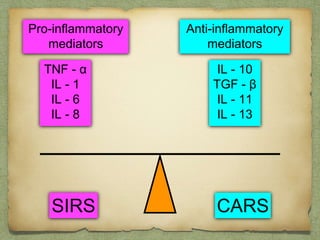
Pro-inflammatory
mediators
TNF - α
IL - 1
IL - 6
IL - 8
Anti-inflammatory
mediators
IL - 10
TGF - β
IL - 11
IL - 13
SIRS CARS
How about Procalcitonin?
PCT: Prohormon (Calcitonin), released into
circulation in response to bacterial infection
sensitivity 88%
specificity 81%
But, there is no Procalcitonin investigation to
establish sepsis definition
So, no need to wait for Procalcitonin result to
initiate resuscitation
3-hour Bundles
Measure Lactate level
Obtain cultures prior to administration of antibiotics
Administer broad spectrum antibiotics
Administer 30 mL/kg crystalloid for hypotension or lactate > 4 mmol/L
“Time of presentation” is defined as the time of triage in ED, or, if presenting from
another venue, from the earliest chart notation consistent with all elements of severe
sepsis or septic shock ascertained through chart review
6-hour Bundles
Apply vasopressors* to maintain MAP > 65 mmHg
Re-assess volume status & tissue perfusion**
Re-measure lactate if initial lactate elevated
*for hypotension that does not respond to initial fluid resuscitation
** In the event of persistent hypotension (MAP < 65 mmHg) or lactate > 4 mmol/L
Physician think
they do a lot for a
patient when they
give his disease a
name
Emmanuel Kant (1743-1804)

Sepsis definition

  • 1.
    Sepsis & SepticShock New Definition
  • 2.
    Nicholas Machiavelli (1532 AD) Sepsis: hecticfever, in its beginning, is difficult to recognise but easy to cure; in the course of time, it becomes easy to recognise but difficult to cure
  • 3.
    Sepsis: physiologic, pathologic,and biochemical abnormalities induced by infection More than $20 billion of total US hospital cost in 2011 estimates: sepsis is a leading cause of mortality & critical illness worldwide
  • 4.
  • 5.
  • 11.
    Sepsis is definedas Life-threatening organ dysfunction caused by a dysregulated host response to infection
  • 14.
    quick SOFA RR >22 Altered mentation Systolic BP < 100 mmHg
  • 15.
  • 16.
    Pro-inflammatory mediators TNF - α IL- 1 IL - 6 IL - 8 Anti-inflammatory mediators IL - 10 TGF - β IL - 11 IL - 13 SIRS CARS
  • 17.
  • 18.
    PCT: Prohormon (Calcitonin),released into circulation in response to bacterial infection sensitivity 88% specificity 81%
  • 21.
    But, there isno Procalcitonin investigation to establish sepsis definition So, no need to wait for Procalcitonin result to initiate resuscitation
  • 27.
    3-hour Bundles Measure Lactatelevel Obtain cultures prior to administration of antibiotics Administer broad spectrum antibiotics Administer 30 mL/kg crystalloid for hypotension or lactate > 4 mmol/L “Time of presentation” is defined as the time of triage in ED, or, if presenting from another venue, from the earliest chart notation consistent with all elements of severe sepsis or septic shock ascertained through chart review
  • 28.
    6-hour Bundles Apply vasopressors*to maintain MAP > 65 mmHg Re-assess volume status & tissue perfusion** Re-measure lactate if initial lactate elevated *for hypotension that does not respond to initial fluid resuscitation ** In the event of persistent hypotension (MAP < 65 mmHg) or lactate > 4 mmol/L
  • 29.
    Physician think they doa lot for a patient when they give his disease a name Emmanuel Kant (1743-1804)