Dr Abdullah A.Almikhlafy
Diagnostic tests:
Sensitivity & Speceficity
09/29/24
Dr-Abdullah A.Almikhlafy
In a perfect world, medical tests would always
be correct. For example, women could undergo
a diagnostic test that would unequivocally
determine whether breast cancer was present
and the test would have no side effects.
09/29/24
Dr-Abdullah A.Almikhlafy
A positive test result would indicate that cancer was
present and a negative test result would indicate that cancer
was absent. In reality, however, every test is fallible.
????????????????????????
09/29/24
Dr-Abdullah A.Almikhlafy
A 54-year-old high school teacher visited her family practitioner for
an annual checkup. She reported no illnesses during the preceding
year, felt well, and had no complaints. The hot flashes she had
experienced a year ago had resolved without treatment.
The results of the mammogram were not normal, and the radiologist
suggested that a breast biopsy be performed. The family practitioner
notified the patient of the abnormal mammogram and referred her
to a surgeon, who concurred that physical examination of the breast
was normal.
09/29/24
Dr-Abdullah A.Almikhlafy
Based on the mammographic abnormality, however, the surgeon
and the radiologist agreed that fine-needle aspiration (FNA) of the
abnormal breast under radiologic guidance was indicated. Evaluation
of the FNA specimen by a pathologist revealed cancer cells, and the
patient was scheduled for further surgery the following week.
09/29/24
Dr-Abdullah A.Almikhlafy
Performance characteristics of a test:
• Sensitivity
• Specificity
• Positive predictive value of a test (PPV)
• Negative predictive value of a test (NPV)
09/29/24
Dr-Abdullah A.Almikhlafy
• Choice of a threshold.
• Impact of disease prevalence, sensitivity and
specificity on predictive values.
09/29/24
Dr-Abdullah A.Almikhlafy
Population with affected and non-affected
individuals
Affected
Non-affected
09/29/24
Dr-Abdullah A.Almikhlafy
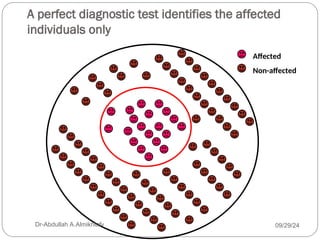
A perfect diagnostic test identifies the affected
individuals only
Affected
Non-affected
09/29/24
Dr-Abdullah A.Almikhlafy
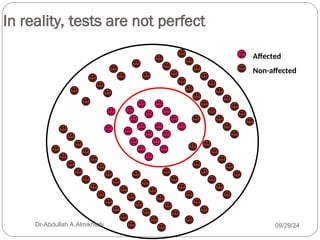
In reality, tests are not perfect
Affected
Non-affected
09/29/24
Dr-Abdullah A.Almikhlafy
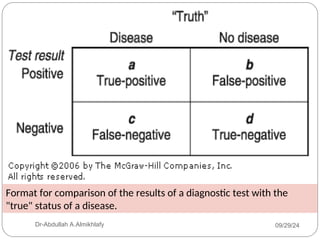
Format for comparison of the results of a diagnostic test with the
"true" status of a disease.
09/29/24
Dr-Abdullah A.Almikhlafy
Any diagnostic test can be evaluated in this manner. The
first step in the evaluation of a test is determining the
"true" status of the disease.
The "true" status of the disease is determined by the (gold standard test)
Gold Standard Test:
Definition: The diagnostic test that is considered the most
accurate test for a particular condition. If the gold standard
test is positive, it is highly likely that the person has the
disease. If the gold standard test is negative, it is highly likely
that the person does not have the disease.
09/29/24
Dr-Abdullah A.Almikhlafy
09/29/24
Dr-Abdullah A.Almikhlafy
Sensitivity and specificity are
terms used to describe the
validity of the FNA test relative
to the surgical excisional biopsy.
Sensitivity
The sensitivity of a test is defined as the percentage of
persons with the disease of interest who have positive
test results.
What is the complement of sensitivity ???
09/29/24
Dr-Abdullah A.Almikhlafy
It is defined as the fraction of the diseased who
test positive.
Estimating the sensitivity of a test
 Identify affected individuals with a gold standard.
 Obtain a wide panel of samples that are representative
of the population of affected individuals.
 Test the affected individuals .
 Estimate the proportion of affected individuals that are
positive with the test.
09/29/24
Dr-Abdullah A.Almikhlafy
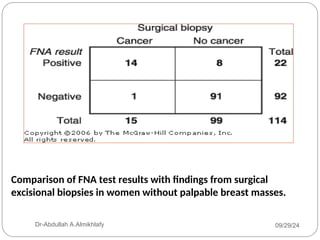
Comparison of FNA test results with findings from surgical
excisional biopsies in women without palpable breast masses.
09/29/24
Dr-Abdullah A.Almikhlafy
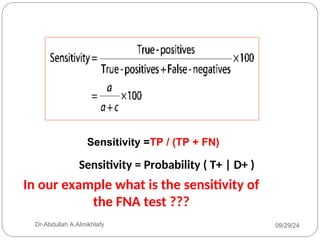
Sensitivity =TP / (TP + FN)
In our example what is the sensitivity of
the FNA test ???
Sensitivity = Probability ( T+ | D+ )
09/29/24
Dr-Abdullah A.Almikhlafy
09/29/24
Dr-Abdullah A.Almikhlafy
The greater the sensitivity of a test, the more likely the test will
detect persons with the disease of interest.
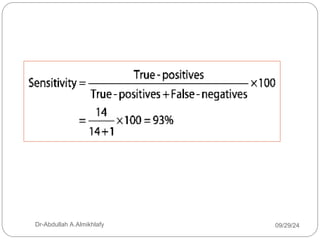
For the FNA test, 93% of all the patients with breast cancer had
positive test results.
Tests with great sensitivity are useful clinically to rule out the
presence of a disease.
That is, a negative result would virtually exclude the possibility that
the patient has the disease of interest.
09/29/24
Dr-Abdullah A.Almikhlafy
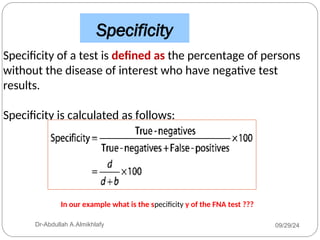
Specificity
Specificity of a test is defined as the percentage of persons
without the disease of interest who have negative test
results.
Specificity is calculated as follows:
09/29/24
Dr-Abdullah A.Almikhlafy
In our example what is the specificity y of the FNA test ???
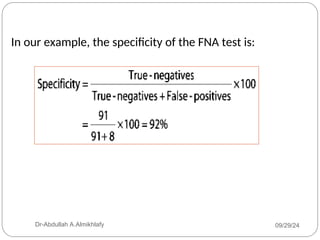
In our example, the specificity of the FNA test is:
09/29/24
Dr-Abdullah A.Almikhlafy
The greater the specificity of a test, the more likely it is
that persons without the disease of interest will be
excluded from consideration of having the disease.
Very specific tests often are used to confirm the presence of a
disease.
If the test is highly specific, a positive test result would strongly
suggest the presence of the disease of interest.
09/29/24
Dr-Abdullah A.Almikhlafy
Positive & Negative Predictive Value
Sensitivity and specificity are descriptors of the accuracy of
a test.
Two measures concerning the estimation of the probability
of the presence or absence of disease are the positive
predictive value (PV+
) (PPV) and the negative predictive
value (PV–
) (NPV) .
09/29/24
Dr-Abdullah A.Almikhlafy
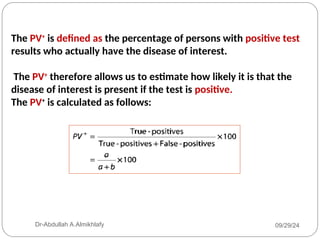
The PV+
is defined as the percentage of persons with positive test
results who actually have the disease of interest.
The PV+
therefore allows us to estimate how likely it is that the
disease of interest is present if the test is positive.
The PV+
is calculated as follows:
09/29/24
Dr-Abdullah A.Almikhlafy
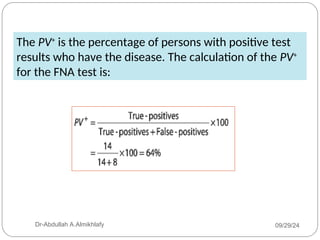
The PV+
is the percentage of persons with positive test
results who have the disease. The calculation of the PV+
for the FNA test is:
09/29/24
Dr-Abdullah A.Almikhlafy
The average probability of breast cancer among women in this
sample prior to the FNA test was 15 affected women out of 114
total women, or 13%. After the FNA test, the probability of breast
cancer for a woman with a positive test result increased to 64%.
09/29/24
Dr-Abdullah A.Almikhlafy
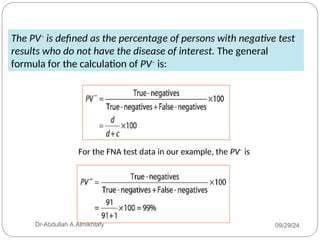
The PV–
is defined as the percentage of persons with negative test
results who do not have the disease of interest. The general
formula for the calculation of PV–
is:
For the FNA test data in our example, the PV–
is
09/29/24
Dr-Abdullah A.Almikhlafy
Before the FNA was performed, the average likelihood of not
having breast cancer among women in this sample was 99
unaffected women out of 114 total women, or 87%.
After a negative FNA result, the probability of not having breast
cancer increased to 99%.
09/29/24
Dr-Abdullah A.Almikhlafy
Now that the post-FNA probability of disease has been calculated
for either a positive or negative test result, the usefulness of the
FNA test for a patient with a nonpalpable breast lesion can be
considered.
A positive test result increased the probability of breast cancer
from 13% to 64%. Whether the probability of breast cancer is 13%
or 64%, further work-up is indicated.
09/29/24
Dr-Abdullah A.Almikhlafy
Both before and after a positive FNA result, the clinician
would conclude that the likelihood of breast cancer was too
great to forego a test such as a surgical biopsy, which would
provide the most definitive diagnosis.
09/29/24
Dr-Abdullah A.Almikhlafy
09/29/24
Dr-Abdullah A.Almikhlafy

Sensitivity & Speceficity diagnostic test (3).ppt

  • 1.
    Dr Abdullah A.Almikhlafy Diagnostictests: Sensitivity & Speceficity 09/29/24 Dr-Abdullah A.Almikhlafy
  • 2.
    In a perfectworld, medical tests would always be correct. For example, women could undergo a diagnostic test that would unequivocally determine whether breast cancer was present and the test would have no side effects. 09/29/24 Dr-Abdullah A.Almikhlafy
  • 3.
    A positive testresult would indicate that cancer was present and a negative test result would indicate that cancer was absent. In reality, however, every test is fallible. ???????????????????????? 09/29/24 Dr-Abdullah A.Almikhlafy
  • 4.
    A 54-year-old highschool teacher visited her family practitioner for an annual checkup. She reported no illnesses during the preceding year, felt well, and had no complaints. The hot flashes she had experienced a year ago had resolved without treatment. The results of the mammogram were not normal, and the radiologist suggested that a breast biopsy be performed. The family practitioner notified the patient of the abnormal mammogram and referred her to a surgeon, who concurred that physical examination of the breast was normal. 09/29/24 Dr-Abdullah A.Almikhlafy
  • 5.
    Based on themammographic abnormality, however, the surgeon and the radiologist agreed that fine-needle aspiration (FNA) of the abnormal breast under radiologic guidance was indicated. Evaluation of the FNA specimen by a pathologist revealed cancer cells, and the patient was scheduled for further surgery the following week. 09/29/24 Dr-Abdullah A.Almikhlafy
  • 6.
    Performance characteristics ofa test: • Sensitivity • Specificity • Positive predictive value of a test (PPV) • Negative predictive value of a test (NPV) 09/29/24 Dr-Abdullah A.Almikhlafy
  • 7.
    • Choice ofa threshold. • Impact of disease prevalence, sensitivity and specificity on predictive values. 09/29/24 Dr-Abdullah A.Almikhlafy
  • 8.
    Population with affectedand non-affected individuals Affected Non-affected 09/29/24 Dr-Abdullah A.Almikhlafy
  • 9.
    A perfect diagnostictest identifies the affected individuals only Affected Non-affected 09/29/24 Dr-Abdullah A.Almikhlafy
  • 10.
    In reality, testsare not perfect Affected Non-affected 09/29/24 Dr-Abdullah A.Almikhlafy
  • 11.
    Format for comparisonof the results of a diagnostic test with the "true" status of a disease. 09/29/24 Dr-Abdullah A.Almikhlafy
  • 12.
    Any diagnostic testcan be evaluated in this manner. The first step in the evaluation of a test is determining the "true" status of the disease. The "true" status of the disease is determined by the (gold standard test) Gold Standard Test: Definition: The diagnostic test that is considered the most accurate test for a particular condition. If the gold standard test is positive, it is highly likely that the person has the disease. If the gold standard test is negative, it is highly likely that the person does not have the disease. 09/29/24 Dr-Abdullah A.Almikhlafy
  • 13.
    09/29/24 Dr-Abdullah A.Almikhlafy Sensitivity andspecificity are terms used to describe the validity of the FNA test relative to the surgical excisional biopsy.
  • 14.
    Sensitivity The sensitivity ofa test is defined as the percentage of persons with the disease of interest who have positive test results. What is the complement of sensitivity ??? 09/29/24 Dr-Abdullah A.Almikhlafy It is defined as the fraction of the diseased who test positive.
  • 15.
    Estimating the sensitivityof a test  Identify affected individuals with a gold standard.  Obtain a wide panel of samples that are representative of the population of affected individuals.  Test the affected individuals .  Estimate the proportion of affected individuals that are positive with the test. 09/29/24 Dr-Abdullah A.Almikhlafy
  • 16.
    Comparison of FNAtest results with findings from surgical excisional biopsies in women without palpable breast masses. 09/29/24 Dr-Abdullah A.Almikhlafy
  • 17.
    Sensitivity =TP /(TP + FN) In our example what is the sensitivity of the FNA test ??? Sensitivity = Probability ( T+ | D+ ) 09/29/24 Dr-Abdullah A.Almikhlafy
  • 18.
  • 19.
    The greater thesensitivity of a test, the more likely the test will detect persons with the disease of interest. For the FNA test, 93% of all the patients with breast cancer had positive test results. Tests with great sensitivity are useful clinically to rule out the presence of a disease. That is, a negative result would virtually exclude the possibility that the patient has the disease of interest. 09/29/24 Dr-Abdullah A.Almikhlafy
  • 20.
    Specificity Specificity of atest is defined as the percentage of persons without the disease of interest who have negative test results. Specificity is calculated as follows: 09/29/24 Dr-Abdullah A.Almikhlafy In our example what is the specificity y of the FNA test ???
  • 21.
    In our example,the specificity of the FNA test is: 09/29/24 Dr-Abdullah A.Almikhlafy
  • 22.
    The greater thespecificity of a test, the more likely it is that persons without the disease of interest will be excluded from consideration of having the disease. Very specific tests often are used to confirm the presence of a disease. If the test is highly specific, a positive test result would strongly suggest the presence of the disease of interest. 09/29/24 Dr-Abdullah A.Almikhlafy
  • 23.
    Positive & NegativePredictive Value Sensitivity and specificity are descriptors of the accuracy of a test. Two measures concerning the estimation of the probability of the presence or absence of disease are the positive predictive value (PV+ ) (PPV) and the negative predictive value (PV– ) (NPV) . 09/29/24 Dr-Abdullah A.Almikhlafy
  • 24.
    The PV+ is definedas the percentage of persons with positive test results who actually have the disease of interest. The PV+ therefore allows us to estimate how likely it is that the disease of interest is present if the test is positive. The PV+ is calculated as follows: 09/29/24 Dr-Abdullah A.Almikhlafy
  • 25.
    The PV+ is thepercentage of persons with positive test results who have the disease. The calculation of the PV+ for the FNA test is: 09/29/24 Dr-Abdullah A.Almikhlafy
  • 26.
    The average probabilityof breast cancer among women in this sample prior to the FNA test was 15 affected women out of 114 total women, or 13%. After the FNA test, the probability of breast cancer for a woman with a positive test result increased to 64%. 09/29/24 Dr-Abdullah A.Almikhlafy
  • 27.
    The PV– is definedas the percentage of persons with negative test results who do not have the disease of interest. The general formula for the calculation of PV– is: For the FNA test data in our example, the PV– is 09/29/24 Dr-Abdullah A.Almikhlafy
  • 28.
    Before the FNAwas performed, the average likelihood of not having breast cancer among women in this sample was 99 unaffected women out of 114 total women, or 87%. After a negative FNA result, the probability of not having breast cancer increased to 99%. 09/29/24 Dr-Abdullah A.Almikhlafy
  • 29.
    Now that thepost-FNA probability of disease has been calculated for either a positive or negative test result, the usefulness of the FNA test for a patient with a nonpalpable breast lesion can be considered. A positive test result increased the probability of breast cancer from 13% to 64%. Whether the probability of breast cancer is 13% or 64%, further work-up is indicated. 09/29/24 Dr-Abdullah A.Almikhlafy
  • 30.
    Both before andafter a positive FNA result, the clinician would conclude that the likelihood of breast cancer was too great to forego a test such as a surgical biopsy, which would provide the most definitive diagnosis. 09/29/24 Dr-Abdullah A.Almikhlafy
  • 31.