SENSITIVITY OF EXPLOSIVES
Sensitivity
A physical characteristic of an explosive material classifying its ability to be initiated upon receiving ab
external impulse such as impact, shock, flame, friction, or other influences that can cause explosive
decomposition.
Friction, impact and static discharge all lead to the heating of an explosive.
Explosives are divided into three main groups:
Initiating explosives (sometimes called primary explosives), e.g., lead azide and lead styphnate
High explosives (sometimes called secondary explosives), e.g., PETN and Pentolite
Deflagrating (or propellant) explosives, e.g., black powder
Initiating Explosives
Initiating explosives are a group of substances that are highly sensitive to the action of mechanical
shock and are readily ignited by direct contact with flame or electric (static) sparks. Primary explosives
such as lead azide (LA) and lead styphnate (LS) have been used for nearly a hundred years to initiate
the detonation of less sensitive secondary explosives.
LA has been used from the early 1900's and it seems to be the ideal detonant; it detonates reliably at
high pressing loads, smaller amounts are required to reliably detonate an adjacent explosive and it
exhibits good thermal stability.
LS is a very "weak" primary explosive and is primarily used as an ignition charge for LA because of its
high ignitability by the direct action of a flame or an electric (static) spark.
Because initiating explosives are sensitive, not only to flame, but also to friction and percussion
(impact sensitive), they are made in small quantities so that special precautions may be taken when
they are handled.
The main difference between an initiating explosive and a high explosive is the ease of ignition of the
former. The two main requirements of an initiating explosive are that firstly, they must reliably
detonate under the influence of a low energy stimulus, either thermal (heat) - electrical (static) or
mechanical (impact or friction), and secondly, it must detonate strongly enough to initiate the
secondary explosive.
Impact
It is essential to understand that an impact must always be considered as two hard surfaces striking
each other with explosive material in between. It is NOT an impact when:
• Explosives are dropped onto a hard surface
• When a foreign object falls into a mass of explosive but does not strile the lower surface of the
container
• Explosives are slowly squeezed (as in a vice)
Friction
A friction event can be compared to striking a match. It must be relatively fast and is usually short-
term. Friction is the act of rubbing the surface of one body against that of another.
Static
Electrical charge at rest on a person or object is called static electricity. It is most often produced by the
contact and separation of different materials. Lightning is a good example of a very large static
discharge. Static electricity builds up inside clouds when water droplets rub together. Whenever a big
enough charge builds up, the electrons try to jump to a positive charge. When the positive charge gets
close to the ground, a negative charge shoots up to meet it, connecting the ground to the cloud. At the
moment they meet, a great blast of electrical current shoots from the ground up to the cloud. So the
flash you see actually starts from the ground and travels up to the cloud.
One of the main causes of accidental initiation of explosives is static electricity, which may be
generated externally or internally of the explosive. Initiating explosives are most sensitive to static
discharge and require only a spark of 10-6
to 10-2
J to cause ignition while secondary explosives require
a minimum spark energy greater than 0,02 J to cause ignition. LS has an electrostatic discharge
sensitivity of 0,0009 J. Numerous accidents have occurred during the drying, pouring, moving, stirring
etc. of LS, caused by the discharge of accumulated static electricity
Heat
When explosives contact a hot surface they may decompose explosively if the temperature is high
enough. At lower temperatures, the explosive will first dry out (slurries or emulsions) and then may
slowly "cook-off". Where continuous friction occurs, as with a defective bearing, the event should be
classified as a thermal event.
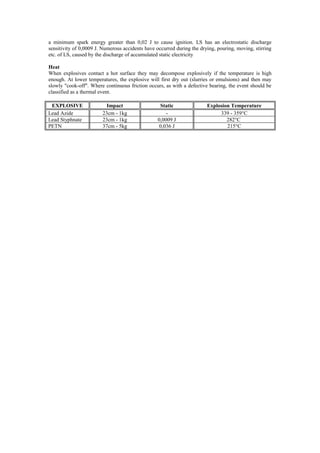
EXPLOSIVE Impact Static Explosion Temperature
Lead Azide 23cm - 1kg - 339 - 359°C
Lead Styphnate 23cm - 1kg 0,0009 J 282°C
PETN 37cm - 5kg 0,036 J 215°C

SENSITIVITY OF EXPLOSIVES

  • 1.
    SENSITIVITY OF EXPLOSIVES Sensitivity Aphysical characteristic of an explosive material classifying its ability to be initiated upon receiving ab external impulse such as impact, shock, flame, friction, or other influences that can cause explosive decomposition. Friction, impact and static discharge all lead to the heating of an explosive. Explosives are divided into three main groups: Initiating explosives (sometimes called primary explosives), e.g., lead azide and lead styphnate High explosives (sometimes called secondary explosives), e.g., PETN and Pentolite Deflagrating (or propellant) explosives, e.g., black powder Initiating Explosives Initiating explosives are a group of substances that are highly sensitive to the action of mechanical shock and are readily ignited by direct contact with flame or electric (static) sparks. Primary explosives such as lead azide (LA) and lead styphnate (LS) have been used for nearly a hundred years to initiate the detonation of less sensitive secondary explosives. LA has been used from the early 1900's and it seems to be the ideal detonant; it detonates reliably at high pressing loads, smaller amounts are required to reliably detonate an adjacent explosive and it exhibits good thermal stability. LS is a very "weak" primary explosive and is primarily used as an ignition charge for LA because of its high ignitability by the direct action of a flame or an electric (static) spark. Because initiating explosives are sensitive, not only to flame, but also to friction and percussion (impact sensitive), they are made in small quantities so that special precautions may be taken when they are handled. The main difference between an initiating explosive and a high explosive is the ease of ignition of the former. The two main requirements of an initiating explosive are that firstly, they must reliably detonate under the influence of a low energy stimulus, either thermal (heat) - electrical (static) or mechanical (impact or friction), and secondly, it must detonate strongly enough to initiate the secondary explosive. Impact It is essential to understand that an impact must always be considered as two hard surfaces striking each other with explosive material in between. It is NOT an impact when: • Explosives are dropped onto a hard surface • When a foreign object falls into a mass of explosive but does not strile the lower surface of the container • Explosives are slowly squeezed (as in a vice) Friction A friction event can be compared to striking a match. It must be relatively fast and is usually short- term. Friction is the act of rubbing the surface of one body against that of another. Static Electrical charge at rest on a person or object is called static electricity. It is most often produced by the contact and separation of different materials. Lightning is a good example of a very large static discharge. Static electricity builds up inside clouds when water droplets rub together. Whenever a big enough charge builds up, the electrons try to jump to a positive charge. When the positive charge gets close to the ground, a negative charge shoots up to meet it, connecting the ground to the cloud. At the moment they meet, a great blast of electrical current shoots from the ground up to the cloud. So the flash you see actually starts from the ground and travels up to the cloud. One of the main causes of accidental initiation of explosives is static electricity, which may be generated externally or internally of the explosive. Initiating explosives are most sensitive to static discharge and require only a spark of 10-6 to 10-2 J to cause ignition while secondary explosives require
  • 2.
    a minimum sparkenergy greater than 0,02 J to cause ignition. LS has an electrostatic discharge sensitivity of 0,0009 J. Numerous accidents have occurred during the drying, pouring, moving, stirring etc. of LS, caused by the discharge of accumulated static electricity Heat When explosives contact a hot surface they may decompose explosively if the temperature is high enough. At lower temperatures, the explosive will first dry out (slurries or emulsions) and then may slowly "cook-off". Where continuous friction occurs, as with a defective bearing, the event should be classified as a thermal event. EXPLOSIVE Impact Static Explosion Temperature Lead Azide 23cm - 1kg - 339 - 359°C Lead Styphnate 23cm - 1kg 0,0009 J 282°C PETN 37cm - 5kg 0,036 J 215°C