Digital Media Foundations
                            Arfa Shah
                            K1109528


SEMIOTICS
What is “Semiotics”?
Semiotics is the study of signs and symbols. It
looks how signs and symbols are used to
communicate and develop interpretations.
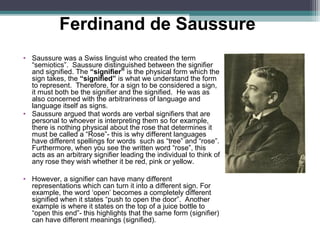
Ferdinand de Saussure
• Saussure was a Swiss linguist who created the term
  “semiotics”. Saussure distinguished between the signifier
  and signified. The “signifier” is the physical form which the
  sign takes, the “signified” is what we understand the form
  to represent. Therefore, for a sign to be considered a sign,
  it must both be the signifier and the signified. He was as
  also concerned with the arbitrariness of language and
  language itself as signs.
• Saussure argued that words are verbal signifiers that are
  personal to whoever is interpreting them so for example,
  there is nothing physical about the rose that determines it
  must be called a “Rose”- this is why different languages
  have different spellings for words such as “tree” and “rose”.
  Furthermore, when you see the written word “rose”, this
  acts as an arbitrary signifier leading the individual to think of
  any rose they wish whether it be red, pink or yellow.

• However, a signifier can have many different
  representations which can turn it into a different sign. For
  example, the word ‘open’ becomes a completely different
  signified when it states “push to open the door”. Another
  example is where it states on the top of a juice bottle to
  “open this end”- this highlights that the same form (signifier)
  can have different meanings (signified).
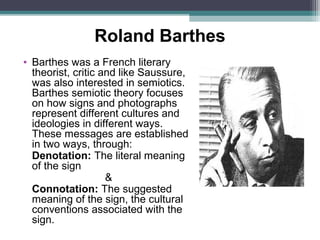
Roland Barthes
• Barthes was a French literary
  theorist, critic and like Saussure,
  was also interested in semiotics.
  Barthes semiotic theory focuses
  on how signs and photographs
  represent different cultures and
  ideologies in different ways.
  These messages are established
  in two ways, through:
  Denotation: The literal meaning
  of the sign
                    &
  Connotation: The suggested
  meaning of the sign, the cultural
  conventions associated with the
  sign.
• For example, Harry Potter denotes a
  storybook character, it connotes to
  wizards, witches, spells, Hogwarts, magic
  and spells. A rose denotes a flower,
  however it’s connotations could be
  passion, love, romance.
• The term “myth” refers to the collective,
  unconscious meaning created as the
  result of a semiotic process.
• Barthes theorised that a myth is a chain
  of semiotic events which, when
  experienced or seen by members of
  society, creates a subconscious meaning.
  For example, when members of society
  come across the signs of McDonalds,
  Burger Kind, KFC, Pizza Hut, the literal
  meaning is that they are restaurants
  whereas the myth would be consumerism,
  capitalism, obesity which society
  members will not register on a conscious
  level.
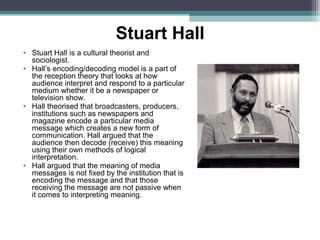
Stuart Hall
• Stuart Hall is a cultural theorist and
  sociologist.
• Hall’s encoding/decoding model is a part of
  the reception theory that looks at how
  audience interpret and respond to a particular
  medium whether it be a newspaper or
  television show.
• Hall theorised that broadcasters, producers,
  institutions such as newspapers and
  magazine encode a particular media
  message which creates a new form of
  communication. Hall argued that the
  audience then decode (receive) this meaning
  using their own methods of logical
  interpretation.
• Hall argued that the meaning of media
  messages is not fixed by the institution that is
  encoding the message and that those
  receiving the message are not passive when
  it comes to interpreting meaning.
• Hall also argued that the meaning of the text is
  relative to the person//audience interpreting it.
  The producer (encoder) can fix the meaning of
  the message in a specific way but they cannot
  control how the audience decode the message
  and this is dependent on their personal
  background, economic situation and cultural
  background.
• For Hall, the denotation and connotation process
  is an analytical tool He also argues that it is very
  rare for signs to signify their literal meaning in
  the world and that most signs will combine both
  the denotative and connotative process and work
  simultaneously together to create meaning.
• Hall went onto argue that for those decoding
  readings, there can be a number of unlimited
  readings and that the decoding process is
  “polysemic”- meaning that one text can have a
  number of meanings. Hall stated that whilst these
  various meanings do exist, they will eventually give
  way to a “dominant or preferred meaning”.

• The next slide gives an example of Hall’s
  communication model.
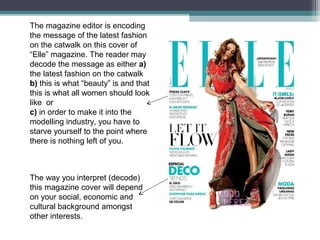
The magazine editor is encoding
the message of the latest fashion
on the catwalk on this cover of
“Elle” magazine. The reader may
decode the message as either a)
the latest fashion on the catwalk
b) this is what “beauty” is and that
this is what all women should look
like or
c) in order to make it into the
modelling industry, you have to
starve yourself to the point where
there is nothing left of you.


The way you interpret (decode)
this magazine cover will depend
on your social, economic and
cultural background amongst
other interests.

Semiotics

  • 1.
    Digital Media Foundations Arfa Shah K1109528 SEMIOTICS
  • 2.
    What is “Semiotics”? Semioticsis the study of signs and symbols. It looks how signs and symbols are used to communicate and develop interpretations.
  • 3.
    Ferdinand de Saussure •Saussure was a Swiss linguist who created the term “semiotics”. Saussure distinguished between the signifier and signified. The “signifier” is the physical form which the sign takes, the “signified” is what we understand the form to represent. Therefore, for a sign to be considered a sign, it must both be the signifier and the signified. He was as also concerned with the arbitrariness of language and language itself as signs. • Saussure argued that words are verbal signifiers that are personal to whoever is interpreting them so for example, there is nothing physical about the rose that determines it must be called a “Rose”- this is why different languages have different spellings for words such as “tree” and “rose”. Furthermore, when you see the written word “rose”, this acts as an arbitrary signifier leading the individual to think of any rose they wish whether it be red, pink or yellow. • However, a signifier can have many different representations which can turn it into a different sign. For example, the word ‘open’ becomes a completely different signified when it states “push to open the door”. Another example is where it states on the top of a juice bottle to “open this end”- this highlights that the same form (signifier) can have different meanings (signified).
  • 4.
    Roland Barthes • Bartheswas a French literary theorist, critic and like Saussure, was also interested in semiotics. Barthes semiotic theory focuses on how signs and photographs represent different cultures and ideologies in different ways. These messages are established in two ways, through: Denotation: The literal meaning of the sign & Connotation: The suggested meaning of the sign, the cultural conventions associated with the sign.
  • 5.
    • For example,Harry Potter denotes a storybook character, it connotes to wizards, witches, spells, Hogwarts, magic and spells. A rose denotes a flower, however it’s connotations could be passion, love, romance. • The term “myth” refers to the collective, unconscious meaning created as the result of a semiotic process. • Barthes theorised that a myth is a chain of semiotic events which, when experienced or seen by members of society, creates a subconscious meaning. For example, when members of society come across the signs of McDonalds, Burger Kind, KFC, Pizza Hut, the literal meaning is that they are restaurants whereas the myth would be consumerism, capitalism, obesity which society members will not register on a conscious level.
  • 6.
    Stuart Hall • StuartHall is a cultural theorist and sociologist. • Hall’s encoding/decoding model is a part of the reception theory that looks at how audience interpret and respond to a particular medium whether it be a newspaper or television show. • Hall theorised that broadcasters, producers, institutions such as newspapers and magazine encode a particular media message which creates a new form of communication. Hall argued that the audience then decode (receive) this meaning using their own methods of logical interpretation. • Hall argued that the meaning of media messages is not fixed by the institution that is encoding the message and that those receiving the message are not passive when it comes to interpreting meaning.
  • 7.
    • Hall alsoargued that the meaning of the text is relative to the person//audience interpreting it. The producer (encoder) can fix the meaning of the message in a specific way but they cannot control how the audience decode the message and this is dependent on their personal background, economic situation and cultural background. • For Hall, the denotation and connotation process is an analytical tool He also argues that it is very rare for signs to signify their literal meaning in the world and that most signs will combine both the denotative and connotative process and work simultaneously together to create meaning.
  • 8.
    • Hall wentonto argue that for those decoding readings, there can be a number of unlimited readings and that the decoding process is “polysemic”- meaning that one text can have a number of meanings. Hall stated that whilst these various meanings do exist, they will eventually give way to a “dominant or preferred meaning”. • The next slide gives an example of Hall’s communication model.
  • 9.
    The magazine editoris encoding the message of the latest fashion on the catwalk on this cover of “Elle” magazine. The reader may decode the message as either a) the latest fashion on the catwalk b) this is what “beauty” is and that this is what all women should look like or c) in order to make it into the modelling industry, you have to starve yourself to the point where there is nothing left of you. The way you interpret (decode) this magazine cover will depend on your social, economic and cultural background amongst other interests.