Narrative Theory
      Digital Media Foundations
                      Arfa Shah
                      K1109528
What is a narrative?
   A narrative essentially tells a story to the reader.
   A narrative doesn’t have to be linear where the story is
    told in chronological order with a beginning, middle and
    an end.
   A narrative can also be non-linear where the story isn’t
    told in a chronological order- a non-linear narrative can
    take the form of a flashback, flash forward, story told
    from the perspective of different characters at different
    points in time.
   In order to understand different narratives, theorists
    such as Todorov, Propp and Levi-Strauss detailed a list of
    common conventions that can be found in narratives.
Tzvetan Todorov
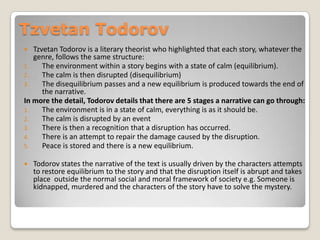
  Tzvetan Todorov is a literary theorist who highlighted that each story, whatever the
   genre, follows the same structure:
1.    The environment within a story begins with a state of calm (equilibrium).
2.    The calm is then disrupted (disequilibrium)
3.    The disequilibrium passes and a new equilibrium is produced towards the end of
      the narrative.
In more the detail, Todorov details that there are 5 stages a narrative can go through:
1.    The environment is in a state of calm, everything is as it should be.
2.    The calm is disrupted by an event
3.    There is then a recognition that a disruption has occurred.
4.    There is an attempt to repair the damage caused by the disruption.
5.    Peace is stored and there is a new equilibrium.

   Todorov states the narrative of the text is usually driven by the characters attempts
    to restore equilibrium to the story and that the disruption itself is abrupt and takes
    place outside the normal social and moral framework of society e.g. Someone is
    kidnapped, murdered and the characters of the story have to solve the mystery.
Vladimir Propp
Vladimir Propp was a Russian critic in the 1920s
who was interested in the narratives of Folk Tales.
He found that characters in stories acted as
narrative functions and drove the plot of the
story forward. He said that the characters of
narratives provided structure to the text and
identified 8 character types:
1.   Hero- a character who is seeking something
2.   Villain- aims to block the hero’s journey
3.   Donor- provides an object with magical qualities
4.   Dispatcher- sends the hero a message which leads
     the hero to go on his quest.
5.   False hero- disrupts the hero’s quest and success by
     making false claims and tries to win over the
     princess.
6.   Helper- aids the hero in his quest.
7.   Princess- Is the reward for the hero and usually used
     by the villain in his plots.
8.   Father- rewards the hero for his effort usually by
     allowing him to be with the Princess.
Example of Propp’s theory: Shrek 2


Shrek- Hero             Fairy Godmother-            Charming-
In Shrek 2, Shrek       Villain & Donor             False Hero
seeks to be reunited                                Once Shrek drinks
                        The Fairy Godmother
with Fiona after her                                the potion and
                        wants her                   becomes
Father arranges for     son, Charming, to           human, he rushes
him to be killed to     become the Prince and       to the castle but
ensure the best         plots with Fiona’s father   finds that
future for Fiona.
                        to get rid of Shrek. She    Charming is there
Shrek believes in                                   impersonating
                        also acts as an unwilling
order to reunite with                               Shrek. He does this
Fiona, he must
                        donor as the potion
                                                    with the aim to
become human and        which Shrek needs to
                                                    marry Fiona and
seeks to find a         become human is             become the Prince.
potion.                 produced at Fairy
                        Godmother’s potion
Donkey- Helper         Fiona- Princess       King Harold-
Donkey helps Shrek     Shrek wins back       Fiona’s Father and
by aiding him in       Fiona once he         unwilling Villain
breaking into the      convinces her that    King Harold rewards
factory and stealing   Charming is not       Shrek with Fiona once
                                             he wins the heart of the
the potion and then    the human version
                                             people. The reason why
helps him reveal       of Shrek. Fiona is    King Harold becomes
Charming’s true        manipulated by        the unwilling villain of
identity to the        Fairy Godmother       the story is to fulfil his
citizens of “Far Far   and King Harold       promise to Fairy
Away” in order to      into believing that   Godmother that
win back Fiona.        Charming is           Charming will become
                       Shrek.                Prince otherwise he will
                                             be turned back into a
                                             frog.
Claude Levi-Strauss
   Levi- Strauss was a social anthropologist and studied myths of
    tribal cultures. He found that stories that are told
    unconsciously mirror the values and myths of a culture. He
    argued that these values and myths are expressed in the form
    of binary oppositions.
   Levi-Strauss argued that we understand words not solely on
    their meaning, but in relation to its opposite component, or its
    “binary opposite”. He argued the words represent society’s
    values and ideas therefore the meaning of words is a
    relationship between two different ideas.
    For example, the only way we can understand the word
    “villain “ is by looking at its opposite, the “hero”. In modern
    society, a hero is kind, noble and brave whereas a villain is the
    complete OPPOSITE- selfish, unkind, evil.
   Other examples of binary opposites are- light and day, love and
    hate, masculinity and femininity, young and old, light and dark.
Roland Barthes
    Barthes was a French literary theorist and along with Todorov, Propp
     and Levi-Strauss, suggested that there are 5 codes that can describe
     the meaning of a text.
    He also said that texts can ‘open’ which means they can be
     interpreted in many different ways, or, ‘closed’ which suggests the
     text has one dominant interpretation.
    The 5 codes are:
1.           The Hermeneutic Code: This code refers to the
             ambiguity/mystery in a text. The purpose of the
             hermeneutic code, also referred to as the enigma code, is to
             leave the audience wanting to know more and therefore
             keeps them hooked to the story (seen mostly in
             horrors, thrillers, mystery e.g. Who is the killer of the text?)
2.           The Proairetic Code: This code builds tension by referring to
             incidents in the text which indicates that something else
             might happen- this keeps the audience guessing. Barthes
             stated that the Hermeneutic Code and Proairetic Code are
             “dependent on” one another to increase the suspense
             within the story and to keep the audience interested.
Roland Barthes continued...
3.   The Semantic Code: This code relates to the connotations
     contained within a text which gives additional meaning to
     the text.
4.   The Symbolic Code: Is very similar to the code above
     however it organises semantic meanings into a wider
     framework of meaning. This is done by creating new
     meanings, tension and drama out of opposing ideas.
5.   The Referential Code: This code refers to anything within the
     text which utilises wider and external framework of
     knowledge grounded in “truth”- for example
     scientific, historical knowledge.

Narrative

  • 1.
    Narrative Theory Digital Media Foundations Arfa Shah K1109528
  • 2.
    What is anarrative?  A narrative essentially tells a story to the reader.  A narrative doesn’t have to be linear where the story is told in chronological order with a beginning, middle and an end.  A narrative can also be non-linear where the story isn’t told in a chronological order- a non-linear narrative can take the form of a flashback, flash forward, story told from the perspective of different characters at different points in time.  In order to understand different narratives, theorists such as Todorov, Propp and Levi-Strauss detailed a list of common conventions that can be found in narratives.
  • 3.
    Tzvetan Todorov  Tzvetan Todorov is a literary theorist who highlighted that each story, whatever the genre, follows the same structure: 1. The environment within a story begins with a state of calm (equilibrium). 2. The calm is then disrupted (disequilibrium) 3. The disequilibrium passes and a new equilibrium is produced towards the end of the narrative. In more the detail, Todorov details that there are 5 stages a narrative can go through: 1. The environment is in a state of calm, everything is as it should be. 2. The calm is disrupted by an event 3. There is then a recognition that a disruption has occurred. 4. There is an attempt to repair the damage caused by the disruption. 5. Peace is stored and there is a new equilibrium.  Todorov states the narrative of the text is usually driven by the characters attempts to restore equilibrium to the story and that the disruption itself is abrupt and takes place outside the normal social and moral framework of society e.g. Someone is kidnapped, murdered and the characters of the story have to solve the mystery.
  • 4.
    Vladimir Propp Vladimir Proppwas a Russian critic in the 1920s who was interested in the narratives of Folk Tales. He found that characters in stories acted as narrative functions and drove the plot of the story forward. He said that the characters of narratives provided structure to the text and identified 8 character types:
  • 5.
    1. Hero- a character who is seeking something 2. Villain- aims to block the hero’s journey 3. Donor- provides an object with magical qualities 4. Dispatcher- sends the hero a message which leads the hero to go on his quest. 5. False hero- disrupts the hero’s quest and success by making false claims and tries to win over the princess. 6. Helper- aids the hero in his quest. 7. Princess- Is the reward for the hero and usually used by the villain in his plots. 8. Father- rewards the hero for his effort usually by allowing him to be with the Princess.
  • 6.
    Example of Propp’stheory: Shrek 2 Shrek- Hero Fairy Godmother- Charming- In Shrek 2, Shrek Villain & Donor False Hero seeks to be reunited Once Shrek drinks The Fairy Godmother with Fiona after her the potion and wants her becomes Father arranges for son, Charming, to human, he rushes him to be killed to become the Prince and to the castle but ensure the best plots with Fiona’s father finds that future for Fiona. to get rid of Shrek. She Charming is there Shrek believes in impersonating also acts as an unwilling order to reunite with Shrek. He does this Fiona, he must donor as the potion with the aim to become human and which Shrek needs to marry Fiona and seeks to find a become human is become the Prince. potion. produced at Fairy Godmother’s potion
  • 7.
    Donkey- Helper Fiona- Princess King Harold- Donkey helps Shrek Shrek wins back Fiona’s Father and by aiding him in Fiona once he unwilling Villain breaking into the convinces her that King Harold rewards factory and stealing Charming is not Shrek with Fiona once he wins the heart of the the potion and then the human version people. The reason why helps him reveal of Shrek. Fiona is King Harold becomes Charming’s true manipulated by the unwilling villain of identity to the Fairy Godmother the story is to fulfil his citizens of “Far Far and King Harold promise to Fairy Away” in order to into believing that Godmother that win back Fiona. Charming is Charming will become Shrek. Prince otherwise he will be turned back into a frog.
  • 8.
    Claude Levi-Strauss  Levi- Strauss was a social anthropologist and studied myths of tribal cultures. He found that stories that are told unconsciously mirror the values and myths of a culture. He argued that these values and myths are expressed in the form of binary oppositions.  Levi-Strauss argued that we understand words not solely on their meaning, but in relation to its opposite component, or its “binary opposite”. He argued the words represent society’s values and ideas therefore the meaning of words is a relationship between two different ideas.  For example, the only way we can understand the word “villain “ is by looking at its opposite, the “hero”. In modern society, a hero is kind, noble and brave whereas a villain is the complete OPPOSITE- selfish, unkind, evil.  Other examples of binary opposites are- light and day, love and hate, masculinity and femininity, young and old, light and dark.
  • 9.
    Roland Barthes  Barthes was a French literary theorist and along with Todorov, Propp and Levi-Strauss, suggested that there are 5 codes that can describe the meaning of a text.  He also said that texts can ‘open’ which means they can be interpreted in many different ways, or, ‘closed’ which suggests the text has one dominant interpretation.  The 5 codes are: 1. The Hermeneutic Code: This code refers to the ambiguity/mystery in a text. The purpose of the hermeneutic code, also referred to as the enigma code, is to leave the audience wanting to know more and therefore keeps them hooked to the story (seen mostly in horrors, thrillers, mystery e.g. Who is the killer of the text?) 2. The Proairetic Code: This code builds tension by referring to incidents in the text which indicates that something else might happen- this keeps the audience guessing. Barthes stated that the Hermeneutic Code and Proairetic Code are “dependent on” one another to increase the suspense within the story and to keep the audience interested.
  • 10.
    Roland Barthes continued... 3. The Semantic Code: This code relates to the connotations contained within a text which gives additional meaning to the text. 4. The Symbolic Code: Is very similar to the code above however it organises semantic meanings into a wider framework of meaning. This is done by creating new meanings, tension and drama out of opposing ideas. 5. The Referential Code: This code refers to anything within the text which utilises wider and external framework of knowledge grounded in “truth”- for example scientific, historical knowledge.