Introduction to innovation
Definitions
Dimensions
Drivers
Developments
What is innovation?
 Innovation is the process and outcome of
creating something new, which is also of
value.
 Innovation involves the whole process
from opportunity identification, ideation or
invention to development, prototyping,
production marketing and sales, while
entrepreneurship only needs to involve
commercialization (Schumpeter).
Definitions
 Innovation = Invention + exploitation
(Ettlie)
 A new way of doing things, which is
commercialized. The process of innovation
cannot be separated from a firm’s strategic
and competetive context (Porter)
 Adoption of ideas that are new to the
adopting organization
What is innovation?
 Today it is also said to involve the capacity
to adapt quickly by adopting new
innovations (products, processes,
strategies, organization, etc)
 Traditionally the focus has been on new
products or processes, but recently new
business models have come into focus, i.e.
the way a firm delivers value and secures
profits.
What is innovation?
 Schumpeter argued that innovation comes
about through new combinations made
by an entrepreneur, resulting in
 a new product,
 a new process,
 opening of new market,
 new way of organizing the business
 new sources of supply
Mechanisms of innovation
 Novelty in product or service (offering something no one else
does)
 Novelty in process (offering it in a new way)
 Complexity (offer something which others find difficult to
master)
 Timing (first mover advantage, fast follower)
 Add/extend competetive factors (e.g. From price to quality or
choice)
 Robust design (contribute a platform on which other
variations can build)
 Reconfiguring the parts (building more effective business
networks)
 ...
Dimensions of innovation
 Extent of change (radical—incremental)
 Modality of change (product—process)
 Complexity of change (component—architecture)
 Materiality of change (physical—intangible)
 Capabilities and change (enhances or destroys
market/technological capabilties)
 Relatedness of change (replaces a firm’s existing
product or extends it)
 Appropriability/Imitability (difficult or hard to hang
on to)
 Cycle of innovation (time between discontinuities)
Drivers for innovation
 Financial pressures to reduce costs, increase efficiency, do
more with less, etc
 Increased competition
 Shorter product life cycles
 Value migration
 Stricter regulation
 Industry and community needs for sustainable development
 Increased demend for accountability
 Demographic, social and maket changes
 Rising customer expectations regarding service and quality
 Changing economy
 Greater availability of potentially useful technologies coupled
with a need to exceed the competition in these technologies
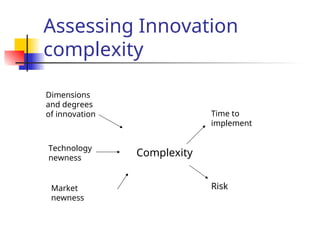
Assessing Innovation
complexity
Dimensions
and degrees
of innovation
Technology
newness
Market
newness
Complexity
Time to
implement
Risk
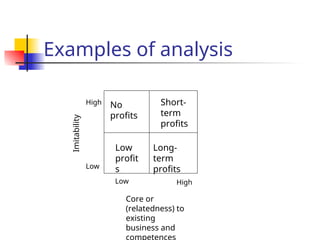
Examples of analysis
Core or
(relatedness) to
existing
business and
Low High
Imitability
Low
High
Low
profit
s
Short-
term
profits
Long-
term
profits
No
profits
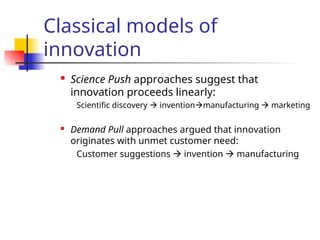
Classical models of
innovation
 Science Push approaches suggest that
innovation proceeds linearly:
Scientific discovery  inventionmanufacturing  marketing
 Demand Pull approaches argued that innovation
originates with unmet customer need:
Customer suggestions  invention  manufacturing
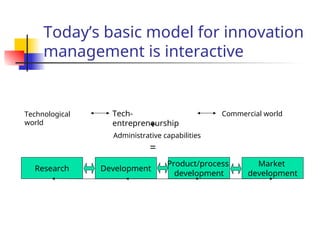
Today’s basic model for innovation
management is interactive
Technological
world
Commercial world
Tech-
entrepreneurship
Administrative capabilities
+
Research Development
Product/process
development
Market
development
=

2 meeting - Innovation, models, patterns

  • 1.
  • 2.
    What is innovation? Innovation is the process and outcome of creating something new, which is also of value.  Innovation involves the whole process from opportunity identification, ideation or invention to development, prototyping, production marketing and sales, while entrepreneurship only needs to involve commercialization (Schumpeter).
  • 3.
    Definitions  Innovation =Invention + exploitation (Ettlie)  A new way of doing things, which is commercialized. The process of innovation cannot be separated from a firm’s strategic and competetive context (Porter)  Adoption of ideas that are new to the adopting organization
  • 4.
    What is innovation? Today it is also said to involve the capacity to adapt quickly by adopting new innovations (products, processes, strategies, organization, etc)  Traditionally the focus has been on new products or processes, but recently new business models have come into focus, i.e. the way a firm delivers value and secures profits.
  • 5.
    What is innovation? Schumpeter argued that innovation comes about through new combinations made by an entrepreneur, resulting in  a new product,  a new process,  opening of new market,  new way of organizing the business  new sources of supply
  • 6.
    Mechanisms of innovation Novelty in product or service (offering something no one else does)  Novelty in process (offering it in a new way)  Complexity (offer something which others find difficult to master)  Timing (first mover advantage, fast follower)  Add/extend competetive factors (e.g. From price to quality or choice)  Robust design (contribute a platform on which other variations can build)  Reconfiguring the parts (building more effective business networks)  ...
  • 7.
    Dimensions of innovation Extent of change (radical—incremental)  Modality of change (product—process)  Complexity of change (component—architecture)  Materiality of change (physical—intangible)  Capabilities and change (enhances or destroys market/technological capabilties)  Relatedness of change (replaces a firm’s existing product or extends it)  Appropriability/Imitability (difficult or hard to hang on to)  Cycle of innovation (time between discontinuities)
  • 8.
    Drivers for innovation Financial pressures to reduce costs, increase efficiency, do more with less, etc  Increased competition  Shorter product life cycles  Value migration  Stricter regulation  Industry and community needs for sustainable development  Increased demend for accountability  Demographic, social and maket changes  Rising customer expectations regarding service and quality  Changing economy  Greater availability of potentially useful technologies coupled with a need to exceed the competition in these technologies
  • 9.
    Assessing Innovation complexity Dimensions and degrees ofinnovation Technology newness Market newness Complexity Time to implement Risk
  • 10.
    Examples of analysis Coreor (relatedness) to existing business and Low High Imitability Low High Low profit s Short- term profits Long- term profits No profits
  • 11.
    Classical models of innovation Science Push approaches suggest that innovation proceeds linearly: Scientific discovery  inventionmanufacturing  marketing  Demand Pull approaches argued that innovation originates with unmet customer need: Customer suggestions  invention  manufacturing
  • 12.
    Today’s basic modelfor innovation management is interactive Technological world Commercial world Tech- entrepreneurship Administrative capabilities + Research Development Product/process development Market development =

Editor's Notes

  • #10 A firm’s ability to profit from its competences has to do with how core (central) its competences are with regard to the innovation it wishes to develop, as well as how easy it is for competitors to imitate the innovation. If a needed competence is not core, and imitability is high, then one may not be able to profit from the innovation (”all things being equal”). If its low-core but inimitable, then the firm may make some profits, but will never be able to develop or grow the innovation successfully. If competences are high-core but the innovation is imitable, there will be an initial profit up until competition catches up (think about how the firm may strategically protect the innovation during this time window). Finally, we conclude that most of the profits will come from products that the firm makes as a result of having inimitable innovation and maximally leveraging its core competences.