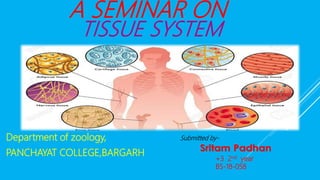
A SEMINAR ON
TISSUE SYSTEM
Department of zoology,
PANCHAYAT COLLEGE,BARGARH
Submitted by-
+3 2nd year
BS-18-058
WHAT IS TISSUE
*Specialized cell of the same type that perform a common
function in the body.
*Life begins as a single cell called as zygote after fertilization.
*This cell differentiates into a variety of tissues.
*A group of tissue with the same function forms an organ.
*Group of organs-organ system.
*Group of organ systems-organisms.
MAJOR TYPES OF ANIMAL TISSUE
*EPITHELIAL TISSUE: Covers or lines body cavity and forms glands.
*CONNECTIVE TISSUE: Binds different organs together and support
the body.
*MUSCLE TISSUE: Movement.
*NERVOUS TISSUE: Senses and transmits impulses.
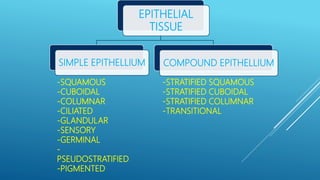
EPITHELIAL
TISSUE
SIMPLE EPITHELLIUM COMPOUND EPITHELLIUM
-SQUAMOUS
-CUBOIDAL
-COLUMNAR
-CILIATED
-GLANDULAR
-SENSORY
-GERMINAL
-
PSEUDOSTRATIFIED
-PIGMENTED
-STRATIFIED SQUAMOUS
-STRATIFIED CUBOIDAL
-STRATIFIED COLUMNAR
-TRANSITIONAL
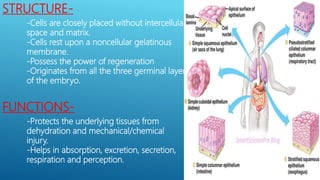
STRUCTURE-
-Cells are closely placed without intercellular
space and matrix.
-Cells rest upon a noncellular gelatinous
membrane.
-Possess the power of regeneration
-Originates from all the three germinal layers
of the embryo.
FUNCTIONS-
-Protects the underlying tissues from
dehydration and mechanical/chemical
injury.
-Helps in absorption, excretion, secretion,
respiration and perception.
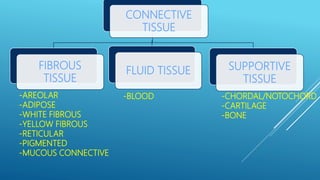
CONNECTIVE
TISSUE
FIBROUS
TISSUE
FLUID TISSUE SUPPORTIVE
TISSUE
-AREOLAR
-ADIPOSE
-WHITE FIBROUS
-YELLOW FIBROUS
-RETICULAR
-PIGMENTED
-MUCOUS CONNECTIVE
-BLOOD -CHORDAL/NOTOCHORD
-CARTILAGE
-BONE
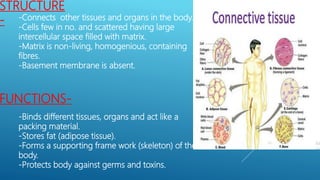
STRUCTURE
- -Connects other tissues and organs in the body.
-Cells few in no. and scattered having large
intercellular space filled with matrix.
-Matrix is non-living, homogenious, containing
fibres.
-Basement membrane is absent.
FUNCTIONS-
-Binds different tissues, organs and act like a
packing material.
-Stores fat (adipose tissue).
-Forms a supporting frame work (skeleton) of the
body.
-Protects body against germs and toxins.
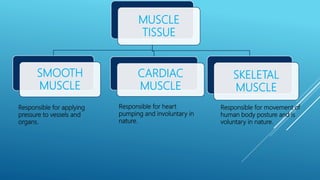
MUSCLE
TISSUE
SMOOTH
MUSCLE
CARDIAC
MUSCLE
SKELETAL
MUSCLE
Responsible for applying
pressure to vessels and
organs.
Responsible for heart
pumping and involuntary in
nature.
Responsible for movement of
human body posture and is
voluntary in nature.
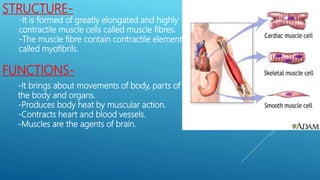
STRUCTURE-
-It is formed of greatly elongated and highly
contractile muscle cells called muscle fibres.
-The muscle fibre contain contractile elements
called myofibrils.
FUNCTIONS-
-It brings about movements of body, parts of
the body and organs.
-Produces body heat by muscular action.
-Contracts heart and blood vessels.
-Muscles are the agents of brain.
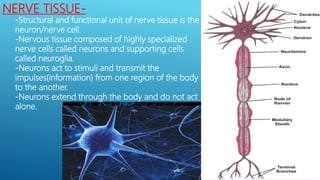
NERVE TISSUE-
-Structural and functional unit of nerve tissue is the
neuron/nerve cell.
-Nervous tissue composed of highly specialized
nerve cells called neurons and supporting cells
called neuroglia.
-Neurons act to stimuli and transmit the
impulses(information) from one region of the body
to the another.
-Neurons extend through the body and do not act
alone.
Seminar on TISSUE SYSTEM.pptx

Seminar on TISSUE SYSTEM.pptx

  • 1.
    A SEMINAR ON TISSUESYSTEM Department of zoology, PANCHAYAT COLLEGE,BARGARH Submitted by- +3 2nd year BS-18-058
  • 2.
    WHAT IS TISSUE *Specializedcell of the same type that perform a common function in the body. *Life begins as a single cell called as zygote after fertilization. *This cell differentiates into a variety of tissues. *A group of tissue with the same function forms an organ. *Group of organs-organ system. *Group of organ systems-organisms.
  • 3.
    MAJOR TYPES OFANIMAL TISSUE *EPITHELIAL TISSUE: Covers or lines body cavity and forms glands. *CONNECTIVE TISSUE: Binds different organs together and support the body. *MUSCLE TISSUE: Movement. *NERVOUS TISSUE: Senses and transmits impulses.
  • 4.
    EPITHELIAL TISSUE SIMPLE EPITHELLIUM COMPOUNDEPITHELLIUM -SQUAMOUS -CUBOIDAL -COLUMNAR -CILIATED -GLANDULAR -SENSORY -GERMINAL - PSEUDOSTRATIFIED -PIGMENTED -STRATIFIED SQUAMOUS -STRATIFIED CUBOIDAL -STRATIFIED COLUMNAR -TRANSITIONAL
  • 5.
    STRUCTURE- -Cells are closelyplaced without intercellular space and matrix. -Cells rest upon a noncellular gelatinous membrane. -Possess the power of regeneration -Originates from all the three germinal layers of the embryo. FUNCTIONS- -Protects the underlying tissues from dehydration and mechanical/chemical injury. -Helps in absorption, excretion, secretion, respiration and perception.
  • 6.
    CONNECTIVE TISSUE FIBROUS TISSUE FLUID TISSUE SUPPORTIVE TISSUE -AREOLAR -ADIPOSE -WHITEFIBROUS -YELLOW FIBROUS -RETICULAR -PIGMENTED -MUCOUS CONNECTIVE -BLOOD -CHORDAL/NOTOCHORD -CARTILAGE -BONE
  • 7.
    STRUCTURE - -Connects othertissues and organs in the body. -Cells few in no. and scattered having large intercellular space filled with matrix. -Matrix is non-living, homogenious, containing fibres. -Basement membrane is absent. FUNCTIONS- -Binds different tissues, organs and act like a packing material. -Stores fat (adipose tissue). -Forms a supporting frame work (skeleton) of the body. -Protects body against germs and toxins.
  • 8.
    MUSCLE TISSUE SMOOTH MUSCLE CARDIAC MUSCLE SKELETAL MUSCLE Responsible for applying pressureto vessels and organs. Responsible for heart pumping and involuntary in nature. Responsible for movement of human body posture and is voluntary in nature.
  • 9.
    STRUCTURE- -It is formedof greatly elongated and highly contractile muscle cells called muscle fibres. -The muscle fibre contain contractile elements called myofibrils. FUNCTIONS- -It brings about movements of body, parts of the body and organs. -Produces body heat by muscular action. -Contracts heart and blood vessels. -Muscles are the agents of brain.
  • 10.
    NERVE TISSUE- -Structural andfunctional unit of nerve tissue is the neuron/nerve cell. -Nervous tissue composed of highly specialized nerve cells called neurons and supporting cells called neuroglia. -Neurons act to stimuli and transmit the impulses(information) from one region of the body to the another. -Neurons extend through the body and do not act alone.