Presented by –
Satyasai Patel
+3 2nd Year
BS-18-161
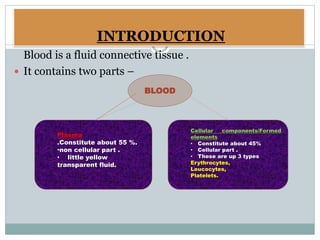
INTRODUCTION
Blood is a fluid connective tissue .
 It contains two parts –
Plasma
.Constitute about 55 %.
•non cellular part .
• little yellow
transparent fluid.
Cellular components/Formed
elements
• Constitute about 45%
• Cellular part .
• These are up 3 types
Erythrocytes,
Leucocytes,
Platelets.
BLOOD
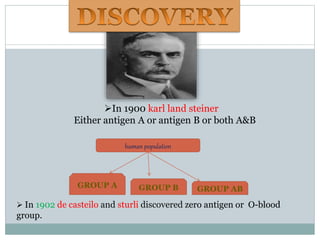
In 1900 karl land steiner
Either antigen A or antigen B or both A&B
human population
GROUP A GROUP B GROUP AB
 In 1902 de casteilo and sturli discovered zero antigen or O-blood
group.
ANTIGEN
 Appears in the sixth week of fetal life.
 Present on red cell membrane and in other tissue
like salivary gland ,pancreas ,kidney except CNS
also in body fluids.
 H antigen is also present usually in all individual.
ANTIBODY
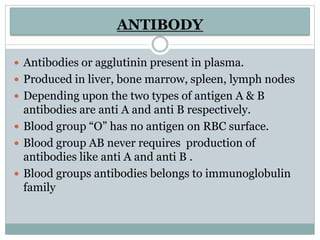
 Antibodies or agglutinin present in plasma.
 Produced in liver, bone marrow, spleen, lymph nodes
 Depending upon the two types of antigen A & B
antibodies are anti A and anti B respectively.
 Blood group “O” has no antigen on RBC surface.
 Blood group AB never requires production of
antibodies like anti A and anti B .
 Blood groups antibodies belongs to immunoglobulin
family
AGGLUTINATION
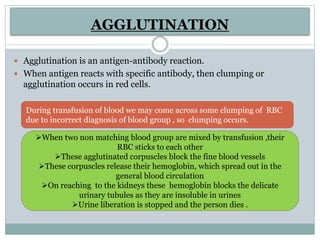
 Agglutination is an antigen-antibody reaction.
 When antigen reacts with specific antibody, then clumping or
agglutination occurs in red cells.
During transfusion of blood we may come across some clumping of RBC
due to incorrect diagnosis of blood group , so clumping occurs.
When two non matching blood group are mixed by transfusion ,their
RBC sticks to each other
These agglutinated corpuscles block the fine blood vessels
These corpuscles release their hemoglobin, which spread out in the
general blood circulation
On reaching to the kidneys these hemoglobin blocks the delicate
urinary tubules as they are insoluble in urines
Urine liberation is stopped and the person dies .
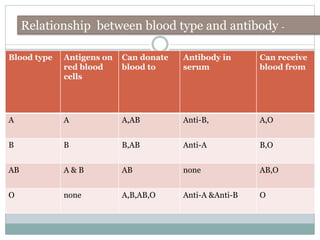
Blood type Antigens on
red blood
cells
Can donate
blood to
Antibody in
serum
Can receive
blood from
A A A,AB Anti-B, A,O
B B B,AB Anti-A B,O
AB A & B AB none AB,O
O none A,B,AB,O Anti-A &Anti-B O
Relationship between blood type and antibody -
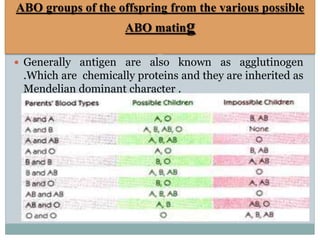
ABO groups of the offspring from the various possible
ABO mating
 Generally antigen are also known as agglutinogen
.Which are chemically proteins and they are inherited as
Mendelian dominant character .
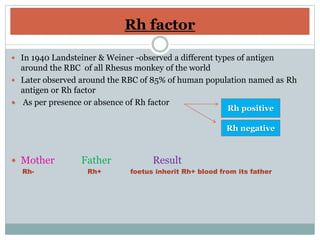
Rh factor
 In 1940 Landsteiner & Weiner -observed a different types of antigen
around the RBC of all Rhesus monkey of the world
 Later observed around the RBC of 85% of human population named as Rh
antigen or Rh factor
 As per presence or absence of Rh factor
 Mother Father Result
Rh- Rh+ foetus inherit Rh+ blood from its father
Rh positive
Rh negative
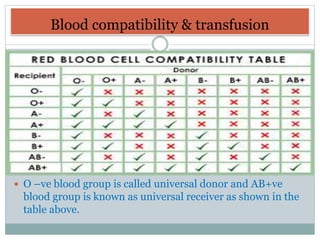
Blood compatibility & transfusion
 O –ve blood group is called universal donor and AB+ve
blood group is known as universal receiver as shown in the
table above.
ABO Blood group.pptx

ABO Blood group.pptx

  • 1.
    Presented by – SatyasaiPatel +3 2nd Year BS-18-161
  • 2.
    INTRODUCTION Blood is afluid connective tissue .  It contains two parts – Plasma .Constitute about 55 %. •non cellular part . • little yellow transparent fluid. Cellular components/Formed elements • Constitute about 45% • Cellular part . • These are up 3 types Erythrocytes, Leucocytes, Platelets. BLOOD
  • 3.
    In 1900 karlland steiner Either antigen A or antigen B or both A&B human population GROUP A GROUP B GROUP AB  In 1902 de casteilo and sturli discovered zero antigen or O-blood group.
  • 4.
    ANTIGEN  Appears inthe sixth week of fetal life.  Present on red cell membrane and in other tissue like salivary gland ,pancreas ,kidney except CNS also in body fluids.  H antigen is also present usually in all individual.
  • 5.
    ANTIBODY  Antibodies oragglutinin present in plasma.  Produced in liver, bone marrow, spleen, lymph nodes  Depending upon the two types of antigen A & B antibodies are anti A and anti B respectively.  Blood group “O” has no antigen on RBC surface.  Blood group AB never requires production of antibodies like anti A and anti B .  Blood groups antibodies belongs to immunoglobulin family
  • 6.
    AGGLUTINATION  Agglutination isan antigen-antibody reaction.  When antigen reacts with specific antibody, then clumping or agglutination occurs in red cells. During transfusion of blood we may come across some clumping of RBC due to incorrect diagnosis of blood group , so clumping occurs. When two non matching blood group are mixed by transfusion ,their RBC sticks to each other These agglutinated corpuscles block the fine blood vessels These corpuscles release their hemoglobin, which spread out in the general blood circulation On reaching to the kidneys these hemoglobin blocks the delicate urinary tubules as they are insoluble in urines Urine liberation is stopped and the person dies .
  • 7.
    Blood type Antigenson red blood cells Can donate blood to Antibody in serum Can receive blood from A A A,AB Anti-B, A,O B B B,AB Anti-A B,O AB A & B AB none AB,O O none A,B,AB,O Anti-A &Anti-B O Relationship between blood type and antibody -
  • 8.
    ABO groups ofthe offspring from the various possible ABO mating  Generally antigen are also known as agglutinogen .Which are chemically proteins and they are inherited as Mendelian dominant character .
  • 9.
    Rh factor  In1940 Landsteiner & Weiner -observed a different types of antigen around the RBC of all Rhesus monkey of the world  Later observed around the RBC of 85% of human population named as Rh antigen or Rh factor  As per presence or absence of Rh factor  Mother Father Result Rh- Rh+ foetus inherit Rh+ blood from its father Rh positive Rh negative
  • 10.
    Blood compatibility &transfusion  O –ve blood group is called universal donor and AB+ve blood group is known as universal receiver as shown in the table above.