A RESEARCH PAPER ON
Generation of Fad2 and Fad3 transgenic mice that
produces n-6 and n-3 polyunsaturated fatty acids
Presented by-
Sritam Padhan
PG-3rd Semester
24S21ZO08
panchayat college ,bargarh
Published on-open biology journal
Volume -09
Issue-10
Received-26/06/19
Accepted-20/09/19
Subject-biotechnology/cellular biology/molecular biology
Authors- Lishuang Song, Lei Yang , Jiapeng Wang, Xuefei Liu, Lige Bai,
Anqi Di and Guangpeng Li.
CONTENTS-
 ABSTRACT
 INTRODUCTION
 MATERIALS AND METHODS
 RESULT
 DISCUSSION
 REFERENCES
ABSTARCT:
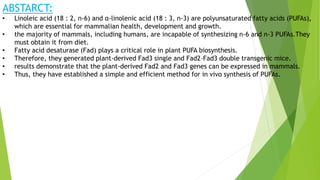
• Linoleic acid (18 : 2, n-6) and α-linolenic acid (18 : 3, n-3) are polyunsaturated fatty acids (PUFAs),
which are essential for mammalian health, development and growth.
• the majority of mammals, including humans, are incapable of synthesizing n-6 and n-3 PUFAs.They
must obtain it from diet.
• Fatty acid desaturase (Fad) plays a critical role in plant PUFA biosynthesis.
• Therefore, they generated plant-derived Fad3 single and Fad2–Fad3 double transgenic mice.
• results demonstrate that the plant-derived Fad2 and Fad3 genes can be expressed in mammals.
• Thus, they have established a simple and efficient method for in vivo synthesis of PUFAs.
Aadvantages-
-retina and brain developments
-reduces risk of vascular disease , arthritis,
cancer, neurological diseases.
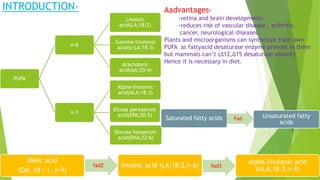
Plants and microorganisms can synthesize their own
PUFA as fattyacid desaturase enzyme present in them
but mammals can’t (∆12,∆15 desaturase absent).
Hence it is necessary in diet.
PUFA
n-6
Linoleic
acid(LA;18:2)
Gamma-linolenic
acid(γ-LA;18:3)
Arachdonic
acid(AA;20:4)
n-3
Alpha-linolenic
acid(ALA;18:3)
Eicosa pentaenoic
acid(EPA;20:5)
Docosa hexaenoic
acid(DHA;22:6)
INTRODUCTION-
Saturated fatty acids Unsaturated fatty
acids
Oleic acid
(OA; 18 : 1, n-9)
fad2 linoleic acid (LA;18:2,n-6) fad3
alpha-linolenic acid
(ALA;18:3,n-3)
MATERIAL AND METHODS-
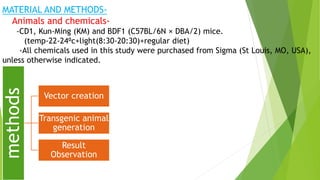
Animals and chemicals-
-CD1, Kun-Ming (KM) and BDF1 (C57BL/6N × DBA/2) mice.
(temp-22-24⁰c+light(8:30-20:30)+regular diet)
-All chemicals used in this study were purchased from Sigma (St Louis, MO, USA),
unless otherwise indicated.
methods
Vector creation
Transgenic animal
generation
Result
Observation
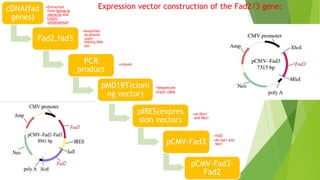
cDNA(fad
genes)
•Extracted
from Spinacia
oleracea and
Linum
usitatissmum
Fad2,fad3
•Amplified
by phanta
super-
fidelity DNA
pol.
PCR
product
•cloned
pMD19T(cloni
ng vector)
•Sequenced
•Fad3-cDNA
pIRES(expres
sion vector)
•at-Xho1
and Mlu1
pCMV-Fad3
•fad2
•At-Sal1 and
Not1
pCMV-Fad3-
Fad2
Expression vector construction of the Fad2/3 gene:
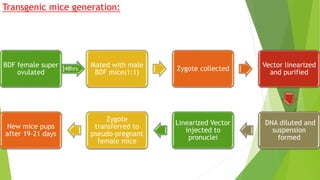
BDF female super
ovulated
48hrs
Mated with male
BDF mice(1:1)
Zygote collected
Vector linearized
and purified
DNA diluted and
suspension
formed
Linearized Vector
injected to
pronuclei
Zygote
transferred to
pseudo-pregnant
female mice
New mice pups
after 19-21 days
Transgenic mice generation:
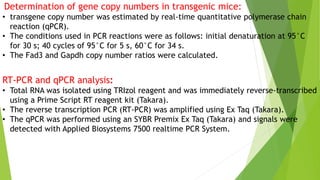
Determination of gene copy numbers in transgenic mice:
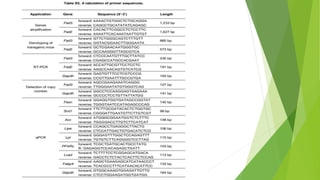
• transgene copy number was estimated by real-time quantitative polymerase chain
reaction (qPCR).
• The conditions used in PCR reactions were as follows: initial denaturation at 95°C
for 30 s; 40 cycles of 95°C for 5 s, 60°C for 34 s.
• The Fad3 and Gapdh copy number ratios were calculated.
RT-PCR and qPCR analysis:
• Total RNA was isolated using TRIzol reagent and was immediately reverse-transcribed
using a Prime Script RT reagent kit (Takara).
• The reverse transcription PCR (RT-PCR) was amplified using Ex Taq (Takara).
• The qPCR was performed using an SYBR Premix Ex Taq (Takara) and signals were
detected with Applied Biosystems 7500 realtime PCR System.
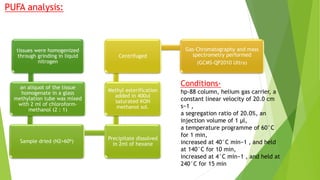
tissues were homogenized
through grinding in liquid
nitrogen
an aliquot of the tissue
homogenate in a glass
methylation tube was mixed
with 2 ml of chloroform-
methanol (2 : 1)
Sample dried (N2=60⁰)
Precipitate dissolved
in 2ml of hexane
Methyl esterification
added in 400սl
saturated KOH
methanol sol.
Centrifuged
Gas-Chromatography and mass
spectrometry performed
(GCMS-QP2010 Ultra)
Conditions-
hp-88 column, helium gas carrier, a
constant linear velocity of 20.0 cm
s−1 ,
a segregation ratio of 20.0%, an
injection volume of 1 µl,
a temperature programme of 60°C
for 1 min,
increased at 40°C min−1 , and held
at 140°C for 10 min,
increased at 4°C min−1 , and held at
240°C for 15 min
PUFA analysis:
Statistical analyses:
• All experiments were repeated at least three times.
• One-way ANOVA was used to determine statistical significance(SAS Software)
following by Duncan’s test to determine the statistical significance between the
relative group.
• All data were expressed as mean ± s.d. Differences were considered to be significant
when p < 0.05.
Result:
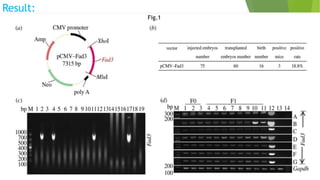
Fig.1
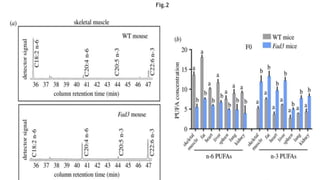
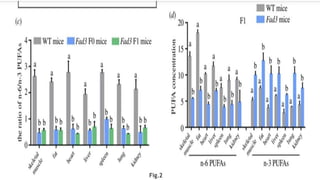
Fig.2
Fig.2
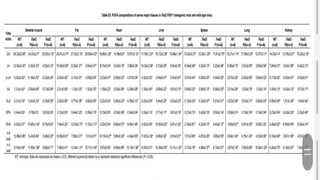
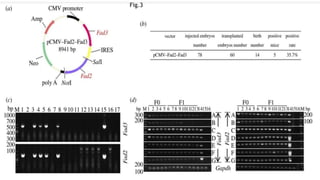
Fig.3
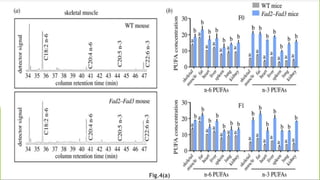
Fig.4(a)
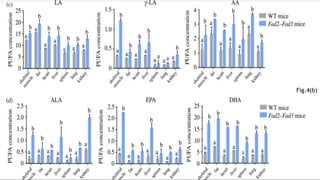
Fig.4(b)
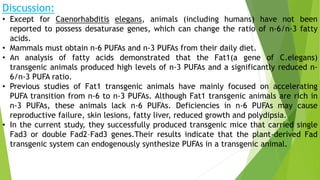
Discussion:
• Except for Caenorhabditis elegans, animals (including humans) have not been
reported to possess desaturase genes, which can change the ratio of n-6/n-3 fatty
acids.
• Mammals must obtain n-6 PUFAs and n-3 PUFAs from their daily diet.
• An analysis of fatty acids demonstrated that the Fat1(a gene of C.elegans)
transgenic animals produced high levels of n-3 PUFAs and a significantly reduced n-
6/n-3 PUFA ratio.
• Previous studies of Fat1 transgenic animals have mainly focused on accelerating
PUFA transition from n-6 to n-3 PUFAs. Although Fat1 transgenic animals are rich in
n-3 PUFAs, these animals lack n-6 PUFAs. Deficiencies in n-6 PUFAs may cause
reproductive failure, skin lesions, fatty liver, reduced growth and polydipsia.
• In the current study, they successfully produced transgenic mice that carried single
Fad3 or double Fad2–Fad3 genes.Their results indicate that the plant-derived Fad
transgenic system can endogenously synthesize PUFAs in a transgenic animal.
References:
1. Lee JM, Lee H, Kang S, Park WJ. 2016 Fatty acid desaturases, polyunsaturated fatty acid regulation, and
biotechnological advances. Nutrients 8, E23. (doi:10.3390/nu8010023)
2. Rahman MM, Gasparini C, Turchini GM, Evans JP. 2014 Experimental reduction in dietary omega-3
polyunsaturated fatty acids depresses sperm competitiveness. Biol. Lett. 10, 20140623. (doi:10.
1098/rsbl.2014.0623)
3. Damude HG, Zhang H, Farral L, Ripp KG, Tomb JF, Hollerbach D, Yadav NS. 2006 Identification of bifunctional
delta12/omega3 fatty acid desaturases for improving the ratio of omega3 to omega6 fatty acids in microbes and
plants. Proc. Natl Acad. Sci. USA 103, 9446–9451. (doi:10.1073/pnas.0511079103)
4. Meesapyodsuk D, Qiu X. 2012 The front-end desaturase: structure, function, evolution and biotechnological use.
Lipids 47, 227–237. (doi:10. 1007/s11745-011-3617-2)
5. Uauy R, Mena P, Rojas C. 2000 Essential fatty acids in early life: structural and functional role. Proc. Nutr. Soc.
59, 3–15. (doi:10.1017/S00296651 00000021)
6. Simopoulos AP. 1991 Omega-3 fatty acids in health and disease and in growth and development. Am. J. Clin.
Nutr. 54, 438–463. (doi:10.1093/ajcn/ 54.3.438)
7. Reyes N, Reyes I, Tiwari R, Geliebter J. 2004 Effect of linoleic acid on proliferation and gene expression in the
breast cancer cell line T47D. Cancer Lett. 209, 25–35. (doi:10.1016/j.canlet.2003.12.010)
8. Chang ET, Balter KM, Torrang A, Smedby KE, Melbye M, Sundstrom C, Glimelius B, Adami HO. 2006 Nutrient
intake and risk of non-Hodgkin’s lymphoma. Am. J. Epidemiol. 164, 1222–1232. (doi:10.1093/aje/kwj330)
9. Almendingen K, Hostmark AT, Fausa O, Mosdol A, Aabakken L, Vatn MH. 2007 Familial adenomatous polyposis
patients have high levels of arachidonic acid and docosahexaenoic acid and low levels of linoleic acid and alpha-
linolenic acid in serum phospholipids. Int. J. Cancer 120, 632–637. (doi:10. 1002/ijc.22337)
10. Lee H, Park WJ. 2014 Unsaturated fatty acids, desaturases, and human health. J. Med. Food 17, 189–197.
(doi:10.1089/jmf.2013.2917)
11. Wallis JG, Watts JL, Browse J. 2002 Polyunsaturated fatty acid synthesis: what will they think of next? Trends
Biochem. Sci. 27, 467. (doi:10.1016/S0968- 0004(02)02168-0)
12. Khaire AA, Kale AA, Joshi SR. 2015 Maternal omega-3 fatty acids and micronutrients modulate fetal lipid
metabolism: a review. Prostaglandins Leukot. Essent. Fatty Acids 98, 49–55. (doi:10.1016/ j.plefa.2015.04.007)
13. Spychalla JP, Kinney AJ, Browse J. 1997 Identification of an animal omega-3 fatty acid desaturase by
heterologous expression in Arabidopsis. Proc. Natl Acad. Sci. USA 94, 1142–1147. (doi:10.1073/pnas.94.4.1142)
14. Shanklin J, Cahoon EB. 1998 Desaturation and related modifications of fatty acids1. Annu. Rev. Plant Physiol.
Plant Mol. Biol. 49, 611–641. (doi:10. 1146/annurev.arplant.49.1.611)
15. Tocher DR, Leaver MJ, Hodgson PA. 1998 Recent advances in the biochemistry and molecular biology of fatty
acyl desaturases. Prog. Lipid Res. 37, 73–117. (doi:10.1016/S0163-7827(98) 00005-8)
16. Alonso DL, Garcia-Maroto F, Rodriguez-Ruiz J, Garrido JA, Vilches MA. 2003 Evolution of the membrane-bound
fatty acid desaturases. Biochem. Syst. Ecol. 31, 1111–1124. (doi:10.1016/S0305- 1978(03)00041-3)
17. Chen Q, Liu Q, Wu Z, Wang Z, Gou K. 2009 Generation of fad2 transgenic mice that produce omega-6 fatty
acids. Sci. China C Life Sci. 52, 1048–1054. (doi:10.1007/s11427-009-0143-z)
18. Duan B et al. 2012 Silencing of fat-1 transgene expression in sheep may result from hypermethylation of its
driven cytomegalovirus (CMV) promoter. Theriogenology 78, 793–802. (doi:10.1016/j.theriogenology.2012.03.027)
19. Kang JX, Wang J, Wu L, Kang ZB. 2004 Transgenic mice. fat-1 mice convert n-6 to n-3 fatty acids. Nature 427,
504. (doi:10.1038/427504a)
20. Lai L et al. 2006 Generation of cloned transgenic pigs rich in omega-3 fatty acids. Nat. Biotechnol. 24, 435–436.
(doi:10.1038/nbt1198)
21. Liu XF et al. 2017 Insights into the function of n-3 PUFAs in fat-1 transgenic cattle. J. Lipid Res. 58, 1524–1535.
(doi:10.1194/jlr.M072983)
22. Wu X et al. 2012 Production of cloned transgenic cow expressing omega-3 fatty acids. Transgenic Res. 21, 537–
543. (doi:10.1007/s11248-011-9554-2)
23. Yang C, Shang X, Cheng L, Yang L, Liu X, Bai C, Wei Z, Hua J, Li G. 2017 DNMT 1 maintains hypermethylation of
CAG promoter specific region and prevents expression of exogenous gene in fat-1 transgenic sheep. PLoS ONE 12,
e0171442. (doi:10. 1371/journal.pone.0171442)
24. Lands B. 2014 Historical perspectives on the impact of n-3 and n-6 nutrients on health. Prog. Lipid Res. 55, 17–
29. (doi:10.1016/j.plipres.2014.04.002)
25. Marszalek JR, Lodish HF. 2005 Docosahexaenoic acid, fatty acid-interacting proteins, and neuronal function:
breastmilk and fish are good for you. Annu. Rev. Cell Dev. Biol. 21, 633–657. (doi:10.
1146/annurev.cellbio.21.122303.120624)
26. Indo Y et al. 2009 Functional expression of a humanized gene for an omega-3 fatty acid desaturase from scarlet
flax in transfected bovine adipocytes and bovine embryos cloned from the cells. Biochim. Biophys. Acta 1791, 183–
190. (doi:10.1016/j.bbalip.2008.12.019)
27. Saeki K et al. 2004 Functional expression of a Delta12 fatty acid desaturase gene from spinach in transgenic
pigs. Proc. Natl Acad. Sci. USA 101, 6361–6366. (doi:10.1073/pnas.0308111101)
28. Yang L, Song L, Liu X, Bai L, Li G. 2018 KDM6A and KDM6B play contrasting roles in nuclear transfer embryos
revealed by MERVL reporter system. EMBO Rep. 19, e46240. (doi:10.15252/embr.201846240)
29. Ittner LM, Gotz J. 2007 Pronuclear injection for the production of transgenic mice. Nat. Protoc. 2, 1206–1215.
(doi:10.1038/nprot.2007.145)
30. Mitrecic D, Huzak M, Curlin M, Gajovic S. 2005 An improved method for determination of gene copy numbers in
transgenic mice by serial dilution curves obtained by real-time quantitative PCR assay. J. Biochem. Biophys.
Methods 64, 83–98. (doi:10. 1016/j.jbbm.2005.05.006)
31. Zhu G, Chen H, Wu X, Zhou Y, Lu J, Chen H, Deng J. 2008 A modified n-3 fatty acid desaturase gene from
Caenorhabditis briggsae produced high proportion of DHA and DPA in transgenic mice. Transgenic Res. 17, 717–725.
(doi:10.1007/s11248- 008-9171-x)
32. Liu X, Bai C, Ding X, Wei Z, Guo H, Li G. 2015 Microarray analysis of the gene expression profile and lipid
metabolism in Fat-1 transgenic cattle. PLoS ONE 10, e0138874. (doi:10.1371/journal.pone. 0138874)
33. Wei Z, Li D, Zhu L, Yang L, Chen C, Bai C, Li G. 2018 Omega 3 polyunsaturated fatty acids inhibit cell
proliferation by regulating cell cycle in fad3b transgenic mouse embryonic stem cells. Lipids Health Dis. 17, 210.
(doi:10.1186/s12944-018- 0862-x)
34. Xin X, Liu X, Li X, Ding X, Yang S, Jin C, Li G, Guo H. 2017 Comparative muscle proteomics/ phosphoproteomics
analysis provides new insight for the biosafety evaluation of fat-1 transgenic cattle. Transgenic Res. 26, 625–638.
(doi:10.1007/ s11248-017-0032-3)
35. Zhou Y, Lin Y, Wu X, Feng C, Long C, Xiong F, Wang N, Pan D, Chen H. 2014 The high-level accumulation of n-3
polyunsaturated fatty acids in transgenic pigs harboring the n-3 fatty acid desaturase gene from Caenorhabditis
briggsae. Transgenic Res. 23, 89–97. (doi:10.1007/s11248- 013-9752-1)
PUFA.pptx

PUFA.pptx

  • 1.
    A RESEARCH PAPERON Generation of Fad2 and Fad3 transgenic mice that produces n-6 and n-3 polyunsaturated fatty acids Presented by- Sritam Padhan PG-3rd Semester 24S21ZO08 panchayat college ,bargarh
  • 2.
    Published on-open biologyjournal Volume -09 Issue-10 Received-26/06/19 Accepted-20/09/19 Subject-biotechnology/cellular biology/molecular biology Authors- Lishuang Song, Lei Yang , Jiapeng Wang, Xuefei Liu, Lige Bai, Anqi Di and Guangpeng Li.
  • 3.
    CONTENTS-  ABSTRACT  INTRODUCTION MATERIALS AND METHODS  RESULT  DISCUSSION  REFERENCES
  • 4.
    ABSTARCT: • Linoleic acid(18 : 2, n-6) and α-linolenic acid (18 : 3, n-3) are polyunsaturated fatty acids (PUFAs), which are essential for mammalian health, development and growth. • the majority of mammals, including humans, are incapable of synthesizing n-6 and n-3 PUFAs.They must obtain it from diet. • Fatty acid desaturase (Fad) plays a critical role in plant PUFA biosynthesis. • Therefore, they generated plant-derived Fad3 single and Fad2–Fad3 double transgenic mice. • results demonstrate that the plant-derived Fad2 and Fad3 genes can be expressed in mammals. • Thus, they have established a simple and efficient method for in vivo synthesis of PUFAs.
  • 5.
    Aadvantages- -retina and braindevelopments -reduces risk of vascular disease , arthritis, cancer, neurological diseases. Plants and microorganisms can synthesize their own PUFA as fattyacid desaturase enzyme present in them but mammals can’t (∆12,∆15 desaturase absent). Hence it is necessary in diet. PUFA n-6 Linoleic acid(LA;18:2) Gamma-linolenic acid(γ-LA;18:3) Arachdonic acid(AA;20:4) n-3 Alpha-linolenic acid(ALA;18:3) Eicosa pentaenoic acid(EPA;20:5) Docosa hexaenoic acid(DHA;22:6) INTRODUCTION- Saturated fatty acids Unsaturated fatty acids Oleic acid (OA; 18 : 1, n-9) fad2 linoleic acid (LA;18:2,n-6) fad3 alpha-linolenic acid (ALA;18:3,n-3)
  • 6.
    MATERIAL AND METHODS- Animalsand chemicals- -CD1, Kun-Ming (KM) and BDF1 (C57BL/6N × DBA/2) mice. (temp-22-24⁰c+light(8:30-20:30)+regular diet) -All chemicals used in this study were purchased from Sigma (St Louis, MO, USA), unless otherwise indicated. methods Vector creation Transgenic animal generation Result Observation
  • 7.
    cDNA(fad genes) •Extracted from Spinacia oleracea and Linum usitatissmum Fad2,fad3 •Amplified byphanta super- fidelity DNA pol. PCR product •cloned pMD19T(cloni ng vector) •Sequenced •Fad3-cDNA pIRES(expres sion vector) •at-Xho1 and Mlu1 pCMV-Fad3 •fad2 •At-Sal1 and Not1 pCMV-Fad3- Fad2 Expression vector construction of the Fad2/3 gene:
  • 9.
    BDF female super ovulated 48hrs Matedwith male BDF mice(1:1) Zygote collected Vector linearized and purified DNA diluted and suspension formed Linearized Vector injected to pronuclei Zygote transferred to pseudo-pregnant female mice New mice pups after 19-21 days Transgenic mice generation:
  • 10.
    Determination of genecopy numbers in transgenic mice: • transgene copy number was estimated by real-time quantitative polymerase chain reaction (qPCR). • The conditions used in PCR reactions were as follows: initial denaturation at 95°C for 30 s; 40 cycles of 95°C for 5 s, 60°C for 34 s. • The Fad3 and Gapdh copy number ratios were calculated. RT-PCR and qPCR analysis: • Total RNA was isolated using TRIzol reagent and was immediately reverse-transcribed using a Prime Script RT reagent kit (Takara). • The reverse transcription PCR (RT-PCR) was amplified using Ex Taq (Takara). • The qPCR was performed using an SYBR Premix Ex Taq (Takara) and signals were detected with Applied Biosystems 7500 realtime PCR System.
  • 11.
    tissues were homogenized throughgrinding in liquid nitrogen an aliquot of the tissue homogenate in a glass methylation tube was mixed with 2 ml of chloroform- methanol (2 : 1) Sample dried (N2=60⁰) Precipitate dissolved in 2ml of hexane Methyl esterification added in 400սl saturated KOH methanol sol. Centrifuged Gas-Chromatography and mass spectrometry performed (GCMS-QP2010 Ultra) Conditions- hp-88 column, helium gas carrier, a constant linear velocity of 20.0 cm s−1 , a segregation ratio of 20.0%, an injection volume of 1 µl, a temperature programme of 60°C for 1 min, increased at 40°C min−1 , and held at 140°C for 10 min, increased at 4°C min−1 , and held at 240°C for 15 min PUFA analysis:
  • 12.
    Statistical analyses: • Allexperiments were repeated at least three times. • One-way ANOVA was used to determine statistical significance(SAS Software) following by Duncan’s test to determine the statistical significance between the relative group. • All data were expressed as mean ± s.d. Differences were considered to be significant when p < 0.05.
  • 13.
  • 15.
  • 16.
  • 17.
  • 19.
  • 20.
  • 21.
    Discussion: • Except forCaenorhabditis elegans, animals (including humans) have not been reported to possess desaturase genes, which can change the ratio of n-6/n-3 fatty acids. • Mammals must obtain n-6 PUFAs and n-3 PUFAs from their daily diet. • An analysis of fatty acids demonstrated that the Fat1(a gene of C.elegans) transgenic animals produced high levels of n-3 PUFAs and a significantly reduced n- 6/n-3 PUFA ratio. • Previous studies of Fat1 transgenic animals have mainly focused on accelerating PUFA transition from n-6 to n-3 PUFAs. Although Fat1 transgenic animals are rich in n-3 PUFAs, these animals lack n-6 PUFAs. Deficiencies in n-6 PUFAs may cause reproductive failure, skin lesions, fatty liver, reduced growth and polydipsia. • In the current study, they successfully produced transgenic mice that carried single Fad3 or double Fad2–Fad3 genes.Their results indicate that the plant-derived Fad transgenic system can endogenously synthesize PUFAs in a transgenic animal.
  • 22.
    References: 1. Lee JM,Lee H, Kang S, Park WJ. 2016 Fatty acid desaturases, polyunsaturated fatty acid regulation, and biotechnological advances. Nutrients 8, E23. (doi:10.3390/nu8010023) 2. Rahman MM, Gasparini C, Turchini GM, Evans JP. 2014 Experimental reduction in dietary omega-3 polyunsaturated fatty acids depresses sperm competitiveness. Biol. Lett. 10, 20140623. (doi:10. 1098/rsbl.2014.0623) 3. Damude HG, Zhang H, Farral L, Ripp KG, Tomb JF, Hollerbach D, Yadav NS. 2006 Identification of bifunctional delta12/omega3 fatty acid desaturases for improving the ratio of omega3 to omega6 fatty acids in microbes and plants. Proc. Natl Acad. Sci. USA 103, 9446–9451. (doi:10.1073/pnas.0511079103) 4. Meesapyodsuk D, Qiu X. 2012 The front-end desaturase: structure, function, evolution and biotechnological use. Lipids 47, 227–237. (doi:10. 1007/s11745-011-3617-2) 5. Uauy R, Mena P, Rojas C. 2000 Essential fatty acids in early life: structural and functional role. Proc. Nutr. Soc. 59, 3–15. (doi:10.1017/S00296651 00000021) 6. Simopoulos AP. 1991 Omega-3 fatty acids in health and disease and in growth and development. Am. J. Clin. Nutr. 54, 438–463. (doi:10.1093/ajcn/ 54.3.438) 7. Reyes N, Reyes I, Tiwari R, Geliebter J. 2004 Effect of linoleic acid on proliferation and gene expression in the breast cancer cell line T47D. Cancer Lett. 209, 25–35. (doi:10.1016/j.canlet.2003.12.010) 8. Chang ET, Balter KM, Torrang A, Smedby KE, Melbye M, Sundstrom C, Glimelius B, Adami HO. 2006 Nutrient intake and risk of non-Hodgkin’s lymphoma. Am. J. Epidemiol. 164, 1222–1232. (doi:10.1093/aje/kwj330) 9. Almendingen K, Hostmark AT, Fausa O, Mosdol A, Aabakken L, Vatn MH. 2007 Familial adenomatous polyposis patients have high levels of arachidonic acid and docosahexaenoic acid and low levels of linoleic acid and alpha- linolenic acid in serum phospholipids. Int. J. Cancer 120, 632–637. (doi:10. 1002/ijc.22337)
  • 23.
    10. Lee H,Park WJ. 2014 Unsaturated fatty acids, desaturases, and human health. J. Med. Food 17, 189–197. (doi:10.1089/jmf.2013.2917) 11. Wallis JG, Watts JL, Browse J. 2002 Polyunsaturated fatty acid synthesis: what will they think of next? Trends Biochem. Sci. 27, 467. (doi:10.1016/S0968- 0004(02)02168-0) 12. Khaire AA, Kale AA, Joshi SR. 2015 Maternal omega-3 fatty acids and micronutrients modulate fetal lipid metabolism: a review. Prostaglandins Leukot. Essent. Fatty Acids 98, 49–55. (doi:10.1016/ j.plefa.2015.04.007) 13. Spychalla JP, Kinney AJ, Browse J. 1997 Identification of an animal omega-3 fatty acid desaturase by heterologous expression in Arabidopsis. Proc. Natl Acad. Sci. USA 94, 1142–1147. (doi:10.1073/pnas.94.4.1142) 14. Shanklin J, Cahoon EB. 1998 Desaturation and related modifications of fatty acids1. Annu. Rev. Plant Physiol. Plant Mol. Biol. 49, 611–641. (doi:10. 1146/annurev.arplant.49.1.611) 15. Tocher DR, Leaver MJ, Hodgson PA. 1998 Recent advances in the biochemistry and molecular biology of fatty acyl desaturases. Prog. Lipid Res. 37, 73–117. (doi:10.1016/S0163-7827(98) 00005-8) 16. Alonso DL, Garcia-Maroto F, Rodriguez-Ruiz J, Garrido JA, Vilches MA. 2003 Evolution of the membrane-bound fatty acid desaturases. Biochem. Syst. Ecol. 31, 1111–1124. (doi:10.1016/S0305- 1978(03)00041-3) 17. Chen Q, Liu Q, Wu Z, Wang Z, Gou K. 2009 Generation of fad2 transgenic mice that produce omega-6 fatty acids. Sci. China C Life Sci. 52, 1048–1054. (doi:10.1007/s11427-009-0143-z) 18. Duan B et al. 2012 Silencing of fat-1 transgene expression in sheep may result from hypermethylation of its driven cytomegalovirus (CMV) promoter. Theriogenology 78, 793–802. (doi:10.1016/j.theriogenology.2012.03.027) 19. Kang JX, Wang J, Wu L, Kang ZB. 2004 Transgenic mice. fat-1 mice convert n-6 to n-3 fatty acids. Nature 427, 504. (doi:10.1038/427504a) 20. Lai L et al. 2006 Generation of cloned transgenic pigs rich in omega-3 fatty acids. Nat. Biotechnol. 24, 435–436. (doi:10.1038/nbt1198)
  • 24.
    21. Liu XFet al. 2017 Insights into the function of n-3 PUFAs in fat-1 transgenic cattle. J. Lipid Res. 58, 1524–1535. (doi:10.1194/jlr.M072983) 22. Wu X et al. 2012 Production of cloned transgenic cow expressing omega-3 fatty acids. Transgenic Res. 21, 537– 543. (doi:10.1007/s11248-011-9554-2) 23. Yang C, Shang X, Cheng L, Yang L, Liu X, Bai C, Wei Z, Hua J, Li G. 2017 DNMT 1 maintains hypermethylation of CAG promoter specific region and prevents expression of exogenous gene in fat-1 transgenic sheep. PLoS ONE 12, e0171442. (doi:10. 1371/journal.pone.0171442) 24. Lands B. 2014 Historical perspectives on the impact of n-3 and n-6 nutrients on health. Prog. Lipid Res. 55, 17– 29. (doi:10.1016/j.plipres.2014.04.002) 25. Marszalek JR, Lodish HF. 2005 Docosahexaenoic acid, fatty acid-interacting proteins, and neuronal function: breastmilk and fish are good for you. Annu. Rev. Cell Dev. Biol. 21, 633–657. (doi:10. 1146/annurev.cellbio.21.122303.120624) 26. Indo Y et al. 2009 Functional expression of a humanized gene for an omega-3 fatty acid desaturase from scarlet flax in transfected bovine adipocytes and bovine embryos cloned from the cells. Biochim. Biophys. Acta 1791, 183– 190. (doi:10.1016/j.bbalip.2008.12.019) 27. Saeki K et al. 2004 Functional expression of a Delta12 fatty acid desaturase gene from spinach in transgenic pigs. Proc. Natl Acad. Sci. USA 101, 6361–6366. (doi:10.1073/pnas.0308111101) 28. Yang L, Song L, Liu X, Bai L, Li G. 2018 KDM6A and KDM6B play contrasting roles in nuclear transfer embryos revealed by MERVL reporter system. EMBO Rep. 19, e46240. (doi:10.15252/embr.201846240) 29. Ittner LM, Gotz J. 2007 Pronuclear injection for the production of transgenic mice. Nat. Protoc. 2, 1206–1215. (doi:10.1038/nprot.2007.145) 30. Mitrecic D, Huzak M, Curlin M, Gajovic S. 2005 An improved method for determination of gene copy numbers in transgenic mice by serial dilution curves obtained by real-time quantitative PCR assay. J. Biochem. Biophys. Methods 64, 83–98. (doi:10. 1016/j.jbbm.2005.05.006)
  • 25.
    31. Zhu G,Chen H, Wu X, Zhou Y, Lu J, Chen H, Deng J. 2008 A modified n-3 fatty acid desaturase gene from Caenorhabditis briggsae produced high proportion of DHA and DPA in transgenic mice. Transgenic Res. 17, 717–725. (doi:10.1007/s11248- 008-9171-x) 32. Liu X, Bai C, Ding X, Wei Z, Guo H, Li G. 2015 Microarray analysis of the gene expression profile and lipid metabolism in Fat-1 transgenic cattle. PLoS ONE 10, e0138874. (doi:10.1371/journal.pone. 0138874) 33. Wei Z, Li D, Zhu L, Yang L, Chen C, Bai C, Li G. 2018 Omega 3 polyunsaturated fatty acids inhibit cell proliferation by regulating cell cycle in fad3b transgenic mouse embryonic stem cells. Lipids Health Dis. 17, 210. (doi:10.1186/s12944-018- 0862-x) 34. Xin X, Liu X, Li X, Ding X, Yang S, Jin C, Li G, Guo H. 2017 Comparative muscle proteomics/ phosphoproteomics analysis provides new insight for the biosafety evaluation of fat-1 transgenic cattle. Transgenic Res. 26, 625–638. (doi:10.1007/ s11248-017-0032-3) 35. Zhou Y, Lin Y, Wu X, Feng C, Long C, Xiong F, Wang N, Pan D, Chen H. 2014 The high-level accumulation of n-3 polyunsaturated fatty acids in transgenic pigs harboring the n-3 fatty acid desaturase gene from Caenorhabditis briggsae. Transgenic Res. 23, 89–97. (doi:10.1007/s11248- 013-9752-1)