Semantic Searchmonkey

Editor's Notes
  • #24 <number>
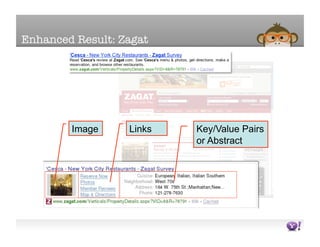
  • #26 A SearchMonkey Enhanced result contains a great deal of structured data. It could have a picture, key/value pairs, deep links…This kind of information goes far beyond what normal search results give you – a title and an autoextracted summary. Where does this information come from? <number>
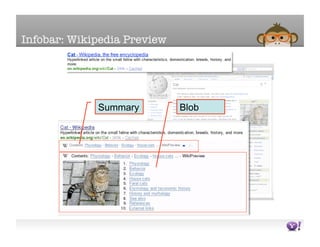
  • #27 Likewise, an Infobar has a summary (what the user sees before the pane is expanded) and a “blob”, an area of free-form HTML. <number>
  • #37 XSLT custom data services are excellent when there is no good structured data available, either because you don’t own the site in question, or because you just want to get a prototype out quickly without having to to change your site’s template markup. You can use these data services to mock up what is possible with SearchMonkey.As with the PHP, the XSLT is fairly simple. The “hard” part of writing the stylesheet is really just finding the right xpath expression for extracting the information you want. The other thing you need to do is pick a good vocabulary for describing the extracted data. For example, a description is a dc:description (Dublin Core description) and so on.If the page is not well-formed XHTML, have no fear, we tidy up the page ahead of time and run the XSLT on that. The tidying can fail, but only if the markup is really pathologically bad.As we mentioned before, XSLT custom data services are good for mocking up Enhanced Results, but they’re too slow in practice. For a production-quality app, you’ll need to use them in infobars.[Show demo]