Semantic Geodemography and
   Urban Interoperability
   J. Borrego-Díaz, A. Chávez-González,
  M. Martín-Pérez and J. Zamora- Aguilera

  Dept. Computer Science and Artificial Intelligence
               University of Seville


        6th Metadata and Semantics Research Conference MTSR 2012
Overview
• Introduction
• Semantic Web and (Urban) Ciberinfrastructure
• Geodemographies as knowledge augmented
  spaces
• Semantizing geodemographies
• Case study
• Applications of semantic geodemography
• Conclusions and related work

                     MTSR 2012
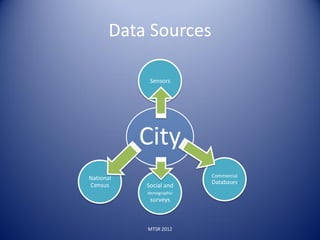
Data Sources

            Sensors


           City
National                 Commercial
                         Databases
Census     Social and
           demographic
            surveys


           MTSR 2012
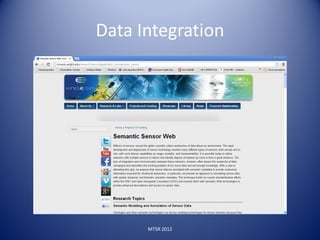
Data Integration


      MTSR 2012
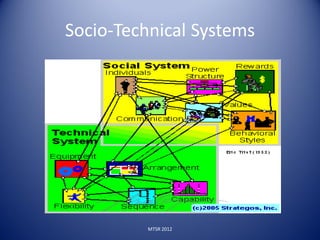
Socio-Technical Systems


          MTSR 2012
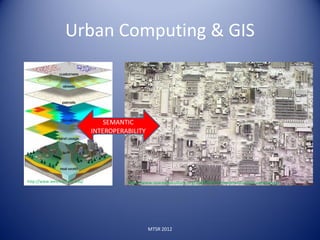
Urban Computing & GIS


                                   SEMANTIC
                               INTEROPERABILITY


http://www.westfield.ma.edu/             http://www.spaceandculture.org/2009/05/13/models-of-urban-computing/


                                                  MTSR 2012
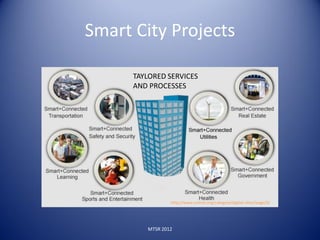
Smart City Projects

      TAYLORED SERVICES
      AND PROCESSES


                 http://www.urenio.org/category/digital-cities/page/3/


         MTSR 2012
Semantic Interoperability
• Services and processes
• Management and valuation of socio-
  economical consequences of regions

• New methodologies: opportunities


                    MTSR 2012
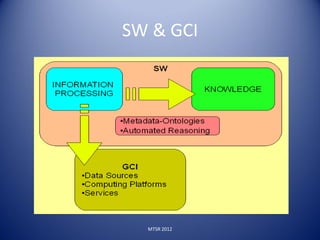
SW & GCI


  MTSR 2012
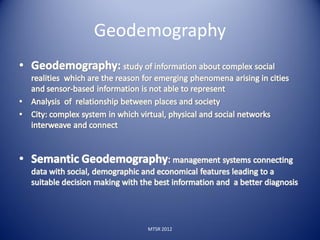
Geodemography


     MTSR 2012
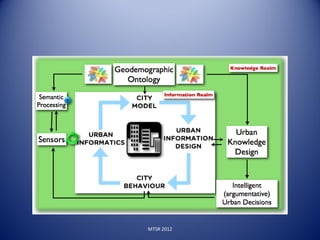
MTSR 2012
Semantizing geodemographies
•   Support for metadata
•   To enhance information from sensors
•   Information about geodemographic indices
•   Decisions which influence city behavior


                      MTSR 2012
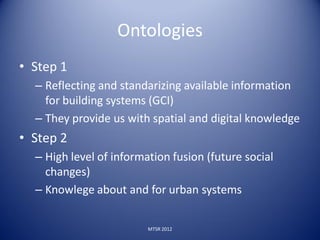
Ontologies
• Step 1
  – Reflecting and standarizing available information
    for building systems (GCI)
  – They provide us with spatial and digital knowledge
• Step 2
  – High level of information fusion (future social
    changes)
  – Knowlege about and for urban systems

                         MTSR 2012
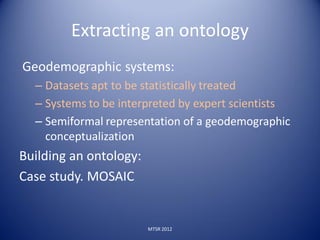
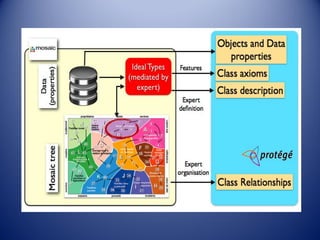
Extracting an ontology
Geodemographic systems:
  – Datasets apt to be statistically treated
  – Systems to be interpreted by expert scientists
  – Semiformal representation of a geodemographic
    conceptualization
Building an ontology:
Case study. MOSAIC


                        MTSR 2012
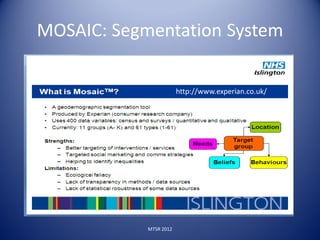
MOSAIC: Segmentation System

                        http://www.experian.co.uk/


            MTSR 2012
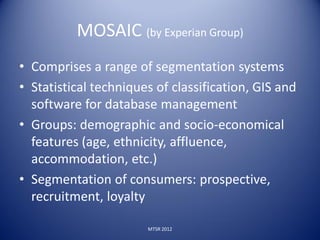
MOSAIC (by Experian Group)
• Comprises a range of segmentation systems
• Statistical techniques of classification, GIS and
  software for database management
• Groups: demographic and socio-economical
  features (age, ethnicity, affluence,
  accommodation, etc.)
• Segmentation of consumers: prospective,
  recruitment, loyalty

                       MTSR 2012
• Detailed descriptions of a range of
  sociodemographic environments
• From the ontological point of view, ideal types
• Explained by estatistical data
• Expert scientists interpret data but do not
  characterize each class


                      MTSR 2012
Limitations
• MOSAIC definitions present difficulties to be
  translated into metadata
  – Variance across individuals
  – Variance of requirements for belonging
  – Lack of critical requirements (features not included           in
    definitions because of sufficent statistical data have not been
    provided). Examples: urban /rural nedighborhoods, tax rates, size of
    houses, etc.


                                MTSR 2012
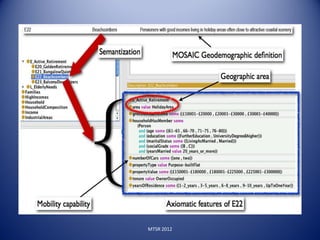
• MOSAIC definition make use of properties
  – Experts interpret but there are no data
• Class is not fully defined by Data
  – Axioms can not be expressed
• Object Properties vs Data Properties
• MOSAIC definitions vs MOSAIC Data
  – Weakening definitions: set of constrains


                        MTSR 2012
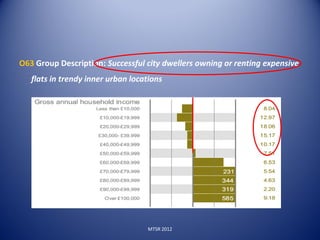
O63 Group Description: Successful city dwellers owning or renting expensive
   flats in trendy inner urban locations


                                   MTSR 2012
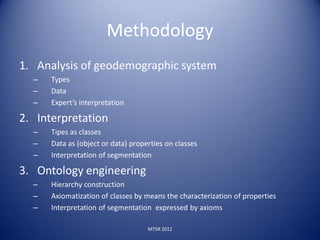
Methodology
1. Analysis of geodemographic system
  –   Types
  –   Data
  –   Expert’s interpretation

2. Interpretation
  –   Tipes as classes
  –   Data as (object or data) properties on classes
  –   Interpretation of segmentation

3. Ontology engineering
  –   Hierarchy construction
  –   Axiomatization of classes by means the characterization of properties
  –   Interpretation of segmentation expressed by axioms

                                    MTSR 2012
MTSR 2012
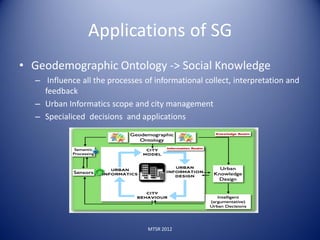
Applications of SG
• Geodemographic Ontology -> Social Knowledge
  – Influence all the processes of informational collect, interpretation and
    feedback
  – Urban Informatics scope and city management
  – Specialiced decisions and applications


                                 MTSR 2012
• Life cycle of knowledge in Smart Cities
     •   Acquisition
     •   Verification
     •   Documentation
     •   Decision
• Enriched not only by Sociodemographic
  ontologies
• Reasoning on processed knowledge

                         MTSR 2012
Innovation Lines on Smart city features:
• Urban planning/landscape systems (decision urban
  interventions)
• Knowledge-based market for social products and
  services
• Analysis of digital information increases urban
  resilience
• Developing social or community apps


                       MTSR 2012
Conclusions
• Main lines of geodemographic ontology
  design and engineering
• Limitations for developing geodemographic
  systems from KE

• Ontologies provide GCI with Knowledge
• Metadata enrich urban subsystems


                     MTSR 2012
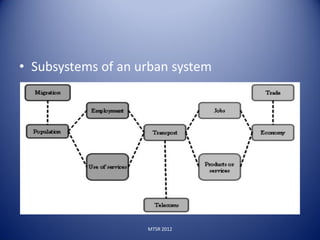
• Subsystems of an urban system


                    MTSR 2012
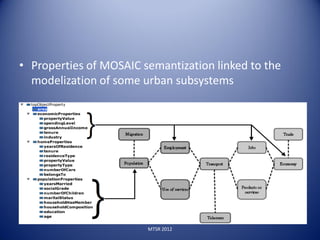
• Properties of MOSAIC semantization linked to the
  modelization of some urban subsystems


                        MTSR 2012
Related works
Interrelate social and physical structures in cities/regions

•   Geodemographic ontologies aligned with semantic tools like the Semantic
    Framework of the Universal Ontology of Geographical Space (UOGS)
•   Qualitative Spatial Reasoning applied to geodemographic zones (variograms
    for binary similarities)
•   TOWNTOLOGY PROJECT: Ontologies for urban civil engineering (Estimate the
    impact of urban intervention on the community)
•   CAMEO, OAC, ACORN, CLOUD CLIENT can be semantized. Interoperability .
•   Ontology Revision : Static Geodemography / Urban Dynamics
•   Desing of Intelligent interfaces for ontology repairing

                                       MTSR 2012
Thanks!

tchavez@us.es


    MTSR 2012
Semantic Geodemography and
   Urban Interoperability
   J. Borrego-Díaz, A. Chávez-González,
  M. Martín-Pérez and J. Zamora- Aguilera


       6th Metadata and Semantics Research Conference MTSR 2012

Semantic Geodemography and Urban interoperability

  • 1.
    Semantic Geodemography and Urban Interoperability J. Borrego-Díaz, A. Chávez-González, M. Martín-Pérez and J. Zamora- Aguilera Dept. Computer Science and Artificial Intelligence University of Seville 6th Metadata and Semantics Research Conference MTSR 2012
  • 2.
    Overview • Introduction • SemanticWeb and (Urban) Ciberinfrastructure • Geodemographies as knowledge augmented spaces • Semantizing geodemographies • Case study • Applications of semantic geodemography • Conclusions and related work MTSR 2012
  • 3.
    Data Sources Sensors City National Commercial Databases Census Social and demographic surveys MTSR 2012
  • 4.
  • 5.
  • 6.
    Urban Computing &GIS SEMANTIC INTEROPERABILITY http://www.westfield.ma.edu/ http://www.spaceandculture.org/2009/05/13/models-of-urban-computing/ MTSR 2012
  • 7.
    Smart City Projects TAYLORED SERVICES AND PROCESSES http://www.urenio.org/category/digital-cities/page/3/ MTSR 2012
  • 8.
    Semantic Interoperability • Servicesand processes • Management and valuation of socio- economical consequences of regions • New methodologies: opportunities MTSR 2012
  • 9.
    SW & GCI MTSR 2012
  • 10.
    Geodemography MTSR 2012
  • 11.
  • 12.
    Semantizing geodemographies • Support for metadata • To enhance information from sensors • Information about geodemographic indices • Decisions which influence city behavior MTSR 2012
  • 13.
    Ontologies • Step 1 – Reflecting and standarizing available information for building systems (GCI) – They provide us with spatial and digital knowledge • Step 2 – High level of information fusion (future social changes) – Knowlege about and for urban systems MTSR 2012
  • 14.
    Extracting an ontology Geodemographicsystems: – Datasets apt to be statistically treated – Systems to be interpreted by expert scientists – Semiformal representation of a geodemographic conceptualization Building an ontology: Case study. MOSAIC MTSR 2012
  • 15.
    MOSAIC: Segmentation System http://www.experian.co.uk/ MTSR 2012
  • 16.
    MOSAIC (by ExperianGroup) • Comprises a range of segmentation systems • Statistical techniques of classification, GIS and software for database management • Groups: demographic and socio-economical features (age, ethnicity, affluence, accommodation, etc.) • Segmentation of consumers: prospective, recruitment, loyalty MTSR 2012
  • 17.
    • Detailed descriptionsof a range of sociodemographic environments • From the ontological point of view, ideal types • Explained by estatistical data • Expert scientists interpret data but do not characterize each class MTSR 2012
  • 18.
    Limitations • MOSAIC definitionspresent difficulties to be translated into metadata – Variance across individuals – Variance of requirements for belonging – Lack of critical requirements (features not included in definitions because of sufficent statistical data have not been provided). Examples: urban /rural nedighborhoods, tax rates, size of houses, etc. MTSR 2012
  • 19.
    • MOSAIC definitionmake use of properties – Experts interpret but there are no data • Class is not fully defined by Data – Axioms can not be expressed • Object Properties vs Data Properties • MOSAIC definitions vs MOSAIC Data – Weakening definitions: set of constrains MTSR 2012
  • 20.
    O63 Group Description:Successful city dwellers owning or renting expensive flats in trendy inner urban locations MTSR 2012
  • 21.
    Methodology 1. Analysis ofgeodemographic system – Types – Data – Expert’s interpretation 2. Interpretation – Tipes as classes – Data as (object or data) properties on classes – Interpretation of segmentation 3. Ontology engineering – Hierarchy construction – Axiomatization of classes by means the characterization of properties – Interpretation of segmentation expressed by axioms MTSR 2012
  • 23.
  • 24.
    Applications of SG •Geodemographic Ontology -> Social Knowledge – Influence all the processes of informational collect, interpretation and feedback – Urban Informatics scope and city management – Specialiced decisions and applications MTSR 2012
  • 25.
    • Life cycleof knowledge in Smart Cities • Acquisition • Verification • Documentation • Decision • Enriched not only by Sociodemographic ontologies • Reasoning on processed knowledge MTSR 2012
  • 26.
    Innovation Lines onSmart city features: • Urban planning/landscape systems (decision urban interventions) • Knowledge-based market for social products and services • Analysis of digital information increases urban resilience • Developing social or community apps MTSR 2012
  • 27.
    Conclusions • Main linesof geodemographic ontology design and engineering • Limitations for developing geodemographic systems from KE • Ontologies provide GCI with Knowledge • Metadata enrich urban subsystems MTSR 2012
  • 28.
    • Subsystems ofan urban system MTSR 2012
  • 29.
    • Properties ofMOSAIC semantization linked to the modelization of some urban subsystems MTSR 2012
  • 30.
    Related works Interrelate socialand physical structures in cities/regions • Geodemographic ontologies aligned with semantic tools like the Semantic Framework of the Universal Ontology of Geographical Space (UOGS) • Qualitative Spatial Reasoning applied to geodemographic zones (variograms for binary similarities) • TOWNTOLOGY PROJECT: Ontologies for urban civil engineering (Estimate the impact of urban intervention on the community) • CAMEO, OAC, ACORN, CLOUD CLIENT can be semantized. Interoperability . • Ontology Revision : Static Geodemography / Urban Dynamics • Desing of Intelligent interfaces for ontology repairing MTSR 2012
  • 31.
  • 32.
    Semantic Geodemography and Urban Interoperability J. Borrego-Díaz, A. Chávez-González, M. Martín-Pérez and J. Zamora- Aguilera 6th Metadata and Semantics Research Conference MTSR 2012