Selfassessment Colour Review Of Cattle And Sheep Medicine Philip R Scott
Selfassessment Colour Review Of Cattle And Sheep Medicine Philip R Scott
Selfassessment Colour Review Of Cattle And Sheep Medicine Philip R Scott
Selfassessment Colour Review Of Cattle And Sheep Medicine Philip R Scott
Selfassessment Colour Review Of Cattle And Sheep Medicine Philip R Scott
1.
Selfassessment Colour ReviewOf Cattle And Sheep
Medicine Philip R Scott download
https://ebookbell.com/product/selfassessment-colour-review-of-
cattle-and-sheep-medicine-philip-r-scott-34824236
Explore and download more ebooks at ebookbell.com
2.
Here are somerecommended products that we believe you will be
interested in. You can click the link to download.
Selfassessment Colour Review Of Feline Medicine Andrew H Sparkes Sarah
M A Caney
https://ebookbell.com/product/selfassessment-colour-review-of-feline-
medicine-andrew-h-sparkes-sarah-m-a-caney-4343086
Selfassessment Colour Review Of Thoracic Imaging 1st Edition Sue
Copley
https://ebookbell.com/product/selfassessment-colour-review-of-
thoracic-imaging-1st-edition-sue-copley-44217544
Self Assessment Colour Review Of Neuroimaging Joseph Heiserman
https://ebookbell.com/product/self-assessment-colour-review-of-
neuroimaging-joseph-heiserman-5103146
Selfassessment Colour Review Of Hepatobiliary Medicine Roger
Bodenheimer Jr
https://ebookbell.com/product/selfassessment-colour-review-of-
hepatobiliary-medicine-roger-bodenheimer-jr-5146604
3.
Selfassessment Colour ReviewOf Clinical Neurology And Neurosurgery
Neil D Kitchen
https://ebookbell.com/product/selfassessment-colour-review-of-
clinical-neurology-and-neurosurgery-neil-d-kitchen-51721912
Selfassessment Colour Review Of Hepatobiliary Medicine Bodenheimer
https://ebookbell.com/product/selfassessment-colour-review-of-
hepatobiliary-medicine-bodenheimer-5394944
Selfassessment Colour Review Of Critical Care Horst H Mathilda
Karmyjones
https://ebookbell.com/product/selfassessment-colour-review-of-
critical-care-horst-h-mathilda-karmyjones-5145832
Selfassessment Colour Review Veterinary Dentistry Franj J M Verstraete
https://ebookbell.com/product/selfassessment-colour-review-veterinary-
dentistry-franj-j-m-verstraete-34824512
Cardiologyselfassessment Colour Review 2e 20041840760532manson
Publishing Ltdpdf Stuart Rosen
https://ebookbell.com/product/cardiologyselfassessment-colour-
review-2e-20041840760532manson-publishing-ltdpdf-stuart-rosen-48294712
Self-Assessment Colour Review
Cattleand Sheep
Medicine
Philip R Scott
BVM&S, MPhil, DVM&S, DSHP, FRCVS,
DipIECSRHM, DiplECBHM, FHEA
Royal (Dick) School of Veterinary Studies
Easter Bush Veterinary Centre
Easter Bush, Nr Roslin, Midlothian, UK
MANSON PUBLISHING/THE VETERINARY PRESS
5
Preface
This book aimsto present the essential facts of the most common ruminant diseases
and conditions in a problem-based format. Clinical cases are not ordered in organ
system, thereby mimicking the random presentation of cases during a busy round
of calls in practice. The diagnosis and treatment regimens described herein are those
used by the author over the past 30 years in commercial large animal practice in
the UK; they acknowledge the time and financial restrictions in many situations
but require no specialized facilities nor equipment. The book is designed for
veterinary undergraduates during their clinical rotations, and for the recent
graduate who encounters the occasional farm animal problem in mixed practice.
All suggestions for further cases, comments, and suggestions will be gratefully
received and acknowledged by the author.
Philip R Scott
11.
Abbreviations
AGID agar gelimmunodiffusion
AP alkaline phosphatase
AST aspartate aminotransferase
BCS body condition score
BP British Pharmacopoeia
BRSV bovine respiratory syncytial
virus
BUN blood urea nitrogen
BVD bovine virus diarrhoea
CFT complement fixation test
CLA caseous lymphadenitis
CNS central nervous system
CPD contagious pustular
dermatitis
CSF cerebrospinal fluid
DM dry matter
EAE enzootic abortion of ewes
EDTA ethylenediamine tetra-acetic
acid
ELISA enzyme-linked
immunosorbent assay
epg eggs per gram
EU European Union
FAT fluorescent antibody test
GGT gamma glutamyltransferase
GLDH glutamate dehydrogenase
IBR infectious bovine
rhinotracheitis
IKC infectious
keratoconjunctivitis
L3 third stage larva
LDA left-displaced abomasum
MD mucosal disease
ME metabolizable energy
MJ megajoules
MVV maedi-visna virus
NEFA nonesterified fatty acid
NSAID nonsteroidal anti-
inflammatory drug
OPP ovine progressive
pneumonia
OPT ovine pregnancy toxaemia
PCV packed cell volume
PEM polioencephalomalacia
PGE parasitic gastroenteritis
RBC red blood cell
SPA sheep pulmonary
adenomatosis
WBC white blood cell
ZN Ziehl-Neelsen (stain)
6
1, 2: Questions
9
1You are presented with two
15-month-old dairy heifers
which have been housed for
2 weeks and fed the remains of
last year’s silage clamp before
the new clamp is opened. The
heifers are very weak and unable
to rise (1a). The farmer had
noted that one heifer in the
group of 84 was unsteady on its
hindlegs the previous evening.
None of the other heifers show
any abnormal clinical signs. Both heifers appear dull and depressed and are
unable to rise. There is profound weakness of the limb muscles. The rectal
temperature is normal for each heifer. The heifers do not eat but can swallow.
There are ruminal movements but only scant mucus-coated faeces are passed.
i. What conditions would you suspect? (Most likely first.)
ii. What treatments would you administer?
iii. What control measures could be adopted?
1a
Section 1: CATTLE
2 A 3-year-old dairy heifer presents
with 2 months’ history of weight loss
and diarrhoea despite anthelmintic
treatment by the farmer. The heifer was
purchased soon after calving 3 months
ago and is yielding only 18 L/day. The
rectal temperature is normal. No sig-
nificant clinical signs are found except
for profuse diarrhoea without blood or
mucosal casts and poor body condition
(2).
i. What conditions would you con-
sider? (Most likely first.)
ii. Which further tests could be under-
taken?
iii. What treatments would you recommend?
iv. What control measures must be adopted for introduced cattle?
2
15.
1, 2: Answers
10
1i. The most likely conditions to
consider include: botulism; lead
poisoning; listeriosis; blackleg; re-
cumbency and endotoxaemia asso-
ciated with septicaemia.
There is no readily available
diagnostic test for botulinum toxin.
There was no access to poultry
waste/carcasses, the most common
source of botulinum toxin, but the
farmer often shot a large number of
feral pigeons in the shed that may
have resulted in carcass contamination of the clamp silage which was not sheeted.
ii. There is no specific treatment although cattle displaying only pelvic limb
weakness may recover over 7–14 days. In this problem, one heifer deteriorated
rapidly overnight (paralysis of tongue and masticatory muscles, head averted
against chest) and was euthanased for welfare reasons. The other recumbent
heifer was destroyed for welfare reasons 2 days later.
iii. To control this problem the old silage was discarded and the new silage pit
opened. No further cases of botulism were reported in this group. Other control
measures include preventing access to potentially contaminated feedstuffs
especially poultry waste. Poultry manure is often used as a fertilizer applied
directly to pasture (1b). Several recent outbreaks of botulism have been tenta-
tively linked to feeding bakery waste to cattle.
1b
2 i . The most likely conditions to consider include: Johne’s disease (Mycobacterium
paratuberculosis); chronic fasciolosis; persistent infection with BVD/MD virus;
chronic salmonellosis; chronic bacterial infection leading to debility.
ii. Further tests include the ELISA test and faecal smear for Johne’s disease,
which were negative in this case. A faecal sample should be examined for
parasite eggs, and an ELISA test can be carried out for liver fluke. In this case, a
single fluke egg is seen on sedimentation; no strongyle eggs are detected by the
modified McMaster method. The ELISA test for liver fluke is positive.
iii. Treatment could include triclabendazole or nitroxynil.
iv. All introduced cattle should be treated for intestinal parasites and fluke on arrival
on the farm where appropriate. All cattle must be screened for BVD/MD virus status
with seronegative animals checked for antigen. Vaccination against leptospirosis and
IBR will depend upon the herd history but should be carefully considered. Single
screening for chronic carrier status with Salmonella dublin is unreliable.
16.
3, 4: Questions
11
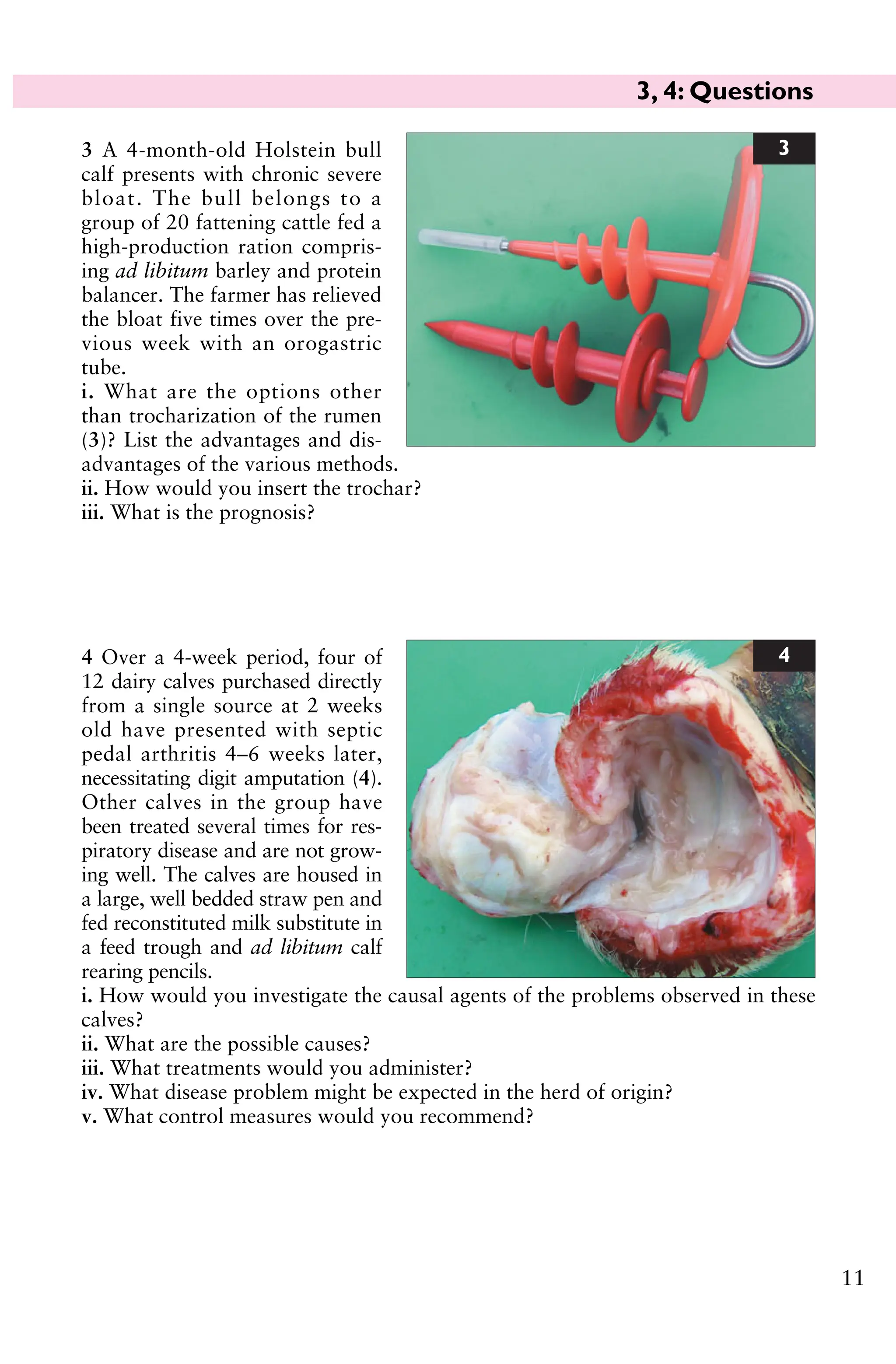
4Over a 4-week period, four of
12 dairy calves purchased directly
from a single source at 2 weeks
old have presented with septic
pedal arthritis 4–6 weeks later,
necessitating digit amputation (4).
Other calves in the group have
been treated several times for res-
piratory disease and are not grow-
ing well. The calves are housed in
a large, well bedded straw pen and
fed reconstituted milk substitute in
a feed trough and ad libitum calf
rearing pencils.
i. How would you investigate the causal agents of the problems observed in these
calves?
ii. What are the possible causes?
iii. What treatments would you administer?
iv. What disease problem might be expected in the herd of origin?
v. What control measures would you recommend?
4
3 A 4-month-old Holstein bull
calf presents with chronic severe
bloat. The bull belongs to a
group of 20 fattening cattle fed a
high-production ration compris-
ing ad libitum barley and protein
balancer. The farmer has relieved
the bloat five times over the pre-
vious week with an orogastric
tube.
i. What are the options other
than trocharization of the rumen
(3)? List the advantages and dis-
advantages of the various methods.
ii. How would you insert the trochar?
iii. What is the prognosis?
3
17.
3, 4: Answers
12
4i. Investigations could include arthrocentesis before antibiotic therapy and
culture of synovial membrane collected after digit amputation. Bronchoalveolar
lavage for BRSV is too late in the disease course. Bacteriological culture of
bronchoalveolar lavage fluid could be undertaken but this is of doubtful benefit.
Paired serology to determine respiratory virus involvement and BVD/MD status
would be influenced by maternally derived antibody.
ii. The most likely conditions to consider include: septic joint – Salmonella spp.
particularly S. dublin and S. typhimurium in this age range; respiratory disease –
bacterial pneumonia following respiratory viral infection; persistently infected
BVD/MD calf in the group causing transient infection in the other calves.
Culture of synovial membrane after digit amputation yields S. dublin.
iii. The response to parenteral antibiotic therapy for joint infections (usually flor-
fenicol), and respiratory disease caused by S. dublin, is poor. Joint lavage necessitates
general anaesthesia and often a second flush 3–5 days later. Digit amputation in the
present situation gives good results and is the most economic option.
iv. Abortion at 5–7 months is a feature of herds with endemic S. dublin infection.
v. Control measures include stopping purchase of calves from this source. If the
farmer is contracted to do so, the calves should be vaccinated at the source farm.
3 i. Trocharization: Advantages – quick therefore cheap. Granulation tissue seals
the fistula within days of trochar removal. Disadvantages – the trochar may
become dislodged and it then proves difficult to insert another. Spiral trochars are
much more effective than straight trochars.
Make a semi-permanent rumen fistula: Advantages – granulation tissue seals the
fistula only after several months. Disadvantages – requires abdominal surgery taking
approximately 20 minutes including preparation time, therefore it is the most costly
option. Rumen liquor escapes on to the flank, which is irritant and unsightly.
ii. The trochar is more easily inserted in the bloated animal. The site chosen is the
highest point midway between the last rib and wing of the ilium. The site is
infiltrated with lidocaine, and a 4 cm skin incision is made. The trochar point is
pushed through the muscle layers and rumen wall, then the trochar is screwed into
the rumen wall. The gas is released slowly over 2–3 minutes. The trochar is fixed to
the skin with nonabsorbable sutures.
iii. Antibiotic therapy is often administered following surgery to treat possible
infections affecting the forestomachs. Where available, transfaunation from a healthy
animal is helpful. The protein content of the ration should be checked, ensuring a
minimum of 16% crude protein and adequate long fibre. The prognosis is generally
poor because chronic recurrent bloat is commonly caused by vagal indigestion.
18.
5, 6: Questions
13
6You are presented with a 2-year-old Charo-
lais bull which has had difficulty grazing for
the past 4 days, caused by the inability to close
his mouth fully. The bull appears dull and
depressed but is aware of your presence and
the confines of his new surroundings following
housing. The bull appears slightly ataxic when
walking to the cattle stocks.
The bull’s rectal temperature is 40.5°C
(104.9°F). There is a normal menace response in
both eyes but the pupillary light reflexes are
absent. There is also bilateral dorsal strabismus
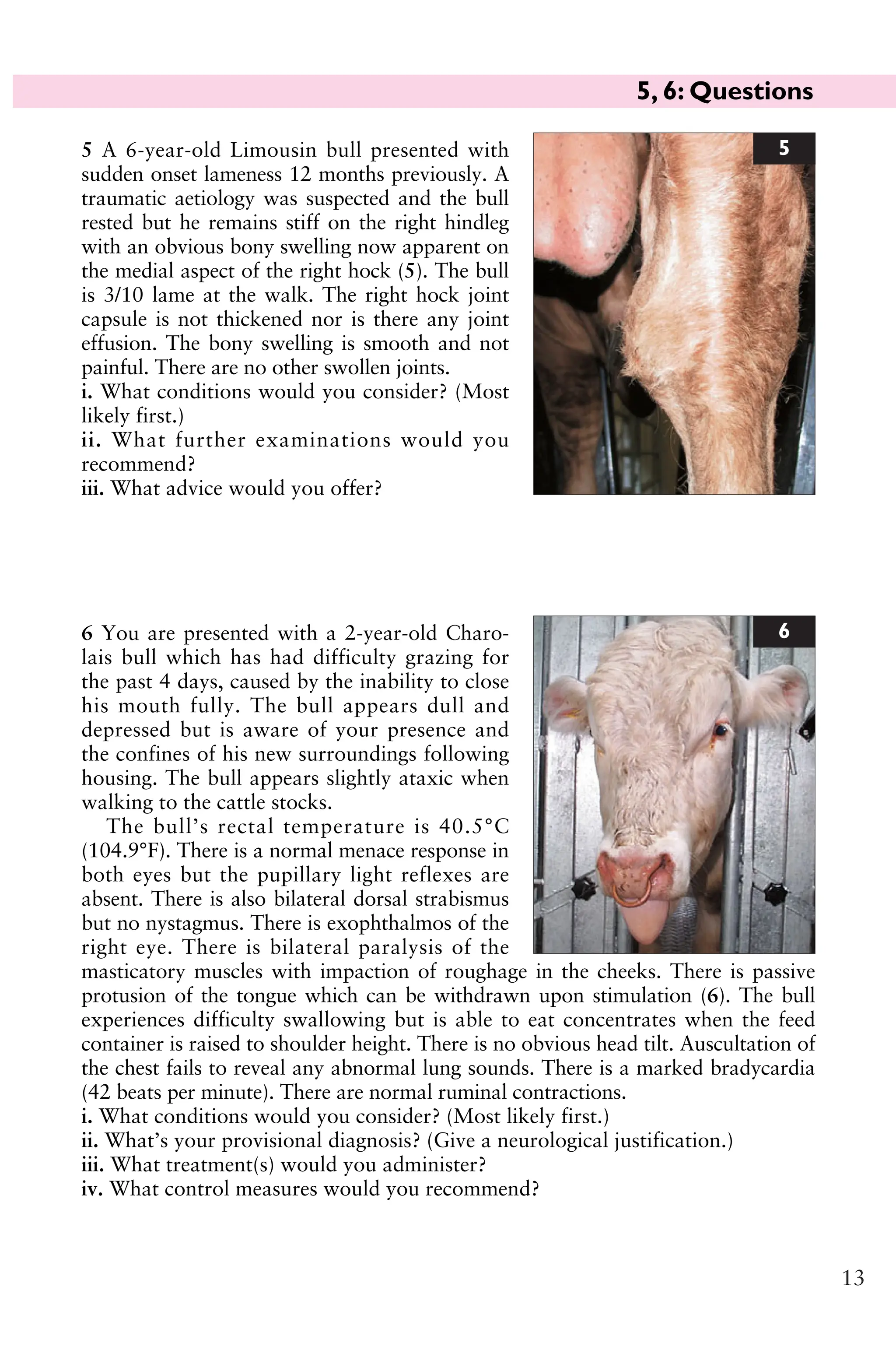
but no nystagmus. There is exophthalmos of the
right eye. There is bilateral paralysis of the
masticatory muscles with impaction of roughage in the cheeks. There is passive
protusion of the tongue which can be withdrawn upon stimulation (6). The bull
experiences difficulty swallowing but is able to eat concentrates when the feed
container is raised to shoulder height. There is no obvious head tilt. Auscultation of
the chest fails to reveal any abnormal lung sounds. There is a marked bradycardia
(42 beats per minute). There are normal ruminal contractions.
i. What conditions would you consider? (Most likely first.)
ii. What’s your provisional diagnosis? (Give a neurological justification.)
iii. What treatment(s) would you administer?
iv. What control measures would you recommend?
6
5 A 6-year-old Limousin bull presented with
sudden onset lameness 12 months previously. A
traumatic aetiology was suspected and the bull
rested but he remains stiff on the right hindleg
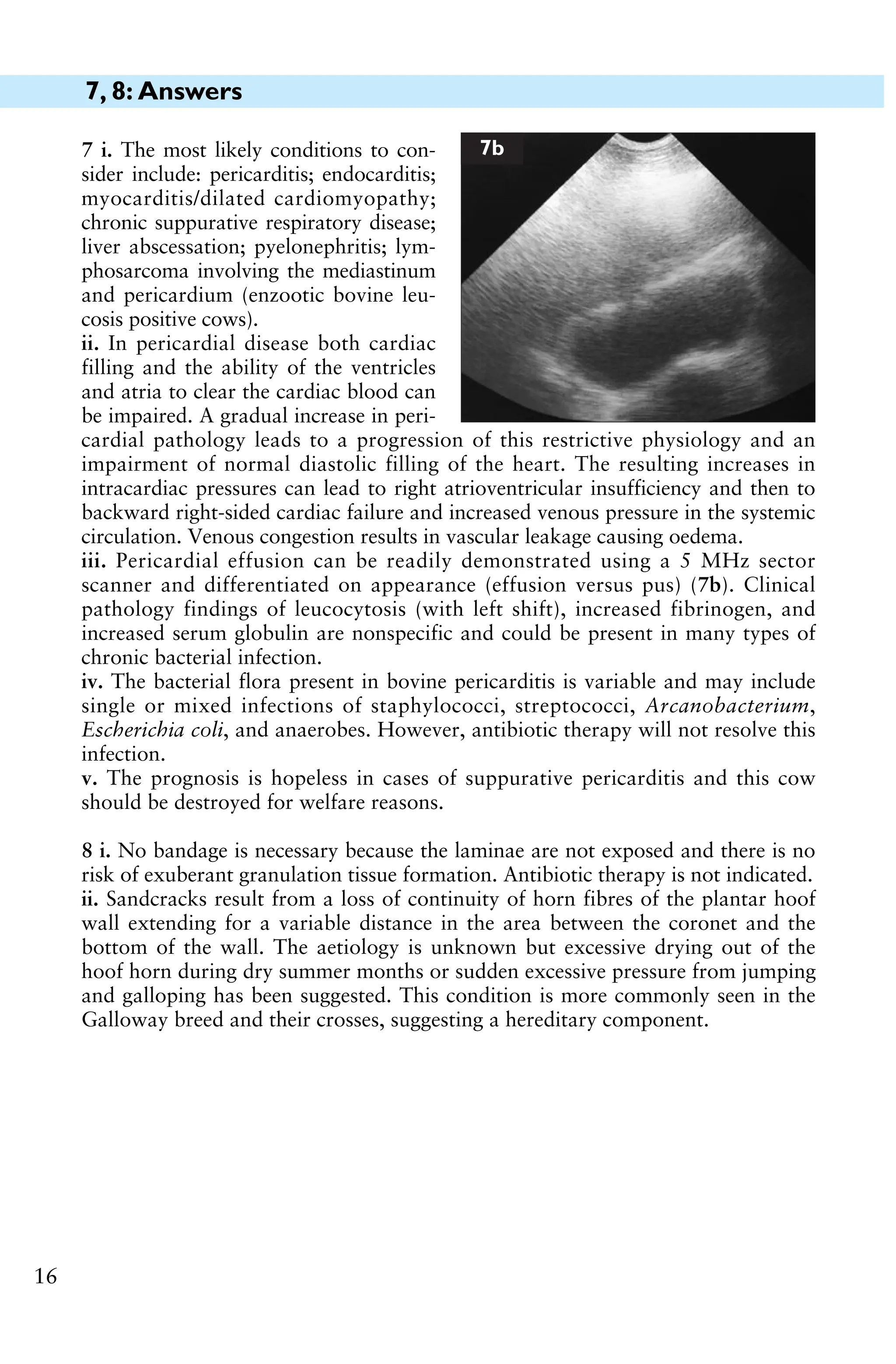
with an obvious bony swelling now apparent on
the medial aspect of the right hock (5). The bull
is 3/10 lame at the walk. The right hock joint
capsule is not thickened nor is there any joint
effusion. The bony swelling is smooth and not
painful. There are no other swollen joints.
i. What conditions would you consider? (Most
likely first.)
ii. What further examinations would you
recommend?
iii. What advice would you offer?
5
19.
5, 6: Answers
14
6i. The most likely conditions to consider include: basilar empyema (pituitary
abscess); listeriosis; peripheral vestibular lesion; brain abscess; bovine spongiform
encephalopathy; botulism; rabies.
ii. A diagnosis of basilar empyema is based on the clinical findings of multiple
cranial nerve deficits, particularly bilateral cranial nerve deficits involving III and
V, ataxia, and bradycardia.
Ataxia results from interruption of extrapyramidal motor nuclei in the brain
stem by the expanding abscess. Extension into the retro-orbital rete would
explain the exophthalmos of the right eye.
iii. Recovery of cattle from basilar empyema depends on early detection of illness
by the farmer and aggressive antibiotic treatment. Arcanobacterium pyogenes is
most commonly isolated from such cases and is susceptible to various antibiotics
including penicillin, ceftiofur, erythromycin, and trimethoprim/sulphonamide.
Treatment involves 44,000 IU/kg procaine penicillin injected intramuscularly
twice daily for 3 weeks. The clinical signs remained unchanged for 5 days, then
the bull’s appetite improved and he was able to eat silage without food material
becoming impacted. The bull’s demeanour also improved. This response should
be judged against deterioration in clinical signs and death in untreated cases
7–10 days after clinical signs first appear. The bull made a full recovery.
iv. The insertion of bull rings is considered a major risk factor with resultant
localized infection spreading haematogenously to the rete mirabile, the complex of
blood capillaries surrounding the pituitary gland, giving rise to basilar empyema.
5 i. The most likely conditions to consider include: osteophyte deposition
involving the tarsometatarsal joint (bone spavin); osteochondritis dissecans;
trauma to the hock joint/ligamentous damage causing osteoarthritis.
ii. Radiography of right hock (left hock radiographs taken for comparison)
reveals extensive new bone deposition involving the tarsometatarsal joint. Ultra-
sonographic examination of the right hock joint reveals no thickening of the joint
capsule or joint effusion.
iii. The tarsometatarsal joint is a low motion joint and therefore ankylosis should
not limit locomotion except that great strain will be placed on this joint during
mounting at service. There are a number of options; leave for another 6 months
and radiograph again, turn the bull out with half the usual number of cows (20)
with the risk of possible fracture through the bridging callus, or cull the bull. The
third option was chosen (value of bull as cull animal representing almost 50% of
the purchase price of a replacement); however, this may not be the correct option
as there are no published studies on this type of injury. The second option could
work but is it worth the risk on animal welfare grounds?
20.
7, 8: Questions
15
7A 6-year-old Holstein cow pre-
sents with 3 weeks’ history of poor
appetite, weight loss, and reduced
milk yield (7a). Treatment with
intramuscular injection of oxytetra-
cycline for 4 consecutive days by the
farmer has effected no improvement.
The rectal temperature is marginally
elevated (39.2°C (102.6°F)). The
cow is dull and depressed, and walks
slowly. There is distension of the
jugular veins and accumulation of
oedema under the brisket and
mandible which pits under digital pressure. The ocular and oral mucous
membranes are congested. The heart rate is 80 beats per minute but the heart
sounds are muffled on both sides of the chest. The respiratory rate is elevated to
40 breaths per minute with a slight abdominal component.
i. What conditions would you consider?
ii. Why is there oedema present?
iii. How could you confirm your provisional diagnosis?
iv. What treatment would you recommend?
v. What is the prognosis?
7a
8 You are presented with a lame dairy cow
which has been 9/10 lame on the left foreleg
for the past 4 days. The cow is due to calve in
approximately 1 month and is at pasture with
a group of 12 other dry cows. Examination of
the leg fails to reveal any swelling, heat or pain.
The prescapular lymph node is of normal size.
The interdigital skin appears normal and
careful foot paring fails to reveal any abnor-
mality. Examination of the dorsal hoof wall
reveals a small sandcrack (8). Application of
pressure over the sandcrack using hoof testers
elicits a painful reaction. Careful foot paring
releases an abscess.
i. What further treatments are indicated?
ii. What is the cause of such lesions?
8
21.
7, 8: Answers
16
7i. The most likely conditions to con-
sider include: pericarditis; endocarditis;
myocarditis/dilated cardiomyopathy;
chronic suppurative respiratory disease;
liver abscessation; pyelonephritis; lym-
phosarcoma involving the mediastinum
and pericardium (enzootic bovine leu-
cosis positive cows).
ii. In pericardial disease both cardiac
filling and the ability of the ventricles
and atria to clear the cardiac blood can
be impaired. A gradual increase in peri-
cardial pathology leads to a progression of this restrictive physiology and an
impairment of normal diastolic filling of the heart. The resulting increases in
intracardiac pressures can lead to right atrioventricular insufficiency and then to
backward right-sided cardiac failure and increased venous pressure in the systemic
circulation. Venous congestion results in vascular leakage causing oedema.
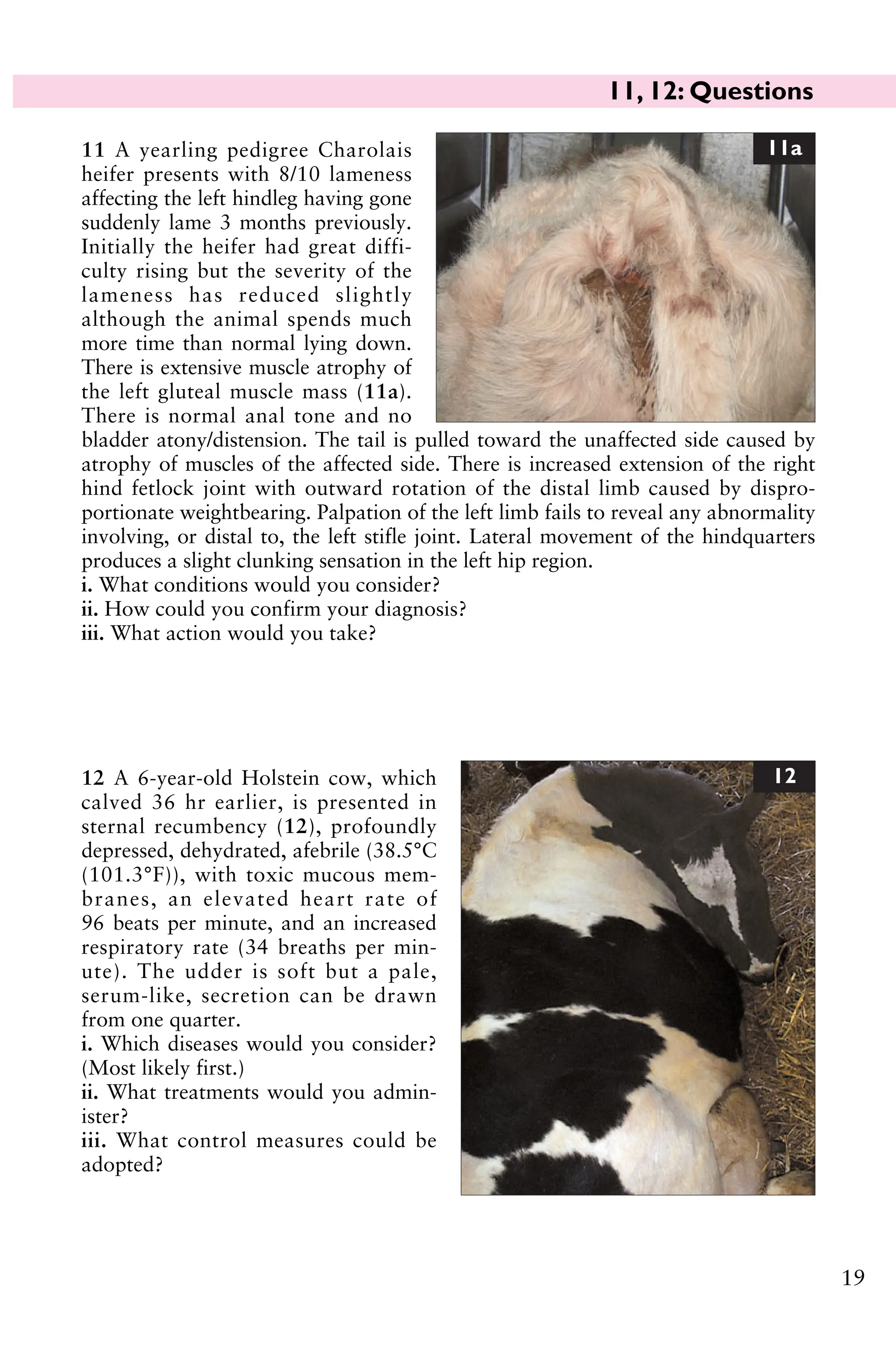
iii. Pericardial effusion can be readily demonstrated using a 5 MHz sector
scanner and differentiated on appearance (effusion versus pus) (7b). Clinical
pathology findings of leucocytosis (with left shift), increased fibrinogen, and
increased serum globulin are nonspecific and could be present in many types of
chronic bacterial infection.
iv. The bacterial flora present in bovine pericarditis is variable and may include
single or mixed infections of staphylococci, streptococci, Arcanobacterium,
Escherichia coli, and anaerobes. However, antibiotic therapy will not resolve this
infection.
v. The prognosis is hopeless in cases of suppurative pericarditis and this cow
should be destroyed for welfare reasons.
7b
8 i. No bandage is necessary because the laminae are not exposed and there is no
risk of exuberant granulation tissue formation. Antibiotic therapy is not indicated.
ii. Sandcracks result from a loss of continuity of horn fibres of the plantar hoof
wall extending for a variable distance in the area between the coronet and the
bottom of the wall. The aetiology is unknown but excessive drying out of the
hoof horn during dry summer months or sudden excessive pressure from jumping
and galloping has been suggested. This condition is more commonly seen in the
Galloway breed and their crosses, suggesting a hereditary component.
22.
9, 10: Questions
17
9You are presented with a collapsed
2-month-old beef calf (9). The rectal
temperature is subnormal (38.1°C
(100.6°F)). The eyes are markedly
sunken and the skin tent is extended
beyond 5 s, consistent with 7–10%
dehydration. The ocular and oral
mucous membranes are markedly con-
gested. The heart rate is 120 beats per
minute. The respiratory rate is elevated
to 28 breaths per minute with a slight
expiratory grunt. The abdomen is dis-
tended and palpation elicits a painful
grunt.
i. What conditions would you consider?
ii. How could you confirm your provisional diagnosis?
iii. What is the prognosis?
iv. What treatment would you recommend?
v. What control measures would you recommend?
9
10 A 5-year-old dairy cow presents
with 6 weeks’ history of increasing
abdominal distension and loss of con-
dition (10). The cow’s appetite is poor
and there are only scant hard faecal
balls coated in mucus in the rectum.
The cow has a roached-back appear-
ance and an anxious expression. The
abdomen is markedly distended and
‘papple-shaped’ (10 to 4 distension).
The rectal temperature is normal. The
pulse rate is 38 beats per minute. The
force and rate of rumen contractions is
increased to approximately three to
four cycles per minute (normal rate is
one cycle every 40 s or so). The withers pinch test (Williams’ test) is negative.
Passage of a stomach tube releases only a small amount of gas.
i. What conditions would you consider? (Most likely first.)
ii. How would you confirm your diagnosis?
iii. What actions/treatments would you recommend?
10
23.
9, 10: Answers
18
9i. The most likely conditions to consider include: abomasal perforation;
clostridial enteritis; intestinal torsion; acute peritonitis; hairball causing obstruc-
tion to abomasal outflow; intussusception; necrotic enteritis; septicaemia;
ruptured bladder/uroperitoneum.
ii. The clinical diagnosis could be supported by abdominocentesis, which would
yield blood-tinged fluid. Ultrasonography may reveal several litres of fluid in the
peritoneal cavity. Explorative laparotomy may be undertaken.
iii. The prognosis for abomasal perforation/acute septic peritonitis is hopeless
despite early veterinary attention. Profound weakness, dehydration, injected
mucous membranes, rapid pulse >100 beats per minute, and expiratory grunt are
poor prognostic indicators.
iv. Symptomatic treatment comprises 2.2 mg/kg of flunixin meglumine injected
intravenously. Five litres of isotonic saline are given intravenously over 1 hr
(50 mL/kg). A further 5 L of isolec are infused over the next 3 hr. In this case a
midline explorative laporotomy under xylazine (0.1 mg/kg intramuscularly) and
ketamine (2–3 mg/kg intravenously) general anaesthesia revealed an abomasal
perforation with contamination of the abdominal cavity. The calf was euthanased
for welfare reasons.
v. Abomasal perforation through a single focal 1–2 cm diameter punctate ulcer
occurs sporadically in 2–3-month-old beef calves. The cause of this sporadic
condition has not been determined.
10 i. The most likely conditions to consider include: vagus indigestion; chronic
bloat resulting from mediastinal mass, e.g. thymic lymphosarcoma or abscess;
twin pregnancy/hydrops allantois; localized peritonitis; left-displaced abomasum;
traumatic reticulitis.
ii. A diagnosis of vagus indigestion is based upon the clinical findings (rumen
hypermotility, bradycardia, abdominal shape) and exclusion of other conditions.
Localized peritonitis, often arising from traumatic reticulitis, is considered to be
the most common cause of vagus indigestion. Ultrasonographic examination of
the anterior abdomen using a 5 MHz sector scanner failed to detect any
abdominal abscess. Abdominocentesis yielded a small quantity of straw-coloured
peritoneal fluid with a low protein concentration and low cell count comprised
mainly of lymphocytes (normal values).
iii. The prognosis in this cow was considered to be very poor due to the chronicity
and severity of the abdominal distension and the cow was euthanased for welfare
reasons. While the lack of specific diagnosis is very frustrating there is nothing
more that can be done and the animal’s welfare is the most important factor.
24.
11, 12: Questions
19
11A yearling pedigree Charolais
heifer presents with 8/10 lameness
affecting the left hindleg having gone
suddenly lame 3 months previously.
Initially the heifer had great diffi-
culty rising but the severity of the
lameness has reduced slightly
although the animal spends much
more time than normal lying down.
There is extensive muscle atrophy of
the left gluteal muscle mass (11a).
There is normal anal tone and no
bladder atony/distension. The tail is pulled toward the unaffected side caused by
atrophy of muscles of the affected side. There is increased extension of the right
hind fetlock joint with outward rotation of the distal limb caused by dispro-
portionate weightbearing. Palpation of the left limb fails to reveal any abnormality
involving, or distal to, the left stifle joint. Lateral movement of the hindquarters
produces a slight clunking sensation in the left hip region.
i. What conditions would you consider?
ii. How could you confirm your diagnosis?
iii. What action would you take?
11a
12 A 6-year-old Holstein cow, which
calved 36 hr earlier, is presented in
sternal recumbency (12), profoundly
depressed, dehydrated, afebrile (38.5°C
(101.3°F)), with toxic mucous mem-
branes, an elevated heart rate of
96 beats per minute, and an increased
respiratory rate (34 breaths per min-
ute). The udder is soft but a pale,
serum-like, secretion can be drawn
from one quarter.
i. Which diseases would you consider?
(Most likely first.)
ii. What treatments would you admin-
ister?
iii. What control measures could be
adopted?
12
25.
11, 12: Answers
20
11i. The most likely conditions to
consider include: femoral fracture
through the proximal growth plate;
pelvic fracture involving the acetabu-
lum; septic physitis leading to fracture
through the proximal femoral growth
plate; septic hip joint; dislocated hip;
fracture of the femoral shaft. There is
no evidence of hip dislocation. The
pelvis appears symmetrical.
ii. The close proximity of the proximal
growth plate to the hip joint and overlying muscle masses present problems with
interpretation of ultrasound images. Radiography necessitates dorsal recumbency
and either deep sedation or general anaesthesia and a powerful machine for cattle
>200 kg.
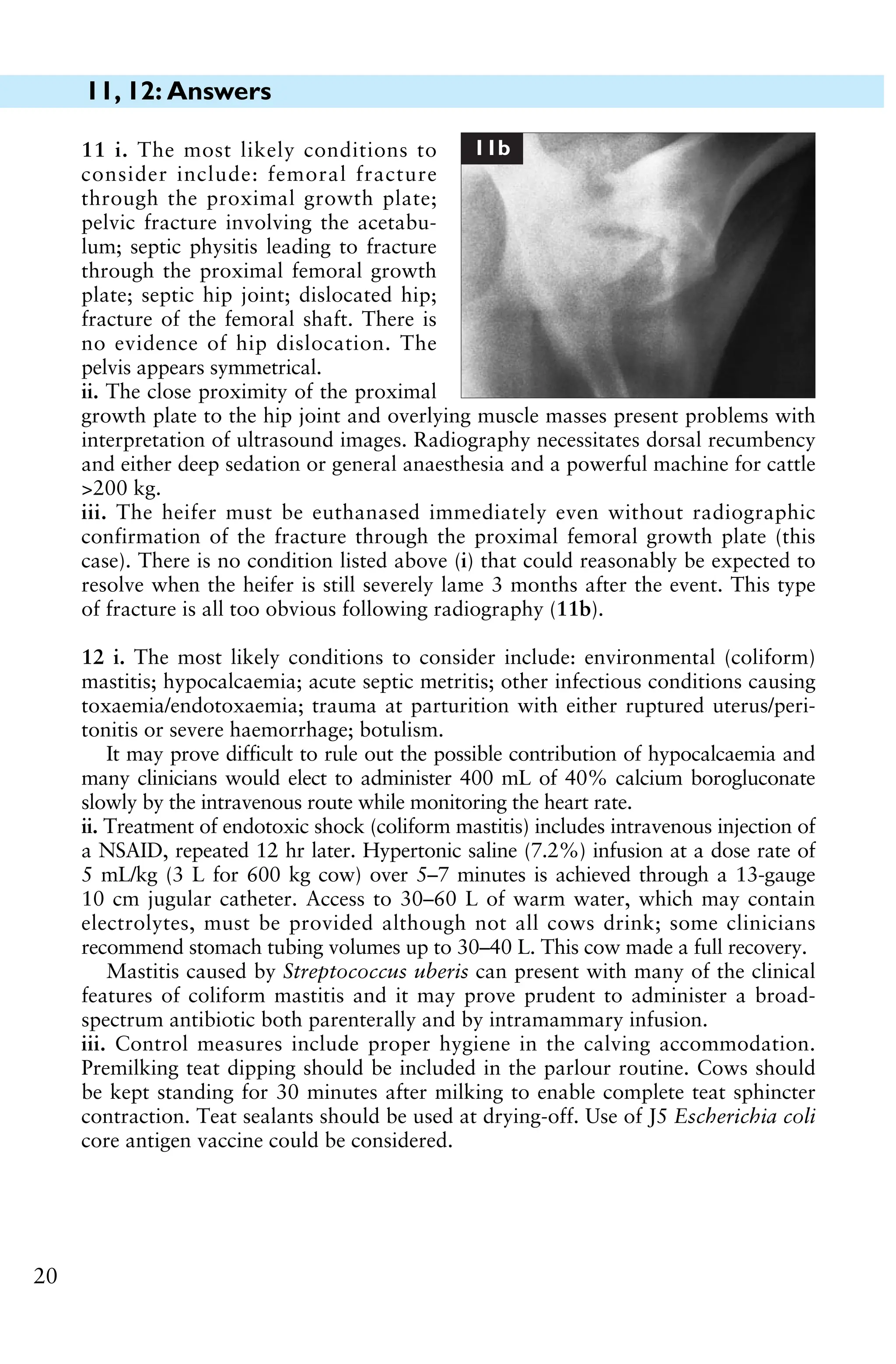
iii. The heifer must be euthanased immediately even without radiographic
confirmation of the fracture through the proximal femoral growth plate (this
case). There is no condition listed above (i) that could reasonably be expected to
resolve when the heifer is still severely lame 3 months after the event. This type
of fracture is all too obvious following radiography (11b).
11b
12 i. The most likely conditions to consider include: environmental (coliform)
mastitis; hypocalcaemia; acute septic metritis; other infectious conditions causing
toxaemia/endotoxaemia; trauma at parturition with either ruptured uterus/peri-
tonitis or severe haemorrhage; botulism.
It may prove difficult to rule out the possible contribution of hypocalcaemia and
many clinicians would elect to administer 400 mL of 40% calcium borogluconate
slowly by the intravenous route while monitoring the heart rate.
ii. Treatment of endotoxic shock (coliform mastitis) includes intravenous injection of
a NSAID, repeated 12 hr later. Hypertonic saline (7.2%) infusion at a dose rate of
5 mL/kg (3 L for 600 kg cow) over 5–7 minutes is achieved through a 13-gauge
10 cm jugular catheter. Access to 30–60 L of warm water, which may contain
electrolytes, must be provided although not all cows drink; some clinicians
recommend stomach tubing volumes up to 30–40 L. This cow made a full recovery.
Mastitis caused by Streptococcus uberis can present with many of the clinical
features of coliform mastitis and it may prove prudent to administer a broad-
spectrum antibiotic both parenterally and by intramammary infusion.
iii. Control measures include proper hygiene in the calving accommodation.
Premilking teat dipping should be included in the parlour routine. Cows should
be kept standing for 30 minutes after milking to enable complete teat sphincter
contraction. Teat sealants should be used at drying-off. Use of J5 Escherichia coli
core antigen vaccine could be considered.
26.
21
13 A Limousinbull presents
with severe (10/10) lameness of
the left pelvic limb with marked
muscle atrophy over the left hip.
The left hindfoot is swollen with
marked widening of the inter-
digital space. There is loss of hair
and thinning of the skin extend-
ing all around the coronary band
of the lateral claw extending
proximally for 3 cm with a dis-
charging sinus consistent with
septic pedal arthritis.
i. Describe the method of
analgesia you would employ for the procedure illustrated here (13a)?
ii. How would you complete the procedure shown?
13a
14 A group of beef cattle pre-
sents with 4 weeks’ history of
pruritus and extensive hair loss
especially over the shoulder,
neck, and ears (14). The cattle
are frequently observed rubbing
against walls and fence posts.
i. What conditions would you
consider?
ii. Which further tests could be
undertaken?
iii. What actions/treatments
would you recommend?
iv. Are there any consequences
of this problem?
14
13, 14: Questions
27.
13, 14: Answers
22
13i. The procedure shown is digit
amputation under intravenous regional
anaesthesia. Flunixin meglumine (or
other NSAID) is injected intravenously
before surgery. A robust tourniquet is
placed below the hock and 30–40 mL of
2% lidocaine solution is injected into the
superficial vein running on the cranio-
lateral aspect of the third metatarsal
bone (butterfly catheter shown in situ).
Analgesia is effective within 2 minutes.
ii. The interdigital skin is incised as close to the infected tissue as possible and the
incision extended for the full length of the interdigital space to a depth of 2 cm
cranially increasing to 4 cm caudally. A length of embryotomy wire is introduced
into the incision and the lateral digit removed at the level of mid P2 (wire at 15° to
horizontal). A melolin dressing (or similar) is applied to the wound then cotton wool
and a pressure bandage applied using Elastoplast (or similar). The dressing is
changed after 4 days. The bull made a full recovery and is still in the herd 18 months
later. A sagittal section through the amputated digit with P2 removed clearly shows
the extent of infection and pathology within the distal interphalangeal joint (13b).
If infection in the deep flexor tendon sheath has extended above the amputa-
tion site, 10–15 cm of flexor tendon can be removed to effect drainage.
14 i. The most likely conditions to consider include: lice (pediculosis); forage mites;
sarcoptic mange; chorioptic mange; ringworm (Trichophyton spp. infection).
ii. Inspection of the skin reveals extensive louse infestation. Microscopic examina-
tion of skin scraping reveals numerous chewing (round mouthparts; Damalinia
bovis) and sucking lice (narrow and more pointed mouthparts; Linognathus vituli).
iii. Treatment options include pour-on organophosphorous or pyrethroid (e.g.
cypermethrin) compounds that effect rapid improvement but may require re-
treatment in 2–4 weeks. All in-contact cattle must be treated. Injectable aver-
mectin products are not always wholly effective against chewing lice.
Pediculosis is widespread in all beef herds and routine treatment is recom-
mended at housing. Interestingly, bulls are invariably more severely affected than
cows.
iv. Disruption to grazing/feeding may cause reduced liveweight gain/loss of body
condition in severe infestations, although very heavy burdens are more often a
consequence rather than the cause of debility. Anaemia, as a consequence of
severe infestations, is rare.
13b
28.
15, 16: Questions
23
16A 4-day-old bull calf has been
unable to bear weight on the right fore-
leg (16) since an assisted delivery in
anterior presentation using a calving
aid. The rectal temperature is 38.5°C
(101.3°F). There is thickening of the
umbilical stump. There is a loss of
muscle tone and markedly reduced
reflexes in the right foreleg but the left
foreleg is normal. Normal reflexes are
present in the pelvic limbs.
i. What conditions would you con-
sider? (Most likely first.)
ii. What treatment(s) would you administer?
iii. What is the prognosis for this calf?
15 A 30-month-old Holstein heifer
presents with 10 days’ history of poor
appetite and weight loss (15a). The
heifer produced a live calf unaided
3 weeks previously and is yielding 16 L
of milk per day. The heifer is dull and
depressed. The rectal temperature is
39.2°C (102.6°F). The ocular and oral
mucous membranes appear slightly
congested. The heart rate is 86 beats
per minute. The respiratory rate is 38
breaths per minute. Auscultation of the chest reveals increased wheezes antero-
ventrally. The heifer has a soft productive cough. The ruminal contractions are
normal, occurring once per minute.
Routine haematological examination reveals a total red blood cell count of
4.1 × 10¹²/L (4.1 × 10⁶/µL) (normal range 5–9 × 10¹²/L, 5–9 × 10⁶/µL), leuco-
cytes 12.4 × 10⁹/L (12.4 × 10³/µL) (normal range 4–10 × 109/L, 4–10 × 103/µL)
with 65% neutrophils. Serum albumin and globulin concentrations are 24.8 g/L
(2.48 g/dL) (normal range 30–40 g/L, 3–4 g/dL) and 61.3 g/L (6.13 g/dL)
(normal range 35–45 g/L, 3.5–4.5 g/dL) respectively.
i. Which conditions would you consider? (Most likely first.)
ii. Comment upon the haematological and serum protein results.
iii. How could you confirm your provisional diagnosis?
iv. What treatment would you recommend?
v. What is the prognosis for this heifer?
16
15a
29.
15, 16: Answers
24
16i. The most likely conditions to consider include: brachial plexus avul-
sion/radial nerve paralysis involving the right foreleg; septic arthritis of right
foreleg joint (it may prove difficult to detect effusion/early infection in the
shoulder/elbow joints); spinal cord trauma; congenital sarcocystosis.
ii. The calf was treated with intravenous flunixin. Procaine penicillin was injected
intramuscularly daily for the next 5 days for the omphalophlebitis lesion. The calf
was assisted to its feet and given basic physiotherapy every 4 hr. Splinting the distal
limb should be considered if there is flexural contraction of the fetlock joint.
iii. The prognosis for such cases is very difficult to predict. This calf slowly
improved over the next 2 weeks.
15 i. The most likely conditions to
consider include: chronic suppurative
pulmonary disease; liver abscessation/
hepatocaval thrombosis; endocarditis;
parasitic bronchitis; left-displaced abo-
masum (secondary to another disease
process).
ii. Routine haematological examination
reveals a mild anaemia consistent with
chronic inflammatory focus. There is a
slight leucocytosis resulting from a mar-
ginal neutrophilia. The changes in the serum albumin and globulin concentrations
are consistent with chronic severe antigenic stimulation (e.g. bacterial infection).
iii. Auscultation of the chest is unreliable, and diagnosis of chronic suppurative
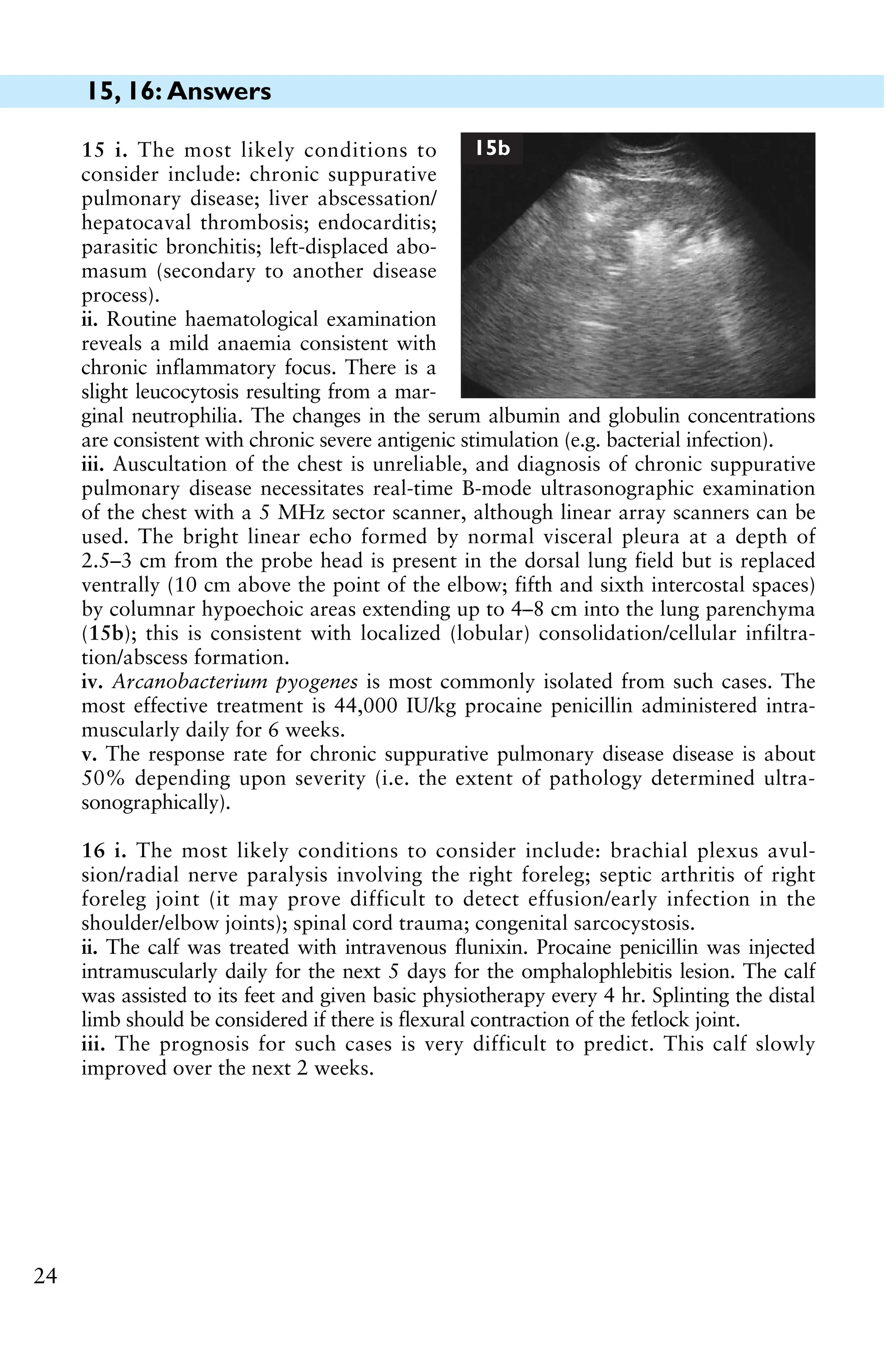
pulmonary disease necessitates real-time B-mode ultrasonographic examination
of the chest with a 5 MHz sector scanner, although linear array scanners can be
used. The bright linear echo formed by normal visceral pleura at a depth of
2.5–3 cm from the probe head is present in the dorsal lung field but is replaced
ventrally (10 cm above the point of the elbow; fifth and sixth intercostal spaces)
by columnar hypoechoic areas extending up to 4–8 cm into the lung parenchyma
(15b); this is consistent with localized (lobular) consolidation/cellular infiltra-
tion/abscess formation.
iv. Arcanobacterium pyogenes is most commonly isolated from such cases. The
most effective treatment is 44,000 IU/kg procaine penicillin administered intra-
muscularly daily for 6 weeks.
v. The response rate for chronic suppurative pulmonary disease disease is about
50% depending upon severity (i.e. the extent of pathology determined ultra-
sonographically).
15b
30.
17, 18: Questions
25
18A 4-day-old bull calf from a beef
herd is very dull and has been
unwilling to suck for the past 36 hr.
The calf appeared normal for the
first 2 days and was observed to
suck colostrum within the first 2 hr.
The rectal temperature is 38.2°C
(100.8°F). The calf is very depressed
and weak but able to stand when
assisted to do so. The calf is mark-
edly dehydrated with sunken eyes
and an extended skin tent beyond 5
s. The mucous membranes appear congested. The respiratory rate is increased at
40 breaths per minute. The abdomen is markedly distended with fluid sounds
audible on succusion. There is no evidence of diarrhoea and there are no faeces
on the thermometer. There is thickening of the umbilical stump. The carcass
lymph nodes are not enlarged.
i. What conditions would you consider? (Most likely first.)
ii. How could you confirm your diagnosis?
iii. What is the prognosis for this calf?
iv. What treatment(s) would you administer?
18
17 Figure 17a shows a standing left laporotomy in
a cow.
i. Identify the viscus and comment upon the
incision site. Any further comments?
ii. What suture material and suture pattern would
you use for closure?
iii. What else would you do before closing the
abdominal incision?
17a
31.
17, 18: Answers
26
18i. The most likely conditions to consider include: atresia coli; omphalo-
phlebitis and associated peritonitis; enterotoxigenic Escherichia coli; septicaemia;
ruptured bladder with uroperitoneum; early meningoencephalitis; acidosis (but
there is no evidence of diarrhoea).
ii. The diagnosis of atresia coli is based upon the clinical findings, particularly
absence of any faeces by 4 days old. Transabdominal ultrasonography can
investigate the umbilicus and guide abdominocentesis if excess accumulations of
peritoneal fluid are identified.
iii. The prognosis for atresia coli cases is hopeless and calves should be euthanased
once the diagnosis has been established.
iv. The calf was treated symptomatically with 5 L of isotonic saline over 6–8 hr,
and intravenous trimethoprim/sulphonamide and flunixin meglumine. The calf’s
hydration status was much improved 6 hr later. The calf appeared much brighter
but the abdomen was even more distended with fluid sounds on succusion. No
faeces were passed in the 12 hr after first examination and the calf was euthanased
for welfare reasons. Atresia coli was confirmed at postmortem examination.
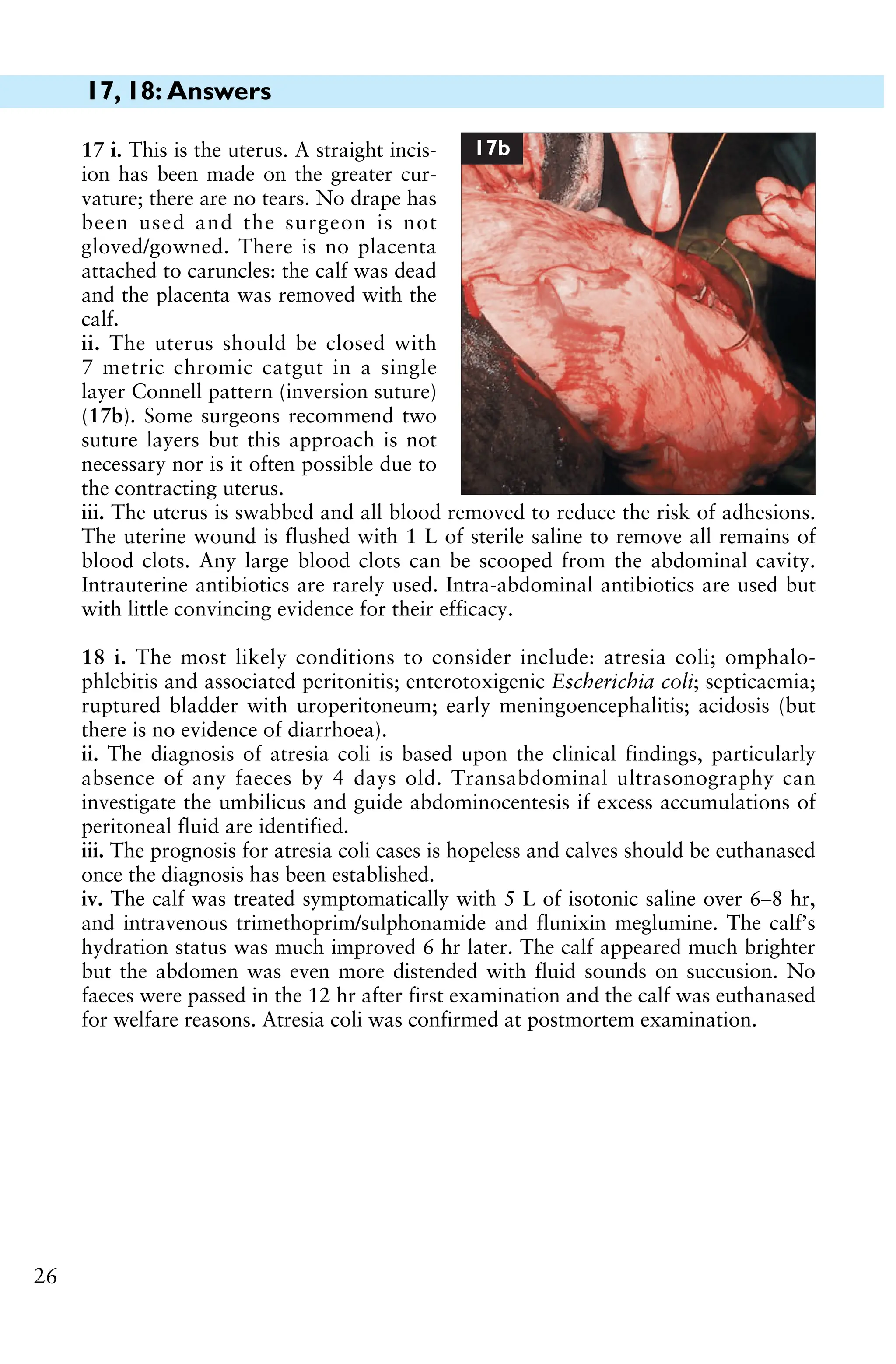
17 i. This is the uterus. A straight incis-
ion has been made on the greater cur-
vature; there are no tears. No drape has
been used and the surgeon is not
gloved/gowned. There is no placenta
attached to caruncles: the calf was dead
and the placenta was removed with the
calf.
ii. The uterus should be closed with
7 metric chromic catgut in a single
layer Connell pattern (inversion suture)
(17b). Some surgeons recommend two
suture layers but this approach is not
necessary nor is it often possible due to
the contracting uterus.
iii. The uterus is swabbed and all blood removed to reduce the risk of adhesions.
The uterine wound is flushed with 1 L of sterile saline to remove all remains of
blood clots. Any large blood clots can be scooped from the abdominal cavity.
Intrauterine antibiotics are rarely used. Intra-abdominal antibiotics are used but
with little convincing evidence for their efficacy.
17b
32.
19, 20: Questions
27
20In late summer a group of
20 yearling beef heifers presents with
poor growth and diarrhoea (20).
Frequent nonproductive coughing
after slight exertion has been heard
over the past week. The heifers are
set-stocked at three animals per hec-
tare on permanent pasture. Clinical
examination reveals normal rectal
temperatures, absence of either ocular
or nasal discharges, and occasional
crackles audible on auscultation of
the chest.
i. What conditions would you consider? (Most likely first.)
ii. What further tests could be undertaken?
iii. What treatment(s) should be administered?
iv. Could this problem(s) be prevented next year?
20
19 In late summer a beef farmer
complains that an autumn-calving
cow grazing poor hill pasture before
calving is ‘going stiff’. The cow is
isolated from the group and is dull
and depressed (19). The cow has a
gaunt appearance and is reluctant
to walk. The rectal temperature is
40.0°C (104.0°F). The mucous
membranes are congested. Rumen
contractions are reduced. The res-
piratory rate is raised to 40 breaths
per minute. There is obvious distension of all four fetlock joints and both hock
joints. The cow is not due to calve for 4 weeks, but the udder is swollen
especially the right fore quarter. The right fore teat is very swollen and oedema-
tous with flies clustered at the teat orifice.
i. What conditions would you consider? (Most likely first.)
ii. What is the cause?
iii. What treatments would you administer?
iv. What control measures would you recommend?
19
33.
19, 20: Answers
28
20i. The most likely conditions to consider include: lungworm; type I
ostertagiasis; respiratory viral infections, including parainfluenza-3 and BRSV;
poor pasture management; copper deficiency; BVD/MD infection (persistently
infected animal in naïve group).
ii. Laboratory faecal examination (Baermann technique) will reveal patent
parasitic infestations only. The modified McMaster technique for strongyle eggs
can be used, either counting four to six individual samples or pooling samples
together. Examination reveals Dictyocaulus viviparus L3 in three of six samples
and a mean of 1,200 Ostertagia ostertagi eggs. Low serum copper concentrations
samples from four to six calves would indicate depletion of liver copper reserves;
normal values are recorded in this investigation.
iii. Treatment with an avermectin anthelmintic effects a good response (cessation
of coughing and diarrhoea over the next few days) and provides protection
against reinfestation for the remainder of the summer grazing period (cattle
housed early autumn). Alternatively, the heifers could be treated with levamisiole
followed by a group 1 benzimidazole anthelmintic (effective against hypobiotic
larvae) administered at housing as the cheaper option.
iv. Where there is a known risk, lungworm is best prevented by vaccination 2 and
6 weeks before exposure. PGE control requires strategic anthelmintic treatment,
including intraruminal pulse-release boluses (benzimidazole every 3 weeks),
ivermectin injection 3, 8, and 13 weeks after turnout, doramectin injection at
turnout and 8 weeks later, or doramectin slow-release injection at turnout.
19 i. The most likely conditions to consider include: summer mastitis; bacterial
endocarditis; other chronic bacterial infections; redwater (babesiosis).
ii. Primary invasion of the mammary gland, with either the anaerobic organism
Peptococcus indolicus or Streptococcus dysgalactiae, is followed by Arcano-
bacterium pyogenes infection to cause summer mastitis. There is circumstantial
evidence only to link the sheep headfly Hydrotaea irritans with disease.
iii. The right fore quarter will not recover normal lactogenesis. Intramammary
antibiotic infusion is ineffective due to the chronicity/extent of the infection although
parenteral antibiotics, typically penicillin, are administered. Frequent stripping of the
affected quarter every 2–4 hr is necessary to remove toxins and cellular debris but is
not a simple procedure because of the painful oedematous teat. Lancing the teat in
the vertical plane, thereby reducing the risk of haemorrhage associated with teat
amputation, to facilitate drainage often produces disappointing results. NSAIDs,
such as flunixin meglumine or ketoprofen, provide pain relief and stimulate appetite.
iv. Dry cow therapy/teat sealants remain the most effective means of preventing
summer mastitis. Fly repellants, whether in the form of pour-on, spray-on or
impregnated ear tag, provide useful protection against nuisance flies. Accessory
teats should be removed before the animal is 6 weeks old.
34.
29
22 A groupof 40 housed 4–6-month-old Friesian heifer calves is presented with
numerous 2–6 cm diameter skin lesions distributed over the whole body but
especially the head and neck (22). The lesions are superficial, dry, white, scaly,
and nonpruritic. The affected skin is not thickened.
i. What conditions would you consider? (Most likely first.)
ii. Which further tests could be undertaken?
iii. What actions/treatments would you recommend?
iv. Are there any special concerns?
22
21 A 900 kg Limousin bull presents with severe lameness (9/10) of the right
pelvic limb with marked muscle atrophy over the hip region. There is marked
swelling of the bulb of the heel with loss of hair and thinning of the skin
extending proximally to an area just below the accessory digits (21a). The distal
limb is oedematous and pits under pressure. There is no widening of the
interdigital space. Careful foot paring fails to reveal any hoof lesion.
i. What analgesia would you administer?
ii. What action would you take?
21a
21, 22: Questions
35.
21, 22: Answers
30
22i. The most likely conditions to consider include: ringworm (Trichophyton spp.
infection); lice (pediculosis); chorioptic mange; dermatophilosis; sarcoptic mange.
ii. Microscopic examination of hair/skin scrapings from the periphery of the
lesions reveals fungal hyphae typical of Trichophyton spp. infection. Cultural
examination can be undertaken on special media.
iii. Treatment includes topical natamycin application. In-feed griseofulvin
medication for 10–14 days is available in some countries. There is the option of
doing nothing, as lesions eventually regress with time (over 3–9 months) but in
the interim the cattle do not look well and there is the risk of transmission to
other livestock. Attentuated ringworm vaccine strain of T. verrucosum can be
used in subsequent batches of calves.
iv. There is a zoonotic risk following contact with the calves or their environment.
21 i. The bull should be sedated, e.g.
with xylazine. Analgesia may be
achieved by intravenous injection of
lidocaine; a NSAID may also be used to
provide analgesia. In this case, the bull
is aggressive but is safely restrained in a
bull crate with the leg hoisted. The bull
has been lightly sedated with 45 mg
xylazine (0.05 mg/kg) injected intra-
venously to remain standing. The right
hindleg is hoisted and a tourniquet applied. Attempted intravenous injection of
30–40 mL of 2% lidocaine solution meets with forceful kicking (allodynia) and the
crate is almost overturned. The bull is further sedated with 200 mg xylazine
injected intramuscularly. At the same time 100 mL of 2% lidocaine are injected
into the sacrococcygeal extradural space to paralyse both hindlegs for safety
reasons and because it was not possible to find a superficial vein because of the
distal limb oedema. Flunixin is injected intravenously when the bull is recumbent.
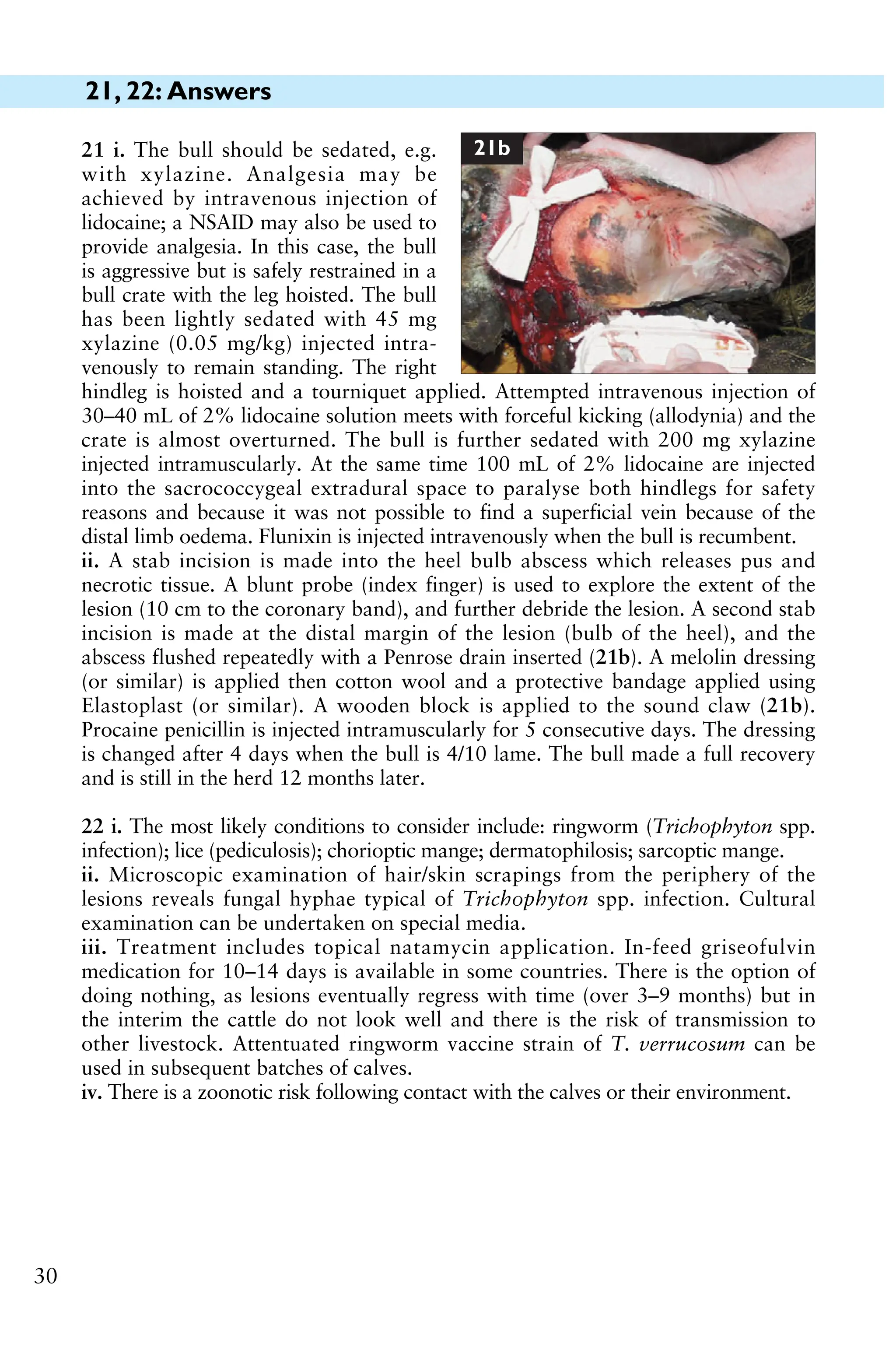
ii. A stab incision is made into the heel bulb abscess which releases pus and
necrotic tissue. A blunt probe (index finger) is used to explore the extent of the
lesion (10 cm to the coronary band), and further debride the lesion. A second stab
incision is made at the distal margin of the lesion (bulb of the heel), and the
abscess flushed repeatedly with a Penrose drain inserted (21b). A melolin dressing
(or similar) is applied then cotton wool and a protective bandage applied using
Elastoplast (or similar). A wooden block is applied to the sound claw (21b).
Procaine penicillin is injected intramuscularly for 5 consecutive days. The dressing
is changed after 4 days when the bull is 4/10 lame. The bull made a full recovery
and is still in the herd 12 months later.
21b
36.
23, 24: Questions
31
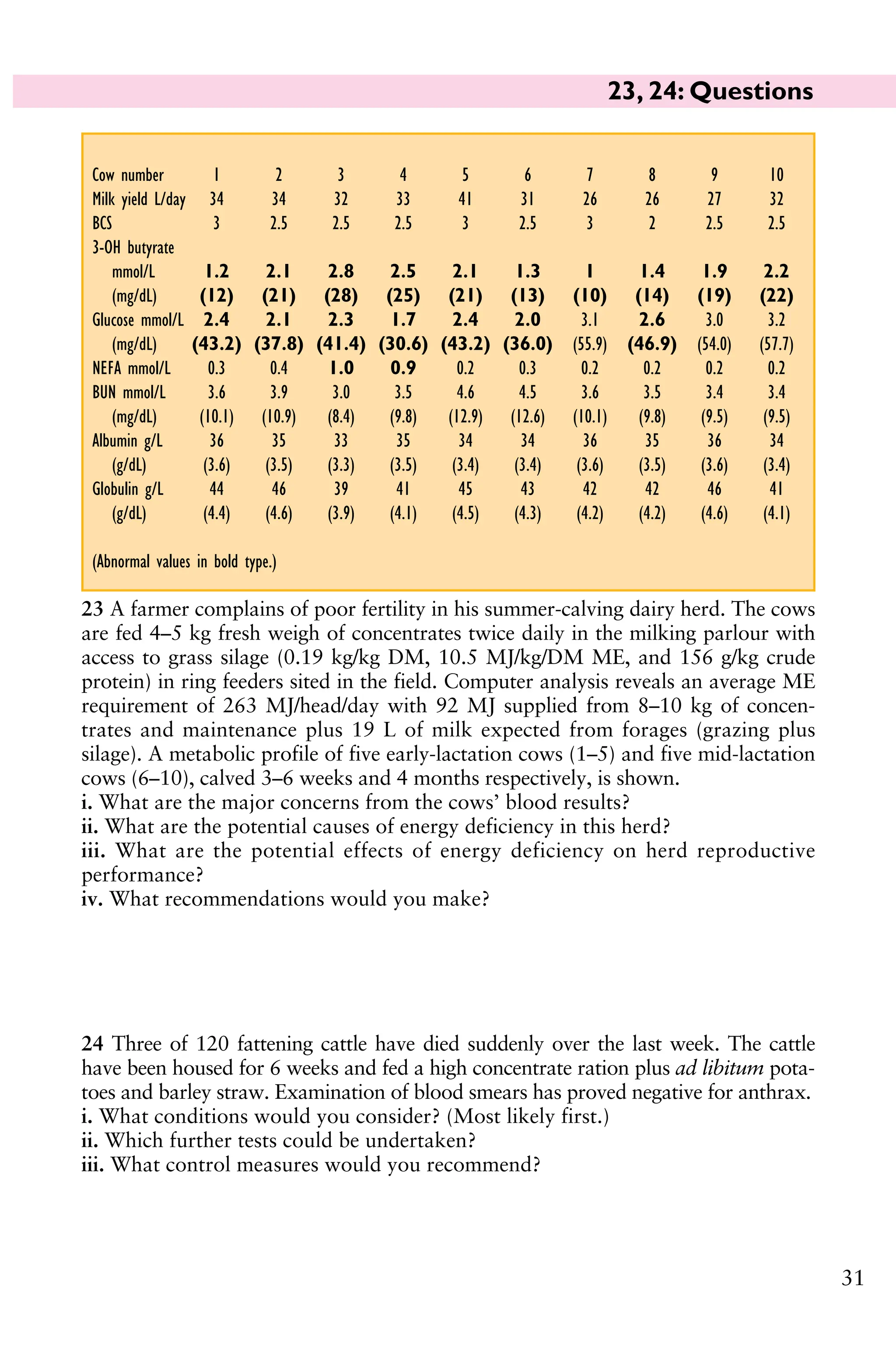
23A farmer complains of poor fertility in his summer-calving dairy herd. The cows
are fed 4–5 kg fresh weigh of concentrates twice daily in the milking parlour with
access to grass silage (0.19 kg/kg DM, 10.5 MJ/kg/DM ME, and 156 g/kg crude
protein) in ring feeders sited in the field. Computer analysis reveals an average ME
requirement of 263 MJ/head/day with 92 MJ supplied from 8–10 kg of concen-
trates and maintenance plus 19 L of milk expected from forages (grazing plus
silage). A metabolic profile of five early-lactation cows (1–5) and five mid-lactation
cows (6–10), calved 3–6 weeks and 4 months respectively, is shown.
i. What are the major concerns from the cows’ blood results?
ii. What are the potential causes of energy deficiency in this herd?
iii. What are the potential effects of energy deficiency on herd reproductive
performance?
iv. What recommendations would you make?
24 Three of 120 fattening cattle have died suddenly over the last week. The cattle
have been housed for 6 weeks and fed a high concentrate ration plus ad libitum pota-
toes and barley straw. Examination of blood smears has proved negative for anthrax.
i. What conditions would you consider? (Most likely first.)
ii. Which further tests could be undertaken?
iii. What control measures would you recommend?
Cow number 1 2 3 4 5 6 7 8 9 10
Milk yield L/day 34 34 32 33 41 31 26 26 27 32
BCS 3 2.5 2.5 2.5 3 2.5 3 2 2.5 2.5
3-OH butyrate
mmol/L 1.2 2.1 2.8 2.5 2.1 1.3 1 1.4 1.9 2.2
(mg/dL) (12) (21) (28) (25) (21) (13) (10) (14) (19) (22)
Glucose mmol/L 2.4 2.1 2.3 1.7 2.4 2.0 3.1 2.6 3.0 3.2
(mg/dL) (43.2) (37.8) (41.4) (30.6) (43.2) (36.0) (55.9) (46.9) (54.0) (57.7)
NEFA mmol/L 0.3 0.4 1.0 0.9 0.2 0.3 0.2 0.2 0.2 0.2
BUN mmol/L 3.6 3.9 3.0 3.5 4.6 4.5 3.6 3.5 3.4 3.4
(mg/dL) (10.1) (10.9) (8.4) (9.8) (12.9) (12.6) (10.1) (9.8) (9.5) (9.5)
Albumin g/L 36 35 33 35 34 34 36 35 36 34
(g/dL) (3.6) (3.5) (3.3) (3.5) (3.4) (3.4) (3.6) (3.5) (3.6) (3.4)
Globulin g/L 44 46 39 41 45 43 42 42 46 41
(g/dL) (4.4) (4.6) (3.9) (4.1) (4.5) (4.3) (4.2) (4.2) (4.6) (4.1)
(Abnormal values in bold type.)
37.
23, 24: Answers
32
23i. The major concerns from the cows’ blood results are the increased 3-OH
butyrate and NEFA concentrations and decreased plasma glucose concentrations,
indicating energy deficiency in both early-lactation and mid-lactation cows.
ii. A thorough review of feeding and husbandry practices is essential. Simple
factors, such as the lack of grazing, buffer feed not available all day, and limited
spaces at ring feeders, can severely restrict energy intake.
iii. The consequence of energy deficiency could include reduced fertility per-
formance, manifest as a reduced submission rate (fewer cows presented for
service by day 60 postpartum), cystic ovarian disease, poor oestrus expression,
extended interval to first service, and lowered first service conception rate. More
cows are presented for ‘not seen bulling’ by day 45 at routine veterinary visits.
iv. Recommendations could include providing buffer feed to all cows for only 2–3 hr
per day prior to the afternoon milking. The protein status is satisfactory so extra
energy can be provided by feeding an extra 2 kg/head/day of cereals (wheat, barley)
to the lactating cows in the buffer feed. No more concentrates need to be fed in the
milking parlour because levels are already too high, averaging 4.5 kg/feed. The bulk
milk tank should be monitored (increased yield expected as well as fertility
improvements), the herd resampled in 2 weeks, and the feeding strategy reassessed.
24 i. The most likely conditions to consider include: blackleg (clostridial
myositis); choke; pasteurellosis; other septicaemic conditions including anthrax;
electrocution from stray voltage; acidosis; thromboembolic meningoencephalitis.
ii. Further tests would include postmortem examination. Necropsy of the third dead
animal reveals rapid autolysis and the musculature of the ventral neck is dry and
dark purple with numerous gas pockets (24). These muscle groups contrast with
normal adjacent muscles. The lungs are congested and oedematous.
iii. The farmer should be advised to vaccinate the remaining cattle against
Clostridium chauvoei (blackleg) immediately. In this case all cattle were also
injected with procaine penicillin at the time of vaccination to prevent the
handling procedure from precipitating further cases. The second blackleg vaccine
was given 2 weeks later. No further losses resulted in this group. Blackleg vaccine
is cheap and a valuable insurance policy should losses from blackleg have
previously occurred on the farm.
24
38.
33
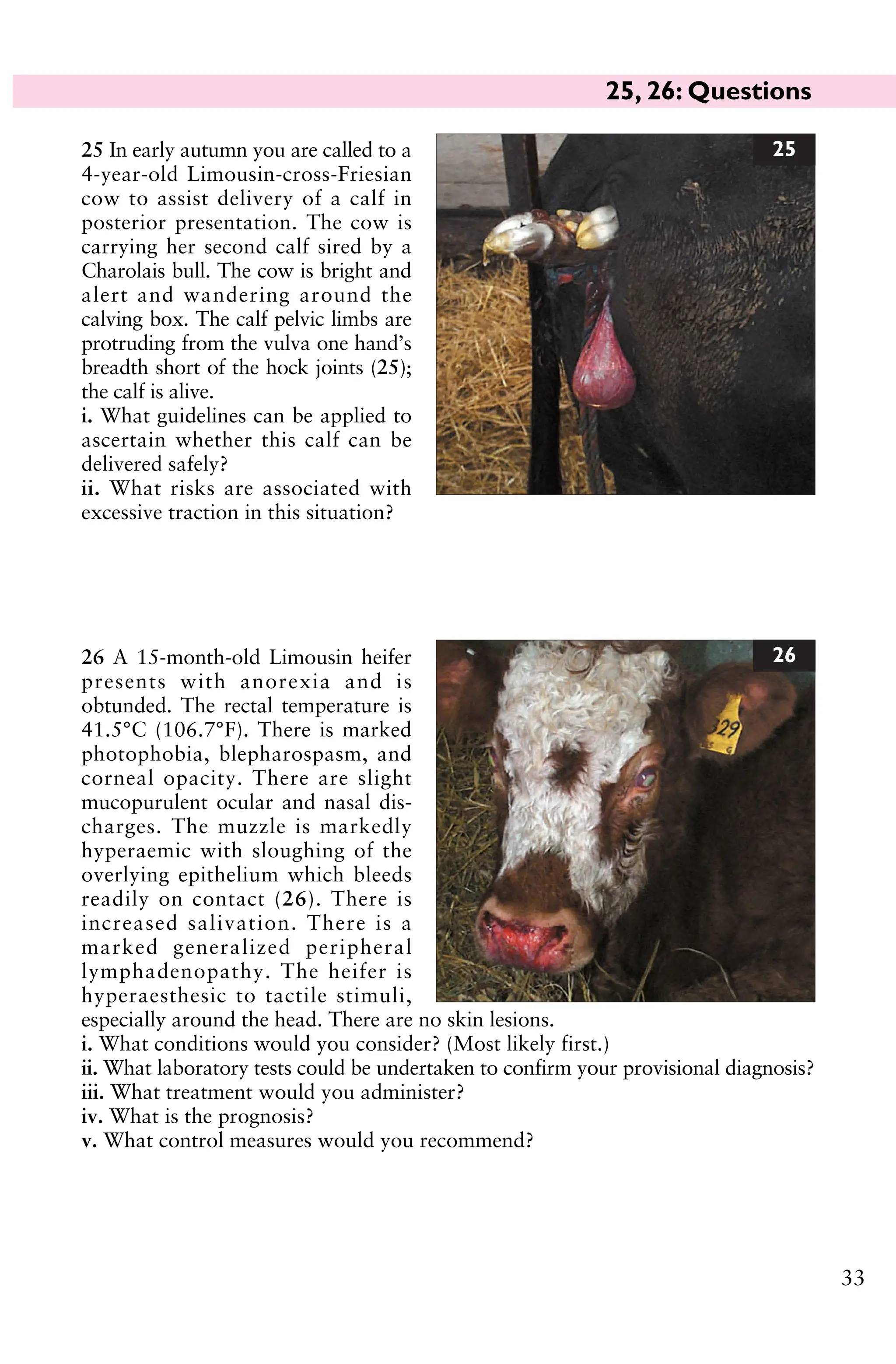
25 In earlyautumn you are called to a
4-year-old Limousin-cross-Friesian
cow to assist delivery of a calf in
posterior presentation. The cow is
carrying her second calf sired by a
Charolais bull. The cow is bright and
alert and wandering around the
calving box. The calf pelvic limbs are
protruding from the vulva one hand’s
breadth short of the hock joints (25);
the calf is alive.
i. What guidelines can be applied to
ascertain whether this calf can be
delivered safely?
ii. What risks are associated with
excessive traction in this situation?
26 A 15-month-old Limousin heifer
presents with anorexia and is
obtunded. The rectal temperature is
41.5°C (106.7°F). There is marked
photophobia, blepharospasm, and
corneal opacity. There are slight
mucopurulent ocular and nasal dis-
charges. The muzzle is markedly
hyperaemic with sloughing of the
overlying epithelium which bleeds
readily on contact (26). There is
increased salivation. There is a
marked generalized peripheral
lymphadenopathy. The heifer is
hyperaesthesic to tactile stimuli,
especially around the head. There are no skin lesions.
i. What conditions would you consider? (Most likely first.)
ii. What laboratory tests could be undertaken to confirm your provisional diagnosis?
iii. What treatment would you administer?
iv. What is the prognosis?
v. What control measures would you recommend?
25
26
25, 26: Questions
39.
25, 26: Answers
34
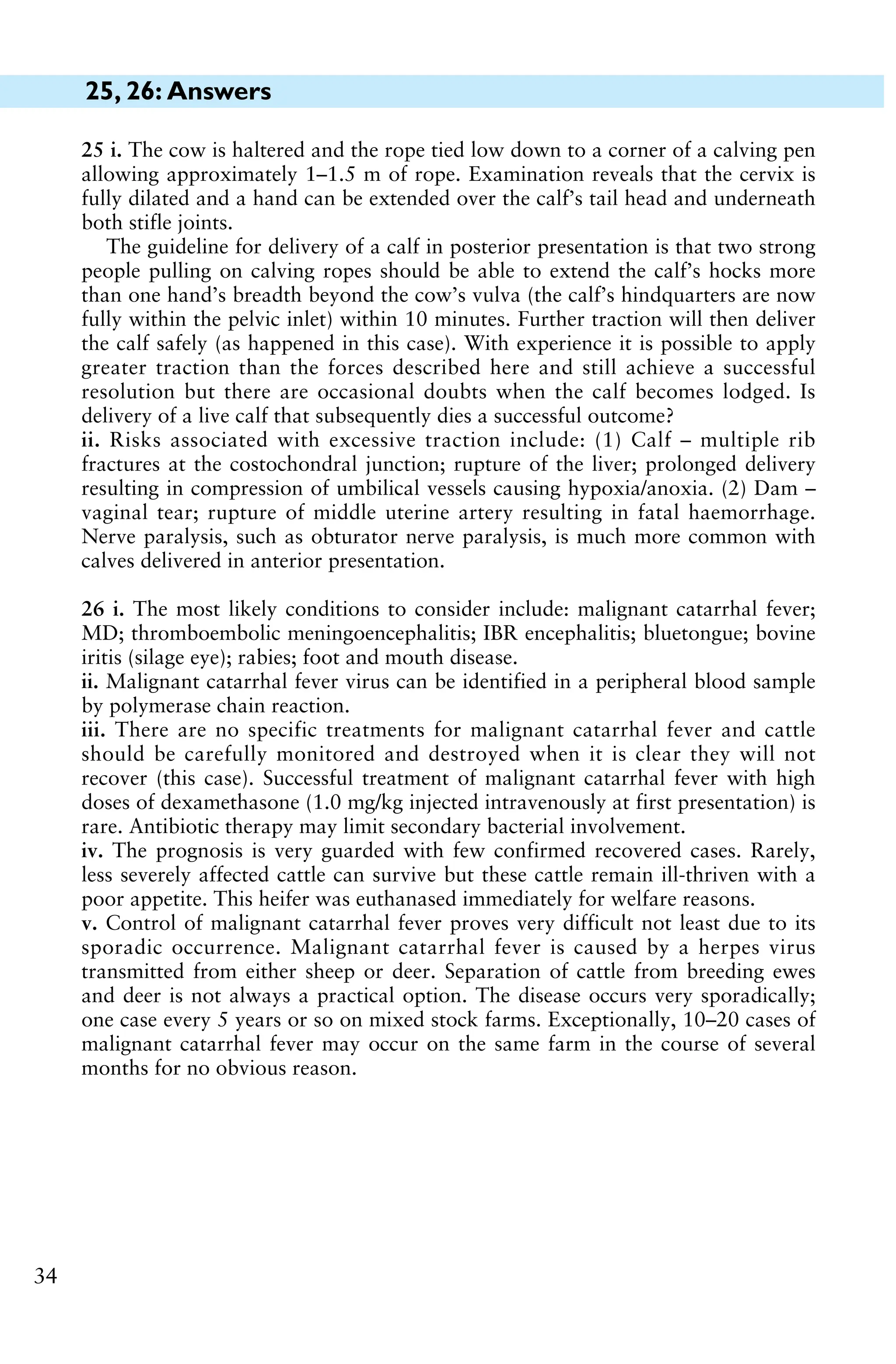
25i. The cow is haltered and the rope tied low down to a corner of a calving pen
allowing approximately 1–1.5 m of rope. Examination reveals that the cervix is
fully dilated and a hand can be extended over the calf’s tail head and underneath
both stifle joints.
The guideline for delivery of a calf in posterior presentation is that two strong
people pulling on calving ropes should be able to extend the calf’s hocks more
than one hand’s breadth beyond the cow’s vulva (the calf’s hindquarters are now
fully within the pelvic inlet) within 10 minutes. Further traction will then deliver
the calf safely (as happened in this case). With experience it is possible to apply
greater traction than the forces described here and still achieve a successful
resolution but there are occasional doubts when the calf becomes lodged. Is
delivery of a live calf that subsequently dies a successful outcome?
ii. Risks associated with excessive traction include: (1) Calf – multiple rib
fractures at the costochondral junction; rupture of the liver; prolonged delivery
resulting in compression of umbilical vessels causing hypoxia/anoxia. (2) Dam –
vaginal tear; rupture of middle uterine artery resulting in fatal haemorrhage.
Nerve paralysis, such as obturator nerve paralysis, is much more common with
calves delivered in anterior presentation.
26 i. The most likely conditions to consider include: malignant catarrhal fever;
MD; thromboembolic meningoencephalitis; IBR encephalitis; bluetongue; bovine
iritis (silage eye); rabies; foot and mouth disease.
ii. Malignant catarrhal fever virus can be identified in a peripheral blood sample
by polymerase chain reaction.
iii. There are no specific treatments for malignant catarrhal fever and cattle
should be carefully monitored and destroyed when it is clear they will not
recover (this case). Successful treatment of malignant catarrhal fever with high
doses of dexamethasone (1.0 mg/kg injected intravenously at first presentation) is
rare. Antibiotic therapy may limit secondary bacterial involvement.
iv. The prognosis is very guarded with few confirmed recovered cases. Rarely,
less severely affected cattle can survive but these cattle remain ill-thriven with a
poor appetite. This heifer was euthanased immediately for welfare reasons.
v. Control of malignant catarrhal fever proves very difficult not least due to its
sporadic occurrence. Malignant catarrhal fever is caused by a herpes virus
transmitted from either sheep or deer. Separation of cattle from breeding ewes
and deer is not always a practical option. The disease occurs very sporadically;
one case every 5 years or so on mixed stock farms. Exceptionally, 10–20 cases of
malignant catarrhal fever may occur on the same farm in the course of several
months for no obvious reason.
40.
27, 28: Questions
35
28A yearling pedigree Charolais heifer
presents with 8/10 lameness affecting
the left hindleg having gone suddenly
lame 3 months previously. The heifer
has been penned on deep straw bedding.
Initially the heifer had great difficulty
rising but the severity of the lameness
has reduced slightly although the animal
spends much more time than normal
lying down. There is extensive muscle
atrophy of the left gluteal muscle mass. Palpation of the left hindlimb fails to reveal
any abnormality involving, or distal to, the left stifle joint. Lateral movement of the
hindquarters produces a slight clunking sensation in the left hip region. There is no
evidence of hip dislocation. The pelvis appears symmetrical. A diagnosis of femoral
fracture through the proximal growth plate is based upon sudden onset with
resultant chronic severe lameness originating above the stifle but not involving the
pelvis. The heifer is euthanased for welfare reasons.
i. Describe the necropsy findings (28).
ii. What general advice would you offer to all clients regarding lameness to
prevent similar cases of suffering?
iii. List those conditions causing severe lameness that fully recover after 3 months’
‘rest’.
27 An 11-month-old Limousin beef stirk is
presented for veterinary examination after
marked lameness of several months’ dura-
tion. The stirk is 10/10 lame on the right
forelimb with extensive muscle wastage and
prominent spine of the right scapula. The
rectal temperature is 39.2°C (102.6°F).
There is extensive soft tissue swelling sur-
rounding the right carpus. The carpal
swelling is very firm, hot, and painful, with
effusion of the radiocarpal joint. The right
prescapular lymph node is ten times normal
size. There are no other swollen joints.
i. Describe the findings of the dorsopalmar
lateromedial oblique radiograph (27a).
ii. What is the likely origin of this problem?
iii. What action should have been taken when the stirk was first noticed lame?
27a
28
41.
27, 28: Answers
36
28i. There is a fracture through the proximal femoral growth plate.
ii. Veterinary examination is essential when there is sudden onset of severe lame-
ness without obvious cause; it is also essential when the farmer believes he/she
knows the cause(s), has given treatment(s), but there has been no improvement
within 5 days. Where there is severe lameness and no response to veterinary
treatment, euthanasia is indicated after no more than 1 week of onset of
lameness.
iii. There are no conditions causing severe lameness that fully recover after
3 months’ ‘rest’.
27 i. There is marked soft tissue
swelling surrounding the carpus and
marked ill defined, fluffy mineral
opacities present surrounding the
radiocarpal and intercarpal joints.
The articular surface of the distal
radius has been lost, there is patchy
lysis of the distal radial epiphysis and
mainly radial carpal bone, and
widening of the radiocarpal joint.
The distal intercarpal joint is widened
and the carpometacarpal joint is ill
defined. The articular margins show osteophyte formation and some periosteal new
bone formation is present on the proximal metacarpus, the carpal bones, and distal
radius. The diagnosis is advanced chronic pancarpal arthritis and osteomyelitis,
most likely septic (27b).
ii. The likely cause is a puncture wound penetrating the joint. Bacteraemia
localized to one joint is unusual in growing cattle. There is no evidence of septic
physitis extending into the joint.
iii. In view of the severity of the lameness, a serious condition should have been
suspected and veterinary examination sought. The minimum treatment for a
suspected joint infection would be parenteral antibiotic therapy and NSAIDs.
Joint lavage is not a simple procedure in a 400 kg animal.
Veterinary examination is essential where the cause of severe lameness is not
immediately obvious to the farmer for prognostic, economic, and welfare reasons.
Euthanasia is indicated if the animal remains 10/10 lame after 1 week unless the
cause has been accurately defined, correctly treated, and has a good prognosis. In
this case it is clear that the animal has not received appropriate care.
27b
42.
29, 30: Questions
37
29You are presented with a 4-year-
old Limousin bull with 2 days’
history of right hindleg lameness.
On assessment the bull is 8/10 lame
and abducts the leg with the weight
taken on the medial claw (29a
shows the right hindfoot hoisted
with the bull restrained in cattle
stocks).
i. What conditions would you
consider?
ii. What action would you take?
30 A Holstein cow, which calved
10 days ago, has no appetite and
yielded only 4 L at her last milking.
The cow is very dull and depressed,
dehydrated with sunken eyes (30),
and a skin tent extended to 5 s,
consistent with >7% dehydration.
Despite a reported poor appetite over
the past 2 days, the abdomen looks
distended. The rectal temperature is
38.4°C (101.1°F). The heart rate is
104 beats per minute and respiratory
rate is 28 breaths per minute. Simulta-
neous percussion and auscultation
reveal high-pitched pings over a
45 cm diameter area in the right sub-
lumbar fossa, but the liver is not
displaced from the right abdominal
wall. Rectal examination fails to
reveal any distended viscera and there
are only scant faeces in the rectum.
There is no melaena.
i. Comment upon the electrolyte con-
centrations listed.
ii. What action would you take?
29a
Cow Normal range
Chloride
(mmol/L, mEq/L) 71 94–111
Potassium
(mmol/L, mEq/L) 3.2 3.6–5.6
Sodium
(mmol/L, mEq/L) 142 136–145
BUN (mmol/L) 24.5 2–6.6
(68.6 mg/dL) (5.6–18.5 mg/dL)
GGT (IU/L) 364 20–46
AP (IU/L) 378 14–75
30
43.
29, 30: Answers
38
29i. The most likely conditions to consider include:
white line abscess in the lateral claw; penetration
wound of the sole of the lateral claw; sole ulcer;
laminitis.
ii. The feet are overgrown and the lateral claw of the
right hindleg is corkscrewed. The sole is pared and a
black mark is detected in the white line of the abaxial
wall more towards the heel region than the toe. Careful
paring of the wall and sole following the black mark
releases an abscess (29b; the toe is to the bottom of the
image, the axial wall has not yet been pared). The
abscess is pared out taking great care not to damage
the corium. The foot is re-shaped. No bandage is
necessary because there is no damage to the corium.
Antibiotics are not necessary in this case because there
is no tissue infection. The sole is thin as a consequence of paring out the abscess,
the farmer is advised to house the bull on deep straw bedding for the next month
while new horn growth takes place. Note the bruising of the sole at the site of a
sole ulcer (29b). This is the classical site for a white line abscess in cattle: the lateral
claw of the hindleg, and medial claw of the foreleg. The abscess is sited in the
abaxial white line more towards the heel region than the toe because this is the site
for greatest torsional forces when the foot contacts the ground, causing disruption
of the white line and impaction of dirt and small stones leading to an abscess. The
bull made an uneventful recovery. The bull’s feet were trimmed using a bull crate
4 weeks after the first visit.
30 i. The clinical signs and electrolyte changes are compatible with pooling of
chloride ions in the abomasum (hypochloraemia) and compensatory shift in
potassium (hypokalaemia) in response to a metabolic alkalosis. These electrolyte
disturbances are more severe than those normally encountered in cases of
abomasal distension/right-sided displacement and may indicate early volvulus.
The grossly elevated GGT is considered to result from biliary stasis as the cow
has been inappetant for at least 2 days.
ii. The prognosis is guarded and surgery must be carefully considered because the
heart rate above 100 beats per minute and serum chloride concentration
<80 mmol/L (<80 mEq/L) indicate a poor prognosis.
Right flank laporotomy under paravertebral anaesthesia could be undertaken
but should be preceded by the administration of intravenous flunixin meglumine
and hypertonic saline (7.2%; 5 mL/kg in 5–7 minutes) followed by isotonic saline
to stabilize the cow for standing surgery. Surgery may be ill advised in this case.
29b
44.
31, 32: Questions
39
32A beef farmer has approxi-
mately 200 fattening cattle in a
slatted shed. Two stirks have lost
varying lengths of the distal por-
tion of the tail and the stumps have
become septic with numerous
discharging sinuses. The farmer did
not worry unduly about this prob-
lem until one of the animals
became lame with swollen joints
and lost weight (32; the animal has
been moved from the slatted shed into an isolation pen). The farmer attributed
this problem to laminitis caused by the high concentrate ration and slatted floor
and did not pursue the problem any further until yesterday when this bullock was
found dead. Postmortem examination confirmed the cause of death as bacterial
endocarditis with the tail lesion as the probable primary septic focus.
The farmer has requested that the septic tail stump is removed from the other
animal. The animal in question is bright and alert and in good bodily condition.
The rectal temperature is normal (38.6°C (101.5°F)). The tail stump is septic
with numerous discharging sinuses. There is no evidence of bacterial endocarditis
but early lesions prove difficult to detect.
What would you do?
31 A 3-year-old beef cow presents
with 2 months’ history of weight
loss and diarrhoea despite anthel-
mintic treatment by the farmer
(31a). The heifer calved 3 months
previously; the calf is not growing
well. The rectal temperature is
normal. No significant clinical signs
are found except for profuse diar-
rhoea without blood or mucosal
casts.
i. What conditions would you con-
sider? (Most likely first.)
ii. Which further tests could be undertaken?
iii. What treatments would you recommend?
iv. What control measures could be adopted?
31a
32
45.
31, 32: Answers
40
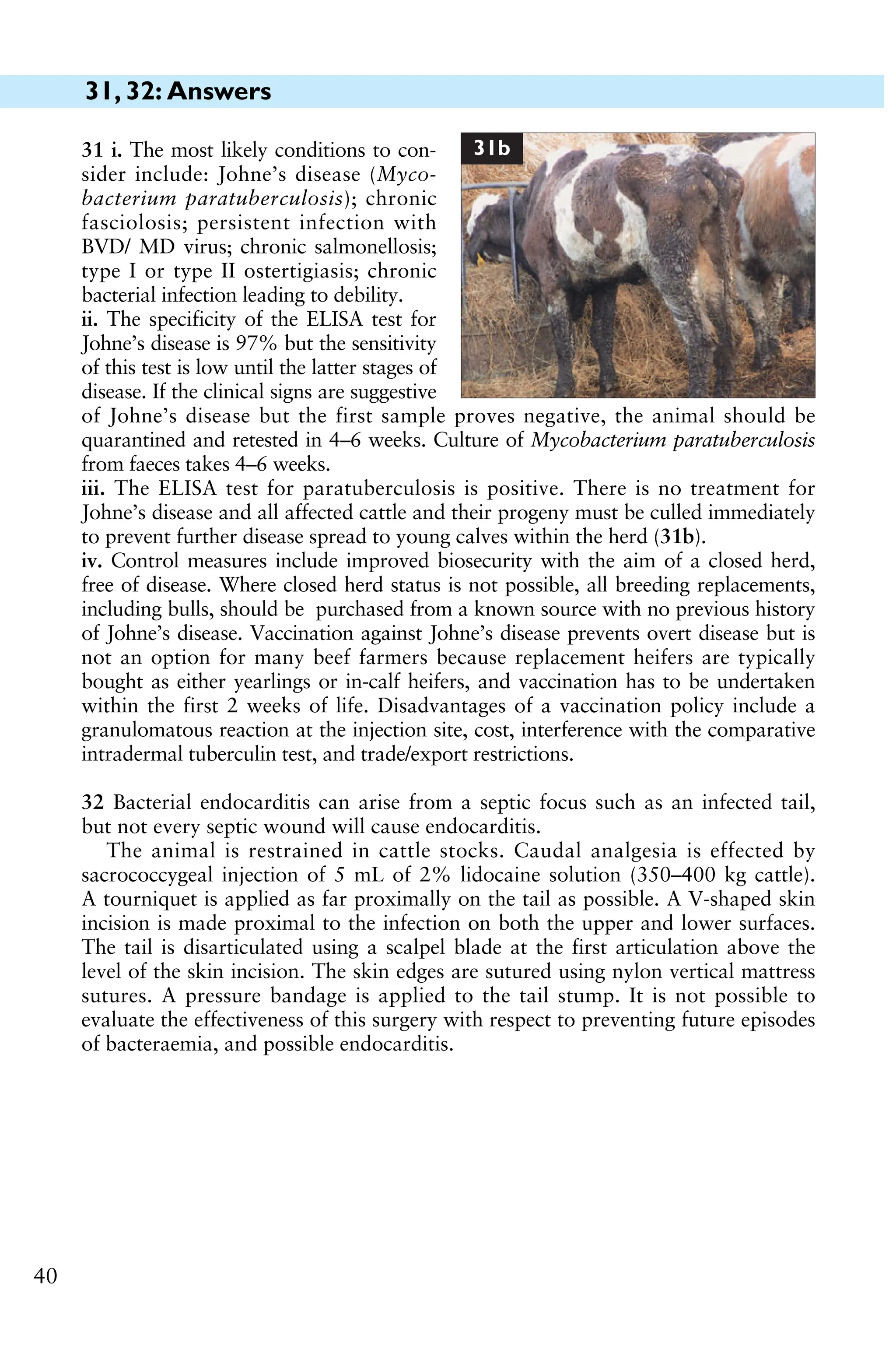
31i. The most likely conditions to con-
sider include: Johne’s disease (Myco-
bacterium paratuberculosis); chronic
fasciolosis; persistent infection with
BVD/ MD virus; chronic salmonellosis;
type I or type II ostertigiasis; chronic
bacterial infection leading to debility.
ii. The specificity of the ELISA test for
Johne’s disease is 97% but the sensitivity
of this test is low until the latter stages of
disease. If the clinical signs are suggestive
of Johne’s disease but the first sample proves negative, the animal should be
quarantined and retested in 4–6 weeks. Culture of Mycobacterium paratuberculosis
from faeces takes 4–6 weeks.
iii. The ELISA test for paratuberculosis is positive. There is no treatment for
Johne’s disease and all affected cattle and their progeny must be culled immediately
to prevent further disease spread to young calves within the herd (31b).
iv. Control measures include improved biosecurity with the aim of a closed herd,
free of disease. Where closed herd status is not possible, all breeding replacements,
including bulls, should be purchased from a known source with no previous history
of Johne’s disease. Vaccination against Johne’s disease prevents overt disease but is
not an option for many beef farmers because replacement heifers are typically
bought as either yearlings or in-calf heifers, and vaccination has to be undertaken
within the first 2 weeks of life. Disadvantages of a vaccination policy include a
granulomatous reaction at the injection site, cost, interference with the comparative
intradermal tuberculin test, and trade/export restrictions.
32 Bacterial endocarditis can arise from a septic focus such as an infected tail,
but not every septic wound will cause endocarditis.
The animal is restrained in cattle stocks. Caudal analgesia is effected by
sacrococcygeal injection of 5 mL of 2% lidocaine solution (350–400 kg cattle).
A tourniquet is applied as far proximally on the tail as possible. A V-shaped skin
incision is made proximal to the infection on both the upper and lower surfaces.
The tail is disarticulated using a scalpel blade at the first articulation above the
level of the skin incision. The skin edges are sutured using nylon vertical mattress
sutures. A pressure bandage is applied to the tail stump. It is not possible to
evaluate the effectiveness of this surgery with respect to preventing future episodes
of bacteraemia, and possible endocarditis.
31b
46.
41
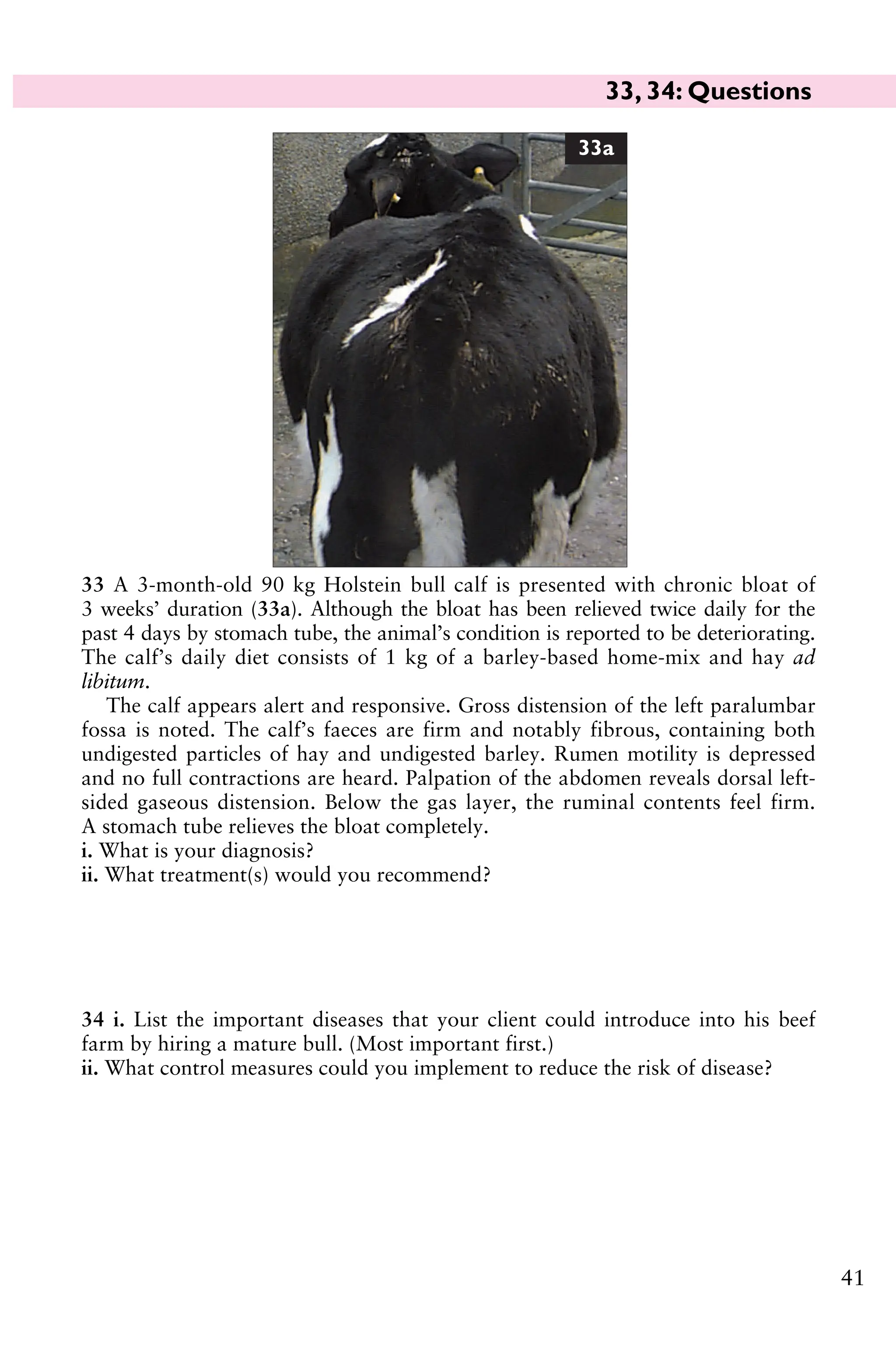
33 A 3-month-old90 kg Holstein bull calf is presented with chronic bloat of
3 weeks’ duration (33a). Although the bloat has been relieved twice daily for the
past 4 days by stomach tube, the animal’s condition is reported to be deteriorating.
The calf’s daily diet consists of 1 kg of a barley-based home-mix and hay ad
libitum.
The calf appears alert and responsive. Gross distension of the left paralumbar
fossa is noted. The calf’s faeces are firm and notably fibrous, containing both
undigested particles of hay and undigested barley. Rumen motility is depressed
and no full contractions are heard. Palpation of the abdomen reveals dorsal left-
sided gaseous distension. Below the gas layer, the ruminal contents feel firm.
A stomach tube relieves the bloat completely.
i. What is your diagnosis?
ii. What treatment(s) would you recommend?
34 i. List the important diseases that your client could introduce into his beef
farm by hiring a mature bull. (Most important first.)
ii. What control measures could you implement to reduce the risk of disease?
33a
33, 34: Questions
47.
33, 34: Answers
42
34i. The most important diseases to consider include: venereal disease, including
Campylobacter fetus venerealis; BVD/MD persistently infected animal; Johne’s
disease; IBR; Leptospira hardjo; Salmonella dublin and other serotypes; tubercu-
losis; lungworm; fasciolosis; BRSV; lice.
ii. Control measures to reduce the risk of disease could include: (1) Premovement
testing for tuberculosis. (2) During 1 month in strict quarantine following arrival
collect the following samples: preputial sheath washing and culture for Campylo-
bacter fetus venerealis; BVD/MD serology and antigen status; Leptospira hardjo,
Johne’s disease, BRSV, and IBR serology (vaccination status). (3) Treat for liver
fluke and lungworm (where appropriate). (4) Treat for lice. (5) Ensure prompt
veterinary examination for any illness.
33 i. The most likely causes of eructa-
tion failure in calves include: inhibition
of rumen motility caused by abnormal
ruminal contents (i.e. indigestion);
vagal lesions in the thorax resulting
from respiratory disease (inflammation,
abscess); vagal damage caused by
abdominal inflammation; physical im-
pairment of the cardia (polyps, inflam-
matory disease); painful abdominal
conditions; abomasal displacement or distension.
The findings of a firm, kneadable mass of ingesta occupying the ventral rumen
along with firm, dry faeces with long undigested fibres indicate poor digestive
function. A rumen sample reveals an alkaline rumen pH (>7), rapid sedimenta-
tion of particulate matter, sparse population of protozoa, and prolonged
methylene blue reduction time of >15 minutes (normal <6 minutes), all indicative
of simple inactivity of the ruminal microflora.
ii. The calf can be treated by administering 4 L of fresh ruminal transfaunate and
4 L of a commercial electrolyte solution via stomach tube, repeated 2 days later.
In this case, the calf’s condition progressively improved during the week follow-
ing treatment. Bloat was relieved twice daily for 2 days and once the following
day but was not required thereafter.
On occasion insertion of a rumen trochar may become necessary to relieve
ruminal bloat while medical treatment is undertaken (33b).
33b
48.
35, 36: Questions
43
35A 6-month-old calf presents with a head tilt
towards the right side and spontaneous hori-
zontal nystagmus with the fast phase directed
towards the left side. There is no circling behav-
iour. Ventral strabismus (eye drop) is present on
the right side. There is drooping of the right
upper eyelid and drooping of the right ear (35).
i. What conditions would you consider? (Most
likely first.)
ii. What is the likely cause?
iii. What treatment would you administer?
iv. What is the prognosis for this case?
36 A Jersey cow that calved a week
ago presents with 4 days’ history of
lethargy, poor appetite, and milk
yield of 5 L/day. The cow had hypo-
calcaemia immediately after calving
when she had been found cast on her
back and extremely bloated. The
cow responded well to intravenous
calcium borogluconate. The cow
now stands with a roached back
stance with the neck extended and
the head held lowered (36). The rectal temperature is elevated (39.4°C (102.9°F)).
The ocular and oral mucous membranes are congested. There is a bilateral mucoid
nasal discharge. The heart rate is 80 beats per minute. The respiratory rate is
elevated to 44 breaths per minute with an obvious abdominal component.
Auscultation of the chest reveals widespread crackles halfway down the chest wall
on the right-hand side. Pinching over the withers elicits a painful expression. The
ruminal contractions are reduced in strength and frequency.
i. What conditions would you consider? (Most likely first.)
ii. What tests would you undertake?
iii. What treatment would you recommend?
35
36
49.
35, 36: Answers
44
35i. The most likely conditions to consider include: peripheral vestibular lesion;
trauma to involve the middle ear/facial nerve; listeriosis.
ii. The vestibular system helps the animal maintain orientation in its environ-
ment, and the position of the eyes, trunk, and limbs with respect to movements
and positioning of the head. Unilateral peripheral vestibular lesions are com-
monly associated with otitis media and ascending bacterial infection of the
eustachian tube. There may be evidence of otitis externa and a purulent aural
discharge in some cases but rupture of the tympanic membrane is not a common
route of infection. Pasteurella spp., Streptococcus spp., and Arcanobacterium
spp. have been isolated from infected lesions.
iii. A good treatment response is achieved with 5 consecutive days’ treatment
with procaine penicillin.
iv. The prognosis is very good in acute cases.
36 i. The most likely conditions to consider include: inhalation pneumonia;
phlebitis/bacteraemia following calcium injection with a contaminated needle;
chronic suppurative respiratory disease exacerbated after calving; pleurisy;
hepatocaval thrombosis; endocarditis; peritonitis.
ii. Further tests would include routine haematology and serum protein analysis,
and ultrasonography of the chest. There is a leucopenia (3.4 × 10⁹/L (3.4 ×
103/µL), normal range 4–10 × 109/L (4–10 × 103/µL)), resulting from a marginal
neutropenia (0.3 × 10⁹/L, 0.3 × 10³/µL) but a pronounced left shift with 22%
immature neutrophils. There are marginal reductions in the serum albumin
(29.9 g/L (2.99 g/dL), normal range >30 g/L (>3 g/dL)) and globulin concen-
trations (29.9 g/L (2.99 g/dL), normal range 35–50 g/L (3.5–5.0 g/dL)). The
serum haptoglobin concentration is markedly elevated at 1.3 g/L (0.13 g/dL);
normal <0.1 g/L (<0.01 g/dL).
A provisional diagnosis of inhalation/necrotizing pneumonia is based upon the
clinical findings including pyrexia with pain on percussion supported by
biochemical changes consistent with acute severe bacterial infection.
Real-time B-mode ultrasonographic examination of the chest with a 5 MHz
sector scanner reveals separation of the pleurae ventrally with a 2 cm hypoechoic
band and irregular ‘columnar’ hypoechoic areas extending up to 6 cm into the lung
parenchyma consistent with pleurisy and severe lobular pneumonia, respectively.
iii. The cow was treated with marbofloxacin and flunixin meglumine injected
intravenously. The cow was considerably worse 12 hr later and was euthanased
for welfare reasons. A severe necrotizing pneumonia and associated pleurisy
predominantly involving the right lung was evident at postmortem.
50.
37, 38: Questions
45
37A 3-week-old Limousin-
cross calf has been 9/10 lame
for 3 days (37a). The right stifle
joint is swollen, hot, and pain-
ful. There is an obvious joint
effusion. The rectal temperature
is 39.2°C (102.6°F). The right
popliteal lymph node is not
enlarged. No other joint lesions
can be detected.
i. What would you do to
investigate this problem further?
ii. How could effective analgesia
be achieved?
iii. What action would you
take?
iv. What is the likely prognosis?
37a
38 In early summer a 2-month-
old beef calf presents as poorly
grown with considerable faecal
staining of the perineum, unlike
other calves in the group. There
is pale yellow, slightly mucoid
diarrhoea which contains flecks
of fresh blood. The calf is dull
and appears gaunt with a tucked-
up abdomen and a dry coat (38).
There is frequent tenesmus with
partial eversion of the rectum.
The calf is pyrexic (40.2°C (104.4°F)), with a slight mucopurulent nasal discharge.
The submandibular and prescapular lymph nodes are enlarged.
i. What conditions would you consider? (Most likely first.)
ii. What tests would you undertake?
iii. What treatments would you administer?
iv. What is the prognosis?
38
51.
37, 38: Answers
46
37i. The cause of the lameness could be
investigated by arthrocentesis. The joint
fluid sample is turbid with a protein
concentration of 34.8 g/L (3.48 g/dL)
(normal <3 g/L (<0.3 g/dL)) and a
white cell concentration of 164 × 109/L
(164 × 103/µL) comprised almost
exclusively of neutrophils, confirming
the diagnosis of septic arthritis.
ii. Injectable general anaesthetic drugs,
such as alphaxalone/alphadolone or
propofol, may be considered prohibitively expensive and too short in duration of
action. Intramuscular administration of 0.1 mg/kg of xylazine followed by
intravenous administration of 2–3 mg/kg of ketamine is commonly used in
practice. Incremental 2–3 mg/kg ketamine can be given to extend anaesthesia.
Effective analgesia after lumbosacral extradural injection of 3 mg/kg of 2%
lidocaine solution allows a detailed and pain-free clinical examination of pelvic
limb joint lesions and fractures and presents a cheap and readily available regime.
iii. The calf is injected with flunixin meglumine or other NSAID intravenously.
The area over the right stifle joint is surgically prepared and two 16-gauge
needles are inserted either side of the patellar ligament into fluid distensions of
the joint. Once established in the joint, 1 L of Hartmann’s solution is flushed
through using a pressure pump device (37b) alternating the direction of flow
through the needles. Florfenicol is commonly used for septic arthritis because
Salmonella spp. are a common cause in older calves.
iv. The prognosis for septic arthritis is generally poor; however, this calf made
good progress and was 3/10 lame when re-examined 2 days after joint lavage. It
made an uneventful recovery. Prompt treatment is essential.
37b
38 i. The most likely conditions to consider include: necrotic enteritis; cocci-
diosis; salmonellosis; intussusception; persistent infection with BVD/MD virus.
ii. The cause of necrotic enteritis has not been established. Where costs permit a
lithium heparin blood sample should be submitted for BVD/MD status, and
faecal samples submitted for both Salmonella culture and coccidial oocyst count
with speciation of oocysts.
iii. Symptomatic treatments should be administered until test results are
available; diclazuril for coccidiosis, and a 3-day course of florfenicol in the event
of salmonellosis. A NSAID should be given daily for 3 days to control pain.
iv. The prognosis for necrotic enteritis is guarded.
52.
47
39 You attenda beef heifer to assist
delivery of a calf in anterior presen-
tation with unilateral (right) shoulder
flexion (leg back; 39). The calf is still
alive despite the farmer applying con-
siderable traction to the left leg using a
calving jack.
i. How would you correct this mal-
posture?
ii. What treatment(s) should be admin-
istered to the heifer?
iii. How should the calf be managed?
39
40 After a stormy autumn night you are called to attend a recumbent 10-year-old
Simmental-cross-Friesian beef suckler cow that calved 36 hr ago (40). The cow is
at pasture with a group of predominantly summer-calving cows which is
receiving no supplementary feeding other than barley straw in a ring feeder. The
cow was found by the farmer to be in lateral recumbency and ‘thrashing wildly’.
When you arrive the cow appears quiet but clinical examination precipitates
seizure activity.
i. What conditions would you consider? (Most likely first.)
ii. What treatment would you administer immediately?
iii. What samples would you collect?
iv. What control measures could be adopted for the remainder of the herd?
40
39, 40: Questions
53.
39, 40: Answers
48
39i. Correction of this malposture is best achieved with the cow standing in
cattle stocks. Forceful straining during correction is prevented by injection of
5 mL of 2% lidocaine into the extradural space at the sacrococcygeal site. After
5 minutes the calf’s head and left foreleg are well lubricated and slowly repelled
until the calf’s poll is level with the pelvic inlet. By first grasping the calf’s right
forearm then the mid-metacarpal region, the elbow and carpal joints are fully
flexed which brings the calf’s right foot towards the pelvic inlet. With the fetlock
joint fully flexed, and the foot cupped in one’s hand to protect the uterus, the
foot is drawn forward into the pelvic canal extending the fetlock joint. Traction
on the distal limb extends the elbow joint and the foot appears at the vulva
where a calving rope is applied proximal to the fetlock joint.
The heifer should now be haltered and let out into a calving box. Steady
traction of two people (veterinary surgeon and the farmer) pulling on the calving
ropes applied to both legs will generally result in the heifer assuming lateral
recumbency which aids delivery of the calf.
ii. Treatment should include a NSAID which should be given before commencing
delivery of the calf; however, the considerable vulval oedema present (see 39)
could also be treated with a single injection of dexamethasone. Antibiotics should
be administered for 3 consecutive days because placental retention is likely after
dystocia, and there is an increased risk of metritis.
iii. The umbilicus is immediately fully immersed in strong veterinary iodine,
repeated 2 and 4 hr later. Two litres of colostrum should be administered by
orogastric tube.
40 i. The most likely conditions to consider include: hypomagnesaemia; hypo-
calcaemia; lead poisoning; bovine spongiform encephalopathy.
ii. While unlicensed for use in cattle, 6–8 mL of 20% pentobarbital solution injected
intravenously controls seizure activity a great deal more effectively than either
diazepam or xylazine. The cow is then haltered and 50 mL of 25% magnesium
sulphate is added to a bottle of 400 mL of 40% calcium borogluconate solution and
given by intravenous injection over 10 minutes. The remaining 350 mL of the bottle
of 25% magnesium sulphate solution is given subcutaneously in two divided sites
immediately behind the left shoulder. The cow was able to maintain sternal
recumbency when pulled upright after all treatments had been administered and
walked off to find its calf after a further 20 minutes.
iii. A serum sample for calcium and magnesium concentrations should be
collected in case the cow does not respond to treatment.
iv. The farmer was advised to start feeding 2 kg per head per day of high-
magnesium concentrates immediately. Good-quality barley straw should also be
available ad libitum.
54.
49
41 You arepresented with a 6-year-old beef cow 5 days after a ‘difficult breech
calving’ (posterior presentation with bilateral hip flexion) corrected by the
farmer. The cow’s rectal temperature is 38.4°C (101.1°F). The cow has a painful
expression, a slightly arched back, and moves slowly (41). The udder contains
little milk. The mucous membranes are congested and the cow is about 5–7%
dehydrated. The heart rate is 96 beats per minute. The abdomen appears dis-
tended contrasting with the reduced appetite over the past 3 days. There are no
rumen contractions heard over 3 minutes. There are no faeces in the rectum, only
thick mucus. There is a reduced rectal sweep, restricting detailed examination of
the abdomen.
i. What conditions would you consider?
ii. Which further tests could be undertaken?
iii. What actions/treatments would you recommend?
42 Calf hutches have become popular on dairy farms in the UK.
i. What advantages do calf hutches confer?
ii. Are there any disadvantages of this system?
41
41, 42: Questions
rapports mystérieux dela peinture et de la musique: sept couleurs
comme il y a sept notes, et la façon d'en jouer, avec ce qu'on
pourrait appeler les dièses et les bémols du prisme. Et comme telle
symphonie est en ré, telle sonate en la, ses tableaux aussi sont
orchestrés selon un ton, par exemple la Dame à l'iris, fleur mauve
posée dans la main de la femme comme une note et signifiant que
tout le portrait sera une polyphonie colorée des lilas et des violets.
Ce qui précise mieux encore cette curieuse esthétique, ce sont
les titres de certaines petites toiles, figurant des crépuscules de
Venise ou de Londres, qu'il intitula lui-même des Nocturnes,
parallèlement à ceux de Chopin, mais d'un Chopin serein et qui rêve
au lieu du Chopin malade et qui pleure; titres significatifs: «Nocturne
en bleu et argent; nocturne en bleu et or». C'est toujours le ton des
horizons maritimes d'Angleterre, ici devenu plus bleu, comme il
deviendra plus gris dans des tableaux d'intérieur où les personnages
évoluent parmi le clair obscur du crépuscule en cendre.
En cela il est bien du pays où il se fixa et dont il porte partout le
ciel dans ses yeux.
De même, dans ses admirables portraits, ceux de Carlyle, de
miss Alexander, de Sarasate, son portrait par lui-même, et les autres,
et tous, il se révèle de son pays d'origine, de cette inquiétante
Amérique, de la race qui a produit Edgar Poë. Les modèles en sont
obsédants. Surtout les femmes, qui, toutes modernes et même en
toilettes de bal, hantent aussi comme des Ligeia et des Morella,
émergeant, en apparitions, du crépuscule des fonds. Il y a de
l'énigme dans tous les personnages de ses portraits. On ne sait s'ils
rentrent dans la vie ou s'ils en sortent presque. Ils sont à la ligne
d'horizon où tombe le jour de l'Éternité. Ils ont l'air anoblis par
l'absence, déjà dans le recul du temps, presque posthumes à eux-
mêmes. Ils sont ce qu'ils auraient dû être, ou ce qu'ils deviendront.
Et c'est sans doute pour ne point déranger cette atmosphère
hallucinée, un peu somnambulique, de ses œuvres, que M. Whistler,
souvent, se garde d'y introduire la réalité trop formelle de son nom.
57.
Comme sa manièreest tout de suite évidente et son originalité
unique, il signe d'un emblème qui est, pour lui, une signature
suffisante: une sorte de papillon immobile, petit vol fantomatique—
comme s'il signait de son âme.
SCULPTEURS
58.
M. RODIN
M. Rodinest un des rares hommes de génie actuels. Nul n'aura
davantage révolutionné son art, si ce n'est, quant à la poésie, Victor
Hugo auquel il fait songer.
Grâce à lui, la sculpture est devenue le drame, c'est-à-dire
quelque chose de vivant et d'humain, au lieu de la tragédie
compassée, de l'art d'hypogée, qu'elle était. La sculpture antérieure
en était arrivée à quelques attitudes conventionnelles, à un
cérémonial restreint de gestes nobles. M. Rodin se renoua à la
sculpture du moyen âge, qui sortait du peuple et en tenait son grand
accent humain. Ainsi il offrit à son tour des gestes, des attitudes de
corps d'une nouveauté qui déconcerte.
Gestes et attitudes moins trouvés que retrouvés; non plus
académiques, mais humains, enfin! Il lui avait suffi de regarder
directement les hommes, les pauvres et tragiques hommes, sans
plus le souvenir des dieux, des héros, des figures allégoriques, tout
l'Olympe suranné, toute l'humanité factice des écoles. Alors il vit qu'il
y avait, non plus quelques gestes, quelques attitudes uniquement
beaux; mais des milliers de gestes, des milliers d'attitudes, qui tous
étaient beaux... L'humanité est divine comme la vie. Chaque être, et
chaque minute de chaque être, est de l'art. Variété infinie! Est-ce
que les corps s'allongent ou se tordent de la même manière pour
souffrir, aimer, dormir, songer, mourir?
Du coup, M. Rodin avait trouvé le moyen de renouveler la
sculpture. Il libéra les gestes et les attitudes. Ainsi Hugo libéra les
vers et les hémistiches, prouvant que, dans le moule de l'alexandrin,
qui semblait strict, on pouvait diversifier le rythme à l'infini. Ainsi M.
Rodin, de son côté, diversifia les lignes avec une variété sans fin qui
59.
ne dérive quede sa lucide observation et de son visionnaire amour
de la Nature.
Car il ne s'agit jamais chez lui d'intentions littéraires ou de
symbolismes, comme les mal clairvoyants, l'ont pu croire. Il ne
s'inquiète que de la Nature. Il affirme à bon droit ne s'inspirer que
d'elle, et prétendre uniquement à l'interpréter, voire à la copier. On
s'étonne... Mais c'est par là précisément qu'il est un grand artiste.
«L'art, c'est cette étoile; je la vois, et vous ne la voyez pas!» disait
déjà Préault. M. Rodin a, pour voir la Nature, des yeux que nous
n'avons pas, et que les artistes ordinaires n'ont pas non plus. C'est le
propre des maîtres d'apercevoir des analogies qui échappent aux
autres.
Le poète, lui, découvre les rapports mystérieux des idées, les
analogies dans les images et il les exprime par le rythme. Ce rythme
est le même dans tout l'Univers. Le vent dans les arbres, la mer sur
les grèves, le battement d'un sein de femme, vont selon le même
rythme.
L'art, de son côté, a pour objet les analogies dans les formes et
les exprime par le modelé. Or M. Rodin découvrit cette loi que—
comme le rythme est le même dans tout l'Univers,—il y a aussi dans
la Nature intime le même modelé. C'est-à-dire une semblable
alternance de creux et de bosses, qu'il s'agisse du rocher, du caillou,
de l'arbre, de l'animal, de l'homme. La lumière y est intermittente,
joue, se distribue pareillement. Et ce modelé uniforme de la Nature
n'est jamais égal. Si on prend un fruit, par exemple et qu'on le fasse
tourner sur lui-même, comme la terre tourne, on remarque que
chaque profil diffère. Cette grande loi de la Nature, M. Rodin l'a
appliquée à toutes ses figures, qui en tirent leur suprême accent de
vie. On comprend ainsi certains de ses torses humains, pareils à des
ceps noueux, à des écorces d'arbres. Et cette figure extraordinaire,
qui doit servir pour son monument de Victor Hugo au Panthéon, et
sera une Muse surplombant, au vol horizontal: un buste et un ventre
de femme, rien que cela; mais c'est assez pour suggérer tout le
paysage de la chair, comme un site choisi par un peintre suggère
60.
tout un payset toute la nature. Etonnant morceau qui offre, lui
aussi, cette loi du même modelé de toute la Nature. Modelé violent
que celui-ci, tumultueux et minutieux, chair ravinée comme une
grève, corps bossué comme une roche, avec des creux et des reliefs
accumulés. Le modelé des autres sculpteurs, auprès de celui-là
apparaît un modelé primaire, se contentant, avec ses surfaces
presque lisses, de donner l'aspect approximatif des corps, et plutôt
la musculature générale que la vérité de la chair, impressionnable
comme une eau qui sans cesse se crispe et change de place en
place.
Si M. Rodin a pu découvrir cette grande loi de la Nature
(inaperçue des autres hommes, même des artistes plus inférieurs)
qu'elle offre partout le même modelé, c'est qu'on peut dire d'un
artiste comme lui qu'il vit de plain-pied avec la Nature. Il s'égale à
elle. Il est lui-même une force de la Nature; et ceci pourrait bien être
la définition la plus exacte de tout homme de génie. Dans ce cas, le
génie de M. Rodin est évident. Il créé comme la Nature. D'abord il
agit selon ses procédés puisqu'il est d'accord avec son modelé—(de
même qu'un écrivain de génie est d'accord avec son rythme, toute
belle phrase, tout beau vers, ayant le même rythme que la mer, la
forêt, la respiration humaine suspendue à des seins de femme).
Ensuite, il a, comme la Nature, une variété infinie. La Nature jamais
ne se recommence. Ni non plus l'homme de génie qu'est M. Rodin.
Lui également crée depuis la fleur jusqu'à l'élément, c'est-à-dire
depuis une petite figure de nymphe, au corps comme une tige,
jusqu'à son Balzac aussi tumultueux que la mer... Mais la variété
n'est pas suffisante sans la fécondité, autre trait de la Nature, autre
signe du génie. Or M. Rodin a produit avec une abondance inlassable
et vraiment déconcertante. On se demande comment un seul
homme y a pu suffire. Et c'est bien vraiment, et plutôt, une force
cosmique qui crée ainsi. Des centaines d'œuvres, déjà produites et
célèbres; et des centaines encore, qui demanderaient à être
exécutées en grand, quoique toutes définitives dans leurs
proportions réduites. Même les notes de l'artiste, c'est-à-dire
d'innombrables figures, esquisses, maquettes, ces notes, qui,
61.
d'ordinaire, lorsqu'il s'agitd'autres sculpteurs, sont incomplètes et ne
servent que pour eux-mêmes, apparaissent, quant à lui, définitives
et réalisées, même pour tous. Ainsi encore fait la Nature, dont les
ébauches, même incomplètes, sont parfaites.
Un autre caractère de la Nature, c'est que, chez elle, la puissance
est en même temps de la douceur. Un paysage vaste de plaine ou de
forêt est grand. Il est doux aussi. C'est pourquoi il est reposant. On
retrouve ce caractère dans les figures de M. Rodin où la vigueur
s'allie à de molles flexions de lignes, à un modelé qui frémit comme
d'un souvenir de caresse. C'est dans ce cas-là que son art se
recueille, oblige à parler bas, devient en quelque sorte sacré. Telle
cette figure de l'homme qui baise son enfant; ou celle du réveil
d'Adonis, dont une nymphe écoute le cœur battre, si grave!
Ses œuvres ont encore cette autre ressemblance avec les
créations de la Nature, c'est d'apparaître sans date. L'histoire, la
légende, des nymphes, des monstres marins, des corps humains,
tout ce qui est, tout ce qu'on rêva et qui, par conséquent, est aussi,
tout l'Univers physique et cérébral, constitue la matière de son art;
et, comme la Nature, il est contemporain de tous les temps... Il y a
une figure de lui bien étonnante à cet égard; une tête d'homme,
borgne, une oreille déchirée, accourant vers celui qui le regarde, juif-
errant des siècles, la bouche ouverte dans une clameur de fou qui
semble crier depuis deux mille ans et criera encore dans deux mille
ans.
Un jour, nous avons senti, par une sorte de minute résumatoire,
combien il est vrai de dire que M. Rodin s'égale à la Nature et en fait
partie, pour ainsi dire... Pour mettre en évidence un fragile groupe:
trois petites femmes nues enlacées et dansant comme au
tournoiement d'une étoile, il les posa sur un vieux vase gallo-romain
(elles étaient censées représenter l'esprit du vase). Pour équilibrer
celui-ci, l'artiste l'entoura, à la base, de fruits qui se trouvaient là,
par hasard, des coings sur leurs branches encore feuillées; il
étançonna le vase de terre rose, avec les belles pommes d'un jaune
de couchant. Le frêle groupe de plâtre, au-dessus, dansait. Des fils
62.
de toiles d'araignéerejoignaient les bras, comme des fils de la vierge
les trois roses blanches d'un même rosier. Un papillon s'y était pris,
on ne sait quand et, mort, gisait... Agencement merveilleux... Tout
cela constituait un poème de nature, comme né ainsi. L'œuvre de
sculpture n'était que la partie d'un tout, un fragment de ce poème
de nature, semblable au reste... Et les mains craintives de M. Rodin
entouraient le fragile accord de tout cela, le prolongeaient, avaient
l'air d'en faire partie encore un peu, de commencer seulement à s'en
séparer, comme un créateur de sa création.
*
* *
Puisque M. Rodin est si conforme à la Nature, il devait
nécessairement accorder à l'amour dans son œuvre la même
importance capitale qu'il a dans la Nature elle-même. Parce que son
art est humain, parce qu'il a introduit la passion dans la sculpture
(devenue drame au lieu de tragédie) il choisira plutôt les paroxysmes
de l'amour et de la volupté. Mais il connaît et exprime tout l'immense
clavier, depuis l'idylle ingénue jusqu'aux frénésies de la pire luxure.
Dans le Baiser, hymen auguste, groupe admirable du couple éternel
qui s'enlace, il mène l'amour jusqu'à l'attitude sacrée... Fonction de
la Nature. Loi des espèces... Tout fait silence autour... L'amour se
hausse à une majesté... L'amour, ici, est religieux. L'homme enlace si
tendrement. La femme s'abandonne si chastement... Toutes les
lignes du groupe se fondent... On ne distingue plus l'homme de la
femme. Unité du couple... Mystère de la Sainte Dualité...
A l'opposé de cette conception de l'Amour, selon la Nature elle-
même, toujours chaste et noble, M. Rodin exprima l'amour selon les
hommes, c'est-à-dire tel que l'ont déformé les passions, les fièvres,
l'hérédité, l'alcool, la maladie, la tristesse, l'ennui, la cruauté, la
curiosité. Il a rendu l'amour éternel, mais aussi l'amour actuel.
Haillons humains tremblant et claquant comme des drapeaux dans le
vent de la concupiscence! Ah! comme il les fixe, cet extraordinaire
sculpteur, les affres du désir! C'est l'immortelle douleur du couple de
la Génèse, uni, séparé, et qui se cherche, se perd, se retrouve, se
63.
réunit, se haitentre des baisers ayant le goût des larmes. Les voilà,
les amants innombrables: torses, croupes, seins et lèvres mêlés—et
si voraces l'un de l'autre! Cent scènes inventées par le sculpteur où
la sensualité terrible, crie, étreint, jouit, en des contorsions qu'on
dirait plutôt celles du désespoir ou de l'agonie. Ici surtout s'atteste la
prodigieuse observation de l'artiste qui a l'air d'inventer des gestes
inédits, des attitudes variées et sans fin, mais en réalité, aurait pu
les voir et ne fit qu'en deviner la quotidienne réalité. La mimique de
la volupté est infinie. Et elle est toujours belle puisqu'elle est
conforme à la Nature. M. Rodin en fixa quelques aspects, assez pour
rompre avec les poncifs sentimentaux en cette matière et apprendre
aux sculpteurs futurs qu'il y avait là à trouver des figures sans fin,
rien qu'en suivant docilement l'exemple humain.
Ici, un couple heureux sur un monstre marin, absorbé dans son
bonheur, insoucieux du péril et de la mort qui est toujours de l'autre
côté de l'amour; là, une figure qui est une femme aux gestes
crispés, à l'épine dorsale comme un arc détendu, prostrée par
quelque brusque adieu; là encore, une vieille, le ventre bossué, qui
attend, lubrique encore. Voilà un groupe effrayant: la Tentation de
saint Antoine; le moine est couché tout de son long; la tête est
souveraine, elle regarde la terre. Toute l'importance est dans la
partie basse du corps, énorme et qui bombe sous le froc; par-
dessus, une femme, nue et serpentine, se prélasse ainsi que sur une
bête vaincue; et le saint, en effet, est accroupi, comme dans un
commencement, déjà, d'animalité. Voici surtout, plus terrible encore,
une autre œuvre: le groupe d'un amant acharné à l'amante et qui se
traîne après elle, cramponné à ses seins comme à des clous, martyr,
en rut de sa croix! Obstination aveugle! Supplice d'un couple
désapparié, où l'un des deux cessa d'aimer! Spectacle tragique... Oh!
ces pâles marbres, ces nocturnes bronzes, témoignage de nos
passions fixé par le sculpteur, et qui attestent à l'humanité effarée
que l'amour, au fond, est tragique et ressemble surtout au malheur.
Il y a loin de ces figures à celles du Baiser. Celle-ci, c'est l'hymen
des premiers jours du monde, des aubes où la nature et l'humanité
È
64.
étaient jeunes. Ivressed'Adam et Ève! Couple en accord parfait, que
tout couple, aujourd'hui, n'est plus qu'une seule minute dans le
cours de son amour. Après, viennent les tourments que les amants
se créent à eux-mêmes, ou que leur suscitent l'appauvrissement du
sang, les nerfs, les vices, la frénésie de leur désir même. Alors ce
sont les étreintes fiévreuses, les corps cabrés par le fouet des
excitants, vins et drogues, les enlacements jaloux et fous, les
caresses qui s'évertuent après un nouveau péché, les passions
équivoques. M. Rodin, notateur de la volupté, est allé jusqu'au bout.
Il a suivi l'humanité jusqu'en les pires erreurs et délires des sens, là
où on aboutit aux étreintes dans le vide, aux coupables délices
d'Onan ou de Lesbos. Les artistes japonais, les sculpteurs des
cathédrales étaient, ici, pour lui servir de précédents et de caution.
Il y a surtout, de lui, dans ce sens, une récente et merveilleuse
collection de dessins qui sont des déconcertantes synthèses, des nus
enlevés d'un trait instantané où la gouache a précipité le ton nuancé
de la chair, toute une humanité féminine, avec des afflux obèses,
des maigreurs extrêmes de décadence, seins boursoufflés, gorges
comme des grappes de raisins suçés, cuisses aux ampleurs
d'animaux, hiératismes comme d'idoles, accroupissements comme
de sphynx. Toute la beauté du corps, ici; et, là, tout le ridicule frileux
du nu. Mille attitudes encore une fois, depuis la pose ingénue d'une
vierge sans voiles qui songe, jusqu'au cabrement d'une femme
damnée que son plaisir solitaire tord sur la blancheur du papier
comme sur un lit.
Dans la notation de ces étranges aspects de la passion, M. Rodin
ne cesse pas d'être selon la Nature, laquelle connaît aussi les
déformations. Et la preuve c'est qu'ici encore son art est sans date,
caractère qui marque les œuvres de la Nature et marque aussi les
siennes, même celles de cet ordre. Si peu datées, qu'on pourrait
croire, quant à ces dessins, gouachés, à des peintures venues de
quelque temple d'Assyrie ou d'une cellule libidineuse de Pompéï...
Peinture murale, vieille de siècles, et reportée par on ne sait quel
miracle égal au rentoilement, sur un bristol d'aujourd'hui.
65.
*
* *
M. Rodinn'a pas seulement exprimé l'amour; mais toutes les
passions. Son art va plus loin que les cas. Il s'agrandit à la beauté de
l'idée générale, à une philosophie de la vie, dans son admirable
Porte de l'Enfer, qui, elle aussi et encore une fois, n'a rien de
contemporain et de contingent, déroule la permanente Humanité.
C'est un tableau des Passions, toutes les passions, regardé par la
grande figure qui est au sommet et représente, non pas même
Dante, mais le poète éternel, pensif et nu, en communion avec ce
que Baudelaire appelait «le spectacle ennuyeux de l'immortel
péché». C'est, en effet, du Baudelaire sculpté. Porte d'entrée du
Jardin des Fleurs du Mal autant que Porte de l'Enfer. Ici roulent pêle-
mêle, comme des pentes mêmes de la vie, les inquiets du désir, les
maudits de la luxure, les déchus de l'orgueil, les damnés de l'avarice,
les repus de la gourmandise, les congestionnés de la colère, les
amaigris de l'envie, toutes les victimes des vices capitaux. Porte
pleine de péchés! Porte qui est une treille satanique, le répertoire
des passions, l'examen de conscience de l'Humanité.
*
* *
Mais l'art de M. Rodin n'a pas connu que les passions et leurs
paroxysmes. Il eut ses heures de cérébralité, de sérénité auguste. A
côté de Baudelaire, il y a un Michelet. Ce sculpteur fut aussi un
historien. Et précisément un historien à la Michelet. Même son
modelé, dans ce cas, procède par raccourcis fulgurants, par bonds
fiévreux, avec de grandes sautes comme celles du vent sur une eau.
Ainsi il présenta avec une éloquence pathétique, l'épisode grandiose
des Bourgeois de Calais, emprunté à Froissart, groupe admirable où
l'on voit les six hommes, nu-tête et pieds nus, aller vers Edouard, roi
d'Angleterre, sur un plan uniforme, sans le mélodrame des gestes,
dans la grandeur de la douleur humaine. Il fut encore historien en
son monument de Victor Hugo qui est une biographie supérieure du
poète. Est-ce que le visage qu'il nous donne n'est pas plus explicatif
66.
que les pluslongs tomes de critique? C'est le visage d'un élément, le
visage de quelqu'un qui a l'air plus grand que l'humanité, offre un
aspect minéral ou végétal, semble plutôt appartenir à l'éternité de la
nature. Visage sourcilleux que celui du poète avec son front de
pierre, ses sourcils de gramen, sa barbe d'herbe sauvage. Et la
magnifique ligne hardie de la jambe, qui s'allonge et se prolonge
comme la racine d'un arbre! Il est figuré devant la mer, ce propice
Océan au bord duquel il vécut dans l'exil et qui agrandit le génie du
poète jusqu'à la proportion de lui-même. Autour les Muses diverses.
Mais non pas à l'état de Muses allégoriques; des femmes plutôt; non
des apparitions, mais des présences, toujours fidèles, toujours
chuchotantes... L'une, surtout, est d'une beauté, d'une nouveauté
uniques: celle qui détient le secret des «Voix intérieures», discrète,
pudique, vêtue des mousselines du brouillard, recroquevillée, comme
ayant l'air de couver des vers qui n'ont pas encore d'ailes... Les
autres sont la Muse tragique, la Muse lyrique. On dirait une scène de
légende. Mais ce qui y domine, c'est quand même l'humanité de
Victor Hugo, ressemblant et textuel, tel que l'artiste nous l'avait déjà
fixé, auparavant, dans deux étonnantes pointes sèches.
Car M. Rodin fut portraitiste aussi, si on peut dire. Il a fait
d'expressifs bustes: de Puvis de Chavannes, de M. Octave Mirbeau,
de quelques femmes, dont l'une, au Musée du Luxembourg, s'offre
dans le marbre blanc avec une grâce si royale et si calme.
Mais où il fut surtout historien, c'est dans sa statue de Balzac. On
n'oubliera pas de longtemps les clameurs que cette œuvre hardie
suscita. On peut dire cependant qu'elle ne faisait que continuer toute
l'œuvre antérieure du sculpteur, ce progressif acheminement à plus
de synthèses et qu'elle n'en est, en somme, que l'aboutissement et
la tumultueuse conclusion. Ici surtout il s'est montré un historien à la
Michelet, c'est-à-dire un historien visionnaire, se préoccupant moins
de vérité littérale et de ressemblance que d'évocation et de
suggestion. C'était le seul moyen pour susciter devant les foules à
venir le déconcertant génie qu'est Balzac. Lui aussi, autant que
Victor Hugo, il fallait le représenter avec un visage comme un
67.
élément. «Oui, s'estdit le sculpteur, tel est le visage qu'il convient de
faire! Le corps, négligeons-le; c'est la masse quelconque, la part
commune avec l'humanité. Il suffit de le sous-entendre, de l'indiquer.
Tous les statuaires pourraient le faire, et moi aussi. Le visage seul
importe, non pas un visage humain, ni le mien, ni le vôtre, ni même
celui de Balzac; mais celui qu'il eut quand il a regardé tout ce qu'il a
vu. Pensez donc: avoir vu la comédie humaine! Avoir vu les
personnages de tant de romans qu'il a écrits, et les personnages de
tant d'autres qu'il aurait écrits s'il n'était pas mort à cinquante ans,
car il en avait vu, de la vie, pour écrire encore, jusqu'au bout,
pendant des siècles, comme Delacroix mourant, qui disait avoir des
projets pour peindre pendant quatre cents ans. Il avait vu toute la
vie, toutes les passions, toutes les âmes, tout l'Univers. La terreur
d'avoir vu tout cela,—et l'angoisse aussi! Car ce n'était que pour un
moment; il fallait tout dire, vite. La mort prématurée était là... Elle
était déjà sur son visage. Voilà le visage qu'il faut rendre, n'est-ce
pas? Voilà ce que doit être la statue d'un homme comme Balzac,
dans l'éternité de Paris—sinon il y a le daguerréotype de Nadar:
Balzac avec des bretelles!...»
Ce point de vue, conscient ou non, du sculpteur, peu s'en sont
rendu compte. Et cependant il était le seul qui fut d'accord et logique
avec le sujet imposé. Etait-il possible de concevoir l'effigie de Balzac
comme d'un écrivain ordinaire? M. Rodin l'a vu énorme et effrayant
comme il est en réalité. Et c'est la tête seule qui exprime dans ce
cas, avec éclat, le démon intérieur. En elle, il fallait, ici, tout
concentrer. Le corps, quoique juste, fut volontairement sous-entendu
et noyé aux plis de la vaste robe de bure dont il s'enveloppait
comme des vagues d'une marée. La tête en sort, effarée de voir ce
qu'elle voit, effarée surtout d'affleurer la vie pour un temps bref,
visage du génie sorti de la matière et qui va rentrer dans la matière,
—il lui en roule cette poire d'angoisse à la gorge!—lui-même un
masque éphémère résumant tous les masques de la comédie
humaine.
68.
Qu'on ne cherchedonc pas ici la ressemblance, mais une
dramatique évocation. La face est formidable, les yeux clignent, se
crispent, vrillent parmi les graisses du visage, parfois ont l'air de
chavirer comme sous le poids de trop de spectacles. Et ce nez
embusqué! et cette moustache qui se hérisse comme d'un fauve,
d'un chat sauvage, d'un tigre qui cherche des proies... Et cela n'est-il
pas conforme à toutes les images suscitées en nous, dès qu'on
prononce seulement le nom de Balzac, à plus forte raison quand
nous réfléchissons sur son œuvre extraordinaire, sa vie, son
immortalité sans fin? Un homme comme lui dépasse si effrayamment
la norme et le cadre habituel de l'humanité. Les génies sont moins
des hommes que des monstres. Voilà ce que M. Rodin a compris et
rendu si magnifiquement. C'est pourquoi il a voulu que son œuvre
aussi fût moins une statue qu'une sorte d'étrange monolithe, un
menhir millénaire, un de ces rochers où le caprice des explosions
volcaniques de la préhistoire figea par hasard un visage humain. On
montre ainsi, en des montagnes des bords du Rhin et d'ailleurs, tels
profils célèbres de l'humanité, celui de Napoléon, par exemple,
immense et très ressemblant, tout découpé sur l'horizon, préexistant
ainsi avant sa venue et de toute éternité. Étrange phénomène,
comme si les génies étaient vraiment des aspects de la Nature et les
visages immanquables de la Destinée. Ainsi M. Rodin, en concevant
de cette façon son Balzac, concordait avec l'ordre éternel et la
logique même de la fatalité du génie. Sa statue aussi fait penser aux
visages qui sont dans les rochers.
*
* *
Et ceci, une fois de plus, prouve que M. Rodin crée comme la
Nature. Même dans la présentation de ses œuvres, on retrouve les
procédés de la Nature. Ses marbres sont frustes, taillés seulement
d'un côté, et il en sort des figures, tantôt une face ruinée par la
douleur, une autre s'ébrouant vers l'amour, une autre encore, qui
n'est pas décidée à vivre. Ses bronzes réalisent le même effet, par
des coulées sans accent, alternées avec des formes décisives qui en
69.
émargent; d'étranges patines,vertes et noires, donnent l'air à ces
bronzes d'avoir séjourné durant des siècles parmi la houille et les
poisons... Tout est vague, inquiétant, complexe, fuyant ou formel,
dans le marbre ou le bronze, comme des pensées dans le cerveau
ou les êtres et les objets dans la Nature.
Et c'est la dernière preuve qu'un tel artiste de génie opère
vraiment d'un bout à l'autre, conformément aux procédés de la
Nature, qu'il s'égale à elle, qu'il est aussi une force de la Nature. On
en trouve le symbole, fixé par lui-même, dans cette esquisse de la
naissance d'Ève, selon la version de la Genèse. Ève est représentée
naissant comme la Nature fait naître, les bras repliés, recroquevillée,
dans la position d'avant la vie, celle prise par l'enfant dans le sein de
la mère... M. Rodin l'a fait sortir telle du néant, parce que,
inconsciemment, il n'a jamais agi que suivant les formes de la
Nature, parce qu'il n'a jamais créé que comme le symbolique
Créateur—avec de l'argile aussi!
70.
TABLE
Pages.
ÉCRIVAINS
Beaudelaire 3
Les Goncourt27
Stéphane Mallarmé 45
Les Rosny 55
Verlaine 67
Villiers de l'Isle-Adam 79
Hugo 87
Alph. Daudet 99
Valmore 109
M. J. K. Huysmans 121
Lamartine 131
M. Octave Mirbeau 143
Brizeux 158
M. Anatole France 167
M. Mistral 179
M. Pierre Loti 187
ORATEURS SACRÉS
P. Monsabré 199
Mgr d'Hulst 209
PEINTRES
M. Puvis de Chavannes 219
71.
M. Albert Besnard225
M. Eugène Carrière 241
M. Jules Chéret 247
M. Claude Monet 253
M. J.-P. Raffaëlli 259
M. James Whistler 265
SCULPTEURS
M. Rodin 273
Extrait du Catalogue de la BIBLIOTHÈQUE-CHARPENTIER
à 3 fr. 50 le volume
EUGENE FASQUELLE, ÉDITEUR, 11, RUE DE GRENELLE
DERNIÈRES PUBLICATIONS
——
ALBERT BOISSIÈRE
Les Magloire
1
vol.
JULES CLARETIE
La Vie à Paris, 1898
1
vol.
ALPHONSE DAUDET
Notes sur la Vie
1
vol.
LEON A. DAUDET
72.
Sébastien Gouvès
1
vol.
EDMOND DESCHAUMES
LaKreutzer
1
vol.
DOCTEUR FOVEAU DE COURMELLES
L'Esprit scientifique contemporain
1
vol.
PASCAL FORTHUNY
Les Étapes inquiètes
1
vol.
YVES GUYOT
L'Evolution politique et sociale de l'Espagne
1
vol.
LEON HENNIQUE
Minnie Brandon
1
vol.
ERNEST LA JEUNESSE
L'Inimitable
1
vol.
GEORGES LECOMTE
Suzeraine
1
vol.
LOUIS LEMAIRE
Mademoiselle Chervillay
1
vol.
JEAN LORRAIN
73.
Heures d'Afrique
1
vol.
MAURICE MAETERLINCK
LaSagesse et la Destinée
1
vol.
FELIX MARTIN
Le Japon vrai
1
vol.
JEAN REVEL
Rustres
1
vol.
JEAN RICHEPIN
Les Truands
1
vol.
LOUIS DE ROBERT
L'Anneau
1
vol.
EDOUARD ROD
Le Ménage du Pasteur Naudié
1
vol.
GEORGES RODENBACH
Le Miroir du Ciel natal
1
vol.
J.-H. ROSNY
Les Ames perdues
1
vol.
MAURICE ROLLINAT
74.
Paysages et Paysans
1
vol.
EDMONDROSTAND
Cyrano de Bergerac
1
vol.
EMILE ZOLA
Paris
1
vol.
ENVOI FRANCO PAR POSTE CONTRE MANDAT
13681.—L.-Imprimeries réunies, rue Saint-Benoît, 7, Paris.
Au lecteur
Cette version électronique reproduit dans
son intégralité la version originale.
La ponctuation n'a pas été modifiée hormis
quelques corrections mineures.
L'orthographe a été conservée. Seuls
quelques mots ont été modifiés. Ils sont
soulignés par des tirets. Passer la souris sur le
mot pour voir le texte original.
76.
*** END OFTHE PROJECT GUTENBERG EBOOK L'ÉLITE:
ÉCRIVAINS, ORATEURS SACRÉS, PEINTRES, SCULPTEURS ***
Updated editions will replace the previous one—the old editions will
be renamed.
Creating the works from print editions not protected by U.S.
copyright law means that no one owns a United States copyright in
these works, so the Foundation (and you!) can copy and distribute it
in the United States without permission and without paying
copyright royalties. Special rules, set forth in the General Terms of
Use part of this license, apply to copying and distributing Project
Gutenberg™ electronic works to protect the PROJECT GUTENBERG™
concept and trademark. Project Gutenberg is a registered trademark,
and may not be used if you charge for an eBook, except by following
the terms of the trademark license, including paying royalties for use
of the Project Gutenberg trademark. If you do not charge anything
for copies of this eBook, complying with the trademark license is
very easy. You may use this eBook for nearly any purpose such as
creation of derivative works, reports, performances and research.
Project Gutenberg eBooks may be modified and printed and given
away—you may do practically ANYTHING in the United States with
eBooks not protected by U.S. copyright law. Redistribution is subject
to the trademark license, especially commercial redistribution.
START: FULL LICENSE
PLEASE READ THISBEFORE YOU DISTRIBUTE OR USE THIS WORK
To protect the Project Gutenberg™ mission of promoting the free
distribution of electronic works, by using or distributing this work (or
any other work associated in any way with the phrase “Project
Gutenberg”), you agree to comply with all the terms of the Full
Project Gutenberg™ License available with this file or online at
www.gutenberg.org/license.
Section 1. General Terms of Use and
Redistributing Project Gutenberg™
electronic works
1.A. By reading or using any part of this Project Gutenberg™
electronic work, you indicate that you have read, understand, agree
to and accept all the terms of this license and intellectual property
(trademark/copyright) agreement. If you do not agree to abide by all
the terms of this agreement, you must cease using and return or
destroy all copies of Project Gutenberg™ electronic works in your
possession. If you paid a fee for obtaining a copy of or access to a
Project Gutenberg™ electronic work and you do not agree to be
bound by the terms of this agreement, you may obtain a refund
from the person or entity to whom you paid the fee as set forth in
paragraph 1.E.8.
1.B. “Project Gutenberg” is a registered trademark. It may only be
used on or associated in any way with an electronic work by people
who agree to be bound by the terms of this agreement. There are a
few things that you can do with most Project Gutenberg™ electronic
works even without complying with the full terms of this agreement.
See paragraph 1.C below. There are a lot of things you can do with
Project Gutenberg™ electronic works if you follow the terms of this
agreement and help preserve free future access to Project
Gutenberg™ electronic works. See paragraph 1.E below.
79.
1.C. The ProjectGutenberg Literary Archive Foundation (“the
Foundation” or PGLAF), owns a compilation copyright in the
collection of Project Gutenberg™ electronic works. Nearly all the
individual works in the collection are in the public domain in the
United States. If an individual work is unprotected by copyright law
in the United States and you are located in the United States, we do
not claim a right to prevent you from copying, distributing,
performing, displaying or creating derivative works based on the
work as long as all references to Project Gutenberg are removed. Of
course, we hope that you will support the Project Gutenberg™
mission of promoting free access to electronic works by freely
sharing Project Gutenberg™ works in compliance with the terms of
this agreement for keeping the Project Gutenberg™ name associated
with the work. You can easily comply with the terms of this
agreement by keeping this work in the same format with its attached
full Project Gutenberg™ License when you share it without charge
with others.
1.D. The copyright laws of the place where you are located also
govern what you can do with this work. Copyright laws in most
countries are in a constant state of change. If you are outside the
United States, check the laws of your country in addition to the
terms of this agreement before downloading, copying, displaying,
performing, distributing or creating derivative works based on this
work or any other Project Gutenberg™ work. The Foundation makes
no representations concerning the copyright status of any work in
any country other than the United States.
1.E. Unless you have removed all references to Project Gutenberg:
1.E.1. The following sentence, with active links to, or other
immediate access to, the full Project Gutenberg™ License must
appear prominently whenever any copy of a Project Gutenberg™
work (any work on which the phrase “Project Gutenberg” appears,
or with which the phrase “Project Gutenberg” is associated) is
accessed, displayed, performed, viewed, copied or distributed:
80.
This eBook isfor the use of anyone anywhere in the United
States and most other parts of the world at no cost and with
almost no restrictions whatsoever. You may copy it, give it away
or re-use it under the terms of the Project Gutenberg License
included with this eBook or online at www.gutenberg.org. If you
are not located in the United States, you will have to check the
laws of the country where you are located before using this
eBook.
1.E.2. If an individual Project Gutenberg™ electronic work is derived
from texts not protected by U.S. copyright law (does not contain a
notice indicating that it is posted with permission of the copyright
holder), the work can be copied and distributed to anyone in the
United States without paying any fees or charges. If you are
redistributing or providing access to a work with the phrase “Project
Gutenberg” associated with or appearing on the work, you must
comply either with the requirements of paragraphs 1.E.1 through
1.E.7 or obtain permission for the use of the work and the Project
Gutenberg™ trademark as set forth in paragraphs 1.E.8 or 1.E.9.
1.E.3. If an individual Project Gutenberg™ electronic work is posted
with the permission of the copyright holder, your use and distribution
must comply with both paragraphs 1.E.1 through 1.E.7 and any
additional terms imposed by the copyright holder. Additional terms
will be linked to the Project Gutenberg™ License for all works posted
with the permission of the copyright holder found at the beginning
of this work.
1.E.4. Do not unlink or detach or remove the full Project
Gutenberg™ License terms from this work, or any files containing a
part of this work or any other work associated with Project
Gutenberg™.
1.E.5. Do not copy, display, perform, distribute or redistribute this
electronic work, or any part of this electronic work, without
prominently displaying the sentence set forth in paragraph 1.E.1
81.
with active linksor immediate access to the full terms of the Project
Gutenberg™ License.
1.E.6. You may convert to and distribute this work in any binary,
compressed, marked up, nonproprietary or proprietary form,
including any word processing or hypertext form. However, if you
provide access to or distribute copies of a Project Gutenberg™ work
in a format other than “Plain Vanilla ASCII” or other format used in
the official version posted on the official Project Gutenberg™ website
(www.gutenberg.org), you must, at no additional cost, fee or
expense to the user, provide a copy, a means of exporting a copy, or
a means of obtaining a copy upon request, of the work in its original
“Plain Vanilla ASCII” or other form. Any alternate format must
include the full Project Gutenberg™ License as specified in
paragraph 1.E.1.
1.E.7. Do not charge a fee for access to, viewing, displaying,
performing, copying or distributing any Project Gutenberg™ works
unless you comply with paragraph 1.E.8 or 1.E.9.
1.E.8. You may charge a reasonable fee for copies of or providing
access to or distributing Project Gutenberg™ electronic works
provided that:
• You pay a royalty fee of 20% of the gross profits you derive
from the use of Project Gutenberg™ works calculated using the
method you already use to calculate your applicable taxes. The
fee is owed to the owner of the Project Gutenberg™ trademark,
but he has agreed to donate royalties under this paragraph to
the Project Gutenberg Literary Archive Foundation. Royalty
payments must be paid within 60 days following each date on
which you prepare (or are legally required to prepare) your
periodic tax returns. Royalty payments should be clearly marked
as such and sent to the Project Gutenberg Literary Archive
Foundation at the address specified in Section 4, “Information
82.
about donations tothe Project Gutenberg Literary Archive
Foundation.”
• You provide a full refund of any money paid by a user who
notifies you in writing (or by e-mail) within 30 days of receipt
that s/he does not agree to the terms of the full Project
Gutenberg™ License. You must require such a user to return or
destroy all copies of the works possessed in a physical medium
and discontinue all use of and all access to other copies of
Project Gutenberg™ works.
• You provide, in accordance with paragraph 1.F.3, a full refund of
any money paid for a work or a replacement copy, if a defect in
the electronic work is discovered and reported to you within 90
days of receipt of the work.
• You comply with all other terms of this agreement for free
distribution of Project Gutenberg™ works.
1.E.9. If you wish to charge a fee or distribute a Project Gutenberg™
electronic work or group of works on different terms than are set
forth in this agreement, you must obtain permission in writing from
the Project Gutenberg Literary Archive Foundation, the manager of
the Project Gutenberg™ trademark. Contact the Foundation as set
forth in Section 3 below.
1.F.
1.F.1. Project Gutenberg volunteers and employees expend
considerable effort to identify, do copyright research on, transcribe
and proofread works not protected by U.S. copyright law in creating
the Project Gutenberg™ collection. Despite these efforts, Project
Gutenberg™ electronic works, and the medium on which they may
be stored, may contain “Defects,” such as, but not limited to,
incomplete, inaccurate or corrupt data, transcription errors, a
copyright or other intellectual property infringement, a defective or
83.
Welcome to ourwebsite – the perfect destination for book lovers and
knowledge seekers. We believe that every book holds a new world,
offering opportunities for learning, discovery, and personal growth.
That’s why we are dedicated to bringing you a diverse collection of
books, ranging from classic literature and specialized publications to
self-development guides and children's books.
More than just a book-buying platform, we strive to be a bridge
connecting you with timeless cultural and intellectual values. With an
elegant, user-friendly interface and a smart search system, you can
quickly find the books that best suit your interests. Additionally,
our special promotions and home delivery services help you save time
and fully enjoy the joy of reading.
Join us on a journey of knowledge exploration, passion nurturing, and
personal growth every day!
ebookbell.com