"KARATE
& SELF
DEFENSE"
Madhvi Prasad
& Prachi Bulbule
August 2015
Look around you!
Are you safe?
If NOT, Then
What can you do
for survival?
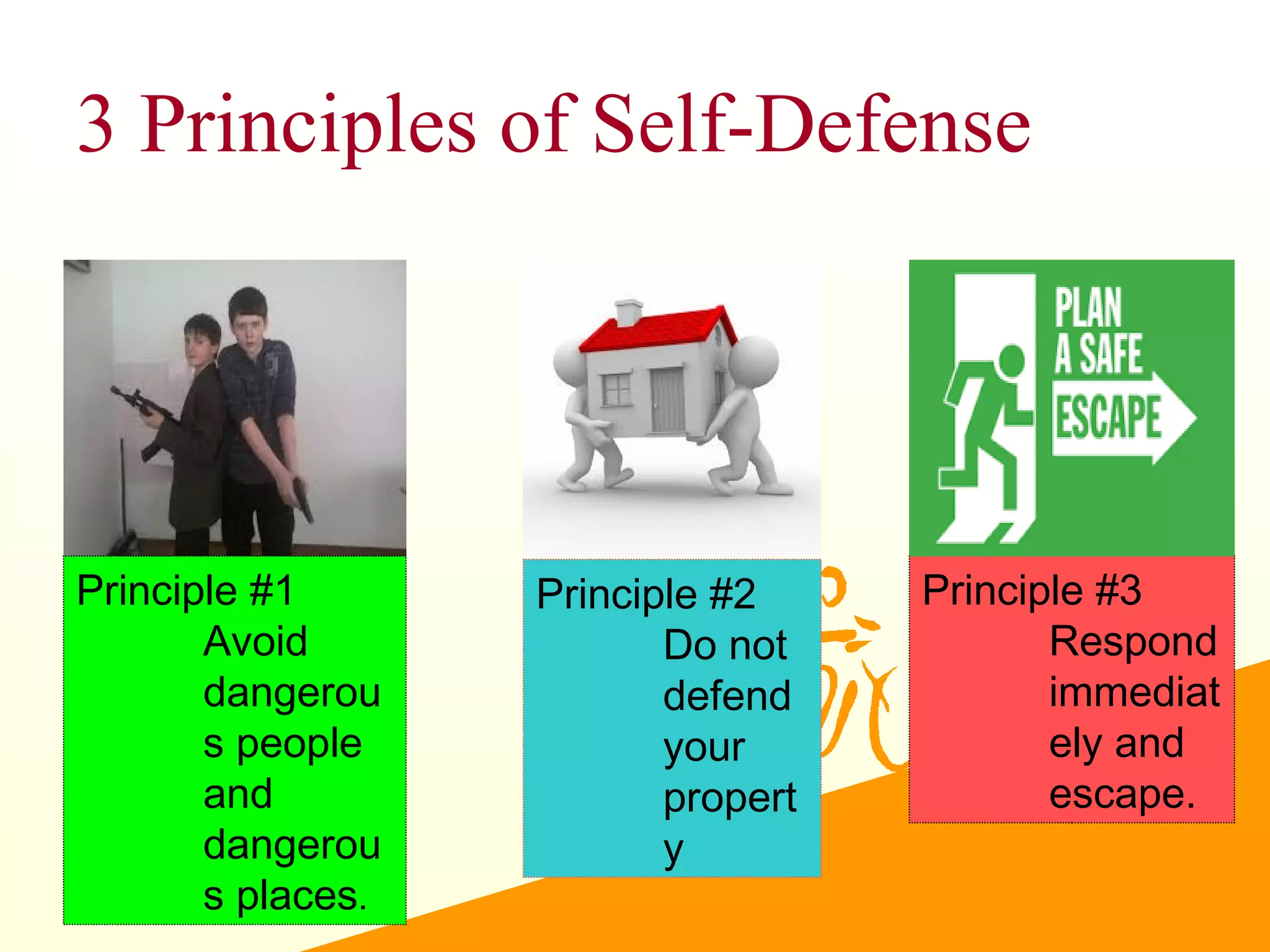
3 Principles of Self-Defense
Principle #1
Avoid
dangerou
s people
and
dangerou
s places.
Principle #2
Do not
defend
your
propert
y
Principle #3
Respond
immediat
ely and
escape.
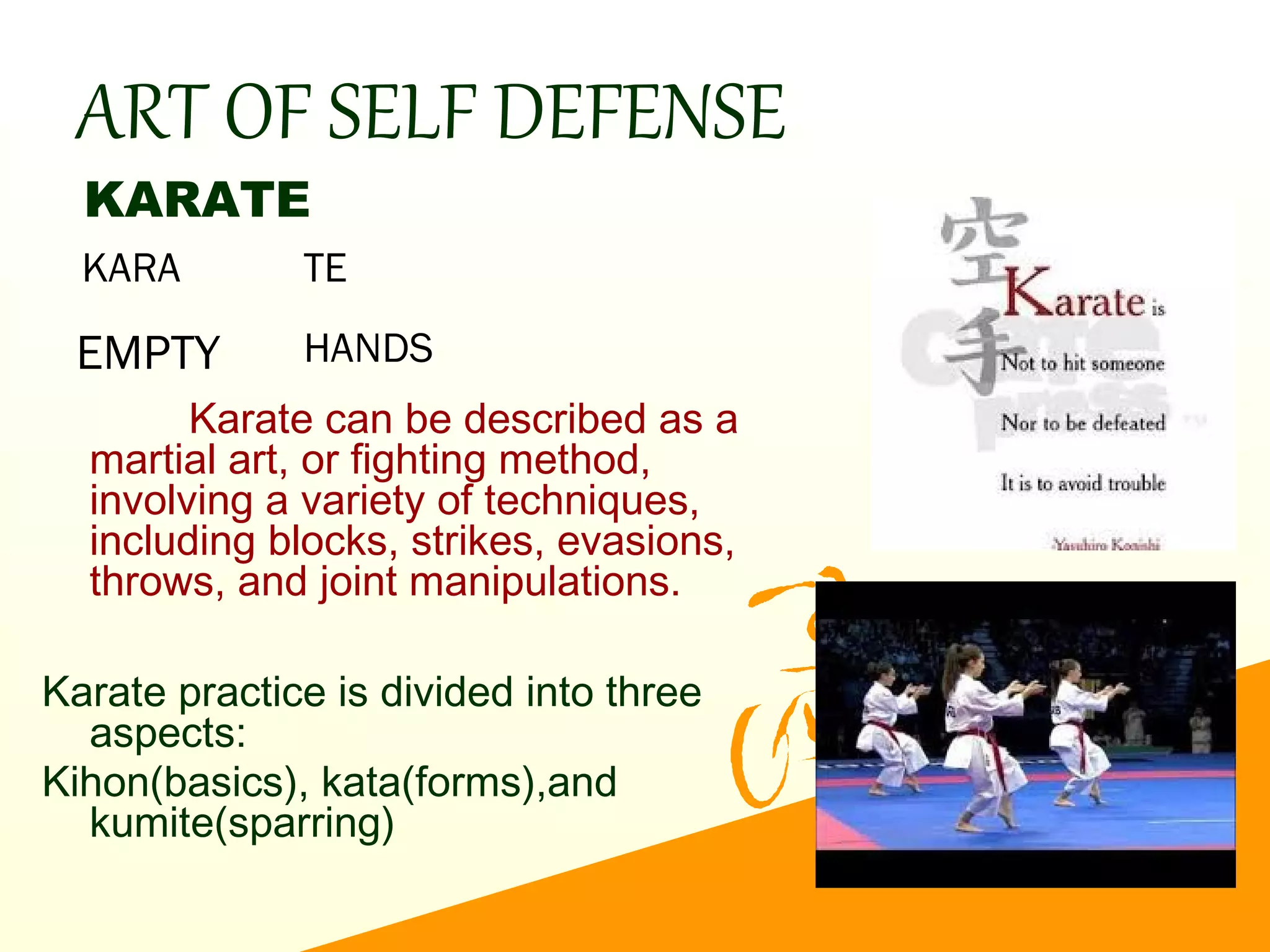
ART OF SELF DEFENSE
Karate can be described as a
martial art, or fighting method,
involving a variety of techniques,
including blocks, strikes, evasions,
throws, and joint manipulations.
Karate practice is divided into three
aspects:
Kihon(basics), kata(forms),and
kumite(sparring)
KARA
EMPTY
TE
HANDS
KARATE
Kata
In kata, student visualizes the attack. It is a fight with imaginary
opponents.The moves of the kata consists of throws, strikes,
bilcks, and control techniques.
Kumite
Person is trained against the opponent using the techniques
learned from kihon(basics) and kata(forms). The referee
and judges decides the winner.
Let's understand basics!
Karate(kah-rah-tay) Kara:Empty
Te:Hands
Sensei(sehn-seh-ee): Instructor
Sempai(sehm-pye): Senior student
Osu(ah-soo) :Greeting
Kiai(key-aye): Focusing shout
Why karate is must?
•
Improvement of physical
and mental health.
•
Build self-esteem.
•
strengthen self-confidence.
•
Improvemnent of academic
performance.
•
Increase your level of
energy, focus and
concentration.
"Let today be the day you say. "You know what? You only
live once-I'M GOING FOR IT."
Karate gives
color
belts.
100% of mental
concentratio
n and
commitment
.
Exercise regularly
"THE SECRET OF CHANGE IS TO
FOCUS ALL OF YOUR
ENERGY, NOT ON FIGHTING
THE OLD, BUT ON BUILDING
THE NEW."
-Socrates
Gichin Funakoshi(1868-1957)
Founder of modern day karate
"I come to you with only karate,
empty hands. I have no
weapons but should I be
forced to defend myself,
my principals or my
honor, should it be a
matter of life or death, of
right or wrong, then here
are my weapons.
Karate, My empty hands."
Karate has its origin
in India!
Origin and there development
•
Kungfu, wushu ( shaoline martial art) :
China
•
Karate (jujustu, kenjustu & naginatajustu) :
Japan
•
Taekwondo : Korea
•
Krav maga ( kick boxing) : Amerika
kungfu
•
Originated during xia
dynasty 4000 years ago
•
Yellow emperor huangdi
•
It is an technique such as
strikes, throws, joint
manipulation & pressure
point attack
In traditional Chinese martial
arts alternative terminologies
for the training of 'sets or
forms are:
• lian quan tao  – practicing sequence of
fist.
• lian quan jiao – practicing fists and
feet.
• lian bing qi  – practicing weapons.
well-known practitioners
throughout history:
Yue Fei (1103–1142 CE)
Ten Tigers of Canton (late 19th
century)
Wong Fei Hung (1847–1924)
Bruce Lee (1940–1973)
Jet Li (b. 1963)
Donnie Yen (b. 1963)
Wu Jing (b. 1974)
Karate
•
Karate  literally means "empty hand". It is also
sometimes called "the way of the empty
hand" Karate originated in Okinawa, formerly
known as the Ry ky Kingdomū ū ,
•
a modern one, and historically the term meant a
way of life encompassing physical,spiritual,
and moral dimensions with a focus of self-
improvement, fulfillment, or personal growth.
•
The historical origin of Japanese martial arts can
be found in the warrior traditions of
the samurai and the caste system
The three attacks
•
Go no sen - meaning “late attack” involves a
defensive or counter movement in response to
an attack.[19]
•
Sen no sen - a defensive initiative launched
simultaneously with the attack of the opponent.
[19]
•
Sensen no sen - an initiative launched in
anticipation of an attack where the opponent is
fully committed to their attack and thus
psychologically beyond the point of no return.
Taekwondo
•
In November 2011, Taekkyeon was recognized
by UNESCO and placed on its Intangible Cultural
Heritage of Humanity List.
•
is the oldest form of ground fighting in Korea,
while subak/taekkyeon was the upright martial
art of foot soldiers
•
Taekwondo is a synthesis from many different
martial arts (both Korean and foreign) and is
constantly evolving, taking the best of other arts
and adapting them.
•
It is an event in every major, multi-sports games,
including the Olympic Games,
the Commonwealth Games and the World
University Games
The Buddhist influence on the hwarang is most
notably seen around 600 AD, when the moral
code Sae Sok O-Gye written by Won Kwang 
was documented. This code consisted of five
rules :
• – Loyalty to one's king.
• – Respect to one's parents.
• – Faithfulness to one's friends.
• – Courage in battle.
• – Justice in killing.
Krav maga•
It is an mixing of Western Boxing, Aikido,
Wrestling, Judo, KAPAP
•
wide combination of techniques sourced
from Aikido boxing, judo and wrestling along
with realistic fight training
•
It was derived from street-fighting
Ideas in Krav Maga include:
• Counterattacking as soon as possible (or attacking
pre-emptively).
• Targeting attacks to the body's most vulnerable
points, such as: the eyes, neck or throat, face, solar
plexus, groin, ribs, knee, foot, fingers, etc.
• Maximum effectiveness and efficiency in order to
neutralize the opponent as quickly as possible.
• Maintaining awareness of surroundings while
dealing with the threat in order to look for escape
routes, further attackers, objects that could be used
to defend or help attack, and so on.
Thank you

Karate self defense

  • 1.
    "KARATE & SELF DEFENSE" Madhvi Prasad &Prachi Bulbule August 2015
  • 2.
    Look around you! Areyou safe? If NOT, Then What can you do for survival?
  • 3.
    3 Principles ofSelf-Defense Principle #1 Avoid dangerou s people and dangerou s places. Principle #2 Do not defend your propert y Principle #3 Respond immediat ely and escape.
  • 4.
    ART OF SELFDEFENSE Karate can be described as a martial art, or fighting method, involving a variety of techniques, including blocks, strikes, evasions, throws, and joint manipulations. Karate practice is divided into three aspects: Kihon(basics), kata(forms),and kumite(sparring) KARA EMPTY TE HANDS KARATE
  • 5.
    Kata In kata, studentvisualizes the attack. It is a fight with imaginary opponents.The moves of the kata consists of throws, strikes, bilcks, and control techniques.
  • 6.
    Kumite Person is trainedagainst the opponent using the techniques learned from kihon(basics) and kata(forms). The referee and judges decides the winner.
  • 7.
    Let's understand basics! Karate(kah-rah-tay)Kara:Empty Te:Hands Sensei(sehn-seh-ee): Instructor Sempai(sehm-pye): Senior student Osu(ah-soo) :Greeting Kiai(key-aye): Focusing shout
  • 8.
    Why karate ismust? • Improvement of physical and mental health. • Build self-esteem. • strengthen self-confidence. • Improvemnent of academic performance. • Increase your level of energy, focus and concentration.
  • 9.
    "Let today bethe day you say. "You know what? You only live once-I'M GOING FOR IT." Karate gives color belts. 100% of mental concentratio n and commitment . Exercise regularly
  • 10.
    "THE SECRET OFCHANGE IS TO FOCUS ALL OF YOUR ENERGY, NOT ON FIGHTING THE OLD, BUT ON BUILDING THE NEW." -Socrates
  • 11.
    Gichin Funakoshi(1868-1957) Founder ofmodern day karate "I come to you with only karate, empty hands. I have no weapons but should I be forced to defend myself, my principals or my honor, should it be a matter of life or death, of right or wrong, then here are my weapons. Karate, My empty hands."
  • 12.
    Karate has itsorigin in India!
  • 13.
    Origin and theredevelopment • Kungfu, wushu ( shaoline martial art) : China • Karate (jujustu, kenjustu & naginatajustu) : Japan • Taekwondo : Korea • Krav maga ( kick boxing) : Amerika
  • 14.
    kungfu • Originated during xia dynasty4000 years ago • Yellow emperor huangdi • It is an technique such as strikes, throws, joint manipulation & pressure point attack
  • 15.
    In traditional Chinesemartial arts alternative terminologies for the training of 'sets or forms are: • lian quan tao  – practicing sequence of fist. • lian quan jiao – practicing fists and feet. • lian bing qi  – practicing weapons.
  • 16.
    well-known practitioners throughout history: YueFei (1103–1142 CE) Ten Tigers of Canton (late 19th century) Wong Fei Hung (1847–1924) Bruce Lee (1940–1973) Jet Li (b. 1963) Donnie Yen (b. 1963) Wu Jing (b. 1974)
  • 17.
    Karate • Karate  literally means "emptyhand". It is also sometimes called "the way of the empty hand" Karate originated in Okinawa, formerly known as the Ry ky Kingdomū ū , • a modern one, and historically the term meant a way of life encompassing physical,spiritual, and moral dimensions with a focus of self- improvement, fulfillment, or personal growth. • The historical origin of Japanese martial arts can be found in the warrior traditions of the samurai and the caste system
  • 19.
    The three attacks • Gono sen - meaning “late attack” involves a defensive or counter movement in response to an attack.[19] • Sen no sen - a defensive initiative launched simultaneously with the attack of the opponent. [19] • Sensen no sen - an initiative launched in anticipation of an attack where the opponent is fully committed to their attack and thus psychologically beyond the point of no return.
  • 20.
    Taekwondo • In November 2011,Taekkyeon was recognized by UNESCO and placed on its Intangible Cultural Heritage of Humanity List. • is the oldest form of ground fighting in Korea, while subak/taekkyeon was the upright martial art of foot soldiers • Taekwondo is a synthesis from many different martial arts (both Korean and foreign) and is constantly evolving, taking the best of other arts and adapting them. • It is an event in every major, multi-sports games, including the Olympic Games, the Commonwealth Games and the World University Games
  • 21.
    The Buddhist influence on thehwarang is most notably seen around 600 AD, when the moral code Sae Sok O-Gye written by Won Kwang  was documented. This code consisted of five rules : • – Loyalty to one's king. • – Respect to one's parents. • – Faithfulness to one's friends. • – Courage in battle. • – Justice in killing.
  • 22.
    Krav maga• It isan mixing of Western Boxing, Aikido, Wrestling, Judo, KAPAP • wide combination of techniques sourced from Aikido boxing, judo and wrestling along with realistic fight training • It was derived from street-fighting
  • 23.
    Ideas in KravMaga include: • Counterattacking as soon as possible (or attacking pre-emptively). • Targeting attacks to the body's most vulnerable points, such as: the eyes, neck or throat, face, solar plexus, groin, ribs, knee, foot, fingers, etc. • Maximum effectiveness and efficiency in order to neutralize the opponent as quickly as possible. • Maintaining awareness of surroundings while dealing with the threat in order to look for escape routes, further attackers, objects that could be used to defend or help attack, and so on.
  • 24.