Self compassion
Psychological flexibility
Be kind to yourself
HeadscienceLtd
Tips and tools to help deal with anxiety
Mandy Kloppers
Cognitive Behavioural Psychotherapist
www.headscience.co.uk
Are you self-critical?
Self compassion and emotional regulation
Why you need self-compassion
• Gets you OFF the ‘hamster wheel’
• EQ, wisdom, life satisfaction & social
connectedness
• Improved mental health/mental strength
• Get more done/procrastinate less
• Promotes self discipline: diet, exercise, self care
How could you be more self-compassionate?
How to increase self-compassion
Positive affirmations: “May I
feel safe, may I feel peaceful,
may I be kind to myself, may I
accept myself as I am.”
passionate at those moment.
Reduce self-criticism: Ignore
the inner bully and talk to
yourself in a kind manner
Write yourself a
compassionate letter
Forgive yourself
Adopt a growth mindset-see
difficulties as opportunities
Gratitude Mindfulness –step back and
observe
Treat yourself as you would a
dear friend/loved one
Questions??
Research:
• Kristin Neff – Austin University in Texas. Self and
Identity, 2005
• Brandeis University, 2004. Link between self
compassion and stress inflammation
(https://www.sciencedirect.com/science/article/pii/S088
9159113005370)
Psychological
flexibility
Psychological
Flexibility:
Questionnaire
Is your thinking
rigid/black and
white?
Why rigid thinking isn’t good:
• Inhibits growth and change
• Minimises learning opportunities
• Decreased mental health
Three aspects
of Psychological
Fleixibility
Present moment focus: mindfulness
Thought Defusion
Values
• Health
• Love
• Family
• Education
• Integrity
Commit to: Take action
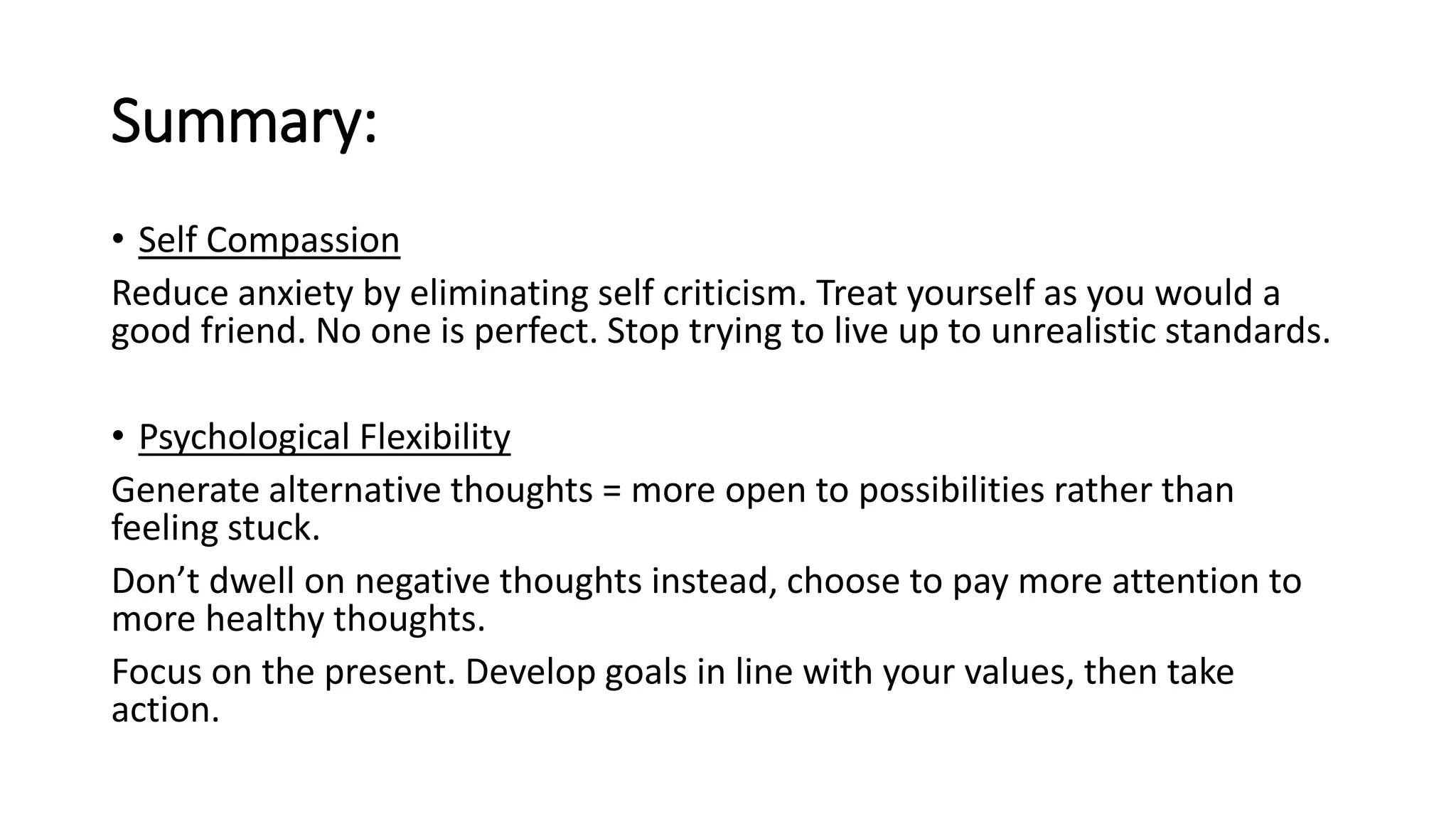
Summary:
• Self Compassion
Reduce anxiety by eliminating self criticism. Treat yourself as you would a
good friend. No one is perfect. Stop trying to live up to unrealistic standards.
• Psychological Flexibility
Generate alternative thoughts = more open to possibilities rather than
feeling stuck.
Don’t dwell on negative thoughts instead, choose to pay more attention to
more healthy thoughts.
Focus on the present. Develop goals in line with your values, then take
action.
Quesions??
Recommended Reading:
The Compassionate Mind – Paul Gilbert; The Happiness Trap – Russ Harris

Self compassion and psychological flexibility

Editor's Notes

  • #2 Two strategies: Self compassion is the opposite of self criticism. You may think being self critical is good for motivation and performance related behaviours but research suggests the opposite (more on this later) hopefully after today’s presentation, you’ll realise there’s more to self compassion. SC isn’t about being too soft on yourself, it’s about giving yourself a break. PF – being more choosy about the thoughts you focus on,
  • #3 I want to ask you something….. How do you react when you fail at something, get rejected or feel you aren’t achieving enough? HOW DOES IT FEEL WHEN YOU ARE SELF CRITICAL?? Good feeling or more pressure? EXAMPLES?? Do you blame yourself? What do you DO to try feel better about yourself? Does this cause you anxiety? Drink alcohol/comfort eat/gamble/go shopping/see friends? Being self critical is the OPPOSITE of self compassion – which is accepting that you are human and make mistakes just like the rest of us. Part of the human condition TELL CF STORY? TELL PRESENTATION STORY – has to be perfect…self critical…
  • #4 Problem with modern day society is we’re all under pressure. No time for anything…we’re all busy. Remote working means we’re alone more. Society is becoming more splintered. Less time for people. More about achievement. Modern day life = stuck in threat to drive system. Feel disconnected. Don’t place enough value on slowing down and just spending time with others… do do do Whether you are self critical or self compassionate –both affect your emotions. Self criticism - Activates amygdala – threat!! Individuals who are highly self-critical or shame-prone tend to have highly developed threat and reward systems. They tend to spend most of their time going between these two systems; seeking pleasure/achievement or responding to and trying to protect themselves from perceived threat. However, they often have difficulty accessing their social safety system and spend little time in that system’s “tend and befriend” functions Soothing system: being happy with things as they are, not striving or wanting. An inner peacefulness. Linked to affection and kindness. Feeling loved. Modern societies are over stimulating our threat and incentive system. Happiness lies in balancing all 3 systems.  Get really present in your interactions with people. Notice the impact of your behaviour on others. See if you can get out of your head and into this moment now.
  • #5 Self criticism is a key predictor of anxiety and depression. GREATER PERSPECTIVE on problems. Self compassion offers a solid foundation or platform from which to venture out into the world. You make this ten times more challenging by being hard on yourself. The world is harsh enough without you adding to it. Like being in a mental prison when you self criticise It’s not about having a big ego, Think it helps to be harsh (motivates you) but research has shown the OPPOSITE. University of Austin in Texas. Research showed people with SC didn’t get hung up on failure – they looked at what they could learn and how they could improve instead of berating themselves or taking it out on themselves in a self critical manner. People with low SC distracted themselves more (drive). People more inclined towards SC coped better physically with stress too. Drop the TOUGH GUY act and stop holding yourself to impossible standards.
  • #6 One thing you could do today? Treat yourself as you would a friend. Stop the overly critical thoughts. – can be counter productive. Write a compassionate letter to yourself. Stop believing being harsh on yourself is a good thing!!
  • #7 Accept that when you feel threatened you are likely to revert to self-protective and unhelpful behaviours. Consider what might trigger that in you and make a plan to be particularly mindful and self-com Positive affirmations: “May I feel safe, may I feel peaceful, may I be kind to myself, may I accept myself as I am.” passionate at those moment.  Reduce self-criticism: Ignore the inner bully and talk to yourself in a kind manner
  • #10 Discuss scores IN WORK CONTEXT: Certain psychological states that underpin high performance irrespective of the task involved.  These include: Task focus.  High performance nearly always rests on the ability to focus on the task, often for long periods and not to be distracted by internal or external factors. Goal clarity. Understanding what is trying to be achieved is critical because it gives meaning to one’s moment to moment experience.  Intrinsic motivation.  Understanding not just what the goal is but why it matters is critical.  Research has indicated that extrinsic rewards alone can lead to a subsequent reduction in intrinsic motivation. Behavioural flexibility.  If you want the same results, then keep doing what you are doing.  A major barrier to improving performance is rigid thinking or habitual responses formed in previous experience.  We need to recognise when to persist and when to adopt a different approach. Experiential avoidance.  Experiential avoidance occurs when someone tries to avoid unpleasant thoughts and feelings by changing what they actually do in their life.  A large body of research shows that higher experiential avoidance is associated with lower wellbeing, work performance and quality of life.
  • #11 Types of rigid thinking – stereotypes/ cog bias, believe something more likely to notice things that confirm our way of thinking. Instead of focusing on getting everything right, perhaps we could give our attention to being here now. To embracing this messy life with all of its imperfection. The more rigid you are in your thinking the more your life rules will get broken “if this then that”. Leads to stress and anxiety when rules are broken. Building stress into our lives that we don’t need. Rules = not psychological flexibility. Make allowances for other ways to do things. Can you think of any rigid rules you have? Musts or Shoulds?? PERFECTIONISTS – good/bad success/failure World isn’t black and white – IT’S GREY!!!!
  • #12  1) Problem solving ability decreases/ Decreases resilience and tolerance of change/ Notice more of what we focus on 2) Decreases ability to focus on the helpful/useful aspects/ Inhibits clarity in decision making 3) Increases anxiety and depression/less able to manage emotions/ Increases worry and overthinking Effective communication decreases
  • #13 These are ways to break out of being too rigid in your thinking. How do you become more PF. Let go of control… DEFUSION: see thoughts, images. memories as words and pictures. That’s all they are. NOT FACTS. let them come and go TRAIN – PLATFORM. That train destination: my boss thinks I’m not working hard enough. Next one: I must do more to feel worthy etc etc Stay on the platform. NO MUSTS AND SHOULDS MINDFULNESS: be in present moment. Instead of dwelling past/future. Stuck in times you can’t control = anxiety VALUES: knowing what’s most important/significant and meaningful to you. Promotes happiness. Know yourself. ACTION: take action in line with values – family/love/honesty/freedom etc values= compass.
  • #14 Increase awareness of the present moment – by increasing one’s sensitivity to what is happening in the present moment we can discriminate between what we observe with our 5 senses and what our sometimes unreliable (or autopilot) minds tell us is happening.
  • #15 Cognitive defusion – this means developing the ability to watch thoughts come and go, and then choosing which thoughts to act on, rather than getting ‘hooked’ by difficult or disruptive thoughts.  It is not about changing thoughts, but changing one’s relationship to them. Train analogy… I’m not good at my job; I can’t do this; I’m a failure; not as good as others are, Nobody said life was fair – good train
  • #16 Values – your compass. Helps you stay on track. Values-based action – psychological flexibility is ultimately about focusing attention on what it is we really want to achieve.  Increasing awareness of an our values helps build motivation and enables us to take positive and sustained action, even when doing so is challenging. Values help us get through the tough times – increases resilience
  • #17 The more action you take, the more PF you will become. Analysis paralysis.
  • #18 Accept that when you feel threatened you are likely to revert to self-protective and unhelpful behaviours (self criticism). Consider what might trigger that in you and make a plan to be particularly mindful and self-compassionate at those moment.  OVERLAP between SC and PF: Be kind, really connect with others in the moment. Don’t always trust your thoughts. Not just one version of the world!