SELECTION CRITERIA OF FLOWMETERS 1
FLOW METERS:
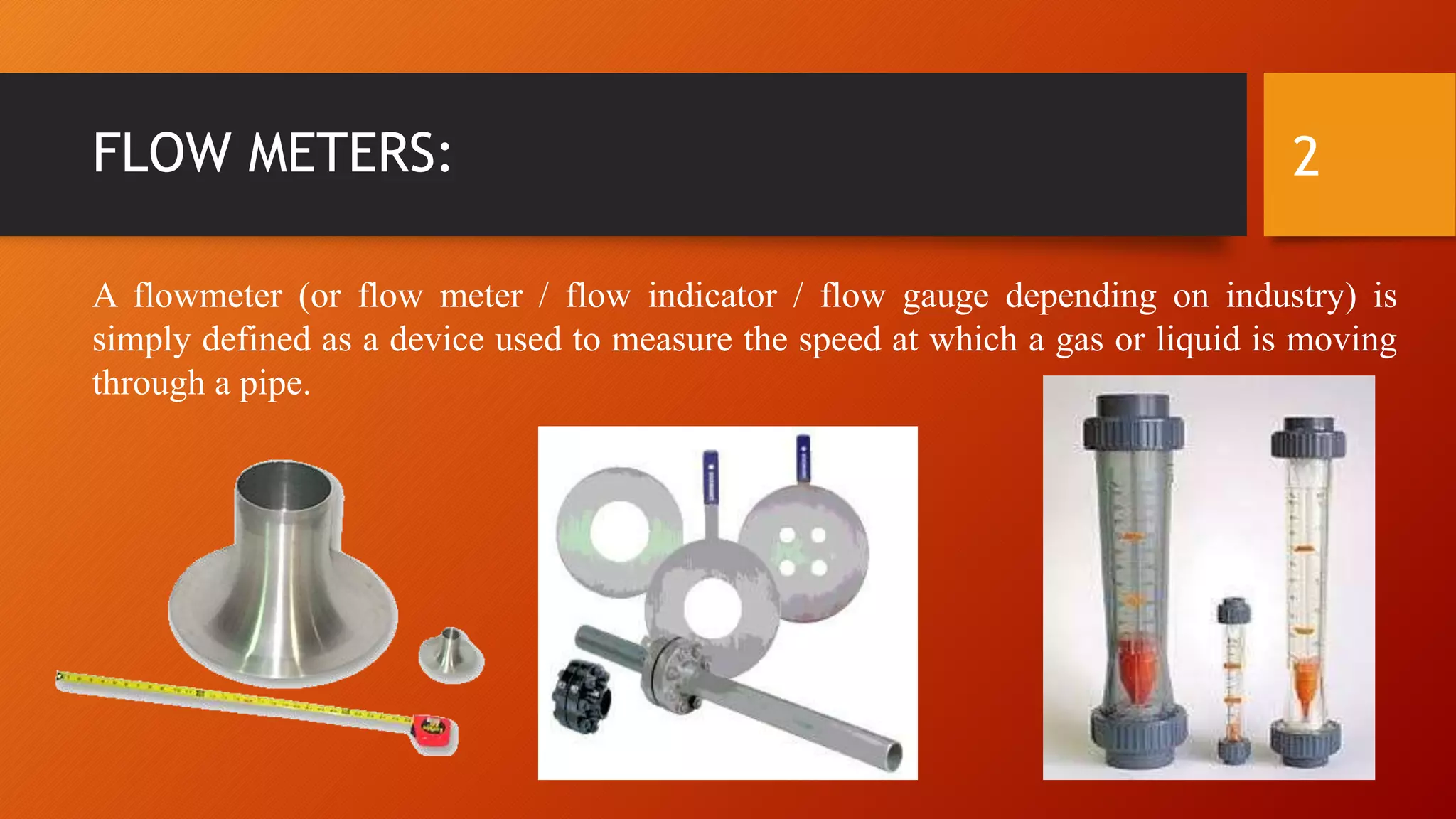
A flowmeter (or flow meter / flow indicator / flow gauge depending on industry) is
simply defined as a device used to measure the speed at which a gas or liquid is moving
through a pipe.
2
SELECTION CRITERIA METHODOLOGIES 3
CONTINUED…..
There are two methodology for selection of any flowmeter:
• Traditional selection of flowmeters
• Best-in-class methodology
4
TRADITIONAL SELECTION OF FLOW METERS
Many users may be generally aware that a particular flowmeter or a flow sensing technology
may be best suited for measuring fluid flows that exhibit certain matching flow characteristics.
magnetic flowmeters are not suitable for measuring flow of nonconducting fluids commonly
found in hydrocarbon processing industries.
DP-based flowmeters
However, users may not have the experience or willingness to acquire the knowledge to
consider relevant factors that can affect flowmeter selection.
Decisions are often made based on purchase price
In many cases, a decision may be simply based on continuation of past practices—making a
status quo selection—without reviewing the available options. As a result, a status quo
selection could result in higher installed costs for the user because additional measurement
devices and/or additional piping may be required to achieve comparable results.
5
STEPS IN BEST-IN-CLASS METHODOLOGY
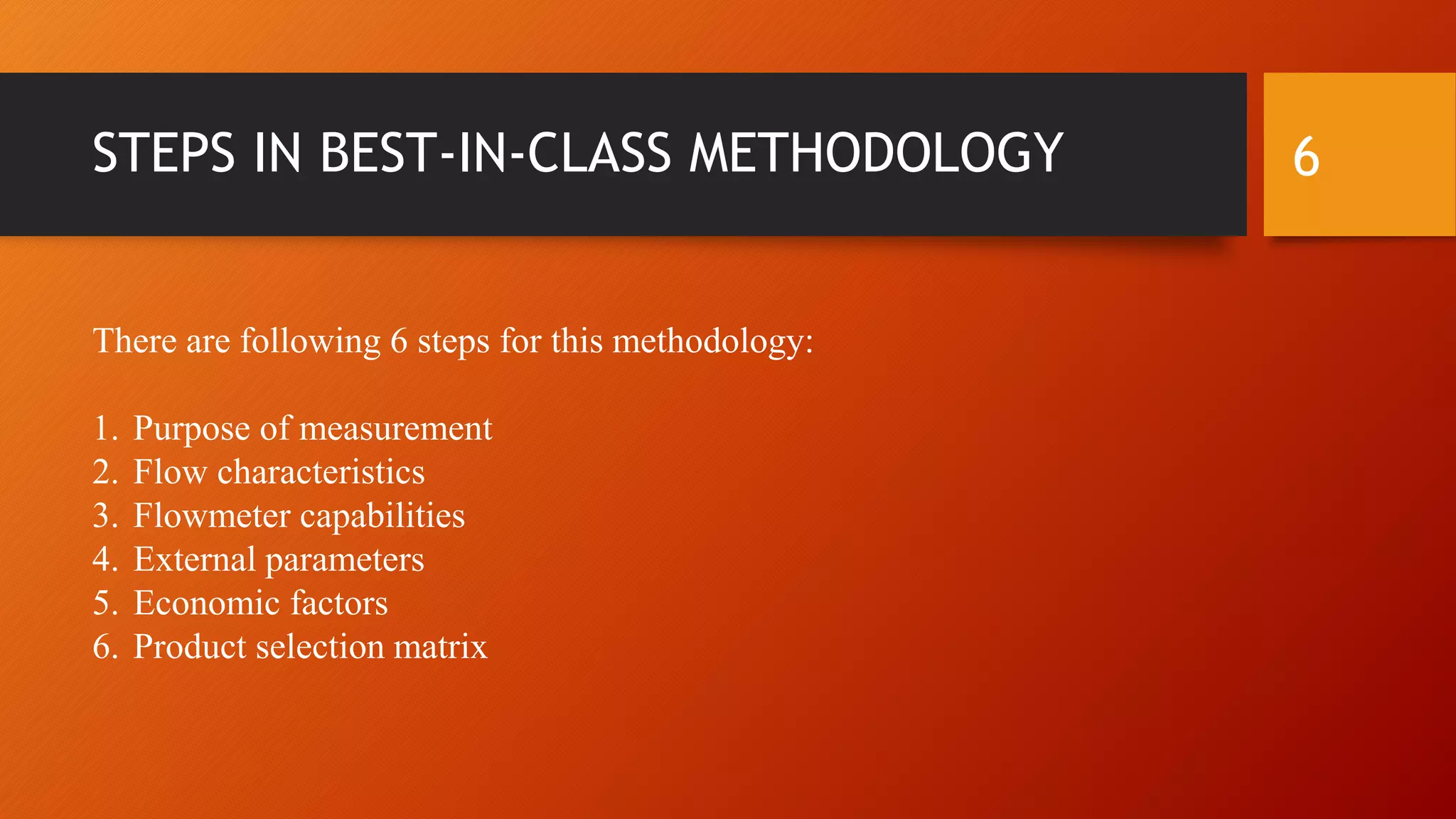
There are following 6 steps for this methodology:
1. Purpose of measurement
2. Flow characteristics
3. Flowmeter capabilities
4. External parameters
5. Economic factors
6. Product selection matrix
6
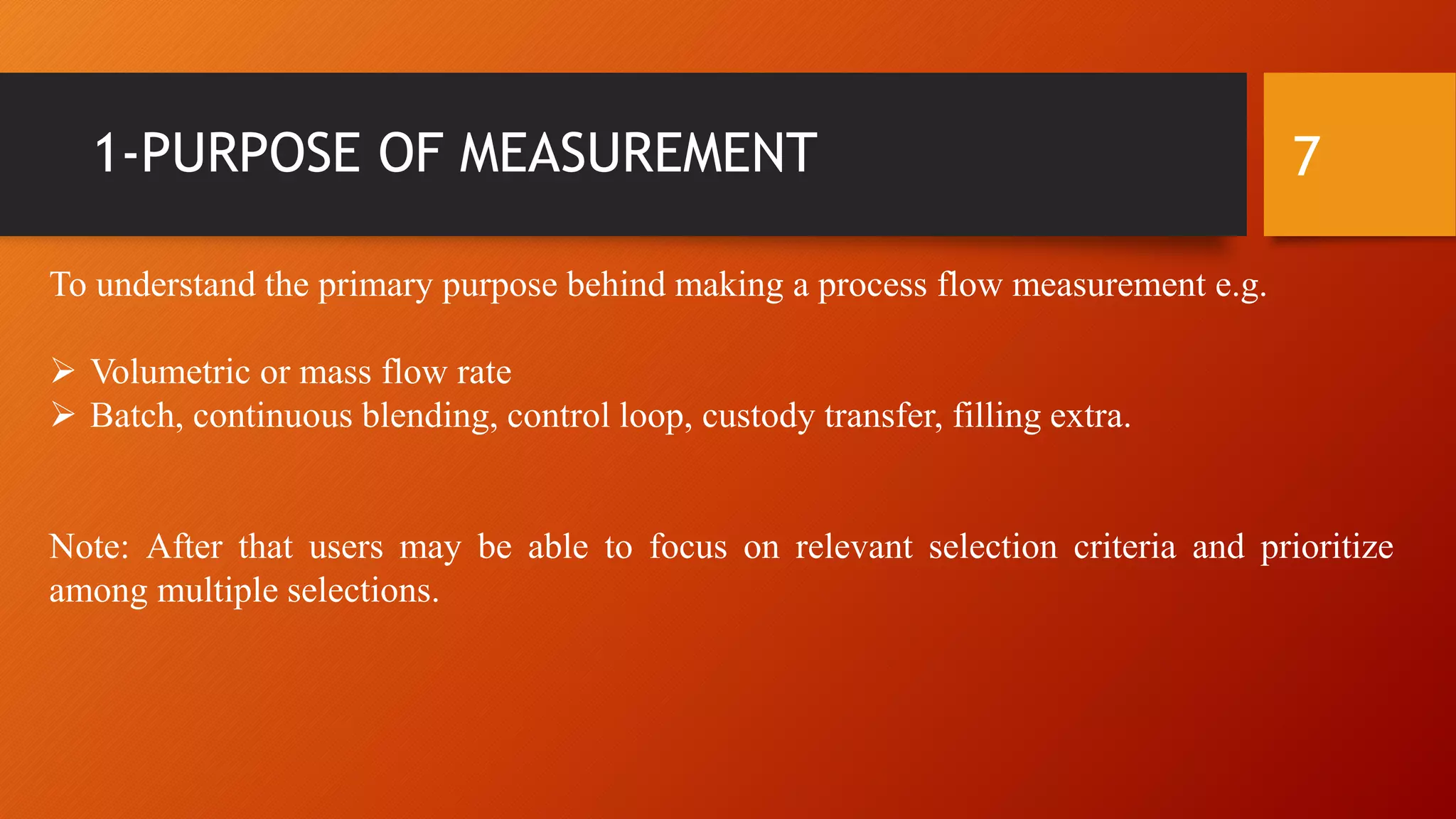
1-PURPOSE OF MEASUREMENT
To understand the primary purpose behind making a process flow measurement e.g.
 Volumetric or mass flow rate
 Batch, continuous blending, control loop, custody transfer, filling extra.
Note: After that users may be able to focus on relevant selection criteria and prioritize
among multiple selections.
7
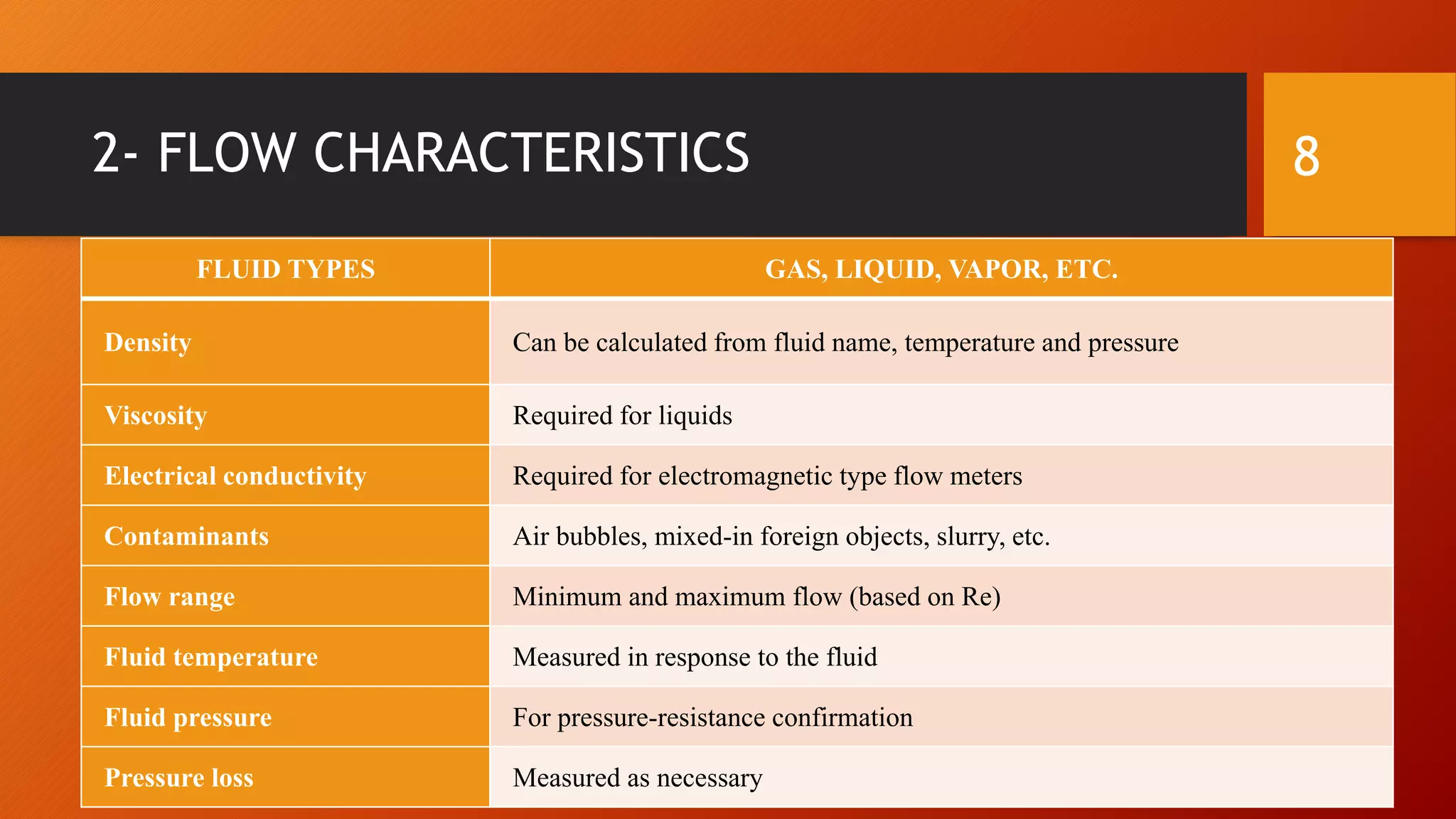
2- FLOW CHARACTERISTICS
FLUID TYPES GAS, LIQUID, VAPOR, ETC.
Density Can be calculated from fluid name, temperature and pressure
Viscosity Required for liquids
Electrical conductivity Required for electromagnetic type flow meters
Contaminants Air bubbles, mixed-in foreign objects, slurry, etc.
Flow range Minimum and maximum flow (based on Re)
Fluid temperature Measured in response to the fluid
Fluid pressure For pressure-resistance confirmation
Pressure loss Measured as necessary
8
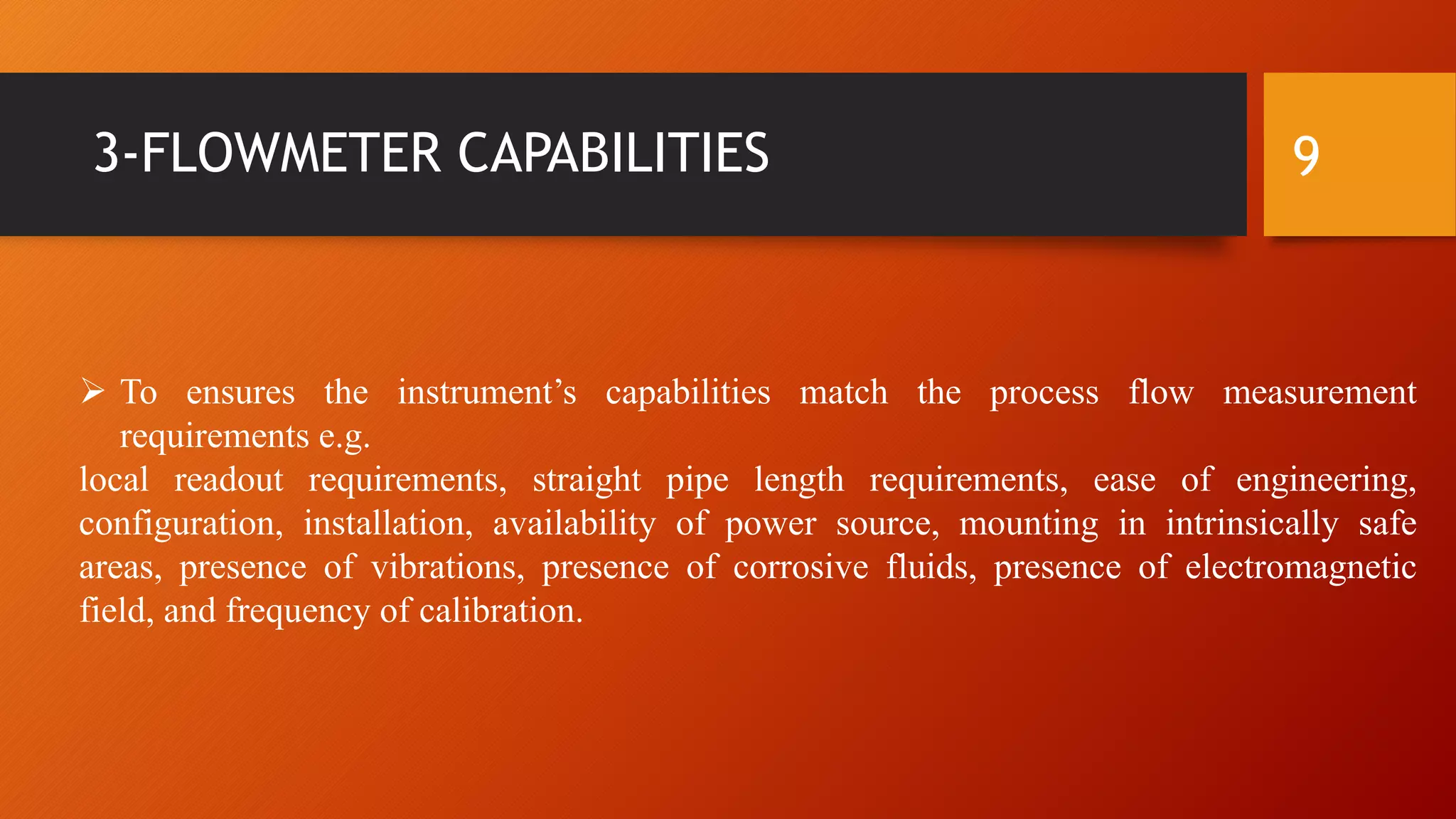
3-FLOWMETER CAPABILITIES
 To ensures the instrument’s capabilities match the process flow measurement
requirements e.g.
local readout requirements, straight pipe length requirements, ease of engineering,
configuration, installation, availability of power source, mounting in intrinsically safe
areas, presence of vibrations, presence of corrosive fluids, presence of electromagnetic
field, and frequency of calibration.
9
4-EXTERNAL FACTORS
Environmental considerations
! fugitive emission of hazardous fluid
DP flow meter instead of traditional
instruments
! Reduce total maintenance cost
10
5-ECONOMIC FACTOR
Purchase price
! Eliminates non affordable price
Installed cost
! Will be low
Lifecycle cost
! Operating cost, maintenance cost
11
6-PRODUCT SELECTION MATRIX
Wrong selection
! Production matrix fluctuates with selection criteria
12
TABLE FOR SELECTION
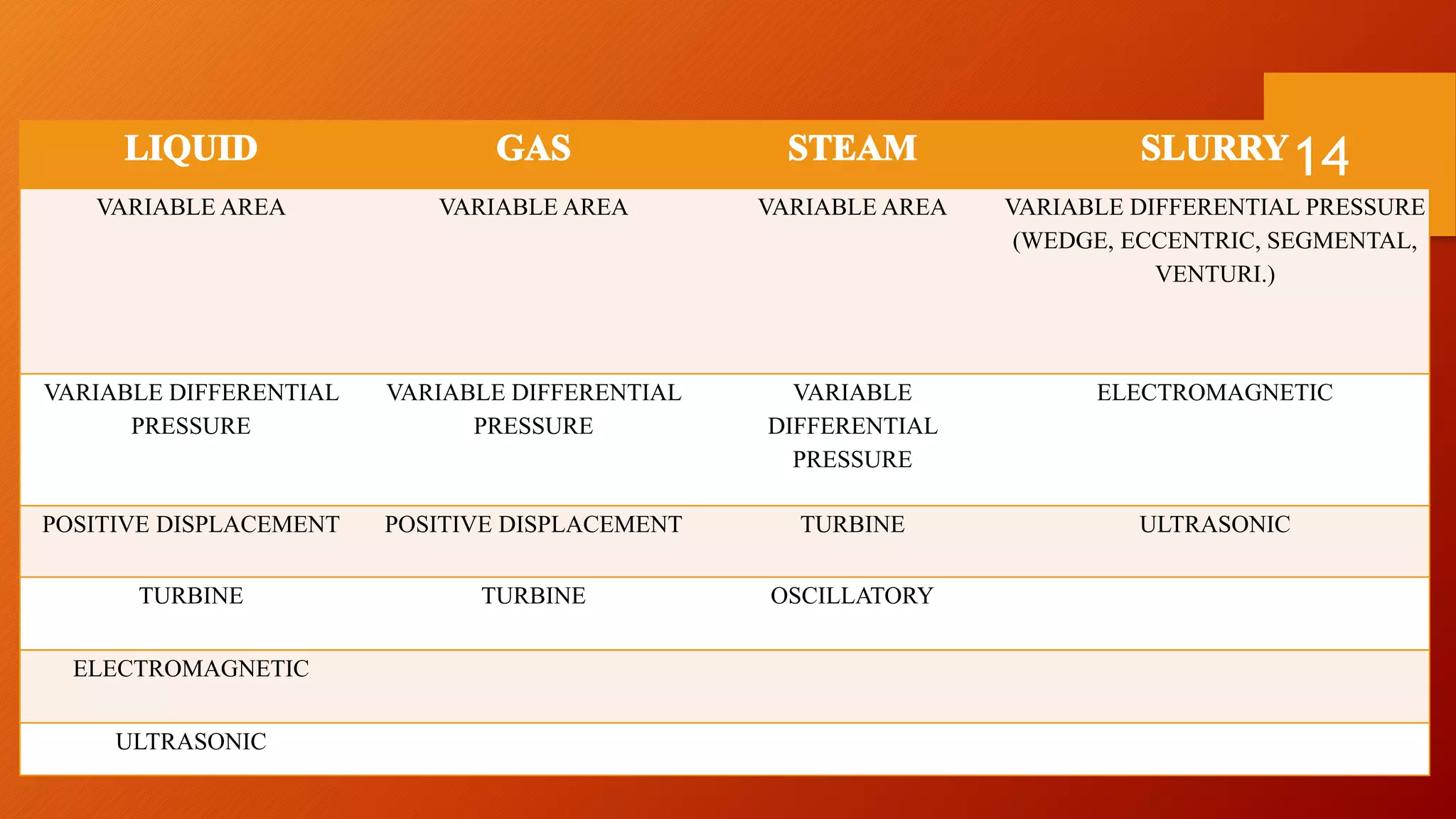
The following table groups the various types of flowmeter according to their suitability for
liquid, gas, steam and slurry applications.
13
VARIABLE AREA VARIABLE AREA VARIABLE AREA VARIABLE DIFFERENTIAL PRESSURE
(WEDGE, ECCENTRIC, SEGMENTAL,
VENTURI.)
VARIABLE DIFFERENTIAL
PRESSURE
VARIABLE DIFFERENTIAL
PRESSURE
VARIABLE
DIFFERENTIAL
PRESSURE
ELECTROMAGNETIC
POSITIVE DISPLACEMENT POSITIVE DISPLACEMENT TURBINE ULTRASONIC
TURBINE TURBINE OSCILLATORY
ELECTROMAGNETIC
ULTRASONIC
14
THANK YOU 15

selection criteria for flow meters

  • 1.
  • 2.
    FLOW METERS: A flowmeter(or flow meter / flow indicator / flow gauge depending on industry) is simply defined as a device used to measure the speed at which a gas or liquid is moving through a pipe. 2
  • 3.
  • 4.
    CONTINUED….. There are twomethodology for selection of any flowmeter: • Traditional selection of flowmeters • Best-in-class methodology 4
  • 5.
    TRADITIONAL SELECTION OFFLOW METERS Many users may be generally aware that a particular flowmeter or a flow sensing technology may be best suited for measuring fluid flows that exhibit certain matching flow characteristics. magnetic flowmeters are not suitable for measuring flow of nonconducting fluids commonly found in hydrocarbon processing industries. DP-based flowmeters However, users may not have the experience or willingness to acquire the knowledge to consider relevant factors that can affect flowmeter selection. Decisions are often made based on purchase price In many cases, a decision may be simply based on continuation of past practices—making a status quo selection—without reviewing the available options. As a result, a status quo selection could result in higher installed costs for the user because additional measurement devices and/or additional piping may be required to achieve comparable results. 5
  • 6.
    STEPS IN BEST-IN-CLASSMETHODOLOGY There are following 6 steps for this methodology: 1. Purpose of measurement 2. Flow characteristics 3. Flowmeter capabilities 4. External parameters 5. Economic factors 6. Product selection matrix 6
  • 7.
    1-PURPOSE OF MEASUREMENT Tounderstand the primary purpose behind making a process flow measurement e.g.  Volumetric or mass flow rate  Batch, continuous blending, control loop, custody transfer, filling extra. Note: After that users may be able to focus on relevant selection criteria and prioritize among multiple selections. 7
  • 8.
    2- FLOW CHARACTERISTICS FLUIDTYPES GAS, LIQUID, VAPOR, ETC. Density Can be calculated from fluid name, temperature and pressure Viscosity Required for liquids Electrical conductivity Required for electromagnetic type flow meters Contaminants Air bubbles, mixed-in foreign objects, slurry, etc. Flow range Minimum and maximum flow (based on Re) Fluid temperature Measured in response to the fluid Fluid pressure For pressure-resistance confirmation Pressure loss Measured as necessary 8
  • 9.
    3-FLOWMETER CAPABILITIES  Toensures the instrument’s capabilities match the process flow measurement requirements e.g. local readout requirements, straight pipe length requirements, ease of engineering, configuration, installation, availability of power source, mounting in intrinsically safe areas, presence of vibrations, presence of corrosive fluids, presence of electromagnetic field, and frequency of calibration. 9
  • 10.
    4-EXTERNAL FACTORS Environmental considerations !fugitive emission of hazardous fluid DP flow meter instead of traditional instruments ! Reduce total maintenance cost 10
  • 11.
    5-ECONOMIC FACTOR Purchase price !Eliminates non affordable price Installed cost ! Will be low Lifecycle cost ! Operating cost, maintenance cost 11
  • 12.
    6-PRODUCT SELECTION MATRIX Wrongselection ! Production matrix fluctuates with selection criteria 12
  • 13.
    TABLE FOR SELECTION Thefollowing table groups the various types of flowmeter according to their suitability for liquid, gas, steam and slurry applications. 13
  • 14.
    VARIABLE AREA VARIABLEAREA VARIABLE AREA VARIABLE DIFFERENTIAL PRESSURE (WEDGE, ECCENTRIC, SEGMENTAL, VENTURI.) VARIABLE DIFFERENTIAL PRESSURE VARIABLE DIFFERENTIAL PRESSURE VARIABLE DIFFERENTIAL PRESSURE ELECTROMAGNETIC POSITIVE DISPLACEMENT POSITIVE DISPLACEMENT TURBINE ULTRASONIC TURBINE TURBINE OSCILLATORY ELECTROMAGNETIC ULTRASONIC 14
  • 15.