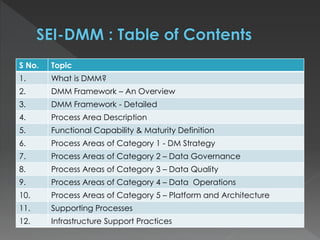
S No. Topic
1. What is DMM?
2. DMM Framework – An Overview
3. DMM Framework - Detailed
4. Process Area Description
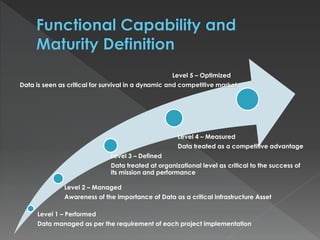
5. Functional Capability & Maturity Definition
6. Process Areas of Category 1 - DM Strategy
7. Process Areas of Category 2 – Data Governance
8. Process Areas of Category 3 – Data Quality
9. Process Areas of Category 4 – Data Operations
10. Process Areas of Category 5 – Platform and Architecture
11. Supporting Processes
12. Infrastructure Support Practices
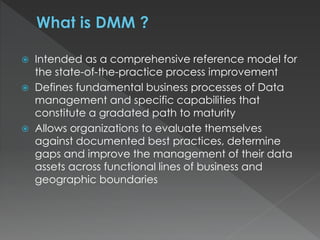
 Intended as a comprehensive reference model for
the state-of-the-practice process improvement
 Defines fundamental business processes of Data
management and specific capabilities that
constitute a gradated path to maturity
 Allows organizations to evaluate themselves
against documented best practices, determine
gaps and improve the management of their data
assets across functional lines of business and
geographic boundaries
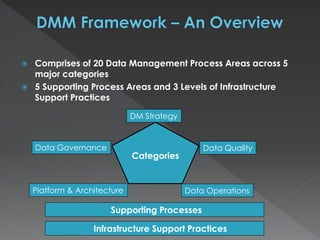
 Comprises of 20 Data Management Process Areas across 5
major categories
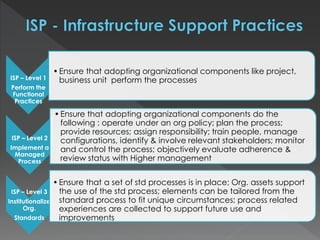
 5 Supporting Process Areas and 3 Levels of Infrastructure
Support Practices
Categories
DM Strategy
Data Quality
Data OperationsPlatform & Architecture
Data Governance
Supporting Processes
Infrastructure Support Practices
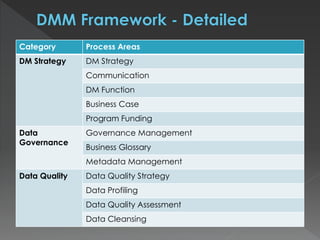
Category Process Areas
DM Strategy DM Strategy
Communication
DM Function
Business Case
Program Funding
Data
Governance
Governance Management
Business Glossary
Metadata Management
Data Quality Data Quality Strategy
Data Profiling
Data Quality Assessment
Data Cleansing
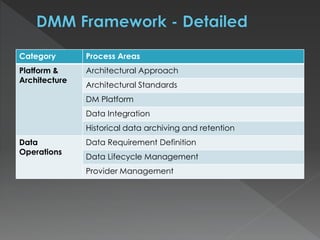
Category Process Areas
Platform &
Architecture
Architectural Approach
Architectural Standards
DM Platform
Data Integration
Historical data archiving and retention
Data
Operations
Data Requirement Definition
Data Lifecycle Management
Provider Management
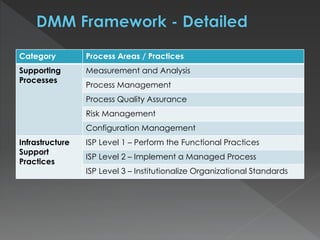
Category Process Areas / Practices
Supporting
Processes
Measurement and Analysis
Process Management
Process Quality Assurance
Risk Management
Configuration Management
Infrastructure
Support
Practices
ISP Level 1 – Perform the Functional Practices
ISP Level 2 – Implement a Managed Process
ISP Level 3 – Institutionalize Organizational Standards
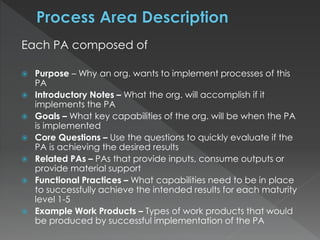
Each PA composed of
 Purpose – Why an org. wants to implement processes of this
PA
 Introductory Notes – What the org. will accomplish if it
implements the PA
 Goals – What key capabilities of the org. will be when the PA
is implemented
 Core Questions – Use the questions to quickly evaluate if the
PA is achieving the desired results
 Related PAs – PAs that provide inputs, consume outputs or
provide material support
 Functional Practices – What capabilities need to be in place
to successfully achieve the intended results for each maturity
level 1-5
 Example Work Products – Types of work products that would
be produced by successful implementation of the PA
Level 1 – Performed
Data managed as per the requirement of each project implementation
Level 2 – Managed
Awareness of the importance of Data as a critical infrastructure Asset
Level 3 – Defined
Data treated at organizational level as critical to the success of
its mission and performance
Level 4 – Measured
Data treated as a competitive advantage
Level 5 – Optimized
Data is seen as critical for survival in a dynamic and competitive market
Deep Dive into the Process Areas of
each Category
CATEGORY 1 : DM Strategy
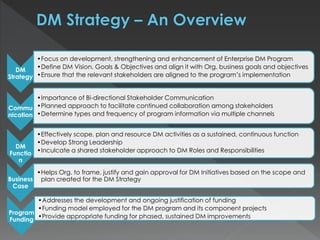
DM
Strategy
•Focus on development, strengthening and enhancement of Enterprise DM Program
•Define DM Vision, Goals & Objectives and align it with Org. business goals and objectives
•Ensure that the relevant stakeholders are aligned to the program’s implementation
Commu
nication
•Importance of Bi-directional Stakeholder Communication
•Planned approach to facilitate continued collaboration among stakeholders
•Determine types and frequency of program information via multiple channels
DM
Functio
n
•Effectively scope, plan and resource DM activities as a sustained, continuous function
•Develop Strong Leadership
•Inculcate a shared stakeholder approach to DM Roles and Responsibilities
Business
Case
•Helps Org. to frame, justify and gain approval for DM Initiatives based on the scope and
plan created for the DM Strategy
Program
Funding
•Addresses the development and ongoing justification of funding
•Funding model employed for the DM program and its component projects
•Provide appropriate funding for phased, sustained DM improvements
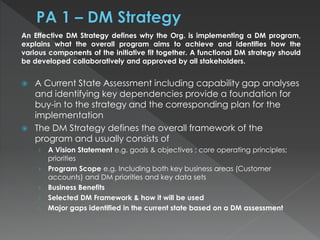
An Effective DM Strategy defines why the Org. is implementing a DM program,
explains what the overall program aims to achieve and identifies how the
various components of the initiative fit together. A functional DM strategy should
be developed collaboratively and approved by all stakeholders.
 A Current State Assessment including capability gap analyses
and identifying key dependencies provide a foundation for
buy-in to the strategy and the corresponding plan for the
implementation
 The DM Strategy defines the overall framework of the
program and usually consists of
› A Vision Statement e.g. goals & objectives ; core operating principles;
priorities
› Program Scope e.g. Including both key business areas (Customer
accounts) and DM priorities and key data sets
› Business Benefits
› Selected DM Framework & how it will be used
› Major gaps identified in the current state based on a DM assessment
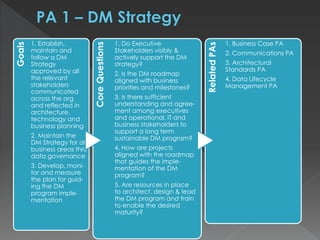
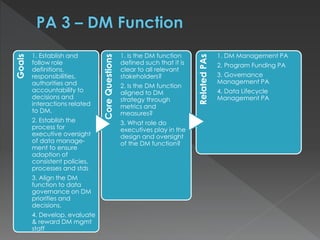
Goals
1. Establish,
maintain and
follow a DM
Strategy
approved by all
the relevant
stakeholders
communicated
across the org
and reflected in
architecture,
technology and
business planning
2. Maintain the
DM Strategy for all
business areas thru
data governance
3. Develop, moni-
tor and measure
the plan for guid-
ing the DM
program imple-
mentation
CoreQuestions
1. Do Executive
Stakeholders visibly &
actively support the DM
strategy?
2. Is the DM roadmap
aligned with business
priorities and milestones?
3. Is there sufficient
understanding and agree-
ment among executives
and operational, IT and
business stakeholders to
support a long term
sustainable DM program?
4. How are projects
aligned with the roadmap
that guides the imple-
mentation of the DM
program?
5. Are resources in place
to architect, design & lead
the DM program and train
to enable the desired
maturity? RelatedPAs
1. Business Case PA
2. Communications PA
3. Architectural
Standards PA
4. Data Lifecycle
Management PA
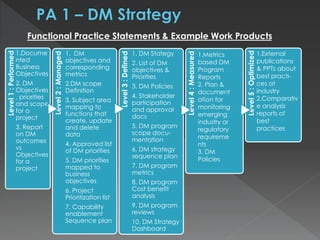
Level1:Performed
1.Docume
nted
Business
Objectives
2. DM
Objectives
, priorities
and scope
for a
project
3. Report
on DM
outcomes
vs
Objectives
for a
project
Level2:Managed
1. DM
objectives and
corresponding
metrics
2.DM scope
Definition
3. Subject area
mapping to
functions that
create, update
and delete
data
4. Approved list
of DM priorities
5. DM priorities
mapped to
business
objectives
6. Project
Prioritization list
7. Capability
enablement
Sequence plan
Level3:Defined
1. DM Stategy
2. List of DM
objectives &
Priorities
3. DM Policies
4. Stakeholder
participation
and approval
docs
5. DM program
scope docu-
mentation
6. DM strategy
sequence plan
7. DM program
metrics
8. DM program
Cost benefit
analysis
9. DM program
reviews
10. DM Strategy
Dashboard
Level4:Measured
Level5:Optimized
Functional Practice Statements & Example Work Products
1.Metrics
based DM
Program
Reports
2. Plan &
document
ation for
monitoring
emerging
industry or
regulatory
requireme
nts
3. DM
Policies
1.External
publications
& PPTs about
best practi-
ces at
industry
2.Comparativ
e analysis
reports of
best
practices
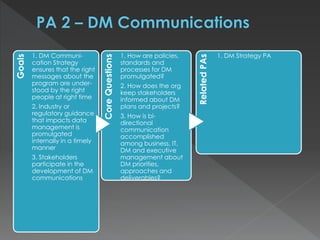
Goals
1. DM Communi-
cation Strategy
ensures that the right
messages about the
program are under-
stood by the right
people at right time
2. Industry or
regulatory guidance
that impacts data
management is
promulgated
internally in a timely
manner
3. Stakeholders
participate in the
development of DM
communications
CoreQuestions
1. How are policies,
standards and
processes for DM
promulgated?
2. How does the org
keep stakeholders
informed about DM
plans and projects?
3. How is bi-
directional
communication
accomplished
among business, IT,
DM and executive
management about
DM priorities,
approaches and
deliverables?
RelatedPAs
1. DM Strategy PA
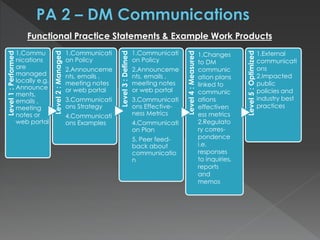
Level1:Performed
1.Commu
nications
are
managed
locally e.g.
Announce
ments,
emails ,
meeting
notes or
web portal
Level2:Managed
1.Communicati
on Policy
2.Announceme
nts, emails ,
meeting notes
or web portal
3.Communicati
ons Strategy
4.Communicati
ons Examples Level3:Defined
1.Communicati
on Policy
2.Announceme
nts, emails ,
meeting notes
or web portal
3.Communicati
ons Effective-
ness Metrics
4.Communicati
on Plan
5. Peer feed-
back about
communicatio
n
Level4:Measured
Level5:Optimized
Functional Practice Statements & Example Work Products
1.Changes
to DM
communic
ation plans
linked to
communic
ations
effectiven
ess metrics
2.Regulato
ry corres-
pondence
i.e.
responses
to inquiries,
reports
and
memos
1.External
communicati
ons
2.Impacted
public
policies and
industry best
practices
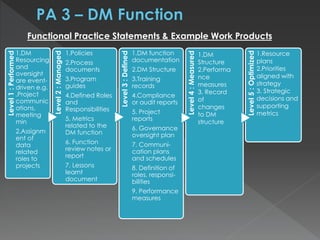
Goals
1. Establish and
follow role
definitions,
responsibilities,
authorities and
accountability to
decisions and
interactions related
to DM.
2. Establish the
process for
executive oversight
of data manage-
ment to ensure
adoption of
consistent policies,
processes and stds
3. Align the DM
function to data
governance on DM
priorities and
decisions.
4. Develop, evaluate
& reward DM mgmt
staff
CoreQuestions
1. Is the DM function
defined such that it is
clear to all relevant
stakeholders?
2. Is the DM function
aligned to DM
strategy through
metrics and
measures?
3. What role do
executives play in the
design and oversight
of the DM function?
RelatedPAs
1. DM Management PA
2. Program Funding PA
3. Governance
Management PA
4. Data Lifecycle
Management PA
Level1:Performed
1.DM
Resourcing
and
oversight
are event-
driven e.g.
.Project
communic
ations,
meeting
min
2.Assignm
ent of
data
related
roles to
projects
Level2:Managed
1.Policies
2.Process
documents
3.Program
guides
4.Defined Roles
and
Responsibilities
5. Metrics
related to the
DM function
6. Function
review notes or
report
7. Lessons
learnt
document
Level3:Defined
1.DM function
documentation
2.DM Structure
3.Training
records
4.Compliance
or audit reports
5. Project
reports
6. Governance
oversight plan
7. Communi-
cation plans
and schedules
8. Definition of
roles, responsi-
bilities
9. Performance
measures
Level4:Measured
Level5:Optimized
Functional Practice Statements & Example Work Products
1.DM
Structure
2.Performa
nce
measures
3. Record
of
changes
to DM
structure
1.Resource
plans
2.Priorities
aligned with
strategy
3. Strategic
decisions and
supporting
metrics
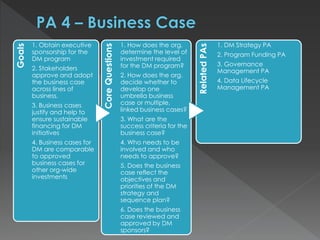
Goals
1. Obtain executive
sponsorship for the
DM program
2. Stakeholders
approve and adopt
the business case
across lines of
business.
3. Business cases
justify and help to
ensure sustainable
financing for DM
initiatives
4. Business cases for
DM are comparable
to approved
business cases for
other org-wide
investments
CoreQuestions
1. How does the org.
determine the level of
investment required
for the DM program?
2. How does the org.
decide whether to
develop one
umbrella business
case or multiple,
linked business cases?
3. What are the
success criteria for the
business case?
4. Who needs to be
involved and who
needs to approve?
5. Does the business
case reflect the
objectives and
priorities of the DM
strategy and
sequence plan?
6. Does the business
case reviewed and
approved by DM
sponsors?
RelatedPAs
1. DM Strategy PA
2. Program Funding PA
3. Governance
Management PA
4. Data Lifecycle
Management PA
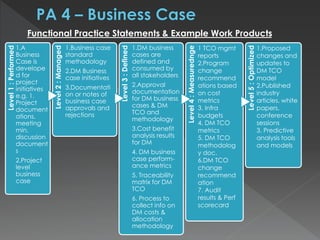
Level1:Performed
1.A
Business
Case is
develope
d for
project
initiatives
e.g. 1.
Project
document
ations,
meeting
min,
discussion
document
s
2.Project
level
business
case
Level2:Managed
1.Business case
standard
methodology
2.DM Business
case initiatives
3.Documentati
on or notes of
business case
approvals and
rejections
Level3:Defined
1.DM business
cases are
defined and
consumed by
all stakeholders
2.Approval
documentation
for DM business
cases & DM
TCO and
methodology
3.Cost benefit
analysis results
for DM
4. DM business
case perform-
ance metrics
5. Traceability
matrix for DM
TCO
6. Process to
collect info on
DM costs &
allocation
methodology
Level4:Measurednge
Level5:Optimized
Functional Practice Statements & Example Work Products
1 TCO mgmt
reports
2.Program
change
recommend
ations based
on cost
metrics
3. Infra
budgets
4. DM TCO
metrics
5. DM TCO
methodolog
y doc.
6.DM TCO
change
recommend
ation
7. Audit
results & Perf
scorecard
1.Proposed
changes and
updates to
DM TCO
model
2.Published
industry
articles, white
papers,
conference
sessions
3. Predictive
analysis tools
and models
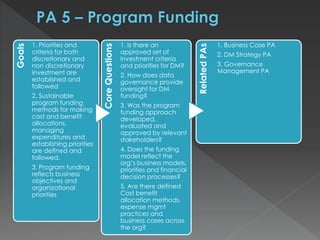
Goals
1. Priorities and
criteria for both
discretionary and
non discretionary
investment are
established and
followed
2. Sustainable
program funding
methods for making
cost and benefit
allocations,
managing
expenditures and
establishing priorities
are defined and
followed.
3. Program funding
reflects business
objectives and
organizational
priorities
CoreQuestions
1. Is there an
approved set of
investment criteria
and priorities for DM?
2. How does data
governance provide
oversight for DM
funding?
3. Was the program
funding approach
developed,
evaluated and
approved by relevant
stakeholders?
4. Does the funding
model reflect the
org’s business models,
priorities and financial
decision processes?
5. Are there defined
Cost benefit
allocation methods,
expense mgmt
practices and
business cases across
the org?
RelatedPAs
1. Business Case PA
2. DM Strategy PA
3. Governance
Management PA
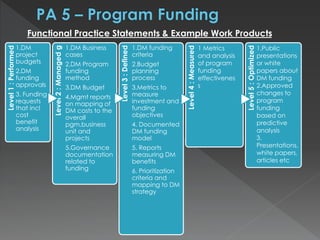
Level1:Performed
1.DM
project
budgets
2.DM
funding
approvals
3. Funding
requests
that incl
cost
benefit
analysis
Level2:Managedg
1.DM Business
cases
2.DM Program
funding
method
3.DM Budget
4.Mgmt reports
on mapping of
DM costs to the
overall
pgm,business
unit and
projects
5.Governance
documentation
related to
funding
Level3:Defined
1.DM funding
criteria
2.Budget
planning
process
3.Metrics to
measure
investment and
funding
objectives
4. Documented
DM funding
model
5. Reports
measuring DM
benefits
6. Prioritization
criteria and
mapping to DM
strategy Level4:Measured
Level5:Optimized
Functional Practice Statements & Example Work Products
1 Metrics
and analysis
of program
funding
effectivenes
s
1.Public
presentations
or white
papers about
DM funding
2.Approved
changes to
program
funding
based on
predictive
analysis
3.
Presentations,
white papers,
articles etc
Deep Dive into the Process Areas of
each Category
CATEGORY 2 : Data
Governance
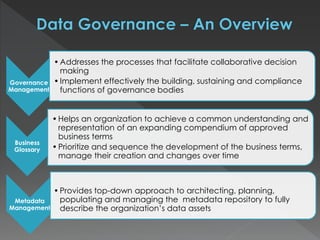
Governance
Management
•Addresses the processes that facilitate collaborative decision
making
•Implement effectively the building, sustaining and compliance
functions of governance bodies
Business
Glossary
•Helps an organization to achieve a common understanding and
representation of an expanding compendium of approved
business terms
•Prioritize and sequence the development of the business terms,
manage their creation and changes over time
Metadata
Management
•Provides top-down approach to architecting, planning,
populating and managing the metadata repository to fully
describe the organization’s data assets
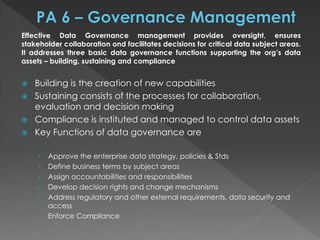
Effective Data Governance management provides oversight, ensures
stakeholder collaboration ond facilitates decisions for critical data subject areas.
It addresses three basic data governance functions supporting the org’s data
assets – building, sustaining and compliance
 Building is the creation of new capabilities
 Sustaining consists of the processes for collaboration,
evaluation and decision making
 Compliance is instituted and managed to control data assets
 Key Functions of data governance are
› Approve the enterprise data strategy, policies & Stds
› Define business terms by subject areas
› Assign accountabilities and responsibilities
› Develop decision rights and change mechanisms
› Address regulatory and other external requirements, data security and
access
› Enforce Compliance
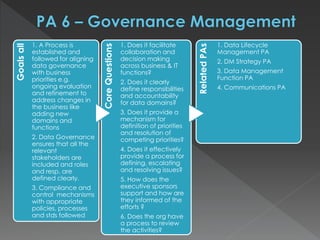
Goalsall
1. A Process is
established and
followed for aligning
data governance
with business
priorities e.g.
ongoing evaluation
and refinement to
address changes in
the business like
adding new
domains and
functions
2. Data Governance
ensures that all the
relevant
stakeholders are
included and roles
and resp. are
defined clearly.
3. Compliance and
control mechanisms
with appropriate
policies, processes
and stds followed
CoreQuestions
1. Does it facilitate
collaboration and
decision making
across business & IT
functions?
2. Does it clearly
define responsibilities
and accountability
for data domains?
3. Does it provide a
mechanism for
definition of priorities
and resolution of
competing priorities?
4. Does it effectively
provide a process for
defining, escalating
and resolving issues?
5. How does the
executive sponsors
support and how are
they informed of the
efforts ?
6. Does the org have
a process to review
the activities?
RelatedPAs
1. Data Lifecycle
Management PA
2. DM Strategy PA
3. Data Management
Function PA
4. Communications PA
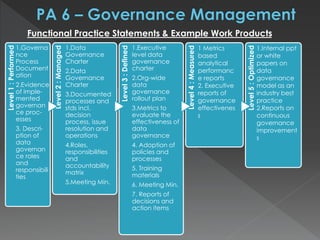
Level1:Performed
1.Governa
nce
Process
Document
ation
2.Evidence
of imple-
mented
governan
ce proc-
esses
3. Descri-
ption of
data
governan
ce roles
and
responsibili
ties
Level2:Managed
1.Data
Governance
Charter
2.Data
Governance
Charter
3.Documented
processes and
stds incl.
decision
process, issue
resolution and
operations
4.Roles,
responsibilities
and
accountability
matrix
5.Meeting Min.
Level3:Defined
1.Executive
level data
governance
charter
2.Org-wide
data
governance
rollout plan
3.Metrics to
evaluate the
effectiveness of
data
governance
4. Adoption of
policies and
processes
5. Training
materials
6. Meeting Min.
7. Reports of
decisions and
action items
Level4:Measured
Level5:Optimized
Functional Practice Statements & Example Work Products
1 Metrics
based
analytical
performanc
e reports
2. Executive
reports of
governance
effectivenes
s
1.Internal ppt
or white
papers on
data
governance
model as an
industry best
practice
2.Reports on
continuous
governance
improvement
s
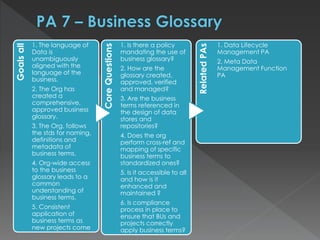
Goalsall
1. The language of
Data is
unambiguously
aligned with the
language of the
business.
2. The Org has
created a
comprehensive,
approved business
glossary.
3. The Org. follows
the stds for naming,
definitions and
metadata of
business terms.
4. Org-wide access
to the business
glossary leads to a
common
understanding of
business terms.
5. Consistent
application of
business terms as
new projects come
CoreQuestions
1. Is there a policy
mandating the use of
business glossary?
2. How are the
glossary created,
approved, verified
and managed?
3. Are the business
terms referenced in
the design of data
stores and
repositories?
4. Does the org
perform cross-ref and
mapping of specific
business terms to
standardized ones?
5. Is it accessible to all
and how is it
enhanced and
maintained ?
6. Is compliance
process in place to
ensure that BUs and
projects correctly
apply business terms?
RelatedPAs
1. Data Lifecycle
Management PA
2. Meta Data
Management Function
PA
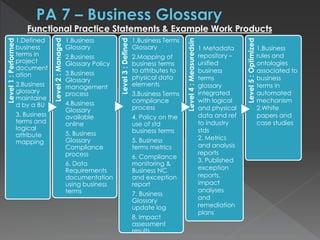
Level1:Performed
1.Defined
business
terms in
project
document
ation
2.Business
glossary
maintaine
d by a BU
3. Business
terms and
logical
attribute
mapping
Level2:Managed
1.Business
Glossary
2.Business
Glossary Policy
3.Business
Glossary
management
process
4.Business
Glossary
available
online
5. Business
Glossary
Compliance
process
6. Data
Requirements
documentation
using business
terms
Level3:Defined
1.Business Terms
Glossary
2.Mapping of
business terms
to attributes to
physical data
elements
3.Business Terms
compliance
process
4. Policy on the
use of std
business terms
5. Business
terms metrics
6. Compliance
monitoring &
Business NC
and exception
report
7. Business
Glossary
update log
8. Impact
assessment
results
Level4:Measuredsin
Level5:Optimized
Functional Practice Statements & Example Work Products
1 Metadata
repository –
unified
business
terms
glossary
integrated
with logical
and physical
data and ref
to industry
stds
2. Metrics
and analysis
reports
3. Published
exception
reports,
impact
analyses
and
remediation
plans
1.Business
rules and
ontologies
associated to
business
terms in
automated
mechanism
2.White
papers and
case studies
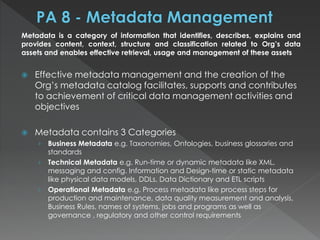
Metadata is a category of information that identifies, describes, explains and
provides content, context, structure and classification related to Org’s data
assets and enables effective retrieval, usage and management of these assets
 Effective metadata management and the creation of the
Org’s metadata catalog facilitates, supports and contributes
to achievement of critical data management activities and
objectives
 Metadata contains 3 Categories
› Business Metadata e.g. Taxonomies, Ontologies, business glossaries and
standards
› Technical Metadata e.g. Run-time or dynamic metadata like XML,
messaging and config. Information and Design-time or static metadata
like physical data models, DDLs, Data Dictionary and ETL scripts
› Operational Metadata e.g. Process metadata like process steps for
production and maintenance, data quality measurement and analysis,
Business Rules, names of systems, jobs and programs as well as
governance , regulatory and other control requirements
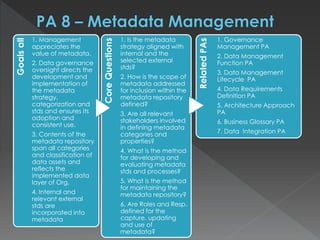
Goalsall
1. Management
appreciates the
value of metadata.
2. Data governance
oversight directs the
development and
implementation of
the metadata
strategy,
categorization and
stds and ensures its
adoption and
consistent use.
3. Contents of the
metadata repository
span all categories
and classification of
data assets and
reflects the
implemented data
layer of Org.
4. Internal and
relevant external
stds are
incorporated into
metadata
CoreQuestions
1. Is the metadata
strategy aligned with
internal and the
selected external
stds?
2. How is the scope of
metadata addressed
for inclusion within the
metadata repository
defined?
3. Are all relevant
stakeholders involved
in defining metadata
categories and
properties?
4. What is the method
for developing and
evaluating metadata
stds and processes?
5. What is the method
for maintaining the
metadata repository?
6. Are Roles and Resp.
defined for the
capture, updating
and use of
metadata?
RelatedPAs
1. Governance
Management PA
2. Data Management
Function PA
3. Data Management
Lifecycle PA
4. Data Requirements
Definition PA
5. Architecture Approach
PA
6. Business Glossary PA
7. Data Integration PA
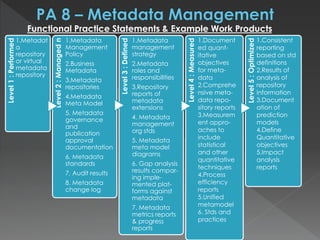
Level1:Performed
1.Metadat
a
repository
or virtual
metadata
repository
Level2:Managedn
1.Metadata
Management
Policy
2.Business
Metadata
3.Metadata
repositories
4.Metadata
Meta Model
5. Metadata
governance
and
publication
approval
documentation
6. Metadata
standards
7. Audit results
8. Metadata
change log
Level3:Defined
1.Metadata
management
strategy
2.Metadata
roles and
responsibilities
3.Repository
reports of
metadata
extensions
4. Metadata
management
org stds
5. Metadata
meta model
diagrams
6. Gap analysis
results compar-
ing imple-
mented plat-
forms against
metadata
7. Metadata
metrics reports
& progress
reports
Level4:Measured
Level5:Optimized
Functional Practice Statements & Example Work Products
1.Document
ed quant-
itative
objectives
for meta-
data
2.Comprehe
nsive meta-
data repo-
sitory reports
3.Measurem
ent appro-
aches to
include
statistical
and other
quantitative
techniques
4.Process
efficiency
reports
5.Unified
metamodel
6. Stds and
practices
1.Consistent
reporting
based on std
definitions
2.Results of
analysis of
repository
information
3.Document
ation of
prediction
models
4.Define
Quantitative
objectives
5.Impact
analysis
reports
Deep Dive into the Process Areas of
each Category
CATEGORY 3 : Data Quality
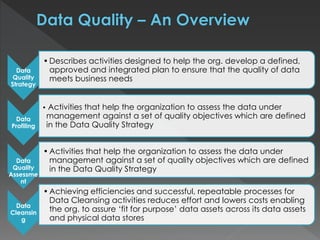
Data
Quality
Strategy
•Describes activities designed to help the org. develop a defined,
approved and integrated plan to ensure that the quality of data
meets business needs
Data
Profiling
• Activities that help the organization to assess the data under
management against a set of quality objectives which are defined
in the Data Quality Strategy
Data
Quality
Assessme
nt
•Activities that help the organization to assess the data under
management against a set of quality objectives which are defined
in the Data Quality Strategy
Data
Cleansin
g
•Achieving efficiencies and successful, repeatable processes for
Data Cleansing activities reduces effort and lowers costs enabling
the org. to assure ‘fit for purpose’ data assets across its data assets
and physical data stores
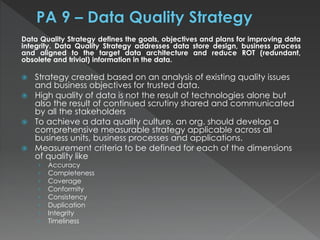
Data Quality Strategy defines the goals, objectives and plans for improving data
integrity. Data Quality Strategy addresses data store design, business process
and aligned to the target data architecture and reduce ROT (redundant,
obsolete and trivial) information in the data.
 Strategy created based on an analysis of existing quality issues
and business objectives for trusted data.
 High quality of data is not the result of technologies alone but
also the result of continued scrutiny shared and communicated
by all the stakeholders
 To achieve a data quality culture, an org. should develop a
comprehensive measurable strategy applicable across all
business units, business processes and applications.
 Measurement criteria to be defined for each of the dimensions
of quality like
› Accuracy
› Completeness
› Coverage
› Conformity
› Consistency
› Duplication
› Integrity
› Timeliness
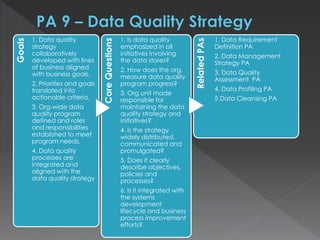
Goals
1. Data quality
strategy
collaboratively
developed with lines
of business aligned
with business goals.
2. Priorities and goals
translated into
actionable criteria.
3. Org-wide data
quality program
defined and roles
and responsibilities
established to meet
program needs.
4. Data quality
processes are
integrated and
aligned with the
data quality strategy
CoreQuestions
1. Is data quality
emphasized in all
initiatives involving
the data stores?
2. How does the org.
measure data quality
program progress?
3. Org unit made
responsible for
maintaining the data
quality strategy and
initiatives?
4. Is the strategy
widely distributed,
communicated and
promulgated?
5. Does it clearly
describe objectives,
policies and
processes?
6. Is it integrated with
the systems
development
lifecycle and business
process improvement
efforts?
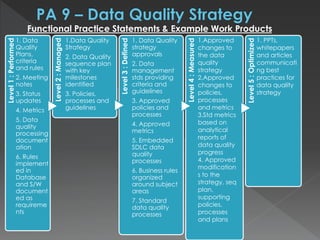
RelatedPAs
1. Data Requirement
Definition PA
2. Data Management
Strategy PA
3. Data Quality
Assessment PA
4. Data Profiling PA
5 Data Cleansing PA
Level1:Performed
1. Data
Quality
Plans,
criteria
and rules
2. Meeting
notes
3. Status
updates
4. Metrics
5. Data
quality
processing
document
ation
6. Rules
implement
ed in
Database
and S/W
document
ed as
requireme
nts
Level2:Managed
1.Data Quality
Strategy
2. Data Quality
sequence plan
with key
milestones
identified
3. Policies,
processes and
guidelines
Level3:Defined
1. Data Quality
strategy
approvals
2. Data
management
stds providing
criteria and
guidelines
3. Approved
policies and
processes
4. Approved
metrics
5. Embedded
SDLC data
quality
processes
6. Business rules
organized
around subject
areas
7. Standard
data quality
processes
Level4:Measured
Level5:Optimized
Functional Practice Statements & Example Work Products
1.Approved
changes to
the data
quality
strategy
2.Approved
changes to
policies,
processes
and metrics
3.Std metrics
based on
analytical
reports of
data quality
progress
4. Approved
modification
s to the
strategy, seq
plan,
supporting
policies,
processes
and plans
1. PPTs,
whitepapers
and articles
communicati
ng best
practices for
data quality
strategy
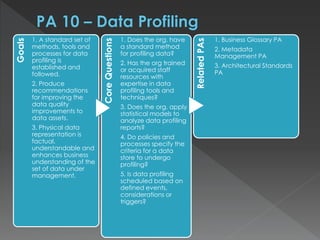
Goals
1. A standard set of
methods, tools and
processes for data
profiling is
established and
followed.
2. Produce
recommendations
for improving the
data quality
improvements to
data assets.
3. Physical data
representation is
factual,
understandable and
enhances business
understanding of the
set of data under
management.
CoreQuestions
1. Does the org. have
a standard method
for profiling data?
2. Has the org trained
or acquired staff
resources with
expertise in data
profiling tools and
techniques?
3. Does the org. apply
statistical models to
analyze data profiling
reports?
4. Do policies and
processes specify the
criteria for a data
store to undergo
profiling?
5. Is data profiling
scheduled based on
defined events,
considerations or
triggers? RelatedPAs
1. Business Glossary PA
2. Metadata
Management PA
3. Architectural Standards
PA
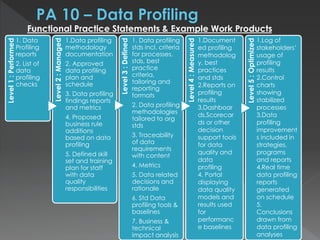
Level1:Performed
1. Data
Profiling
reports
2. List of
data
profiling
checks
Level2:Managed
1.Data profiling
methodology
documentation
2. Approved
data profiling
plan and
schedule
3. Data profiling
findings reports
and metrics
4. Proposed
business rule
additions
based on data
profiling
5. Defined skill
set and training
plan for staff
with data
quality
responsibilities
Level3:Defined
1. Data profiling
stds incl. criteria
for processes,
stds, best
practice
criteria,
tailoring and
reporting
formats
2. Data profiling
methodologies
tailored to org
stds
3. Traceability
of data
requirements
with content
4. Metrics
5. Data related
decisions and
rationale
6. Std Data
profiling tools &
baselines
7. Business &
technical
impact analysis
Level4:Measured
Level5:Optimized
Functional Practice Statements & Example Work Products
1.Document
ed profiling
methodolog
y, best
practices
and stds
2.Reports on
profiling
results
3.Dashboar
ds,Scorecar
ds or other
decision
support tools
for data
quality and
data
profiling
4. Portal
displaying
data quality
models and
results used
for
performanc
e baselines
1.Log of
stakeholders’
usage of
profiling
results
2.Control
charts
showing
stabilized
processes
3.Data
profiling
improvement
s included in
strategies,
programs
and reports
4.Real time
data profiling
reports
generated
on schedule
5.
Conclusions
drawn from
data profiling
analyses
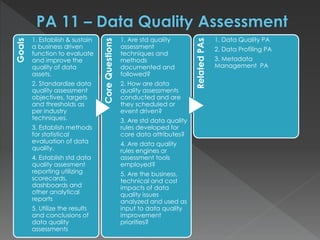
Goals
1. Establish & sustain
a business driven
function to evaluate
and improve the
quality of data
assets.
2. Standardize data
quality assessment
objectives, targets
and thresholds as
per industry
techniques.
3. Establish methods
for statistical
evaluation of data
quality.
4. Establish std data
quality assesment
reporting utilizing
scorecards,
dashboards and
other analytical
reports
5. Utilize the results
and conclusions of
data quality
assessments
CoreQuestions
1. Are std quality
assessment
techniques and
methods
documented and
followed?
2. How are data
quality assessments
conducted and are
they scheduled or
event driven?
3. Are std data quality
rules developed for
core data attributes?
4. Are data quality
rules engines or
assessment tools
employed?
5. Are the business,
technical and cost
impacts of data
quality issues
analyzed and used as
input to data quality
improvement
priorities?
RelatedPAs
1. Data Quality PA
2. Data Profiling PA
3. Metadata
Management PA
Level1:Performed
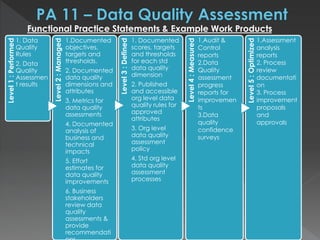
1. Data
Quality
Rules
2. Data
Quality
Assessmen
t results
Level2:Managed
1.Documented
objectives,
targets and
thresholds.
2. Documented
data quality
dimensions and
attributes
3. Metrics for
data quality
assessments
4. Documented
analysis of
business and
technical
impacts
5. Effort
estimates for
data quality
improvements
6. Business
stakeholders
review data
quality
assessments &
provide
recommendati
Level3:Defined
1. Documented
scores, targets
and thresholds
for each std
data quality
dimension
2. Published
and accessible
org level data
quality rules for
approved
attributes
3. Org level
data quality
assessment
policy
4. Std org level
data quality
assessment
processes
Level4:Measured
Level5:Optimized
Functional Practice Statements & Example Work Products
1.Audit &
Control
reports
2.Data
Quality
assessment
progress
reports for
improvemen
ts
3.Data
quality
confidence
surveys
1.Assessment
analysis
reports
2. Process
review
documentati
on
3. Process
improvement
proposals
and
approvals
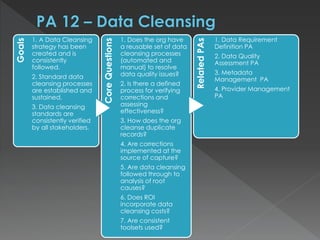
Goals
1. A Data Cleansing
strategy has been
created and is
consistently
followed.
2. Standard data
cleansing processes
are established and
sustained.
3. Data cleansing
standards are
consistently verified
by all stakeholders.
CoreQuestions
1. Does the org have
a reusable set of data
cleansing processes
(automated and
manual) to resolve
data quality issues?
2. Is there a defined
process for verifying
corrections and
assessing
effectiveness?
3. How does the org
cleanse duplicate
records?
4. Are corrections
implemented at the
source of capture?
5. Are data cleansing
followed through to
analysis of root
causes?
6. Does ROI
incorporate data
cleansing costs?
7. Are consistent
toolsets used?
RelatedPAs
1. Data Requirement
Definition PA
2. Data Quality
Assessment PA
3. Metadata
Management PA
4. Provider Management
PA
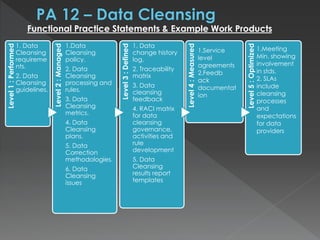
Level1:Performed
1. Data
Cleansing
requireme
nts.
2. Data
Cleansing
guidelines.
Level2:Managed
1.Data
Cleansing
policy.
2. Data
Cleansing
processing and
rules.
3. Data
Cleansing
metrics.
4. Data
Cleansing
plans.
5. Data
Correction
methodologies.
6. Data
Cleansing
issues
Level3:Defined
1. Data
change history
log.
2. Traceability
matrix
3. Data
cleansing
feedback
4. RACI matrix
for data
cleansing
governance,
activities and
rule
development
5. Data
Cleansing
results report
templates
Level4:Measured
Level5:Optimized
Functional Practice Statements & Example Work Products
1.Service
level
agreements
2.Feedb
ack
documentat
ion
1.Meeting
Min. showing
involvement
in stds.
2. SLAs
include
cleansing
processes
and
expectations
for data
providers
Deep Dive into the Process Areas of each
Category
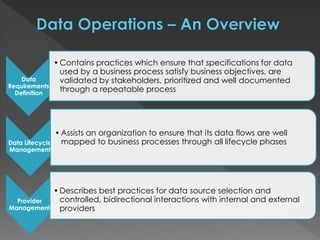
CATEGORY 4 : Data Operations
Data
Requirements
Definition
•Contains practices which ensure that specifications for data
used by a business process satisfy business objectives, are
validated by stakeholders, prioritized and well documented
through a repeatable process
Data Lifecycle
Management
•Assists an organization to ensure that its data flows are well
mapped to business processes through all lifecycle phases
Provider
Management
•Describes best practices for data source selection and
controlled, bidirectional interactions with internal and external
providers
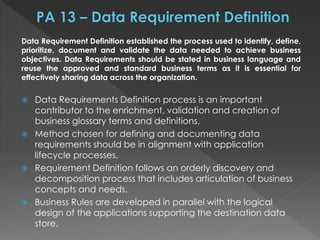
Data Requirement Definition established the process used to identify, define,
prioritize, document and validate the data needed to achieve business
objectives. Data Requirements should be stated in business language and
reuse the approved and standard business terms as it is essential for
effectively sharing data across the organization.
 Data Requirements Definition process is an important
contributor to the enrichment, validation and creation of
business glossary terms and definitions.
 Method chosen for defining and documenting data
requirements should be in alignment with application
lifecycle processes.
 Requirement Definition follows an orderly discovery and
decomposition process that includes articulation of business
concepts and needs.
 Business Rules are developed in parallel with the logical
design of the applications supporting the destination data
store.
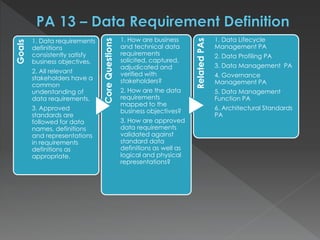
Goals
1. Data requirements
definitions
consistently satisfy
business objectives.
2. All relevant
stakeholders have a
common
understanding of
data requirements.
3. Approved
standards are
followed for data
names, definitions
and representations
in requirements
definitions as
appropriate.
CoreQuestions
1. How are business
and technical data
requirements
solicited, captured,
adjudicated and
verified with
stakeholders?
2. How are the data
requirements
mapped to the
business objectives?
3. How are approved
data requirements
validated against
standard data
definitions as well as
logical and physical
representations?
RelatedPAs
1. Data Lifecycle
Management PA
2. Data Profiling PA
3. Data Management PA
4. Governance
Management PA
5. Data Management
Function PA
6. Architectural Standards
PA
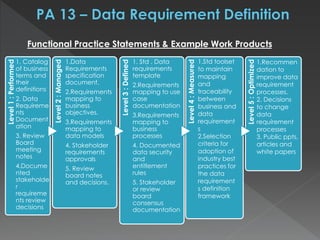
Level1:Performed
1. Catalog
of business
terms and
their
definitions
2. Data
Requireme
nts
Document
ation
3. Review
Board
meeting
notes
4.Docume
nted
stakeholde
r
requireme
nts review
decisions
Level2:Managed 1.Data
Requirements
specification
document.
2.Requirements
mapping to
business
objectives.
3.Requirements
mapping to
data models
4. Stakeholder
requirements
approvals
5. Review
board notes
and decisions.
Level3:Defined
1. Std . Data
requirements
template
2.Requirements
mapping to use
case
documentation
3.Requirements
mapping to
business
processes
4. Documented
data security
and
entitlement
rules
5. Stakeholder
or review
board
consensus
documentation
Level4:Measured
Level5:Optimized
Functional Practice Statements & Example Work Products
1.Std toolset
to maintain
mapping
and
traceability
between
business and
data
requirement
s
2.Selection
criteria for
adoption of
industry best
practices for
the data
requirement
s definition
framework
1.Recommen
dation to
improve data
requirement
processes.
2. Decisions
to change
data
requirement
processes
3. Public ppts,
articles and
white papers
Goals
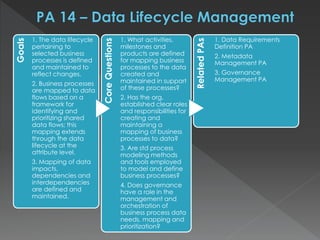
1. The data lifecycle
pertaining to
selected business
processes is defined
and maintained to
reflect changes.
2. Business processes
are mapped to data
flows based on a
framework for
identifying and
prioritizing shared
data flows; this
mapping extends
through the data
lifecycle at the
attribute level.
3. Mapping of data
impacts,
dependencies and
interdependencies
are defined and
maintained.
CoreQuestions
1. What activities,
milestones and
products are defined
for mapping business
processes to the data
created and
maintained in support
of these processes?
2. Has the org.
established clear roles
and responsibilities for
creating and
maintaining a
mapping of business
processes to data?
3. Are std process
modeling methods
and tools employed
to model and define
business processes?
4. Does governance
have a role in the
management and
orchestration of
business process data
needs, mapping and
prioritization?
RelatedPAs
1. Data Requirements
Definition PA
2. Metadata
Management PA
3. Governance
Management PA
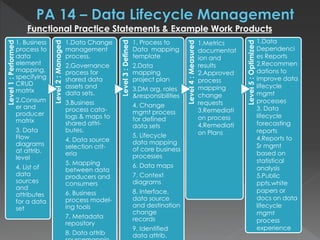
Level1:Performed
1. Business
process to
data
element
mapping,
specifying
CRUD
matrix
2.Consum
er and
producer
matrix
3. Data
Flow
diagrams
at attrib.
level
4. List of
data
sources
and
attributes
for a data
set
Level2:Managed
1.Data Change
management
process.
2.Governance
process for
shared data
assets and
data sets.
3.Business
process cata-
logs & maps to
shared attri-
butes.
4. Data source
selection crit-
eria
5. Mapping
between data
producers and
consumers
6. Business
process model-
ing tools
7. Metadata
repository
8. Data attrib
Level3:Defined
1. Process to
Data mapping
template
2.Data
mapping
project plan
3.DM org. roles
&responsibilities
4. Change
mgmt process
for defined
data sets
5. Lifecycle
data mapping
of core business
processes
6. Data maps
7. Context
diagrams
8. Interface,
data source
and destination
change
records
9. Identified
data attrib.
Level4:Measured
Level5:Optimized
Functional Practice Statements & Example Work Products
1.Metrics
documentat
ion and
results
2.Approved
process
mapping
change
requests
3.Remediati
on process
4.Remediati
on Plans
1.Data
Dependenci
es Reports
2.Recommen
dations to
improve data
lifecycle
mgmt
processes
3. Data
lifecycle
forecasting
reports
4.Reports to
Sr mgmt
based on
statistical
analysis
5.Public
ppts,white
papers or
docs on data
lifecycle
mgmt
process
experience
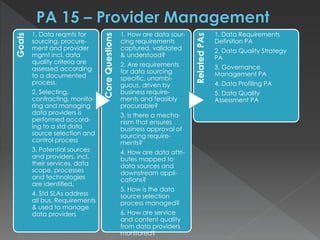
Goals
1. Data reqmts for
sourcing, procure-
ment and provider
mgmt incl. data
quality criteria are
assessed according
to a documented
process.
2. Selecting,
contracting, monito-
ring and managing
data providers is
performed accord-
ing to a std data
source selection and
control process
3. Potential sources
and providers, incl.
their services, data
scope, processes
and technologies
are identified.
4. Std SLAs address
all bus. Requirements
& used to manage
data providers
CoreQuestions
1. How are data sour-
cing requirements
captured, validated
& understood?
2. Are requirements
for data sourcing
specific, unambi-
guous, driven by
business require-
ments and feasibly
procurable?
3. Is there a mecha-
nism that ensures
business approval of
sourcing require-
ments?
4. How are data attri-
butes mapped to
data sources and
downstream appli-
cations?
5. How is the data
source selection
process managed?
6. How are service
and content quality
from data providers
monitored?
RelatedPAs
1. Data Requirements
Definition PA
2. Data Quality Strategy
PA
3. Governance
Management PA
4. Data Profiling PA
5. Data Quality
Assessment PA
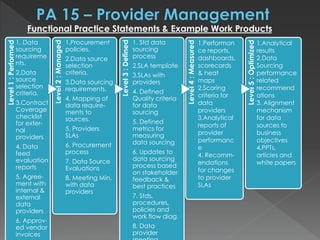
Level1:Performed
1. Data
sourcing
requireme
nts.
2.Data
source
selection
criteria.
3.Contract
Coverage
checklist
for exter-
nal
providers
4. Data
feed
evaluation
reports
5. Agree-
ment with
internal &
external
data
providers
6. Approv-
ed vendor
invoices
Level2:Managed
1.Procurement
policies.
2.Data source
selection
criteria.
3.Data sourcing
requirements.
4. Mapping of
data require-
ments to
sources.
5. Providers
SLAs
6. Procurement
process
7. Data Source
Evaluations
8. Meeting Min.
with data
providers
Level3:Defined
1. Std data
sourcing
process
2.SLA template
3.SLAs with
providers
4. Defined
Quality criteria
for data
sourcing
5. Defined
metrics for
measuring
data sourcing
6. Updates to
data sourcing
process based
on stakeholder
feedback &
best practices
7. Stds,
procedures,
policies and
work flow diag.
8. Data
provider
Level4:Measured
Level5:Optimized
Functional Practice Statements & Example Work Products
1.Performan
ce reports,
dashboards,
scorecards
& heat
maps
2.Scoring
criteria for
data
providers
3.Analytical
reports of
provider
performanc
e
4. Recomm-
endations
for changes
to provider
SLAs
1.Analytical
results
2.Data
Sourcing
performance
related
recommend
ations
3. Alignment
mechanism
for data
sources to
business
objectives
4.PPTs,
articles and
white papers
Deep Dive into the Process Areas of each
Category
CATEGORY 5 : Platform and
Architecture
Architec
tural
Approac
h
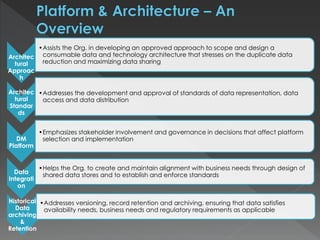
•Assists the Org. in developing an approved approach to scope and design a
consumable data and technology architecture that stresses on the duplicate data
reduction and maximizing data sharing
Architec
tural
Standar
ds
•Addresses the development and approval of standards of data representation, data
access and data distribution
DM
Platform
•Emphasizes stakeholder involvement and governance in decisions that affect platform
selection and implementation
Data
Integrati
on
•Helps the Org. to create and maintain alignment with business needs through design of
shared data stores and to establish and enforce standards
Historical
Data
archiving
&
Retention
•Addresses versioning, record retention and archiving, ensuring that data satisfies
availability needs, business needs and regulatory requirements as applicable
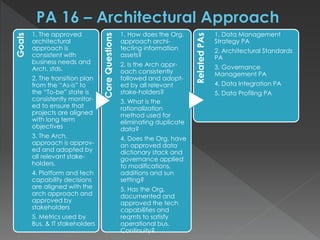
Goals
1. The approved
architectural
approach is
consistent with
business needs and
Arch. stds.
2. The transition plan
from the “As-is” to
the “To-be” state is
consistently monitor-
ed to ensure that
projects are aligned
with long term
objectives
3. The Arch.
approach is approv-
ed and adopted by
all relevant stake-
holders.
4. Platform and tech
capability decisions
are aligned with the
arch approach and
approved by
stakeholders
5. Metrics used by
Bus. & IT stakeholders
CoreQuestions
1. How does the Org.
approach archi-
tecting information
assets?
2. Is the Arch appr-
oach consistently
followed and adopt-
ed by all relevant
stake-holders?
3. What is the
rationalization
method used for
eliminating duplicate
data?
4. Does the Org. have
an approved data
dictionary stack and
governance applied
to modifications,
additions and sun
setting?
5. Has the Org.
documented and
approved the tech
capabilities and
reqmts to satisfy
operational bus.
Continuity?
RelatedPAs
1. Data Management
Strategy PA
2. Architectural Standards
PA
3. Governance
Management PA
4. Data Integration PA
5. Data Profiling PA
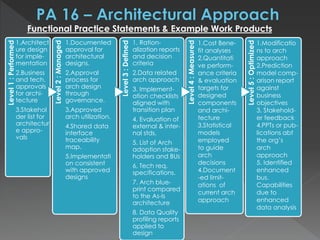
Level1:Performed
1.Architect
ure design
for imple-
mentation
2.Business
and tech.
approvals
for archi-
tecture
3.Stakehol
der list for
architectur
e appro-
vals
Level2:Managed
1.Documented
approval for
architectural
designs.
2.Approval
process for
arch design
through
governance.
3.Approved
arch utilization.
4.Shared data
interface
traceability
map.
5.Implementati
on consistent
with approved
designs
Level3:Defined
1. Ration-
alization reports
and decision
criteria
2.Data related
arch approach
3. Implement-
ation checklists
aligned with
transition plan
4. Evaluation of
external & inter-
nal stds.
5. List of Arch
adoption stake-
holders and BUs
6. Tech req.
specifications.
7. Arch blue-
print compared
to the As-Is
architecture
8. Data Quality
profiling reports
applied to
design
Level4:Measured
Level5:Optimized
Functional Practice Statements & Example Work Products
1.Cost Bene-
fit analyses
2.Quantitati
ve perform-
ance criteria
& evaluation
targets for
designed
components
and archi-
tecture
3.Statistical
models
employed
to guide
arch
decisions
4.Document
-ed limit-
ations of
current arch
approach
1.Modificatio
ns to arch
approach
2.Prediction
model comp-
arison report
against
business
objectives
3. Stakehold-
er feedback
4.PPTs or pub-
lications abt
the org’s
arch
approach
5. Identified
enhanced
bus.
Capabilities
due to
enhanced
data analysis
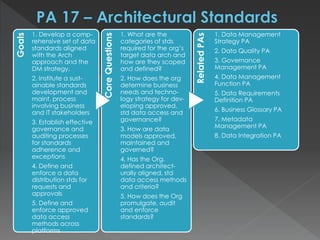
Goals
1. Develop a comp-
rehensive set of data
standards aligned
with the Arch
approach and the
DM strategy.
2. Institute a sust-
ainable standards
development and
maint. process
involving business
and IT stakeholders
3. Establish effective
governance and
auditing processes
for standards
adherence and
exceptions
4. Define and
enforce a data
distribution stds for
requests and
approvals
5. Define and
enforce approved
data access
methods across
platforms
CoreQuestions
1. What are the
categories of stds
required for the org’s
target data arch and
how are they scoped
and defined?
2. How does the org
determine business
needs and techno-
logy strategy for dev-
eloping approved,
std data access and
governance?
3. How are data
models approved,
maintained and
governed?
4. Has the Org.
defined architect-
urally aligned, std
data access methods
and criteria?
5. How does the Org
promulgate, audit
and enforce
standards?
RelatedPAs
1. Data Management
Strategy PA
2. Data Quality PA
3. Governance
Management PA
4. Data Management
Function PA
5. Data Requirements
Definition PA
6. Business Glossary PA
7. Metadata
Management PA
8. Data Integration PA
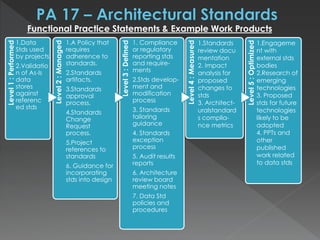
Level1:Performed
1.Data
Stds used
by projects
2.Validatio
n of As-Is
data
stores
against
referenc
ed stds
Level2:Managed
1.A Policy that
requires
adherence to
standards.
2.Standards
artifacts.
3.Standards
approval
process.
4.Standards
Change
Request
process.
5.Project
references to
standards
6. Guidance for
incorporating
stds into design
Level3:Defined
1. Compliance
or regulatory
reporting stds
and require-
ments
2.Stds develop-
ment and
modification
process
3. Standards
tailoring
guidance
4. Standards
exception
process
5. Audit results
reports
6. Architecture
review board
meeting notes
7. Data Std
policies and
procedures
Level4:Measured
Level5:Optimized
Functional Practice Statements & Example Work Products
1.Standards
review docu
mentation
2. Impact
analysis for
proposed
changes to
stds
3. Architect-
uralstandard
s complia-
nce metrics
1.Engageme
nt with
external stds
bodies
2.Research of
emerging
technologies
3. Proposed
stds for future
technologies
likely to be
adopted
4. PPTs and
other
published
work related
to data stds
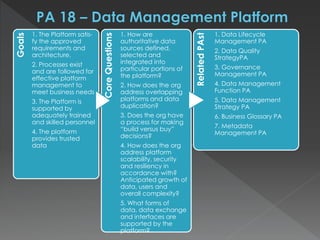
Goals
1. The Platform satis-
fy the approved
requirements and
architecture.
2. Processes exist
and are followed for
effective platform
management to
meet business needs
3. The Platform is
supported by
adequately trained
and skilled personnel
4. The platform
provides trusted
data
CoreQuestions
1. How are
authoritative data
sources defined,
selected and
integrated into
particular portions of
the platform?
2. How does the org
address overlapping
platforms and data
duplication?
3. Does the org have
a process for making
“build versus buy”
decisions?
4. How does the org
address platform
scalability, security
and resiliency in
accordance with?
Anticipated growth of
data, users and
overall complexity?
5. What forms of
data, data exchange
and interfaces are
supported by the
platform?
RelatedPAst
1. Data Lifecycle
Management PA
2. Data Quality
StrategyPA
3. Governance
Management PA
4. Data Management
Function PA
5. Data Management
Strategy PA
6. Business Glossary PA
7. Metadata
Management PA
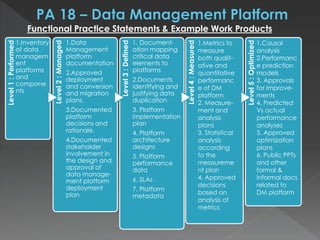
Level1:Performed
1.Inventory
of data
managem
ent
platforms
and
compone
nts
Level2:Managed
1.Data
Management
platform
documentation
2.Approved
deployment
and conversion
and migration
plans.
3.Documented
platform
decisions and
rationale.
4.Documented
stakeholder
involvement in
the design and
approval of
data manage-
ment platform
deployment
plan
Level3:Defined
1. Document-
ation mapping
critical data
elements to
platforms
2.Documents
identifying and
justifying data
duplication
3. Platform
implementation
plan
4. Platform
architecture
designs
5. Platform
performance
data
6. SLAs
7. Platform
metadata
Level4:Measured
Level5:Optimized
Functional Practice Statements & Example Work Products
1.Metrics to
measure
both qualit-
ative and
quantitative
performanc
e of DM
platform
2. Measure-
ment and
analysis
plans
3. Statistical
analysis
according
to the
measureme
nt plan
4. Approved
decisions
based on
analysis of
metrics
1.Causal
analysis
2.Performanc
e prediction
models
3. Approvals
for improve-
ments
4. Predicted
Vs actual
performance
analyses
5. Approved
optimization
plans
6. Public PPTs
and other
formal &
informal docs
related to
DM platform
Goals
1. Establish and
follow a consistent
process to ensure
ongoing business &
technology align-
ment for data
integration.
2. Data Integration is
performed utilizing
std processes and
toolsets that enable
compliance with
data architecture
stds & data quality
requirements
3. Proactively
research and eval-
uate integration
technologies for
application and
adoption
4. Establish, manage
data conversion,
transformation and
enrichment so that
the data is fully
processed & meets
quality stds
CoreQuestions
1. How are data
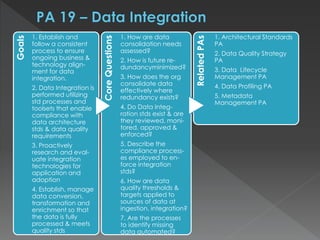
consolidation needs
assessed?
2. How is future re-
dundancyminimized?
3. How does the org
consolidate data
effectively where
redundancy exists?
4. Do Data Integ-
ration stds exist & are
they reviewed, moni-
tored, approved &
enforced?
5. Describe the
compliance process-
es employed to en-
force integration
stds?
6. How are data
quality thresholds &
targets applied to
sources of data at
ingestion, integration?
7. Are the processes
to identify missing
data automated?
RelatedPAs
1. Architectural Standards
PA
2. Data Quality Strategy
PA
3. Data Lifecycle
Management PA
4. Data Profiling PA
5. Metadata
Management PA
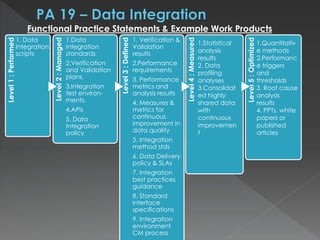
Level1:Performed
1. Data
Integration
scripts
Level2:Managed
1.Data
Integration
standards
2.Verification
and Validation
plans.
3.Integration
test environ-
ments.
4.APIs
5. Data
Integration
policy
Level3:Defined
1. Verification &
Validation
results
2.Performance
requirements
3. Performance
metrics and
analysis results
4. Measures &
metrics for
continuous
improvement in
data quality
5. Integration
method stds
6. Data Delivery
policy & SLAs
7. Integration
best practices
guidance
8. Standard
interface
specifications
9. Integration
environment
CM process
Level4:Measured
Level5:Optimized
Functional Practice Statements & Example Work Products
1.Statistical
analysis
results
2. Data
profiling
analyses
3.Consolidat
ed highly
shared data
with
continuous
improvemen
t
1.Quantitativ
e methods
2.Performanc
e triggers
and
thresholds
3. Root cause
analysis
results
4. PPTs, white
papers or
published
articles
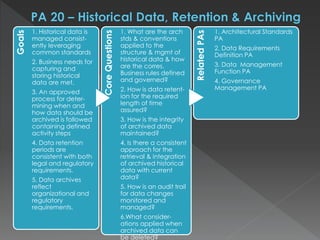
Goals
1. Historical data is
managed consist-
ently leveraging
common standards
2. Business needs for
capturing and
storing historical
data are met.
3. An approved
process for deter-
mining when and
how data should be
archived is followed
containing defined
activity steps
4. Data retention
periods are
consistent with both
legal and regulatory
requirements.
5. Data archives
reflect
organizational and
regulatory
requirements.
CoreQuestions
1. What are the arch
stds & conventions
applied to the
structure & mgmt of
historical data & how
are the corres.
Business rules defined
and governed?
2. How is data retent-
ion for the required
length of time
assured?
3. How is the integrity
of archived data
maintained?
4. Is there a consistent
approach for the
retrieval & integration
of archived historical
data with current
data?
5. How is an audit trail
for data changes
monitored and
managed?
6.What consider-
ations applied when
archived data can
be deleted?
RelatedPAs
1. Architectural Standards
PA
2. Data Requirements
Definition PA
3. Data Management
Function PA
4. Governance
Management PA
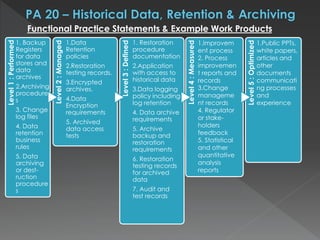
Level1:Performed
1. Backup
Registers
for data
stores and
data
archives
2.Archiving
procedure
s
3. Change
log files
4. Data
retention
business
rules
5. Data
archiving
or dest-
ruction
procedure
s
Level2:Managed
1.Data
Retention
policies
2.Restoration
testing records.
3.Encrypted
archives.
4.Data
Encryption
requirements
5. Archived
data access
tests
Level3:Defined
1. Restoration
procedure
documentation
2.Application
with access to
historical data
3.Data logging
policy including
log retention
4. Data archive
requirements
5. Archive
backup and
restoration
requirements
6. Restoration
testing records
for archived
data
7. Audit and
test records
Level4:Measured
Level5:Optimized
Functional Practice Statements & Example Work Products
1.Improvem
ent process
2. Process
improvemen
t reports and
records
3.Change
manageme
nt records
4. Regulator
or stake-
holders
feedback
5. Statistical
and other
quantitative
analysis
reports
1.Public PPTs,
white papers,
articles and
other
documents
communicati
ng processes
and
experience
SUPPORTING PROCESSES
INFRASTRUCTURE SUPPORT
PRACTICES
Measure
ment &
Analysis
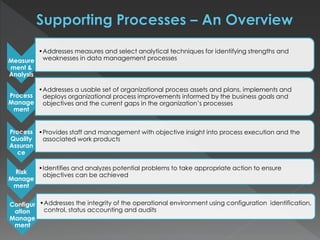
•Addresses measures and select analytical techniques for identifying strengths and
weaknesses in data management processes
Process
Manage
ment
•Addresses a usable set of organizational process assets and plans, implements and
deploys organizational process improvements informed by the business goals and
objectives and the current gaps in the organization’s processes
Process
Quality
Assuran
ce
•Provides staff and management with objective insight into process execution and the
associated work products
Risk
Manage
ment
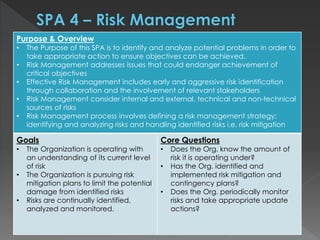
•Identifies and analyzes potential problems to take appropriate action to ensure
objectives can be achieved
Configur
ation
Manage
ment
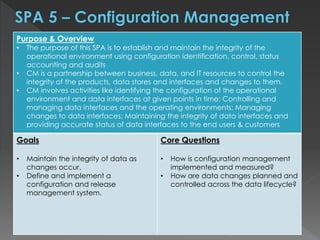
•Addresses the integrity of the operational environment using configuration identification,
control, status accounting and audits
Purpose & Overview
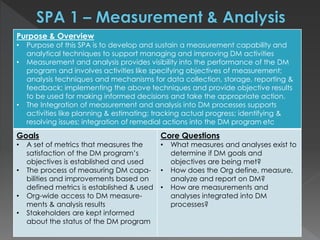
• Purpose of this SPA is to develop and sustain a measurement capability and
analytical techniques to support managing and improving DM activities
• Measurement and analysis provides visibility into the performance of the DM
program and involves activities like specifying objectives of measurement;
analysis techniques and mechanisms for data collection, storage, reporting &
feedback; implementing the above techniques and provide objective results
to be used for making informed decisions and take the appropriate action.
• The Integration of measurement and analysis into DM processes supports
activities like planning & estimating; tracking actual progress; identifying &
resolving issues; integration of remedial actions into the DM program etc
Goals
• A set of metrics that measures the
satisfaction of the DM program’s
objectives is established and used
• The process of measuring DM capa-
bilities and improvements based on
defined metrics is established & used
• Org-wide access to DM measure-
ments & analysis results
• Stakeholders are kept informed
about the status of the DM program
Core Questions
• What measures and analyses exist to
determine if DM goals and
objectives are being met?
• How does the Org define, measure,
analyze and report on DM?
• How are measurements and
analyses integrated into DM
processes?
Purpose & Overview
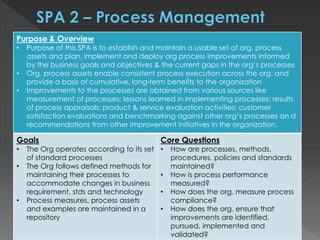
• Purpose of this SPA is to establish and maintain a usable set of org. process
assets and plan, implement and deploy org process improvements informed
by the business goals and objectives & the current gaps in the org’s processes
• Org. process assets enable consistent process execution across the org. and
provide a basis of cumulative, long-term benefits to the organization
• Improvements to the processes are obtained from various sources like
measurement of processes; lessons learned in implementing processes; results
of process appraisals; product & service evaluation activities; customer
satisfaction evaluations and benchmarking against other org’s processes an d
recommendations from other improvement initiatives in the organization.
Goals
• The Org operates according to its set
of standard processes
• The Org follows defined methods for
maintaining their processes to
accommodate changes in business
requirement, stds and technology
• Process measures, process assets
and examples are maintained in a
repository
Core Questions
• How are processes, methods,
procedures, policies and standards
maintained?
• How is process performance
measured?
• How does the org. measure process
compliance?
• How does the org. ensure that
improvements are identified,
pursued, implemented and
validated?
Purpose & Overview
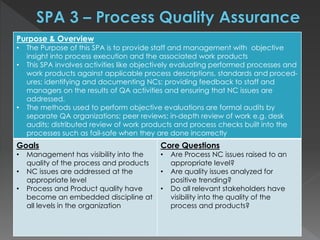
• The Purpose of this SPA is to provide staff and management with objective
insight into process execution and the associated work products
• This SPA involves activities like objectively evaluating performed processes and
work products against applicable process descriptions, standards and proced-
ures; identifying and documenting NCs; providing feedback to staff and
managers on the results of QA activities and ensuring that NC issues are
addressed.
• The methods used to perform objective evaluations are formal audits by
separate QA organizations; peer reviews; in-depth review of work e.g. desk
audits; distributed review of work products and process checks built into the
processes such as fail-safe when they are done incorrectly
Goals
• Management has visibility into the
quality of the process and products
• NC issues are addressed at the
appropriate level
• Process and Product quality have
become an embedded discipline at
all levels in the organization
Core Questions
• Are Process NC issues raised to an
appropriate level?
• Are quality issues analyzed for
positive trending?
• Do all relevant stakeholders have
visibility into the quality of the
process and products?
Purpose & Overview
• The Purpose of this SPA is to identify and analyze potential problems in order to
take appropriate action to ensure objectives can be achieved.
• Risk Management addresses issues that could endanger achievement of
critical objectives
• Effective Risk Management includes early and aggressive risk identification
through collaboration and the involvement of relevant stakeholders
• Risk Management consider internal and external, technical and non-technical
sources of risks
• Risk Management process involves defining a risk management strategy;
identifying and analyzing risks and handling identified risks i.e. risk mitigation
Goals
• The Organization is operating with
an understanding of its current level
of risk
• The Organization is pursuing risk
mitigation plans to limit the potential
damage from identified risks
• Risks are continually identified,
analyzed and monitored.
Core Questions
• Does the Org. know the amount of
risk it is operating under?
• Has the Org. identified and
implemented risk mitigation and
contingency plans?
• Does the Org. periodically monitor
risks and take appropriate update
actions?
Purpose & Overview
• The purpose of this SPA is to establish and maintain the integrity of the
operational environment using configuration identification, control, status
accounting and audits
• CM is a partnership between business, data, and IT resources to control the
integrity of the products, data stores and interfaces and changes to them.
• CM involves activities like identifying the configuration of the operational
environment and data interfaces at given points in time; Controlling and
managing data interfaces and the operating environments; Managing
changes to data interfaces; Maintaining the integrity of data interfaces and
providing accurate status of data interfaces to the end users & customers
Goals
• Maintain the integrity of data as
changes occur.
• Define and implement a
configuration and release
management system.
Core Questions
• How is configuration management
implemented and measured?
• How are data changes planned and
controlled across the data lifecycle?
ISP – Level 1
Perform the
Functional
Practices
•Ensure that adopting organizational components like project,
business unit perform the processes
ISP – Level 2
Implement a
Managed
Process
•Ensure that adopting organizational components do the
following : operate under an org policy; plan the process;
provide resources; assign responsibility; train people, manage
configurations, identify & involve relevant stakeholders; monitor
and control the process; objectively evaluate adherence &
review status with Higher management
ISP – Level 3
Institutionalize
Org.
Standards
•Ensure that a set of std processes is in place; Org. assets support
the use of the std process; elements can be tailored from the
standard process to fit unique circumstances; process related
experiences are collected to support future use and
improvements
Prepared By:
Meena Shivram
meenashivram@gmail.com

Sei dmm-intro1

  • 2.
    S No. Topic 1.What is DMM? 2. DMM Framework – An Overview 3. DMM Framework - Detailed 4. Process Area Description 5. Functional Capability & Maturity Definition 6. Process Areas of Category 1 - DM Strategy 7. Process Areas of Category 2 – Data Governance 8. Process Areas of Category 3 – Data Quality 9. Process Areas of Category 4 – Data Operations 10. Process Areas of Category 5 – Platform and Architecture 11. Supporting Processes 12. Infrastructure Support Practices
  • 3.
     Intended asa comprehensive reference model for the state-of-the-practice process improvement  Defines fundamental business processes of Data management and specific capabilities that constitute a gradated path to maturity  Allows organizations to evaluate themselves against documented best practices, determine gaps and improve the management of their data assets across functional lines of business and geographic boundaries
  • 4.
     Comprises of20 Data Management Process Areas across 5 major categories  5 Supporting Process Areas and 3 Levels of Infrastructure Support Practices Categories DM Strategy Data Quality Data OperationsPlatform & Architecture Data Governance Supporting Processes Infrastructure Support Practices
  • 5.
    Category Process Areas DMStrategy DM Strategy Communication DM Function Business Case Program Funding Data Governance Governance Management Business Glossary Metadata Management Data Quality Data Quality Strategy Data Profiling Data Quality Assessment Data Cleansing
  • 6.
    Category Process Areas Platform& Architecture Architectural Approach Architectural Standards DM Platform Data Integration Historical data archiving and retention Data Operations Data Requirement Definition Data Lifecycle Management Provider Management
  • 7.
    Category Process Areas/ Practices Supporting Processes Measurement and Analysis Process Management Process Quality Assurance Risk Management Configuration Management Infrastructure Support Practices ISP Level 1 – Perform the Functional Practices ISP Level 2 – Implement a Managed Process ISP Level 3 – Institutionalize Organizational Standards
  • 8.
    Each PA composedof  Purpose – Why an org. wants to implement processes of this PA  Introductory Notes – What the org. will accomplish if it implements the PA  Goals – What key capabilities of the org. will be when the PA is implemented  Core Questions – Use the questions to quickly evaluate if the PA is achieving the desired results  Related PAs – PAs that provide inputs, consume outputs or provide material support  Functional Practices – What capabilities need to be in place to successfully achieve the intended results for each maturity level 1-5  Example Work Products – Types of work products that would be produced by successful implementation of the PA
  • 9.
    Level 1 –Performed Data managed as per the requirement of each project implementation Level 2 – Managed Awareness of the importance of Data as a critical infrastructure Asset Level 3 – Defined Data treated at organizational level as critical to the success of its mission and performance Level 4 – Measured Data treated as a competitive advantage Level 5 – Optimized Data is seen as critical for survival in a dynamic and competitive market
  • 10.
    Deep Dive intothe Process Areas of each Category CATEGORY 1 : DM Strategy
  • 11.
    DM Strategy •Focus on development,strengthening and enhancement of Enterprise DM Program •Define DM Vision, Goals & Objectives and align it with Org. business goals and objectives •Ensure that the relevant stakeholders are aligned to the program’s implementation Commu nication •Importance of Bi-directional Stakeholder Communication •Planned approach to facilitate continued collaboration among stakeholders •Determine types and frequency of program information via multiple channels DM Functio n •Effectively scope, plan and resource DM activities as a sustained, continuous function •Develop Strong Leadership •Inculcate a shared stakeholder approach to DM Roles and Responsibilities Business Case •Helps Org. to frame, justify and gain approval for DM Initiatives based on the scope and plan created for the DM Strategy Program Funding •Addresses the development and ongoing justification of funding •Funding model employed for the DM program and its component projects •Provide appropriate funding for phased, sustained DM improvements
  • 12.
    An Effective DMStrategy defines why the Org. is implementing a DM program, explains what the overall program aims to achieve and identifies how the various components of the initiative fit together. A functional DM strategy should be developed collaboratively and approved by all stakeholders.  A Current State Assessment including capability gap analyses and identifying key dependencies provide a foundation for buy-in to the strategy and the corresponding plan for the implementation  The DM Strategy defines the overall framework of the program and usually consists of › A Vision Statement e.g. goals & objectives ; core operating principles; priorities › Program Scope e.g. Including both key business areas (Customer accounts) and DM priorities and key data sets › Business Benefits › Selected DM Framework & how it will be used › Major gaps identified in the current state based on a DM assessment
  • 13.
    Goals 1. Establish, maintain and followa DM Strategy approved by all the relevant stakeholders communicated across the org and reflected in architecture, technology and business planning 2. Maintain the DM Strategy for all business areas thru data governance 3. Develop, moni- tor and measure the plan for guid- ing the DM program imple- mentation CoreQuestions 1. Do Executive Stakeholders visibly & actively support the DM strategy? 2. Is the DM roadmap aligned with business priorities and milestones? 3. Is there sufficient understanding and agree- ment among executives and operational, IT and business stakeholders to support a long term sustainable DM program? 4. How are projects aligned with the roadmap that guides the imple- mentation of the DM program? 5. Are resources in place to architect, design & lead the DM program and train to enable the desired maturity? RelatedPAs 1. Business Case PA 2. Communications PA 3. Architectural Standards PA 4. Data Lifecycle Management PA
  • 14.
    Level1:Performed 1.Docume nted Business Objectives 2. DM Objectives , priorities andscope for a project 3. Report on DM outcomes vs Objectives for a project Level2:Managed 1. DM objectives and corresponding metrics 2.DM scope Definition 3. Subject area mapping to functions that create, update and delete data 4. Approved list of DM priorities 5. DM priorities mapped to business objectives 6. Project Prioritization list 7. Capability enablement Sequence plan Level3:Defined 1. DM Stategy 2. List of DM objectives & Priorities 3. DM Policies 4. Stakeholder participation and approval docs 5. DM program scope docu- mentation 6. DM strategy sequence plan 7. DM program metrics 8. DM program Cost benefit analysis 9. DM program reviews 10. DM Strategy Dashboard Level4:Measured Level5:Optimized Functional Practice Statements & Example Work Products 1.Metrics based DM Program Reports 2. Plan & document ation for monitoring emerging industry or regulatory requireme nts 3. DM Policies 1.External publications & PPTs about best practi- ces at industry 2.Comparativ e analysis reports of best practices
  • 15.
    Goals 1. DM Communi- cationStrategy ensures that the right messages about the program are under- stood by the right people at right time 2. Industry or regulatory guidance that impacts data management is promulgated internally in a timely manner 3. Stakeholders participate in the development of DM communications CoreQuestions 1. How are policies, standards and processes for DM promulgated? 2. How does the org keep stakeholders informed about DM plans and projects? 3. How is bi- directional communication accomplished among business, IT, DM and executive management about DM priorities, approaches and deliverables? RelatedPAs 1. DM Strategy PA
  • 16.
    Level1:Performed 1.Commu nications are managed locally e.g. Announce ments, emails , meeting notesor web portal Level2:Managed 1.Communicati on Policy 2.Announceme nts, emails , meeting notes or web portal 3.Communicati ons Strategy 4.Communicati ons Examples Level3:Defined 1.Communicati on Policy 2.Announceme nts, emails , meeting notes or web portal 3.Communicati ons Effective- ness Metrics 4.Communicati on Plan 5. Peer feed- back about communicatio n Level4:Measured Level5:Optimized Functional Practice Statements & Example Work Products 1.Changes to DM communic ation plans linked to communic ations effectiven ess metrics 2.Regulato ry corres- pondence i.e. responses to inquiries, reports and memos 1.External communicati ons 2.Impacted public policies and industry best practices
  • 17.
    Goals 1. Establish and followrole definitions, responsibilities, authorities and accountability to decisions and interactions related to DM. 2. Establish the process for executive oversight of data manage- ment to ensure adoption of consistent policies, processes and stds 3. Align the DM function to data governance on DM priorities and decisions. 4. Develop, evaluate & reward DM mgmt staff CoreQuestions 1. Is the DM function defined such that it is clear to all relevant stakeholders? 2. Is the DM function aligned to DM strategy through metrics and measures? 3. What role do executives play in the design and oversight of the DM function? RelatedPAs 1. DM Management PA 2. Program Funding PA 3. Governance Management PA 4. Data Lifecycle Management PA
  • 18.
    Level1:Performed 1.DM Resourcing and oversight are event- driven e.g. .Project communic ations, meeting min 2.Assignm entof data related roles to projects Level2:Managed 1.Policies 2.Process documents 3.Program guides 4.Defined Roles and Responsibilities 5. Metrics related to the DM function 6. Function review notes or report 7. Lessons learnt document Level3:Defined 1.DM function documentation 2.DM Structure 3.Training records 4.Compliance or audit reports 5. Project reports 6. Governance oversight plan 7. Communi- cation plans and schedules 8. Definition of roles, responsi- bilities 9. Performance measures Level4:Measured Level5:Optimized Functional Practice Statements & Example Work Products 1.DM Structure 2.Performa nce measures 3. Record of changes to DM structure 1.Resource plans 2.Priorities aligned with strategy 3. Strategic decisions and supporting metrics
  • 19.
    Goals 1. Obtain executive sponsorshipfor the DM program 2. Stakeholders approve and adopt the business case across lines of business. 3. Business cases justify and help to ensure sustainable financing for DM initiatives 4. Business cases for DM are comparable to approved business cases for other org-wide investments CoreQuestions 1. How does the org. determine the level of investment required for the DM program? 2. How does the org. decide whether to develop one umbrella business case or multiple, linked business cases? 3. What are the success criteria for the business case? 4. Who needs to be involved and who needs to approve? 5. Does the business case reflect the objectives and priorities of the DM strategy and sequence plan? 6. Does the business case reviewed and approved by DM sponsors? RelatedPAs 1. DM Strategy PA 2. Program Funding PA 3. Governance Management PA 4. Data Lifecycle Management PA
  • 20.
    Level1:Performed 1.A Business Case is develope d for project initiatives e.g.1. Project document ations, meeting min, discussion document s 2.Project level business case Level2:Managed 1.Business case standard methodology 2.DM Business case initiatives 3.Documentati on or notes of business case approvals and rejections Level3:Defined 1.DM business cases are defined and consumed by all stakeholders 2.Approval documentation for DM business cases & DM TCO and methodology 3.Cost benefit analysis results for DM 4. DM business case perform- ance metrics 5. Traceability matrix for DM TCO 6. Process to collect info on DM costs & allocation methodology Level4:Measurednge Level5:Optimized Functional Practice Statements & Example Work Products 1 TCO mgmt reports 2.Program change recommend ations based on cost metrics 3. Infra budgets 4. DM TCO metrics 5. DM TCO methodolog y doc. 6.DM TCO change recommend ation 7. Audit results & Perf scorecard 1.Proposed changes and updates to DM TCO model 2.Published industry articles, white papers, conference sessions 3. Predictive analysis tools and models
  • 21.
    Goals 1. Priorities and criteriafor both discretionary and non discretionary investment are established and followed 2. Sustainable program funding methods for making cost and benefit allocations, managing expenditures and establishing priorities are defined and followed. 3. Program funding reflects business objectives and organizational priorities CoreQuestions 1. Is there an approved set of investment criteria and priorities for DM? 2. How does data governance provide oversight for DM funding? 3. Was the program funding approach developed, evaluated and approved by relevant stakeholders? 4. Does the funding model reflect the org’s business models, priorities and financial decision processes? 5. Are there defined Cost benefit allocation methods, expense mgmt practices and business cases across the org? RelatedPAs 1. Business Case PA 2. DM Strategy PA 3. Governance Management PA
  • 22.
    Level1:Performed 1.DM project budgets 2.DM funding approvals 3. Funding requests that incl cost benefit analysis Level2:Managedg 1.DMBusiness cases 2.DM Program funding method 3.DM Budget 4.Mgmt reports on mapping of DM costs to the overall pgm,business unit and projects 5.Governance documentation related to funding Level3:Defined 1.DM funding criteria 2.Budget planning process 3.Metrics to measure investment and funding objectives 4. Documented DM funding model 5. Reports measuring DM benefits 6. Prioritization criteria and mapping to DM strategy Level4:Measured Level5:Optimized Functional Practice Statements & Example Work Products 1 Metrics and analysis of program funding effectivenes s 1.Public presentations or white papers about DM funding 2.Approved changes to program funding based on predictive analysis 3. Presentations, white papers, articles etc
  • 23.
    Deep Dive intothe Process Areas of each Category CATEGORY 2 : Data Governance
  • 24.
    Governance Management •Addresses the processesthat facilitate collaborative decision making •Implement effectively the building, sustaining and compliance functions of governance bodies Business Glossary •Helps an organization to achieve a common understanding and representation of an expanding compendium of approved business terms •Prioritize and sequence the development of the business terms, manage their creation and changes over time Metadata Management •Provides top-down approach to architecting, planning, populating and managing the metadata repository to fully describe the organization’s data assets
  • 25.
    Effective Data Governancemanagement provides oversight, ensures stakeholder collaboration ond facilitates decisions for critical data subject areas. It addresses three basic data governance functions supporting the org’s data assets – building, sustaining and compliance  Building is the creation of new capabilities  Sustaining consists of the processes for collaboration, evaluation and decision making  Compliance is instituted and managed to control data assets  Key Functions of data governance are › Approve the enterprise data strategy, policies & Stds › Define business terms by subject areas › Assign accountabilities and responsibilities › Develop decision rights and change mechanisms › Address regulatory and other external requirements, data security and access › Enforce Compliance
  • 26.
    Goalsall 1. A Processis established and followed for aligning data governance with business priorities e.g. ongoing evaluation and refinement to address changes in the business like adding new domains and functions 2. Data Governance ensures that all the relevant stakeholders are included and roles and resp. are defined clearly. 3. Compliance and control mechanisms with appropriate policies, processes and stds followed CoreQuestions 1. Does it facilitate collaboration and decision making across business & IT functions? 2. Does it clearly define responsibilities and accountability for data domains? 3. Does it provide a mechanism for definition of priorities and resolution of competing priorities? 4. Does it effectively provide a process for defining, escalating and resolving issues? 5. How does the executive sponsors support and how are they informed of the efforts ? 6. Does the org have a process to review the activities? RelatedPAs 1. Data Lifecycle Management PA 2. DM Strategy PA 3. Data Management Function PA 4. Communications PA
  • 27.
    Level1:Performed 1.Governa nce Process Document ation 2.Evidence of imple- mented governan ce proc- esses 3.Descri- ption of data governan ce roles and responsibili ties Level2:Managed 1.Data Governance Charter 2.Data Governance Charter 3.Documented processes and stds incl. decision process, issue resolution and operations 4.Roles, responsibilities and accountability matrix 5.Meeting Min. Level3:Defined 1.Executive level data governance charter 2.Org-wide data governance rollout plan 3.Metrics to evaluate the effectiveness of data governance 4. Adoption of policies and processes 5. Training materials 6. Meeting Min. 7. Reports of decisions and action items Level4:Measured Level5:Optimized Functional Practice Statements & Example Work Products 1 Metrics based analytical performanc e reports 2. Executive reports of governance effectivenes s 1.Internal ppt or white papers on data governance model as an industry best practice 2.Reports on continuous governance improvement s
  • 28.
    Goalsall 1. The languageof Data is unambiguously aligned with the language of the business. 2. The Org has created a comprehensive, approved business glossary. 3. The Org. follows the stds for naming, definitions and metadata of business terms. 4. Org-wide access to the business glossary leads to a common understanding of business terms. 5. Consistent application of business terms as new projects come CoreQuestions 1. Is there a policy mandating the use of business glossary? 2. How are the glossary created, approved, verified and managed? 3. Are the business terms referenced in the design of data stores and repositories? 4. Does the org perform cross-ref and mapping of specific business terms to standardized ones? 5. Is it accessible to all and how is it enhanced and maintained ? 6. Is compliance process in place to ensure that BUs and projects correctly apply business terms? RelatedPAs 1. Data Lifecycle Management PA 2. Meta Data Management Function PA
  • 29.
    Level1:Performed 1.Defined business terms in project document ation 2.Business glossary maintaine d bya BU 3. Business terms and logical attribute mapping Level2:Managed 1.Business Glossary 2.Business Glossary Policy 3.Business Glossary management process 4.Business Glossary available online 5. Business Glossary Compliance process 6. Data Requirements documentation using business terms Level3:Defined 1.Business Terms Glossary 2.Mapping of business terms to attributes to physical data elements 3.Business Terms compliance process 4. Policy on the use of std business terms 5. Business terms metrics 6. Compliance monitoring & Business NC and exception report 7. Business Glossary update log 8. Impact assessment results Level4:Measuredsin Level5:Optimized Functional Practice Statements & Example Work Products 1 Metadata repository – unified business terms glossary integrated with logical and physical data and ref to industry stds 2. Metrics and analysis reports 3. Published exception reports, impact analyses and remediation plans 1.Business rules and ontologies associated to business terms in automated mechanism 2.White papers and case studies
  • 30.
    Metadata is acategory of information that identifies, describes, explains and provides content, context, structure and classification related to Org’s data assets and enables effective retrieval, usage and management of these assets  Effective metadata management and the creation of the Org’s metadata catalog facilitates, supports and contributes to achievement of critical data management activities and objectives  Metadata contains 3 Categories › Business Metadata e.g. Taxonomies, Ontologies, business glossaries and standards › Technical Metadata e.g. Run-time or dynamic metadata like XML, messaging and config. Information and Design-time or static metadata like physical data models, DDLs, Data Dictionary and ETL scripts › Operational Metadata e.g. Process metadata like process steps for production and maintenance, data quality measurement and analysis, Business Rules, names of systems, jobs and programs as well as governance , regulatory and other control requirements
  • 31.
    Goalsall 1. Management appreciates the valueof metadata. 2. Data governance oversight directs the development and implementation of the metadata strategy, categorization and stds and ensures its adoption and consistent use. 3. Contents of the metadata repository span all categories and classification of data assets and reflects the implemented data layer of Org. 4. Internal and relevant external stds are incorporated into metadata CoreQuestions 1. Is the metadata strategy aligned with internal and the selected external stds? 2. How is the scope of metadata addressed for inclusion within the metadata repository defined? 3. Are all relevant stakeholders involved in defining metadata categories and properties? 4. What is the method for developing and evaluating metadata stds and processes? 5. What is the method for maintaining the metadata repository? 6. Are Roles and Resp. defined for the capture, updating and use of metadata? RelatedPAs 1. Governance Management PA 2. Data Management Function PA 3. Data Management Lifecycle PA 4. Data Requirements Definition PA 5. Architecture Approach PA 6. Business Glossary PA 7. Data Integration PA
  • 32.
    Level1:Performed 1.Metadat a repository or virtual metadata repository Level2:Managedn 1.Metadata Management Policy 2.Business Metadata 3.Metadata repositories 4.Metadata Meta Model 5.Metadata governance and publication approval documentation 6. Metadata standards 7. Audit results 8. Metadata change log Level3:Defined 1.Metadata management strategy 2.Metadata roles and responsibilities 3.Repository reports of metadata extensions 4. Metadata management org stds 5. Metadata meta model diagrams 6. Gap analysis results compar- ing imple- mented plat- forms against metadata 7. Metadata metrics reports & progress reports Level4:Measured Level5:Optimized Functional Practice Statements & Example Work Products 1.Document ed quant- itative objectives for meta- data 2.Comprehe nsive meta- data repo- sitory reports 3.Measurem ent appro- aches to include statistical and other quantitative techniques 4.Process efficiency reports 5.Unified metamodel 6. Stds and practices 1.Consistent reporting based on std definitions 2.Results of analysis of repository information 3.Document ation of prediction models 4.Define Quantitative objectives 5.Impact analysis reports
  • 33.
    Deep Dive intothe Process Areas of each Category CATEGORY 3 : Data Quality
  • 34.
    Data Quality Strategy •Describes activities designedto help the org. develop a defined, approved and integrated plan to ensure that the quality of data meets business needs Data Profiling • Activities that help the organization to assess the data under management against a set of quality objectives which are defined in the Data Quality Strategy Data Quality Assessme nt •Activities that help the organization to assess the data under management against a set of quality objectives which are defined in the Data Quality Strategy Data Cleansin g •Achieving efficiencies and successful, repeatable processes for Data Cleansing activities reduces effort and lowers costs enabling the org. to assure ‘fit for purpose’ data assets across its data assets and physical data stores
  • 35.
    Data Quality Strategydefines the goals, objectives and plans for improving data integrity. Data Quality Strategy addresses data store design, business process and aligned to the target data architecture and reduce ROT (redundant, obsolete and trivial) information in the data.  Strategy created based on an analysis of existing quality issues and business objectives for trusted data.  High quality of data is not the result of technologies alone but also the result of continued scrutiny shared and communicated by all the stakeholders  To achieve a data quality culture, an org. should develop a comprehensive measurable strategy applicable across all business units, business processes and applications.  Measurement criteria to be defined for each of the dimensions of quality like › Accuracy › Completeness › Coverage › Conformity › Consistency › Duplication › Integrity › Timeliness
  • 36.
    Goals 1. Data quality strategy collaboratively developedwith lines of business aligned with business goals. 2. Priorities and goals translated into actionable criteria. 3. Org-wide data quality program defined and roles and responsibilities established to meet program needs. 4. Data quality processes are integrated and aligned with the data quality strategy CoreQuestions 1. Is data quality emphasized in all initiatives involving the data stores? 2. How does the org. measure data quality program progress? 3. Org unit made responsible for maintaining the data quality strategy and initiatives? 4. Is the strategy widely distributed, communicated and promulgated? 5. Does it clearly describe objectives, policies and processes? 6. Is it integrated with the systems development lifecycle and business process improvement efforts? RelatedPAs 1. Data Requirement Definition PA 2. Data Management Strategy PA 3. Data Quality Assessment PA 4. Data Profiling PA 5 Data Cleansing PA
  • 37.
    Level1:Performed 1. Data Quality Plans, criteria and rules 2.Meeting notes 3. Status updates 4. Metrics 5. Data quality processing document ation 6. Rules implement ed in Database and S/W document ed as requireme nts Level2:Managed 1.Data Quality Strategy 2. Data Quality sequence plan with key milestones identified 3. Policies, processes and guidelines Level3:Defined 1. Data Quality strategy approvals 2. Data management stds providing criteria and guidelines 3. Approved policies and processes 4. Approved metrics 5. Embedded SDLC data quality processes 6. Business rules organized around subject areas 7. Standard data quality processes Level4:Measured Level5:Optimized Functional Practice Statements & Example Work Products 1.Approved changes to the data quality strategy 2.Approved changes to policies, processes and metrics 3.Std metrics based on analytical reports of data quality progress 4. Approved modification s to the strategy, seq plan, supporting policies, processes and plans 1. PPTs, whitepapers and articles communicati ng best practices for data quality strategy
  • 38.
    Goals 1. A standardset of methods, tools and processes for data profiling is established and followed. 2. Produce recommendations for improving the data quality improvements to data assets. 3. Physical data representation is factual, understandable and enhances business understanding of the set of data under management. CoreQuestions 1. Does the org. have a standard method for profiling data? 2. Has the org trained or acquired staff resources with expertise in data profiling tools and techniques? 3. Does the org. apply statistical models to analyze data profiling reports? 4. Do policies and processes specify the criteria for a data store to undergo profiling? 5. Is data profiling scheduled based on defined events, considerations or triggers? RelatedPAs 1. Business Glossary PA 2. Metadata Management PA 3. Architectural Standards PA
  • 39.
    Level1:Performed 1. Data Profiling reports 2. Listof data profiling checks Level2:Managed 1.Data profiling methodology documentation 2. Approved data profiling plan and schedule 3. Data profiling findings reports and metrics 4. Proposed business rule additions based on data profiling 5. Defined skill set and training plan for staff with data quality responsibilities Level3:Defined 1. Data profiling stds incl. criteria for processes, stds, best practice criteria, tailoring and reporting formats 2. Data profiling methodologies tailored to org stds 3. Traceability of data requirements with content 4. Metrics 5. Data related decisions and rationale 6. Std Data profiling tools & baselines 7. Business & technical impact analysis Level4:Measured Level5:Optimized Functional Practice Statements & Example Work Products 1.Document ed profiling methodolog y, best practices and stds 2.Reports on profiling results 3.Dashboar ds,Scorecar ds or other decision support tools for data quality and data profiling 4. Portal displaying data quality models and results used for performanc e baselines 1.Log of stakeholders’ usage of profiling results 2.Control charts showing stabilized processes 3.Data profiling improvement s included in strategies, programs and reports 4.Real time data profiling reports generated on schedule 5. Conclusions drawn from data profiling analyses
  • 40.
    Goals 1. Establish &sustain a business driven function to evaluate and improve the quality of data assets. 2. Standardize data quality assessment objectives, targets and thresholds as per industry techniques. 3. Establish methods for statistical evaluation of data quality. 4. Establish std data quality assesment reporting utilizing scorecards, dashboards and other analytical reports 5. Utilize the results and conclusions of data quality assessments CoreQuestions 1. Are std quality assessment techniques and methods documented and followed? 2. How are data quality assessments conducted and are they scheduled or event driven? 3. Are std data quality rules developed for core data attributes? 4. Are data quality rules engines or assessment tools employed? 5. Are the business, technical and cost impacts of data quality issues analyzed and used as input to data quality improvement priorities? RelatedPAs 1. Data Quality PA 2. Data Profiling PA 3. Metadata Management PA
  • 41.
    Level1:Performed 1. Data Quality Rules 2. Data Quality Assessmen tresults Level2:Managed 1.Documented objectives, targets and thresholds. 2. Documented data quality dimensions and attributes 3. Metrics for data quality assessments 4. Documented analysis of business and technical impacts 5. Effort estimates for data quality improvements 6. Business stakeholders review data quality assessments & provide recommendati Level3:Defined 1. Documented scores, targets and thresholds for each std data quality dimension 2. Published and accessible org level data quality rules for approved attributes 3. Org level data quality assessment policy 4. Std org level data quality assessment processes Level4:Measured Level5:Optimized Functional Practice Statements & Example Work Products 1.Audit & Control reports 2.Data Quality assessment progress reports for improvemen ts 3.Data quality confidence surveys 1.Assessment analysis reports 2. Process review documentati on 3. Process improvement proposals and approvals
  • 42.
    Goals 1. A DataCleansing strategy has been created and is consistently followed. 2. Standard data cleansing processes are established and sustained. 3. Data cleansing standards are consistently verified by all stakeholders. CoreQuestions 1. Does the org have a reusable set of data cleansing processes (automated and manual) to resolve data quality issues? 2. Is there a defined process for verifying corrections and assessing effectiveness? 3. How does the org cleanse duplicate records? 4. Are corrections implemented at the source of capture? 5. Are data cleansing followed through to analysis of root causes? 6. Does ROI incorporate data cleansing costs? 7. Are consistent toolsets used? RelatedPAs 1. Data Requirement Definition PA 2. Data Quality Assessment PA 3. Metadata Management PA 4. Provider Management PA
  • 43.
    Level1:Performed 1. Data Cleansing requireme nts. 2. Data Cleansing guidelines. Level2:Managed 1.Data Cleansing policy. 2.Data Cleansing processing and rules. 3. Data Cleansing metrics. 4. Data Cleansing plans. 5. Data Correction methodologies. 6. Data Cleansing issues Level3:Defined 1. Data change history log. 2. Traceability matrix 3. Data cleansing feedback 4. RACI matrix for data cleansing governance, activities and rule development 5. Data Cleansing results report templates Level4:Measured Level5:Optimized Functional Practice Statements & Example Work Products 1.Service level agreements 2.Feedb ack documentat ion 1.Meeting Min. showing involvement in stds. 2. SLAs include cleansing processes and expectations for data providers
  • 44.
    Deep Dive intothe Process Areas of each Category CATEGORY 4 : Data Operations
  • 45.
    Data Requirements Definition •Contains practices whichensure that specifications for data used by a business process satisfy business objectives, are validated by stakeholders, prioritized and well documented through a repeatable process Data Lifecycle Management •Assists an organization to ensure that its data flows are well mapped to business processes through all lifecycle phases Provider Management •Describes best practices for data source selection and controlled, bidirectional interactions with internal and external providers
  • 46.
    Data Requirement Definitionestablished the process used to identify, define, prioritize, document and validate the data needed to achieve business objectives. Data Requirements should be stated in business language and reuse the approved and standard business terms as it is essential for effectively sharing data across the organization.  Data Requirements Definition process is an important contributor to the enrichment, validation and creation of business glossary terms and definitions.  Method chosen for defining and documenting data requirements should be in alignment with application lifecycle processes.  Requirement Definition follows an orderly discovery and decomposition process that includes articulation of business concepts and needs.  Business Rules are developed in parallel with the logical design of the applications supporting the destination data store.
  • 47.
    Goals 1. Data requirements definitions consistentlysatisfy business objectives. 2. All relevant stakeholders have a common understanding of data requirements. 3. Approved standards are followed for data names, definitions and representations in requirements definitions as appropriate. CoreQuestions 1. How are business and technical data requirements solicited, captured, adjudicated and verified with stakeholders? 2. How are the data requirements mapped to the business objectives? 3. How are approved data requirements validated against standard data definitions as well as logical and physical representations? RelatedPAs 1. Data Lifecycle Management PA 2. Data Profiling PA 3. Data Management PA 4. Governance Management PA 5. Data Management Function PA 6. Architectural Standards PA
  • 48.
    Level1:Performed 1. Catalog of business termsand their definitions 2. Data Requireme nts Document ation 3. Review Board meeting notes 4.Docume nted stakeholde r requireme nts review decisions Level2:Managed 1.Data Requirements specification document. 2.Requirements mapping to business objectives. 3.Requirements mapping to data models 4. Stakeholder requirements approvals 5. Review board notes and decisions. Level3:Defined 1. Std . Data requirements template 2.Requirements mapping to use case documentation 3.Requirements mapping to business processes 4. Documented data security and entitlement rules 5. Stakeholder or review board consensus documentation Level4:Measured Level5:Optimized Functional Practice Statements & Example Work Products 1.Std toolset to maintain mapping and traceability between business and data requirement s 2.Selection criteria for adoption of industry best practices for the data requirement s definition framework 1.Recommen dation to improve data requirement processes. 2. Decisions to change data requirement processes 3. Public ppts, articles and white papers
  • 49.
    Goals 1. The datalifecycle pertaining to selected business processes is defined and maintained to reflect changes. 2. Business processes are mapped to data flows based on a framework for identifying and prioritizing shared data flows; this mapping extends through the data lifecycle at the attribute level. 3. Mapping of data impacts, dependencies and interdependencies are defined and maintained. CoreQuestions 1. What activities, milestones and products are defined for mapping business processes to the data created and maintained in support of these processes? 2. Has the org. established clear roles and responsibilities for creating and maintaining a mapping of business processes to data? 3. Are std process modeling methods and tools employed to model and define business processes? 4. Does governance have a role in the management and orchestration of business process data needs, mapping and prioritization? RelatedPAs 1. Data Requirements Definition PA 2. Metadata Management PA 3. Governance Management PA
  • 50.
    Level1:Performed 1. Business process to data element mapping, specifying CRUD matrix 2.Consum erand producer matrix 3. Data Flow diagrams at attrib. level 4. List of data sources and attributes for a data set Level2:Managed 1.Data Change management process. 2.Governance process for shared data assets and data sets. 3.Business process cata- logs & maps to shared attri- butes. 4. Data source selection crit- eria 5. Mapping between data producers and consumers 6. Business process model- ing tools 7. Metadata repository 8. Data attrib Level3:Defined 1. Process to Data mapping template 2.Data mapping project plan 3.DM org. roles &responsibilities 4. Change mgmt process for defined data sets 5. Lifecycle data mapping of core business processes 6. Data maps 7. Context diagrams 8. Interface, data source and destination change records 9. Identified data attrib. Level4:Measured Level5:Optimized Functional Practice Statements & Example Work Products 1.Metrics documentat ion and results 2.Approved process mapping change requests 3.Remediati on process 4.Remediati on Plans 1.Data Dependenci es Reports 2.Recommen dations to improve data lifecycle mgmt processes 3. Data lifecycle forecasting reports 4.Reports to Sr mgmt based on statistical analysis 5.Public ppts,white papers or docs on data lifecycle mgmt process experience
  • 51.
    Goals 1. Data reqmtsfor sourcing, procure- ment and provider mgmt incl. data quality criteria are assessed according to a documented process. 2. Selecting, contracting, monito- ring and managing data providers is performed accord- ing to a std data source selection and control process 3. Potential sources and providers, incl. their services, data scope, processes and technologies are identified. 4. Std SLAs address all bus. Requirements & used to manage data providers CoreQuestions 1. How are data sour- cing requirements captured, validated & understood? 2. Are requirements for data sourcing specific, unambi- guous, driven by business require- ments and feasibly procurable? 3. Is there a mecha- nism that ensures business approval of sourcing require- ments? 4. How are data attri- butes mapped to data sources and downstream appli- cations? 5. How is the data source selection process managed? 6. How are service and content quality from data providers monitored? RelatedPAs 1. Data Requirements Definition PA 2. Data Quality Strategy PA 3. Governance Management PA 4. Data Profiling PA 5. Data Quality Assessment PA
  • 52.
    Level1:Performed 1. Data sourcing requireme nts. 2.Data source selection criteria. 3.Contract Coverage checklist for exter- nal providers 4.Data feed evaluation reports 5. Agree- ment with internal & external data providers 6. Approv- ed vendor invoices Level2:Managed 1.Procurement policies. 2.Data source selection criteria. 3.Data sourcing requirements. 4. Mapping of data require- ments to sources. 5. Providers SLAs 6. Procurement process 7. Data Source Evaluations 8. Meeting Min. with data providers Level3:Defined 1. Std data sourcing process 2.SLA template 3.SLAs with providers 4. Defined Quality criteria for data sourcing 5. Defined metrics for measuring data sourcing 6. Updates to data sourcing process based on stakeholder feedback & best practices 7. Stds, procedures, policies and work flow diag. 8. Data provider Level4:Measured Level5:Optimized Functional Practice Statements & Example Work Products 1.Performan ce reports, dashboards, scorecards & heat maps 2.Scoring criteria for data providers 3.Analytical reports of provider performanc e 4. Recomm- endations for changes to provider SLAs 1.Analytical results 2.Data Sourcing performance related recommend ations 3. Alignment mechanism for data sources to business objectives 4.PPTs, articles and white papers
  • 53.
    Deep Dive intothe Process Areas of each Category CATEGORY 5 : Platform and Architecture
  • 54.
    Architec tural Approac h •Assists the Org.in developing an approved approach to scope and design a consumable data and technology architecture that stresses on the duplicate data reduction and maximizing data sharing Architec tural Standar ds •Addresses the development and approval of standards of data representation, data access and data distribution DM Platform •Emphasizes stakeholder involvement and governance in decisions that affect platform selection and implementation Data Integrati on •Helps the Org. to create and maintain alignment with business needs through design of shared data stores and to establish and enforce standards Historical Data archiving & Retention •Addresses versioning, record retention and archiving, ensuring that data satisfies availability needs, business needs and regulatory requirements as applicable
  • 55.
    Goals 1. The approved architectural approachis consistent with business needs and Arch. stds. 2. The transition plan from the “As-is” to the “To-be” state is consistently monitor- ed to ensure that projects are aligned with long term objectives 3. The Arch. approach is approv- ed and adopted by all relevant stake- holders. 4. Platform and tech capability decisions are aligned with the arch approach and approved by stakeholders 5. Metrics used by Bus. & IT stakeholders CoreQuestions 1. How does the Org. approach archi- tecting information assets? 2. Is the Arch appr- oach consistently followed and adopt- ed by all relevant stake-holders? 3. What is the rationalization method used for eliminating duplicate data? 4. Does the Org. have an approved data dictionary stack and governance applied to modifications, additions and sun setting? 5. Has the Org. documented and approved the tech capabilities and reqmts to satisfy operational bus. Continuity? RelatedPAs 1. Data Management Strategy PA 2. Architectural Standards PA 3. Governance Management PA 4. Data Integration PA 5. Data Profiling PA
  • 56.
    Level1:Performed 1.Architect ure design for imple- mentation 2.Business andtech. approvals for archi- tecture 3.Stakehol der list for architectur e appro- vals Level2:Managed 1.Documented approval for architectural designs. 2.Approval process for arch design through governance. 3.Approved arch utilization. 4.Shared data interface traceability map. 5.Implementati on consistent with approved designs Level3:Defined 1. Ration- alization reports and decision criteria 2.Data related arch approach 3. Implement- ation checklists aligned with transition plan 4. Evaluation of external & inter- nal stds. 5. List of Arch adoption stake- holders and BUs 6. Tech req. specifications. 7. Arch blue- print compared to the As-Is architecture 8. Data Quality profiling reports applied to design Level4:Measured Level5:Optimized Functional Practice Statements & Example Work Products 1.Cost Bene- fit analyses 2.Quantitati ve perform- ance criteria & evaluation targets for designed components and archi- tecture 3.Statistical models employed to guide arch decisions 4.Document -ed limit- ations of current arch approach 1.Modificatio ns to arch approach 2.Prediction model comp- arison report against business objectives 3. Stakehold- er feedback 4.PPTs or pub- lications abt the org’s arch approach 5. Identified enhanced bus. Capabilities due to enhanced data analysis
  • 57.
    Goals 1. Develop acomp- rehensive set of data standards aligned with the Arch approach and the DM strategy. 2. Institute a sust- ainable standards development and maint. process involving business and IT stakeholders 3. Establish effective governance and auditing processes for standards adherence and exceptions 4. Define and enforce a data distribution stds for requests and approvals 5. Define and enforce approved data access methods across platforms CoreQuestions 1. What are the categories of stds required for the org’s target data arch and how are they scoped and defined? 2. How does the org determine business needs and techno- logy strategy for dev- eloping approved, std data access and governance? 3. How are data models approved, maintained and governed? 4. Has the Org. defined architect- urally aligned, std data access methods and criteria? 5. How does the Org promulgate, audit and enforce standards? RelatedPAs 1. Data Management Strategy PA 2. Data Quality PA 3. Governance Management PA 4. Data Management Function PA 5. Data Requirements Definition PA 6. Business Glossary PA 7. Metadata Management PA 8. Data Integration PA
  • 58.
    Level1:Performed 1.Data Stds used by projects 2.Validatio nof As-Is data stores against referenc ed stds Level2:Managed 1.A Policy that requires adherence to standards. 2.Standards artifacts. 3.Standards approval process. 4.Standards Change Request process. 5.Project references to standards 6. Guidance for incorporating stds into design Level3:Defined 1. Compliance or regulatory reporting stds and require- ments 2.Stds develop- ment and modification process 3. Standards tailoring guidance 4. Standards exception process 5. Audit results reports 6. Architecture review board meeting notes 7. Data Std policies and procedures Level4:Measured Level5:Optimized Functional Practice Statements & Example Work Products 1.Standards review docu mentation 2. Impact analysis for proposed changes to stds 3. Architect- uralstandard s complia- nce metrics 1.Engageme nt with external stds bodies 2.Research of emerging technologies 3. Proposed stds for future technologies likely to be adopted 4. PPTs and other published work related to data stds
  • 59.
    Goals 1. The Platformsatis- fy the approved requirements and architecture. 2. Processes exist and are followed for effective platform management to meet business needs 3. The Platform is supported by adequately trained and skilled personnel 4. The platform provides trusted data CoreQuestions 1. How are authoritative data sources defined, selected and integrated into particular portions of the platform? 2. How does the org address overlapping platforms and data duplication? 3. Does the org have a process for making “build versus buy” decisions? 4. How does the org address platform scalability, security and resiliency in accordance with? Anticipated growth of data, users and overall complexity? 5. What forms of data, data exchange and interfaces are supported by the platform? RelatedPAst 1. Data Lifecycle Management PA 2. Data Quality StrategyPA 3. Governance Management PA 4. Data Management Function PA 5. Data Management Strategy PA 6. Business Glossary PA 7. Metadata Management PA
  • 60.
    Level1:Performed 1.Inventory of data managem ent platforms and compone nts Level2:Managed 1.Data Management platform documentation 2.Approved deployment and conversion andmigration plans. 3.Documented platform decisions and rationale. 4.Documented stakeholder involvement in the design and approval of data manage- ment platform deployment plan Level3:Defined 1. Document- ation mapping critical data elements to platforms 2.Documents identifying and justifying data duplication 3. Platform implementation plan 4. Platform architecture designs 5. Platform performance data 6. SLAs 7. Platform metadata Level4:Measured Level5:Optimized Functional Practice Statements & Example Work Products 1.Metrics to measure both qualit- ative and quantitative performanc e of DM platform 2. Measure- ment and analysis plans 3. Statistical analysis according to the measureme nt plan 4. Approved decisions based on analysis of metrics 1.Causal analysis 2.Performanc e prediction models 3. Approvals for improve- ments 4. Predicted Vs actual performance analyses 5. Approved optimization plans 6. Public PPTs and other formal & informal docs related to DM platform
  • 61.
    Goals 1. Establish and followa consistent process to ensure ongoing business & technology align- ment for data integration. 2. Data Integration is performed utilizing std processes and toolsets that enable compliance with data architecture stds & data quality requirements 3. Proactively research and eval- uate integration technologies for application and adoption 4. Establish, manage data conversion, transformation and enrichment so that the data is fully processed & meets quality stds CoreQuestions 1. How are data consolidation needs assessed? 2. How is future re- dundancyminimized? 3. How does the org consolidate data effectively where redundancy exists? 4. Do Data Integ- ration stds exist & are they reviewed, moni- tored, approved & enforced? 5. Describe the compliance process- es employed to en- force integration stds? 6. How are data quality thresholds & targets applied to sources of data at ingestion, integration? 7. Are the processes to identify missing data automated? RelatedPAs 1. Architectural Standards PA 2. Data Quality Strategy PA 3. Data Lifecycle Management PA 4. Data Profiling PA 5. Metadata Management PA
  • 62.
    Level1:Performed 1. Data Integration scripts Level2:Managed 1.Data Integration standards 2.Verification and Validation plans. 3.Integration testenviron- ments. 4.APIs 5. Data Integration policy Level3:Defined 1. Verification & Validation results 2.Performance requirements 3. Performance metrics and analysis results 4. Measures & metrics for continuous improvement in data quality 5. Integration method stds 6. Data Delivery policy & SLAs 7. Integration best practices guidance 8. Standard interface specifications 9. Integration environment CM process Level4:Measured Level5:Optimized Functional Practice Statements & Example Work Products 1.Statistical analysis results 2. Data profiling analyses 3.Consolidat ed highly shared data with continuous improvemen t 1.Quantitativ e methods 2.Performanc e triggers and thresholds 3. Root cause analysis results 4. PPTs, white papers or published articles
  • 63.
    Goals 1. Historical datais managed consist- ently leveraging common standards 2. Business needs for capturing and storing historical data are met. 3. An approved process for deter- mining when and how data should be archived is followed containing defined activity steps 4. Data retention periods are consistent with both legal and regulatory requirements. 5. Data archives reflect organizational and regulatory requirements. CoreQuestions 1. What are the arch stds & conventions applied to the structure & mgmt of historical data & how are the corres. Business rules defined and governed? 2. How is data retent- ion for the required length of time assured? 3. How is the integrity of archived data maintained? 4. Is there a consistent approach for the retrieval & integration of archived historical data with current data? 5. How is an audit trail for data changes monitored and managed? 6.What consider- ations applied when archived data can be deleted? RelatedPAs 1. Architectural Standards PA 2. Data Requirements Definition PA 3. Data Management Function PA 4. Governance Management PA
  • 64.
    Level1:Performed 1. Backup Registers for data storesand data archives 2.Archiving procedure s 3. Change log files 4. Data retention business rules 5. Data archiving or dest- ruction procedure s Level2:Managed 1.Data Retention policies 2.Restoration testing records. 3.Encrypted archives. 4.Data Encryption requirements 5. Archived data access tests Level3:Defined 1. Restoration procedure documentation 2.Application with access to historical data 3.Data logging policy including log retention 4. Data archive requirements 5. Archive backup and restoration requirements 6. Restoration testing records for archived data 7. Audit and test records Level4:Measured Level5:Optimized Functional Practice Statements & Example Work Products 1.Improvem ent process 2. Process improvemen t reports and records 3.Change manageme nt records 4. Regulator or stake- holders feedback 5. Statistical and other quantitative analysis reports 1.Public PPTs, white papers, articles and other documents communicati ng processes and experience
  • 65.
  • 66.
    Measure ment & Analysis •Addresses measuresand select analytical techniques for identifying strengths and weaknesses in data management processes Process Manage ment •Addresses a usable set of organizational process assets and plans, implements and deploys organizational process improvements informed by the business goals and objectives and the current gaps in the organization’s processes Process Quality Assuran ce •Provides staff and management with objective insight into process execution and the associated work products Risk Manage ment •Identifies and analyzes potential problems to take appropriate action to ensure objectives can be achieved Configur ation Manage ment •Addresses the integrity of the operational environment using configuration identification, control, status accounting and audits
  • 67.
    Purpose & Overview •Purpose of this SPA is to develop and sustain a measurement capability and analytical techniques to support managing and improving DM activities • Measurement and analysis provides visibility into the performance of the DM program and involves activities like specifying objectives of measurement; analysis techniques and mechanisms for data collection, storage, reporting & feedback; implementing the above techniques and provide objective results to be used for making informed decisions and take the appropriate action. • The Integration of measurement and analysis into DM processes supports activities like planning & estimating; tracking actual progress; identifying & resolving issues; integration of remedial actions into the DM program etc Goals • A set of metrics that measures the satisfaction of the DM program’s objectives is established and used • The process of measuring DM capa- bilities and improvements based on defined metrics is established & used • Org-wide access to DM measure- ments & analysis results • Stakeholders are kept informed about the status of the DM program Core Questions • What measures and analyses exist to determine if DM goals and objectives are being met? • How does the Org define, measure, analyze and report on DM? • How are measurements and analyses integrated into DM processes?
  • 68.
    Purpose & Overview •Purpose of this SPA is to establish and maintain a usable set of org. process assets and plan, implement and deploy org process improvements informed by the business goals and objectives & the current gaps in the org’s processes • Org. process assets enable consistent process execution across the org. and provide a basis of cumulative, long-term benefits to the organization • Improvements to the processes are obtained from various sources like measurement of processes; lessons learned in implementing processes; results of process appraisals; product & service evaluation activities; customer satisfaction evaluations and benchmarking against other org’s processes an d recommendations from other improvement initiatives in the organization. Goals • The Org operates according to its set of standard processes • The Org follows defined methods for maintaining their processes to accommodate changes in business requirement, stds and technology • Process measures, process assets and examples are maintained in a repository Core Questions • How are processes, methods, procedures, policies and standards maintained? • How is process performance measured? • How does the org. measure process compliance? • How does the org. ensure that improvements are identified, pursued, implemented and validated?
  • 69.
    Purpose & Overview •The Purpose of this SPA is to provide staff and management with objective insight into process execution and the associated work products • This SPA involves activities like objectively evaluating performed processes and work products against applicable process descriptions, standards and proced- ures; identifying and documenting NCs; providing feedback to staff and managers on the results of QA activities and ensuring that NC issues are addressed. • The methods used to perform objective evaluations are formal audits by separate QA organizations; peer reviews; in-depth review of work e.g. desk audits; distributed review of work products and process checks built into the processes such as fail-safe when they are done incorrectly Goals • Management has visibility into the quality of the process and products • NC issues are addressed at the appropriate level • Process and Product quality have become an embedded discipline at all levels in the organization Core Questions • Are Process NC issues raised to an appropriate level? • Are quality issues analyzed for positive trending? • Do all relevant stakeholders have visibility into the quality of the process and products?
  • 70.
    Purpose & Overview •The Purpose of this SPA is to identify and analyze potential problems in order to take appropriate action to ensure objectives can be achieved. • Risk Management addresses issues that could endanger achievement of critical objectives • Effective Risk Management includes early and aggressive risk identification through collaboration and the involvement of relevant stakeholders • Risk Management consider internal and external, technical and non-technical sources of risks • Risk Management process involves defining a risk management strategy; identifying and analyzing risks and handling identified risks i.e. risk mitigation Goals • The Organization is operating with an understanding of its current level of risk • The Organization is pursuing risk mitigation plans to limit the potential damage from identified risks • Risks are continually identified, analyzed and monitored. Core Questions • Does the Org. know the amount of risk it is operating under? • Has the Org. identified and implemented risk mitigation and contingency plans? • Does the Org. periodically monitor risks and take appropriate update actions?
  • 71.
    Purpose & Overview •The purpose of this SPA is to establish and maintain the integrity of the operational environment using configuration identification, control, status accounting and audits • CM is a partnership between business, data, and IT resources to control the integrity of the products, data stores and interfaces and changes to them. • CM involves activities like identifying the configuration of the operational environment and data interfaces at given points in time; Controlling and managing data interfaces and the operating environments; Managing changes to data interfaces; Maintaining the integrity of data interfaces and providing accurate status of data interfaces to the end users & customers Goals • Maintain the integrity of data as changes occur. • Define and implement a configuration and release management system. Core Questions • How is configuration management implemented and measured? • How are data changes planned and controlled across the data lifecycle?
  • 72.
    ISP – Level1 Perform the Functional Practices •Ensure that adopting organizational components like project, business unit perform the processes ISP – Level 2 Implement a Managed Process •Ensure that adopting organizational components do the following : operate under an org policy; plan the process; provide resources; assign responsibility; train people, manage configurations, identify & involve relevant stakeholders; monitor and control the process; objectively evaluate adherence & review status with Higher management ISP – Level 3 Institutionalize Org. Standards •Ensure that a set of std processes is in place; Org. assets support the use of the std process; elements can be tailored from the standard process to fit unique circumstances; process related experiences are collected to support future use and improvements
  • 73.