European Ph.D. defense
Christophe Rigaud
December 11th
, 2014
1
L3i – Université de La Rochelle
2
CVC - Universitat Autònoma de Barcelona
Co-supervised by:
Jean-Christophe Burie1
Dimosthenis Karatzas2
Jean-Marc Ogier1
Segmentation and indexation of complex objects in comic book imagesSegmentation and indexation of complex objects in comic book images
2
IntroductionComic books
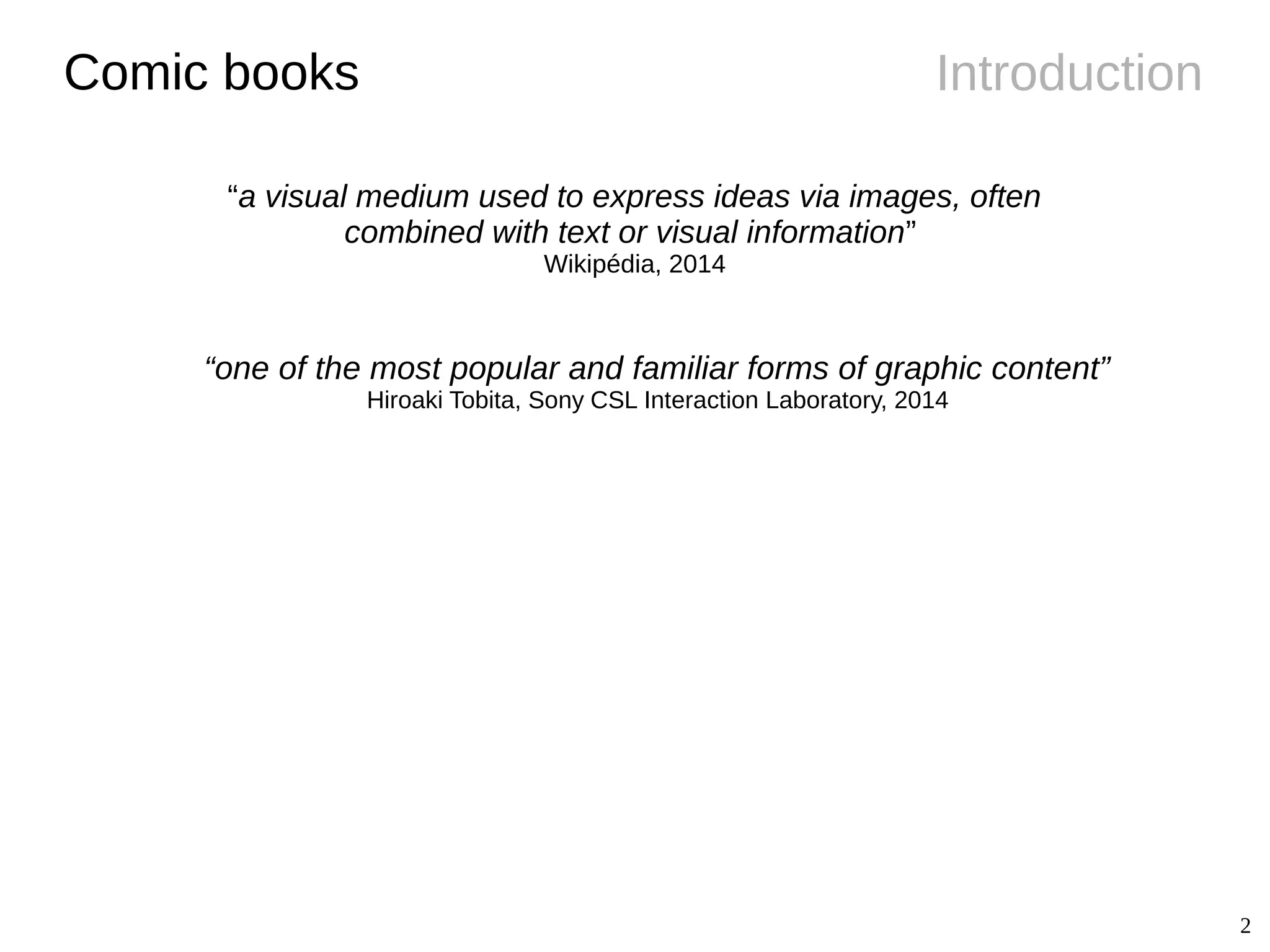
“a visual medium used to express ideas via images, often
combined with text or visual information”
Wikipédia, 2014
“one of the most popular and familiar forms of graphic content”
Hiroaki Tobita, Sony CSL Interaction Laboratory, 2014
3
IntroductionComic books
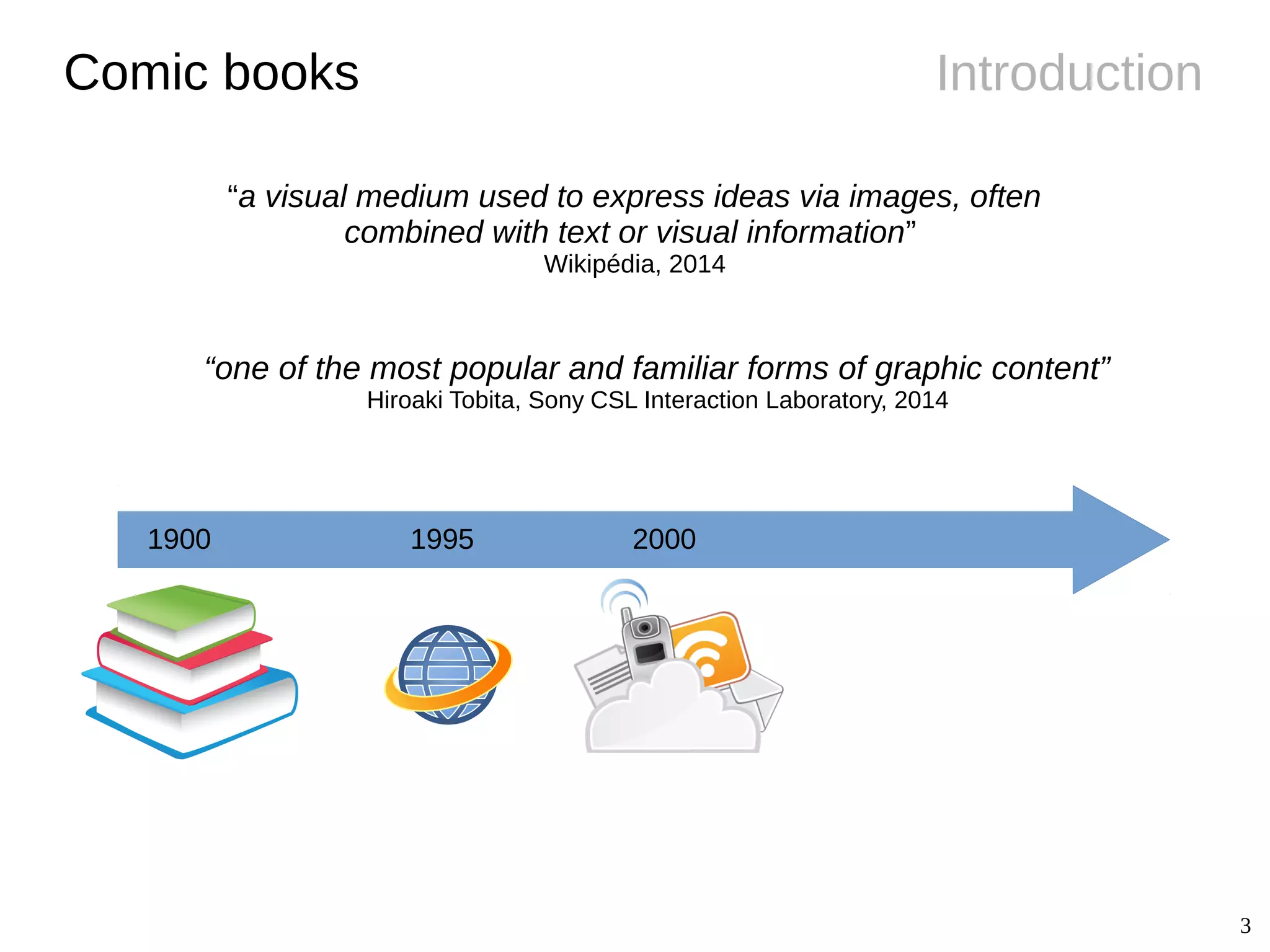
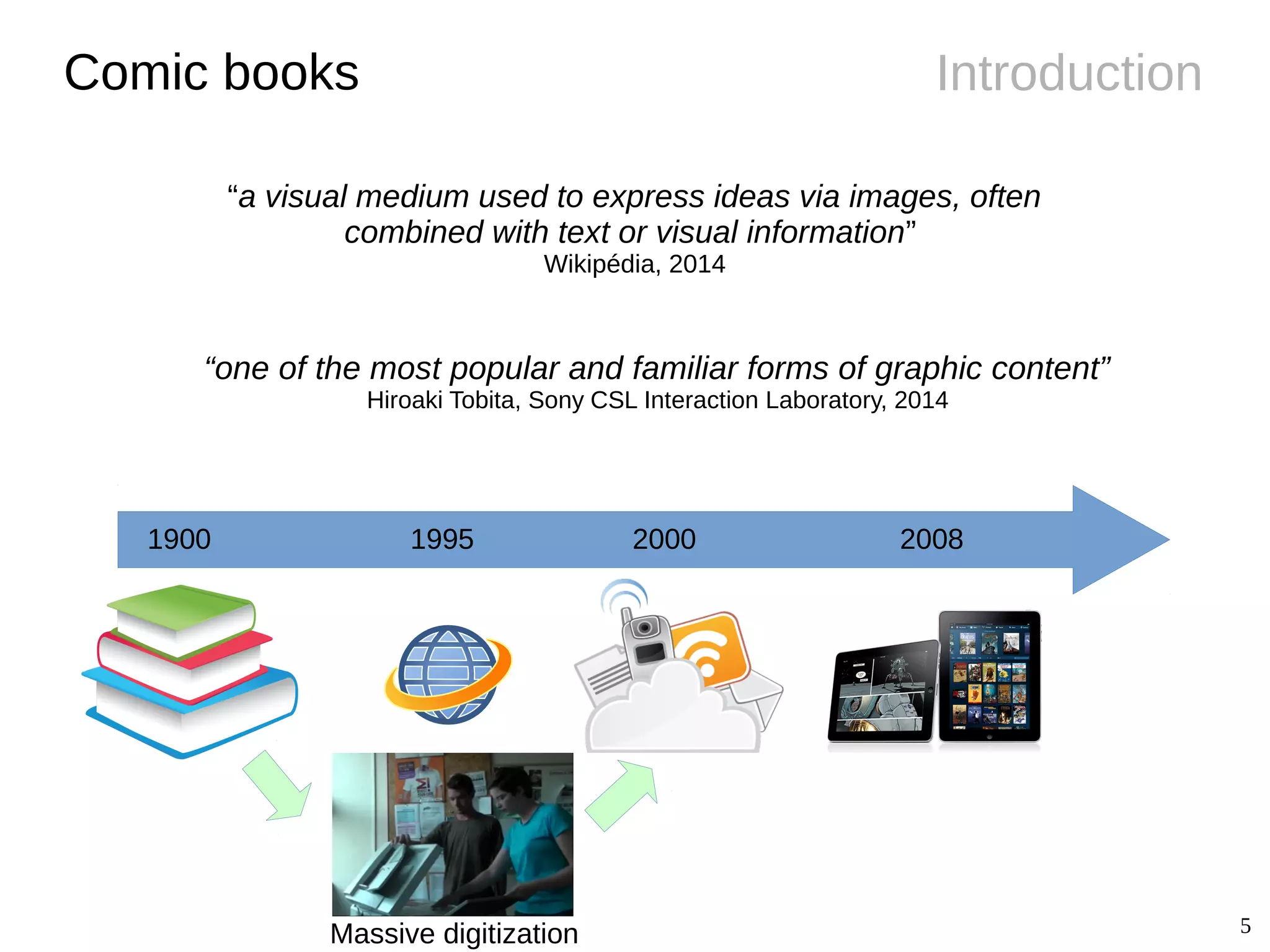
1900 1995 2000
“a visual medium used to express ideas via images, often
combined with text or visual information”
Wikipédia, 2014
“one of the most popular and familiar forms of graphic content”
Hiroaki Tobita, Sony CSL Interaction Laboratory, 2014
4
IntroductionComic books
1900 1995 2000
“a visual medium used to express ideas via images, often
combined with text or visual information”
Wikipédia, 2014
“one of the most popular and familiar forms of graphic content”
Hiroaki Tobita, Sony CSL Interaction Laboratory, 2014
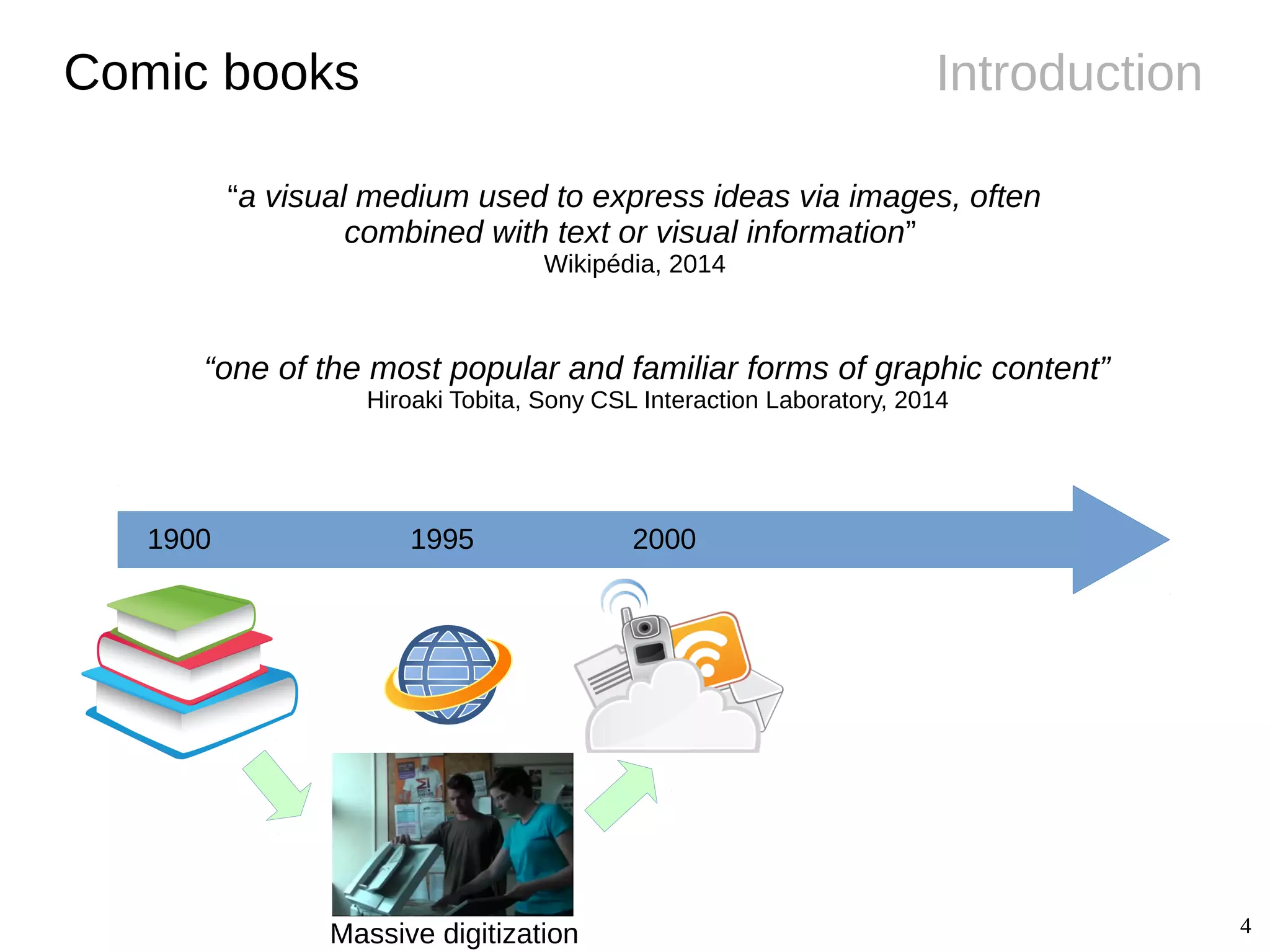
Massive digitization
5
IntroductionComic books
1900 1995 2000
“a visual medium used to express ideas via images, often
combined with text or visual information”
Wikipédia, 2014
“one of the most popular and familiar forms of graphic content”
Hiroaki Tobita, Sony CSL Interaction Laboratory, 2014
Massive digitization
2008
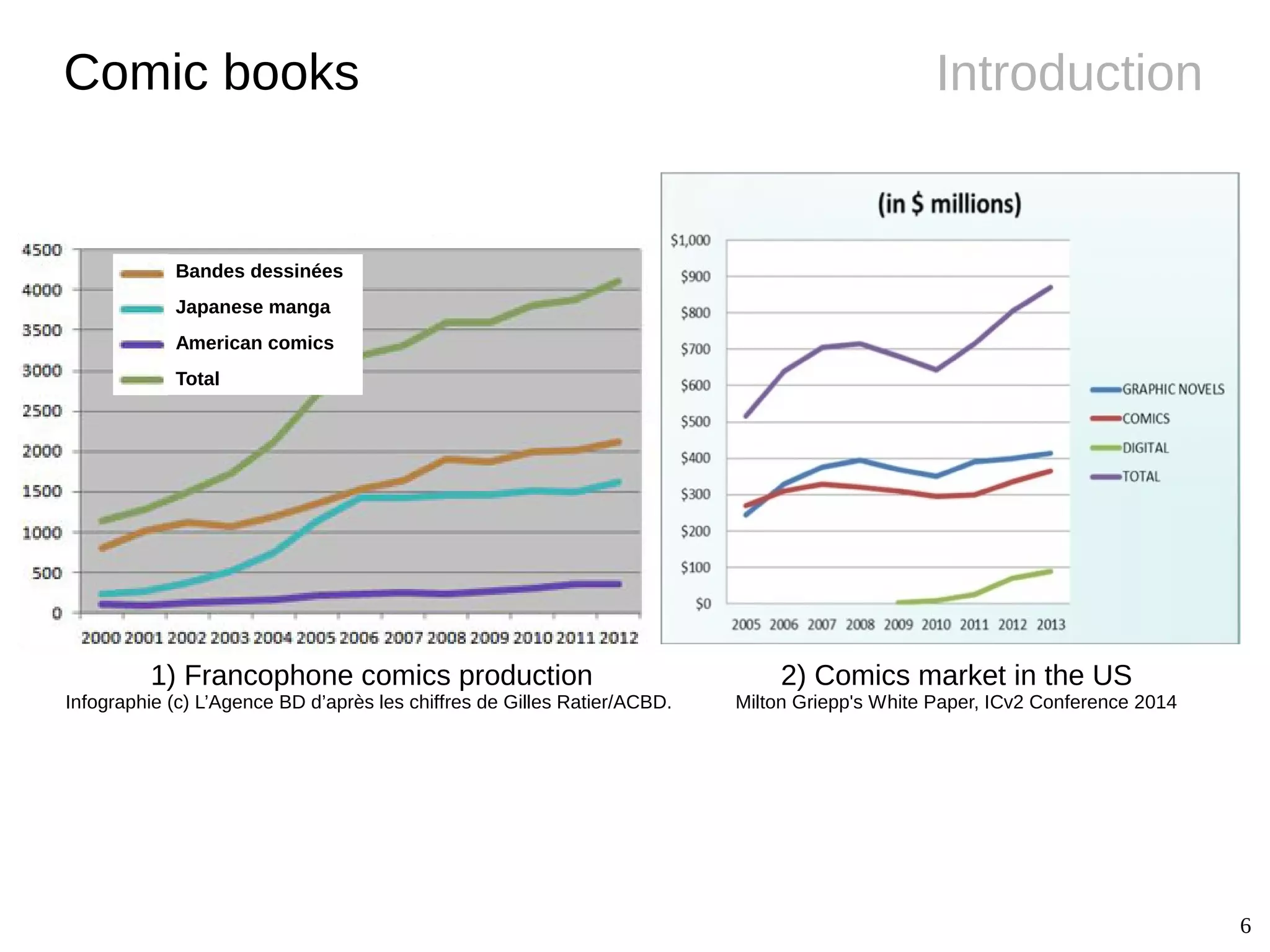
6
IntroductionComic books
2) Comics market in the US
Milton Griepp's White Paper, ICv2 Conference 2014
Bandes dessinées
Japanese manga
American comics
Total
1) Francophone comics production
Infographie (c) L’Agence BD d’après les chiffres de Gilles Ratier/ACBD.
7
IntroductionContext of the thesis
● eBDthèque project (since 2011)
– Add value to digitized comics using the new technologies
●
Content extraction (thesis of Christophe Rigaud)
● Knowledge representation (thesis of Clément Guérin)
– Public founding CPER 2007-2013
– 2 Ph.D. students, 1 engineer, 1 post doc, 6 professors (L3i)
●
Scientific challenges
– Mixed contents of a graphical and textual nature
– Combination of the difficulties of free-form and complex background documents
– Recent and unexplored field of research
● Objectives
– Propose generic approaches able to retrieve as many elements as possible from
any comic book image
– Provide a first dataset and ground truth
8
IntroductionContext of the thesis
● eBDthèque project (since 2011)
– Add value to digitized comics using the new technologies
●
Content extraction (thesis of Christophe Rigaud)
● Knowledge representation (thesis of Clément Guérin)
– Public founding CPER 2007-2013
– 2 Ph.D. students, 1 engineer, 1 post doc, 6 professors (L3i)
●
Scientific challenges
– Mixed contents of a graphical and textual nature
– Combination of the difficulties of free-form and complex background documents
– Recent and unexplored field of research
● Objectives
– Propose generic approaches able to retrieve as many elements as possible from
any comic book image
– Provide a first dataset and ground truth
9
IntroductionContext of the thesis
● eBDthèque project (since 2011)
– Add value to digitized comics using the new technologies
●
Content extraction (thesis of Christophe Rigaud)
● Knowledge representation (thesis of Clément Guérin)
– Public founding CPER 2007-2013
– 2 Ph.D. students, 1 engineer, 1 post doc, 6 professors (L3i)
●
Scientific challenges
– Mixed contents of a graphical and textual nature
– Combination of the difficulties of free-form and complex background documents
– Recent and unexplored field of research
● Objectives
– Propose generic approaches able to retrieve as many elements as possible from
any comic book image
– Provide a first dataset and ground truth
10
Introduction Background Contributions ConclusionExperiments
Pencil drawing. Image credits: Le cycle des
bulles, Christophe Rigaud, 2012
11
Introduction Background Contributions ConclusionExperiments
Pencil drawing. Image credits: Le cycle des
bulles, Christophe Rigaud, 2012
● Panel extraction
● Balloon extraction
● Text extraction & recognition
● Comic character extraction
● Overall progress
12
BackgroundPanel extraction
● Challenges
– Diversity of styles (gutter, implicit)
– Semi-structured layout
● Panel extraction
– White line cut [Chung07]
– Recursive X-Y cut [Eunjung07]
– Density gradient [Tanaka07]
– Connected-components [Arai10, Pang14]
– Polygon detection [Li14a]
– Corners and line segments [Stommel12]
● Conclusions
– Specific approaches only
– Remaining difficulties for non-rectangle and
implicit panels
– Copyrighted images (not shareable)
13
BackgroundPanel extraction
● Challenges
– Diversity of styles (gutter, implicit)
– Semi-structured layout
● Panel extraction
– White line cut [Chung07]
– Recursive X-Y cut [Eunjung07]
– Density gradient [Tanaka07]
– Connected-components [Arai10, Pang14]
– Polygon detection [Li14a]
– Corners and line segments [Stommel12]
● Conclusions
– Specific approaches only
– Remaining difficulties for non-rectangle and
implicit panels
– Copyrighted images (not shareable)
14
Background
● Challenges
– Difference between shape and
contour
– Implicit balloon positions
– Semantics related to text
● Extraction
– Connected-components [Arai11, Ho12]
● Conclusions
– Closed balloon with text inside
– Several unexplored fields (e.g.
implicit balloon positions, balloon
classification, tail detection)
Balloon extraction
Image Shape Contour
Oval Smooth
Rectangle Smooth
Oval Wavy
Oval Spiky
Oval /
implicit
Smooth /
Implicit
15
BackgroundBalloon extraction
Image Shape Contour
Oval Smooth
Rectangle Smooth
Oval Wavy
Oval Spiky
Oval /
implicit
Smooth /
Implicit
● Challenges
– Difference between shape and
contour
– Implicit balloon positions
– Semantics related to text
● Extraction
– Connected-components [Arai11, Ho12]
● Conclusions
– Closed balloon with text inside
– Several unexplored fields (e.g.
implicit balloon positions, balloon
classification, tail detection)
16
Background
● Conclusions
– Speech text (from balloons)
– Captions and sound effects
unexplored
– Text recognition very poor
Text extraction & recognition
● Challenges
– Non-standard fonts
– Multi-script/orientation/scale
– Complex background (sound effects)
– Hyphenation, voluntary spelling
mistakes
● Extraction
– Sliding Concentric Windows + SVM
[Su11]
– Connected-components [Ho12, Pang14]
– SVM and Bayesian classifier [Li14b]
● Recognition
– OCR trained for a specific comics
font [Ponsard12]
17
Background
● Conclusions
– Speech text only (from balloons)
– Captions and sound effects
unexplored
– Text recognition very poor
Text extraction & recognition
● Challenges
– Non-standard fonts
– Multi-script/orientation/scale
– Complex background (sound effects)
– Hyphenation, voluntary spelling
mistakes
● Extraction
– Sliding Concentric Windows + SVM
[Su11]
– Connected-components [Ho12, Pang14]
– SVM and Bayesian classifier [Li14b]
● Recognition
– OCR trained for a specific comics
font [Ponsard12]
18
Background
● Conclusions
– Preliminary results
– Complex and versatile structure
– Contains most of the interesting
information
Comic character extraction
● Challenges
– Hand-drawn, stroke-based
– Intra/inter class variability
– Scale, deformation, posture,
occlusion
● Extraction & recognition
– Manga faces [Cheung08, Sun10,
Kohei12]
– Cartoons [Khan12]
19
Background
● Conclusions
– Preliminary results
– Complex and versatile structure
– Contains most of the interesting
information
Comic character extraction
● Challenges
– Hand-drawn, stroke-based
– Intra/inter class variability
– Scale, deformation, posture,
occlusion
● Extraction & recognition
– Manga faces [Cheung08, Sun10,
Kohei12]
– Cartoons [Khan12]
20
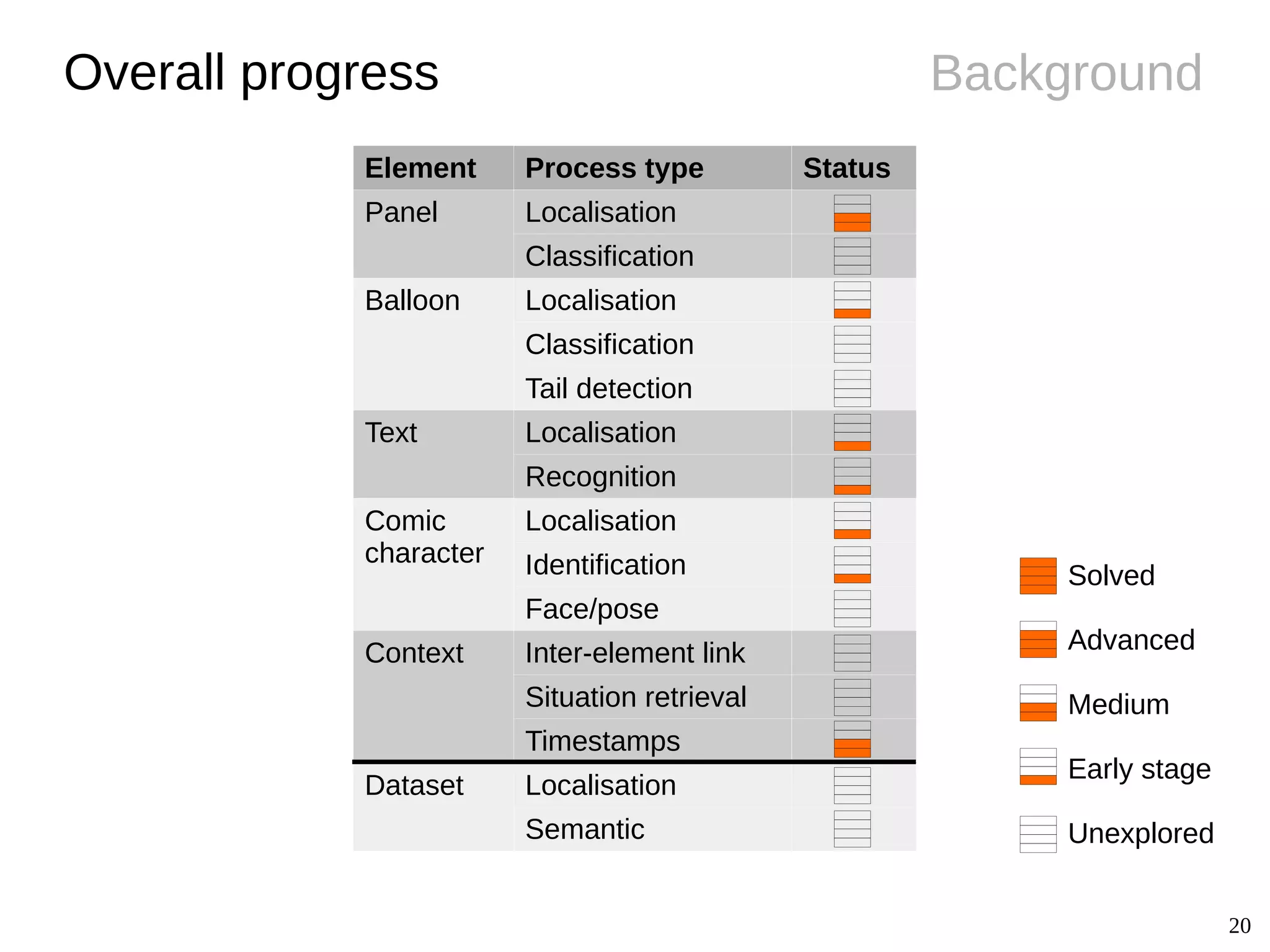
Background
Element Process type Status
Panel Localisation
Classification
Balloon Localisation
Classification
Tail detection
Text Localisation
Recognition
Comic
character
Localisation
Identification
Face/pose
Context Inter-element link
Situation retrieval
Timestamps
Dataset Localisation
Semantic
Overall progress
Solved
Advanced
Medium
Early stage
Unexplored
21
● Introduction
● Sequential approach
● (Independent approach)
● Knowledge-driven approach
Introduction Documents Contributions ConclusionExperiments
Inking. Image credits: Le cycle des bulles,
Christophe Rigaud, 2012
22
Introduction Documents Contributions ConclusionExperiments
Inking. Image credits: Le cycle des bulles,
Christophe Rigaud, 2012
● Introduction
● Sequential approach
● (Independent approach)
● Knowledge-driven approach
23
ContributionsIntroduction
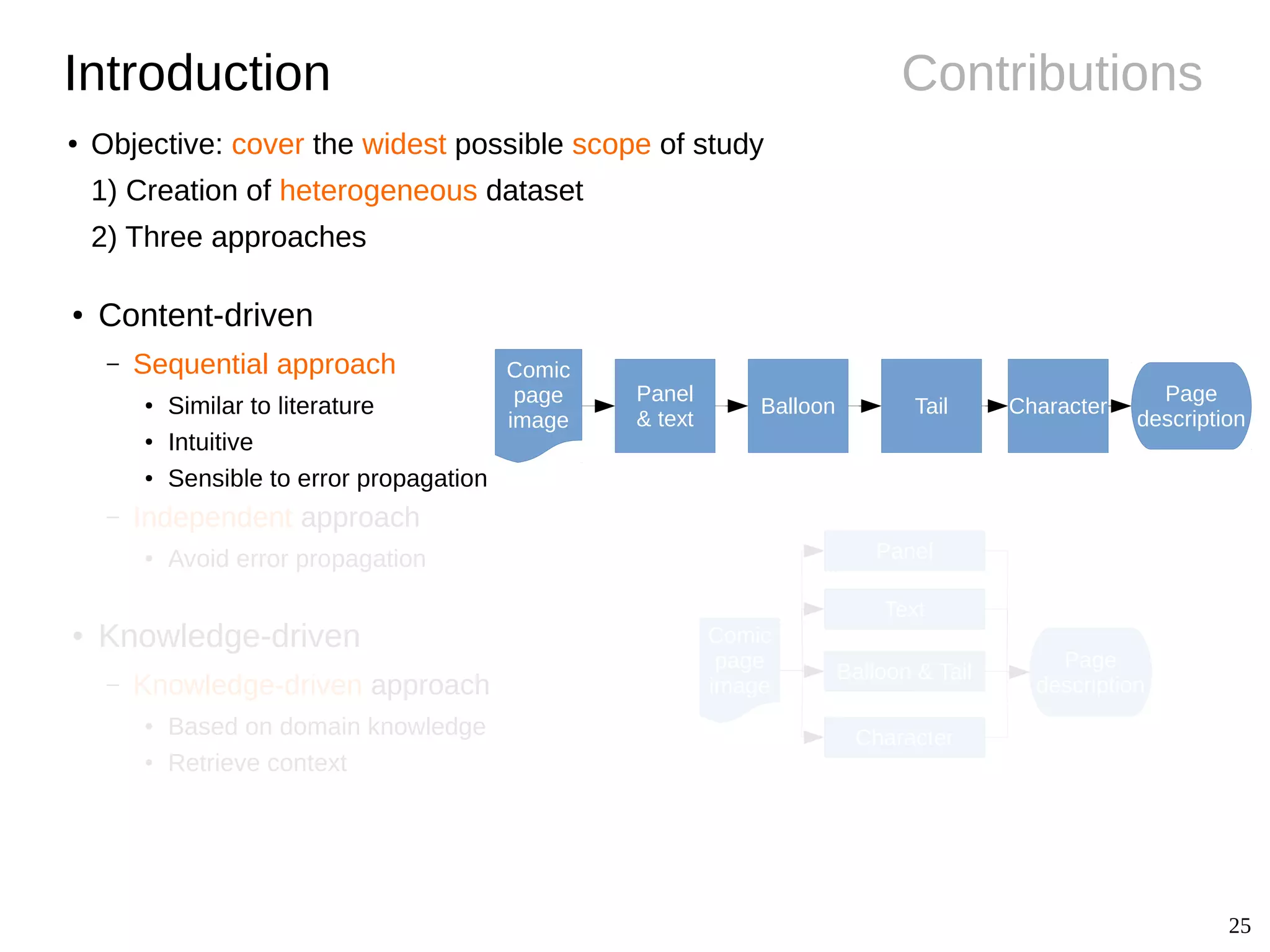
● Objective: cover the widest possible scope of study
24
ContributionsIntroduction
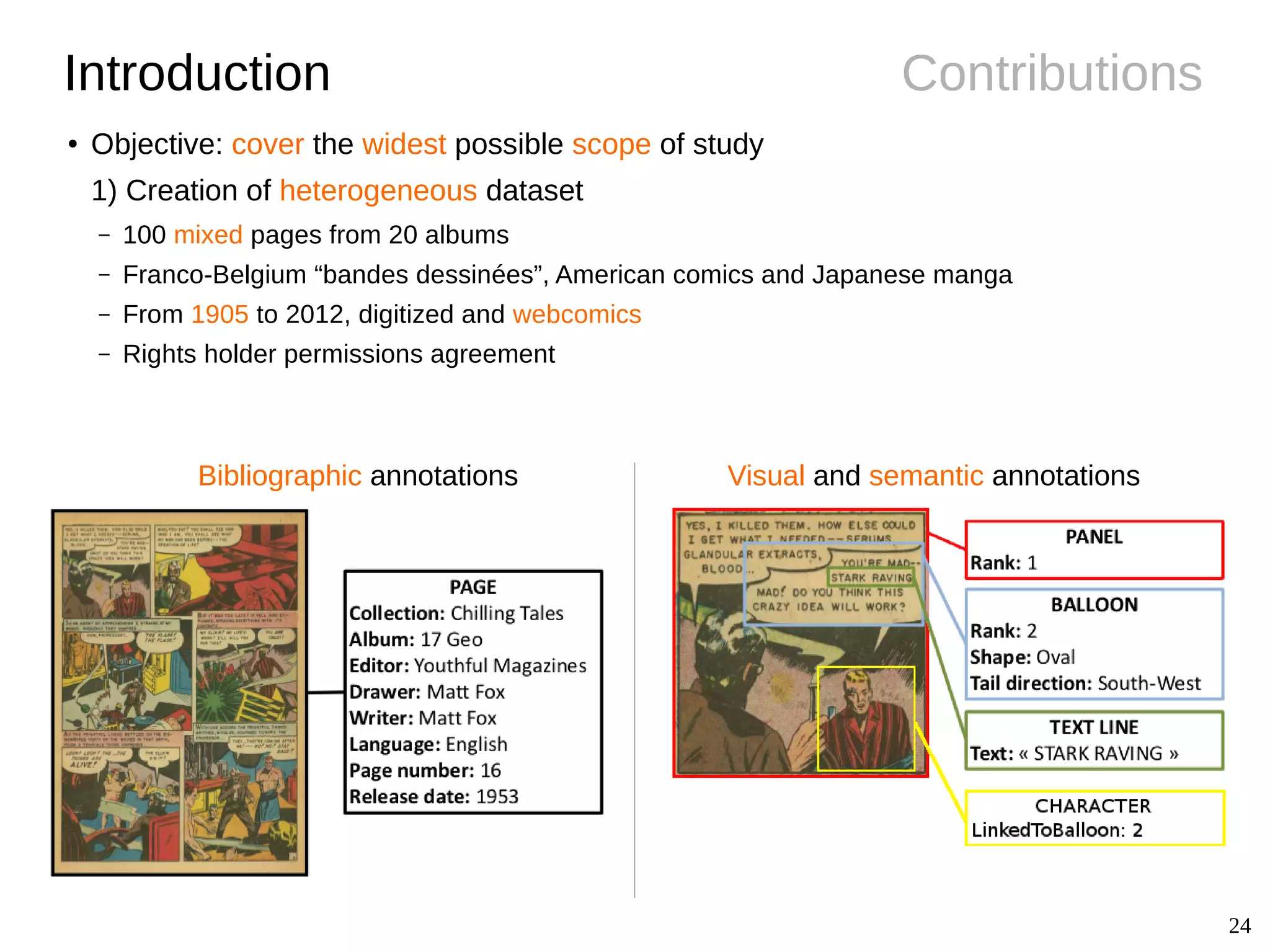
Bibliographic annotations Visual and semantic annotations
● Objective: cover the widest possible scope of study
1) Creation of heterogeneous dataset
– 100 mixed pages from 20 albums
– Franco-Belgium “bandes dessinées”, American comics and Japanese manga
– From 1905 to 2012, digitized and webcomics
– Rights holder permissions agreement
25
Contributions
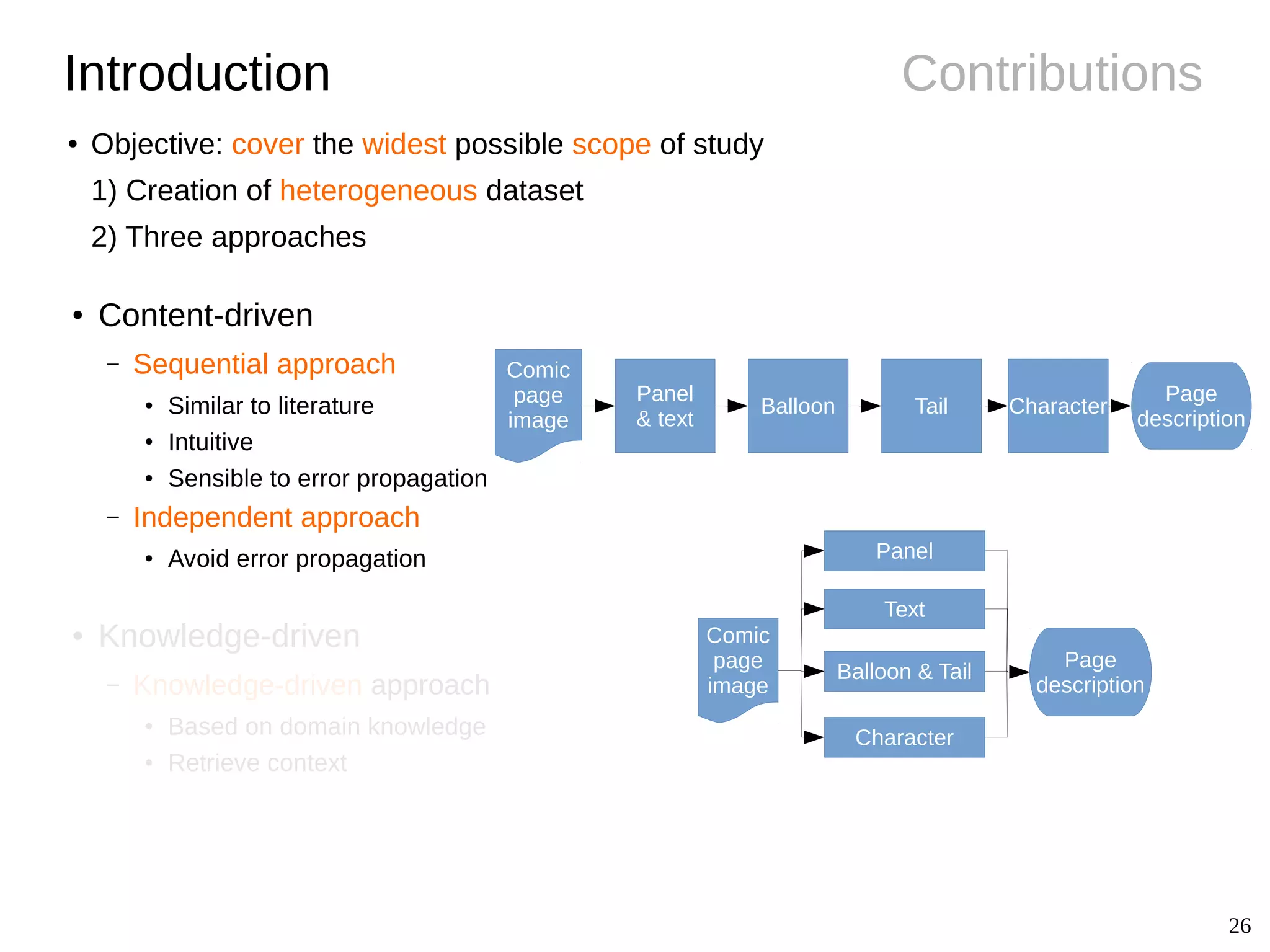
● Content-driven
– Sequential approach
●
Similar to literature
●
Intuitive
● Sensible to error propagation
– Independent approach
●
Avoid error propagation
● Knowledge-driven
– Knowledge-driven approach
●
Based on domain knowledge
●
Retrieve context
Comic
page
image
Panel
& text
Balloon Tail Character
Page
description
Comic
page
image
Page
description
Panel
Text
Character
Balloon & Tail
Introduction
● Objective: cover the widest possible scope of study
1) Creation of heterogeneous dataset
2) Three approaches
26
ContributionsIntroduction
● Content-driven
– Sequential approach
●
Similar to literature
●
Intuitive
● Sensible to error propagation
– Independent approach
●
Avoid error propagation
● Knowledge-driven
– Knowledge-driven approach
●
Based on domain knowledge
●
Retrieve context
Comic
page
image
Panel
& text
Balloon Tail Character
Page
description
Comic
page
image
Page
description
Panel
Text
Character
Balloon & Tail
● Objective: cover the widest possible scope of study
1) Creation of heterogeneous dataset
2) Three approaches
27
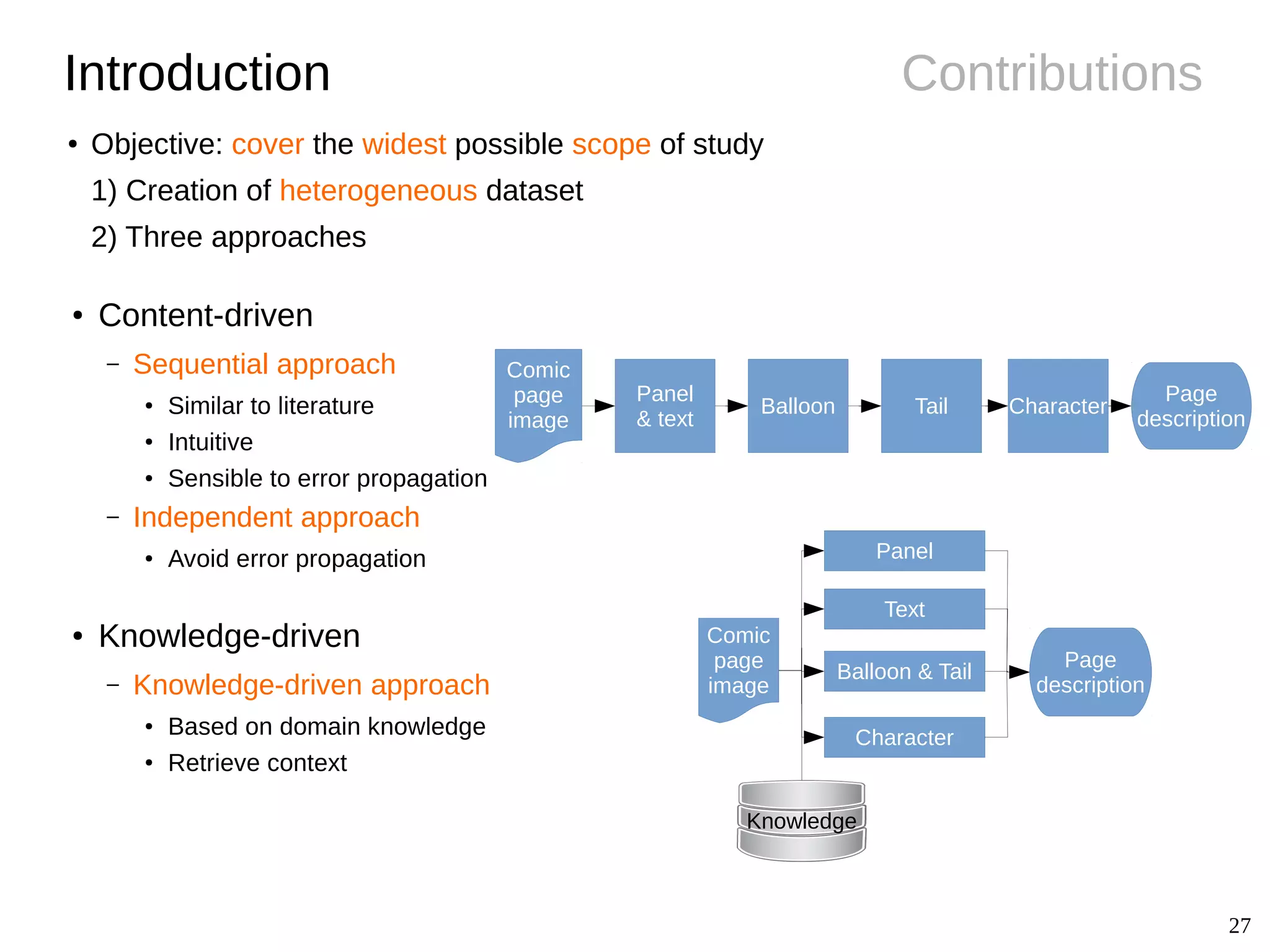
ContributionsIntroduction
● Content-driven
– Sequential approach
●
Similar to literature
●
Intuitive
● Sensible to error propagation
– Independent approach
●
Avoid error propagation
● Knowledge-driven
– Knowledge-driven approach
●
Based on domain knowledge
●
Retrieve context
Comic
page
image
Panel
& text
Balloon Tail Character
Page
description
Comic
page
image
Page
description
Panel
Text
Character
Balloon & Tail
Knowledge
● Objective: cover the widest possible scope of study
1) Creation of heterogeneous dataset
2) Three approaches
28
Introduction Documents Contributions ConclusionExperiments
Inking. Image credits: Le cycle des bulles,
Christophe Rigaud, 2012
● Introduction
● Sequential approach
● (Independent approach)
● Knowledge-driven approach
29
Introduction Documents Contributions ConclusionExperiments
Inking. Image credits: Le cycle des bulles,
Christophe Rigaud, 2012
● Introduction
● Sequential approach
– Panel & text extraction
– Balloon extraction
– Tail extraction
– Comic character extraction
● (Independent approach)
● Knowledge-driven approach
30
Introduction Documents Contributions ConclusionExperiments
Inking. Image credits: Le cycle des bulles,
Christophe Rigaud, 2012
● Introduction
● Sequential approach
– Panel & text extraction
– Balloon extraction
– Tail extraction
– Comic character extraction
● (Independent approach)
● Knowledge-driven approach
31
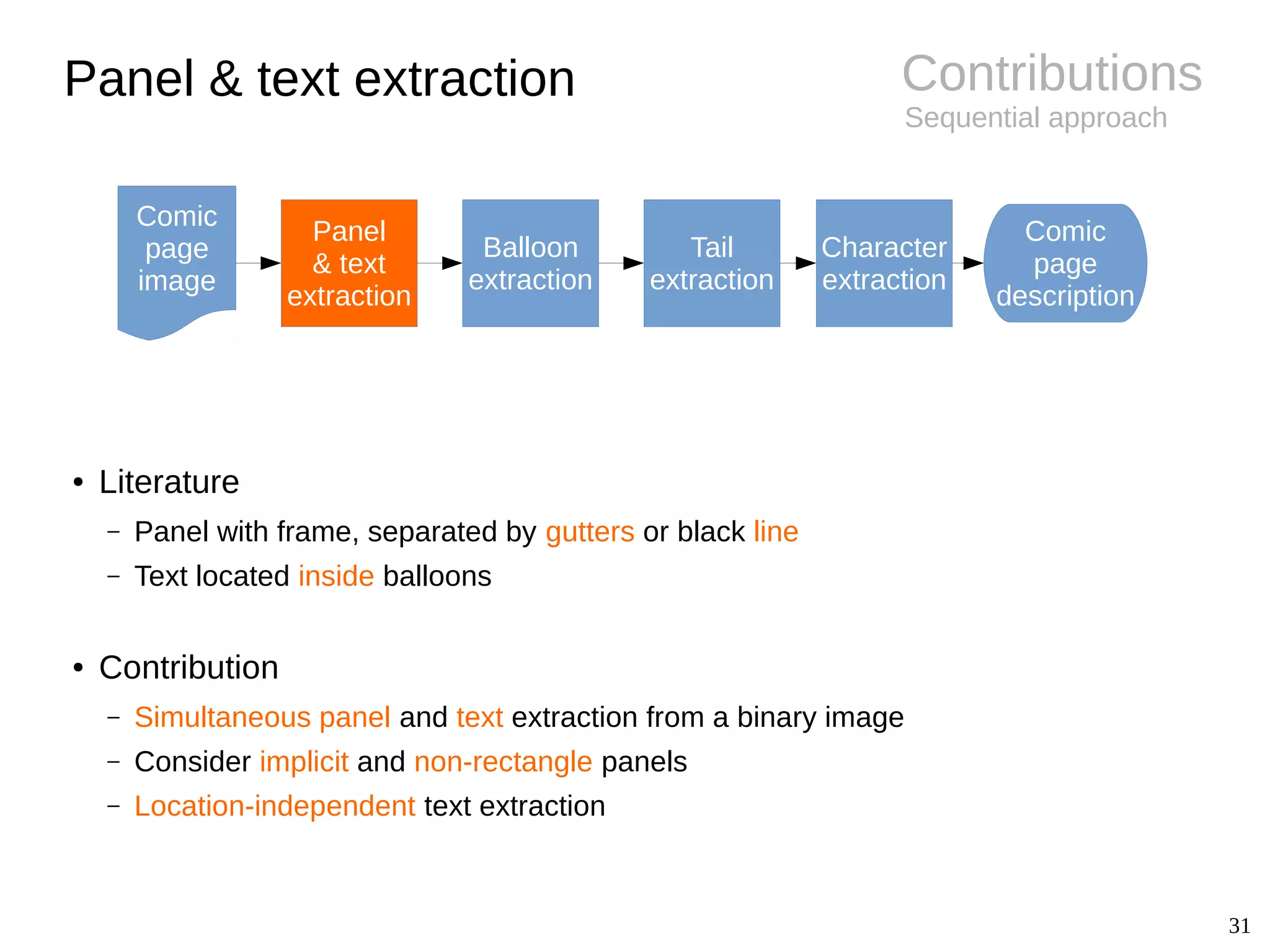
Contributions
Sequential approach
Panel & text extraction
Comic
page
image
Panel
& text
extraction
Balloon
extraction
Tail
extraction
Character
extraction
Comic
page
description
● Literature
– Panel with frame, separated by gutters or black line
– Text located inside balloons
● Contribution
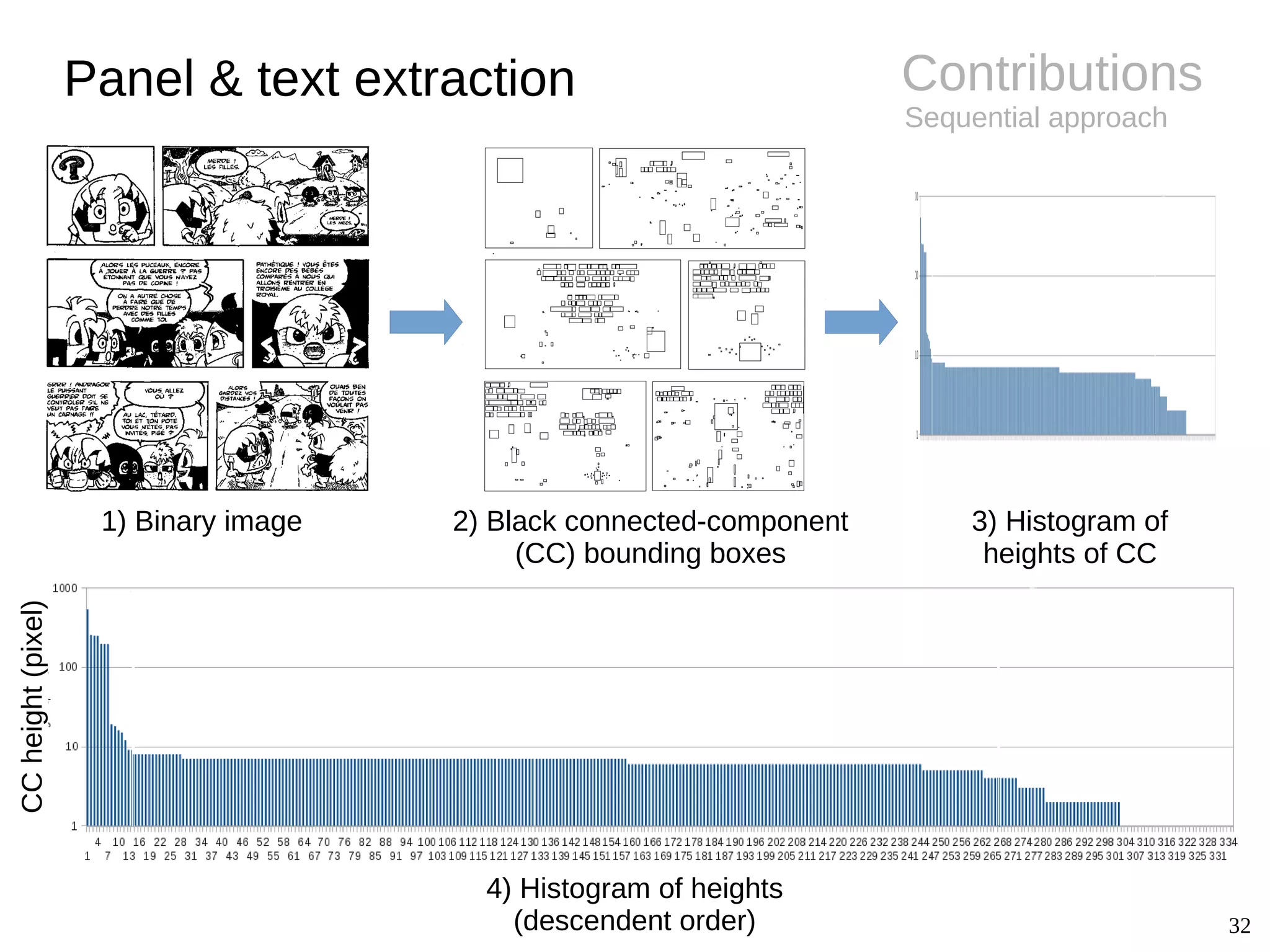
– Simultaneous panel and text extraction from a binary image
– Consider implicit and non-rectangle panels
– Location-independent text extraction
32
Contributions
Sequential approach
Panel & text extraction
CCheight(pixel)
4) Histogram of heights
(descendent order)
1) Binary image 2) Black connected-component
(CC) bounding boxes
3) Histogram of
heights of CC
33
Contributions
Sequential approach
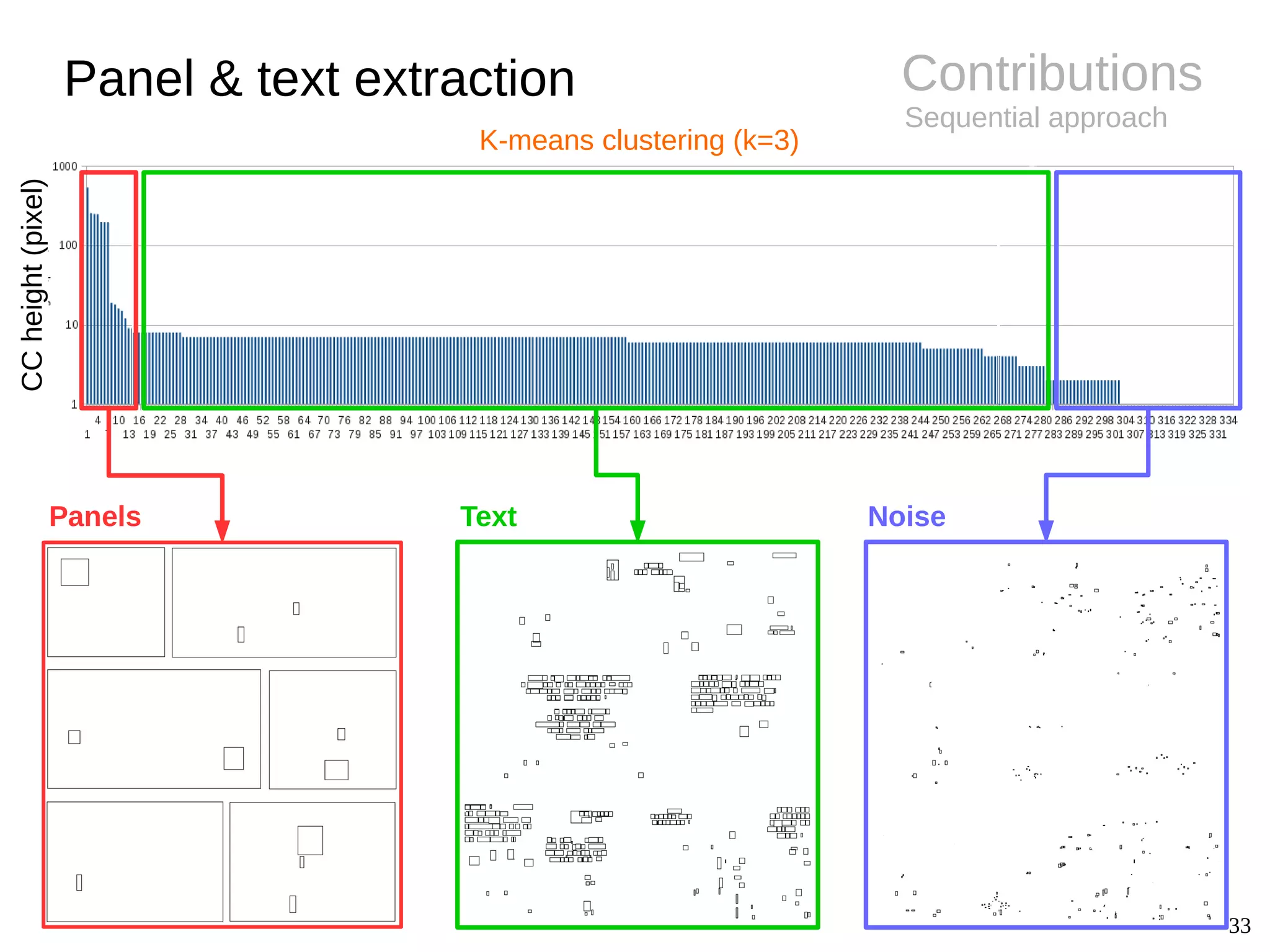
Panel & text extraction
CCheight(pixel)
K-means clustering (k=3)
Panels Text Noise
34
Contributions
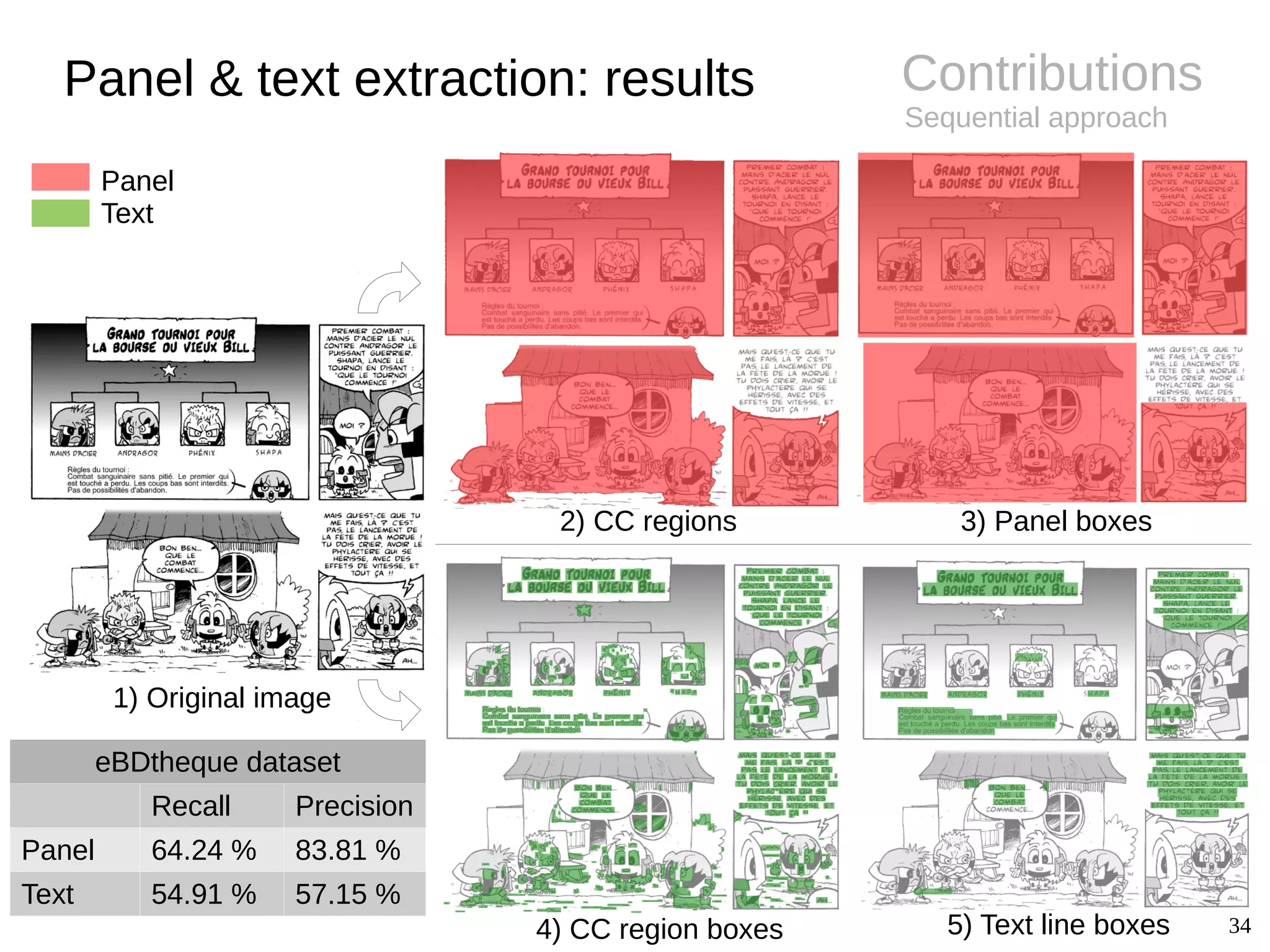
Sequential approach
TODO
Panel & text extraction: results
1) Original image
4) CC region boxes 5) Text line boxes
2) CC regions 3) Panel boxes
eBDtheque dataset
Recall Precision
Panel 64.24 % 83.81 %
Text 54.91 % 57.15 %
Panel
Text
35
Introduction Documents Contributions ConclusionExperiments
Inking. Image credits: Le cycle des bulles,
Christophe Rigaud, 2012
● Introduction
● Sequential approach
– Panel & text extraction
– Balloon extraction
– Tail extraction
– Comic character extraction
● (Independent approach)
● Knowledge-driven approach
36
Contributions
Sequential approach
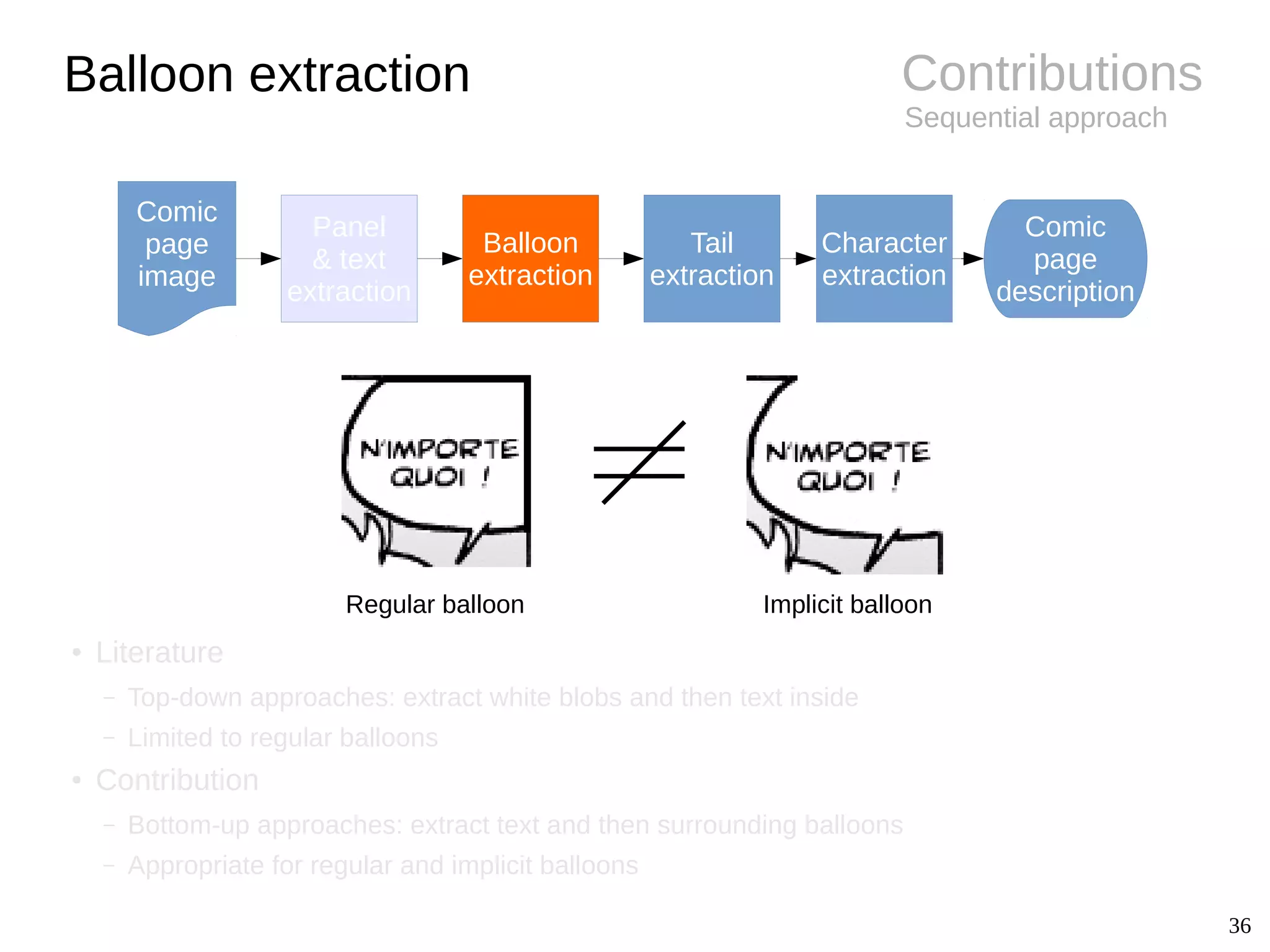
Balloon extraction
Comic
page
image
Panel
& text
extraction
Balloon
extraction
Tail
extraction
Character
extraction
Comic
page
description
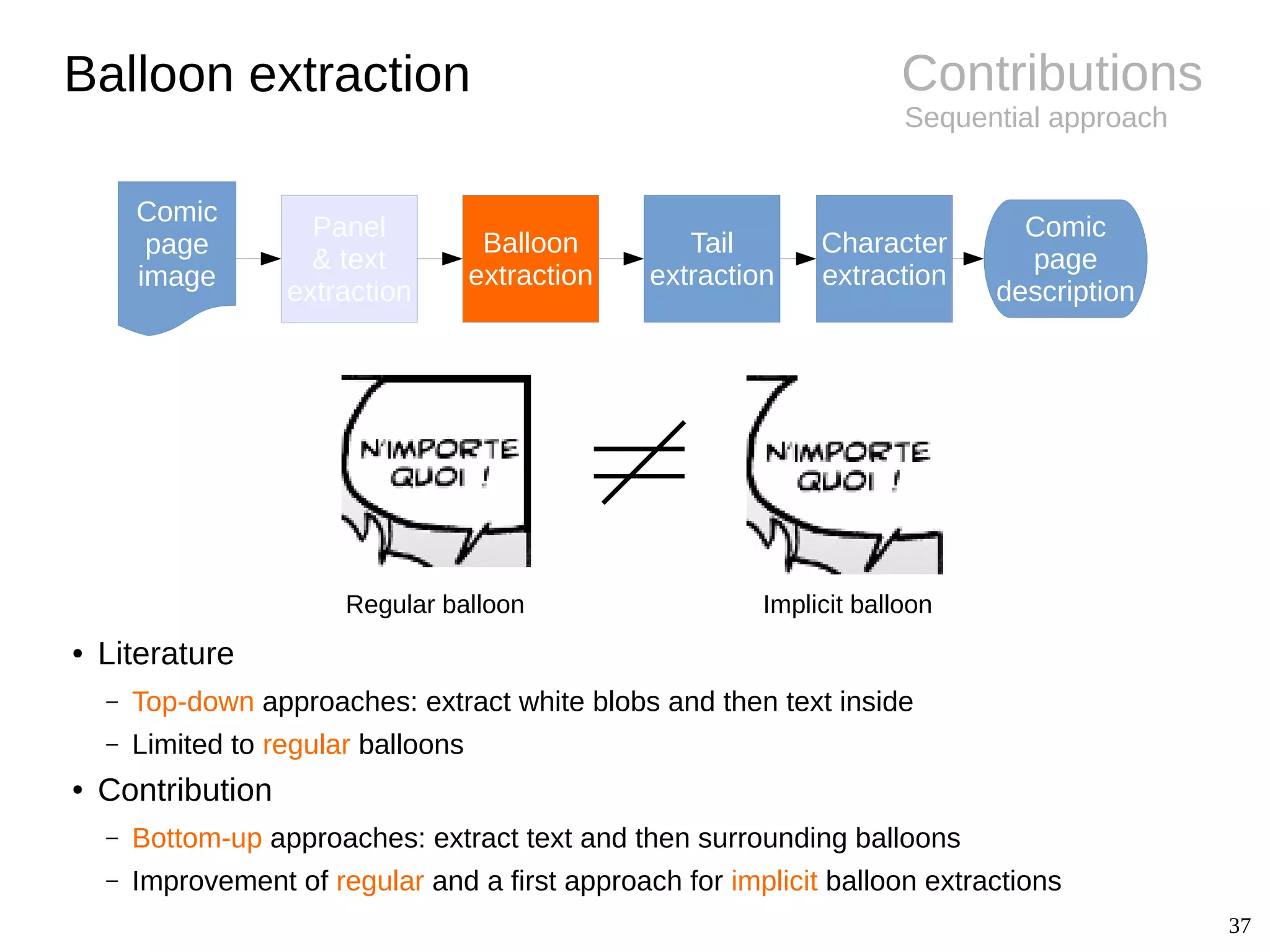
Regular balloon Implicit balloon
● Literature
– Top-down approaches: extract white blobs and then text inside
– Limited to regular balloons
● Contribution
– Bottom-up approaches: extract text and then surrounding balloons
– Appropriate for regular and implicit balloons
37
Contributions
Sequential approach
Balloon extraction
Regular balloon Implicit balloon
● Literature
– Top-down approaches: extract white blobs and then text inside
– Limited to regular balloons
● Contribution
– Bottom-up approaches: extract text and then surrounding balloons
– Improvement of regular and a first approach for implicit balloon extractions
Comic
page
image
Panel
& text
extraction
Balloon
extraction
Tail
extraction
Character
extraction
Comic
page
description
38
Contributions
Sequential approach
Balloon extraction: regular
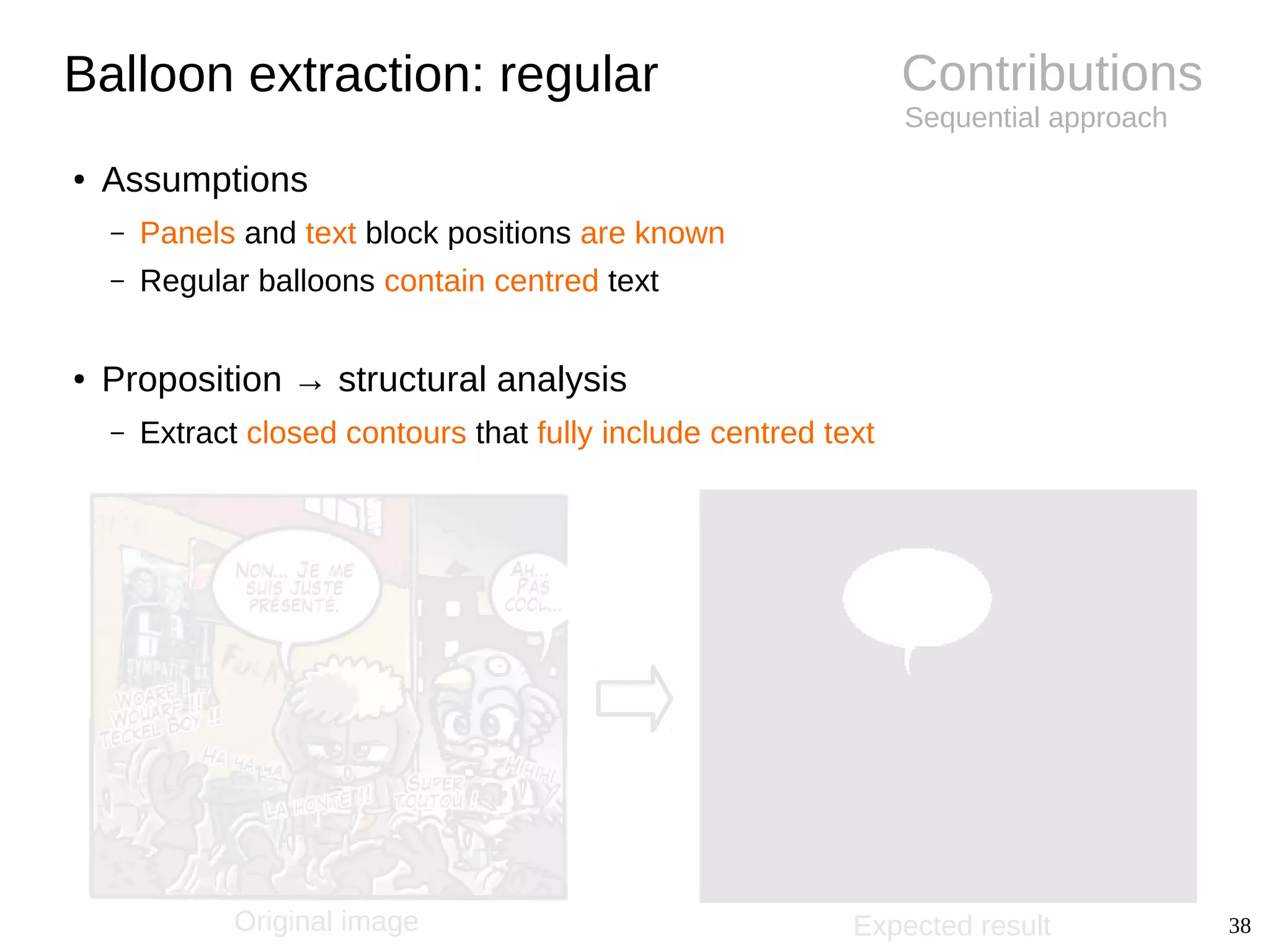
● Assumptions
– Panels and text block positions are known
– Regular balloons contain centred text
● Proposition → structural analysis
– Extract closed contours that fully include centred text
Original image Expected result
39
Contributions
Sequential approach
Balloon extraction: regular
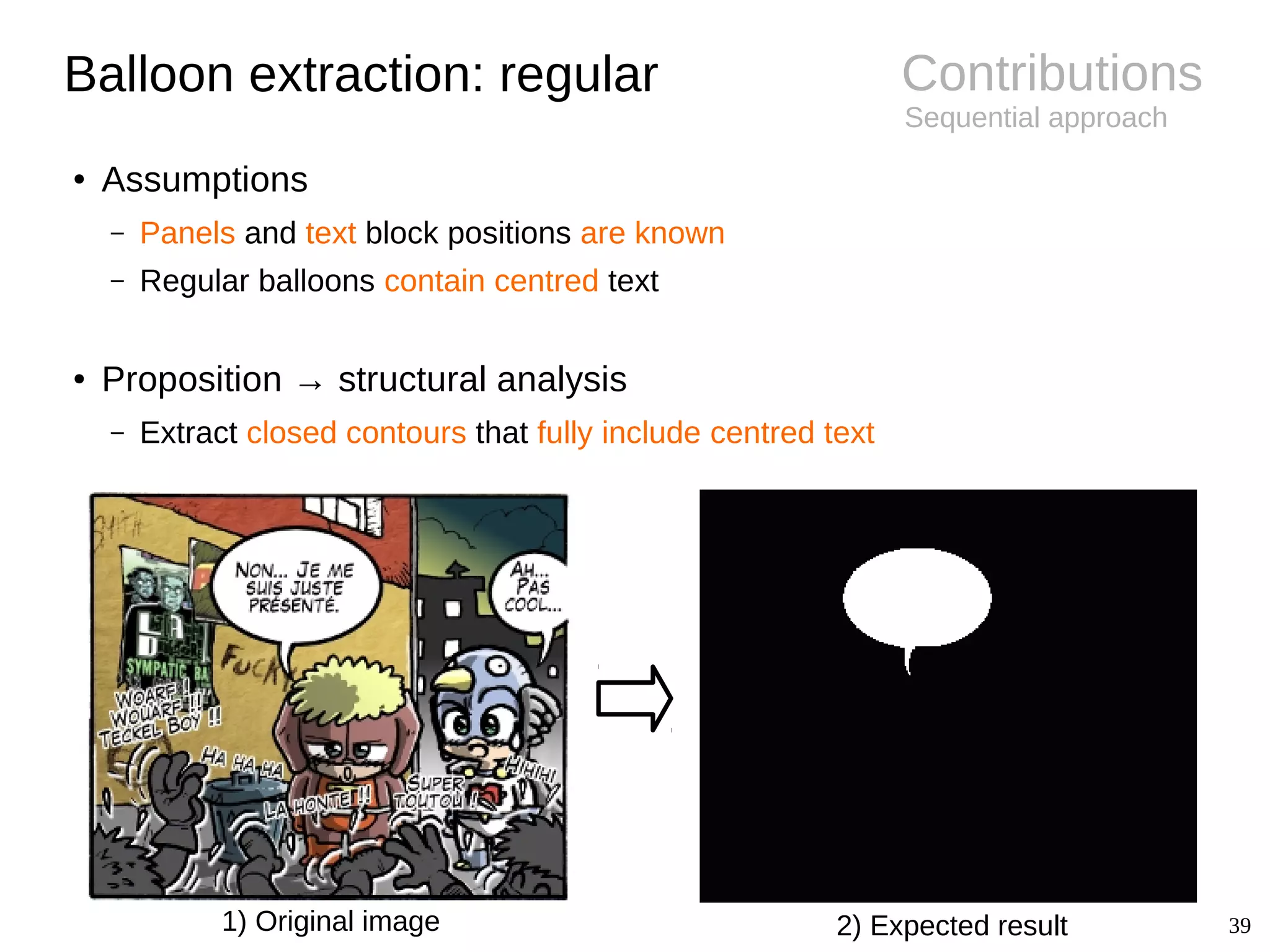
● Assumptions
– Panels and text block positions are known
– Regular balloons contain centred text
● Proposition → structural analysis
– Extract closed contours that fully include centred text
1) Original image 2) Expected result
40
Contributions
Sequential approach
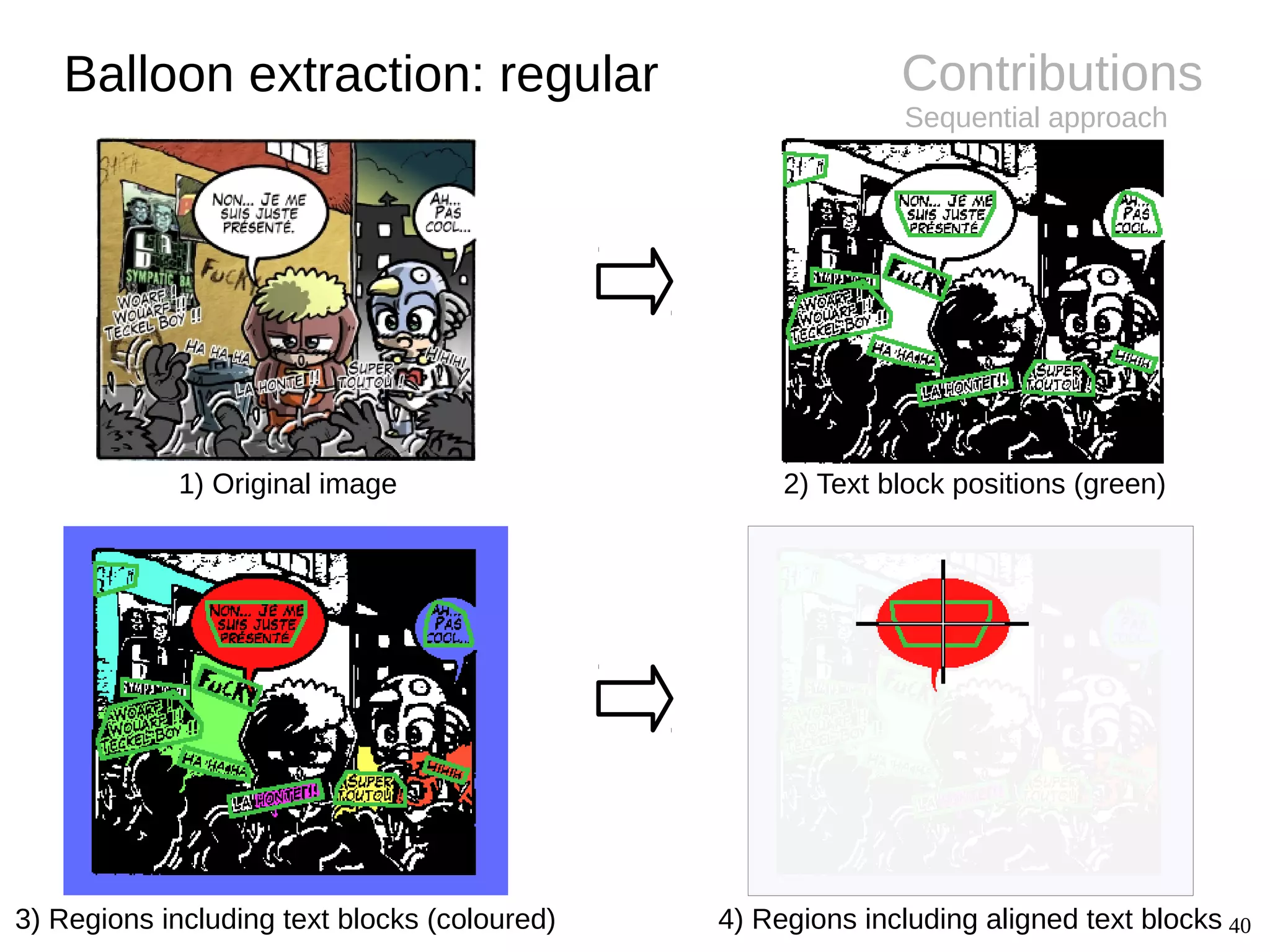
Balloon extraction: regular
1) Original image 2) Text block positions (green)
3) Regions including text blocks (coloured) 4) Regions including aligned text blocks
41
Contributions
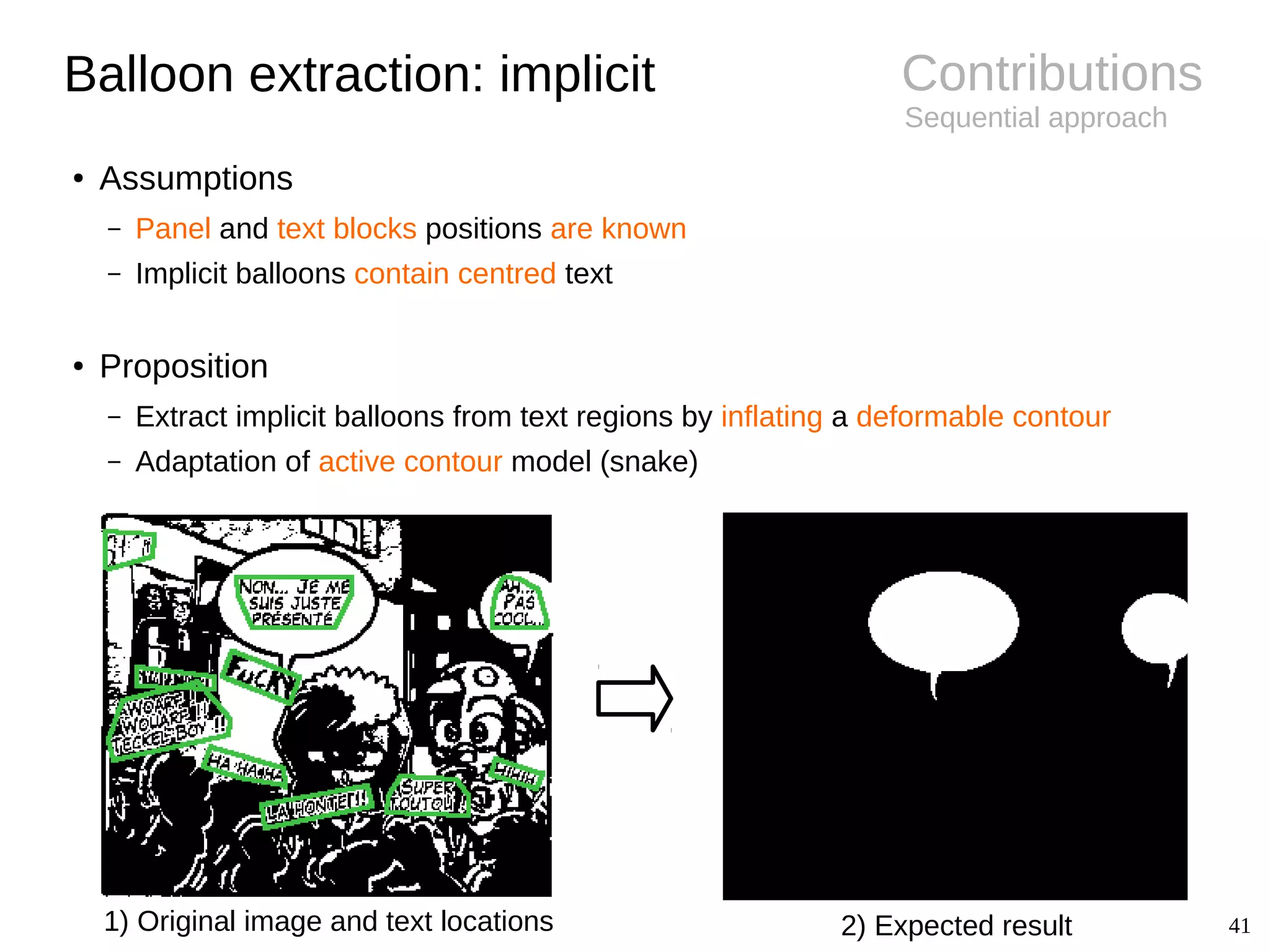
Sequential approach
Balloon extraction: implicit
● Assumptions
– Panel and text blocks positions are known
– Implicit balloons contain centred text
● Proposition
– Extract implicit balloons from text regions by inflating a deformable contour
– Adaptation of active contour model (snake)
1) Original image and text locations 2) Expected result
42
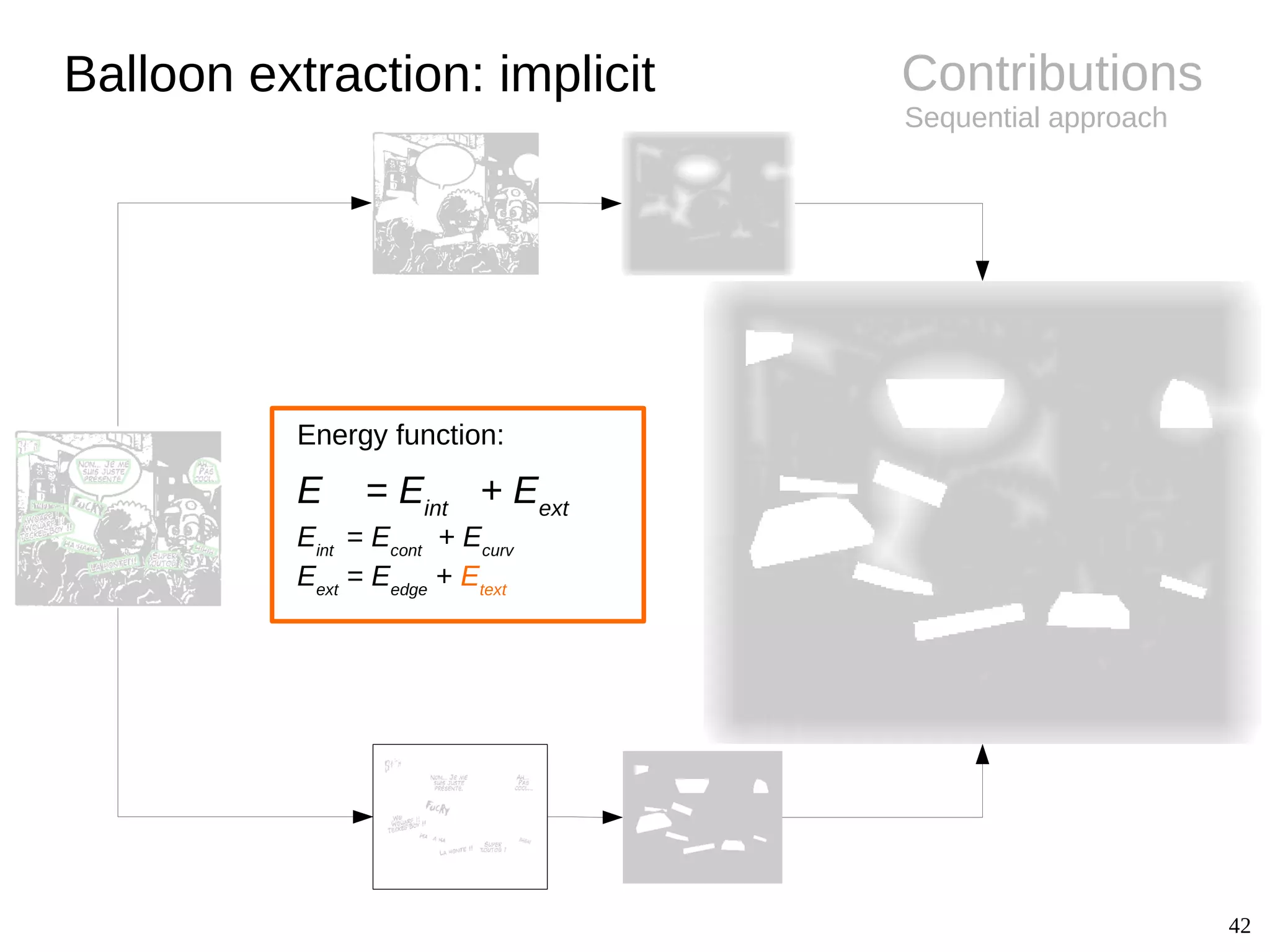
Contributions
Sequential approach
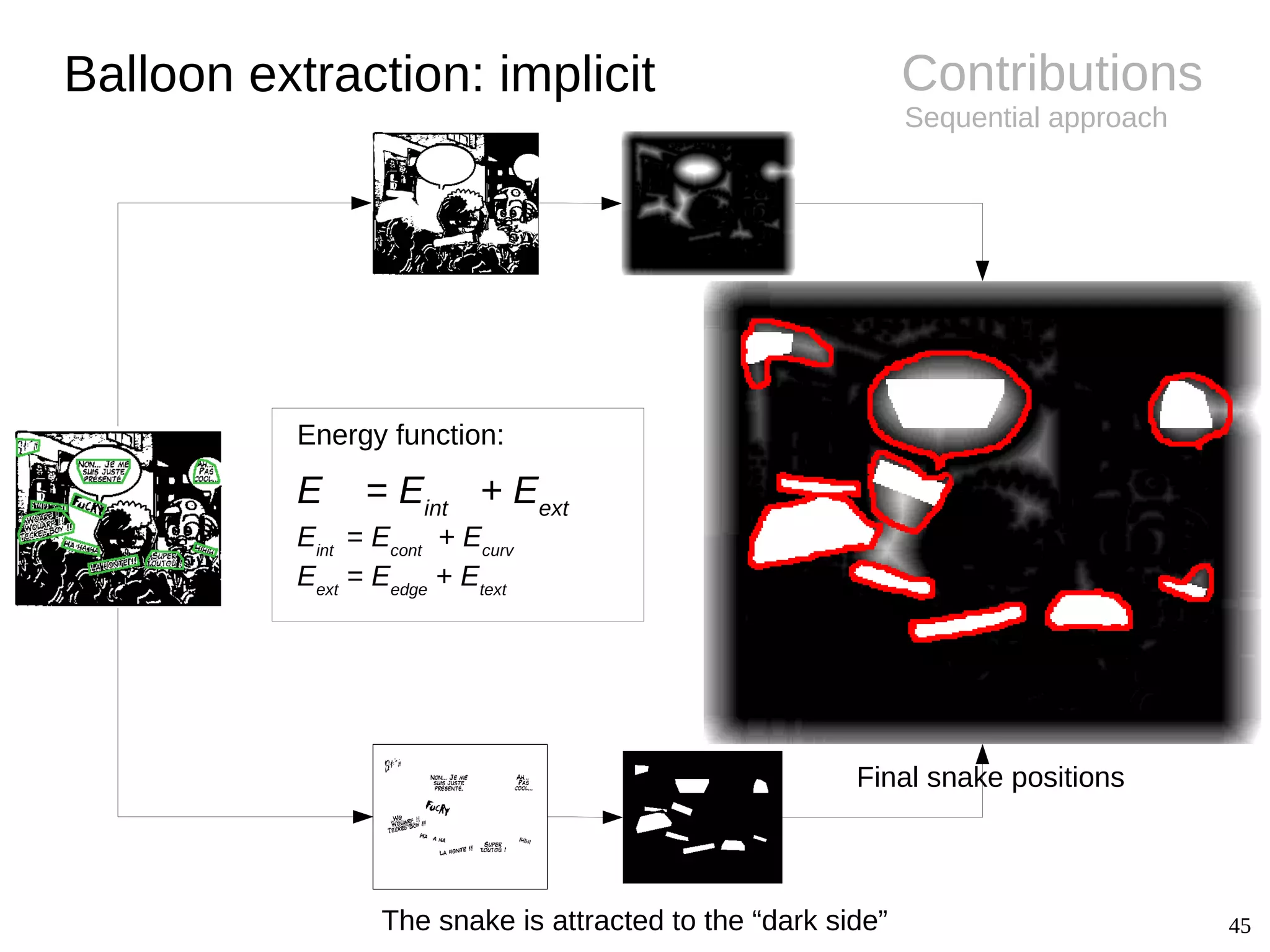
Balloon extraction: implicit
E = Eint
+ Eext
Eint
= Econt
+ Ecurv
Eext
= Eedge
+ Etext
Energy function:
43
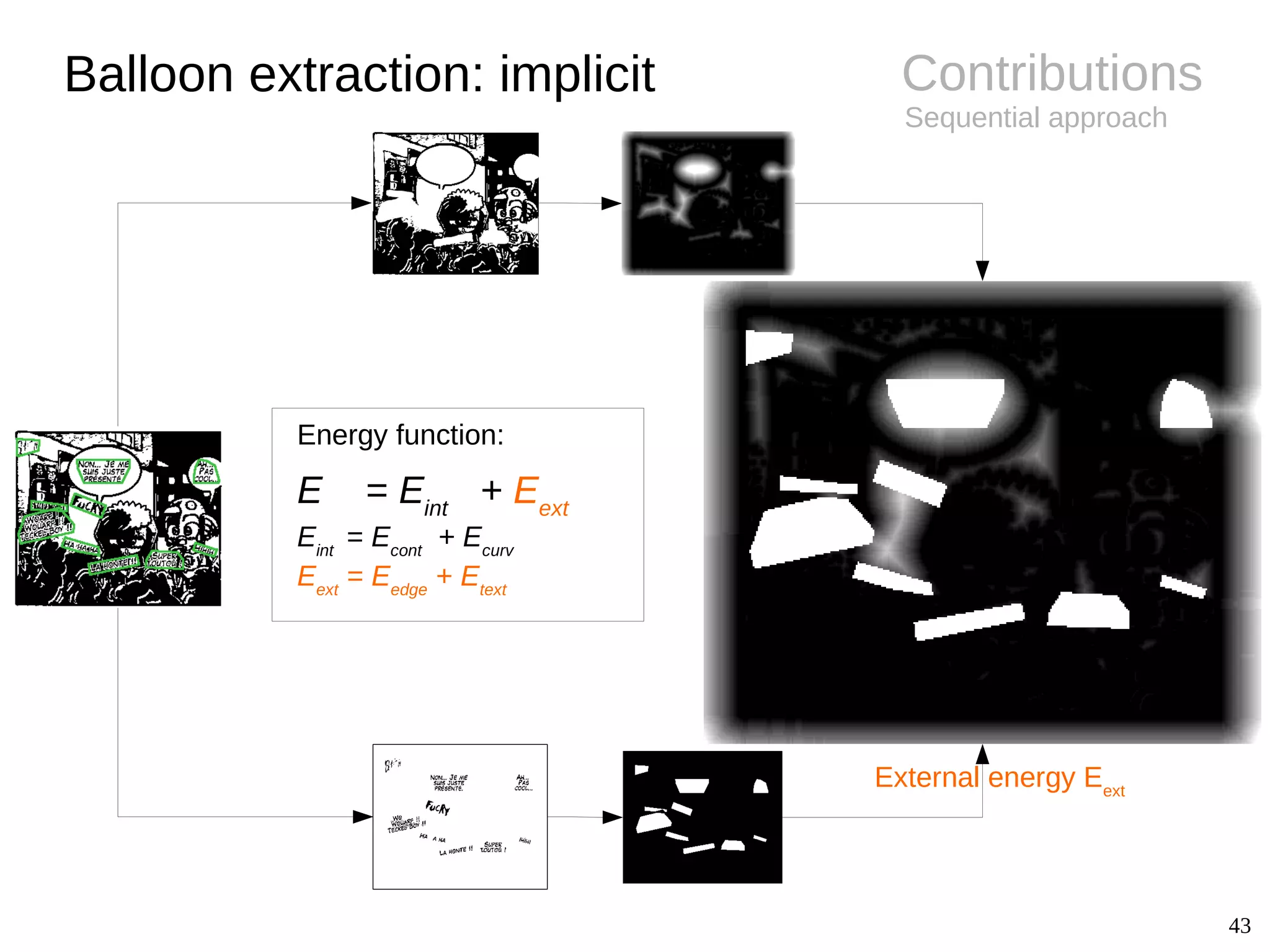
Contributions
Sequential approach
Balloon extraction: implicit
External energy Eext
E = Eint
+ Eext
Eint
= Econt
+ Ecurv
Eext
= Eedge
+ Etext
Energy function:
44
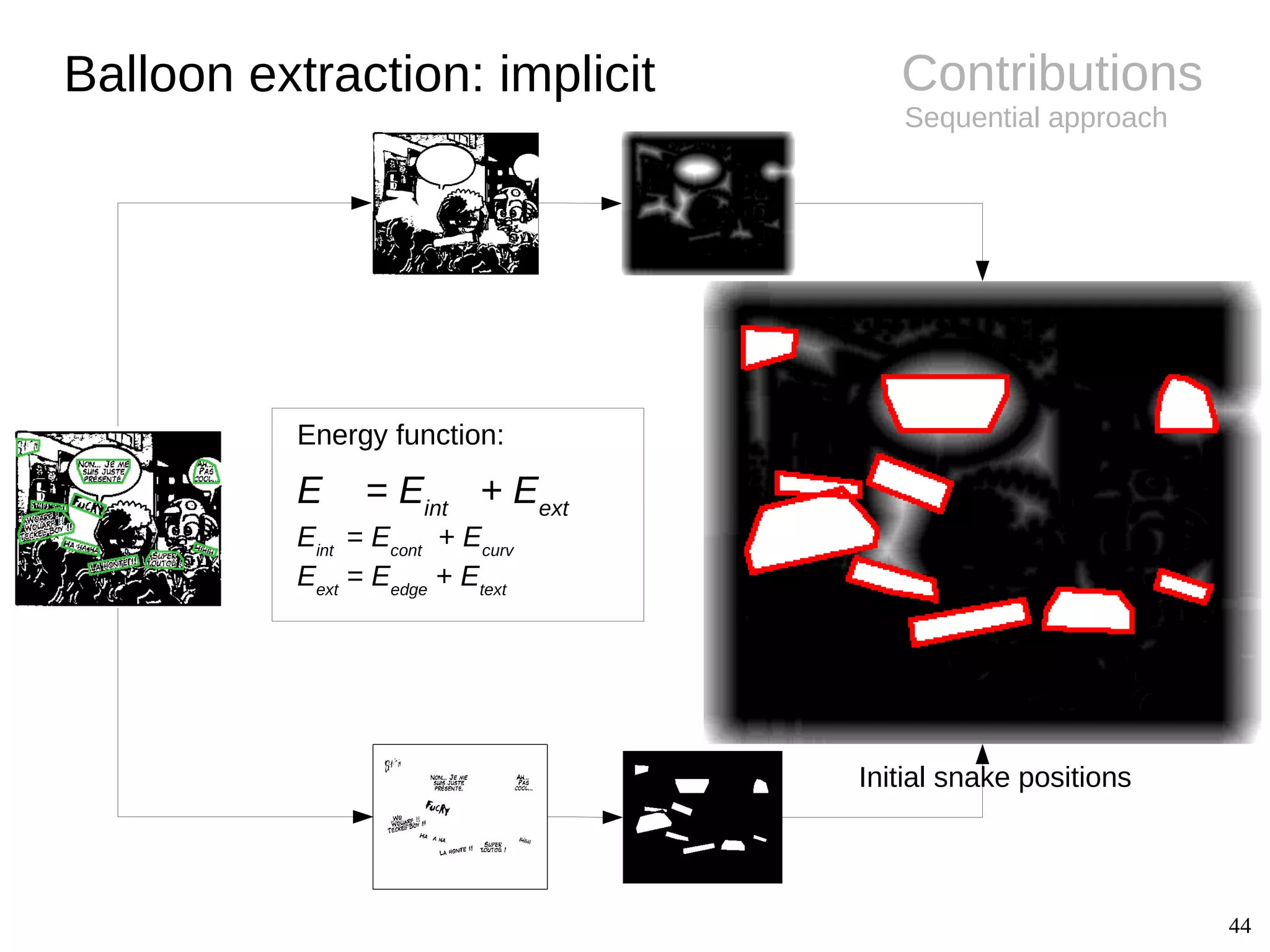
Contributions
Sequential approach
Balloon extraction: implicit
Initial snake positions
E = Eint
+ Eext
Eint
= Econt
+ Ecurv
Eext
= Eedge
+ Etext
Energy function:
45
Contributions
Sequential approach
Balloon extraction: implicit
Final snake positions
The snake is attracted to the “dark side”
E = Eint
+ Eext
Eint
= Econt
+ Ecurv
Eext
= Eedge
+ Etext
Energy function:
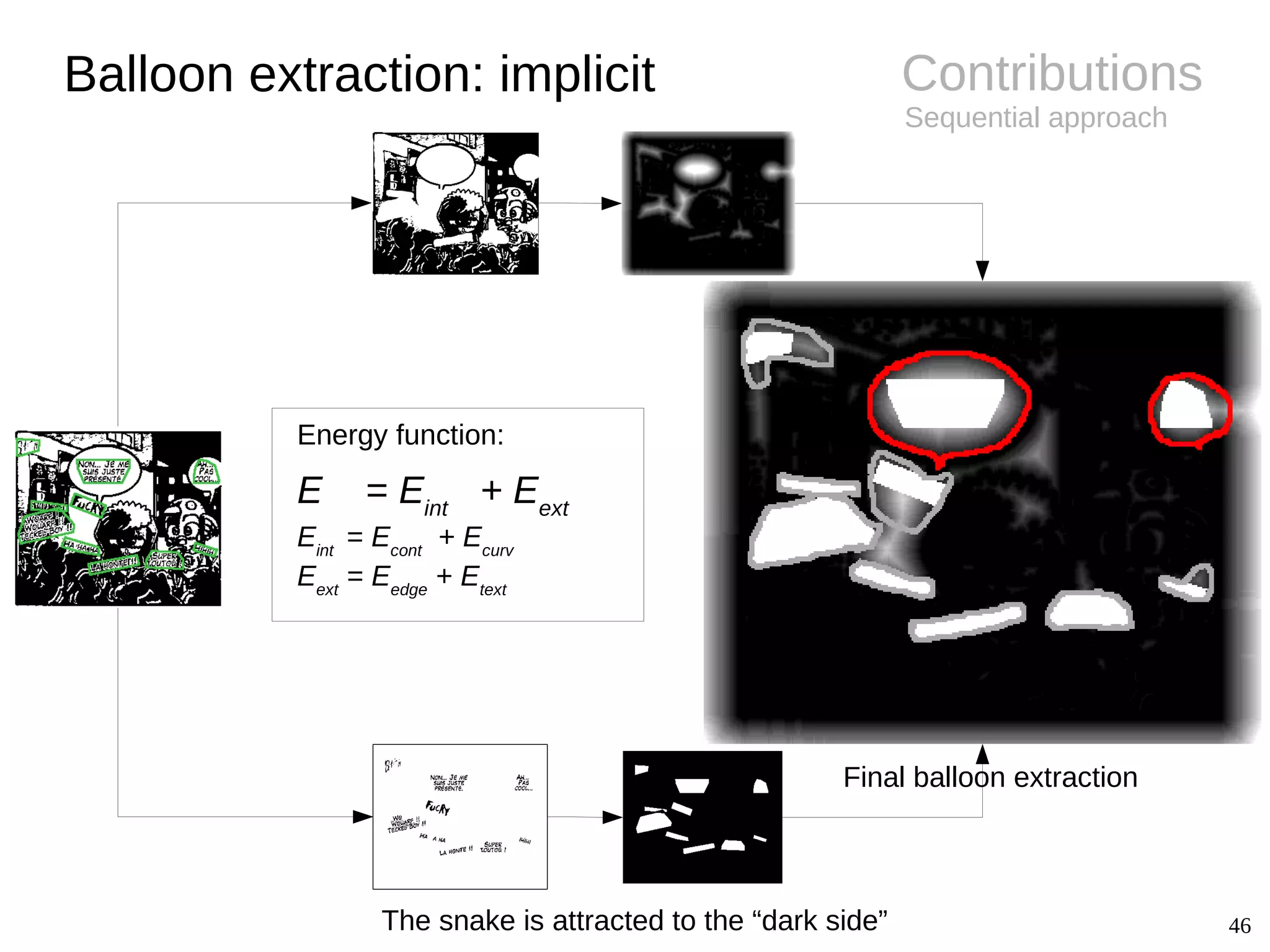
46
Contributions
Sequential approach
Balloon extraction: implicit
Final balloon extraction
The snake is attracted to the “dark side”
E = Eint
+ Eext
Eint
= Econt
+ Ecurv
Eext
= Eedge
+ Etext
Energy function:
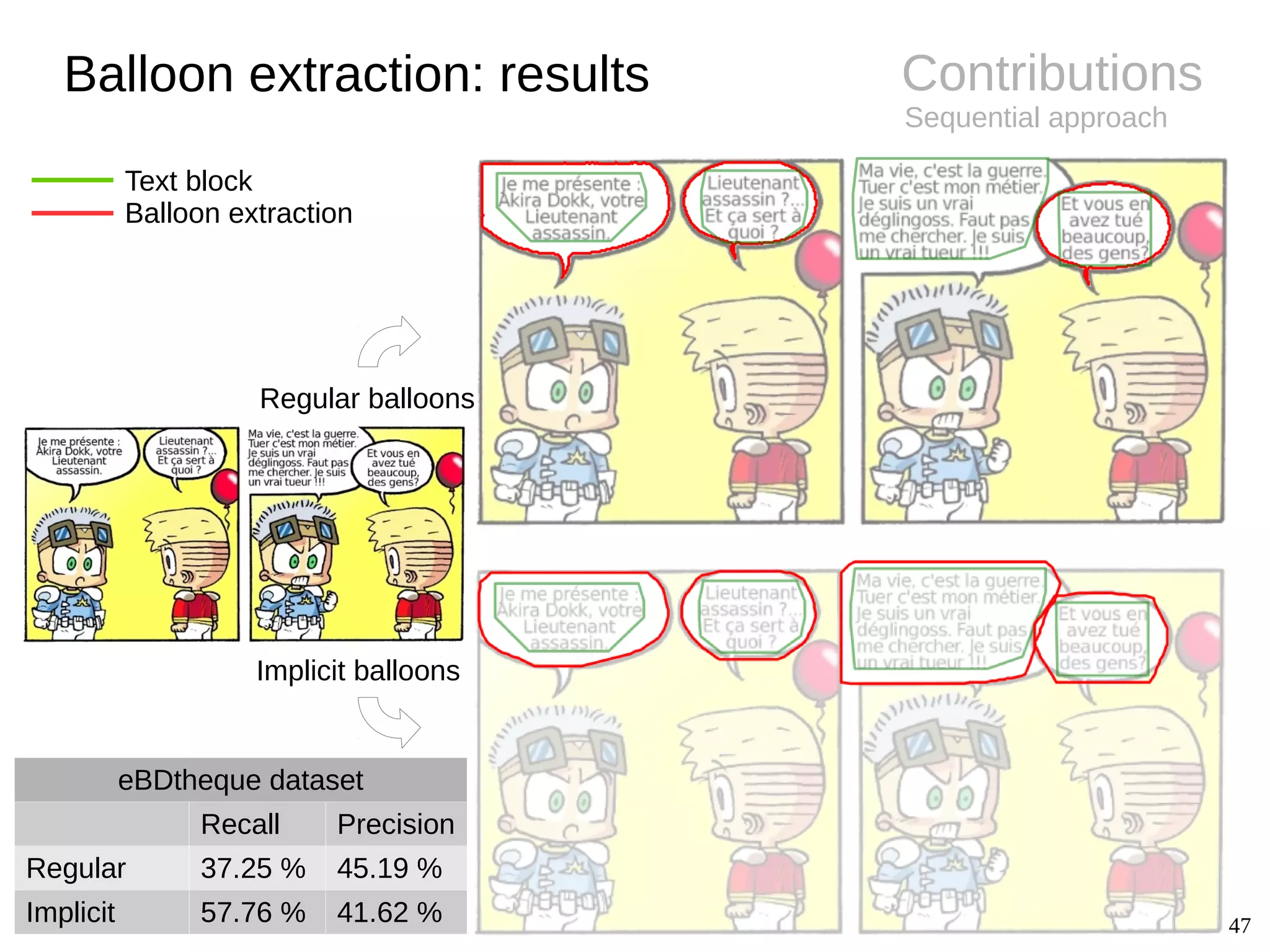
47
Contributions
Sequential approach
Balloon extraction: results
eBDtheque dataset
Recall Precision
Regular 37.25 % 45.19 %
Implicit 57.76 % 41.62 %
Implicit balloons
Regular balloons
Text block
Balloon extraction
48
Introduction Documents Contributions ConclusionExperiments
Inking. Image credits: Le cycle des bulles,
Christophe Rigaud, 2012
● Introduction
● Sequential approach
– Panel & text extraction
– Balloon extraction
– Tail extraction
– Comic character extraction
● (Independent approach)
● Knowledge-driven approach
49
Contributions
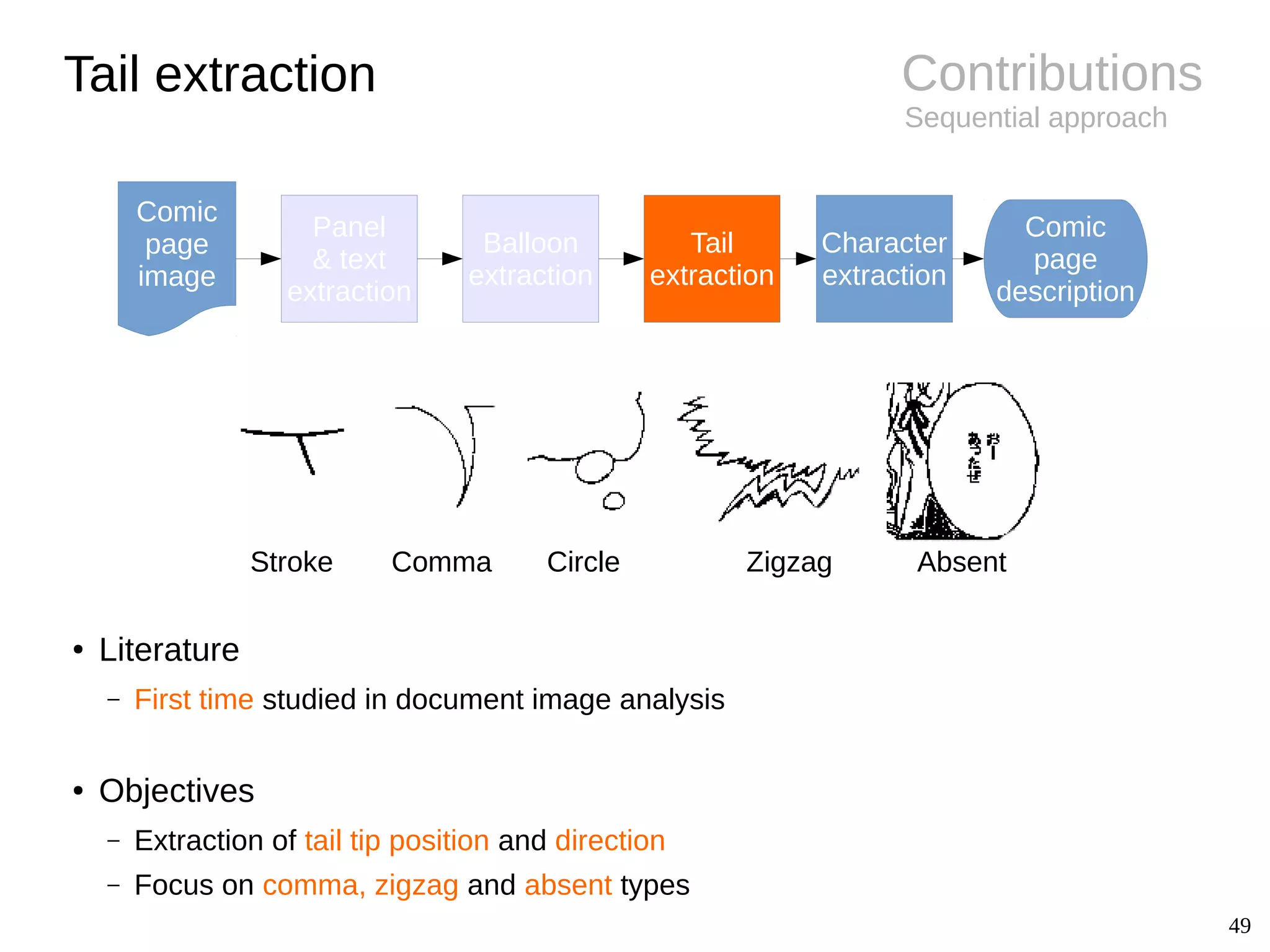
Sequential approach
Tail extraction
Comic
page
image
Panel
& text
extraction
Balloon
extraction
Tail
extraction
Character
extraction
Comic
page
description
Stroke Comma Circle Zigzag Absent
● Literature
– First time studied in document image analysis
● Objectives
– Extraction of tail tip position and direction
– Focus on comma, zigzag and absent types
50
Contributions
Sequential approach
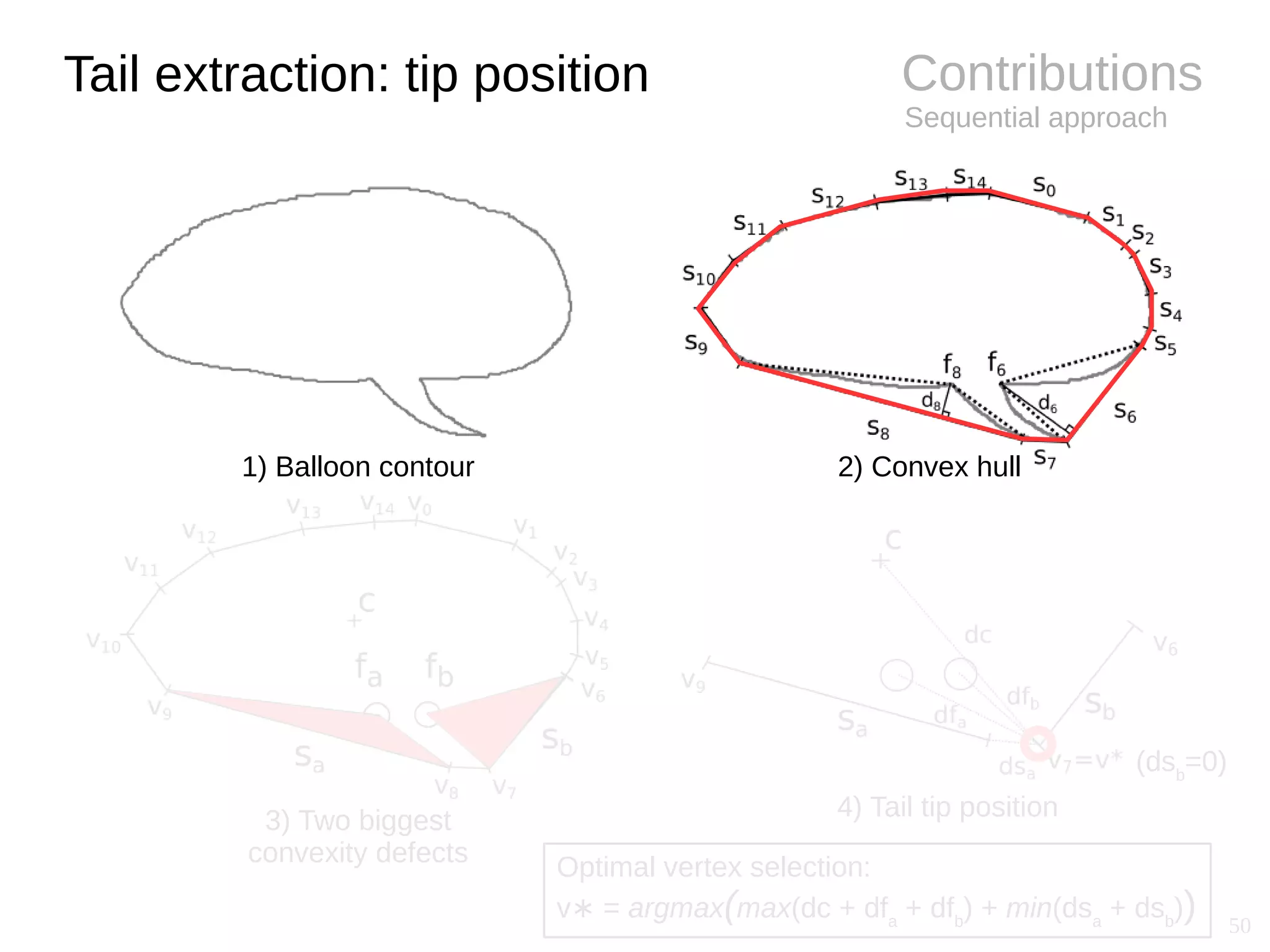
Tail extraction: tip position
1) Balloon contour 2) Convex hull
3) Two biggest
convexity defects
(dsb
=0)
4) Tail tip position
Optimal vertex selection:
v =∗ argmax(max(dc + dfa
+ dfb
) + min(dsa
+ dsb
))
51
Contributions
Sequential approach
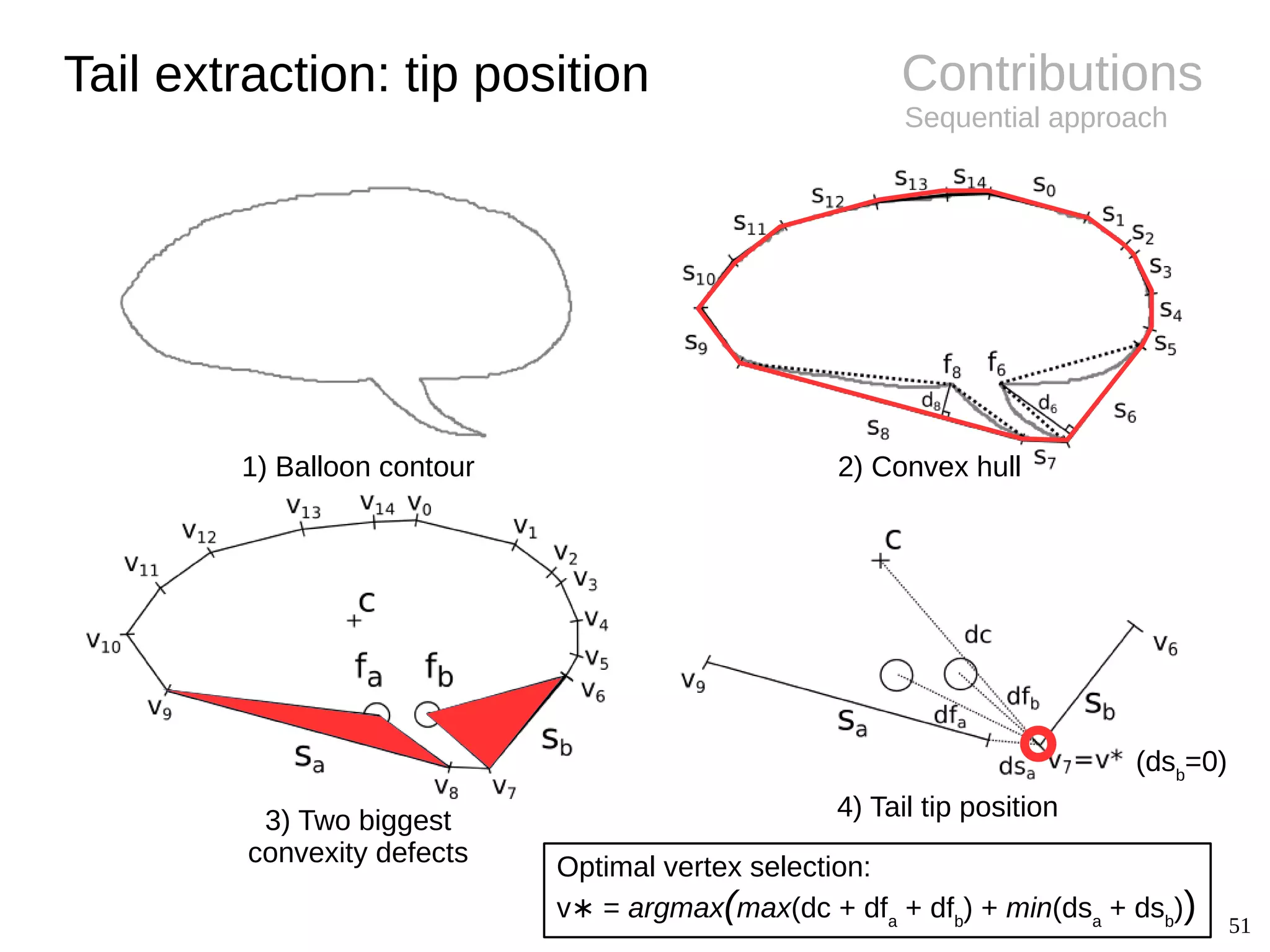
Tail extraction: tip position
2) Convex hull
3) Two biggest
convexity defects
4) Tail tip position
Optimal vertex selection:
v =∗ argmax(max(dc + dfa
+ dfb
) + min(dsa
+ dsb
))
(dsb
=0)
1) Balloon contour
52
Contributions
Sequential approach
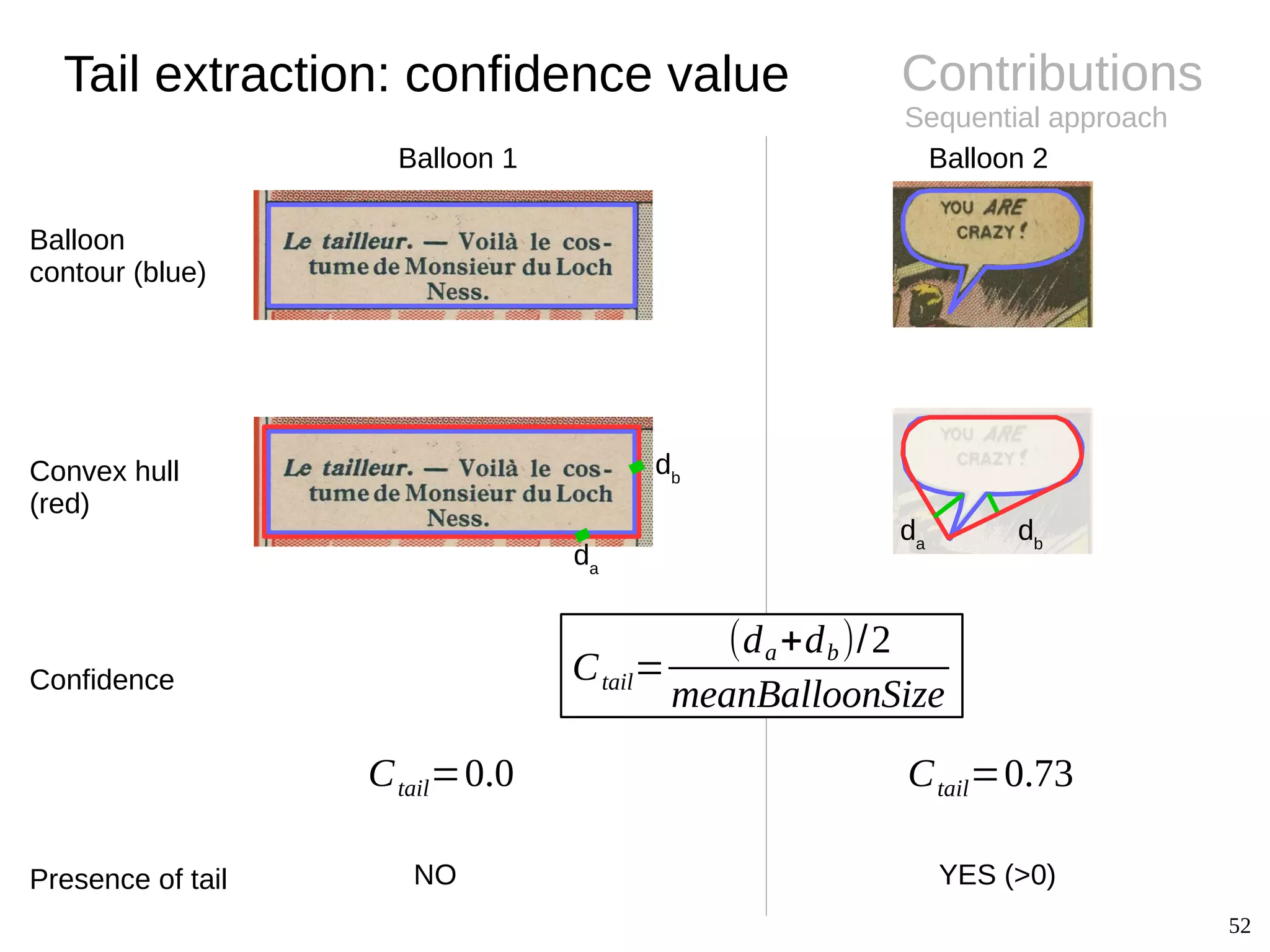
Tail extraction: confidence value
Balloon
contour (blue)
Convex hull
(red)
Balloon 1 Balloon 2
db
da
Ctail=
(da+db)/2
meanBalloonSizeConfidence
Ctail=0.0 Ctail=0.73
Presence of tail NO YES (>0)
da
db
53
Contributions
Sequential approach
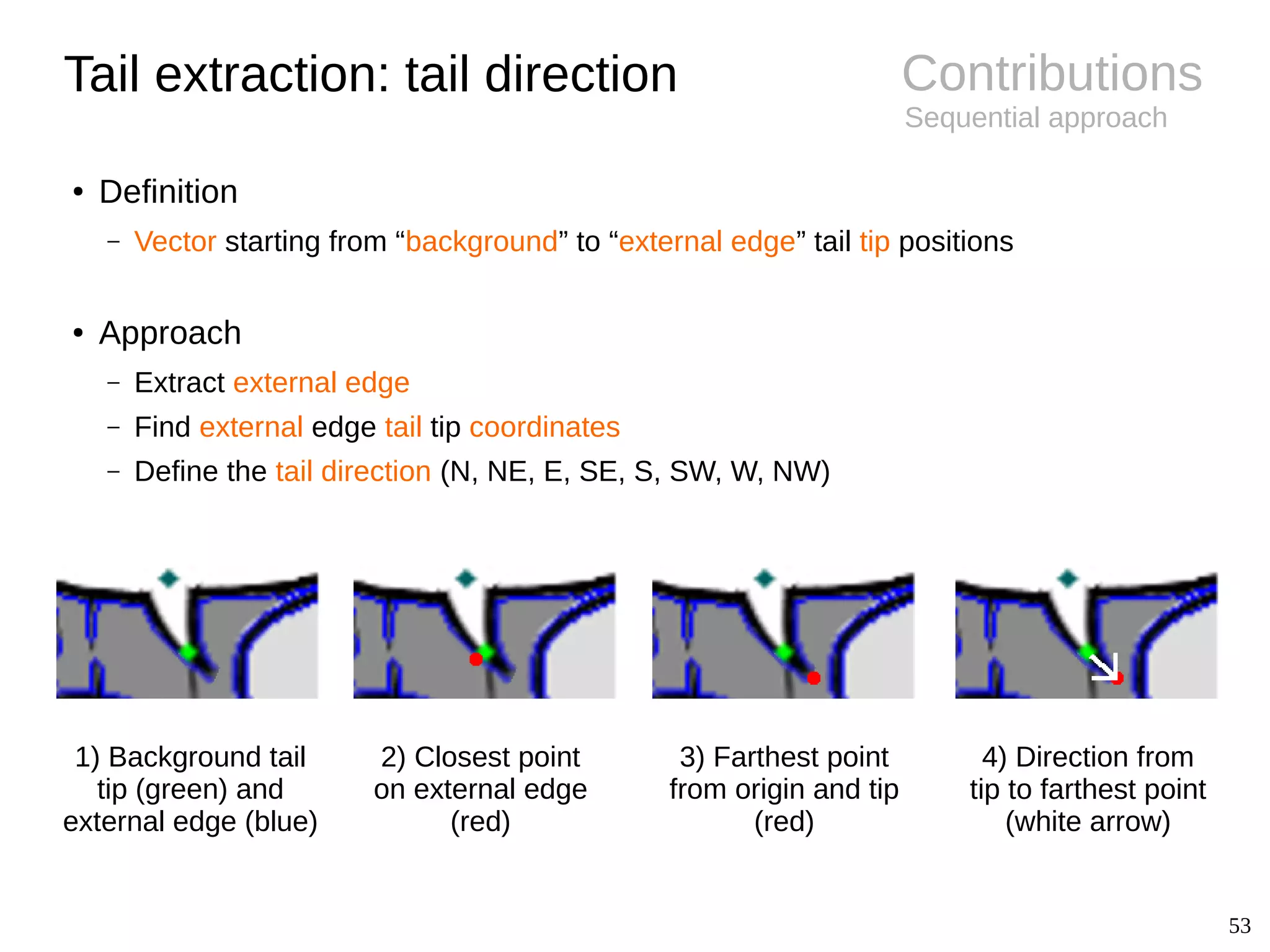
Tail extraction: tail direction
● Definition
– Vector starting from “background” to “external edge” tail tip positions
● Approach
– Extract external edge
– Find external edge tail tip coordinates
– Define the tail direction (N, NE, E, SE, S, SW, W, NW)
1) Background tail
tip (green) and
external edge (blue)
2) Closest point
on external edge
(red)
3) Farthest point
from origin and tip
(red)
4) Direction from
tip to farthest point
(white arrow)
54
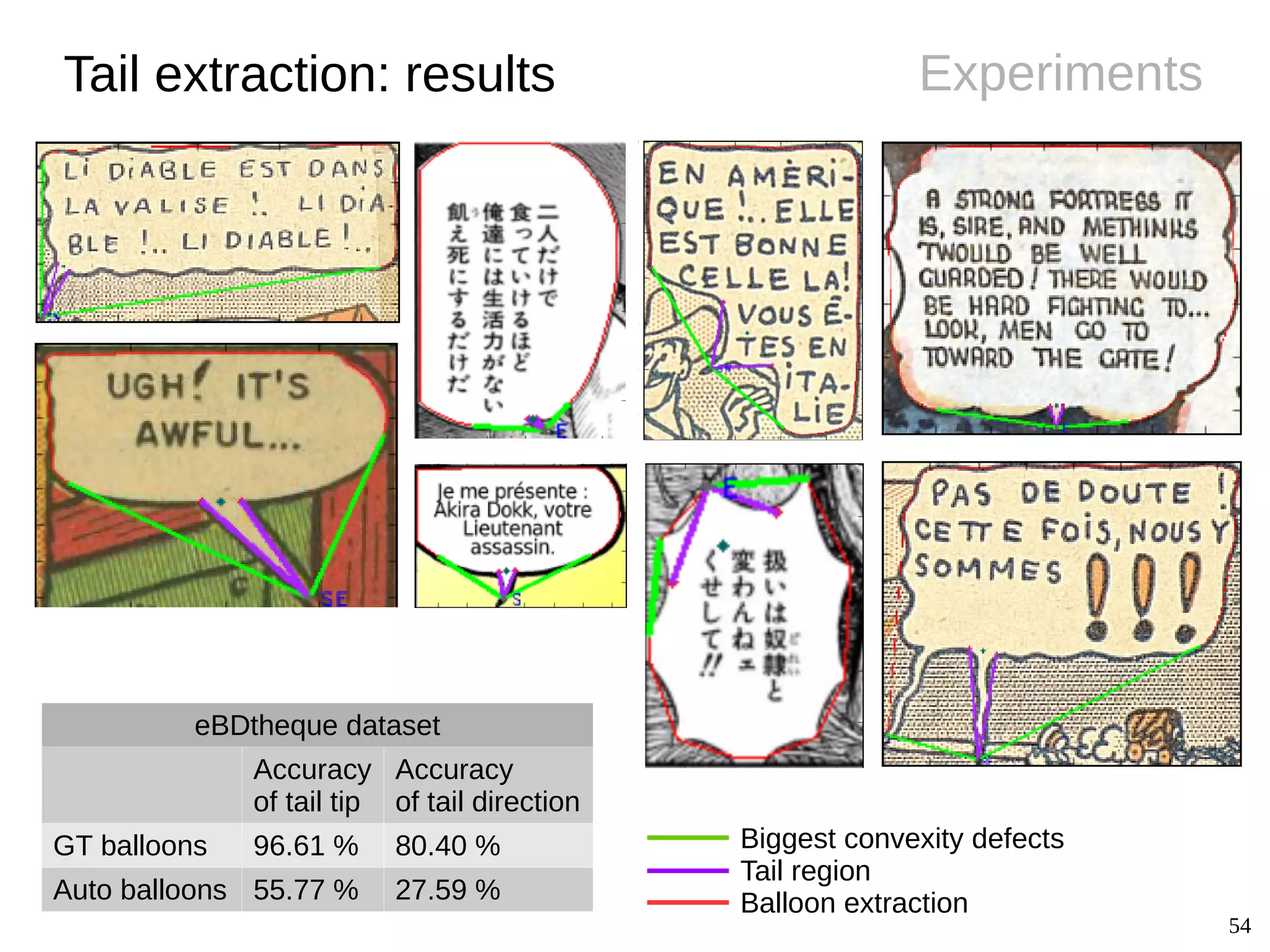
ExperimentsTail extraction: results
eBDtheque dataset
Accuracy
of tail tip
Accuracy
of tail direction
GT balloons 96.61 % 80.40 %
Auto balloons 55.77 % 27.59 %
Biggest convexity defects
Tail region
Balloon extraction
55
Introduction Documents Contributions ConclusionExperiments
Inking. Image credits: Le cycle des bulles,
Christophe Rigaud, 2012
● Introduction
● Sequential approach
– Panel & text extraction
– Balloon extraction
– Tail extraction
– Comic character extraction
● (Independent approach)
● Knowledge-driven approach
56
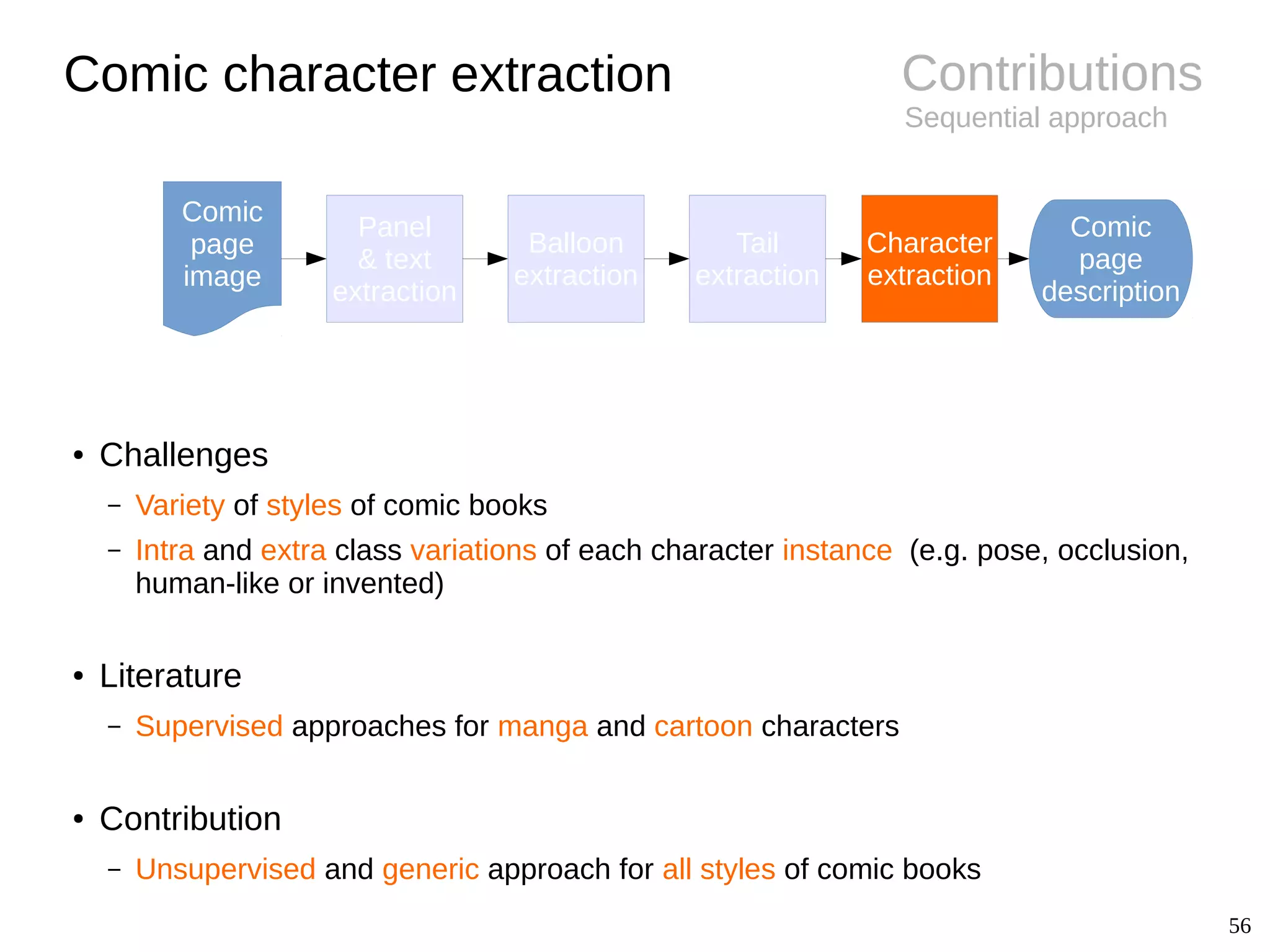
Contributions
Sequential approach
Comic character extraction
Comic
page
image
Panel
& text
extraction
Balloon
extraction
Tail
extraction
Character
extraction
Comic
page
description
● Challenges
– Variety of styles of comic books
– Intra and extra class variations of each character instance (e.g. pose, occlusion,
human-like or invented)
● Literature
– Supervised approaches for manga and cartoon characters
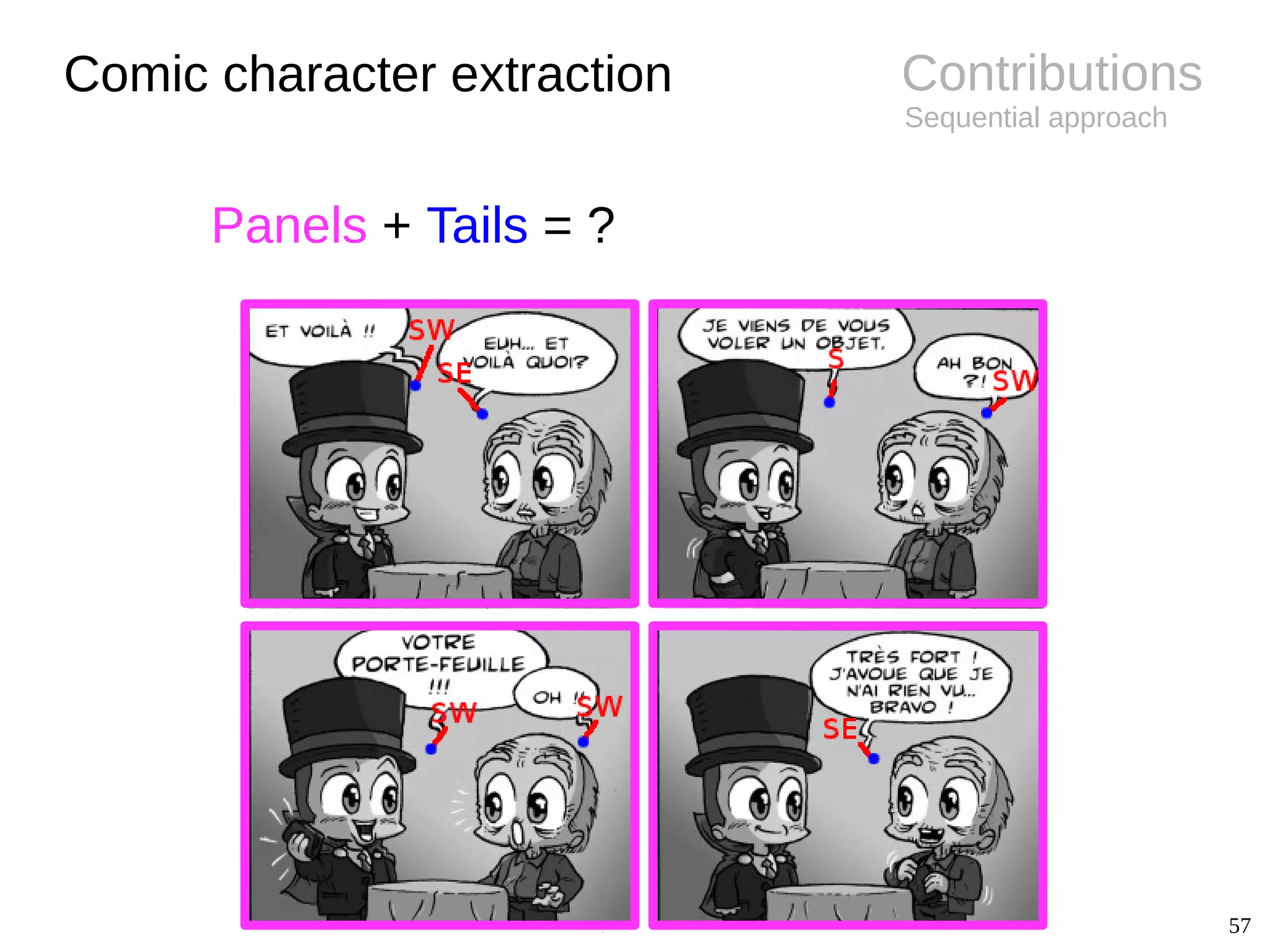
● Contribution
– Unsupervised and generic approach for all styles of comic books
57
Contributions
Sequential approach
Comic character extraction
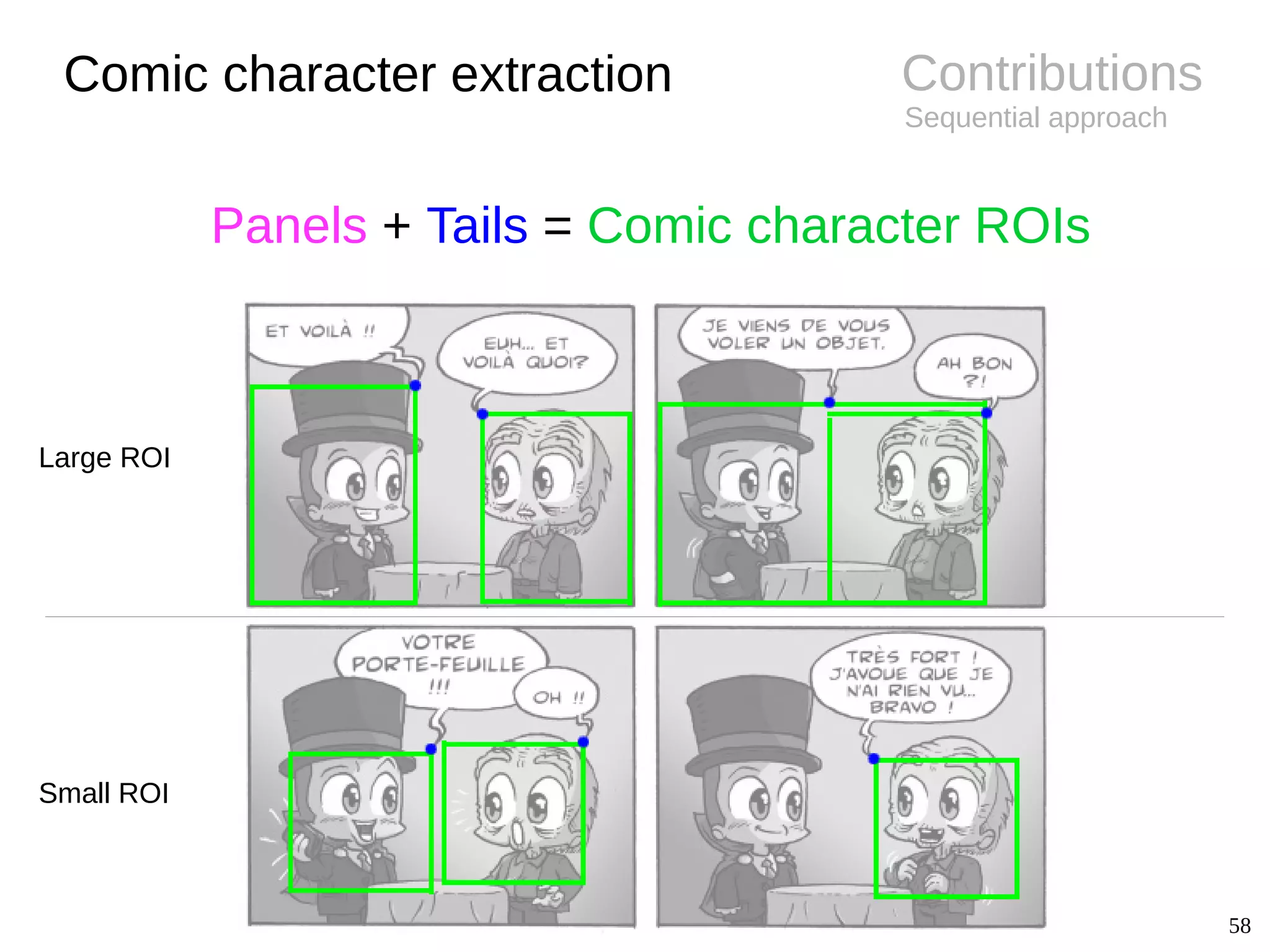
Panels + Tails = ?
58
Contributions
Sequential approach
Comic character extraction
Large ROI
Small ROI
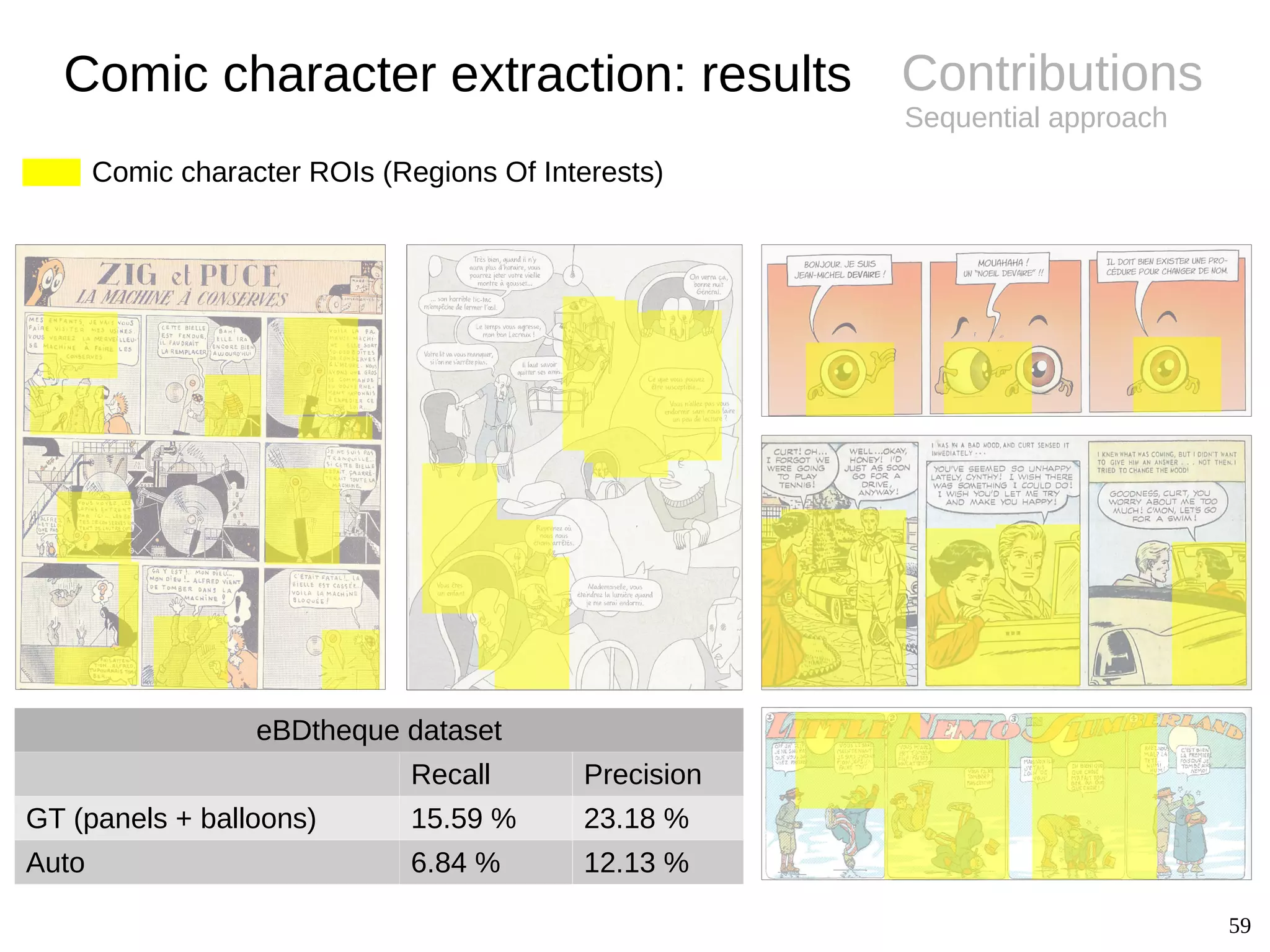
Panels + Tails = Comic character ROIs
59
Contributions
Sequential approach
Comic character extraction: results
Comic character ROIs (Regions Of Interests)
eBDtheque dataset
Recall Precision
GT (panels + balloons) 15.59 % 23.18 %
Auto 6.84 % 12.13 %
60
Introduction Documents Contributions ConclusionExperiments
● Introduction
● Sequential approach
● (Independent approach)
● Knowledge-driven approach
– Introduction
– Knowledge representation
– Processing sequence
Colouring. Image credits: Le cycle des
bulles, Christophe Rigaud, 2012
61
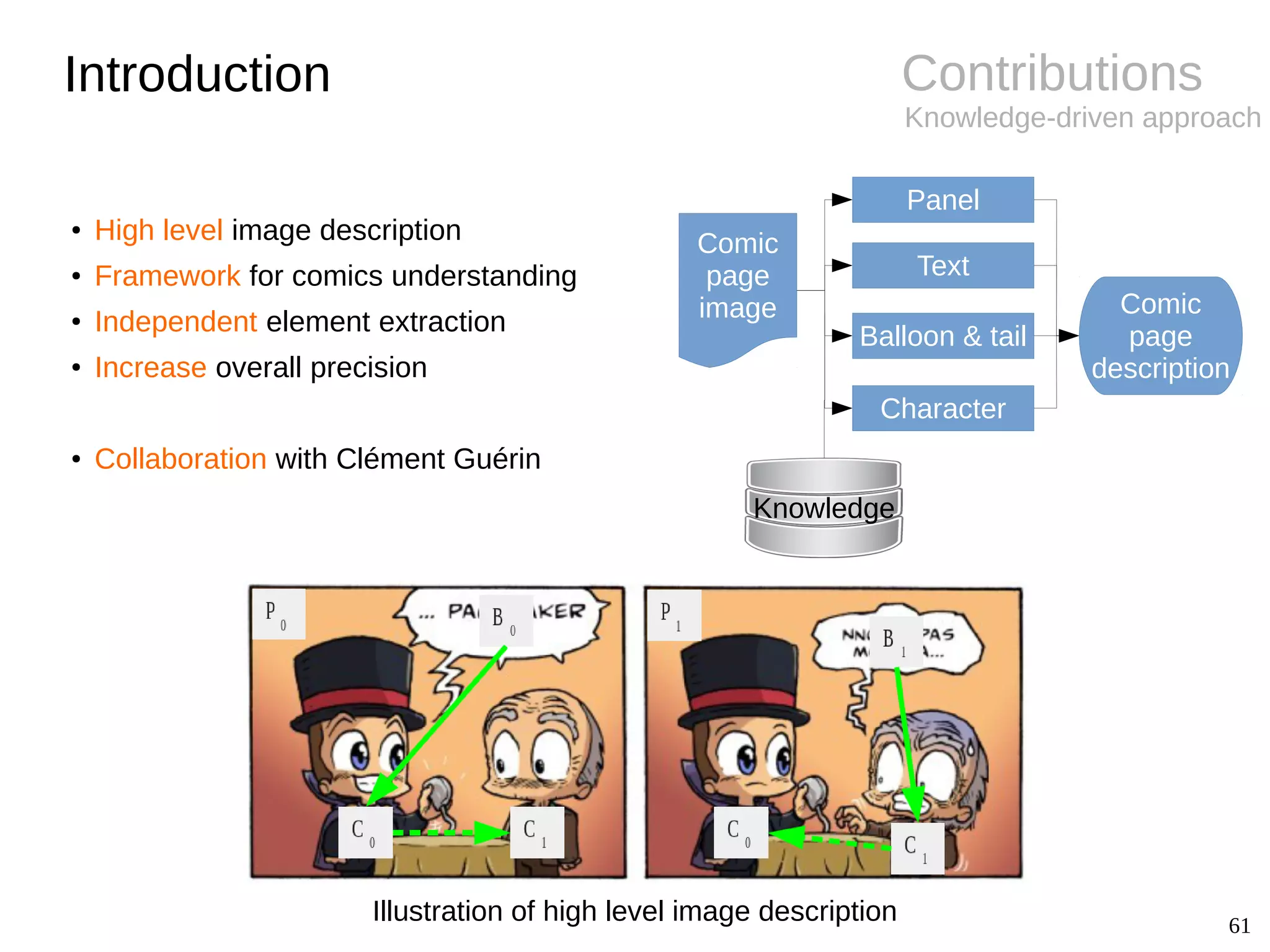
Contributions
Knowledge-driven approach
Introduction
●
High level image description
●
Framework for comics understanding
●
Independent element extraction
●
Increase overall precision
●
Collaboration with Clément Guérin
Illustration of high level image description
Comic
page
image Comic
page
description
Panel
Text
Character
Balloon & tail
Knowledge
62
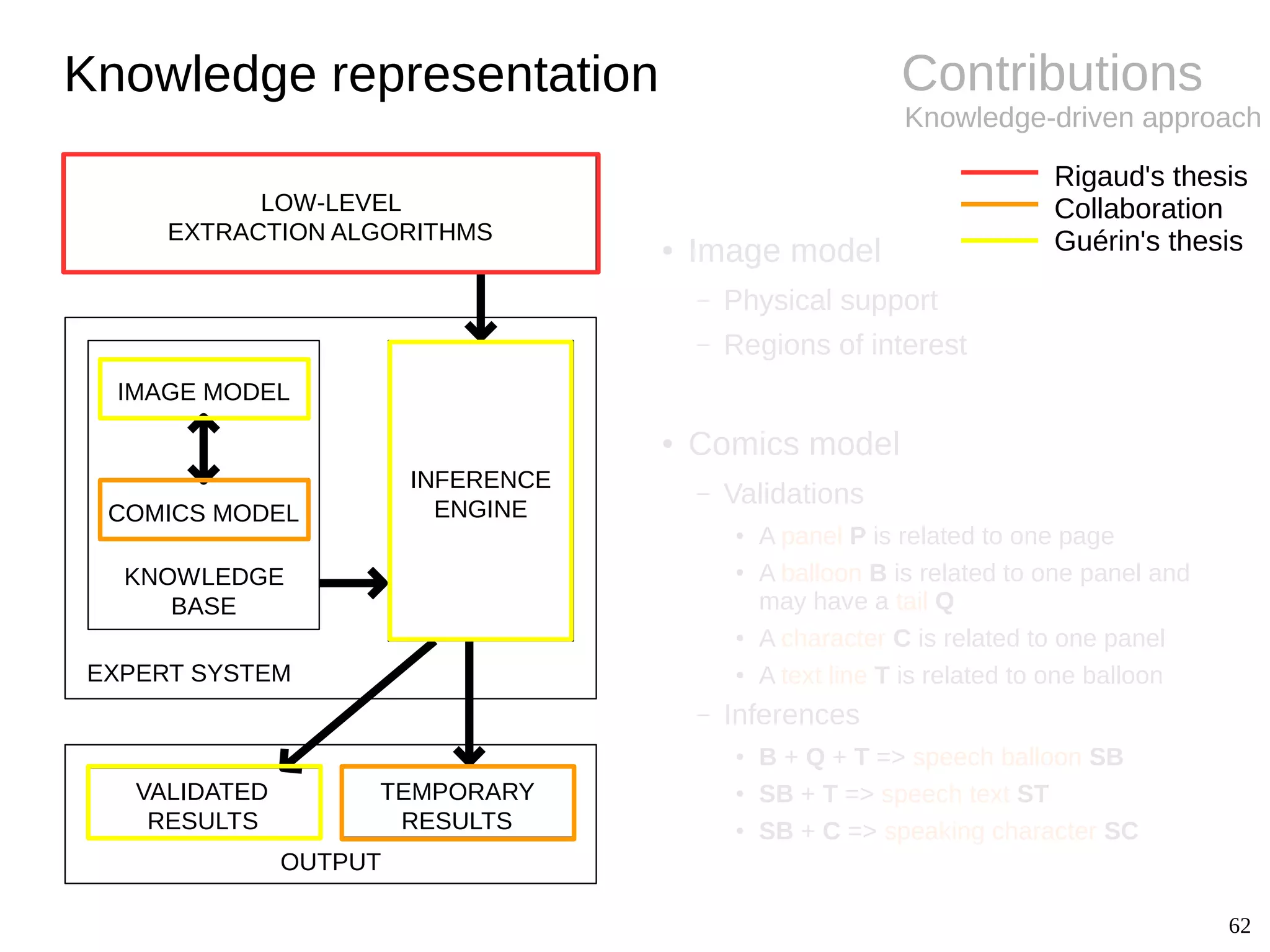
Contributions
Knowledge-driven approach
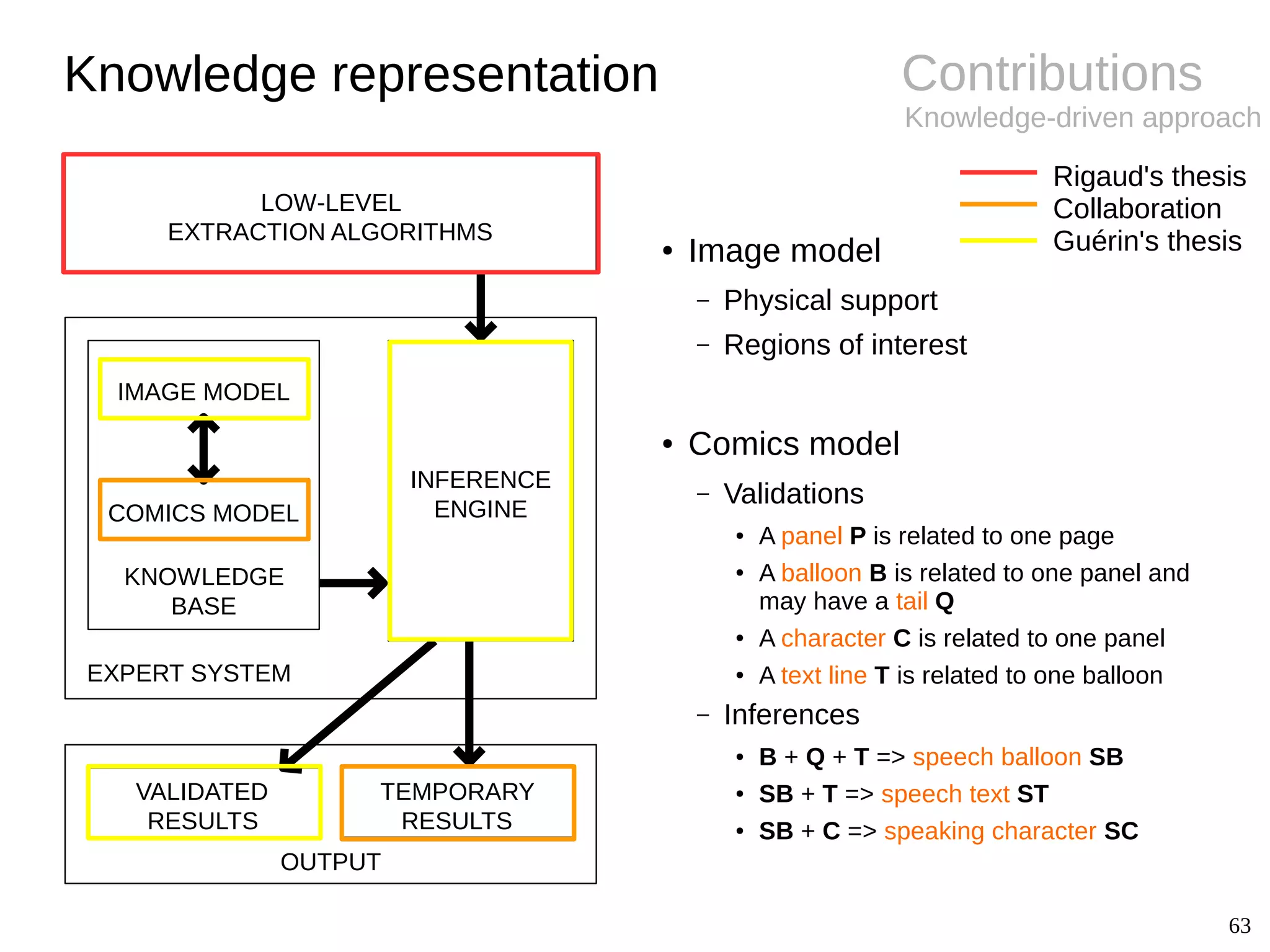
● Image model
– Physical support
– Regions of interest
● Comics model
– Validations
● A panel P is related to one page
● A balloon B is related to one panel and
may have a tail Q
● A character C is related to one panel
● A text line T is related to one balloon
– Inferences
● B + Q + T => speech balloon SB
● SB + T => speech text ST
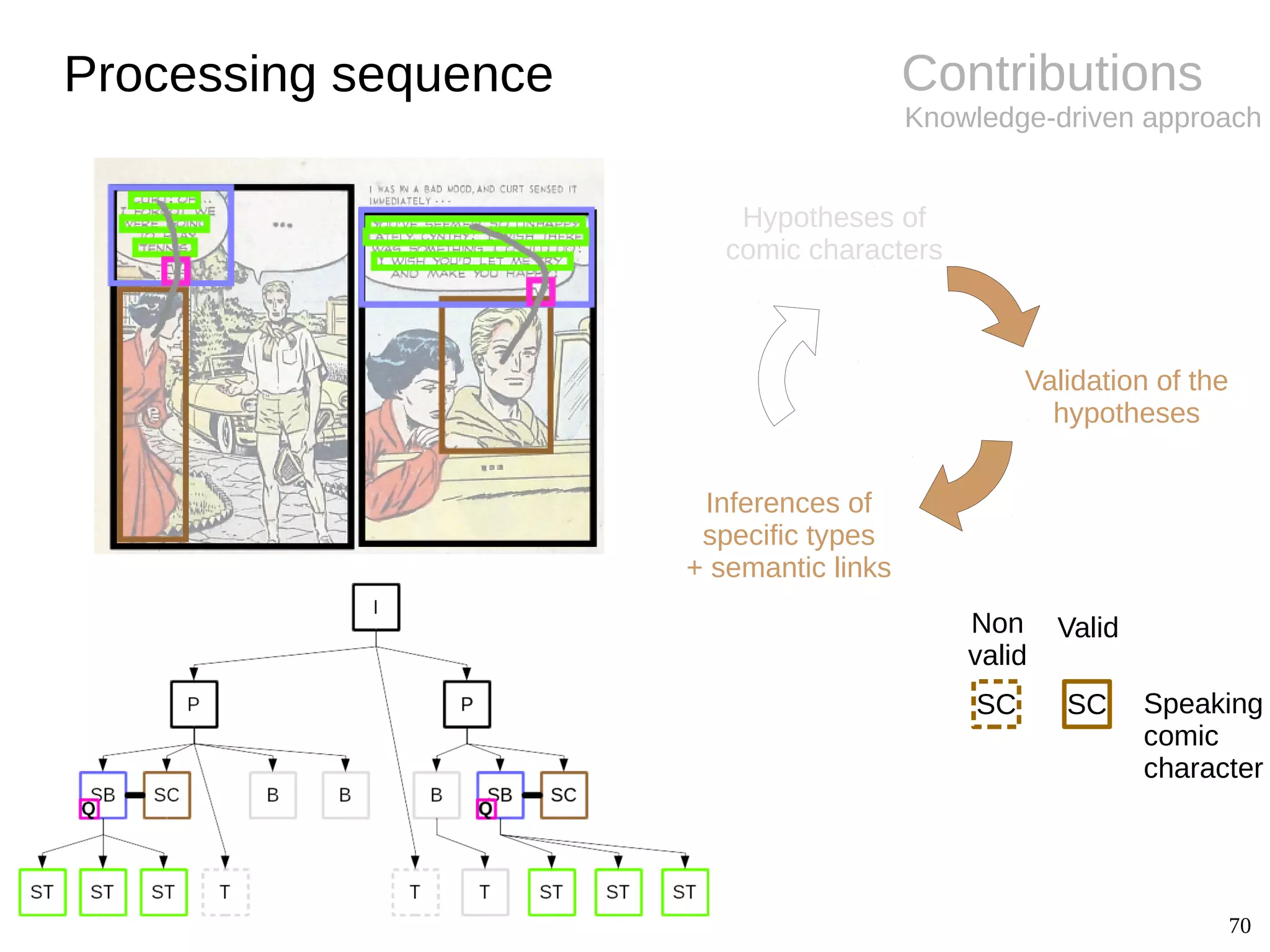
● SB + C => speaking character SC
Knowledge representation
EXPERT SYSTEM
OUTPUT
VALIDATED
RESULTS
LOW-LEVEL
EXTRACTION ALGORITHMS
INFERENCE
ENGINE
KNOWLEDGE
BASE
IMAGE MODEL
COMICS MODEL
TEMPORARY
RESULTS
Rigaud's thesis
Collaboration
Guérin's thesis
63
Contributions
Knowledge-driven approach
● Image model
– Physical support
– Regions of interest
● Comics model
– Validations
● A panel P is related to one page
● A balloon B is related to one panel and
may have a tail Q
● A character C is related to one panel
● A text line T is related to one balloon
– Inferences
● B + Q + T => speech balloon SB
● SB + T => speech text ST
● SB + C => speaking character SC
Knowledge representation
EXPERT SYSTEM
OUTPUT
VALIDATED
RESULTS
LOW-LEVEL
EXTRACTION ALGORITHMS
INFERENCE
ENGINE
KNOWLEDGE
BASE
IMAGE MODEL
COMICS MODEL
TEMPORARY
RESULTS
Rigaud's thesis
Collaboration
Guérin's thesis
64
Contributions
Knowledge-driven approach
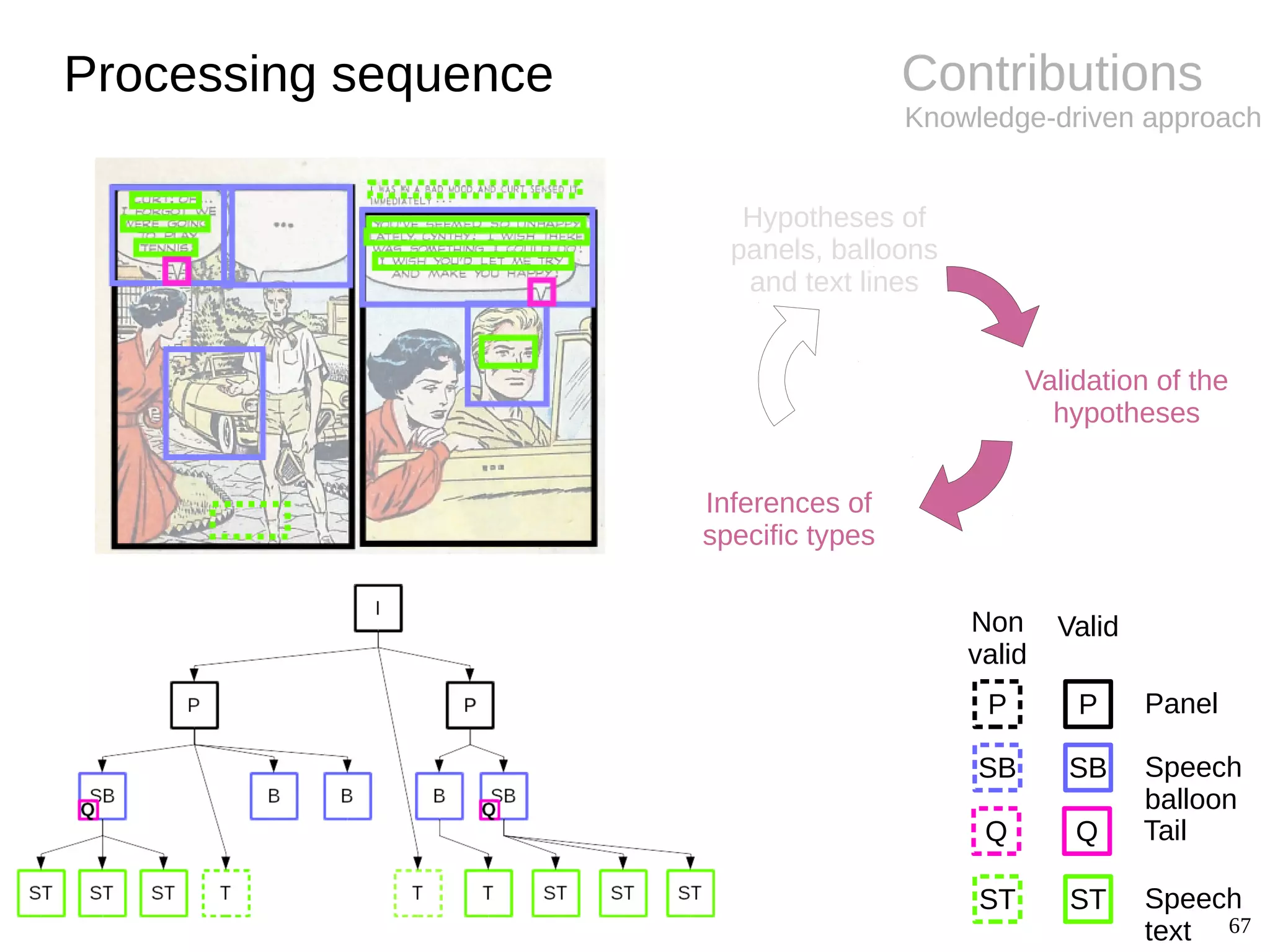
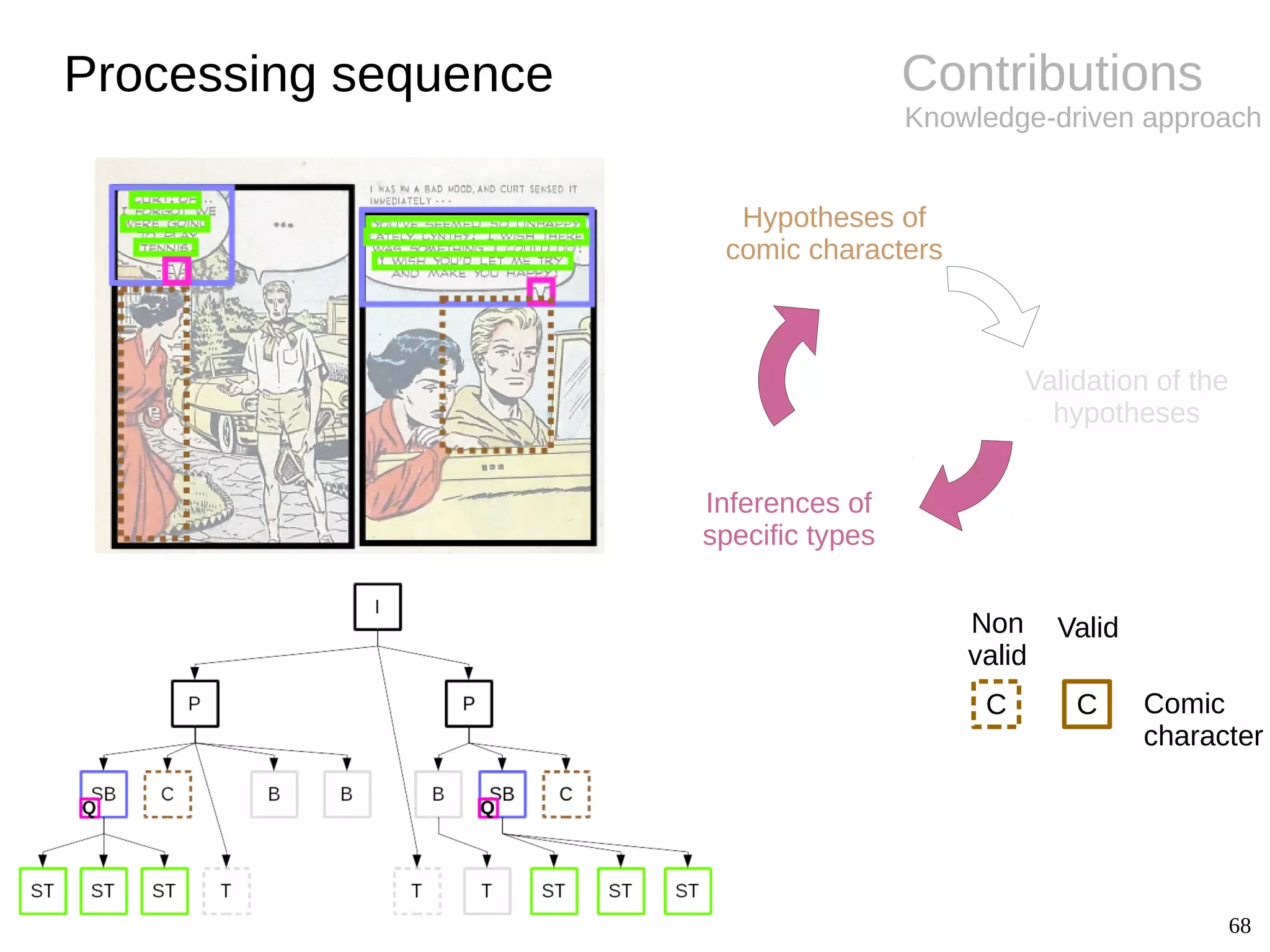
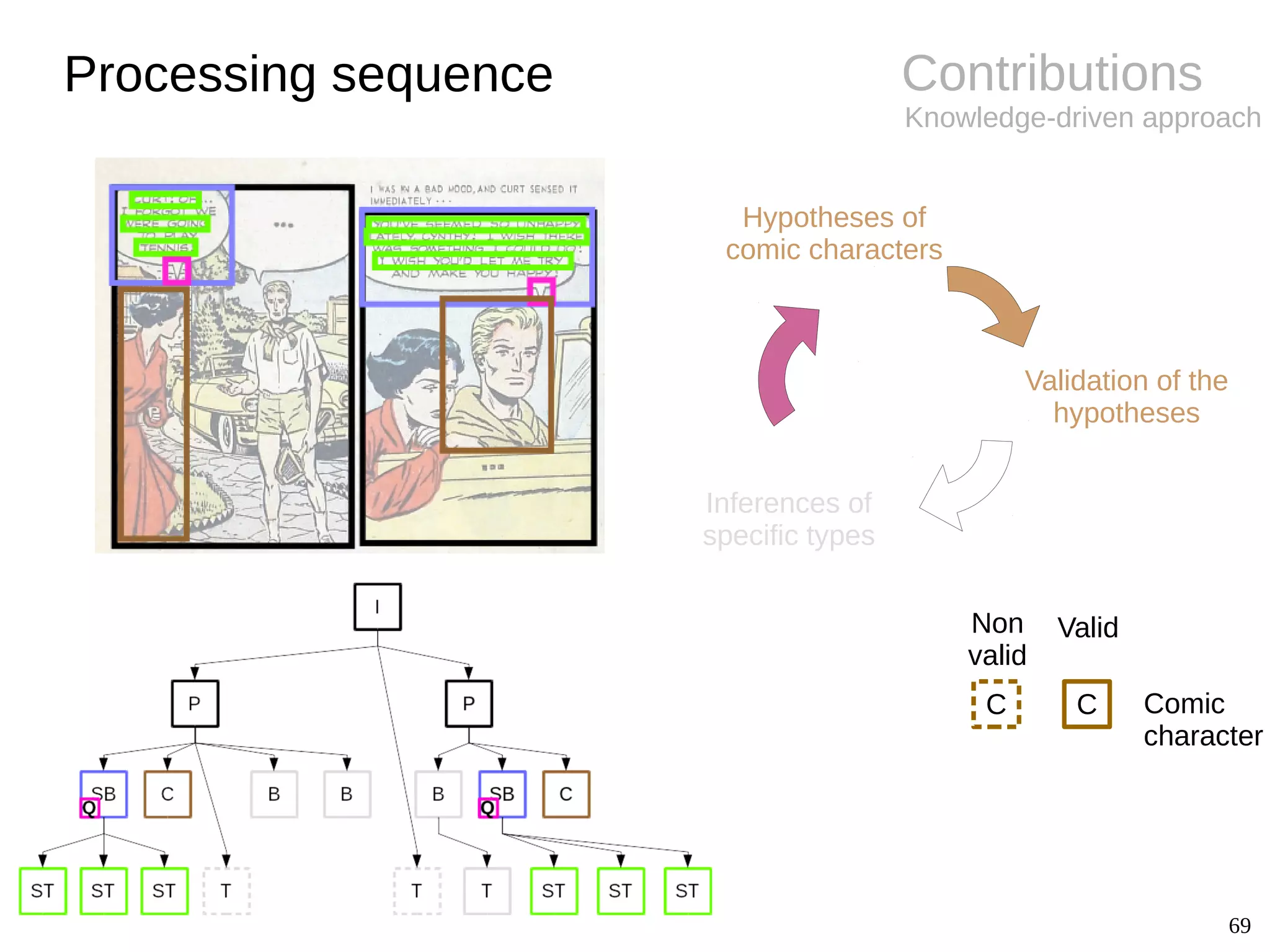
Processing sequence
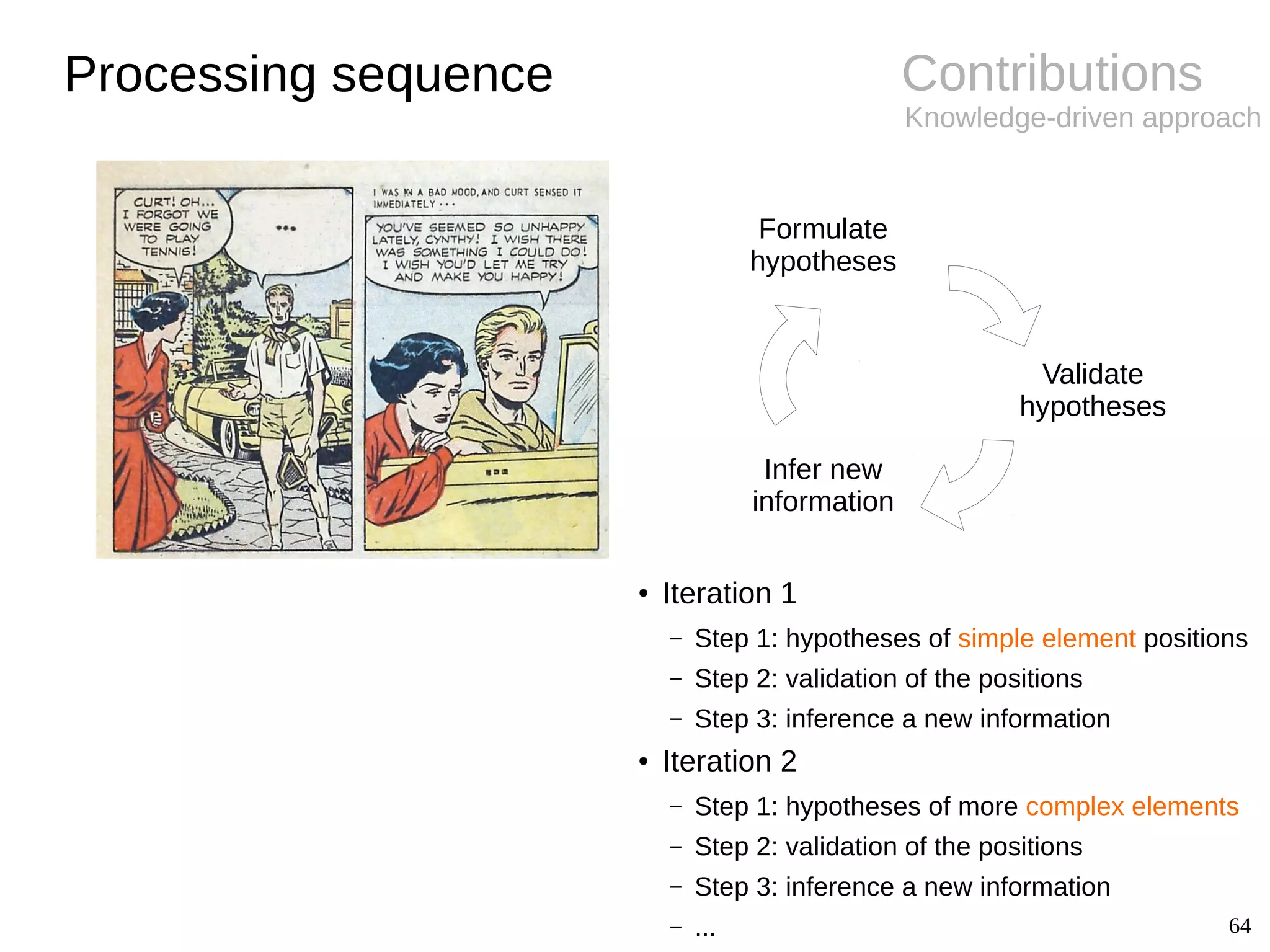
● Iteration 1
– Step 1: hypotheses of simple element positions
– Step 2: validation of the positions
– Step 3: inference a new information
● Iteration 2
– Step 1: hypotheses of more complex elements
– Step 2: validation of the positions
– Step 3: inference a new information
– ...
Validate
hypotheses
Formulate
hypotheses
Infer new
information
65
Contributions
Knowledge-driven approach
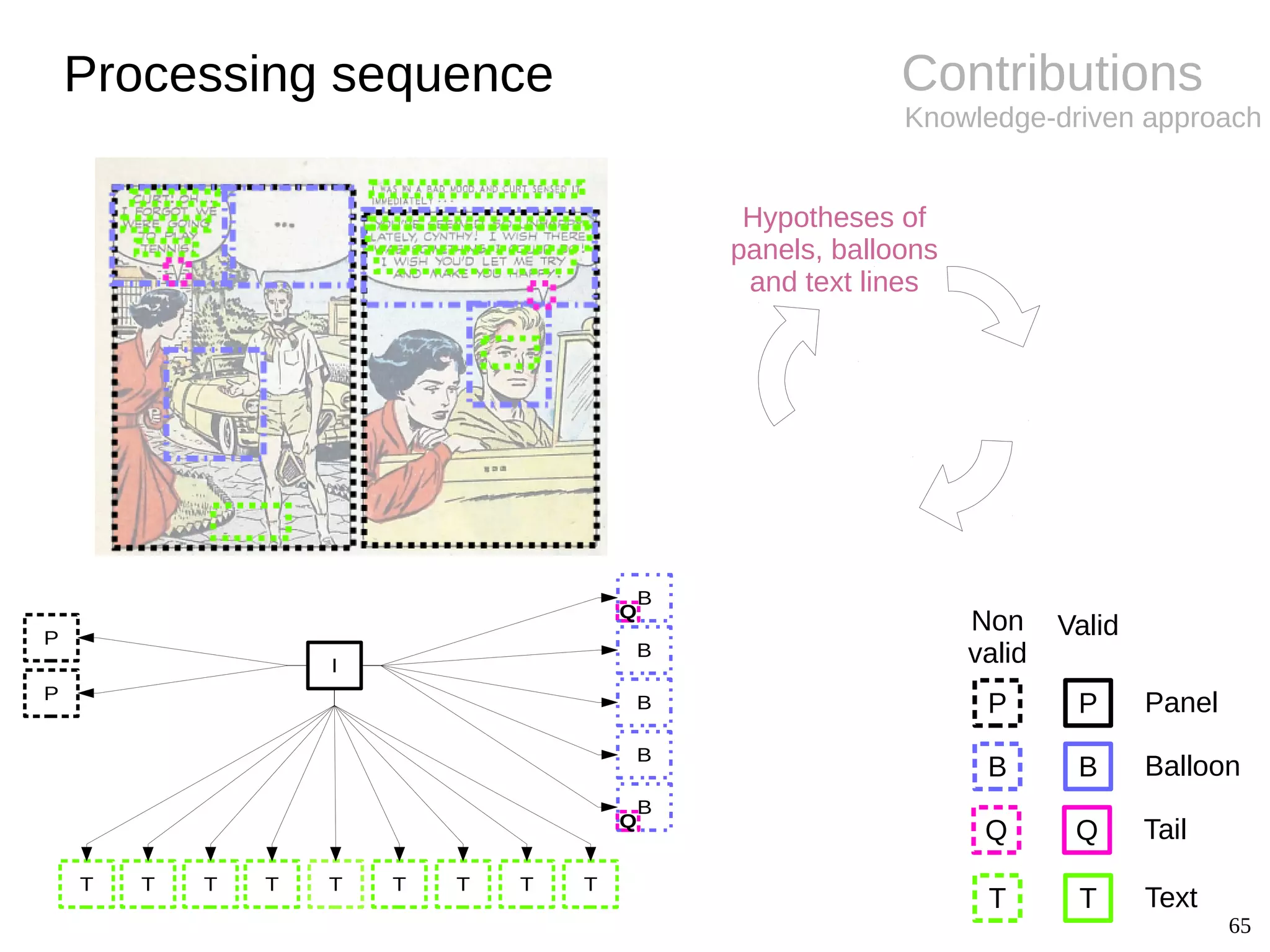
I
P
B
B
B
T T T TT T T T
P
B
Q
B
Q
T
Processing sequence
Hypotheses of
panels, balloons
and text lines
P
B
T
Panel
Balloon
Text
P
B
T
Non
valid
Valid
Q TailQ
66
Contributions
Knowledge-driven approach
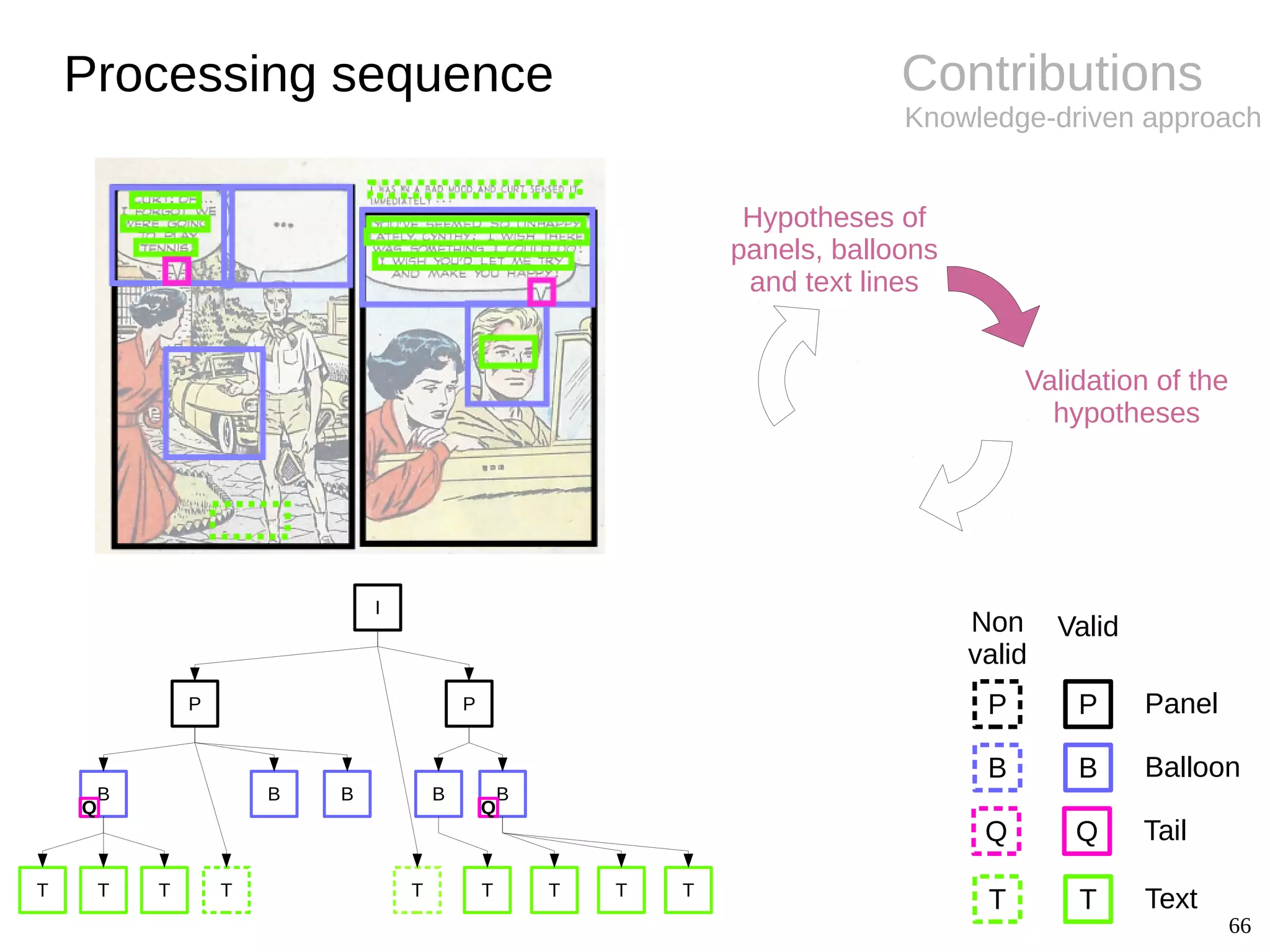
Processing sequence
Validation of the
hypotheses
I
P
B B B BB
T T T TT T T T
P
QQ
T
Hypotheses of
panels, balloons
and text lines
P
B
T
Panel
Balloon
Text
P
B
T
Non
valid
Valid
Q TailQ
67
Contributions
Knowledge-driven approach
Processing sequence
Inferences of
specific types
Hypotheses of
panels, balloons
and text lines
Validation of the
hypotheses
P
SB
ST
Panel
Speech
balloon
Speech
text
P
SB
ST
Non
valid
Valid
Q TailQ
68
Contributions
Knowledge-driven approach
Processing sequence
Hypotheses of
comic characters
Inferences of
specific types
Validation of the
hypotheses
C Comic
character
C
Non
valid
Valid
69
Contributions
Knowledge-driven approach
Processing sequence
Hypotheses of
comic characters
Validation of the
hypotheses
Inferences of
specific types
C Comic
character
C
Non
valid
Valid
70
Contributions
Knowledge-driven approach
Processing sequence
Inferences of
specific types
+ semantic links
Hypotheses of
comic characters
Validation of the
hypotheses
SC Speaking
comic
character
SC
Non
valid
Valid
71
● Evaluations
● Overall contribution
Introduction Background Contributions ConclusionExperiments
Lettering. Image credits: Le cycle des bulles,
Christophe Rigaud, 2012
Ready for
experiments?
72
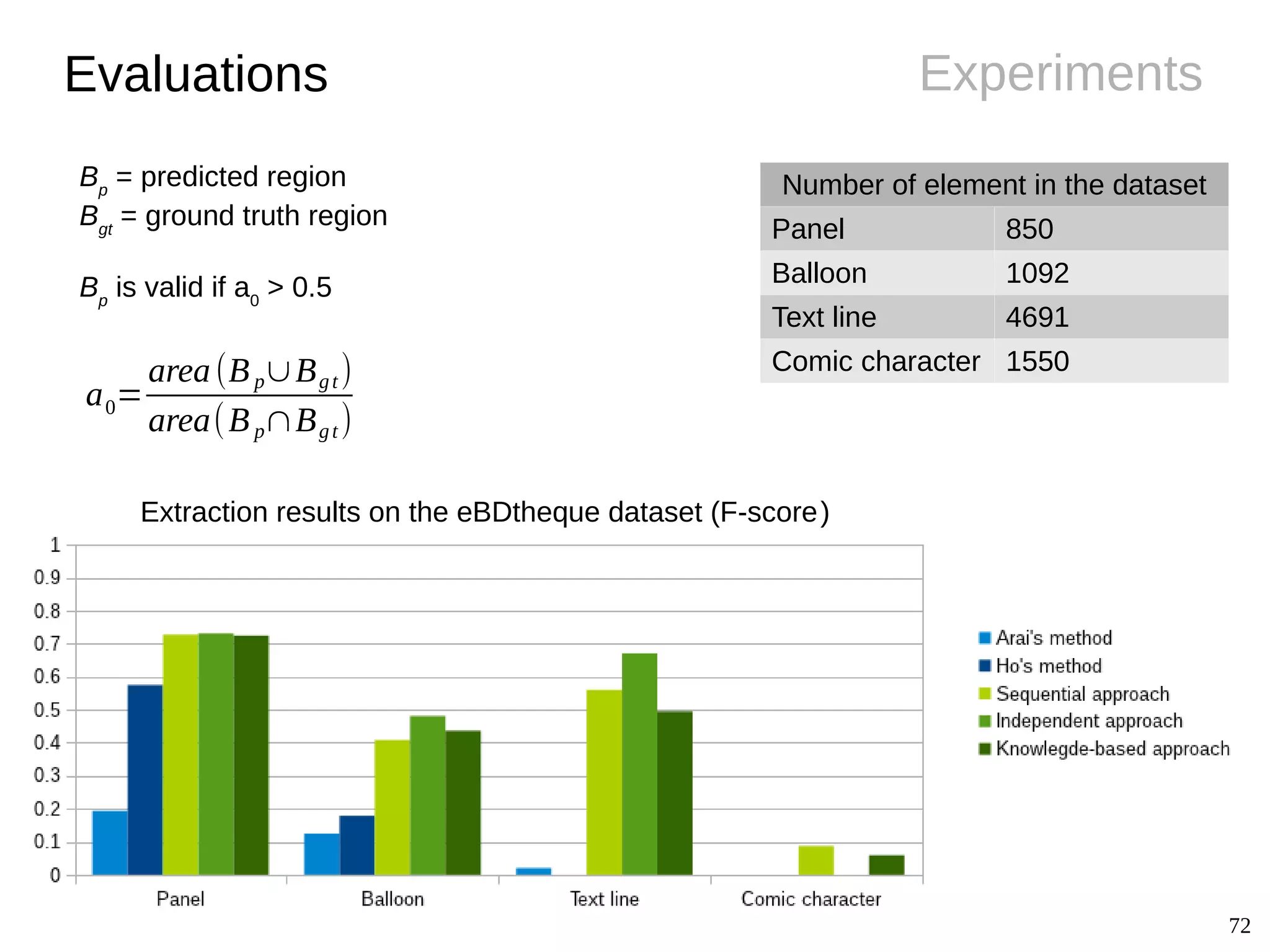
ExperimentsEvaluations
a0=
area(Bp∪Bgt)
area(Bp∩Bgt)
Bp
= predicted region
Bgt
= ground truth region
Bp
is valid if a0
> 0.5
Extraction results on the eBDtheque dataset (F-score)
Number of element in the dataset
Panel 850
Balloon 1092
Text line 4691
Comic character 1550
73
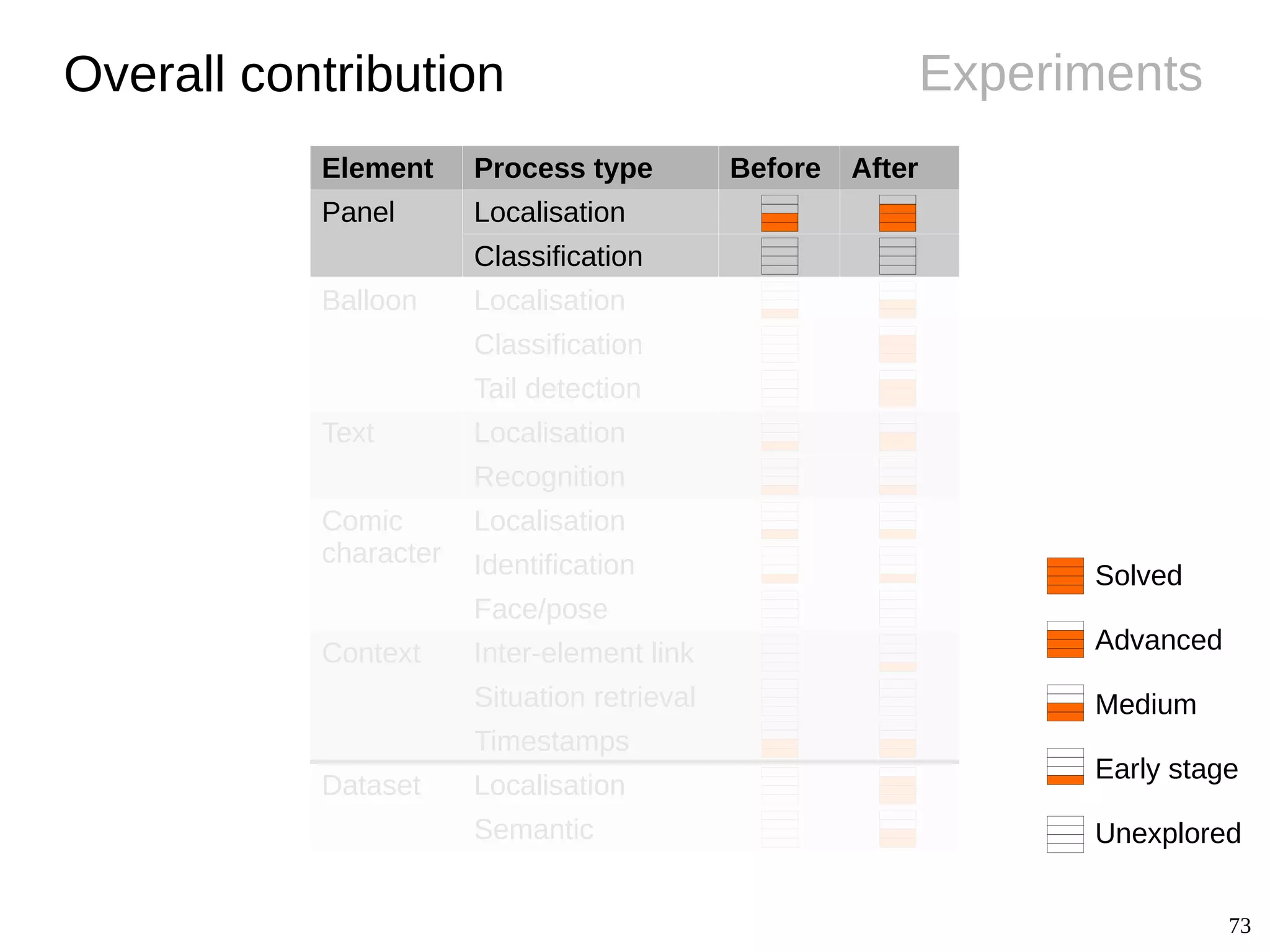
Experiments
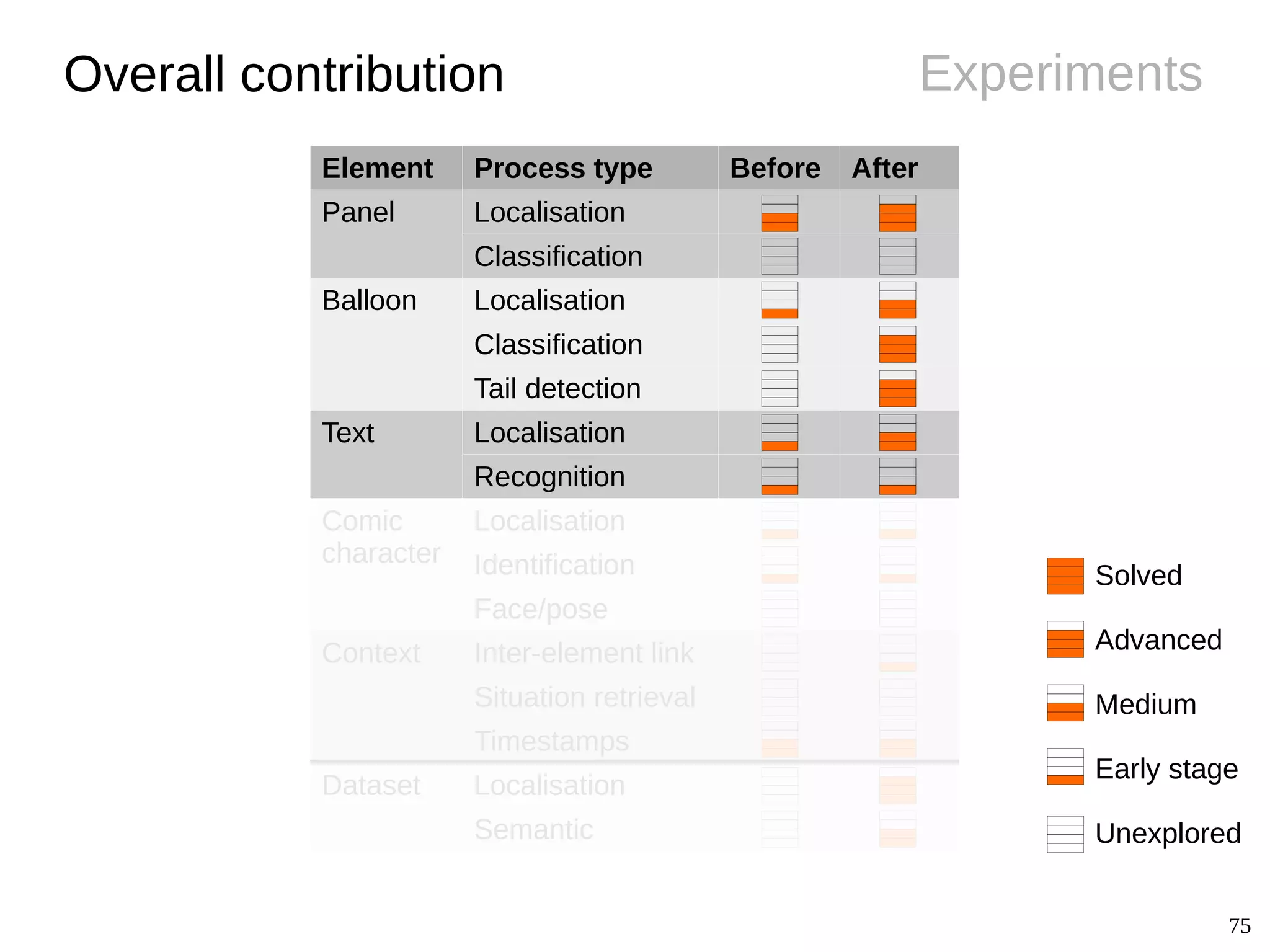
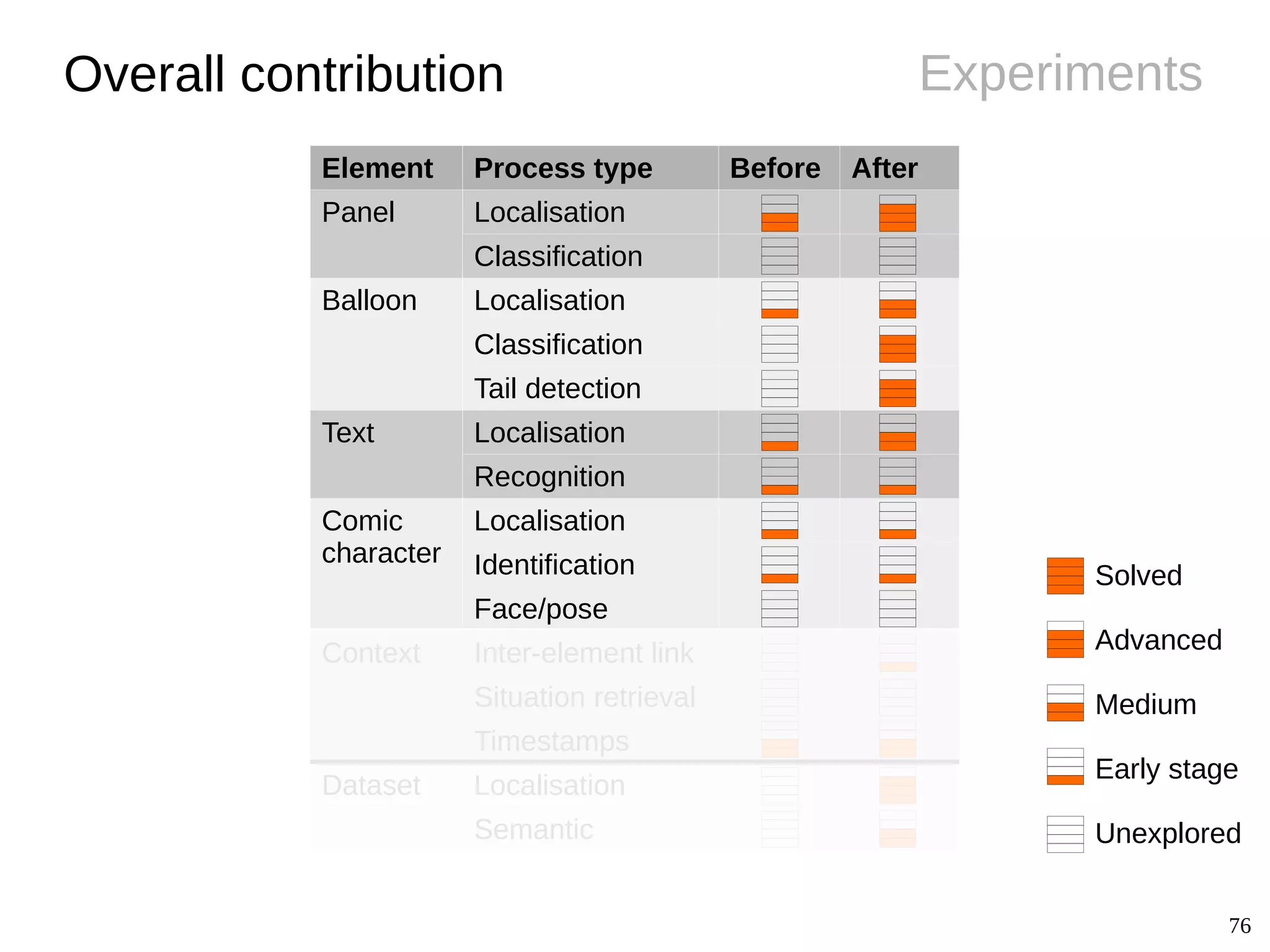
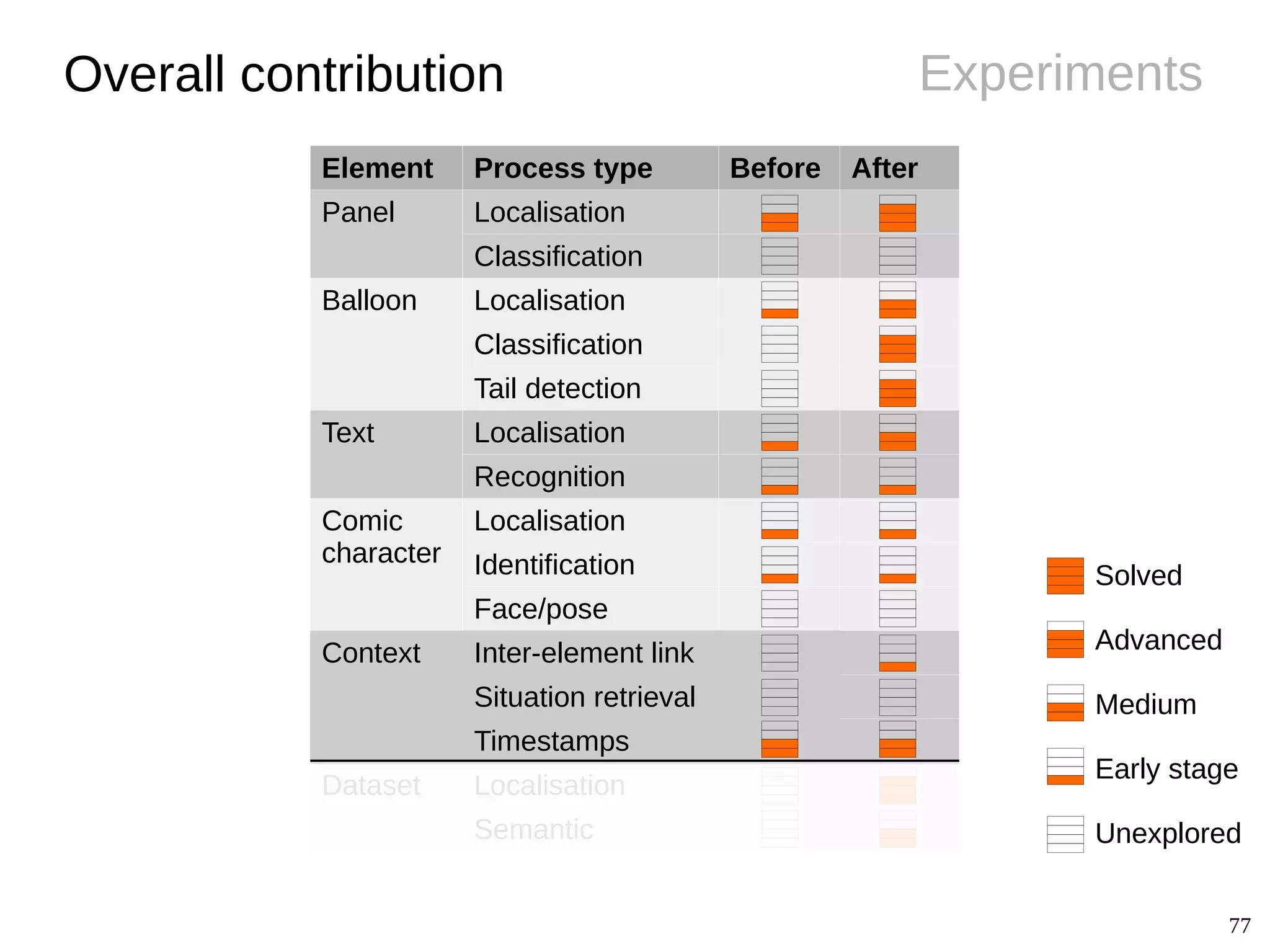
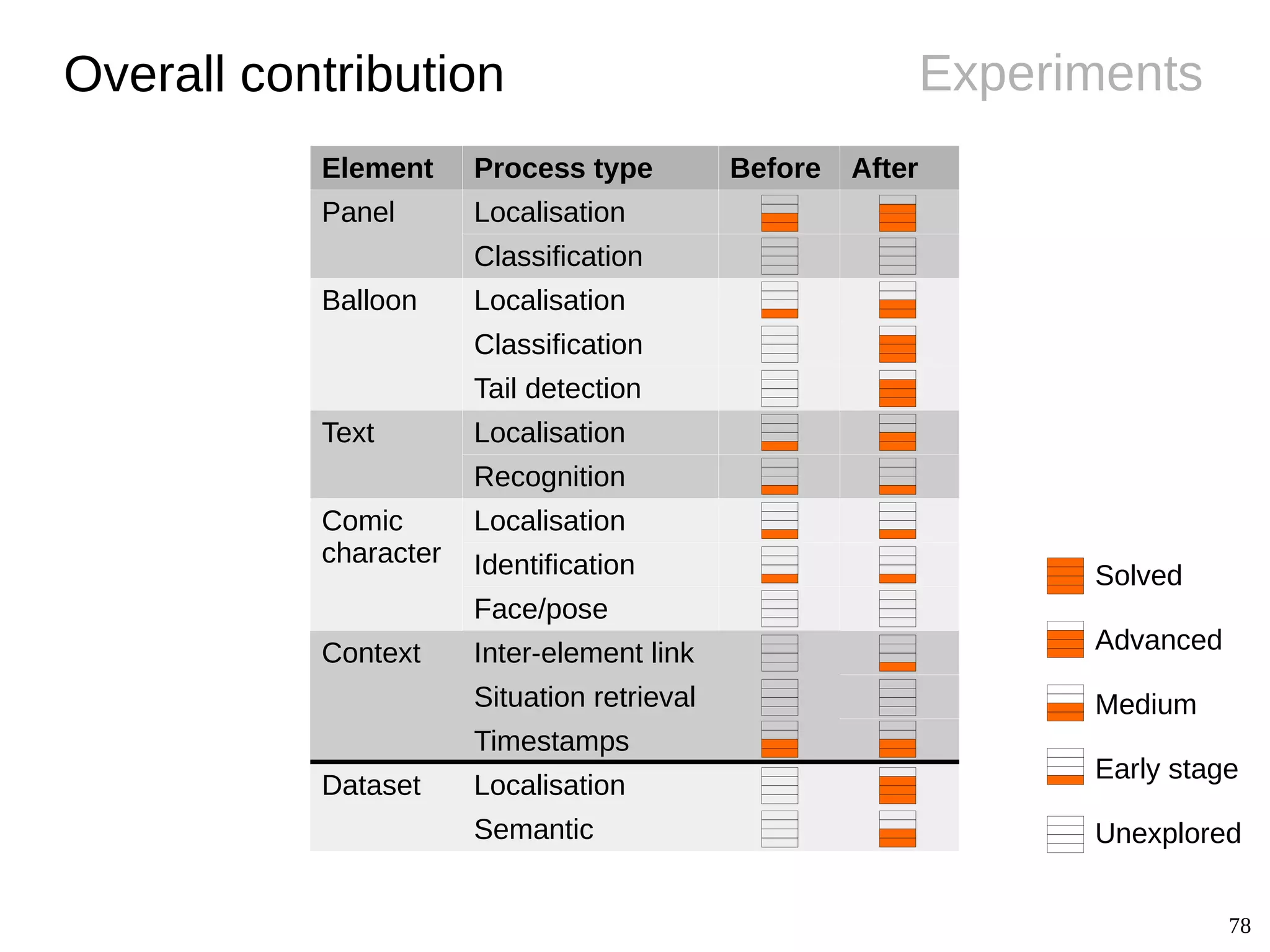
Element Process type Before After
Panel Localisation
Classification
Balloon Localisation
Classification
Tail detection
Text Localisation
Recognition
Comic
character
Localisation
Identification
Face/pose
Context Inter-element link
Situation retrieval
Timestamps
Dataset Localisation
Semantic
Overall contribution
Solved
Advanced
Medium
Early stage
Unexplored
74
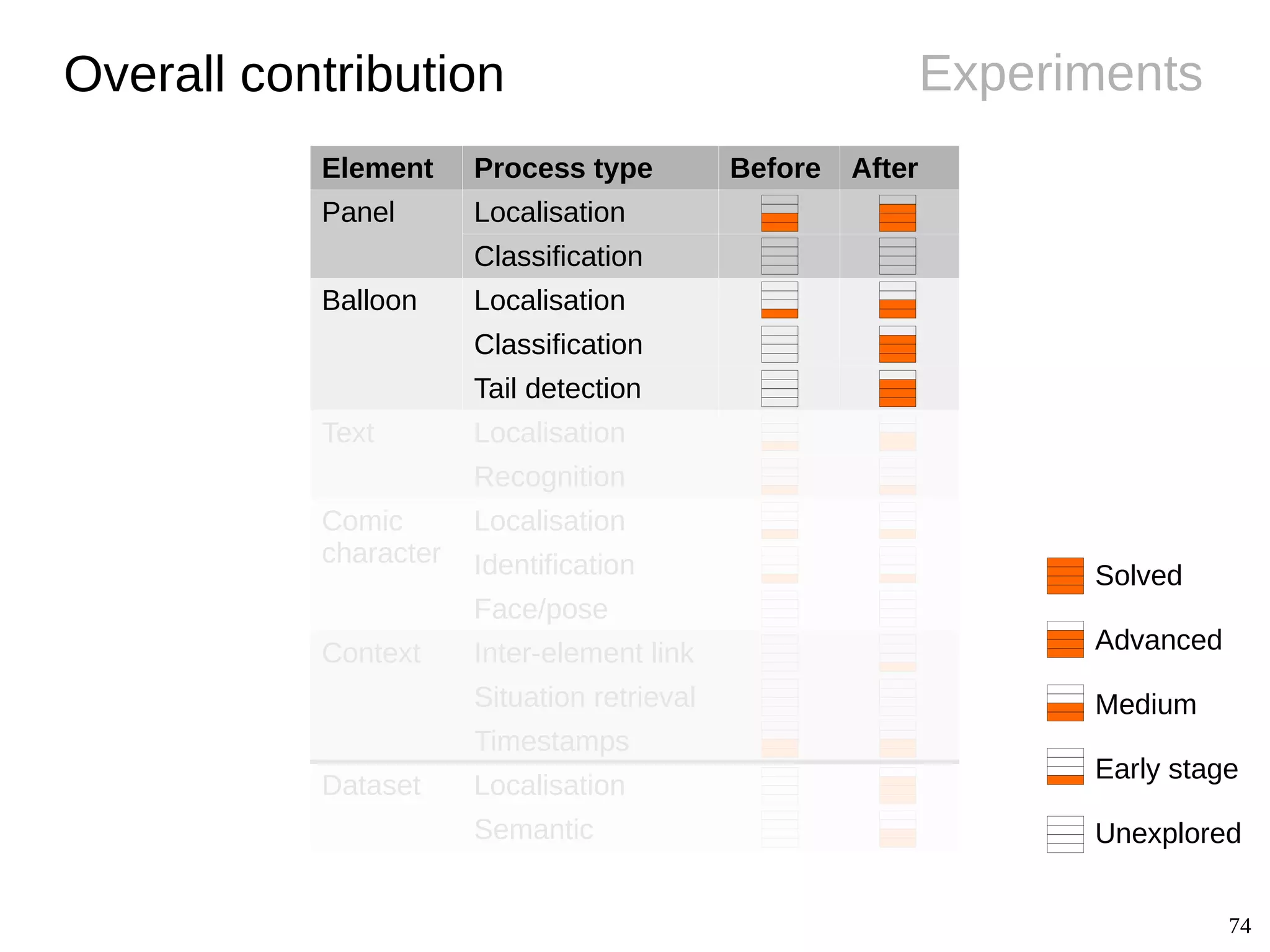
Experiments
Element Process type Before After
Panel Localisation
Classification
Balloon Localisation
Classification
Tail detection
Text Localisation
Recognition
Comic
character
Localisation
Identification
Face/pose
Context Inter-element link
Situation retrieval
Timestamps
Dataset Localisation
Semantic
Overall contribution
Solved
Advanced
Medium
Early stage
Unexplored
75
Experiments
Element Process type Before After
Panel Localisation
Classification
Balloon Localisation
Classification
Tail detection
Text Localisation
Recognition
Comic
character
Localisation
Identification
Face/pose
Context Inter-element link
Situation retrieval
Timestamps
Dataset Localisation
Semantic
Overall contribution
Solved
Advanced
Medium
Early stage
Unexplored
76
Experiments
Element Process type Before After
Panel Localisation
Classification
Balloon Localisation
Classification
Tail detection
Text Localisation
Recognition
Comic
character
Localisation
Identification
Face/pose
Context Inter-element link
Situation retrieval
Timestamps
Dataset Localisation
Semantic
Overall contribution
Solved
Advanced
Medium
Early stage
Unexplored
77
Experiments
Element Process type Before After
Panel Localisation
Classification
Balloon Localisation
Classification
Tail detection
Text Localisation
Recognition
Comic
character
Localisation
Identification
Face/pose
Context Inter-element link
Situation retrieval
Timestamps
Dataset Localisation
Semantic
Overall contribution
Solved
Advanced
Medium
Early stage
Unexplored
78
Experiments
Element Process type Before After
Panel Localisation
Classification
Balloon Localisation
Classification
Tail detection
Text Localisation
Recognition
Comic
character
Localisation
Identification
Face/pose
Context Inter-element link
Situation retrieval
Timestamps
Dataset Localisation
Semantic
Overall contribution
Solved
Advanced
Medium
Early stage
Unexplored
79
● Global conclusions
● Global perspectives
● Publications
Introduction Background Comics ConclusionExperiments
Lettering. Image credits: Le cycle des bulles,
Christophe Rigaud, 2012
Soon finish...
80
ConclusionGlobal conclusions
● Reached objectives
– Efficient panel, balloon, text and tail extraction methods
– First approaches for comic character extraction and context retrieval
– Public dataset and ground truth (http://ebdtheque.univ-lr.fr)
● Publications
– 1 journal, 3 book chapters, 4 conferences, 5 workshops (3 national)
– 6 local seminars
● Research impacts
– L3i is now a main actor of comic book analysis in Europe
– New Ph.D. thesis started in 2013 (Nam Le Thanh)
– Dataset used by international peers (Germany, India, China, Japan)
– National projects (PIA BigData Actialuna/LIP6, ANR EXPION 2015)
– International project on manga analysis (PHC-SAKURA with Japan)
81
ConclusionGlobal perspectives
● Content extraction
– Consider overlapping panel extraction
– Investigate text recognition
– Improve implicit balloon extraction and evaluation
– Extract and identify non-speaking comic characters
● Content understanding
– Situation retrieval (e.g. landscape, outdoor, night)
– Action recognition (e.g. running, driving, dreaming)
– Interaction retrieval (e.g. balloon said by/to)
– Labelling from text analysis (e.g. auto tagging)
● Dataset
– Increase and balance the number of images of each category
– Add more annotation (e.g. panel situation, comic character body parts and roles)
83
ConclusionPublications
JOURNAL
Christophe Rigaud, Clément Guérin, Dimosthenis Karatzas, Jean-Christophe Burie and
Jean-Marc Ogier. “Knowledge-driven understanding of images in comic books”.
International Journal on Document Analysis and Recognition (IJDAR), 2015 (accepted with
minor reviews).
BOOK CHAPTERS
Christophe Rigaud, Dimosthenis Karatzas, Jean-Christophe Burie and Jean-Marc Ogier.
“Adaptive contour classification of comics speech balloons”. In Graphic Recognition.
New Trends and Challenges. Lecture Notes in Computer Science (LNCS), Vol. 8746, pp.
53-62, 2014.
Nam Ho Hoang, Christophe Rigaud, Jean-Christophe Burie and Jean-Marc Ogier.
“Detecting recurring deformable objects: an approximate graph matching method for
detecting characters in comics books”. In Graphics Recognition. Current Trends and
Challenges. Lecture Notes in Computer Science (LNCS), Vol. 8746, pp. 122-134, 2014.
Christophe Rigaud, Norbert Tsopze, Jean-Christophe Burie and Jean-Marc Ogier. “Robust
frame and text extraction from comic books”. In Graphic Recognition. New Trends and
Challenges. Lecture Notes in Computer Science (LNCS), Vol. 7423, pp. 129-138, 2013.
84
ConclusionPublications
CONFERENCES
Christophe Rigaud, Dimosthenis Karatzas, Jean-Christophe Burie and Jean-Marc Ogier.
“Color descriptor for content-based drawing retrieval”. In the Proceedings of the 11th
IAPR International Workshop on Document Analysis Systems (DAS), pp. 267-271 , Tours,
France, April, 2014.
Christophe Rigaud, Dimosthenis Karatzas, Joost Van de Weijer, Jean-Christophe Burie
and Jean-Marc Ogier. “An active contour model for speech balloon detection in
comics”. In the Proceedings of the 12th International Conference on Document Analysis
and Recognition (ICDAR), pp. 1240-1244, Washington DC, USA, August, 2013.
Clément Guérin, Christophe Rigaud, Antoine Mercier, Farid Ammar-Boudjelal, Karell
Bertet, Alain Bouju, Jean-Christophe Burie, Georges Louis, Jean-Marc Ogier and Arnaud
Revel. “eBDtheque: a representative database of comics”. In the Proceedings of the
12th International Conference on Document Analysis and Recognition (ICDAR), pp. 1145-
1149, Washington DC, USA, August, 2013.
Christophe Rigaud, Dimosthenis Karatzas, Joost Van de Weijer, Jean-Christophe Burie
and Jean-Marc Ogier. “Automatic Text Localisation in Scanned Comic Books”. In the
Proceedings of the 8th International Conference on Computer 153 Vision Theory and
Applications (VISAPP), pp. 814-819, Barcelona, Spain, February, 2013.
85
ConclusionPublications
WORKSHOPS
Clément Guérin, Christophe Rigaud, Karell Bertet, Jean-Christophe Burie, Arnaud Revel
and Jean-Marc Ogier. “Réduction de l’espace de recherche pour les personnages de
bandes dessinéé́es”. In the Proceedings of the 19ème congrès national sur la
Reconnaissance de Formes et l’Intelligence Artificielle (RFIA), Rouen, France, July, 2014.
Christophe Rigaud, and Clément Guérin. “Localisation contextuelle des personnages de
bandes dessinées”. In the Proceedings of the 13ème Colloque International Francophone
sur l’Ecrit et le Document (CIFED), pp. 367–370, Nancy, France, March 2014.
Christophe Rigaud, Dimosthenis Karatzas, Jean-Christophe Burie and Jean-Marc Ogier.
“Speech balloon contour classification in comics”. Proceedings of the 10th
International
Workshop on Graphics RECognition (GREC), pp. 23-25, Bethlehem, USA, August, 2013.
Hoang Nam Ho, Christophe Rigaud, Jean-Christophe Burie and Jean-Marc Ogier.
“Redundant structure detection in attributed adjacency graphs for character detection
in comics books”. In the Proceedings of the 10th
IAPR International Workshop on Graphics
RECognition (GREC), pp. 109-113, Bethlehem, PA, USA, August, 2013.
Christophe Rigaud, Norbert Tsopze, Jean-Christophe Burie and Jean-Marc Ogier.
“Extraction robuste des cases et du texte de bandes dessinées”. In the Proceedings of
the 10ème Colloque International Francophone sur l’Ecrit et le Document (CIFED), pp. 349-
360, Bordeaux, France, March 2012.
86
ConclusionReferences
[Arai10] Kohei Arai and Herman Tolle. Method for automatic e-comic scene frame
extraction for reading comic on mobile devices. In Seventh International Conference on
Information Technology: New Generations, ITNG ’10, pages 370–375, Washington, DC,
USA, 2010. IEEE Computer Society.
[Cheung08] S.C.S. Cheung, City University of Hong Kong. Run Run Shaw Library, and City
University of Hong Kong. Face Detection and Face Recognition of Human-like
Characters in Comics. Outstanding academic papers by students. Run Run Shaw Library,
City University of Hong Kong, 2008.
[Chung07] ChungHo Chan, Howard Leung, and Taku Komura. Automatic panel extraction
of color comic images. In HoraceH.-S. Ip, OscarC. Au, Howard Leung, Ming-Ting Sun,
Wei-Ying Ma, and Shi-Min Hu, editors, Advances in Multimedia Information Processing -
PCM 2007, volume 4810 of Lecture Notes in Computer Science, pages 775–784. Springer
Berlin Heidelberg, 2007.
[Eunjung07] Eunjung Han, Kirak Kim, HwangKyu Yang, and Keechul Jung. Frame seg-
mentation used mlp-based x-y recursive for mobile cartoon content. In Proceedings of
the 12th international conference on Human-computer interaction: intelligent multimodal
interaction environments, HCI’07, pages 872–881, Berlin, Heidelberg, 2007. Springer.
[Ho12] Anh Khoi Ngo Ho, Jean-Christophe Burie, and Jean-Marc Ogier. Panel and speech
balloon extraction from comic books. In 2012 10th IAPR International Workshop on
Document Analysis Systems, pages 424–428. IEEE, 2012.
87
ConclusionReferences
[Khan12] Fahad Shahbaz Khan, Muhammad Anwer Rao, Joost van de Weijer, Andrew D.
Bagdanov, Maria Vanrell, and Antonio Lopez. Color attributes for object detection. In 25th
IEEE Conference on Computer Vision and Pattern Recognition (CVPR 2012), 2012.
[Li14a] Luyuan Li, Yongtao Wang, Zhi Tang, and Liangcai Gao. Automatic comic page
segmentation based on polygon detection. Multimedia Tools Applications, 171–197,
2014, Kluwer Academic Publishers.
[Li14b] Luyuan Li, Yongtao Wang, Zhi Tang, Xiaoqing Lu, and Liangcai Gao. Unsuper-
vised speech text localization in comic images. In Proceedings of International
Conference on Document Analysis and Recognition (ICDAR), pages 1190–1194, Aug 2013
[Pang14] Xufang Pang, Ying Cao, Rynson W.H. Lau, and Antoni B. Chan. A robust panel
extraction method for manga. In Proceedings of the ACM International Conference on
Multimedia, MM ’14, pages 1125–1128, New York, NY, USA, 2014.
[Ponsard12] Christophe Ponsard, Ravi Ramdoyal, and Daniel Dziamski. An ocr-enabled
digital comic books viewer. In Computers Helping People with Special Needs, pages
471–478. Springer, 2012.
[Stommel12] Martin Stommel, Lena I Merhej, and Marion G Müller. Segmentation-free
detection of comic panels. In Computer Vision and Graphics, pages 633–640, 2012.
88
ConclusionReferences
[Su11] Chung-Yuan Su, Ray-I Chang, and Jen-Chang Liu. Recognizing text elements
for svg comic compression and its novel applications. In Proceedings of International
Conference on Document Analysis and Recognition (ICDAR), pages 1329–1333,
Washington, DC, USA, 2011
[Sun10] Weihan Sun and Koichi Kise. Similar partial copy detection of line drawings
using a cascade classifier and feature matching. In Hiroshi Sako, Katrin Franke, and
Shuji Saitoh, editors, ICWF, volume 6540 of Lecture Notes in Computer Science, pages
126–137. Springer, 2010.
[Tanaka07] Takamasa Tanaka, Kenji Shoji, Fubito Toyama, and Juichi Miyamichi. Layout
analysis of tree-structured scene frames in comic images. In IJCAI’07, pages 2885–
2890, 2007.
89
https://github.com/crigaud/thesis
http://www.christophe-rigaud.com
Imagecredits:@carenalfaro

Segmentation and indexation of complex objects in comic book images

  • 1.
    European Ph.D. defense ChristopheRigaud December 11th , 2014 1 L3i – Université de La Rochelle 2 CVC - Universitat Autònoma de Barcelona Co-supervised by: Jean-Christophe Burie1 Dimosthenis Karatzas2 Jean-Marc Ogier1 Segmentation and indexation of complex objects in comic book imagesSegmentation and indexation of complex objects in comic book images
  • 2.
    2 IntroductionComic books “a visualmedium used to express ideas via images, often combined with text or visual information” Wikipédia, 2014 “one of the most popular and familiar forms of graphic content” Hiroaki Tobita, Sony CSL Interaction Laboratory, 2014
  • 3.
    3 IntroductionComic books 1900 19952000 “a visual medium used to express ideas via images, often combined with text or visual information” Wikipédia, 2014 “one of the most popular and familiar forms of graphic content” Hiroaki Tobita, Sony CSL Interaction Laboratory, 2014
  • 4.
    4 IntroductionComic books 1900 19952000 “a visual medium used to express ideas via images, often combined with text or visual information” Wikipédia, 2014 “one of the most popular and familiar forms of graphic content” Hiroaki Tobita, Sony CSL Interaction Laboratory, 2014 Massive digitization
  • 5.
    5 IntroductionComic books 1900 19952000 “a visual medium used to express ideas via images, often combined with text or visual information” Wikipédia, 2014 “one of the most popular and familiar forms of graphic content” Hiroaki Tobita, Sony CSL Interaction Laboratory, 2014 Massive digitization 2008
  • 6.
    6 IntroductionComic books 2) Comicsmarket in the US Milton Griepp's White Paper, ICv2 Conference 2014 Bandes dessinées Japanese manga American comics Total 1) Francophone comics production Infographie (c) L’Agence BD d’après les chiffres de Gilles Ratier/ACBD.
  • 7.
    7 IntroductionContext of thethesis ● eBDthèque project (since 2011) – Add value to digitized comics using the new technologies ● Content extraction (thesis of Christophe Rigaud) ● Knowledge representation (thesis of Clément Guérin) – Public founding CPER 2007-2013 – 2 Ph.D. students, 1 engineer, 1 post doc, 6 professors (L3i) ● Scientific challenges – Mixed contents of a graphical and textual nature – Combination of the difficulties of free-form and complex background documents – Recent and unexplored field of research ● Objectives – Propose generic approaches able to retrieve as many elements as possible from any comic book image – Provide a first dataset and ground truth
  • 8.
    8 IntroductionContext of thethesis ● eBDthèque project (since 2011) – Add value to digitized comics using the new technologies ● Content extraction (thesis of Christophe Rigaud) ● Knowledge representation (thesis of Clément Guérin) – Public founding CPER 2007-2013 – 2 Ph.D. students, 1 engineer, 1 post doc, 6 professors (L3i) ● Scientific challenges – Mixed contents of a graphical and textual nature – Combination of the difficulties of free-form and complex background documents – Recent and unexplored field of research ● Objectives – Propose generic approaches able to retrieve as many elements as possible from any comic book image – Provide a first dataset and ground truth
  • 9.
    9 IntroductionContext of thethesis ● eBDthèque project (since 2011) – Add value to digitized comics using the new technologies ● Content extraction (thesis of Christophe Rigaud) ● Knowledge representation (thesis of Clément Guérin) – Public founding CPER 2007-2013 – 2 Ph.D. students, 1 engineer, 1 post doc, 6 professors (L3i) ● Scientific challenges – Mixed contents of a graphical and textual nature – Combination of the difficulties of free-form and complex background documents – Recent and unexplored field of research ● Objectives – Propose generic approaches able to retrieve as many elements as possible from any comic book image – Provide a first dataset and ground truth
  • 10.
    10 Introduction Background ContributionsConclusionExperiments Pencil drawing. Image credits: Le cycle des bulles, Christophe Rigaud, 2012
  • 11.
    11 Introduction Background ContributionsConclusionExperiments Pencil drawing. Image credits: Le cycle des bulles, Christophe Rigaud, 2012 ● Panel extraction ● Balloon extraction ● Text extraction & recognition ● Comic character extraction ● Overall progress
  • 12.
    12 BackgroundPanel extraction ● Challenges –Diversity of styles (gutter, implicit) – Semi-structured layout ● Panel extraction – White line cut [Chung07] – Recursive X-Y cut [Eunjung07] – Density gradient [Tanaka07] – Connected-components [Arai10, Pang14] – Polygon detection [Li14a] – Corners and line segments [Stommel12] ● Conclusions – Specific approaches only – Remaining difficulties for non-rectangle and implicit panels – Copyrighted images (not shareable)
  • 13.
    13 BackgroundPanel extraction ● Challenges –Diversity of styles (gutter, implicit) – Semi-structured layout ● Panel extraction – White line cut [Chung07] – Recursive X-Y cut [Eunjung07] – Density gradient [Tanaka07] – Connected-components [Arai10, Pang14] – Polygon detection [Li14a] – Corners and line segments [Stommel12] ● Conclusions – Specific approaches only – Remaining difficulties for non-rectangle and implicit panels – Copyrighted images (not shareable)
  • 14.
    14 Background ● Challenges – Differencebetween shape and contour – Implicit balloon positions – Semantics related to text ● Extraction – Connected-components [Arai11, Ho12] ● Conclusions – Closed balloon with text inside – Several unexplored fields (e.g. implicit balloon positions, balloon classification, tail detection) Balloon extraction Image Shape Contour Oval Smooth Rectangle Smooth Oval Wavy Oval Spiky Oval / implicit Smooth / Implicit
  • 15.
    15 BackgroundBalloon extraction Image ShapeContour Oval Smooth Rectangle Smooth Oval Wavy Oval Spiky Oval / implicit Smooth / Implicit ● Challenges – Difference between shape and contour – Implicit balloon positions – Semantics related to text ● Extraction – Connected-components [Arai11, Ho12] ● Conclusions – Closed balloon with text inside – Several unexplored fields (e.g. implicit balloon positions, balloon classification, tail detection)
  • 16.
    16 Background ● Conclusions – Speechtext (from balloons) – Captions and sound effects unexplored – Text recognition very poor Text extraction & recognition ● Challenges – Non-standard fonts – Multi-script/orientation/scale – Complex background (sound effects) – Hyphenation, voluntary spelling mistakes ● Extraction – Sliding Concentric Windows + SVM [Su11] – Connected-components [Ho12, Pang14] – SVM and Bayesian classifier [Li14b] ● Recognition – OCR trained for a specific comics font [Ponsard12]
  • 17.
    17 Background ● Conclusions – Speechtext only (from balloons) – Captions and sound effects unexplored – Text recognition very poor Text extraction & recognition ● Challenges – Non-standard fonts – Multi-script/orientation/scale – Complex background (sound effects) – Hyphenation, voluntary spelling mistakes ● Extraction – Sliding Concentric Windows + SVM [Su11] – Connected-components [Ho12, Pang14] – SVM and Bayesian classifier [Li14b] ● Recognition – OCR trained for a specific comics font [Ponsard12]
  • 18.
    18 Background ● Conclusions – Preliminaryresults – Complex and versatile structure – Contains most of the interesting information Comic character extraction ● Challenges – Hand-drawn, stroke-based – Intra/inter class variability – Scale, deformation, posture, occlusion ● Extraction & recognition – Manga faces [Cheung08, Sun10, Kohei12] – Cartoons [Khan12]
  • 19.
    19 Background ● Conclusions – Preliminaryresults – Complex and versatile structure – Contains most of the interesting information Comic character extraction ● Challenges – Hand-drawn, stroke-based – Intra/inter class variability – Scale, deformation, posture, occlusion ● Extraction & recognition – Manga faces [Cheung08, Sun10, Kohei12] – Cartoons [Khan12]
  • 20.
    20 Background Element Process typeStatus Panel Localisation Classification Balloon Localisation Classification Tail detection Text Localisation Recognition Comic character Localisation Identification Face/pose Context Inter-element link Situation retrieval Timestamps Dataset Localisation Semantic Overall progress Solved Advanced Medium Early stage Unexplored
  • 21.
    21 ● Introduction ● Sequentialapproach ● (Independent approach) ● Knowledge-driven approach Introduction Documents Contributions ConclusionExperiments Inking. Image credits: Le cycle des bulles, Christophe Rigaud, 2012
  • 22.
    22 Introduction Documents ContributionsConclusionExperiments Inking. Image credits: Le cycle des bulles, Christophe Rigaud, 2012 ● Introduction ● Sequential approach ● (Independent approach) ● Knowledge-driven approach
  • 23.
    23 ContributionsIntroduction ● Objective: coverthe widest possible scope of study
  • 24.
    24 ContributionsIntroduction Bibliographic annotations Visualand semantic annotations ● Objective: cover the widest possible scope of study 1) Creation of heterogeneous dataset – 100 mixed pages from 20 albums – Franco-Belgium “bandes dessinées”, American comics and Japanese manga – From 1905 to 2012, digitized and webcomics – Rights holder permissions agreement
  • 25.
    25 Contributions ● Content-driven – Sequentialapproach ● Similar to literature ● Intuitive ● Sensible to error propagation – Independent approach ● Avoid error propagation ● Knowledge-driven – Knowledge-driven approach ● Based on domain knowledge ● Retrieve context Comic page image Panel & text Balloon Tail Character Page description Comic page image Page description Panel Text Character Balloon & Tail Introduction ● Objective: cover the widest possible scope of study 1) Creation of heterogeneous dataset 2) Three approaches
  • 26.
    26 ContributionsIntroduction ● Content-driven – Sequentialapproach ● Similar to literature ● Intuitive ● Sensible to error propagation – Independent approach ● Avoid error propagation ● Knowledge-driven – Knowledge-driven approach ● Based on domain knowledge ● Retrieve context Comic page image Panel & text Balloon Tail Character Page description Comic page image Page description Panel Text Character Balloon & Tail ● Objective: cover the widest possible scope of study 1) Creation of heterogeneous dataset 2) Three approaches
  • 27.
    27 ContributionsIntroduction ● Content-driven – Sequentialapproach ● Similar to literature ● Intuitive ● Sensible to error propagation – Independent approach ● Avoid error propagation ● Knowledge-driven – Knowledge-driven approach ● Based on domain knowledge ● Retrieve context Comic page image Panel & text Balloon Tail Character Page description Comic page image Page description Panel Text Character Balloon & Tail Knowledge ● Objective: cover the widest possible scope of study 1) Creation of heterogeneous dataset 2) Three approaches
  • 28.
    28 Introduction Documents ContributionsConclusionExperiments Inking. Image credits: Le cycle des bulles, Christophe Rigaud, 2012 ● Introduction ● Sequential approach ● (Independent approach) ● Knowledge-driven approach
  • 29.
    29 Introduction Documents ContributionsConclusionExperiments Inking. Image credits: Le cycle des bulles, Christophe Rigaud, 2012 ● Introduction ● Sequential approach – Panel & text extraction – Balloon extraction – Tail extraction – Comic character extraction ● (Independent approach) ● Knowledge-driven approach
  • 30.
    30 Introduction Documents ContributionsConclusionExperiments Inking. Image credits: Le cycle des bulles, Christophe Rigaud, 2012 ● Introduction ● Sequential approach – Panel & text extraction – Balloon extraction – Tail extraction – Comic character extraction ● (Independent approach) ● Knowledge-driven approach
  • 31.
    31 Contributions Sequential approach Panel &text extraction Comic page image Panel & text extraction Balloon extraction Tail extraction Character extraction Comic page description ● Literature – Panel with frame, separated by gutters or black line – Text located inside balloons ● Contribution – Simultaneous panel and text extraction from a binary image – Consider implicit and non-rectangle panels – Location-independent text extraction
  • 32.
    32 Contributions Sequential approach Panel &text extraction CCheight(pixel) 4) Histogram of heights (descendent order) 1) Binary image 2) Black connected-component (CC) bounding boxes 3) Histogram of heights of CC
  • 33.
    33 Contributions Sequential approach Panel &text extraction CCheight(pixel) K-means clustering (k=3) Panels Text Noise
  • 34.
    34 Contributions Sequential approach TODO Panel &text extraction: results 1) Original image 4) CC region boxes 5) Text line boxes 2) CC regions 3) Panel boxes eBDtheque dataset Recall Precision Panel 64.24 % 83.81 % Text 54.91 % 57.15 % Panel Text
  • 35.
    35 Introduction Documents ContributionsConclusionExperiments Inking. Image credits: Le cycle des bulles, Christophe Rigaud, 2012 ● Introduction ● Sequential approach – Panel & text extraction – Balloon extraction – Tail extraction – Comic character extraction ● (Independent approach) ● Knowledge-driven approach
  • 36.
    36 Contributions Sequential approach Balloon extraction Comic page image Panel &text extraction Balloon extraction Tail extraction Character extraction Comic page description Regular balloon Implicit balloon ● Literature – Top-down approaches: extract white blobs and then text inside – Limited to regular balloons ● Contribution – Bottom-up approaches: extract text and then surrounding balloons – Appropriate for regular and implicit balloons
  • 37.
    37 Contributions Sequential approach Balloon extraction Regularballoon Implicit balloon ● Literature – Top-down approaches: extract white blobs and then text inside – Limited to regular balloons ● Contribution – Bottom-up approaches: extract text and then surrounding balloons – Improvement of regular and a first approach for implicit balloon extractions Comic page image Panel & text extraction Balloon extraction Tail extraction Character extraction Comic page description
  • 38.
    38 Contributions Sequential approach Balloon extraction:regular ● Assumptions – Panels and text block positions are known – Regular balloons contain centred text ● Proposition → structural analysis – Extract closed contours that fully include centred text Original image Expected result
  • 39.
    39 Contributions Sequential approach Balloon extraction:regular ● Assumptions – Panels and text block positions are known – Regular balloons contain centred text ● Proposition → structural analysis – Extract closed contours that fully include centred text 1) Original image 2) Expected result
  • 40.
    40 Contributions Sequential approach Balloon extraction:regular 1) Original image 2) Text block positions (green) 3) Regions including text blocks (coloured) 4) Regions including aligned text blocks
  • 41.
    41 Contributions Sequential approach Balloon extraction:implicit ● Assumptions – Panel and text blocks positions are known – Implicit balloons contain centred text ● Proposition – Extract implicit balloons from text regions by inflating a deformable contour – Adaptation of active contour model (snake) 1) Original image and text locations 2) Expected result
  • 42.
    42 Contributions Sequential approach Balloon extraction:implicit E = Eint + Eext Eint = Econt + Ecurv Eext = Eedge + Etext Energy function:
  • 43.
    43 Contributions Sequential approach Balloon extraction:implicit External energy Eext E = Eint + Eext Eint = Econt + Ecurv Eext = Eedge + Etext Energy function:
  • 44.
    44 Contributions Sequential approach Balloon extraction:implicit Initial snake positions E = Eint + Eext Eint = Econt + Ecurv Eext = Eedge + Etext Energy function:
  • 45.
    45 Contributions Sequential approach Balloon extraction:implicit Final snake positions The snake is attracted to the “dark side” E = Eint + Eext Eint = Econt + Ecurv Eext = Eedge + Etext Energy function:
  • 46.
    46 Contributions Sequential approach Balloon extraction:implicit Final balloon extraction The snake is attracted to the “dark side” E = Eint + Eext Eint = Econt + Ecurv Eext = Eedge + Etext Energy function:
  • 47.
    47 Contributions Sequential approach Balloon extraction:results eBDtheque dataset Recall Precision Regular 37.25 % 45.19 % Implicit 57.76 % 41.62 % Implicit balloons Regular balloons Text block Balloon extraction
  • 48.
    48 Introduction Documents ContributionsConclusionExperiments Inking. Image credits: Le cycle des bulles, Christophe Rigaud, 2012 ● Introduction ● Sequential approach – Panel & text extraction – Balloon extraction – Tail extraction – Comic character extraction ● (Independent approach) ● Knowledge-driven approach
  • 49.
    49 Contributions Sequential approach Tail extraction Comic page image Panel &text extraction Balloon extraction Tail extraction Character extraction Comic page description Stroke Comma Circle Zigzag Absent ● Literature – First time studied in document image analysis ● Objectives – Extraction of tail tip position and direction – Focus on comma, zigzag and absent types
  • 50.
    50 Contributions Sequential approach Tail extraction:tip position 1) Balloon contour 2) Convex hull 3) Two biggest convexity defects (dsb =0) 4) Tail tip position Optimal vertex selection: v =∗ argmax(max(dc + dfa + dfb ) + min(dsa + dsb ))
  • 51.
    51 Contributions Sequential approach Tail extraction:tip position 2) Convex hull 3) Two biggest convexity defects 4) Tail tip position Optimal vertex selection: v =∗ argmax(max(dc + dfa + dfb ) + min(dsa + dsb )) (dsb =0) 1) Balloon contour
  • 52.
    52 Contributions Sequential approach Tail extraction:confidence value Balloon contour (blue) Convex hull (red) Balloon 1 Balloon 2 db da Ctail= (da+db)/2 meanBalloonSizeConfidence Ctail=0.0 Ctail=0.73 Presence of tail NO YES (>0) da db
  • 53.
    53 Contributions Sequential approach Tail extraction:tail direction ● Definition – Vector starting from “background” to “external edge” tail tip positions ● Approach – Extract external edge – Find external edge tail tip coordinates – Define the tail direction (N, NE, E, SE, S, SW, W, NW) 1) Background tail tip (green) and external edge (blue) 2) Closest point on external edge (red) 3) Farthest point from origin and tip (red) 4) Direction from tip to farthest point (white arrow)
  • 54.
    54 ExperimentsTail extraction: results eBDthequedataset Accuracy of tail tip Accuracy of tail direction GT balloons 96.61 % 80.40 % Auto balloons 55.77 % 27.59 % Biggest convexity defects Tail region Balloon extraction
  • 55.
    55 Introduction Documents ContributionsConclusionExperiments Inking. Image credits: Le cycle des bulles, Christophe Rigaud, 2012 ● Introduction ● Sequential approach – Panel & text extraction – Balloon extraction – Tail extraction – Comic character extraction ● (Independent approach) ● Knowledge-driven approach
  • 56.
    56 Contributions Sequential approach Comic characterextraction Comic page image Panel & text extraction Balloon extraction Tail extraction Character extraction Comic page description ● Challenges – Variety of styles of comic books – Intra and extra class variations of each character instance (e.g. pose, occlusion, human-like or invented) ● Literature – Supervised approaches for manga and cartoon characters ● Contribution – Unsupervised and generic approach for all styles of comic books
  • 57.
  • 58.
    58 Contributions Sequential approach Comic characterextraction Large ROI Small ROI Panels + Tails = Comic character ROIs
  • 59.
    59 Contributions Sequential approach Comic characterextraction: results Comic character ROIs (Regions Of Interests) eBDtheque dataset Recall Precision GT (panels + balloons) 15.59 % 23.18 % Auto 6.84 % 12.13 %
  • 60.
    60 Introduction Documents ContributionsConclusionExperiments ● Introduction ● Sequential approach ● (Independent approach) ● Knowledge-driven approach – Introduction – Knowledge representation – Processing sequence Colouring. Image credits: Le cycle des bulles, Christophe Rigaud, 2012
  • 61.
    61 Contributions Knowledge-driven approach Introduction ● High levelimage description ● Framework for comics understanding ● Independent element extraction ● Increase overall precision ● Collaboration with Clément Guérin Illustration of high level image description Comic page image Comic page description Panel Text Character Balloon & tail Knowledge
  • 62.
    62 Contributions Knowledge-driven approach ● Imagemodel – Physical support – Regions of interest ● Comics model – Validations ● A panel P is related to one page ● A balloon B is related to one panel and may have a tail Q ● A character C is related to one panel ● A text line T is related to one balloon – Inferences ● B + Q + T => speech balloon SB ● SB + T => speech text ST ● SB + C => speaking character SC Knowledge representation EXPERT SYSTEM OUTPUT VALIDATED RESULTS LOW-LEVEL EXTRACTION ALGORITHMS INFERENCE ENGINE KNOWLEDGE BASE IMAGE MODEL COMICS MODEL TEMPORARY RESULTS Rigaud's thesis Collaboration Guérin's thesis
  • 63.
    63 Contributions Knowledge-driven approach ● Imagemodel – Physical support – Regions of interest ● Comics model – Validations ● A panel P is related to one page ● A balloon B is related to one panel and may have a tail Q ● A character C is related to one panel ● A text line T is related to one balloon – Inferences ● B + Q + T => speech balloon SB ● SB + T => speech text ST ● SB + C => speaking character SC Knowledge representation EXPERT SYSTEM OUTPUT VALIDATED RESULTS LOW-LEVEL EXTRACTION ALGORITHMS INFERENCE ENGINE KNOWLEDGE BASE IMAGE MODEL COMICS MODEL TEMPORARY RESULTS Rigaud's thesis Collaboration Guérin's thesis
  • 64.
    64 Contributions Knowledge-driven approach Processing sequence ●Iteration 1 – Step 1: hypotheses of simple element positions – Step 2: validation of the positions – Step 3: inference a new information ● Iteration 2 – Step 1: hypotheses of more complex elements – Step 2: validation of the positions – Step 3: inference a new information – ... Validate hypotheses Formulate hypotheses Infer new information
  • 65.
    65 Contributions Knowledge-driven approach I P B B B T TT TT T T T P B Q B Q T Processing sequence Hypotheses of panels, balloons and text lines P B T Panel Balloon Text P B T Non valid Valid Q TailQ
  • 66.
    66 Contributions Knowledge-driven approach Processing sequence Validationof the hypotheses I P B B B BB T T T TT T T T P QQ T Hypotheses of panels, balloons and text lines P B T Panel Balloon Text P B T Non valid Valid Q TailQ
  • 67.
    67 Contributions Knowledge-driven approach Processing sequence Inferencesof specific types Hypotheses of panels, balloons and text lines Validation of the hypotheses P SB ST Panel Speech balloon Speech text P SB ST Non valid Valid Q TailQ
  • 68.
    68 Contributions Knowledge-driven approach Processing sequence Hypothesesof comic characters Inferences of specific types Validation of the hypotheses C Comic character C Non valid Valid
  • 69.
    69 Contributions Knowledge-driven approach Processing sequence Hypothesesof comic characters Validation of the hypotheses Inferences of specific types C Comic character C Non valid Valid
  • 70.
    70 Contributions Knowledge-driven approach Processing sequence Inferencesof specific types + semantic links Hypotheses of comic characters Validation of the hypotheses SC Speaking comic character SC Non valid Valid
  • 71.
    71 ● Evaluations ● Overallcontribution Introduction Background Contributions ConclusionExperiments Lettering. Image credits: Le cycle des bulles, Christophe Rigaud, 2012 Ready for experiments?
  • 72.
    72 ExperimentsEvaluations a0= area(Bp∪Bgt) area(Bp∩Bgt) Bp = predicted region Bgt =ground truth region Bp is valid if a0 > 0.5 Extraction results on the eBDtheque dataset (F-score) Number of element in the dataset Panel 850 Balloon 1092 Text line 4691 Comic character 1550
  • 73.
    73 Experiments Element Process typeBefore After Panel Localisation Classification Balloon Localisation Classification Tail detection Text Localisation Recognition Comic character Localisation Identification Face/pose Context Inter-element link Situation retrieval Timestamps Dataset Localisation Semantic Overall contribution Solved Advanced Medium Early stage Unexplored
  • 74.
    74 Experiments Element Process typeBefore After Panel Localisation Classification Balloon Localisation Classification Tail detection Text Localisation Recognition Comic character Localisation Identification Face/pose Context Inter-element link Situation retrieval Timestamps Dataset Localisation Semantic Overall contribution Solved Advanced Medium Early stage Unexplored
  • 75.
    75 Experiments Element Process typeBefore After Panel Localisation Classification Balloon Localisation Classification Tail detection Text Localisation Recognition Comic character Localisation Identification Face/pose Context Inter-element link Situation retrieval Timestamps Dataset Localisation Semantic Overall contribution Solved Advanced Medium Early stage Unexplored
  • 76.
    76 Experiments Element Process typeBefore After Panel Localisation Classification Balloon Localisation Classification Tail detection Text Localisation Recognition Comic character Localisation Identification Face/pose Context Inter-element link Situation retrieval Timestamps Dataset Localisation Semantic Overall contribution Solved Advanced Medium Early stage Unexplored
  • 77.
    77 Experiments Element Process typeBefore After Panel Localisation Classification Balloon Localisation Classification Tail detection Text Localisation Recognition Comic character Localisation Identification Face/pose Context Inter-element link Situation retrieval Timestamps Dataset Localisation Semantic Overall contribution Solved Advanced Medium Early stage Unexplored
  • 78.
    78 Experiments Element Process typeBefore After Panel Localisation Classification Balloon Localisation Classification Tail detection Text Localisation Recognition Comic character Localisation Identification Face/pose Context Inter-element link Situation retrieval Timestamps Dataset Localisation Semantic Overall contribution Solved Advanced Medium Early stage Unexplored
  • 79.
    79 ● Global conclusions ●Global perspectives ● Publications Introduction Background Comics ConclusionExperiments Lettering. Image credits: Le cycle des bulles, Christophe Rigaud, 2012 Soon finish...
  • 80.
    80 ConclusionGlobal conclusions ● Reachedobjectives – Efficient panel, balloon, text and tail extraction methods – First approaches for comic character extraction and context retrieval – Public dataset and ground truth (http://ebdtheque.univ-lr.fr) ● Publications – 1 journal, 3 book chapters, 4 conferences, 5 workshops (3 national) – 6 local seminars ● Research impacts – L3i is now a main actor of comic book analysis in Europe – New Ph.D. thesis started in 2013 (Nam Le Thanh) – Dataset used by international peers (Germany, India, China, Japan) – National projects (PIA BigData Actialuna/LIP6, ANR EXPION 2015) – International project on manga analysis (PHC-SAKURA with Japan)
  • 81.
    81 ConclusionGlobal perspectives ● Contentextraction – Consider overlapping panel extraction – Investigate text recognition – Improve implicit balloon extraction and evaluation – Extract and identify non-speaking comic characters ● Content understanding – Situation retrieval (e.g. landscape, outdoor, night) – Action recognition (e.g. running, driving, dreaming) – Interaction retrieval (e.g. balloon said by/to) – Labelling from text analysis (e.g. auto tagging) ● Dataset – Increase and balance the number of images of each category – Add more annotation (e.g. panel situation, comic character body parts and roles)
  • 82.
    83 ConclusionPublications JOURNAL Christophe Rigaud, ClémentGuérin, Dimosthenis Karatzas, Jean-Christophe Burie and Jean-Marc Ogier. “Knowledge-driven understanding of images in comic books”. International Journal on Document Analysis and Recognition (IJDAR), 2015 (accepted with minor reviews). BOOK CHAPTERS Christophe Rigaud, Dimosthenis Karatzas, Jean-Christophe Burie and Jean-Marc Ogier. “Adaptive contour classification of comics speech balloons”. In Graphic Recognition. New Trends and Challenges. Lecture Notes in Computer Science (LNCS), Vol. 8746, pp. 53-62, 2014. Nam Ho Hoang, Christophe Rigaud, Jean-Christophe Burie and Jean-Marc Ogier. “Detecting recurring deformable objects: an approximate graph matching method for detecting characters in comics books”. In Graphics Recognition. Current Trends and Challenges. Lecture Notes in Computer Science (LNCS), Vol. 8746, pp. 122-134, 2014. Christophe Rigaud, Norbert Tsopze, Jean-Christophe Burie and Jean-Marc Ogier. “Robust frame and text extraction from comic books”. In Graphic Recognition. New Trends and Challenges. Lecture Notes in Computer Science (LNCS), Vol. 7423, pp. 129-138, 2013.
  • 83.
    84 ConclusionPublications CONFERENCES Christophe Rigaud, DimosthenisKaratzas, Jean-Christophe Burie and Jean-Marc Ogier. “Color descriptor for content-based drawing retrieval”. In the Proceedings of the 11th IAPR International Workshop on Document Analysis Systems (DAS), pp. 267-271 , Tours, France, April, 2014. Christophe Rigaud, Dimosthenis Karatzas, Joost Van de Weijer, Jean-Christophe Burie and Jean-Marc Ogier. “An active contour model for speech balloon detection in comics”. In the Proceedings of the 12th International Conference on Document Analysis and Recognition (ICDAR), pp. 1240-1244, Washington DC, USA, August, 2013. Clément Guérin, Christophe Rigaud, Antoine Mercier, Farid Ammar-Boudjelal, Karell Bertet, Alain Bouju, Jean-Christophe Burie, Georges Louis, Jean-Marc Ogier and Arnaud Revel. “eBDtheque: a representative database of comics”. In the Proceedings of the 12th International Conference on Document Analysis and Recognition (ICDAR), pp. 1145- 1149, Washington DC, USA, August, 2013. Christophe Rigaud, Dimosthenis Karatzas, Joost Van de Weijer, Jean-Christophe Burie and Jean-Marc Ogier. “Automatic Text Localisation in Scanned Comic Books”. In the Proceedings of the 8th International Conference on Computer 153 Vision Theory and Applications (VISAPP), pp. 814-819, Barcelona, Spain, February, 2013.
  • 84.
    85 ConclusionPublications WORKSHOPS Clément Guérin, ChristopheRigaud, Karell Bertet, Jean-Christophe Burie, Arnaud Revel and Jean-Marc Ogier. “Réduction de l’espace de recherche pour les personnages de bandes dessinéé́es”. In the Proceedings of the 19ème congrès national sur la Reconnaissance de Formes et l’Intelligence Artificielle (RFIA), Rouen, France, July, 2014. Christophe Rigaud, and Clément Guérin. “Localisation contextuelle des personnages de bandes dessinées”. In the Proceedings of the 13ème Colloque International Francophone sur l’Ecrit et le Document (CIFED), pp. 367–370, Nancy, France, March 2014. Christophe Rigaud, Dimosthenis Karatzas, Jean-Christophe Burie and Jean-Marc Ogier. “Speech balloon contour classification in comics”. Proceedings of the 10th International Workshop on Graphics RECognition (GREC), pp. 23-25, Bethlehem, USA, August, 2013. Hoang Nam Ho, Christophe Rigaud, Jean-Christophe Burie and Jean-Marc Ogier. “Redundant structure detection in attributed adjacency graphs for character detection in comics books”. In the Proceedings of the 10th IAPR International Workshop on Graphics RECognition (GREC), pp. 109-113, Bethlehem, PA, USA, August, 2013. Christophe Rigaud, Norbert Tsopze, Jean-Christophe Burie and Jean-Marc Ogier. “Extraction robuste des cases et du texte de bandes dessinées”. In the Proceedings of the 10ème Colloque International Francophone sur l’Ecrit et le Document (CIFED), pp. 349- 360, Bordeaux, France, March 2012.
  • 85.
    86 ConclusionReferences [Arai10] Kohei Araiand Herman Tolle. Method for automatic e-comic scene frame extraction for reading comic on mobile devices. In Seventh International Conference on Information Technology: New Generations, ITNG ’10, pages 370–375, Washington, DC, USA, 2010. IEEE Computer Society. [Cheung08] S.C.S. Cheung, City University of Hong Kong. Run Run Shaw Library, and City University of Hong Kong. Face Detection and Face Recognition of Human-like Characters in Comics. Outstanding academic papers by students. Run Run Shaw Library, City University of Hong Kong, 2008. [Chung07] ChungHo Chan, Howard Leung, and Taku Komura. Automatic panel extraction of color comic images. In HoraceH.-S. Ip, OscarC. Au, Howard Leung, Ming-Ting Sun, Wei-Ying Ma, and Shi-Min Hu, editors, Advances in Multimedia Information Processing - PCM 2007, volume 4810 of Lecture Notes in Computer Science, pages 775–784. Springer Berlin Heidelberg, 2007. [Eunjung07] Eunjung Han, Kirak Kim, HwangKyu Yang, and Keechul Jung. Frame seg- mentation used mlp-based x-y recursive for mobile cartoon content. In Proceedings of the 12th international conference on Human-computer interaction: intelligent multimodal interaction environments, HCI’07, pages 872–881, Berlin, Heidelberg, 2007. Springer. [Ho12] Anh Khoi Ngo Ho, Jean-Christophe Burie, and Jean-Marc Ogier. Panel and speech balloon extraction from comic books. In 2012 10th IAPR International Workshop on Document Analysis Systems, pages 424–428. IEEE, 2012.
  • 86.
    87 ConclusionReferences [Khan12] Fahad ShahbazKhan, Muhammad Anwer Rao, Joost van de Weijer, Andrew D. Bagdanov, Maria Vanrell, and Antonio Lopez. Color attributes for object detection. In 25th IEEE Conference on Computer Vision and Pattern Recognition (CVPR 2012), 2012. [Li14a] Luyuan Li, Yongtao Wang, Zhi Tang, and Liangcai Gao. Automatic comic page segmentation based on polygon detection. Multimedia Tools Applications, 171–197, 2014, Kluwer Academic Publishers. [Li14b] Luyuan Li, Yongtao Wang, Zhi Tang, Xiaoqing Lu, and Liangcai Gao. Unsuper- vised speech text localization in comic images. In Proceedings of International Conference on Document Analysis and Recognition (ICDAR), pages 1190–1194, Aug 2013 [Pang14] Xufang Pang, Ying Cao, Rynson W.H. Lau, and Antoni B. Chan. A robust panel extraction method for manga. In Proceedings of the ACM International Conference on Multimedia, MM ’14, pages 1125–1128, New York, NY, USA, 2014. [Ponsard12] Christophe Ponsard, Ravi Ramdoyal, and Daniel Dziamski. An ocr-enabled digital comic books viewer. In Computers Helping People with Special Needs, pages 471–478. Springer, 2012. [Stommel12] Martin Stommel, Lena I Merhej, and Marion G Müller. Segmentation-free detection of comic panels. In Computer Vision and Graphics, pages 633–640, 2012.
  • 87.
    88 ConclusionReferences [Su11] Chung-Yuan Su,Ray-I Chang, and Jen-Chang Liu. Recognizing text elements for svg comic compression and its novel applications. In Proceedings of International Conference on Document Analysis and Recognition (ICDAR), pages 1329–1333, Washington, DC, USA, 2011 [Sun10] Weihan Sun and Koichi Kise. Similar partial copy detection of line drawings using a cascade classifier and feature matching. In Hiroshi Sako, Katrin Franke, and Shuji Saitoh, editors, ICWF, volume 6540 of Lecture Notes in Computer Science, pages 126–137. Springer, 2010. [Tanaka07] Takamasa Tanaka, Kenji Shoji, Fubito Toyama, and Juichi Miyamichi. Layout analysis of tree-structured scene frames in comic images. In IJCAI’07, pages 2885– 2890, 2007.
  • 88.