#wpewebinar
Michael Tremante, Cloudflare
Will West & Rob Hock, WP Engine
Securing Your Web Infrastructure:
What, When, Why and How.
#wpewebinar
What You’ll Learn
● Types of common security threat types
● Potential impact if you’re compromised
● How to mitigate these threats for your business
● Steps to help you better secure your digital footprint & customer data
● Q&A
#wpewebinar
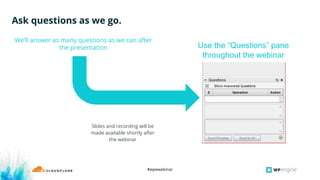
Ask questions as we go.
We’ll answer as many questions as we can after
the presentation
Slides and recording will be
made available shortly after
the webinar
Use the “Questions” pane
throughout the webinar
#wpewebinar
Solutions Engineer
Cloudflare
Michael Tremante
● Recently moved to Bay Area
● Has pen tested many sites
● Initially hoped for a career in
windsurfing...
Product Manager
WP Engine
Rob Hock
● 20 years in IT Ops
● Still misses carrying a pager
● Breakfast taco connoisseur
Security Architect
WP Engine
Will West
● Height: 2 Meters
● Knew PIC16F84A Assembler
● Bikes to work
#wpewebinar
Types of common security
threats
#wpewebinar
Security Threats
Security threats often overlap and go hand in
hand. Today we will talk about the following:
● Application Vulnerabilities
● Account Takeover
● Denial of Service (DoS & DDoS)
● Man in the middle
● Data Theft
There are many bad players on the internet,
some are real individuals but most are very
sophisticated bots (programs) looking for
vulnerabilities in your applications. How do you
recognise them?
#wpewebinar
Bugs in libraries, frameworks, plugins, extensions, themes, logic
OWASP Top 10 / SANS Top 25
Application Vulnerabilities
#wpewebinar
Phishing
Credential Stuffing
Brute Force
Account Takeover
#wpewebinar
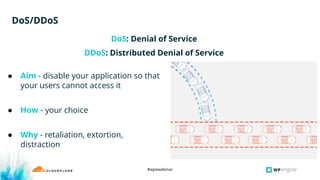
DoS: Denial of Service
DDoS: Distributed Denial of Service
DoS/DDoS
● Aim - disable your application so that
your users cannot access it
● How - your choice
● Why - retaliation, extortion,
distraction
#wpewebinar
DoS/DDoS (2)
Recently we were DDoS-ing Neteller:
https://twitter.com/neteller/status/583363894665715712
Yes, our attacks are powerful.
So, it’s your turn!
Your site is going under attack unless you pay 40 Bitcoin.
Pay to 17PxcnK84x98B9TdEbUvuCeivM7yaH1x4Q
Please note that it will not be easy to mitigate our attack, because our current UDP flood power is 400-500 Gbps, so don't even
bother. At least, don't expect cheap services like CloudFlare or Incapsula to help...but you can try. :)
Right now we are running small demonstrative attack. Don't worry, it will not be that hard (it shouldn't crash your site) and it will
stop in 1 hour. It's just to prove that we are serious.We are aware that you probably don't have 40 BTC at the moment, so we are
giving you 24 hours. Current price of 1 BTC is about 230 USD, so we are cheap, at the moment. But if you ignore us, price will
increase.
IMPORTANT: You don’t even have to reply. Just pay 40 BTC to 17PxcnK84x98B9TdEbUvuCeivM7yaH1x4Q – we will know it’s you and you will
never hear from us again. We say it because for big companies it's usually the problem as they don't want that there is proof that
they cooperated. If you need to contact us, feel free to use some free email service. Or contact us via Bitmessage:
BM-NC1jRewNdHxX3jHrufjxDsRWXGdNisY5
But if you ignore us, and don't pay us within a given time, long term attack will start, price to stop will go to 100 BTC and will
keep increasing for every hour of attack.
IMPORTANT: It’s a one-time payment. Pay and you will not hear from us ever again!
We do bad things, but we keep our word.
#wpewebinar
DoS/DDoS (3)
Normally (D)DoS attacks aim to overload either the network or computational resources:
● Saturate the bandwidth available
● Overload the number of “packets” the operating system can handle
● Overload a particularly expensive query on your application (e.g. an inventory search)
#wpewebinar
DoS/DDoS - Impact
Most famous DDoS attack in the last couple of years is the Dyn attack (October 2016) during which a
number of large web properties went offline including Twitter, AirBnB, BBC and others for large areas of
the US.
What does it mean for you? Downtime is bad…
● Lost revenue (e.g. black Friday)
● Brand reputation
DDoS attacks are a cat and mouse game.
You need to be prepared for the worst case scenario.
#wpewebinar
You don’t own the network between you and your users. What if someone is listening?
Man in the middle attacks (MITM)
An entity in an advantageous position on the network (a man in
the middle) may be able to observe your traffic.
● Owns the network (ISPs, network providers, government)
● Runs an internet hotspot (airports, internet cafes)
● Tries to “listen” to your WiFi connection
We have mathematical tools to help us with this problem:
How do Alice and Bob speak to each other secretly with
Mallory in the room?
#wpewebinar
Man in the middle attacks (MITM) - Impact
If an attacker has access to network unencrypted traffic, he can:
● View user username and password;
● View user details that are being transmitted over the
network;
● Reverse engineer application logic;
● …. Essentially he sees everything
Check how well your application scores with the SSL test tool from
Qualys.
If you perform transactions on your
application you will be required to
pass PCI audit. There are strict
requirements around encryption.
#wpewebinar
Not an attack per se, but rather the end result that is achieved by other attack methods, for example:
Data Theft/Breach
Type Description
DNS Spoofing Send users to a fake website
Snooping data in transit E.g. MITM attacks
Brute force login attempts E.g. account takeovers or forcing credentials from
previously stolen user databases
Malicious payload exploits Via Application vulnerabilities
User data leaks are probably number 1 worst scenarios for IT companies… the potential
reputational damage is difficult to predict and will vary based on what is leaked.
#wpewebinar
How to mitigate these threats
for your business
#wpewebinar
+ Authenticity
+ Confidentiality
- MITM
Even better - add HSTS
HTTPS
#wpewebinar
Faster recovery
Offline forensics
Backups
#wpewebinar
Even with non-security releases
- Old vulnerabilities
- Dealing with many changes all at once
- Avoid EOL components
Stay Current
#wpewebinar
Review users and permissions for appropriate settings
+ Onboard
+ Offboard
+ Role Change
+ Process Change
Review extensions for active use
Periodic Review
#wpewebinar
+ SSO
+ MFA / 2FA
+ Password managers
+ Unique passwords
Secure Login
#wpewebinar
Global Edge Security
22
Managed Web Application Firewall (WAF)
WAF rule sets tailored and managed to protect
WordPress by mitigating threats at the edge, and
automatically updated to respond to emerging
threats
SSL/TLS
Encryption with certificates terminated at the
edge for improved performance
Advanced DDoS Mitigation
Global edge network with capacity more than 15x
greater than the largest DDOS attack and
protections built throughout our network at the
DNS, layers 3, 4 & 7
Full Page CDN
Sends all traffic through CDN, across an edge
network of 120 datacenters to accelerate security
and site performance at global level
#wpewebinar
How advanced security works
HTTP request
Web crawlers
& bots
Attackers
Origin
Server (contains
original version of site)
Response
Inspects HTTPS requests to detect and block
attacks before they can reach the origin server;
resolves requests to Cloudflare IP
CDN pulls new
content from the
origin
Visitor/ Client
Filters out bad
bots
Cloudflare’s Globally
Distributed Edge Network
(caches content at the edge)
Blocks spambots,
spammer postings
Comment
Spam
#wpewebinar
Inquiring minds want to know.
Questions and Answers.
* Slides, recording and resources will be made available within
the next several days
#wpewebinar
15 Ways to Harden the Security of Your WordPress Site
Resources.
Have I been pwned?
SSL Server Test from Qualys
Enterprise-Grade WordPress Security on WP Engine
How to Convince Clients WordPress is More Secure than They Think
WPScan Vulnerability Database
#wpewebinar
How helpful?
How to improve?
Future topics?
Help us get better.
How helpful?
How to improve?
Future topics?
#wpewebinar
Thank You.

Securing your web infrastructure

  • 1.
    #wpewebinar Michael Tremante, Cloudflare WillWest & Rob Hock, WP Engine Securing Your Web Infrastructure: What, When, Why and How.
  • 2.
    #wpewebinar What You’ll Learn ●Types of common security threat types ● Potential impact if you’re compromised ● How to mitigate these threats for your business ● Steps to help you better secure your digital footprint & customer data ● Q&A
  • 3.
    #wpewebinar Ask questions aswe go. We’ll answer as many questions as we can after the presentation Slides and recording will be made available shortly after the webinar Use the “Questions” pane throughout the webinar
  • 4.
    #wpewebinar Solutions Engineer Cloudflare Michael Tremante ●Recently moved to Bay Area ● Has pen tested many sites ● Initially hoped for a career in windsurfing... Product Manager WP Engine Rob Hock ● 20 years in IT Ops ● Still misses carrying a pager ● Breakfast taco connoisseur Security Architect WP Engine Will West ● Height: 2 Meters ● Knew PIC16F84A Assembler ● Bikes to work
  • 5.
  • 6.
    #wpewebinar Security Threats Security threatsoften overlap and go hand in hand. Today we will talk about the following: ● Application Vulnerabilities ● Account Takeover ● Denial of Service (DoS & DDoS) ● Man in the middle ● Data Theft There are many bad players on the internet, some are real individuals but most are very sophisticated bots (programs) looking for vulnerabilities in your applications. How do you recognise them?
  • 7.
    #wpewebinar Bugs in libraries,frameworks, plugins, extensions, themes, logic OWASP Top 10 / SANS Top 25 Application Vulnerabilities
  • 8.
  • 9.
    #wpewebinar DoS: Denial ofService DDoS: Distributed Denial of Service DoS/DDoS ● Aim - disable your application so that your users cannot access it ● How - your choice ● Why - retaliation, extortion, distraction
  • 10.
    #wpewebinar DoS/DDoS (2) Recently wewere DDoS-ing Neteller: https://twitter.com/neteller/status/583363894665715712 Yes, our attacks are powerful. So, it’s your turn! Your site is going under attack unless you pay 40 Bitcoin. Pay to 17PxcnK84x98B9TdEbUvuCeivM7yaH1x4Q Please note that it will not be easy to mitigate our attack, because our current UDP flood power is 400-500 Gbps, so don't even bother. At least, don't expect cheap services like CloudFlare or Incapsula to help...but you can try. :) Right now we are running small demonstrative attack. Don't worry, it will not be that hard (it shouldn't crash your site) and it will stop in 1 hour. It's just to prove that we are serious.We are aware that you probably don't have 40 BTC at the moment, so we are giving you 24 hours. Current price of 1 BTC is about 230 USD, so we are cheap, at the moment. But if you ignore us, price will increase. IMPORTANT: You don’t even have to reply. Just pay 40 BTC to 17PxcnK84x98B9TdEbUvuCeivM7yaH1x4Q – we will know it’s you and you will never hear from us again. We say it because for big companies it's usually the problem as they don't want that there is proof that they cooperated. If you need to contact us, feel free to use some free email service. Or contact us via Bitmessage: BM-NC1jRewNdHxX3jHrufjxDsRWXGdNisY5 But if you ignore us, and don't pay us within a given time, long term attack will start, price to stop will go to 100 BTC and will keep increasing for every hour of attack. IMPORTANT: It’s a one-time payment. Pay and you will not hear from us ever again! We do bad things, but we keep our word.
  • 11.
    #wpewebinar DoS/DDoS (3) Normally (D)DoSattacks aim to overload either the network or computational resources: ● Saturate the bandwidth available ● Overload the number of “packets” the operating system can handle ● Overload a particularly expensive query on your application (e.g. an inventory search)
  • 12.
    #wpewebinar DoS/DDoS - Impact Mostfamous DDoS attack in the last couple of years is the Dyn attack (October 2016) during which a number of large web properties went offline including Twitter, AirBnB, BBC and others for large areas of the US. What does it mean for you? Downtime is bad… ● Lost revenue (e.g. black Friday) ● Brand reputation DDoS attacks are a cat and mouse game. You need to be prepared for the worst case scenario.
  • 13.
    #wpewebinar You don’t ownthe network between you and your users. What if someone is listening? Man in the middle attacks (MITM) An entity in an advantageous position on the network (a man in the middle) may be able to observe your traffic. ● Owns the network (ISPs, network providers, government) ● Runs an internet hotspot (airports, internet cafes) ● Tries to “listen” to your WiFi connection We have mathematical tools to help us with this problem: How do Alice and Bob speak to each other secretly with Mallory in the room?
  • 14.
    #wpewebinar Man in themiddle attacks (MITM) - Impact If an attacker has access to network unencrypted traffic, he can: ● View user username and password; ● View user details that are being transmitted over the network; ● Reverse engineer application logic; ● …. Essentially he sees everything Check how well your application scores with the SSL test tool from Qualys. If you perform transactions on your application you will be required to pass PCI audit. There are strict requirements around encryption.
  • 15.
    #wpewebinar Not an attackper se, but rather the end result that is achieved by other attack methods, for example: Data Theft/Breach Type Description DNS Spoofing Send users to a fake website Snooping data in transit E.g. MITM attacks Brute force login attempts E.g. account takeovers or forcing credentials from previously stolen user databases Malicious payload exploits Via Application vulnerabilities User data leaks are probably number 1 worst scenarios for IT companies… the potential reputational damage is difficult to predict and will vary based on what is leaked.
  • 16.
    #wpewebinar How to mitigatethese threats for your business
  • 17.
    #wpewebinar + Authenticity + Confidentiality -MITM Even better - add HSTS HTTPS
  • 18.
  • 19.
    #wpewebinar Even with non-securityreleases - Old vulnerabilities - Dealing with many changes all at once - Avoid EOL components Stay Current
  • 20.
    #wpewebinar Review users andpermissions for appropriate settings + Onboard + Offboard + Role Change + Process Change Review extensions for active use Periodic Review
  • 21.
    #wpewebinar + SSO + MFA/ 2FA + Password managers + Unique passwords Secure Login
  • 22.
    #wpewebinar Global Edge Security 22 ManagedWeb Application Firewall (WAF) WAF rule sets tailored and managed to protect WordPress by mitigating threats at the edge, and automatically updated to respond to emerging threats SSL/TLS Encryption with certificates terminated at the edge for improved performance Advanced DDoS Mitigation Global edge network with capacity more than 15x greater than the largest DDOS attack and protections built throughout our network at the DNS, layers 3, 4 & 7 Full Page CDN Sends all traffic through CDN, across an edge network of 120 datacenters to accelerate security and site performance at global level
  • 23.
    #wpewebinar How advanced securityworks HTTP request Web crawlers & bots Attackers Origin Server (contains original version of site) Response Inspects HTTPS requests to detect and block attacks before they can reach the origin server; resolves requests to Cloudflare IP CDN pulls new content from the origin Visitor/ Client Filters out bad bots Cloudflare’s Globally Distributed Edge Network (caches content at the edge) Blocks spambots, spammer postings Comment Spam
  • 24.
    #wpewebinar Inquiring minds wantto know. Questions and Answers. * Slides, recording and resources will be made available within the next several days
  • 25.
    #wpewebinar 15 Ways toHarden the Security of Your WordPress Site Resources. Have I been pwned? SSL Server Test from Qualys Enterprise-Grade WordPress Security on WP Engine How to Convince Clients WordPress is More Secure than They Think WPScan Vulnerability Database
  • 26.
    #wpewebinar How helpful? How toimprove? Future topics? Help us get better. How helpful? How to improve? Future topics?
  • 27.