Securing a Brighter
Future
A Social Security Roadmap
Welcome
Darlene Finzer
 Rea & Associates, Inc.
Michael Oberholzer
 Aperio Wealth & Protection Solutions
Brad Wise
 Prudential
History of Social Security
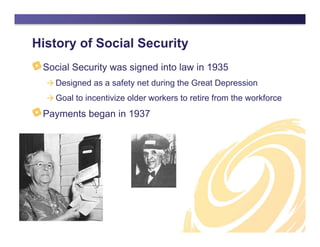
Social Security was signed into law in 1935
 Designed as a safety net during the Great Depression
 Goal to incentivize older workers to retire from the workforce
Payments began in 1937
History of Social Security
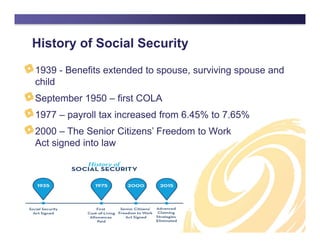
1939 - Benefits extended to spouse, surviving spouse and
child
September 1950 – first COLA
1977 – payroll tax increased from 6.45% to 7.65%
2000 – The Senior Citizens’ Freedom to Work
Act signed into law
Then and Now
In 1935
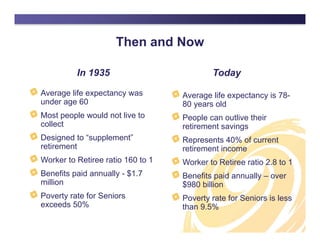
Average life expectancy was
under age 60
Most people would not live to
collect
Designed to “supplement”
retirement
Worker to Retiree ratio 160 to 1
Benefits paid annually - $1.7
million
Poverty rate for Seniors
exceeds 50%
Today
Average life expectancy is 78-
80 years old
People can outlive their
retirement savings
Represents 40% of current
retirement income
Worker to Retiree ratio 2.8 to 1
Benefits paid annually – over
$980 billion
Poverty rate for Seniors is less
than 9.5%
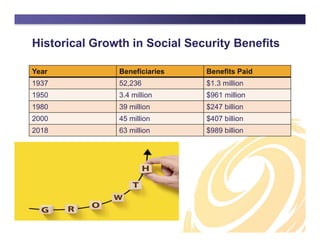
Historical Growth in Social Security Benefits
Year Beneficiaries Benefits Paid
1937 52,236 $1.3 million
1950 3.4 million $961 million
1980 39 million $247 billion
2000 45 million $407 billion
2018 63 million $989 billion
Two Pressing Questions
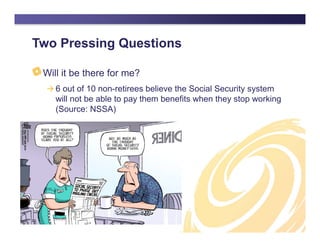
Will it be there for me?
 6 out of 10 non-retirees believe the Social Security system
will not be able to pay them benefits when they stop working
(Source: NSSA)
Two Pressing Questions
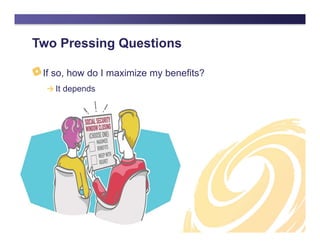
If so, how do I maximize my benefits?
 It depends
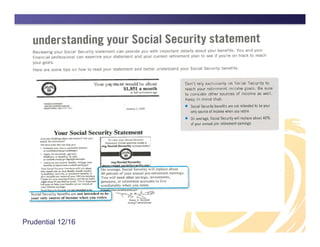
Prudential 3/16
Prudential 3/16
Prudential 4/16
Prudential 4/16
Prudential 5/16
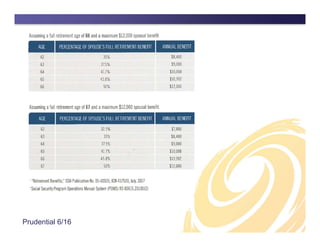
Prudential 6/16
Prudential 6/16
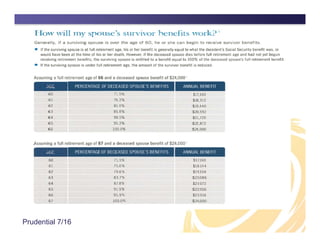
Prudential 7/16
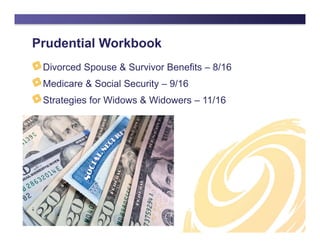
Prudential Workbook
Divorced Spouse & Survivor Benefits – 8/16
Medicare & Social Security – 9/16
Strategies for Widows & Widowers – 11/16
Prudential 12/16
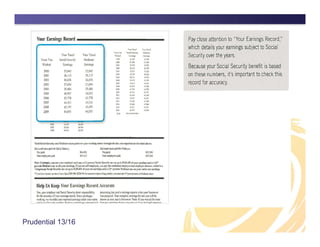
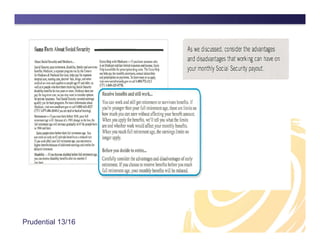
Prudential 13/16
Prudential 13/16
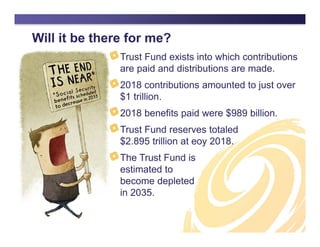
Will it be there for me?
Trust Fund exists into which contributions
are paid and distributions are made.
2018 contributions amounted to just over
$1 trillion.
2018 benefits paid were $989 billion.
Trust Fund reserves totaled
$2.895 trillion at eoy 2018.
The Trust Fund is
estimated to
become depleted
in 2035.
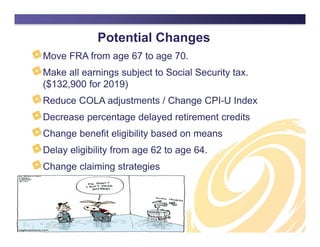
Potential Changes
Move FRA from age 67 to age 70.
Make all earnings subject to Social Security tax.
($132,900 for 2019)
Reduce COLA adjustments / Change CPI-U Index
Decrease percentage delayed retirement credits
Change benefit eligibility based on means
Delay eligibility from age 62 to age 64.
Change claiming strategies
Calculating Benefits
Is complicated – many factors are considered in the
calculation
Based on earnings
 All earnings (not to exceed the Social Security wage limit) and
the highest 35 years of earnings
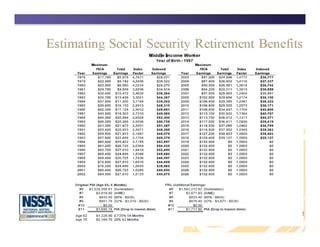
Inflation adjustment is made (wage indexing)
 For example, $1 from 2002 equates
to $1.513 today
Bend points are used (similar to
tax brackets)
Indexing factors and bend points
are set at age 62
Considerations in a Claiming Strategy
Based on individual situations and decisions
 At least 90% of all recipients do not maximize
Planning strategies
 For married couples, hundreds of claiming strategies exist considering
there are 96 possible months to claim (each) between the ages of 62-70.
Personal finances
Work level
Cost of waiting (ie: breakeven point)
Affect on future widow benefits
Health care needs
Life span
Spouse age differences
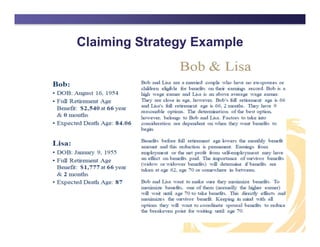
Claiming Strategy Example
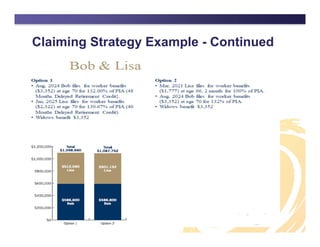
Claiming Strategy Example - Continued
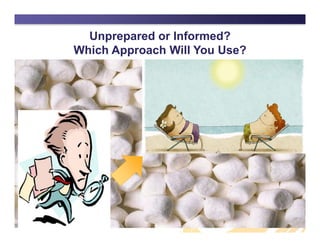
Unprepared or Informed?
Which Approach Will You Use?

Securing A Brighter Future: A Social Security Roadmap

  • 1.
    Securing a Brighter Future ASocial Security Roadmap
  • 2.
    Welcome Darlene Finzer  Rea& Associates, Inc. Michael Oberholzer  Aperio Wealth & Protection Solutions Brad Wise  Prudential
  • 4.
    History of SocialSecurity Social Security was signed into law in 1935  Designed as a safety net during the Great Depression  Goal to incentivize older workers to retire from the workforce Payments began in 1937
  • 5.
    History of SocialSecurity 1939 - Benefits extended to spouse, surviving spouse and child September 1950 – first COLA 1977 – payroll tax increased from 6.45% to 7.65% 2000 – The Senior Citizens’ Freedom to Work Act signed into law
  • 6.
    Then and Now In1935 Average life expectancy was under age 60 Most people would not live to collect Designed to “supplement” retirement Worker to Retiree ratio 160 to 1 Benefits paid annually - $1.7 million Poverty rate for Seniors exceeds 50% Today Average life expectancy is 78- 80 years old People can outlive their retirement savings Represents 40% of current retirement income Worker to Retiree ratio 2.8 to 1 Benefits paid annually – over $980 billion Poverty rate for Seniors is less than 9.5%
  • 7.
    Historical Growth inSocial Security Benefits Year Beneficiaries Benefits Paid 1937 52,236 $1.3 million 1950 3.4 million $961 million 1980 39 million $247 billion 2000 45 million $407 billion 2018 63 million $989 billion
  • 8.
    Two Pressing Questions Willit be there for me?  6 out of 10 non-retirees believe the Social Security system will not be able to pay them benefits when they stop working (Source: NSSA)
  • 9.
    Two Pressing Questions Ifso, how do I maximize my benefits?  It depends
  • 10.
  • 11.
  • 12.
  • 13.
  • 14.
  • 16.
  • 17.
  • 18.
  • 19.
    Prudential Workbook Divorced Spouse& Survivor Benefits – 8/16 Medicare & Social Security – 9/16 Strategies for Widows & Widowers – 11/16
  • 20.
  • 21.
  • 22.
  • 23.
    Will it bethere for me? Trust Fund exists into which contributions are paid and distributions are made. 2018 contributions amounted to just over $1 trillion. 2018 benefits paid were $989 billion. Trust Fund reserves totaled $2.895 trillion at eoy 2018. The Trust Fund is estimated to become depleted in 2035.
  • 24.
    Potential Changes Move FRAfrom age 67 to age 70. Make all earnings subject to Social Security tax. ($132,900 for 2019) Reduce COLA adjustments / Change CPI-U Index Decrease percentage delayed retirement credits Change benefit eligibility based on means Delay eligibility from age 62 to age 64. Change claiming strategies
  • 25.
    Calculating Benefits Is complicated– many factors are considered in the calculation Based on earnings  All earnings (not to exceed the Social Security wage limit) and the highest 35 years of earnings Inflation adjustment is made (wage indexing)  For example, $1 from 2002 equates to $1.513 today Bend points are used (similar to tax brackets) Indexing factors and bend points are set at age 62
  • 27.
    Considerations in aClaiming Strategy Based on individual situations and decisions  At least 90% of all recipients do not maximize Planning strategies  For married couples, hundreds of claiming strategies exist considering there are 96 possible months to claim (each) between the ages of 62-70. Personal finances Work level Cost of waiting (ie: breakeven point) Affect on future widow benefits Health care needs Life span Spouse age differences
  • 28.
  • 29.
  • 30.
    Unprepared or Informed? WhichApproach Will You Use?