When to Start
Social Security Benefits
Presented by:
Robert L. Wolff, Esq.
P.O. Box 381
Dumaguete City, Negros Oriental
Philippines 6200
wolff2000@earthlink.net
NY (518) 325-6015
PH 09266485273
Disclaimer
I am not an attorney admitted to practice law in the
Philippines. I am an attorney admitted to practice law in
New York. Forunately I have a friend who is a Philippine
lawyer that can give advice.
•The following is not a legal advice, but rather comments
and observations.
•For answers to legal issues raised by this presentation,
you need to consult an attorney admitted to practice law
in the Philippines.
When to Start
Social Security Benefits
You say to yourself, I have earned my Social
Security by working all my life.
What’s the best way to get the most money out
of my contributions to Social Security?
Answer - Take the time to understand Social
Security rules.
35 Years is the Magic Number
Your Social Security payment is figured using a complex calculation
based on a 35-year average of your covered wages. Each year’s
wages are adjusted for inflation before being averaged.
•If you worked longer than 35 years, the government will use the
highest years.
•If you worked for less than 35 years, they’ll average in zeros for the
years you are lacking. You don’t have to be math genius to figure out
the impact of that – it drags down your average. If you can avoid zeros
by working a couple years longer, you’ll increase your Social Security
payment.
Social Security
• Who is eligible for benefits?
Applicant – worker
Spouse- living, divorce and decease
Qualified children and parents
The Skinny on Social Security
Social Security is
basically a Joint Life
Annuity, with a Cost of
Living Adjustment
(COLA)
For spouses, this is
important for retirement
planning, particularly
for the surviving
spouse.
Social Security - Retirement
• Eligibility – Age
Full Retirement Age varies depending on year
of birth
 For Individuals born between 1943 – 1954
the full retirement age is 66.
 Born after 1960 – full retirement age is 67
A question individuals nearing retirement often
ask themselves is, “What is the earliest age I can retire
and receive benefits?” Age 62, (age 60 if you are a
surviving spouse) but if you take early retirement,
your Social Security benefit will be reduced.
The question should be asked – Should I.
Earliest Retirement Age
Three Factors To Consider If You
Take Social Security At 62
1. If you were born between 1943 and 1954, Your Social
Security benefit will be reduced by 25 percent. 30
percent if born after 1960.
2. Your Social Security benefit may be reduced by earned
income.
3. 50 or 85% of your Social Security could be subject to
income taxes.
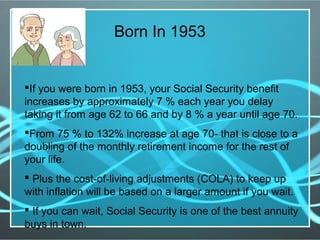
If you were born in 1953, your Social Security benefit
increases by approximately 7 % each year you delay
taking it from age 62 to 66 and by 8 % a year until age 70.
From 75 % to 132% increase at age 70- that is close to a
doubling of the monthly retirement income for the rest of
your life.
 Plus the cost-of-living adjustments (COLA) to keep up
with inflation will be based on a larger amount if you wait.
 If you can wait, Social Security is one of the best annuity
buys in town.
Born In 1953
COLA
1975 8.0% 1984 3.5% 1993 2.6% 2002 1.4%
1976 6.4% 1985 3.1% 1994 2.8% 2003 2.1%
1977 5.9% 1986 1.3% 1995 2.6% 2004 2.7%
1978 6.5% 1987 4.2% 1996 2.9% 2005 4.1%
1979 9.9% 1988 4.0% 1997 2.1% 2006 3.3%
1980 14.3% 1989 4.7% 1998 1.3% 2007 2.3%
1881 11.2% 1990 2.5% 1999 2.5% 2008 2.3%
1982 7.4% 1991 3.7% 2000 3.5% 2009 5.8%
1983 3.5% 1992 3.0% 2001 2.6% 2010 0 %
2011 0 % 2012 3.8% 2013 1.7% 2014 1.5%
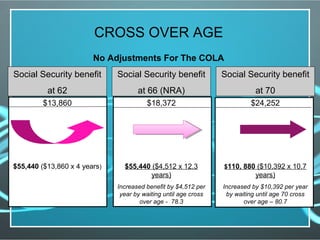
Gross Over Age
• The gross over age is that point in time you will receive
the same amount of Social Security payments no matter
what age you started taken benefits age 62-66-70 or
some age in between.
• What is different is the amount of your monthly payment
after you have reached your gross over age.
• The longer you wait to take social security benefit up to
the age 70, the bigger your monthly payment and maybe
that of your spouse.
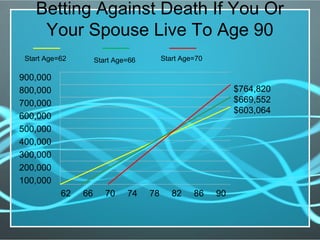
Betting Against Death
The cross over age or break-even point for a person who
earned the inflation-adjusted equivalent of $70,000 per year
for 35 years.
•If this person waits until 70 to claim Social Security and
lives until at least age 90, he’ll accumulate almost $162,000
more in benefits than he would if he had claimed at 62.
•But there’s a possibility of losing the bet and getting
nothing.
•But if you are married, your spouse can claim your benefit
if it is bigger than theirs.
Betting Against Death If You Or
Your Spouse Live To Age 90
900,000
800,000
700,000
600,000
500,000
400,000
300,000
200,000
100,000
62 66 70 74 78 82 86 90
Start Age=62 Start Age=66 Start Age=70
$764,820
$669,552
$603,064
CROSS OVER AGE
No Adjustments For The COLA
Social Security benefit
at 62
Social Security benefit
at 66 (NRA)
Social Security benefit
at 70
$13,860 $18,372 $24,252
$55,440 ($13,860 x 4 years) $55,440 ($4,512 x 12.3
years)
Increased benefit by $4,512 per
year by waiting until age cross
over age - 78.3
$110, 880 ($10,392 x 10.7
years)
Increased by $10,392 per year
by waiting until age 70 cross
over age – 80.7
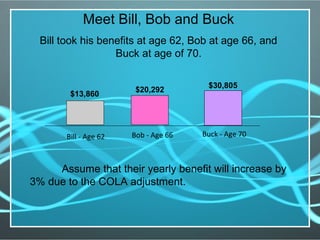
Meet Bill, Bob and Buck
Bill took his benefits at age 62, Bob at age 66, and
Buck at age of 70.
Assume that their yearly benefit will increase by
3% due to the COLA adjustment.
Bill - Age 62 Bob - Age 66 Buck - Age 70
$13,860
$20,292
$30,805
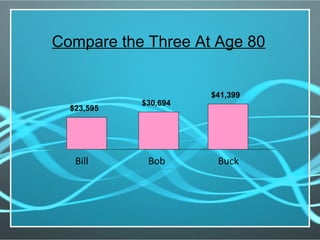
Compare the Three At Age 80
Bill Bob Buck
$23,595
$30,694
$41,399
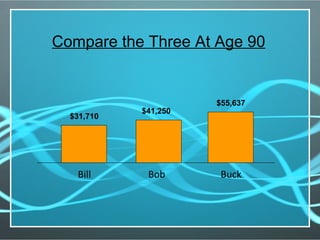
Compare the Three At Age 90
Bill Bob Buck
$31,710
$41,250
$55,637
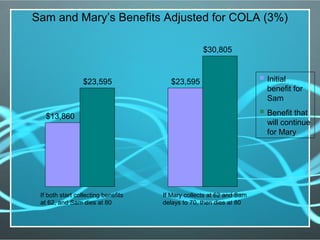
Sam and Mary’s Benefits Adjusted for COLA (3%)
$13,860
$23,595 $23,595
$30,805
If both start collecting benefits
at 62, and Sam dies at 80
If Mary collects at 62 and Sam
delays to 70, then dies at 80
 Initial
benefit for
Sam
 Benefit that
will continue
for Mary
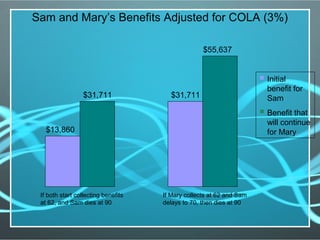
Sam and Mary’s Benefits Adjusted for COLA (3%)
$13,860
$31,711 $31,711
$55,637
If both start collecting benefits
at 62, and Sam dies at 90
If Mary collects at 62 and Sam
delays to 70, then dies at 90
 Initial
benefit for
Sam
 Benefit that
will continue
for Mary
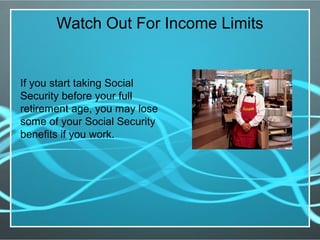
Watch Out For Income Limits
If you start taking Social
Security before your full
retirement age, you may lose
some of your Social Security
benefits if you work.
Social Security - Retirement
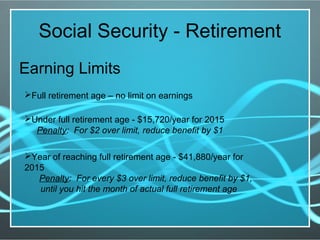
Earning Limits
Full retirement age – no limit on earnings
Under full retirement age - $15,720/year for 2015
Penalty: For $2 over limit, reduce benefit by $1
Year of reaching full retirement age - $41,880/year for
2015
Penalty: For every $3 over limit, reduce benefit by $1,
until you hit the month of actual full retirement age
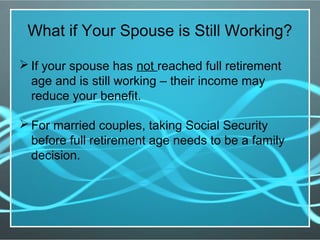
What if Your Spouse is Still Working?
 If your spouse has not reached full retirement
age and is still working – their income may
reduce your benefit.
 For married couples, taking Social Security
before full retirement age needs to be a family
decision.
Caution -Your Social Security
Benefits May Be Taxable!
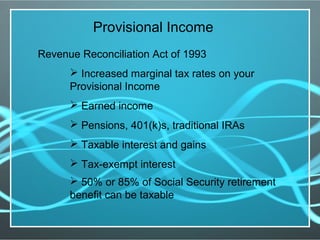
Provisional Income
Revenue Reconciliation Act of 1993
 Increased marginal tax rates on your
Provisional Income
 Earned income
 Pensions, 401(k)s, traditional IRAs
 Taxable interest and gains
 Tax-exempt interest
 50% or 85% of Social Security retirement
benefit can be taxable
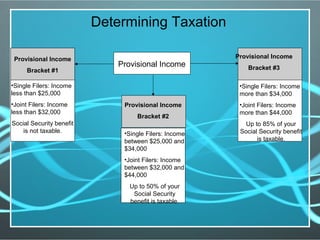
Determining Taxation
Provisional Income
Bracket #1
•Single Filers: Income
less than $25,000
•Joint Filers: Income
less than $32,000
Social Security benefit
is not taxable.
Provisional Income
Bracket #3
•Single Filers: Income
more than $34,000
•Joint Filers: Income
more than $44,000
Up to 85% of your
Social Security benefit
is taxable.
Provisional Income
Bracket #2
•Single Filers: Income
between $25,000 and
$34,000
•Joint Filers: Income
between $32,000 and
$44,000
Up to 50% of your
Social Security
benefit is taxable.
Provisional Income
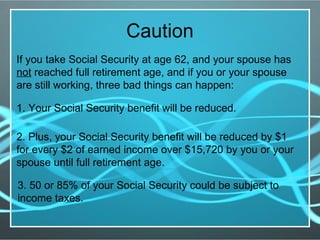
Caution
If you take Social Security at age 62, and your spouse has
not reached full retirement age, and if you or your spouse
are still working, three bad things can happen:
1. Your Social Security benefit will be reduced.
2. Plus, your Social Security benefit will be reduced by $1
for every $2 of earned income over $15,720 by you or your
spouse until full retirement age.
3. 50 or 85% of your Social Security could be subject to
income taxes.
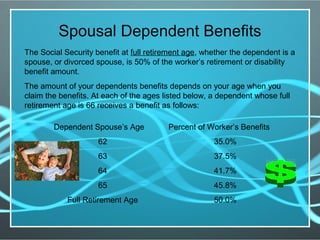
Dependent Spouse’s Age
62
63
64
65
Full Retirement Age
Percent of Worker’s Benefits
35.0%
37.5%
41.7%
45.8%
50.0%
Spousal Dependent Benefits
The Social Security benefit at full retirement age, whether the dependent is a
spouse, or divorced spouse, is 50% of the worker’s retirement or disability
benefit amount.
The amount of your dependents benefits depends on your age when you
claim the benefits. At each of the ages listed below, a dependent whose full
retirement age is 66 receives a benefit as follows:
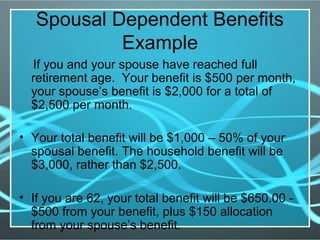
Spousal Dependent Benefits
Example
If you and your spouse have reached full
retirement age. Your benefit is $500 per month,
your spouse’s benefit is $2,000 for a total of
$2,500 per month.
• Your total benefit will be $1,000 – 50% of your
spousal benefit. The household benefit will be
$3,000, rather than $2,500.
• If you are 62, your total benefit will be $650.00 -
$500 from your benefit, plus $150 allocation
from your spouse’s benefit.
Spousal Dependent Benefits
If the high-earning spouse is not taken Social
Security benefits, then he or she must have
applied for benefits before the other spouse can
claim spousal benefits, but the higher earner has
the option to “file and suspend”– file for benefits,
so his or her spouse can claim spousal benefits,
and then suspend the application so that his or her
own benefits can continue to grow.
Some Good News If Married
At Full Retirement Age, Social Security
gives a person two choices:
• You can take your own benefit, or
• If eligible – you can collect just your spousal
benefit, let your benefit grow, and then claim your
own benefits at a later date - say age 70.
Social Security – Survivor Benefits
• Certain members of a decedent’s family
can collect benefits
– Surviving spouse, if married at least nine
months, unless an exception applies.
– Some divorced surviving spouses
• Marriage lasted at least 10 years
• OR caring for minor or disabled child of decedent
– Children
– Dependent parents
Surviving Spouse Under Full
Retirement Age
A surviving spouse at age 60 will receive 71.5% of what
their spouse’s full retirement benefits would have been.
Each year a surviving spouse delays claiming benefits
after age 60, those benefits will rise 4.1% to 5.7% per
year, depending on the year of birth, until the survivor
reaches full benefits age.
Surviving Spouse at
Full Retirement Age
A surviving spouse who waits until full
retirement age to claim benefits as a surviving
spouse, will receive 100% of what the
deceased spouse’s full retirement benefit would
have been.
For example, if the surviving spouse benefit is
$1,000 per month and the decease spouse’s
benefit is $2,000, the surviving spouse can
claim the $2,000 benefit
Widows and Widowers Can Switch From
Retirement to Survivors Benefits
or From Survivors to Retirement Benefits
Claiming early retirement benefits permanently reduces your
retirement benefits based on your earning record, but not your
survivors benefits. Who is eligible?
1. A surviving spouse age 60 or older (age 50 if disable)
2. A divorced surviving spouse age 60 (age 50 if
disable) or older, if the marriage lasted at least
10 years
More Flexibility for Widows and
Widower
A widow/ widower can begin benefits based on based on his
or her own earnings record and later switch to survivors benefits or
begin with survivors benefits and later switch to benefits based on his
or her own record – even if the surviving spouse is filing before full
retirement age. You can not do that with spousal benefits.
•In other words, a widow or widower can begin drawing Social Security
based on his or her late spouse’s Social Security when he or she is as
young as 60(50 if disabled). To get the full benefit, one must wait until
the full retirement age.
•Then he or she can choose to leave his or her own Social security
alone, allowing it to grow in value until their full retirement age or even
age 70.
Can a Surviving Spouse Lose Survivor
Benefits by Working?
• Yes – if under full retirement age for the entire year and
earnings exceed $15,720 in 2015.
• Except for year you reach full retirement
age, the cap is $41,880 in 2015.
What Counts as Earnings?
• Wages received as an employee and net earnings from
self-employment
• Income excluded – interest and dividends, rental
income that is not treated as self-employment income,
distributions for IRA and retirement accounts, capital
gains, etc.
• The above list does not include all items that are
excluded.
Widow(er)s Remarrying Before Age 60
A widow or widower who remarries before
age 60 loses the right to collect survivors benefits
through the deceased spouse, even if he or she
still cares for the former spouse’s minor or
disabled child.
If marriage ends, may be entitled to benefits
A widow or widower who remarries after
reaching age 60 does not lose survivors
benefits from the deceased former spouse.
New spouse’s income will not affect benefits
Widow(er)s Remarrying After Age 60
Divorced Spouses
You are eligible for dependents benefits if
both you and your former spouse have reached age 62,
your marriage lasted ten years, and you have been
divorced two years.
This two-year waiting period does not apply if your former
spouse was already collecting retirement benefits before
the divorce.
You can collect benefits as soon as your former spouse is
eligible for retirement benefits at age 62. He or she does
not actually have to be collecting those benefits for you to
collect your benefits. Note, this not the rule for married
spouses.
Earnings of Ex-Spouse
• The excess earnings of an ex-spouse do
not cause deductions of benefits of an
entitled divorced spouse.
Remarried – Then Divorces or Widow(er)
If you are collecting dependents benefits on your former
spouse’s work record and then marry someone else, you
lose your right to continue those benefits.
If you divorce again or your new spouse dies, you can
collect benefits again on your first former spouse’s record,
or on your second spouse’s record if you were married for
ten years the second time as well.
Whether your former spouse remarries does not affect your
eligibility.
Receiving Your Payments While
Outside the United States
• If you are a U.S. citizen, you may receive your Social
Security payments in the Philippines as long as you are
eligible.
• There are certain countries where Social Security will not
be sent, such as North Korea.
Not a U.S. Citizen
• If you are not a U.S. citizen, the ability to receive Social
Security benefits depends on the country you are living
in.
• If living in the Philippines you will receive your Social
Security benefits unless you are receiving your benefits
as a dependent or surviving spouse. In that case there
are additional requirements that have to be meet.
Non-U.S. Citizen Spouse and
Dependents
To qualify for Social Security benefits in the
Philippines as a non-U.S. citizen dependent or
surviving spouse, as a general rule, you must
have lived in the U.S. in a family relationship for
at least five years.
There are exceptions, such as those
related to military service, etc.
Social Security Benefits for
Children
• Children of a retired, disabled or deceased worker living
in the Philippines, if they QUALIFY, may collect a child’s
benefit up until age 18.
• The Social Security benefit to surviving child is 75% of
the deceased parent’s PIA subject to reduction due to
the family maximum limit.
When Do Benefits For a Child Stop
• Benefits stop when a child reaches age 18,19 if
the child is a full time student or disabled
• Benefits will continue after age 18 to a child who
is disabled. If the disability began before age 22.
Adopted Children
• Adoption, if a child is adopted after the death of their
natural parent, may be able to collect Social Security on
the deceased parent’s account. Adoption before the
parent’s death, child is no longer a dependent and can
not collect.
• Children adopted outside the U.S. will not be paid
outside the U.S., even if the residency requirement is
met.
Eligibility For A Spouse To Become A
U.S. Citizen – General Rules
• Must be 18, legally permanent resident that has resided
continuously for 5 years in the U.S. If married to a U.S. citizen – 3
years.
• Must be physically present in the U.S. for at lease one-half of the
5 or 3 year period.
• Must reside for at least 3 months within the state in which petition is
filed.
• There are other requirements and exceptions, such as related to
military service.
Eligibility For A Child To Become A U.S.
Citizen – General Rules
• Generally a child born in the U.S. is automatically a U.S. citizen.
• A child born in the Philippines generally will qualify to be a U.S.
citizen if his or her parents are married and one is a U.S. citizen..
• A child born out of wedlock may qualify to be a U.S. citizen, where
one parent is a U.S. citizen, depending on numerous factors.
• The rules for children born outside the U.S. are complex.
Remember, Social Security is the foundation
upon which you can build your retirement
plan.
When planning for retirement, think of Social
Security as a joint life survivor annuity with a
COLA.
If your spouse in not a U.S. citizen, he or
she may not qualifly for your Social Security
benefit.
If you are thinking about taking Social Security,
you should also be thinking about estate planning
and such documents as:
• Power-of-Attorney
• Health Care Proxy
• Living Will
• Last Will and Testament
• Living and Asset Protection Trusts
You should also be thinking about protecting your
estate from catastrophic illness.
IRS Circular 230
Pursuant to Internal Revenue Service Circular 230,
we hereby inform you that the advice set forth herein
with respect to U.S. federal tax issues was not intended
or written by the law firm of Robert L. Wolff to used, and
cannot be used, by you or any taxpayer, for the purpose
of (i) avoiding any penalties that may be imposed on you
or nay other under the Internal Revenue Code or (ii)
promoting, marketing or recommending to another party
any transaction or matter addressed herein. Taxpayer
should seek advice based on the taxpayer’s particular
circumstances from an independent tax advisor.

Social security ph 5 26-15

  • 1.
    When to Start SocialSecurity Benefits Presented by: Robert L. Wolff, Esq. P.O. Box 381 Dumaguete City, Negros Oriental Philippines 6200 wolff2000@earthlink.net NY (518) 325-6015 PH 09266485273
  • 2.
    Disclaimer I am notan attorney admitted to practice law in the Philippines. I am an attorney admitted to practice law in New York. Forunately I have a friend who is a Philippine lawyer that can give advice. •The following is not a legal advice, but rather comments and observations. •For answers to legal issues raised by this presentation, you need to consult an attorney admitted to practice law in the Philippines.
  • 3.
    When to Start SocialSecurity Benefits You say to yourself, I have earned my Social Security by working all my life. What’s the best way to get the most money out of my contributions to Social Security? Answer - Take the time to understand Social Security rules.
  • 4.
    35 Years isthe Magic Number Your Social Security payment is figured using a complex calculation based on a 35-year average of your covered wages. Each year’s wages are adjusted for inflation before being averaged. •If you worked longer than 35 years, the government will use the highest years. •If you worked for less than 35 years, they’ll average in zeros for the years you are lacking. You don’t have to be math genius to figure out the impact of that – it drags down your average. If you can avoid zeros by working a couple years longer, you’ll increase your Social Security payment.
  • 5.
    Social Security • Whois eligible for benefits? Applicant – worker Spouse- living, divorce and decease Qualified children and parents
  • 6.
    The Skinny onSocial Security Social Security is basically a Joint Life Annuity, with a Cost of Living Adjustment (COLA) For spouses, this is important for retirement planning, particularly for the surviving spouse.
  • 7.
    Social Security -Retirement • Eligibility – Age Full Retirement Age varies depending on year of birth  For Individuals born between 1943 – 1954 the full retirement age is 66.  Born after 1960 – full retirement age is 67
  • 8.
    A question individualsnearing retirement often ask themselves is, “What is the earliest age I can retire and receive benefits?” Age 62, (age 60 if you are a surviving spouse) but if you take early retirement, your Social Security benefit will be reduced. The question should be asked – Should I. Earliest Retirement Age
  • 9.
    Three Factors ToConsider If You Take Social Security At 62 1. If you were born between 1943 and 1954, Your Social Security benefit will be reduced by 25 percent. 30 percent if born after 1960. 2. Your Social Security benefit may be reduced by earned income. 3. 50 or 85% of your Social Security could be subject to income taxes.
  • 10.
    If you wereborn in 1953, your Social Security benefit increases by approximately 7 % each year you delay taking it from age 62 to 66 and by 8 % a year until age 70. From 75 % to 132% increase at age 70- that is close to a doubling of the monthly retirement income for the rest of your life.  Plus the cost-of-living adjustments (COLA) to keep up with inflation will be based on a larger amount if you wait.  If you can wait, Social Security is one of the best annuity buys in town. Born In 1953
  • 11.
    COLA 1975 8.0% 19843.5% 1993 2.6% 2002 1.4% 1976 6.4% 1985 3.1% 1994 2.8% 2003 2.1% 1977 5.9% 1986 1.3% 1995 2.6% 2004 2.7% 1978 6.5% 1987 4.2% 1996 2.9% 2005 4.1% 1979 9.9% 1988 4.0% 1997 2.1% 2006 3.3% 1980 14.3% 1989 4.7% 1998 1.3% 2007 2.3% 1881 11.2% 1990 2.5% 1999 2.5% 2008 2.3% 1982 7.4% 1991 3.7% 2000 3.5% 2009 5.8% 1983 3.5% 1992 3.0% 2001 2.6% 2010 0 % 2011 0 % 2012 3.8% 2013 1.7% 2014 1.5%
  • 12.
    Gross Over Age •The gross over age is that point in time you will receive the same amount of Social Security payments no matter what age you started taken benefits age 62-66-70 or some age in between. • What is different is the amount of your monthly payment after you have reached your gross over age. • The longer you wait to take social security benefit up to the age 70, the bigger your monthly payment and maybe that of your spouse.
  • 13.
    Betting Against Death Thecross over age or break-even point for a person who earned the inflation-adjusted equivalent of $70,000 per year for 35 years. •If this person waits until 70 to claim Social Security and lives until at least age 90, he’ll accumulate almost $162,000 more in benefits than he would if he had claimed at 62. •But there’s a possibility of losing the bet and getting nothing. •But if you are married, your spouse can claim your benefit if it is bigger than theirs.
  • 14.
    Betting Against DeathIf You Or Your Spouse Live To Age 90 900,000 800,000 700,000 600,000 500,000 400,000 300,000 200,000 100,000 62 66 70 74 78 82 86 90 Start Age=62 Start Age=66 Start Age=70 $764,820 $669,552 $603,064
  • 15.
    CROSS OVER AGE NoAdjustments For The COLA Social Security benefit at 62 Social Security benefit at 66 (NRA) Social Security benefit at 70 $13,860 $18,372 $24,252 $55,440 ($13,860 x 4 years) $55,440 ($4,512 x 12.3 years) Increased benefit by $4,512 per year by waiting until age cross over age - 78.3 $110, 880 ($10,392 x 10.7 years) Increased by $10,392 per year by waiting until age 70 cross over age – 80.7
  • 16.
    Meet Bill, Boband Buck Bill took his benefits at age 62, Bob at age 66, and Buck at age of 70. Assume that their yearly benefit will increase by 3% due to the COLA adjustment. Bill - Age 62 Bob - Age 66 Buck - Age 70 $13,860 $20,292 $30,805
  • 17.
    Compare the ThreeAt Age 80 Bill Bob Buck $23,595 $30,694 $41,399
  • 18.
    Compare the ThreeAt Age 90 Bill Bob Buck $31,710 $41,250 $55,637
  • 19.
    Sam and Mary’sBenefits Adjusted for COLA (3%) $13,860 $23,595 $23,595 $30,805 If both start collecting benefits at 62, and Sam dies at 80 If Mary collects at 62 and Sam delays to 70, then dies at 80  Initial benefit for Sam  Benefit that will continue for Mary
  • 20.
    Sam and Mary’sBenefits Adjusted for COLA (3%) $13,860 $31,711 $31,711 $55,637 If both start collecting benefits at 62, and Sam dies at 90 If Mary collects at 62 and Sam delays to 70, then dies at 90  Initial benefit for Sam  Benefit that will continue for Mary
  • 21.
    Watch Out ForIncome Limits If you start taking Social Security before your full retirement age, you may lose some of your Social Security benefits if you work.
  • 22.
    Social Security -Retirement Earning Limits Full retirement age – no limit on earnings Under full retirement age - $15,720/year for 2015 Penalty: For $2 over limit, reduce benefit by $1 Year of reaching full retirement age - $41,880/year for 2015 Penalty: For every $3 over limit, reduce benefit by $1, until you hit the month of actual full retirement age
  • 23.
    What if YourSpouse is Still Working?  If your spouse has not reached full retirement age and is still working – their income may reduce your benefit.  For married couples, taking Social Security before full retirement age needs to be a family decision.
  • 24.
    Caution -Your SocialSecurity Benefits May Be Taxable!
  • 25.
    Provisional Income Revenue ReconciliationAct of 1993  Increased marginal tax rates on your Provisional Income  Earned income  Pensions, 401(k)s, traditional IRAs  Taxable interest and gains  Tax-exempt interest  50% or 85% of Social Security retirement benefit can be taxable
  • 26.
    Determining Taxation Provisional Income Bracket#1 •Single Filers: Income less than $25,000 •Joint Filers: Income less than $32,000 Social Security benefit is not taxable. Provisional Income Bracket #3 •Single Filers: Income more than $34,000 •Joint Filers: Income more than $44,000 Up to 85% of your Social Security benefit is taxable. Provisional Income Bracket #2 •Single Filers: Income between $25,000 and $34,000 •Joint Filers: Income between $32,000 and $44,000 Up to 50% of your Social Security benefit is taxable. Provisional Income
  • 27.
    Caution If you takeSocial Security at age 62, and your spouse has not reached full retirement age, and if you or your spouse are still working, three bad things can happen: 1. Your Social Security benefit will be reduced. 2. Plus, your Social Security benefit will be reduced by $1 for every $2 of earned income over $15,720 by you or your spouse until full retirement age. 3. 50 or 85% of your Social Security could be subject to income taxes.
  • 28.
    Dependent Spouse’s Age 62 63 64 65 FullRetirement Age Percent of Worker’s Benefits 35.0% 37.5% 41.7% 45.8% 50.0% Spousal Dependent Benefits The Social Security benefit at full retirement age, whether the dependent is a spouse, or divorced spouse, is 50% of the worker’s retirement or disability benefit amount. The amount of your dependents benefits depends on your age when you claim the benefits. At each of the ages listed below, a dependent whose full retirement age is 66 receives a benefit as follows:
  • 29.
    Spousal Dependent Benefits Example Ifyou and your spouse have reached full retirement age. Your benefit is $500 per month, your spouse’s benefit is $2,000 for a total of $2,500 per month. • Your total benefit will be $1,000 – 50% of your spousal benefit. The household benefit will be $3,000, rather than $2,500. • If you are 62, your total benefit will be $650.00 - $500 from your benefit, plus $150 allocation from your spouse’s benefit.
  • 30.
    Spousal Dependent Benefits Ifthe high-earning spouse is not taken Social Security benefits, then he or she must have applied for benefits before the other spouse can claim spousal benefits, but the higher earner has the option to “file and suspend”– file for benefits, so his or her spouse can claim spousal benefits, and then suspend the application so that his or her own benefits can continue to grow.
  • 31.
    Some Good NewsIf Married At Full Retirement Age, Social Security gives a person two choices: • You can take your own benefit, or • If eligible – you can collect just your spousal benefit, let your benefit grow, and then claim your own benefits at a later date - say age 70.
  • 32.
    Social Security –Survivor Benefits • Certain members of a decedent’s family can collect benefits – Surviving spouse, if married at least nine months, unless an exception applies. – Some divorced surviving spouses • Marriage lasted at least 10 years • OR caring for minor or disabled child of decedent – Children – Dependent parents
  • 33.
    Surviving Spouse UnderFull Retirement Age A surviving spouse at age 60 will receive 71.5% of what their spouse’s full retirement benefits would have been. Each year a surviving spouse delays claiming benefits after age 60, those benefits will rise 4.1% to 5.7% per year, depending on the year of birth, until the survivor reaches full benefits age.
  • 34.
    Surviving Spouse at FullRetirement Age A surviving spouse who waits until full retirement age to claim benefits as a surviving spouse, will receive 100% of what the deceased spouse’s full retirement benefit would have been. For example, if the surviving spouse benefit is $1,000 per month and the decease spouse’s benefit is $2,000, the surviving spouse can claim the $2,000 benefit
  • 35.
    Widows and WidowersCan Switch From Retirement to Survivors Benefits or From Survivors to Retirement Benefits Claiming early retirement benefits permanently reduces your retirement benefits based on your earning record, but not your survivors benefits. Who is eligible? 1. A surviving spouse age 60 or older (age 50 if disable) 2. A divorced surviving spouse age 60 (age 50 if disable) or older, if the marriage lasted at least 10 years
  • 36.
    More Flexibility forWidows and Widower A widow/ widower can begin benefits based on based on his or her own earnings record and later switch to survivors benefits or begin with survivors benefits and later switch to benefits based on his or her own record – even if the surviving spouse is filing before full retirement age. You can not do that with spousal benefits. •In other words, a widow or widower can begin drawing Social Security based on his or her late spouse’s Social Security when he or she is as young as 60(50 if disabled). To get the full benefit, one must wait until the full retirement age. •Then he or she can choose to leave his or her own Social security alone, allowing it to grow in value until their full retirement age or even age 70.
  • 37.
    Can a SurvivingSpouse Lose Survivor Benefits by Working? • Yes – if under full retirement age for the entire year and earnings exceed $15,720 in 2015. • Except for year you reach full retirement age, the cap is $41,880 in 2015.
  • 38.
    What Counts asEarnings? • Wages received as an employee and net earnings from self-employment • Income excluded – interest and dividends, rental income that is not treated as self-employment income, distributions for IRA and retirement accounts, capital gains, etc. • The above list does not include all items that are excluded.
  • 39.
    Widow(er)s Remarrying BeforeAge 60 A widow or widower who remarries before age 60 loses the right to collect survivors benefits through the deceased spouse, even if he or she still cares for the former spouse’s minor or disabled child. If marriage ends, may be entitled to benefits
  • 40.
    A widow orwidower who remarries after reaching age 60 does not lose survivors benefits from the deceased former spouse. New spouse’s income will not affect benefits Widow(er)s Remarrying After Age 60
  • 41.
    Divorced Spouses You areeligible for dependents benefits if both you and your former spouse have reached age 62, your marriage lasted ten years, and you have been divorced two years. This two-year waiting period does not apply if your former spouse was already collecting retirement benefits before the divorce. You can collect benefits as soon as your former spouse is eligible for retirement benefits at age 62. He or she does not actually have to be collecting those benefits for you to collect your benefits. Note, this not the rule for married spouses.
  • 42.
    Earnings of Ex-Spouse •The excess earnings of an ex-spouse do not cause deductions of benefits of an entitled divorced spouse.
  • 43.
    Remarried – ThenDivorces or Widow(er) If you are collecting dependents benefits on your former spouse’s work record and then marry someone else, you lose your right to continue those benefits. If you divorce again or your new spouse dies, you can collect benefits again on your first former spouse’s record, or on your second spouse’s record if you were married for ten years the second time as well. Whether your former spouse remarries does not affect your eligibility.
  • 44.
    Receiving Your PaymentsWhile Outside the United States • If you are a U.S. citizen, you may receive your Social Security payments in the Philippines as long as you are eligible. • There are certain countries where Social Security will not be sent, such as North Korea.
  • 45.
    Not a U.S.Citizen • If you are not a U.S. citizen, the ability to receive Social Security benefits depends on the country you are living in. • If living in the Philippines you will receive your Social Security benefits unless you are receiving your benefits as a dependent or surviving spouse. In that case there are additional requirements that have to be meet.
  • 46.
    Non-U.S. Citizen Spouseand Dependents To qualify for Social Security benefits in the Philippines as a non-U.S. citizen dependent or surviving spouse, as a general rule, you must have lived in the U.S. in a family relationship for at least five years. There are exceptions, such as those related to military service, etc.
  • 47.
    Social Security Benefitsfor Children • Children of a retired, disabled or deceased worker living in the Philippines, if they QUALIFY, may collect a child’s benefit up until age 18. • The Social Security benefit to surviving child is 75% of the deceased parent’s PIA subject to reduction due to the family maximum limit.
  • 48.
    When Do BenefitsFor a Child Stop • Benefits stop when a child reaches age 18,19 if the child is a full time student or disabled • Benefits will continue after age 18 to a child who is disabled. If the disability began before age 22.
  • 49.
    Adopted Children • Adoption,if a child is adopted after the death of their natural parent, may be able to collect Social Security on the deceased parent’s account. Adoption before the parent’s death, child is no longer a dependent and can not collect. • Children adopted outside the U.S. will not be paid outside the U.S., even if the residency requirement is met.
  • 50.
    Eligibility For ASpouse To Become A U.S. Citizen – General Rules • Must be 18, legally permanent resident that has resided continuously for 5 years in the U.S. If married to a U.S. citizen – 3 years. • Must be physically present in the U.S. for at lease one-half of the 5 or 3 year period. • Must reside for at least 3 months within the state in which petition is filed. • There are other requirements and exceptions, such as related to military service.
  • 51.
    Eligibility For AChild To Become A U.S. Citizen – General Rules • Generally a child born in the U.S. is automatically a U.S. citizen. • A child born in the Philippines generally will qualify to be a U.S. citizen if his or her parents are married and one is a U.S. citizen.. • A child born out of wedlock may qualify to be a U.S. citizen, where one parent is a U.S. citizen, depending on numerous factors. • The rules for children born outside the U.S. are complex.
  • 52.
    Remember, Social Securityis the foundation upon which you can build your retirement plan. When planning for retirement, think of Social Security as a joint life survivor annuity with a COLA. If your spouse in not a U.S. citizen, he or she may not qualifly for your Social Security benefit.
  • 53.
    If you arethinking about taking Social Security, you should also be thinking about estate planning and such documents as: • Power-of-Attorney • Health Care Proxy • Living Will • Last Will and Testament • Living and Asset Protection Trusts You should also be thinking about protecting your estate from catastrophic illness.
  • 54.
    IRS Circular 230 Pursuantto Internal Revenue Service Circular 230, we hereby inform you that the advice set forth herein with respect to U.S. federal tax issues was not intended or written by the law firm of Robert L. Wolff to used, and cannot be used, by you or any taxpayer, for the purpose of (i) avoiding any penalties that may be imposed on you or nay other under the Internal Revenue Code or (ii) promoting, marketing or recommending to another party any transaction or matter addressed herein. Taxpayer should seek advice based on the taxpayer’s particular circumstances from an independent tax advisor.