By:
- Ghada Nasser 21121066 - 01113853833
- Marwa Hosny 20121434 - 01017707161
- Hend Hosameldin 20222047 - 01000958300
Group: R1
LG
Performance Management Project
Company Profile
LG Electronics (KSE: 066570.KS) is a global innovator in
technology and consumer electronics with a presence in
almost every country and an international workforce of
more than 75,000. LG’s four companies – Home Appliance
& Air Solution, Home Entertainment, Vehicle component
Solutions and Business Solutions – combined for global
sales of over USD 63 billion in 2021. LG is a leading
manufacturer of consumer and commercial products
ranging from TVs, home appliances, air solutions,
monitors, service robots, automotive components and its
premium LG SIGNATURE and intelligent LG ThinQ brands
are familiar names world over.
It sells a wide range of digital display and digital media
products, digital appliances, and mobile phones under
LG's "Life's Good" marketing theme.
LG Vision & Mission
Vision
LG aims to connect science to life for a better future,
integrating new insight with our wealth of knowledge,
technologies, and solutions.
Mission
We are committed to providing electronic products that
help customers live better. To support this, we wish to
continue bringing added value to the lives of a consumers.
LG's Mission is to be #1 LG by creating a better life with our
customers.
The Case
LG electronics is a manufacturing company that sells a wide range of electronics whose sales success or failure rests in the hands of
sales representatives employed by franchised dealers operating independently. LG faces a challenging situation because it does not
have control over the people working for the independent dealerships. It is the performance of these individuals that dictates LG’s
sales success.
To make things more complicated, until recently there was no clear understanding of the role of the sales representatives and there
were no formal sales processes in place. Sales representatives varied greatly in terms of their level of skill and knowledge; most put
out little effort beyond taking orders, and they did not feel motivated to make additional sales.
Finally, franchises varied greatly regarding their management strategies and follow-up with LG. Recently, understanding the need
to improve the performance of sales representatives, LG agreed to partially fund and support a training program for them. The
network of franchise owners in turn agreed to work together to implement a performance management system.
The Case (cont’)
As a first step in creating the performance management system, the franchise owners conducted a job analysis of the role of the
sale representatives, wrote a job description, and distributed it to all sales representatives. The franchise owners also adopted a
franchise-wide mission statement based primarily on the need to provide high-quality customer service.
This mission statement was posted in all franchise offices, and each franchise owner spoke with his employees about the
contribution made by individual sales on achieving their mission.
As a second step, the managers set performance goals (i.e., sales quotas) for each employee. Then, all sales representatives
attended extensive training sessions. The employees received feedback based on their performance in the training course and then
were reminded once again of their sales quotas. Back on the job, managers gave feedback to their employees regarding their
standing in relation to their sales quotas.
6
Performance Management Problems
2 No performance
appraisal in place.
1 No way of monitoring
sales rep. progress.
3 Discussions were not
documented.
4 Lack of feedback.
No way of
monitoring
sales rep.
progress.
Set goals and expectations.
Involve the sales team in goals setting. So being involved will make them motivated and the goals
will be more realistic so they will work on achieving them.
Could be tracked by :Activity Metrics.
These are sales activities and tasks that the sales rep. undertake everyday including the number of sales,
calls, outreach emails, scheduled meetings and data entry into CRM software.
Plan to measure goals
Performance measures maintain a dual-focus on short-term tasks and long-term performance.
Weekly or daily goals keeps team on track, and it will be easy to review sales activities and see if it’s
actually helping everyone to get intended results.
Develop an up-to-date visual dashboard
That contains:
- Snapshots of your deals.
- Activities.
- Emails.
- Revenue & sales forecast.
Discussions
were not
documented
If you don't document the issues that need to be solved,
they may never be solved at all and may be lost in a pile of
work.
There are a lot more things that documentation helps with and that also prevents and solve
problems, but as you can see, without a purpose, it is useless or it does more harm than good.
Document decisions and action items in real time
Take note of any key decisions, outcomes or action items as they are discussed. Don’t wait until the end
of discussion to record those points from memory.
Incorporate visuals to guide and record discussion
Visuals are an effective tool for engaging group discussion, organizing and
clarifying ideas, and presenting information more efficiently. Visuals can
include simple whiteboard diagrams or attached images, as well as more
elaborate charts and templates.
Performance Appraisal
Performance appraisals are essential for the growth of a company and the
employee. It helps the company to find out whether the employee is being
productive or is a liability. It helps the employee to find out where his / her
career is heading. It is an essential part of HR management.
It motivates the employee to work hard, which in turn, benefits the company.
A regular appraisal program can have a deep impact on levels of employee
satisfaction and motivation.
No
performance
appraisal in
place
1- Planning
Involve This first phase is around expectation setting for employees. This
starts with employees clearly understanding role, responsibilities and
expectations. This starts with the job description. It’s important for the job
description to accurately reflect what the employee will be doing. It’s also
important to include the employee in this planning phase. This includes
outlining tasks, deliverables, and how work will be measured. It’s also
important to factor in learning and development in the planning process. In
what ways will you help create learning opportunities? What training
or upskilling can help the employee grow?
2- Assessing (or Reviewing)
Assessing performance through regular one-on-one meetings on a
monthly basis. It’s important touchpoints between an employee and their
manager .These deliverables can be reviewed in regular one-on-one
meetings. Tracking progress doesn’t need to wait until an annual
performance review. As a manager, it’s important to stay close to how
progress is being made and provide support where needed.
No
performance
appraisal in
place (cont’)
3- Coaching
This third phase of performance management is critical to success. As
humans, asking for and receiving feedback can be sensitive. In fact, feedback
can actually empower your employees to tap into their full potential. But
beyond feedback, we all need coaching. In this phase, managers should
identify any barriers the employee may face in reaching their objectives. It’s
also critically important for open lines of feedback to be fostered in the form of
coaching. Without coaching, the employee is likely not going to know how to
best allocate their time and resources effectively. But it’s also a great
opportunity to ask for feedback from your employees. Feedback isn’t a one-
way street.
4- Rewarding
This last and final phase of performance management is centered around
recognition. Employee recognition can come in all shapes and sizes. And it
doesn’t need to be reserved for the annual performance review. In fact, quite the
opposite. Recognition can be used as an employee retention. When employees
are recognized and rewarded for their work, they’re more likely to stay
committed to the organization. Managers should make sure reward and
recognition are built into their habits. This can be as simple as a Slack message
recognizing an employee for their hard work. Or it could be something more in-
depth, like a gift, a card, or a shout-out in a big team meeting.
Lack of feedback
• Feedback – or its lack – can
impact employee performance.
According to HubSpot, 69
percent of employees say they
would work harder if they felt
their efforts were being
recognized. When managers
offer little or no feedback, it can
lead to higher turnover rates
and major monetary losses for
your company.
• Without feedback,
communication is nothing more
than information.
• Without feedback, the sender
cannot confirm that the receiver
has interpreted the message
correctly.
• Without a proper feedback the
communication is incomplete
and cannot move
forward because both sender
and receiver will be thinking
something else.
• Feedback improves employee's
confidence, motivation to learn.
It's also what your people want -
65% of employees say they want
more feedback.
• Ignoring employee feedback
causes employees to lose trust in
their managers and maybe even
senior leaders.
• Feedback gives people a sense of
purpose.
Lack of
feedback
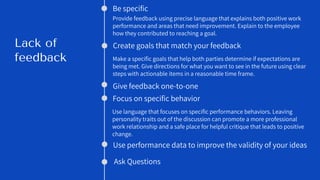
Create goals that match your feedback
Make a specific goals that help both parties determine if expectations are
being met. Give directions for what you want to see in the future using clear
steps with actionable items in a reasonable time frame.
Be specific
Provide feedback using precise language that explains both positive work
performance and areas that need improvement. Explain to the employee
how they contributed to reaching a goal.
Give feedback one-to-one
Focus on specific behavior
Use language that focuses on specific performance behaviors. Leaving
personality traits out of the discussion can promote a more professional
work relationship and a safe place for helpful critique that leads to positive
change.
Use performance data to improve the validity of your ideas
Ask Questions
Performance Management project - LG.pptx

Performance Management project - LG.pptx

  • 1.
    By: - Ghada Nasser21121066 - 01113853833 - Marwa Hosny 20121434 - 01017707161 - Hend Hosameldin 20222047 - 01000958300 Group: R1 LG Performance Management Project
  • 2.
    Company Profile LG Electronics(KSE: 066570.KS) is a global innovator in technology and consumer electronics with a presence in almost every country and an international workforce of more than 75,000. LG’s four companies – Home Appliance & Air Solution, Home Entertainment, Vehicle component Solutions and Business Solutions – combined for global sales of over USD 63 billion in 2021. LG is a leading manufacturer of consumer and commercial products ranging from TVs, home appliances, air solutions, monitors, service robots, automotive components and its premium LG SIGNATURE and intelligent LG ThinQ brands are familiar names world over. It sells a wide range of digital display and digital media products, digital appliances, and mobile phones under LG's "Life's Good" marketing theme.
  • 3.
    LG Vision &Mission Vision LG aims to connect science to life for a better future, integrating new insight with our wealth of knowledge, technologies, and solutions. Mission We are committed to providing electronic products that help customers live better. To support this, we wish to continue bringing added value to the lives of a consumers. LG's Mission is to be #1 LG by creating a better life with our customers.
  • 4.
    The Case LG electronicsis a manufacturing company that sells a wide range of electronics whose sales success or failure rests in the hands of sales representatives employed by franchised dealers operating independently. LG faces a challenging situation because it does not have control over the people working for the independent dealerships. It is the performance of these individuals that dictates LG’s sales success. To make things more complicated, until recently there was no clear understanding of the role of the sales representatives and there were no formal sales processes in place. Sales representatives varied greatly in terms of their level of skill and knowledge; most put out little effort beyond taking orders, and they did not feel motivated to make additional sales. Finally, franchises varied greatly regarding their management strategies and follow-up with LG. Recently, understanding the need to improve the performance of sales representatives, LG agreed to partially fund and support a training program for them. The network of franchise owners in turn agreed to work together to implement a performance management system.
  • 5.
    The Case (cont’) Asa first step in creating the performance management system, the franchise owners conducted a job analysis of the role of the sale representatives, wrote a job description, and distributed it to all sales representatives. The franchise owners also adopted a franchise-wide mission statement based primarily on the need to provide high-quality customer service. This mission statement was posted in all franchise offices, and each franchise owner spoke with his employees about the contribution made by individual sales on achieving their mission. As a second step, the managers set performance goals (i.e., sales quotas) for each employee. Then, all sales representatives attended extensive training sessions. The employees received feedback based on their performance in the training course and then were reminded once again of their sales quotas. Back on the job, managers gave feedback to their employees regarding their standing in relation to their sales quotas.
  • 6.
    6 Performance Management Problems 2No performance appraisal in place. 1 No way of monitoring sales rep. progress. 3 Discussions were not documented. 4 Lack of feedback.
  • 7.
    No way of monitoring salesrep. progress. Set goals and expectations. Involve the sales team in goals setting. So being involved will make them motivated and the goals will be more realistic so they will work on achieving them. Could be tracked by :Activity Metrics. These are sales activities and tasks that the sales rep. undertake everyday including the number of sales, calls, outreach emails, scheduled meetings and data entry into CRM software. Plan to measure goals Performance measures maintain a dual-focus on short-term tasks and long-term performance. Weekly or daily goals keeps team on track, and it will be easy to review sales activities and see if it’s actually helping everyone to get intended results. Develop an up-to-date visual dashboard That contains: - Snapshots of your deals. - Activities. - Emails. - Revenue & sales forecast.
  • 8.
    Discussions were not documented If youdon't document the issues that need to be solved, they may never be solved at all and may be lost in a pile of work. There are a lot more things that documentation helps with and that also prevents and solve problems, but as you can see, without a purpose, it is useless or it does more harm than good. Document decisions and action items in real time Take note of any key decisions, outcomes or action items as they are discussed. Don’t wait until the end of discussion to record those points from memory. Incorporate visuals to guide and record discussion Visuals are an effective tool for engaging group discussion, organizing and clarifying ideas, and presenting information more efficiently. Visuals can include simple whiteboard diagrams or attached images, as well as more elaborate charts and templates.
  • 9.
    Performance Appraisal Performance appraisalsare essential for the growth of a company and the employee. It helps the company to find out whether the employee is being productive or is a liability. It helps the employee to find out where his / her career is heading. It is an essential part of HR management. It motivates the employee to work hard, which in turn, benefits the company. A regular appraisal program can have a deep impact on levels of employee satisfaction and motivation.
  • 10.
    No performance appraisal in place 1- Planning InvolveThis first phase is around expectation setting for employees. This starts with employees clearly understanding role, responsibilities and expectations. This starts with the job description. It’s important for the job description to accurately reflect what the employee will be doing. It’s also important to include the employee in this planning phase. This includes outlining tasks, deliverables, and how work will be measured. It’s also important to factor in learning and development in the planning process. In what ways will you help create learning opportunities? What training or upskilling can help the employee grow? 2- Assessing (or Reviewing) Assessing performance through regular one-on-one meetings on a monthly basis. It’s important touchpoints between an employee and their manager .These deliverables can be reviewed in regular one-on-one meetings. Tracking progress doesn’t need to wait until an annual performance review. As a manager, it’s important to stay close to how progress is being made and provide support where needed.
  • 11.
    No performance appraisal in place (cont’) 3-Coaching This third phase of performance management is critical to success. As humans, asking for and receiving feedback can be sensitive. In fact, feedback can actually empower your employees to tap into their full potential. But beyond feedback, we all need coaching. In this phase, managers should identify any barriers the employee may face in reaching their objectives. It’s also critically important for open lines of feedback to be fostered in the form of coaching. Without coaching, the employee is likely not going to know how to best allocate their time and resources effectively. But it’s also a great opportunity to ask for feedback from your employees. Feedback isn’t a one- way street. 4- Rewarding This last and final phase of performance management is centered around recognition. Employee recognition can come in all shapes and sizes. And it doesn’t need to be reserved for the annual performance review. In fact, quite the opposite. Recognition can be used as an employee retention. When employees are recognized and rewarded for their work, they’re more likely to stay committed to the organization. Managers should make sure reward and recognition are built into their habits. This can be as simple as a Slack message recognizing an employee for their hard work. Or it could be something more in- depth, like a gift, a card, or a shout-out in a big team meeting.
  • 12.
    Lack of feedback •Feedback – or its lack – can impact employee performance. According to HubSpot, 69 percent of employees say they would work harder if they felt their efforts were being recognized. When managers offer little or no feedback, it can lead to higher turnover rates and major monetary losses for your company. • Without feedback, communication is nothing more than information. • Without feedback, the sender cannot confirm that the receiver has interpreted the message correctly. • Without a proper feedback the communication is incomplete and cannot move forward because both sender and receiver will be thinking something else. • Feedback improves employee's confidence, motivation to learn. It's also what your people want - 65% of employees say they want more feedback. • Ignoring employee feedback causes employees to lose trust in their managers and maybe even senior leaders. • Feedback gives people a sense of purpose.
  • 13.
    Lack of feedback Create goalsthat match your feedback Make a specific goals that help both parties determine if expectations are being met. Give directions for what you want to see in the future using clear steps with actionable items in a reasonable time frame. Be specific Provide feedback using precise language that explains both positive work performance and areas that need improvement. Explain to the employee how they contributed to reaching a goal. Give feedback one-to-one Focus on specific behavior Use language that focuses on specific performance behaviors. Leaving personality traits out of the discussion can promote a more professional work relationship and a safe place for helpful critique that leads to positive change. Use performance data to improve the validity of your ideas Ask Questions