© Brian Titley 2012: this may be reproduced for class use solely for the purchaser’s institute
Section 3 - Microeconomic decision makers
Chapter 19 - Trade Unions
© Brian Titley 2012: this may be reproduced for class use solely for the purchaser’s institute
2
© Brian Titley 2012: this may be reproduced for class use solely for the purchaser’s institute
What is a trade union or labour union?
Trade unions are organizations that promote and protect the interests of
their members (employees) to improve their wages and working conditions
The trade union movement worldwide has helped to:
• fight and bring to an end child labour in many
countries
• improve workers’ safety
• increase wages for both union and non-unionized
workers
• improve education and other benefits for many
poor and working class families
© Brian Titley 2012: this may be reproduced for class use solely for the purchaser’s institute
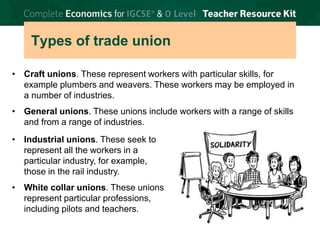
Types of trade union
• Craft unions. These represent workers with particular skills, for
example plumbers and weavers. These workers may be employed in
a number of industries.
• General unions. These unions include workers with a range of skills
and from a range of industries.
• Industrial unions. These seek to
represent all the workers in a
particular industry, for example,
those in the rail industry.
• White collar unions. These unions
represent particular professions,
including pilots and teachers.
© Brian Titley 2012: this may be reproduced for class use solely for the purchaser’s institute
The aims of unions
Unions’ aims are:
• negotiating improvements in wages and other non-wage
benefits
• defending employees’ rights and jobs
• improving working conditions, such as securing better
hours of work and better health and safety policies
• improving pay and other benefits, including holiday
entitlement, sick pay and pensions
• encouraging firms to increase workers’ participation in
business decision making
© Brian Titley 2012: this may be reproduced for class use solely for the purchaser’s institute
The aims of unions
continue…
• supporting members who have been dismissed or who are
taking industrial action
• developing the skills of union members, by providing
training and education courses
• providing social and recreational amenities for their
members
• improving employment legislation
© Brian Titley 2012: this may be reproduced for class use solely for the purchaser’s institute
Collective bargaining
• price inflation is high and rising
• other groups of workers have received
pay rises
• new machinery or working practices
have been introduced in the workplace
• the productivity of their members has
increased
• the profits of the employing
organization have increased
Negotiations take place between trade unions and employers over
improvements in wages and other non-wage benefits for employees
Trade unions may seek to improve the wages and other working conditions
of their members if:
© Brian Titley 2012: this may be reproduced for class use solely for the purchaser’s institute
What if negotiations fail?
Trade union members may take industrial action in an
attempt to increase their bargaining strength. Industrial
action disrupts production, increases costs and reduces
revenues for employers.
Arbitration may be necessary to settle
industrial disputes. This involves
employers and unions agreeing to let
an independent referee, often a senior
government official or lawyer, help
them to settle their industrial dispute.
© Brian Titley 2012: this may be reproduced for class use solely for the purchaser’s institute
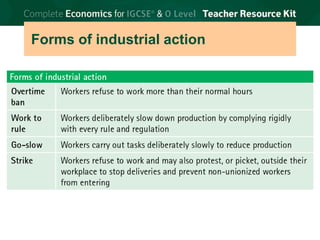
Forms of industrial action
© Brian Titley 2012: this may be reproduced for class use solely for the purchaser’s institute
The disadvantages of trade union activity
• Firms can be harmed by industrial action undertaken by
trade unions.
• The amount of revenue lost and damage done to the
reputation of a particular firm by a strike will be influenced
by the length of the strike.
• A firm’s costs and flexibility will also be adversely affected
by overtime bans and ‘work to rule’ action.
© Brian Titley 2012: this may be reproduced for class use solely for the purchaser’s institute
The advantages of trade union activity
• It is less time consuming and hence cheaper to negotiate
with workers as a group, than to negotiate with each
worker individually.
• Unions also provide a useful channel of communication
between employers and workers.
• They often encourage workers to engage in education and
training which raises productivity and promotes improved
health and safety.
• Unions can also benefit non-unionised labour as any
improvement in pay and working conditions usually
applies to non-members also.
© Brian Titley 2012: this may be reproduced for class use solely for the purchaser’s institute

Section 3 - Trade Unions (Chapter 19).ppt

  • 1.
    © Brian Titley2012: this may be reproduced for class use solely for the purchaser’s institute Section 3 - Microeconomic decision makers Chapter 19 - Trade Unions
  • 2.
    © Brian Titley2012: this may be reproduced for class use solely for the purchaser’s institute 2
  • 3.
    © Brian Titley2012: this may be reproduced for class use solely for the purchaser’s institute What is a trade union or labour union? Trade unions are organizations that promote and protect the interests of their members (employees) to improve their wages and working conditions The trade union movement worldwide has helped to: • fight and bring to an end child labour in many countries • improve workers’ safety • increase wages for both union and non-unionized workers • improve education and other benefits for many poor and working class families
  • 4.
    © Brian Titley2012: this may be reproduced for class use solely for the purchaser’s institute Types of trade union • Craft unions. These represent workers with particular skills, for example plumbers and weavers. These workers may be employed in a number of industries. • General unions. These unions include workers with a range of skills and from a range of industries. • Industrial unions. These seek to represent all the workers in a particular industry, for example, those in the rail industry. • White collar unions. These unions represent particular professions, including pilots and teachers.
  • 5.
    © Brian Titley2012: this may be reproduced for class use solely for the purchaser’s institute The aims of unions Unions’ aims are: • negotiating improvements in wages and other non-wage benefits • defending employees’ rights and jobs • improving working conditions, such as securing better hours of work and better health and safety policies • improving pay and other benefits, including holiday entitlement, sick pay and pensions • encouraging firms to increase workers’ participation in business decision making
  • 6.
    © Brian Titley2012: this may be reproduced for class use solely for the purchaser’s institute The aims of unions continue… • supporting members who have been dismissed or who are taking industrial action • developing the skills of union members, by providing training and education courses • providing social and recreational amenities for their members • improving employment legislation
  • 7.
    © Brian Titley2012: this may be reproduced for class use solely for the purchaser’s institute Collective bargaining • price inflation is high and rising • other groups of workers have received pay rises • new machinery or working practices have been introduced in the workplace • the productivity of their members has increased • the profits of the employing organization have increased Negotiations take place between trade unions and employers over improvements in wages and other non-wage benefits for employees Trade unions may seek to improve the wages and other working conditions of their members if:
  • 8.
    © Brian Titley2012: this may be reproduced for class use solely for the purchaser’s institute What if negotiations fail? Trade union members may take industrial action in an attempt to increase their bargaining strength. Industrial action disrupts production, increases costs and reduces revenues for employers. Arbitration may be necessary to settle industrial disputes. This involves employers and unions agreeing to let an independent referee, often a senior government official or lawyer, help them to settle their industrial dispute.
  • 9.
    © Brian Titley2012: this may be reproduced for class use solely for the purchaser’s institute Forms of industrial action
  • 10.
    © Brian Titley2012: this may be reproduced for class use solely for the purchaser’s institute The disadvantages of trade union activity • Firms can be harmed by industrial action undertaken by trade unions. • The amount of revenue lost and damage done to the reputation of a particular firm by a strike will be influenced by the length of the strike. • A firm’s costs and flexibility will also be adversely affected by overtime bans and ‘work to rule’ action.
  • 11.
    © Brian Titley2012: this may be reproduced for class use solely for the purchaser’s institute The advantages of trade union activity • It is less time consuming and hence cheaper to negotiate with workers as a group, than to negotiate with each worker individually. • Unions also provide a useful channel of communication between employers and workers. • They often encourage workers to engage in education and training which raises productivity and promotes improved health and safety. • Unions can also benefit non-unionised labour as any improvement in pay and working conditions usually applies to non-members also.
  • 12.
    © Brian Titley2012: this may be reproduced for class use solely for the purchaser’s institute
  • 13.
    © Brian Titley2012: this may be reproduced for class use solely for the purchaser’s institute