Principles of Marketing
Section 1
What is Marketing ?
The Marketing is
The process by which companies create value for
customers and build strong customer relationships in
order to capture value from customers in return
The Main goal of marketing is to attract new
customers by promising superior value and to keep and
grow current customers by delivering satisfaction.
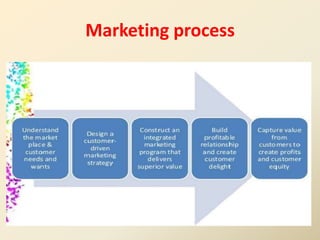
Marketing process
Understanding Customer needs, wants, and demands
Customer needs: is the states of felt deprivation.
There are three types of human needs:
1) Physical needs : like a need for food, clothing, safety
2) Social needs: like a need for belonging and affection.
3) Individual needs: like a need for knowledge and self-
expression.
Human Wants :are the form human needs take as they are
shaped by culture and individual personality (ex: An American
needs food but wants a Big Mac, French fries, and a soft drink)
Demands: are human wants that are backed by buying power.
Market offerings: are some combination of
products, services, information, or experiences
offered to a market to satisfy a need or want.
Marketing myopia : is focusing only on existing
wants and losing sight of underlying consumer needs
Market Offerings—Products, Services,
and Experiences
Exchanges and Relationships
Exchange: is the act of obtaining a desired object from
someone by offering something in return
Markets: are the set of actual and potential buyers of a
product
Marketers want to build and maintain strong
relationships by consistently delivering superior
customer value
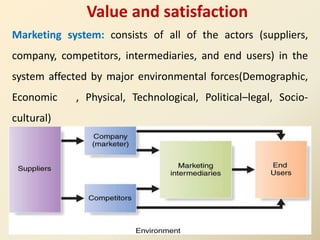
Value and satisfaction
Marketing system: consists of all of the actors (suppliers,
company, competitors, intermediaries, and end users) in the
system affected by major environmental forces(Demographic,
Economic , Physical, Technological, Political–legal, Socio-
cultural)
2.Designing a Customer-Driven Marketing
Strategy
Marketing management : is the art and science of choosing
target markets and building profitable relationships with them
What customers will we serve?
How can we best serve these customers?
 Market segmentation: refers to dividing the markets into
segments of customers
 Target marketing: refers to which segments to go after
 Demarketing is marketing to reduce demand temporarily or
permanently; the aim is not to destroy demand but to reduce
or shift it.
2.Designing a Customer-Driven Marketing
Strategy
Value proposition: is the set of benefits or values a company
promises to deliver to customers to satisfy their needs
Market management: is both :Customer management and
Demand management
Marketing Management Orientations
֍Production concept
֍Product concept
֍Selling concept
֍Marketing concept
֍Societal concept
Marketing Management Orientations
Production concept is the idea that consumers will favor
products that are available or highly affordable
Product concept: is the idea that consumers will favor
products that offer the most quality, performance, and
features that the organization should therefore devote its
energy to making continuous improvements
Marketing Management Orientations
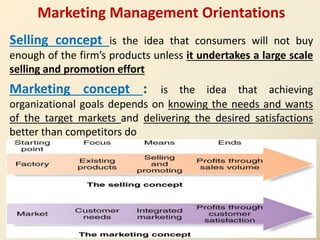
Selling concept is the idea that consumers will not buy
enough of the firm’s products unless it undertakes a large scale
selling and promotion effort
Marketing concept : is the idea that achieving
organizational goals depends on knowing the needs and wants
of the target markets and delivering the desired satisfactions
better than competitors do
Marketing Management Orientations
Societal marketing concept is the idea that a company
should make good marketing decisions by considering
consumers’ wants, the company’s requirements,
consumers’ long-term interests, and society’s long-run
interests
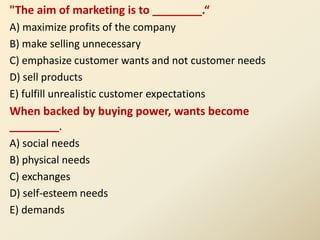
"The aim of marketing is to ________.“
A) maximize profits of the company
B) make selling unnecessary
C) emphasize customer wants and not customer needs
D) sell products
E) fulfill unrealistic customer expectations
When backed by buying power, wants become
________.
A) social needs
B) physical needs
C) exchanges
D) self-esteem needs
E) demands
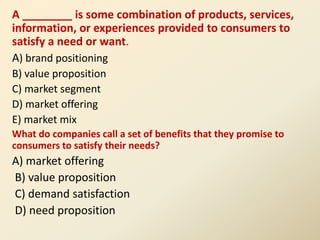
A ________ is some combination of products, services,
information, or experiences provided to consumers to
satisfy a need or want.
A) brand positioning
B) value proposition
C) market segment
D) market offering
E) market mix
What do companies call a set of benefits that they promise to
consumers to satisfy their needs?
A) market offering
B) value proposition
C) demand satisfaction
D) need proposition
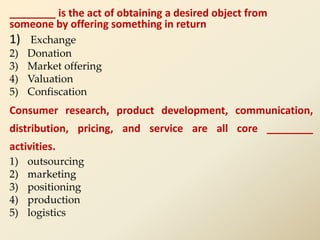
________ is the act of obtaining a desired object from
someone by offering something in return
1) Exchange
2) Donation
3) Market offering
4) Valuation
5) Confiscation
Consumer research, product development, communication,
distribution, pricing, and service are all core ________
activities.
1) outsourcing
2) marketing
3) positioning
4) production
5) logistics
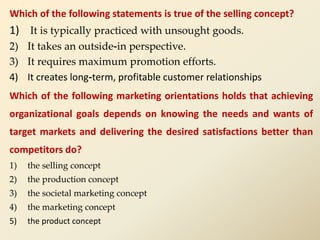
Which of the following statements is true of the selling concept?
1) It is typically practiced with unsought goods.
2) It takes an outside-in perspective.
3) It requires maximum promotion efforts.
4) It creates long-term, profitable customer relationships
Which of the following marketing orientations holds that achieving
organizational goals depends on knowing the needs and wants of
target markets and delivering the desired satisfactions better than
competitors do?
1) the selling concept
2) the production concept
3) the societal marketing concept
4) the marketing concept
5) the product concept
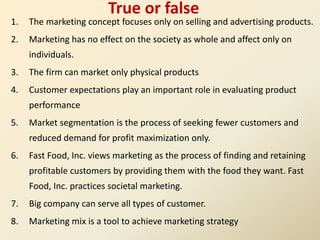
True or false
1. The marketing concept focuses only on selling and advertising products.
2. Marketing has no effect on the society as whole and affect only on
individuals.
3. The firm can market only physical products
4. Customer expectations play an important role in evaluating product
performance
5. Market segmentation is the process of seeking fewer customers and
reduced demand for profit maximization only.
6. Fast Food, Inc. views marketing as the process of finding and retaining
profitable customers by providing them with the food they want. Fast
Food, Inc. practices societal marketing.
7. Big company can serve all types of customer.
8. Marketing mix is a tool to achieve marketing strategy

Section 1.pptx

  • 1.
  • 2.
    What is Marketing? The Marketing is The process by which companies create value for customers and build strong customer relationships in order to capture value from customers in return The Main goal of marketing is to attract new customers by promising superior value and to keep and grow current customers by delivering satisfaction.
  • 3.
  • 4.
    Understanding Customer needs,wants, and demands Customer needs: is the states of felt deprivation. There are three types of human needs: 1) Physical needs : like a need for food, clothing, safety 2) Social needs: like a need for belonging and affection. 3) Individual needs: like a need for knowledge and self- expression. Human Wants :are the form human needs take as they are shaped by culture and individual personality (ex: An American needs food but wants a Big Mac, French fries, and a soft drink) Demands: are human wants that are backed by buying power.
  • 5.
    Market offerings: aresome combination of products, services, information, or experiences offered to a market to satisfy a need or want. Marketing myopia : is focusing only on existing wants and losing sight of underlying consumer needs Market Offerings—Products, Services, and Experiences
  • 6.
    Exchanges and Relationships Exchange:is the act of obtaining a desired object from someone by offering something in return Markets: are the set of actual and potential buyers of a product Marketers want to build and maintain strong relationships by consistently delivering superior customer value
  • 7.
    Value and satisfaction Marketingsystem: consists of all of the actors (suppliers, company, competitors, intermediaries, and end users) in the system affected by major environmental forces(Demographic, Economic , Physical, Technological, Political–legal, Socio- cultural)
  • 8.
    2.Designing a Customer-DrivenMarketing Strategy Marketing management : is the art and science of choosing target markets and building profitable relationships with them What customers will we serve? How can we best serve these customers?  Market segmentation: refers to dividing the markets into segments of customers  Target marketing: refers to which segments to go after  Demarketing is marketing to reduce demand temporarily or permanently; the aim is not to destroy demand but to reduce or shift it.
  • 9.
    2.Designing a Customer-DrivenMarketing Strategy Value proposition: is the set of benefits or values a company promises to deliver to customers to satisfy their needs Market management: is both :Customer management and Demand management Marketing Management Orientations ֍Production concept ֍Product concept ֍Selling concept ֍Marketing concept ֍Societal concept
  • 10.
    Marketing Management Orientations Productionconcept is the idea that consumers will favor products that are available or highly affordable Product concept: is the idea that consumers will favor products that offer the most quality, performance, and features that the organization should therefore devote its energy to making continuous improvements
  • 11.
    Marketing Management Orientations Sellingconcept is the idea that consumers will not buy enough of the firm’s products unless it undertakes a large scale selling and promotion effort Marketing concept : is the idea that achieving organizational goals depends on knowing the needs and wants of the target markets and delivering the desired satisfactions better than competitors do
  • 12.
    Marketing Management Orientations Societalmarketing concept is the idea that a company should make good marketing decisions by considering consumers’ wants, the company’s requirements, consumers’ long-term interests, and society’s long-run interests
  • 13.
    "The aim ofmarketing is to ________.“ A) maximize profits of the company B) make selling unnecessary C) emphasize customer wants and not customer needs D) sell products E) fulfill unrealistic customer expectations When backed by buying power, wants become ________. A) social needs B) physical needs C) exchanges D) self-esteem needs E) demands
  • 14.
    A ________ issome combination of products, services, information, or experiences provided to consumers to satisfy a need or want. A) brand positioning B) value proposition C) market segment D) market offering E) market mix What do companies call a set of benefits that they promise to consumers to satisfy their needs? A) market offering B) value proposition C) demand satisfaction D) need proposition
  • 15.
    ________ is theact of obtaining a desired object from someone by offering something in return 1) Exchange 2) Donation 3) Market offering 4) Valuation 5) Confiscation Consumer research, product development, communication, distribution, pricing, and service are all core ________ activities. 1) outsourcing 2) marketing 3) positioning 4) production 5) logistics
  • 16.
    Which of thefollowing statements is true of the selling concept? 1) It is typically practiced with unsought goods. 2) It takes an outside-in perspective. 3) It requires maximum promotion efforts. 4) It creates long-term, profitable customer relationships Which of the following marketing orientations holds that achieving organizational goals depends on knowing the needs and wants of target markets and delivering the desired satisfactions better than competitors do? 1) the selling concept 2) the production concept 3) the societal marketing concept 4) the marketing concept 5) the product concept
  • 17.
    True or false 1.The marketing concept focuses only on selling and advertising products. 2. Marketing has no effect on the society as whole and affect only on individuals. 3. The firm can market only physical products 4. Customer expectations play an important role in evaluating product performance 5. Market segmentation is the process of seeking fewer customers and reduced demand for profit maximization only. 6. Fast Food, Inc. views marketing as the process of finding and retaining profitable customers by providing them with the food they want. Fast Food, Inc. practices societal marketing. 7. Big company can serve all types of customer. 8. Marketing mix is a tool to achieve marketing strategy