Section 10

  3/13/13
Today
•   Quiz 3 review
•   Course evaluations
•   Vilain lecture material from week 9
•   Saguy – review of sociology readings
Difficulties in studying biological
     contribution to homosexuality
• Some studies on humans are neither practical nor
  ethical
• Animal models may not be optimal because of
  human/animal differences
• Recruitment difficulties
  – Selection bias
  – How is homosexuality defined?
  – What is the object of study? Tissue? Genes? An area
    of the brain? During what period of development?
• Gene environment interactions
Looking for “a” gene
• Linkage analysis: don’t know which specific genes are
  responsible
   – Narrowing it down: whichever parts of the genome are
     shared between affected family members
   – Need 2+ affected family members
• Identify family members with the same trait.
  Find the genetic marker for that trait
• Repeat the process multiple times to identify a
  genetic marker that is statistically more linked
  to a particular trait
• In other words, search for a genetic region that
  is passed on to affected members in a family
  more than to those not affected
Linkage analyses
• Suggests Xq28
  – This region is on the tip of the X chromosome
• However, linkage studies suggest other
  autosomal regions (not on sex chromosomes)
• Could be more than one gene and multiple
  physiological determinants/factors
• 12 million base pairs in human DNA makes the
  search challenging
Looking for “a” gene
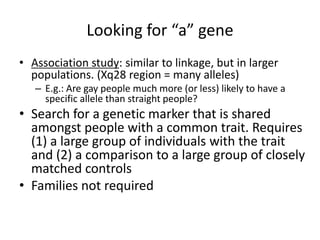
• Association study: similar to linkage, but in larger
  populations. (Xq28 region = many alleles)
   – E.g.: Are gay people much more (or less) likely to have a
     specific allele than straight people?
• Search for a genetic marker that is shared
  amongst people with a common trait. Requires
  (1) a large group of individuals with the trait
  and (2) a comparison to a large group of closely
  matched controls
• Families not required
Looking for “a” gene
• Candidate genes
• Best guess for a gene is nominated and then
  studied
Looking for “a” gene
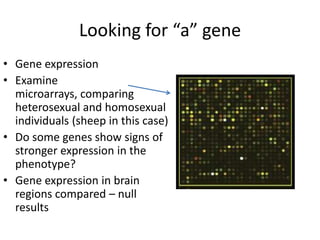
• Gene expression
• Examine
  microarrays, comparing
  heterosexual and homosexual
  individuals (sheep in this case)
• Do some genes show signs of
  stronger expression in the
  phenotype?
• Gene expression in brain
  regions compared – null
  results
Epigenetics
• Gene expression varies and can be regulated
  by methylation
• Methylation acts on cytosine
• Epigenome seen as interface between
  environmental signals and persistent behavior
• But it is currently impossible to determine
  “how much” environmental influence
Epigenetics continued
• Can be viewed as “a unifying solution for
  gene-environment interactions”
• Only have to look for methylation – not the
  cause of methylation
• In addition, it can also be assumed that there
  will not be a one-to-one correlation between
  the presence of a particular allele combination
  and homosexuality
• Therefore, twin studies may be useful
Twin studies
• Because while MZ twins share 100% of their
  DNA, they do not have the same epigenetic
  patterns
• Recall concordance rates for male
  homosexuals:
  – MZ = 52%
  – DZ = 22%
Twin studies
• Looking at some of the regions of the genome
  identified by linkage analysis
• Looked for differences between the
  methylation of these genes between twins
• 4-5% differences in methylation
The ex-gay movement

•1. History of Mental Health Attitudes toward
Homosexuality
•2. Sexual Conversion Therapies in a Cultural
Context
•3. Clinical/Research Issues
History Of Mental Attitudes
•19th: From Sin to Sick
• - from judgment to “science”: ex. Degeneracy theory  “arrested
development” (Freud)

•Mid 20th: DSM : efforts to standardize mental health in general
• -1952: Sociopathic Personality Disturbance
• -1953: Evelyn Hooker – major evidence to the contrary
• -1973: APA Decision to remove homosexuality

• Interaction with culture/politics: i.e. activism informed the APA
• not a mental illness  “normalization”  cultural war
“Conversion”/”Reparative”
         Therapy in Context
- Normalization Provokes Culture wars

-Opposing Views on Homosexuality:

-Normal/Identity Model: accepting one's normal
homosexual orientation

-Illness/Behavior Model: rejection of identity model
and says it is abnormal
Clinical and Research Issues
•- Robert L. Spitzer: Reparative Therapy Works [?]
  – Scales of sexual orientation:
     •attraction, identity, sexual behavior
• Critiques:
  –no follow-up or face to face interviews
  –retrospective accounts
  –recruitment and sample bias
  –NO peer review
Gay Rights, Research, and Politics
• Research about the origins or sexual orientation
is tied up in politics.
    – Anti-gay activists use “reparative” therapy
        as evidence that sexual orientation is
        “changeable” and a “choice” and thus not
        deserving of legal rights and protections.
    – This stance is used to justify legal
        discrimination in employment, marriage
        rights, and other areas.
Saguy exercise
•   Race                         Covering   Flaunting

•   Sex            Appearance
•   Motherhood
•   Class          Affiliation

•   Fat
                   Activism
•   Others
                   Association

Section 10

  • 1.
    Section 10 3/13/13
  • 2.
    Today • Quiz 3 review • Course evaluations • Vilain lecture material from week 9 • Saguy – review of sociology readings
  • 3.
    Difficulties in studyingbiological contribution to homosexuality • Some studies on humans are neither practical nor ethical • Animal models may not be optimal because of human/animal differences • Recruitment difficulties – Selection bias – How is homosexuality defined? – What is the object of study? Tissue? Genes? An area of the brain? During what period of development? • Gene environment interactions
  • 4.
    Looking for “a”gene • Linkage analysis: don’t know which specific genes are responsible – Narrowing it down: whichever parts of the genome are shared between affected family members – Need 2+ affected family members • Identify family members with the same trait. Find the genetic marker for that trait • Repeat the process multiple times to identify a genetic marker that is statistically more linked to a particular trait • In other words, search for a genetic region that is passed on to affected members in a family more than to those not affected
  • 5.
    Linkage analyses • SuggestsXq28 – This region is on the tip of the X chromosome • However, linkage studies suggest other autosomal regions (not on sex chromosomes) • Could be more than one gene and multiple physiological determinants/factors • 12 million base pairs in human DNA makes the search challenging
  • 6.
    Looking for “a”gene • Association study: similar to linkage, but in larger populations. (Xq28 region = many alleles) – E.g.: Are gay people much more (or less) likely to have a specific allele than straight people? • Search for a genetic marker that is shared amongst people with a common trait. Requires (1) a large group of individuals with the trait and (2) a comparison to a large group of closely matched controls • Families not required
  • 7.
    Looking for “a”gene • Candidate genes • Best guess for a gene is nominated and then studied
  • 8.
    Looking for “a”gene • Gene expression • Examine microarrays, comparing heterosexual and homosexual individuals (sheep in this case) • Do some genes show signs of stronger expression in the phenotype? • Gene expression in brain regions compared – null results
  • 9.
    Epigenetics • Gene expressionvaries and can be regulated by methylation • Methylation acts on cytosine • Epigenome seen as interface between environmental signals and persistent behavior • But it is currently impossible to determine “how much” environmental influence
  • 10.
    Epigenetics continued • Canbe viewed as “a unifying solution for gene-environment interactions” • Only have to look for methylation – not the cause of methylation • In addition, it can also be assumed that there will not be a one-to-one correlation between the presence of a particular allele combination and homosexuality • Therefore, twin studies may be useful
  • 11.
    Twin studies • Becausewhile MZ twins share 100% of their DNA, they do not have the same epigenetic patterns • Recall concordance rates for male homosexuals: – MZ = 52% – DZ = 22%
  • 12.
    Twin studies • Lookingat some of the regions of the genome identified by linkage analysis • Looked for differences between the methylation of these genes between twins • 4-5% differences in methylation
  • 13.
    The ex-gay movement •1.History of Mental Health Attitudes toward Homosexuality •2. Sexual Conversion Therapies in a Cultural Context •3. Clinical/Research Issues
  • 14.
    History Of MentalAttitudes •19th: From Sin to Sick • - from judgment to “science”: ex. Degeneracy theory  “arrested development” (Freud) •Mid 20th: DSM : efforts to standardize mental health in general • -1952: Sociopathic Personality Disturbance • -1953: Evelyn Hooker – major evidence to the contrary • -1973: APA Decision to remove homosexuality • Interaction with culture/politics: i.e. activism informed the APA • not a mental illness  “normalization”  cultural war
  • 15.
    “Conversion”/”Reparative” Therapy in Context - Normalization Provokes Culture wars -Opposing Views on Homosexuality: -Normal/Identity Model: accepting one's normal homosexual orientation -Illness/Behavior Model: rejection of identity model and says it is abnormal
  • 16.
    Clinical and ResearchIssues •- Robert L. Spitzer: Reparative Therapy Works [?] – Scales of sexual orientation: •attraction, identity, sexual behavior • Critiques: –no follow-up or face to face interviews –retrospective accounts –recruitment and sample bias –NO peer review
  • 17.
    Gay Rights, Research,and Politics • Research about the origins or sexual orientation is tied up in politics. – Anti-gay activists use “reparative” therapy as evidence that sexual orientation is “changeable” and a “choice” and thus not deserving of legal rights and protections. – This stance is used to justify legal discrimination in employment, marriage rights, and other areas.
  • 18.
    Saguy exercise • Race Covering Flaunting • Sex Appearance • Motherhood • Class Affiliation • Fat Activism • Others Association