BANKING ON MOBILE 2016
5 secrets for making it work
1 sales@swrve.com | @swrve_inc
BANKING ON MOBILE 2016
INTRODUCTION
Something big is happening in the world of
finance. Or rather, something small is happening.
The relationship between a bank and consumer is now
taking place on a screen about 5 inches across: the
smartphone. To an extraordinary degree, the man or
woman in the street has taken to mobile banking like a
duck to water. And in the process, they have left many
financial institutions struggling to keep up.
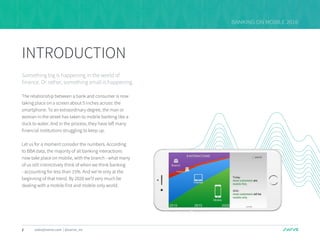
Let us for a moment consider the numbers. According
to BBA data, the majority of all banking interactions
now take place on mobile, with the branch - what many
of us still instinctively think of when we think banking
- accounting for less than 15%. And we’re only at the
beginning of that trend. By 2020 we’ll very much be
dealing with a mobile first and mobile only world.
2 sales@swrve.com | @swrve_inc
BANKING ON MOBILE 2016
That trend is further emphasised by the fact that over 30x
as many logins take place via the mobile screen (internet
or app) than do on desktop.
All that data leads to a single, simple conclusion - you
need to start thinking about how to deliver the full
banking experience within a small screen. But more than
that, smart banking businesses need to consider how to
take advantage of the opportunity in mobile.
3 sales@swrve.com | @swrve_inc
BANKING ON MOBILE 2016
MOBILE AS A
MULTIPLIER
Mobile is certainly a challenge. But it also represents
a significant potential benefit to financial institutions.
That’s because as an always-on technology that lives in
the consumer’s pocket, mobile acts as a multiplier when
it comes to the frequency and depth of our interactions.
The mobile enables smart organizations to learn more
about their customers and deliver innovative experiences
that were previously not possible. It provides the
opportunity for real 1-2-1 communication anytime and
anywhere. For banks, it means a chance to deliver new
levels of relevance and success.
The rest of this whitepaper looks at 5 keys ways to think
about and meet that challenge.
Enjoy.
“By 2020 we’ll very much be
dealing with a mobile first and
mobile only world”
4 sales@swrve.com | @swrve_inc
BANKING ON MOBILE 2016
The first step in the development of any mobile strategy is ensuring
you have a true understanding of what is at stake. Only by having a
clear view of the environment and challenge can a smart strategy
be developed and delivered.
With this in mind it is as well to remember a couple of key facts. Perhaps
most importantly, we should be aware that the rise of mobile has been
accompanied by another largely unrelated trend: the growing ease with which
banking customers can now switch accounts.
Gone are the days of a ‘bank for life’. For the younger ‘millennial’ generation
at least (those aged between 18 and 34) a full 18% of these changed their
primary bank in the past 12 months. So there’s a huge amount at stake,
and banks are not protected from the threats to brand loyalty whenever
consumers move from one technology to another (just ask Borders and
Amazon about that one).
What’s really interesting is that in the majority of cases consumers cite
“quality of experience” as their reason for switching, rather than commercial
considerations. In a mobile-first world, that has interesting implications for the
amount of work banks need to invest in getting the mobile app experience just
right.
UNDERSTAND
THECHALLENGE
5 sales@swrve.com | @swrve_inc
BANKING ON MOBILE 2016
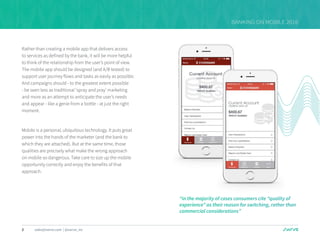
Rather than creating a mobile app that delivers access
to services as defined by the bank, it will be more helpful
to think of the relationship from the user’s point of view.
The mobile app should be designed (and A/B tested) to
support user journey flows and tasks as easily as possible.
And campaigns should - to the greatest extent possible
- be seen less as traditional ‘spray and pray’ marketing
and more as an attempt to anticipate the user’s needs
and appear - like a genie from a bottle - at just the right
moment.
Mobile is a personal, ubiquitous technology. It puts great
power into the hands of the marketer (and the bank to
which they are attached). But at the same time, those
qualities are precisely what make the wrong approach
on mobile so dangerous. Take care to size up the mobile
opportunity correctly and enjoy the benefits of that
approach.
“in the majority of cases consumers cite “quality of
experience” as their reason for switching, rather than
commercial considerations”
6 sales@swrve.com | @swrve_inc
BANKING ON MOBILE 2016
BRING THE
BRANCH
TO MOBILE
If the ‘bank’ is now manifested in a mobile app, what does that
mean for the branch experience? In general, it simply means that
experience now needs to be recreated in a new environment. Not
the bad parts of course - what digital tech in general delivers is the
removal of the need to queue or indeed get there in the first place.
But the good, for both the bank and the consumer, should be delivered in the
native mobile arena if possible.
Here’s one simple example of that. In any bank branch you’ll see a variety
of posters, leaflets and so on, all developed and designed by marketing
departments to introduce bank customers to products such as credit cards,
motor loans, mortgages and deposit accounts. There’s no surprise in that, for
a retail bank these are the products that move a customer from loss-making to
profitable.
If the mobile app is now the new branch, how effectively are these products
sold? In many cases, the answer is ‘not particularly well’. At worst, it is
difficult to impossible to access these services at all via the app. That’s not
helpful either for the bank themselves or the customer who may actually be
interested.
7 sales@swrve.com | @swrve_inc
BANKING ON MOBILE 2016
At best, these services are available and some form
of advertising is also included to drive customers to
these products. But in most cases that advertising is
un-targeted, appears at the wrong time, and is thus
ineffective and frustrating in equal measure.
Mobile can do better than that. As with any other digital
channel, we have access to huge amounts of user data
relating to both transactions and behavior. And we have
almost unlimited flexibility when it comes to how we
display content and advertising, and where we do so in
the app.
Success in mobile banking will depend on taking
advantage of both these opportunities and delivering
smart, targeted marketing as a result that does an
effective job of promoting the full range of marketing
services within the app - because that’s where today’s
bank customer spends their time.
8 sales@swrve.com | @swrve_inc
BANKING ON MOBILE 2016
Mobile dominates the modern banking relationship. But it isn’t the
whole story, and it never will be. If we target our mobile marketing
activity solely based on the data we collect from mobile app
activity, it will limit our effectiveness and in some cases mean the
delivery of campaigns that are just plain ‘wrong’. After all, nobody
wants to be asked to apply for a mortgage when they’ve just signed
the papers in the branch!
The best mobile marketing - in banking and indeed any other vertical - is
informed by our activity across all channels and indeed the environment
around us at any moment in time. That means it is vital for banks to put in
place structures that share mobile, desktop and branch data, and do so in
real-time.
Remember - consumers don’t think in terms of ‘channels’. They have a
relationship with a bank (or other financial institution) and expect that bank
to show them the same face in all channels - just like a human being would.
That’s why real-time data sharing matters, and why it is essential that all
marketing is informed by this 360 degree view.
TAKE A 360 VIEW
OF THE USER
9 sales@swrve.com | @swrve_inc
BANKING ON MOBILE 2016
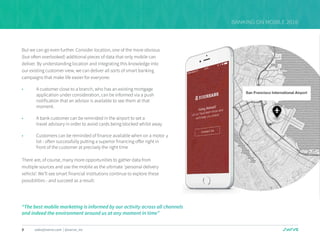
But we can go even further. Consider location, one of the more obvious
(but often overlooked) additional pieces of data that only mobile can
deliver. By understanding location and integrating this knowledge into
our existing customer view, we can deliver all sorts of smart banking
campaigns that make life easier for everyone:
•	 A customer close to a branch, who has an existing mortgage 	
	 application under consideration, can be informed via a push 	
	 notification that an advisor is available to see them at that 		
	 moment.
•	 A bank customer can be reminded in the airport to set a 		
	 travel advisory in order to avoid cards being blocked whilst away
•	 Customers can be reminded of finance available when on a motor 	
	 lot - often successfully putting a superior financing offer right in 	
	 front of the customer at precisely the right time
There are, of course, many more opportunities to gather data from
multiple sources and use the mobile as the ultimate ‘personal delivery
vehicle’. We’ll see smart financial institutions continue to explore these
possibilities - and succeed as a result.
“The best mobile marketing is informed by our activity across all channels
and indeed the environment around us at any moment in time”
10 sales@swrve.com | @swrve_inc
BANKING ON MOBILE 2016
Bringing data together and integrating the view of the customer
has immediate and obvious benefits. But it can also help improve
marketing performance in ways that are not immediately apparent.
The more data banks collect on their customers, the more they are able
to identify not only what those customers have done in the past, but also
what they are more likely to do in the future. We are entering the realm of
‘propensity marketing’ - an area that banks and consumer financial services
have always performed well in.
In most cases banks will already have methods for profiling and identifying
those of their customers ready for a particular financial product or service.
Mobile just brings more data to the party. A lot more. In addition to the central
systems of record (usually based on concrete transactions or what financial
institutions call ‘reference data’ - data relating to the customer that doesn’t
change much, such as address and demographic group), mobile can add an
almost infinite number of data points around app usage.PREDICT THE
FUTURE
11 sales@swrve.com | @swrve_inc
BANKING ON MOBILE 2016
That additional data can be telling. To use the most obvious
example, a customer who has looked at details of a particular
product multiple times is almost certainly considering it. When we
fold that usage data into existing models, we are suddenly looking
at significantly higher levels of accuracy when it comes to propensity
modelling than ever before.
That’s important - because accuracy in this area is absolutely central
to the effectiveness of marketing campaigns and the profitability
of the business as a whole. If you have accurate propensity scores
it can save money in incentives that would otherwise be offered,
and help avoid customer churn or missed sales opportunities when
marketing campaigns or changes to service levels are targeted at
precisely those who are most likely to be affected.
“The more data banks collect on their customers, the
more they are able to identify not only what those
customers have done in the past, but also what they
are more likely to do in the future”
12 sales@swrve.com | @swrve_inc
BANKING ON MOBILE 2016
Sometimes - and particularly in the world of retail banking - we
just have to get a message through. In this context we’re not
talking about marketing, we’re talking about alerting customers
to potentially fraudulent transactions, balance updates, or terms
of service changes.
And that poses a problem, because the methods we currently use are either
ineffective (email) or expensive (calls, texts and direct mail). More observant
readers will also note that these strategies are not exactly ‘native’ to mobile
– a platform on which consumers increasingly consider some form of instant
messaging to be the norm.
That’s where in-app messaging can step in. With the app now in so many
customers hands (with figures of over 80% penetration not uncommon)
it becomes quite viable to consider native mobile messaging as a smart
communication strategy for operational purposes.
Consider the case of fraud alerts. As an alternative to an (expensive) text, an
alert can be sent to any app user informing them of a suspicious payment or
hold on the account. From the push notification, the user opens up the app
to view a conversation that adds contextual information that could never be
supplied in an SMS alone.
GET OPERATIONAL
13 sales@swrve.com | @swrve_inc
BANKING ON MOBILE 2016
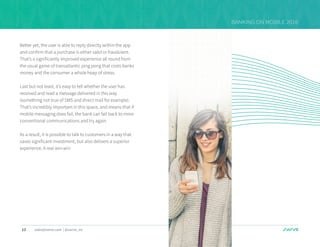
Better yet, the user is able to reply directly within the app
and confirm that a purchase is either valid or fraudulent.
That’s a significantly improved experience all round from
the usual game of transatlantic ping pong that costs banks
money and the consumer a whole heap of stress.
Last but not least, it’s easy to tell whether the user has
received and read a message delivered in this way
(something not true of SMS and direct mail for example).
That’s incredibly important in this space, and means that if
mobile messaging does fail, the bank can fall back to more
conventional communications and try again.
As a result, it is possible to talk to customers in a way that
saves significant investment, but also delivers a superior
experience. A real win-win
GROW YOUR MOBILE BUSINESS WITH SWRVE
The Swrve Mobile Engagement Platform is designed for digital marketers who are
focused on transforming the way brands connect and interact with customers in
an increasingly mobile-centric world.
Understanding how to engage users quickly and maximize revenue is a core competence of
Swrve’s, and recognized by our partners - including Sony, The Guardian, Condé Nast,
Warner Brothers and Microsoft. Swrve customers have delivered more than
one billion mobile messages, and every single day the Swrve platform
processes over six billion events.
www.swrve.com

Secrets for banking_on_mobile1

  • 1.
    BANKING ON MOBILE2016 5 secrets for making it work
  • 2.
    1 sales@swrve.com |@swrve_inc BANKING ON MOBILE 2016 INTRODUCTION Something big is happening in the world of finance. Or rather, something small is happening. The relationship between a bank and consumer is now taking place on a screen about 5 inches across: the smartphone. To an extraordinary degree, the man or woman in the street has taken to mobile banking like a duck to water. And in the process, they have left many financial institutions struggling to keep up. Let us for a moment consider the numbers. According to BBA data, the majority of all banking interactions now take place on mobile, with the branch - what many of us still instinctively think of when we think banking - accounting for less than 15%. And we’re only at the beginning of that trend. By 2020 we’ll very much be dealing with a mobile first and mobile only world.
  • 3.
    2 sales@swrve.com |@swrve_inc BANKING ON MOBILE 2016 That trend is further emphasised by the fact that over 30x as many logins take place via the mobile screen (internet or app) than do on desktop. All that data leads to a single, simple conclusion - you need to start thinking about how to deliver the full banking experience within a small screen. But more than that, smart banking businesses need to consider how to take advantage of the opportunity in mobile.
  • 4.
    3 sales@swrve.com |@swrve_inc BANKING ON MOBILE 2016 MOBILE AS A MULTIPLIER Mobile is certainly a challenge. But it also represents a significant potential benefit to financial institutions. That’s because as an always-on technology that lives in the consumer’s pocket, mobile acts as a multiplier when it comes to the frequency and depth of our interactions. The mobile enables smart organizations to learn more about their customers and deliver innovative experiences that were previously not possible. It provides the opportunity for real 1-2-1 communication anytime and anywhere. For banks, it means a chance to deliver new levels of relevance and success. The rest of this whitepaper looks at 5 keys ways to think about and meet that challenge. Enjoy. “By 2020 we’ll very much be dealing with a mobile first and mobile only world”
  • 5.
    4 sales@swrve.com |@swrve_inc BANKING ON MOBILE 2016 The first step in the development of any mobile strategy is ensuring you have a true understanding of what is at stake. Only by having a clear view of the environment and challenge can a smart strategy be developed and delivered. With this in mind it is as well to remember a couple of key facts. Perhaps most importantly, we should be aware that the rise of mobile has been accompanied by another largely unrelated trend: the growing ease with which banking customers can now switch accounts. Gone are the days of a ‘bank for life’. For the younger ‘millennial’ generation at least (those aged between 18 and 34) a full 18% of these changed their primary bank in the past 12 months. So there’s a huge amount at stake, and banks are not protected from the threats to brand loyalty whenever consumers move from one technology to another (just ask Borders and Amazon about that one). What’s really interesting is that in the majority of cases consumers cite “quality of experience” as their reason for switching, rather than commercial considerations. In a mobile-first world, that has interesting implications for the amount of work banks need to invest in getting the mobile app experience just right. UNDERSTAND THECHALLENGE
  • 6.
    5 sales@swrve.com |@swrve_inc BANKING ON MOBILE 2016 Rather than creating a mobile app that delivers access to services as defined by the bank, it will be more helpful to think of the relationship from the user’s point of view. The mobile app should be designed (and A/B tested) to support user journey flows and tasks as easily as possible. And campaigns should - to the greatest extent possible - be seen less as traditional ‘spray and pray’ marketing and more as an attempt to anticipate the user’s needs and appear - like a genie from a bottle - at just the right moment. Mobile is a personal, ubiquitous technology. It puts great power into the hands of the marketer (and the bank to which they are attached). But at the same time, those qualities are precisely what make the wrong approach on mobile so dangerous. Take care to size up the mobile opportunity correctly and enjoy the benefits of that approach. “in the majority of cases consumers cite “quality of experience” as their reason for switching, rather than commercial considerations”
  • 7.
    6 sales@swrve.com |@swrve_inc BANKING ON MOBILE 2016 BRING THE BRANCH TO MOBILE If the ‘bank’ is now manifested in a mobile app, what does that mean for the branch experience? In general, it simply means that experience now needs to be recreated in a new environment. Not the bad parts of course - what digital tech in general delivers is the removal of the need to queue or indeed get there in the first place. But the good, for both the bank and the consumer, should be delivered in the native mobile arena if possible. Here’s one simple example of that. In any bank branch you’ll see a variety of posters, leaflets and so on, all developed and designed by marketing departments to introduce bank customers to products such as credit cards, motor loans, mortgages and deposit accounts. There’s no surprise in that, for a retail bank these are the products that move a customer from loss-making to profitable. If the mobile app is now the new branch, how effectively are these products sold? In many cases, the answer is ‘not particularly well’. At worst, it is difficult to impossible to access these services at all via the app. That’s not helpful either for the bank themselves or the customer who may actually be interested.
  • 8.
    7 sales@swrve.com |@swrve_inc BANKING ON MOBILE 2016 At best, these services are available and some form of advertising is also included to drive customers to these products. But in most cases that advertising is un-targeted, appears at the wrong time, and is thus ineffective and frustrating in equal measure. Mobile can do better than that. As with any other digital channel, we have access to huge amounts of user data relating to both transactions and behavior. And we have almost unlimited flexibility when it comes to how we display content and advertising, and where we do so in the app. Success in mobile banking will depend on taking advantage of both these opportunities and delivering smart, targeted marketing as a result that does an effective job of promoting the full range of marketing services within the app - because that’s where today’s bank customer spends their time.
  • 9.
    8 sales@swrve.com |@swrve_inc BANKING ON MOBILE 2016 Mobile dominates the modern banking relationship. But it isn’t the whole story, and it never will be. If we target our mobile marketing activity solely based on the data we collect from mobile app activity, it will limit our effectiveness and in some cases mean the delivery of campaigns that are just plain ‘wrong’. After all, nobody wants to be asked to apply for a mortgage when they’ve just signed the papers in the branch! The best mobile marketing - in banking and indeed any other vertical - is informed by our activity across all channels and indeed the environment around us at any moment in time. That means it is vital for banks to put in place structures that share mobile, desktop and branch data, and do so in real-time. Remember - consumers don’t think in terms of ‘channels’. They have a relationship with a bank (or other financial institution) and expect that bank to show them the same face in all channels - just like a human being would. That’s why real-time data sharing matters, and why it is essential that all marketing is informed by this 360 degree view. TAKE A 360 VIEW OF THE USER
  • 10.
    9 sales@swrve.com |@swrve_inc BANKING ON MOBILE 2016 But we can go even further. Consider location, one of the more obvious (but often overlooked) additional pieces of data that only mobile can deliver. By understanding location and integrating this knowledge into our existing customer view, we can deliver all sorts of smart banking campaigns that make life easier for everyone: • A customer close to a branch, who has an existing mortgage application under consideration, can be informed via a push notification that an advisor is available to see them at that moment. • A bank customer can be reminded in the airport to set a travel advisory in order to avoid cards being blocked whilst away • Customers can be reminded of finance available when on a motor lot - often successfully putting a superior financing offer right in front of the customer at precisely the right time There are, of course, many more opportunities to gather data from multiple sources and use the mobile as the ultimate ‘personal delivery vehicle’. We’ll see smart financial institutions continue to explore these possibilities - and succeed as a result. “The best mobile marketing is informed by our activity across all channels and indeed the environment around us at any moment in time”
  • 11.
    10 sales@swrve.com |@swrve_inc BANKING ON MOBILE 2016 Bringing data together and integrating the view of the customer has immediate and obvious benefits. But it can also help improve marketing performance in ways that are not immediately apparent. The more data banks collect on their customers, the more they are able to identify not only what those customers have done in the past, but also what they are more likely to do in the future. We are entering the realm of ‘propensity marketing’ - an area that banks and consumer financial services have always performed well in. In most cases banks will already have methods for profiling and identifying those of their customers ready for a particular financial product or service. Mobile just brings more data to the party. A lot more. In addition to the central systems of record (usually based on concrete transactions or what financial institutions call ‘reference data’ - data relating to the customer that doesn’t change much, such as address and demographic group), mobile can add an almost infinite number of data points around app usage.PREDICT THE FUTURE
  • 12.
    11 sales@swrve.com |@swrve_inc BANKING ON MOBILE 2016 That additional data can be telling. To use the most obvious example, a customer who has looked at details of a particular product multiple times is almost certainly considering it. When we fold that usage data into existing models, we are suddenly looking at significantly higher levels of accuracy when it comes to propensity modelling than ever before. That’s important - because accuracy in this area is absolutely central to the effectiveness of marketing campaigns and the profitability of the business as a whole. If you have accurate propensity scores it can save money in incentives that would otherwise be offered, and help avoid customer churn or missed sales opportunities when marketing campaigns or changes to service levels are targeted at precisely those who are most likely to be affected. “The more data banks collect on their customers, the more they are able to identify not only what those customers have done in the past, but also what they are more likely to do in the future”
  • 13.
    12 sales@swrve.com |@swrve_inc BANKING ON MOBILE 2016 Sometimes - and particularly in the world of retail banking - we just have to get a message through. In this context we’re not talking about marketing, we’re talking about alerting customers to potentially fraudulent transactions, balance updates, or terms of service changes. And that poses a problem, because the methods we currently use are either ineffective (email) or expensive (calls, texts and direct mail). More observant readers will also note that these strategies are not exactly ‘native’ to mobile – a platform on which consumers increasingly consider some form of instant messaging to be the norm. That’s where in-app messaging can step in. With the app now in so many customers hands (with figures of over 80% penetration not uncommon) it becomes quite viable to consider native mobile messaging as a smart communication strategy for operational purposes. Consider the case of fraud alerts. As an alternative to an (expensive) text, an alert can be sent to any app user informing them of a suspicious payment or hold on the account. From the push notification, the user opens up the app to view a conversation that adds contextual information that could never be supplied in an SMS alone. GET OPERATIONAL
  • 14.
    13 sales@swrve.com |@swrve_inc BANKING ON MOBILE 2016 Better yet, the user is able to reply directly within the app and confirm that a purchase is either valid or fraudulent. That’s a significantly improved experience all round from the usual game of transatlantic ping pong that costs banks money and the consumer a whole heap of stress. Last but not least, it’s easy to tell whether the user has received and read a message delivered in this way (something not true of SMS and direct mail for example). That’s incredibly important in this space, and means that if mobile messaging does fail, the bank can fall back to more conventional communications and try again. As a result, it is possible to talk to customers in a way that saves significant investment, but also delivers a superior experience. A real win-win
  • 15.
    GROW YOUR MOBILEBUSINESS WITH SWRVE The Swrve Mobile Engagement Platform is designed for digital marketers who are focused on transforming the way brands connect and interact with customers in an increasingly mobile-centric world. Understanding how to engage users quickly and maximize revenue is a core competence of Swrve’s, and recognized by our partners - including Sony, The Guardian, Condé Nast, Warner Brothers and Microsoft. Swrve customers have delivered more than one billion mobile messages, and every single day the Swrve platform processes over six billion events. www.swrve.com