‘A trust is the binding of the
   conscience of one to the
   intention another’ - per
Viscount Sumner in Blackwell
  v Blackwell (1929) AC 318


  In the light of the above
  statement, illustrate the
  conditions for validity of
   both full and half secret
             trusts.
• The secret trusts comprise both:
             • Full secret trusts
               • half-secret trusts

             • They are a relic of a bygone era and do not
               conform to established trust principles.
               Their prior purpose has largely disappeared
Definition     with the changing patterns and expectations
               of social behaviour. They do however find a
               limited place with the testator who is
               hesitant and cannot make up his mind.
               Some explanation of the similarities and
               difference of the two types of secret trust
               will lead on to an evaluation of why they
               might be justified.
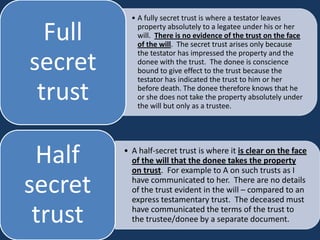
• A fully secret trust is where a testator leaves

  Full       property absolutely to a legatee under his or her
             will. There is no evidence of the trust on the face
             of the will. The secret trust arises only because
             the testator has impressed the property and the
secret       donee with the trust. The donee is conscience
             bound to give effect to the trust because the
             testator has indicated the trust to him or her

 trust       before death. The donee therefore knows that he
             or she does not take the property absolutely under
             the will but only as a trustee.


 Half    • A half-secret trust is where it is clear on the face
           of the will that the donee takes the property
           on trust. For example to A on such trusts as I

secret     have communicated to her. There are no details
           of the trust evident in the will – compared to an
           express testamentary trust. The deceased must

 trust     have communicated the terms of the trust to
           the trustee/donee by a separate document.
The requirements for a half-secret trust to be valid are similar to those for fully secret
 trusts, and were laid out in Blackwell v Blackwell, where a testator gave five trustees
pieces of property, instructing them (in the will) to hold on to this property as they had
been asked. Prior to the testator's death, the trustees had all been told what to do with
                          the property. Lord Sumner said that:
The necessary elements [to create a half-secret trust], on which the question turns, are

 1. INTENTION : If the trust is
secret then clearly there must
     be some evidence of it
    somewhere if it is to be
enforceable. An expression of          2. COMMUNICATION :
                                                                  3. ACQUIESCENE : The trustee
 a mere hope or “precatory”        communication of the trust to
                                                                      must also agree either
words is not sufficient. In the    the trustee – otherwise his or
                                                                  expressly or implicitly – silence
case of Re Snowden [1979} All        her conscience will not be
                                                                   may be sufficient – to hold as
   ER 172, the deceased left       bound. Thus the legatee must
                                                                        trustee. It can be
property to her brother in the     know before or at the time of
                                                                      communicated either
hope that he would do with it      receiving the property that he
                                                                        directly, or tacitly.
  what he thought she would              takes it as a trustee
 have wanted. This was held
 not to be sufficient to give a
clear indication of intention to
         set up a trust.
1st element : Intention to subject the
          trustee to an obligation


Thus an intention
                      In the case of Re Snowden, court held that
to impose a moral
                     it was only a moral obligation which cannot
 obligation on the
                         be construe as a positive intention to
  legatee is not
                        create a trust. The property thus passed
    sufficient to
                          beneficially under the brother’s will
   create a trust
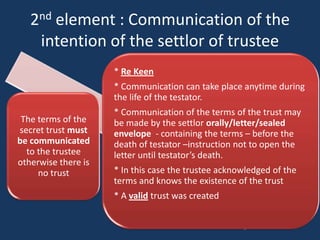
2nd element : Communication of the
    intention of the settlor of trustee
                     * Re Keen
                     * Communication can take place anytime during
                     the life of the testator.
                     * Communication of the terms of the trust may
 The terms of the    be made by the settlor orally/letter/sealed
secret trust must    envelope - containing the terms – before the
be communicated      death of testator –instruction not to open the
  to the trustee     letter until testator’s death.
otherwise there is
     no trust        * In this case the trustee acknowledged of the
                     terms and knows the existence of the trust
                     * A valid trust was created
3rd element : Acquiescene/that the
      trustee accepted his obligations

                       Ottoway v Norman 1972
  To prevent fraud     Testator left property to
 on the part of the
      trustee its      housekeeper provided she left it
important that the     to his son and daughter-in-law
     trustee has       [Ottoways] after her death – she
 accepted office of
 trustee otherwise     agreed – he died – she took – she
there is no fraud in   died – left not to the Ottoways
   the gift of the
       testator        but to Norman – held the
                       Ottoways took.
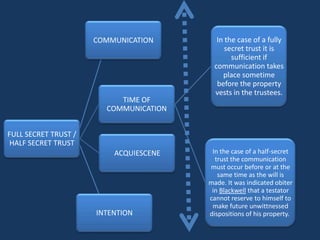
COMMUNICATION        In the case of a fully
                                              secret trust it is
                                                sufficient if
                                          communication takes
                                             place sometime
                                           before the property
                                          vests in the trustees.
                           TIME OF
                        COMMUNICATION


FULL SECRET TRUST /
 HALF SECRET TRUST
                          ACQUIESCENE    In the case of a half-secret
                                          trust the communication
                                        must occur before or at the
                                           same time as the will is
                                        made. It was indicated obiter
                                         in Blackwell that a testator
                                        cannot reserve to himself to
                                         make future unwittnessed
                      INTENTION         dispositions of his property.
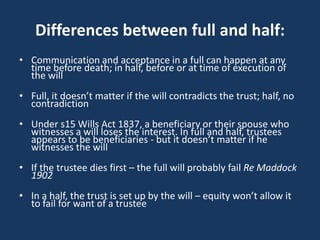
Differences between full and half:
• Communication and acceptance in a full can happen at any
  time before death; in half, before or at time of execution of
  the will
• Full, it doesn’t matter if the will contradicts the trust; half, no
  contradiction
• Under s15 Wills Act 1837, a beneficiary or their spouse who
  witnesses a will loses the interest. In full and half, trustees
  appears to be beneficiaries - but it doesn’t matter if he
  witnesses the will
• If the trustee dies first – the full will probably fail Re Maddock
  1902
• In a half, the trust is set up by the will – equity won’t allow it
  to fail for want of a trustee
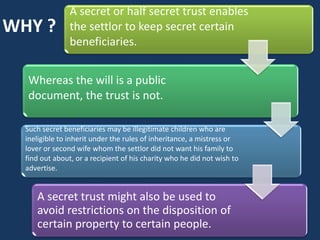
A secret or half secret trust enables
WHY ?           the settlor to keep secret certain
                beneficiaries.


  Whereas the will is a public
  document, the trust is not.

  Such secret beneficiaries may be illegitimate children who are
  ineligible to inherit under the rules of inheritance, a mistress or
  lover or second wife whom the settlor did not want his family to
  find out about, or a recipient of his charity who he did not wish to
  advertise.


     A secret trust might also be used to
     avoid restrictions on the disposition of
     certain property to certain people.
Secret trust

Secret trust

  • 1.
    ‘A trust isthe binding of the conscience of one to the intention another’ - per Viscount Sumner in Blackwell v Blackwell (1929) AC 318 In the light of the above statement, illustrate the conditions for validity of both full and half secret trusts.
  • 2.
    • The secrettrusts comprise both: • Full secret trusts • half-secret trusts • They are a relic of a bygone era and do not conform to established trust principles. Their prior purpose has largely disappeared Definition with the changing patterns and expectations of social behaviour. They do however find a limited place with the testator who is hesitant and cannot make up his mind. Some explanation of the similarities and difference of the two types of secret trust will lead on to an evaluation of why they might be justified.
  • 3.
    • A fullysecret trust is where a testator leaves Full property absolutely to a legatee under his or her will. There is no evidence of the trust on the face of the will. The secret trust arises only because the testator has impressed the property and the secret donee with the trust. The donee is conscience bound to give effect to the trust because the testator has indicated the trust to him or her trust before death. The donee therefore knows that he or she does not take the property absolutely under the will but only as a trustee. Half • A half-secret trust is where it is clear on the face of the will that the donee takes the property on trust. For example to A on such trusts as I secret have communicated to her. There are no details of the trust evident in the will – compared to an express testamentary trust. The deceased must trust have communicated the terms of the trust to the trustee/donee by a separate document.
  • 4.
    The requirements fora half-secret trust to be valid are similar to those for fully secret trusts, and were laid out in Blackwell v Blackwell, where a testator gave five trustees pieces of property, instructing them (in the will) to hold on to this property as they had been asked. Prior to the testator's death, the trustees had all been told what to do with the property. Lord Sumner said that: The necessary elements [to create a half-secret trust], on which the question turns, are 1. INTENTION : If the trust is secret then clearly there must be some evidence of it somewhere if it is to be enforceable. An expression of 2. COMMUNICATION : 3. ACQUIESCENE : The trustee a mere hope or “precatory” communication of the trust to must also agree either words is not sufficient. In the the trustee – otherwise his or expressly or implicitly – silence case of Re Snowden [1979} All her conscience will not be may be sufficient – to hold as ER 172, the deceased left bound. Thus the legatee must trustee. It can be property to her brother in the know before or at the time of communicated either hope that he would do with it receiving the property that he directly, or tacitly. what he thought she would takes it as a trustee have wanted. This was held not to be sufficient to give a clear indication of intention to set up a trust.
  • 5.
    1st element :Intention to subject the trustee to an obligation Thus an intention In the case of Re Snowden, court held that to impose a moral it was only a moral obligation which cannot obligation on the be construe as a positive intention to legatee is not create a trust. The property thus passed sufficient to beneficially under the brother’s will create a trust
  • 6.
    2nd element :Communication of the intention of the settlor of trustee * Re Keen * Communication can take place anytime during the life of the testator. * Communication of the terms of the trust may The terms of the be made by the settlor orally/letter/sealed secret trust must envelope - containing the terms – before the be communicated death of testator –instruction not to open the to the trustee letter until testator’s death. otherwise there is no trust * In this case the trustee acknowledged of the terms and knows the existence of the trust * A valid trust was created
  • 7.
    3rd element :Acquiescene/that the trustee accepted his obligations Ottoway v Norman 1972 To prevent fraud Testator left property to on the part of the trustee its housekeeper provided she left it important that the to his son and daughter-in-law trustee has [Ottoways] after her death – she accepted office of trustee otherwise agreed – he died – she took – she there is no fraud in died – left not to the Ottoways the gift of the testator but to Norman – held the Ottoways took.
  • 8.
    COMMUNICATION In the case of a fully secret trust it is sufficient if communication takes place sometime before the property vests in the trustees. TIME OF COMMUNICATION FULL SECRET TRUST / HALF SECRET TRUST ACQUIESCENE In the case of a half-secret trust the communication must occur before or at the same time as the will is made. It was indicated obiter in Blackwell that a testator cannot reserve to himself to make future unwittnessed INTENTION dispositions of his property.
  • 9.
    Differences between fulland half: • Communication and acceptance in a full can happen at any time before death; in half, before or at time of execution of the will • Full, it doesn’t matter if the will contradicts the trust; half, no contradiction • Under s15 Wills Act 1837, a beneficiary or their spouse who witnesses a will loses the interest. In full and half, trustees appears to be beneficiaries - but it doesn’t matter if he witnesses the will • If the trustee dies first – the full will probably fail Re Maddock 1902 • In a half, the trust is set up by the will – equity won’t allow it to fail for want of a trustee
  • 10.
    A secret orhalf secret trust enables WHY ? the settlor to keep secret certain beneficiaries. Whereas the will is a public document, the trust is not. Such secret beneficiaries may be illegitimate children who are ineligible to inherit under the rules of inheritance, a mistress or lover or second wife whom the settlor did not want his family to find out about, or a recipient of his charity who he did not wish to advertise. A secret trust might also be used to avoid restrictions on the disposition of certain property to certain people.