Sharifah Zubaidah
Sem.2 (2008/2009)
 1) Application for Order for Sale at the Land
Office
 2) Purchase Money
 3) Sale of Land by Private Treaty
 4) Discharge of Charge
 5) Taking Possession by Chargee
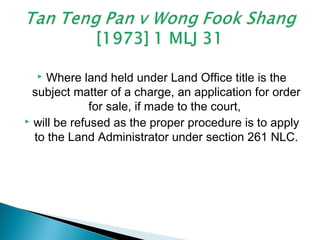
 Where land held under Land Office title is the
subject matter of a charge, an application for order
for sale, if made to the court,
 will be refused as the proper procedure is to apply
to the Land Administrator under section 261 NLC.
 Order for sale in respect of Land Office title, if
made by the court under section 256 NLC, can be
nullified and is of no effect.
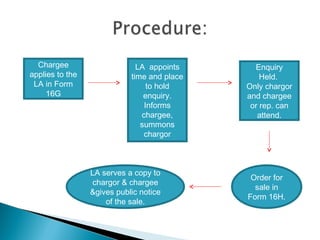
Chargee
applies to the
LA in Form
16G
LA appoints
time and place
to hold
enquiry.
Informs
chargee,
summons
chargor
Enquiry
Held.
Only chargor
and chargee
or rep. can
attend.
Order for
sale in
Form 16H.
LA serves a copy to
chargor & chargee
&gives public notice
of the sale.
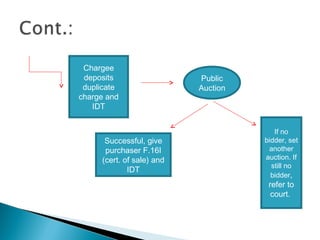
Chargee
deposits
duplicate
charge and
IDT
Public
Auction
Successful, give
purchaser F.16I
(cert. of sale) and
IDT
If no
bidder, set
another
auction. If
still no
bidder,
refer to
court.
 1) What is the nature of the Land
Administrator’s powers during the enquiry?
 Limited powers compared to a judge in court
under s.256 NLC.
 Powers of LA under s. 263 are non- judicial Purely
administrative. Determine default in charge and
ascertain cause to the contrary. Cannot go behind
the charge.
 The Land Administrator is to enquire whether the
chargor has defaulted in the charge, rather than
examining the merits of the charge or its validity.
 1) No existence of charge on the register.
 2) No breach of charge by the chargor.
 3) Breach is not caused by the chargor (e.g. chargee
hd refused to accept the monthly instalments by the
chargor.)
 (See: Govt. of Malaysia v Omar bn Hj. Ahmad [1983] 1
CLJ 242) – LA cannot make order for chargor to pay
the arrears due to chargee by instalments.)
 Land administrator may not disturb the order once it is
made.
 Exception: LA may cancel the order under s.264A ( by
application of chargee with concurrence of chargor).
 The order is final unless an appeal is brought to the
High Court under section 418 NLC.
 - possible grounds to challenge? Defeat the charge
under the exceptions to indefeasibility under s.340(2)
NLC.
 FC held:
 LA is functus officio after the order for sale is
given except his power to postpone the sale under
s. 264(3) NLC.
 Although the chargor is still the legal owner of the
land, during the auction stage, the chargee is
regarded as the vendor as it has been granted
with the order for sale and prepares the conditions
for sale.
 (Malayan United Finance Bhd., JB v Liew Yet Lan
[1990] 1 MLJ 317)
 Both in court and in the land office, the sale is
concluded at the fall of the auctioneer’s hammer.
 A contract of sale is formed between the vendor
and the highest bidder but ownership of the land
does not pass to the purchaser until registration.
 (Case: M&J Frozen S/B v Siland S/B [1994] 1 MLJ
294)
See s. 265(2) and (3):
The LA may schedule the public auction up to a
maximum of 3 times, afterwhich he must withdraw
the land from the sale and refer the matter to the
court.
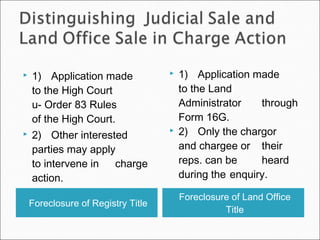
Foreclosure of Registry Title
Foreclosure of Land Office
Title
 1) Application made
to the High Court
u- Order 83 Rules
of the High Court.
 2) Other interested
parties may apply
to intervene in charge
action.
 1) Application made
to the Land
Administrator through
Form 16G.
 2) Only the chargor
and chargee or their
reps. can be heard
during the enquiry.
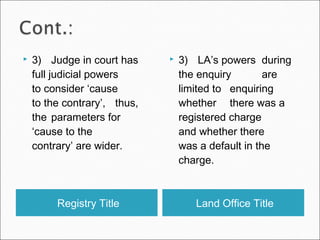
Registry Title Land Office Title
 3) Judge in court has
full judicial powers
to consider ‘cause
to the contrary’, thus,
the parameters for
‘cause to the
contrary’ are wider.
 3) LA’s powers during
the enquiry are
limited to enquiring
whether there was a
registered charge
and whether there
was a default in the
charge.
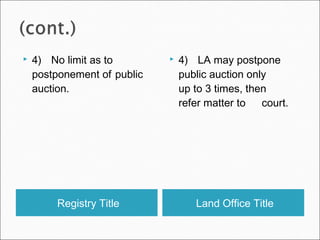
Registry Title Land Office Title
 4) No limit as to
postponement of public
auction.
 4) LA may postpone
public auction only
up to 3 times, then
refer matter to court.
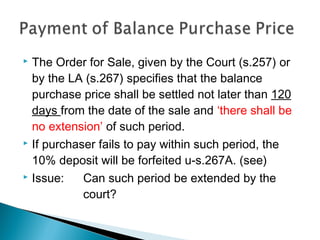
 The Order for Sale, given by the Court (s.257) or
by the LA (s.267) specifies that the balance
purchase price shall be settled not later than 120
days from the date of the sale and ‘there shall be
no extension’ of such period.
 If purchaser fails to pay within such period, the
10% deposit will be forfeited u-s.267A. (see)
 Issue: Can such period be extended by the
court?
 Purchaser had failed to pay the balance purchase
price on time and sought an extension order from
the court without giving notice to the chargor. HC
allowed. Chargor appealed.
 Issue: Whether the Court has the power to
extend time for a defaulting
purchaser ?
 As the application to court for alteration of the order for
sale (i.e. extension of the period to pay the balance
purchase price) was made without giving notice to the
chargor, the order was VOID for being ultra-vires the
NLC.
 Note: The judgment in this case excellently
explains the rights of a chargor in a judicial sale.
 The Court of Appeal in Chi Liung Holdings S/B v
L&T Realty S/B [2000] 4 CLJ 8, (distinguishing
M&J Frozens’ case) has held:
 If the ‘Conditions of Sale’ expressly allow the
extension of time, an order of court to approve
such extension of time is valid.
 Certificate of sale given to a purchaser is an
instrument of dealing that upon registration will
pass the title/interest of the chargor in the
land/lease to the purchaser.
 Land/lease is discharged from all liabilities under
the charge.
 See s.268:
 a) payment of rent due to SA or local authority;
 b) payment of expenses incurred in making and
carrying out the order for sale;
 c) payment of chargee of total amount due
under the charge;
 d) sums subsequently due if charge is to
secure annuity payments/ periodic sums;
 e) payment of subsequent charges.
 Chargor, when the order for sale has been made,
may, at any time before conclusion of the sale,
tender the amounts due to the chargee and all
expenses incurred in making and carrying out the
order for sale, to the Registrar or LA, as the case
may be.
 The order for sale will then cease to have effect.
 Q: When is a sale considered ‘concluded’ for
purposes of this section?
 Issue:
 Whether the chargee, upon default of the chargor,
may sell the land by private treaty instead of
applying to the court/ LA for an order for sale?
 The chargee may sell the land by private treaty on
default of the chargor but once the chargee takes
proceedings under the legislation, then a public
auction must be ordered.
 High Court:
 The provisions of the NLC relating to charge
actions contemplate a sale by public auction only
and as such the court has no power to order a
sale by private treaty under the Code.
In this case, the High Court held that once the order
for sale is granted by the court under s. 257, the
court does not have the power to make a
subsequent order for the charged property to be
sold by private treaty.
 Chung Khiaw Bank Ltd v Lau Ah Yen & Anor.
[1989]
 In view of the right of a chargor to tender amounts
to discharge the charge before conclusion of the
sale under s. 266(1), the court may allow a chargor
of any land to sell the land in question by private
treaty where the court is satisfied that the proceeds
of such sale are not less than the amount due
under the charge and that the chargee will be duly
paid in full out of the said proceeds.
 Supreme Ct. observed:
 Before any commencement of proceedings for an
order for sale, a chargor has a right to sell, with
consent of the chargee, the charged property.
 The High Court in UMBC Bhd v Chong Bun Sun &
Anor. [1994], in obiter, held that the chargor still
has the right to sell the land by private treaty after
the grant of the order for sale as long as sale by
public auction has not been concluded. For this
purpose, the chargor should first get the consent
of the chargee. No need to apply to court.
 A discharge of charge is done by way of the
chargor paying of all amounts due under the
charge and the chargee then proceeding to file in
Form 16N to be registered at the land office.
 The remedy of possession given to the chargee
under the Code is designed to allow the chargee
to secure some payments and profits from the
land whilst the title to the land still remains with
the chargor.
 However, in providing this remedy, the Code has
limited it only to registry title and where such lands
are town and village lands, the chargor should not
be in occupation of such lands.
 See s.270:
 1) Does not apply to Land Office title.
 2) Does not apply to charge of undivided share
of land.
 3) Does not apply to town or village land held
under Registry Title that is occupied by the
chargor.
 4) Available to first chargees only.
 Thus, the remedy of possession is not open to the
chargee if the chargor is still occupying such land.
 S.271(1):
 a) By receiving the rent payable to the chargor, if
there is a tenant or lessee on the land; (How?
Chargee serves F.16J on tenant/lessee – s.272)
 b) If no tenant or lessee, by going into
occupation thereof; (Chargee serves F. 16K on
chargor – s.272). U- s.273, chargee may after
that lease the land and collect rent.
charges 4

charges 4

  • 1.
  • 2.
     1) Applicationfor Order for Sale at the Land Office  2) Purchase Money  3) Sale of Land by Private Treaty  4) Discharge of Charge  5) Taking Possession by Chargee
  • 3.
     Where landheld under Land Office title is the subject matter of a charge, an application for order for sale, if made to the court,  will be refused as the proper procedure is to apply to the Land Administrator under section 261 NLC.
  • 4.
     Order forsale in respect of Land Office title, if made by the court under section 256 NLC, can be nullified and is of no effect.
  • 5.
    Chargee applies to the LAin Form 16G LA appoints time and place to hold enquiry. Informs chargee, summons chargor Enquiry Held. Only chargor and chargee or rep. can attend. Order for sale in Form 16H. LA serves a copy to chargor & chargee &gives public notice of the sale.
  • 6.
    Chargee deposits duplicate charge and IDT Public Auction Successful, give purchaserF.16I (cert. of sale) and IDT If no bidder, set another auction. If still no bidder, refer to court.
  • 7.
     1) Whatis the nature of the Land Administrator’s powers during the enquiry?  Limited powers compared to a judge in court under s.256 NLC.  Powers of LA under s. 263 are non- judicial Purely administrative. Determine default in charge and ascertain cause to the contrary. Cannot go behind the charge.
  • 8.
     The LandAdministrator is to enquire whether the chargor has defaulted in the charge, rather than examining the merits of the charge or its validity.
  • 9.
     1) Noexistence of charge on the register.  2) No breach of charge by the chargor.  3) Breach is not caused by the chargor (e.g. chargee hd refused to accept the monthly instalments by the chargor.)  (See: Govt. of Malaysia v Omar bn Hj. Ahmad [1983] 1 CLJ 242) – LA cannot make order for chargor to pay the arrears due to chargee by instalments.)
  • 10.
     Land administratormay not disturb the order once it is made.  Exception: LA may cancel the order under s.264A ( by application of chargee with concurrence of chargor).  The order is final unless an appeal is brought to the High Court under section 418 NLC.  - possible grounds to challenge? Defeat the charge under the exceptions to indefeasibility under s.340(2) NLC.
  • 11.
     FC held: LA is functus officio after the order for sale is given except his power to postpone the sale under s. 264(3) NLC.
  • 12.
     Although thechargor is still the legal owner of the land, during the auction stage, the chargee is regarded as the vendor as it has been granted with the order for sale and prepares the conditions for sale.  (Malayan United Finance Bhd., JB v Liew Yet Lan [1990] 1 MLJ 317)
  • 13.
     Both incourt and in the land office, the sale is concluded at the fall of the auctioneer’s hammer.  A contract of sale is formed between the vendor and the highest bidder but ownership of the land does not pass to the purchaser until registration.  (Case: M&J Frozen S/B v Siland S/B [1994] 1 MLJ 294)
  • 14.
    See s. 265(2)and (3): The LA may schedule the public auction up to a maximum of 3 times, afterwhich he must withdraw the land from the sale and refer the matter to the court.
  • 15.
    Foreclosure of RegistryTitle Foreclosure of Land Office Title  1) Application made to the High Court u- Order 83 Rules of the High Court.  2) Other interested parties may apply to intervene in charge action.  1) Application made to the Land Administrator through Form 16G.  2) Only the chargor and chargee or their reps. can be heard during the enquiry.
  • 16.
    Registry Title LandOffice Title  3) Judge in court has full judicial powers to consider ‘cause to the contrary’, thus, the parameters for ‘cause to the contrary’ are wider.  3) LA’s powers during the enquiry are limited to enquiring whether there was a registered charge and whether there was a default in the charge.
  • 17.
    Registry Title LandOffice Title  4) No limit as to postponement of public auction.  4) LA may postpone public auction only up to 3 times, then refer matter to court.
  • 18.
     The Orderfor Sale, given by the Court (s.257) or by the LA (s.267) specifies that the balance purchase price shall be settled not later than 120 days from the date of the sale and ‘there shall be no extension’ of such period.  If purchaser fails to pay within such period, the 10% deposit will be forfeited u-s.267A. (see)  Issue: Can such period be extended by the court?
  • 19.
     Purchaser hadfailed to pay the balance purchase price on time and sought an extension order from the court without giving notice to the chargor. HC allowed. Chargor appealed.  Issue: Whether the Court has the power to extend time for a defaulting purchaser ?
  • 20.
     As theapplication to court for alteration of the order for sale (i.e. extension of the period to pay the balance purchase price) was made without giving notice to the chargor, the order was VOID for being ultra-vires the NLC.  Note: The judgment in this case excellently explains the rights of a chargor in a judicial sale.
  • 21.
     The Courtof Appeal in Chi Liung Holdings S/B v L&T Realty S/B [2000] 4 CLJ 8, (distinguishing M&J Frozens’ case) has held:  If the ‘Conditions of Sale’ expressly allow the extension of time, an order of court to approve such extension of time is valid.
  • 22.
     Certificate ofsale given to a purchaser is an instrument of dealing that upon registration will pass the title/interest of the chargor in the land/lease to the purchaser.  Land/lease is discharged from all liabilities under the charge.
  • 23.
     See s.268: a) payment of rent due to SA or local authority;  b) payment of expenses incurred in making and carrying out the order for sale;  c) payment of chargee of total amount due under the charge;  d) sums subsequently due if charge is to secure annuity payments/ periodic sums;  e) payment of subsequent charges.
  • 24.
     Chargor, whenthe order for sale has been made, may, at any time before conclusion of the sale, tender the amounts due to the chargee and all expenses incurred in making and carrying out the order for sale, to the Registrar or LA, as the case may be.  The order for sale will then cease to have effect.  Q: When is a sale considered ‘concluded’ for purposes of this section?
  • 25.
     Issue:  Whetherthe chargee, upon default of the chargor, may sell the land by private treaty instead of applying to the court/ LA for an order for sale?
  • 26.
     The chargeemay sell the land by private treaty on default of the chargor but once the chargee takes proceedings under the legislation, then a public auction must be ordered.
  • 27.
     High Court: The provisions of the NLC relating to charge actions contemplate a sale by public auction only and as such the court has no power to order a sale by private treaty under the Code.
  • 28.
    In this case,the High Court held that once the order for sale is granted by the court under s. 257, the court does not have the power to make a subsequent order for the charged property to be sold by private treaty.
  • 29.
     Chung KhiawBank Ltd v Lau Ah Yen & Anor. [1989]  In view of the right of a chargor to tender amounts to discharge the charge before conclusion of the sale under s. 266(1), the court may allow a chargor of any land to sell the land in question by private treaty where the court is satisfied that the proceeds of such sale are not less than the amount due under the charge and that the chargee will be duly paid in full out of the said proceeds.
  • 30.
     Supreme Ct.observed:  Before any commencement of proceedings for an order for sale, a chargor has a right to sell, with consent of the chargee, the charged property.
  • 31.
     The HighCourt in UMBC Bhd v Chong Bun Sun & Anor. [1994], in obiter, held that the chargor still has the right to sell the land by private treaty after the grant of the order for sale as long as sale by public auction has not been concluded. For this purpose, the chargor should first get the consent of the chargee. No need to apply to court.
  • 32.
     A dischargeof charge is done by way of the chargor paying of all amounts due under the charge and the chargee then proceeding to file in Form 16N to be registered at the land office.
  • 34.
     The remedyof possession given to the chargee under the Code is designed to allow the chargee to secure some payments and profits from the land whilst the title to the land still remains with the chargor.  However, in providing this remedy, the Code has limited it only to registry title and where such lands are town and village lands, the chargor should not be in occupation of such lands.
  • 35.
     See s.270: 1) Does not apply to Land Office title.  2) Does not apply to charge of undivided share of land.  3) Does not apply to town or village land held under Registry Title that is occupied by the chargor.  4) Available to first chargees only.  Thus, the remedy of possession is not open to the chargee if the chargor is still occupying such land.
  • 36.
     S.271(1):  a)By receiving the rent payable to the chargor, if there is a tenant or lessee on the land; (How? Chargee serves F.16J on tenant/lessee – s.272)  b) If no tenant or lessee, by going into occupation thereof; (Chargee serves F. 16K on chargor – s.272). U- s.273, chargee may after that lease the land and collect rent.