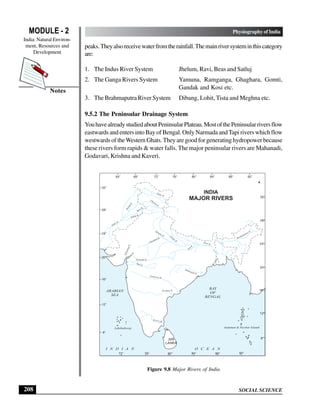
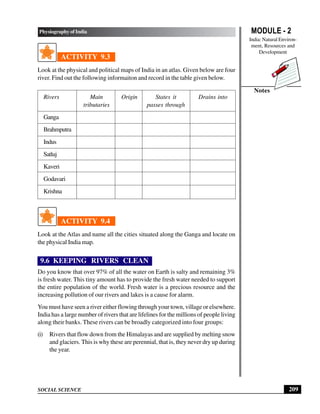
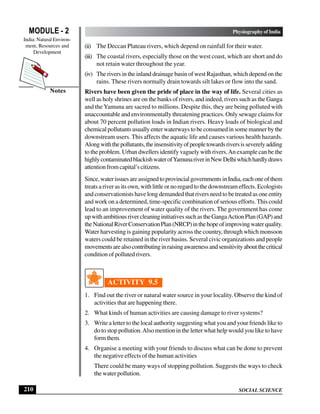
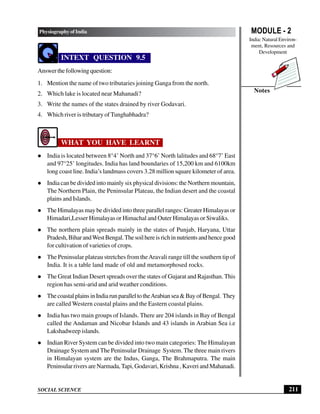
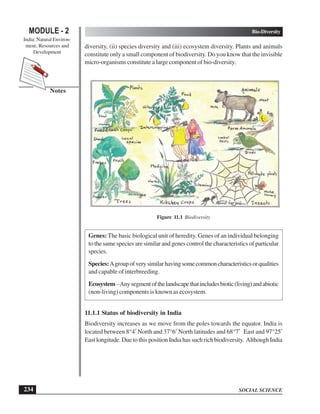
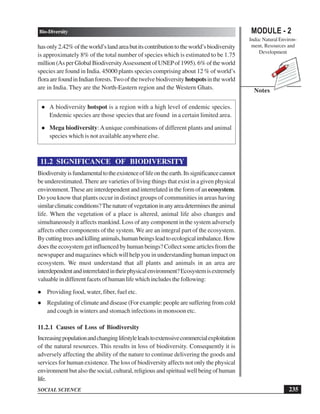
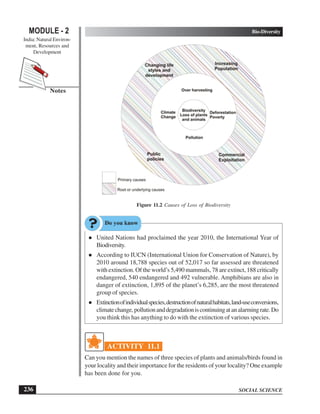
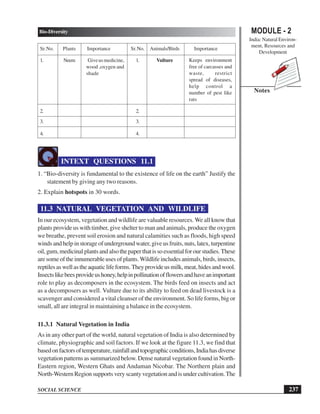
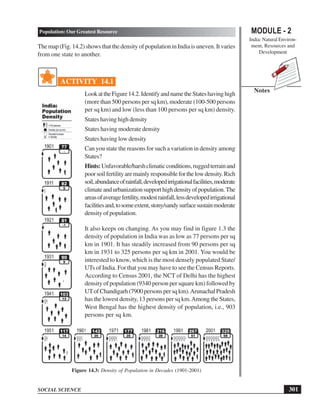
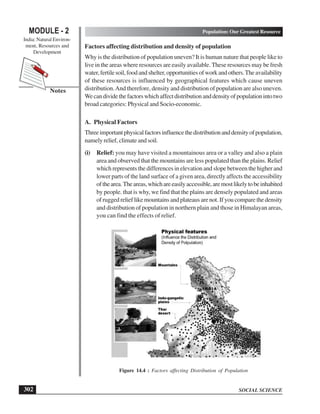
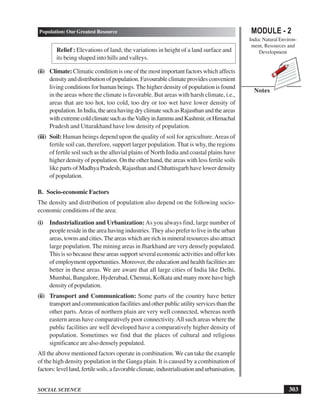
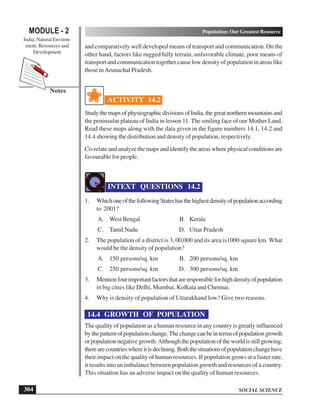
MODULE - 2
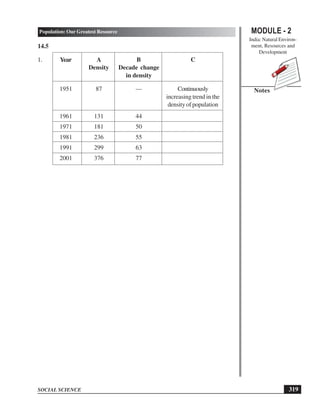
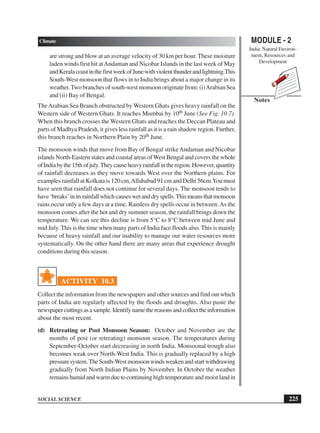
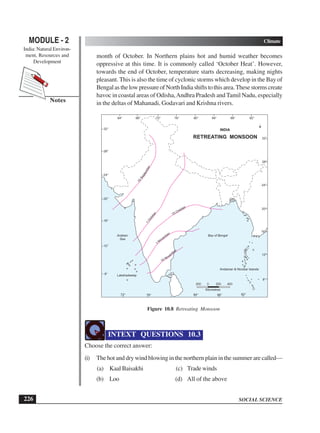
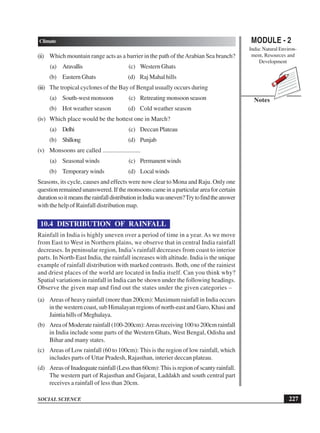
India: Natural Environ-
ment, Resources and
Development
193
Physiography of India
SOCIAL SCIENCE
Notes
9
PHYSIOGRAPHY OF INDIA
Tutor : Dear learners, you will agree that the place to which we belong has many
influences on our thinking and behaiour. Let us try to know which place
do we belong to?
Natasha : I belong to Hisar town. Farah is from Fatehabad and Rajinder comes
fromBhiwani.
Tutor : Do you know where all these places are located?
Rajinder : Yes, they are in Haryana as well as in India. But, where is India located?
Farah : What is the need to know India’s location?
Tutor : Locationofacountryisthekeytoitsidentity.Itdeterminestheimportant
aspectslikeclimate,vegetation,agriculture,resourcesetc.Thishasadeep
impact on the way people of that area live, what they eat and how
powerful is their voice on the world stage. Therefore, to understand the
various aspects of India, we need to look into its location. Let us discuss
more about it in this lesson.
OBJECTIVES
After studying this lesson you will be able to:
l describe the location of India in terms of latitude and longitude;
l describe with the help of map, the significance of the relative location of India
in terms of neighbouring countries;
l illustrate the States and UnionTerritories with the help of political map of India;
l explain the major physical divisions of India;
l describe the drainage system in India;
l compare and contrast between the Himalayan and the Peninsular drainage
system; and
l explain the importance of people’s participation in keeping river clean.
SOCIAL SCIENCE
MODULE - 2 Physiography of India
India: Natural Environ-
ment, Resources and
Development
194
Notes
9.1 LOCATION
Teacher: Learners, when someone asks where India is, we can answer in two ways,
in terms of absolute and relative location. Let us see what we mean by absolute
location and relative location.Absolute location is given in degrees of latitude and
longitude. Relative location depends upon point of reference, e.g., near, far etc.
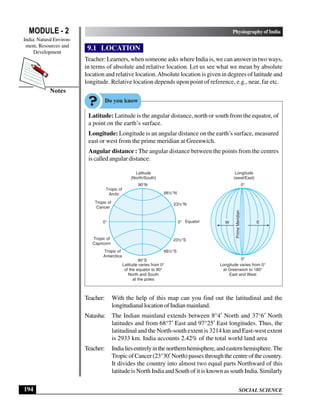
Latitude: Latitude is the angular distance, north or south from the equator, of
a point on the earth’s surface.
Longitude: Longitude is an angular distance on the earth’s surface, measured
east or west from the prime meridian at Greenwich.
Angular distance : The angular distance between the points from the centres
is called angular distance.
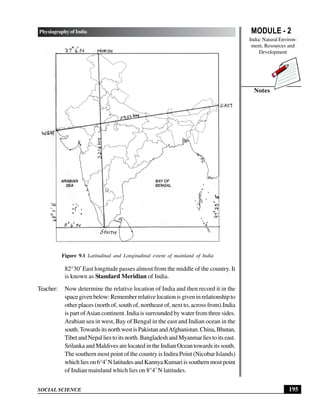
Teacher: With the help of this map can you find out the latitudinal and the
longitudianallocationofIndianmainland.
Natasha: The Indian mainland extends between 8°4′ North and 37°6′ North
latitudes and from 68°7′ East and 97°25′ East longitudes. Thus, the
latitudinal and the North-south extent is 3214 km and East-west extent
is 2933 km. India accounts 2.42% of the total world land area
Teacher: Indialiesentirelyinthenorthernhemisphere,andeasternhemisphere.The
TropicofCancer(23°30′North)passesthroughthecentreofthecountry.
It divides the country into almost two equal parts Northward of this
latitude is North India and South of it is known as south India. Similarly
90°N
Longitude
(west/East)
Latitude varies from 0°
of the equator to 90°
North and South
at the poles
90°S
Longitude varies from 0°
at Greenwich to 180°
East and West
W E
Equator
0° 0°
0°
0°
Tropic of
Antarctica
Tropic of
Capricorn
Tropic of
Cancer
Tropic of
Arctic 66½°N
23½°N
23½°S
66½°S
Prime
Meridian
Latitude
(North/South)
MODULE - 2
India: Natural Environ-
ment, Resources and
Development
195
Physiography of India
SOCIAL SCIENCE
Notes
82°30′ East longitude passes almost from the middle of the country. It
is known as Standard Meridian of India.
Teacher: Now determine the relative location of India and then record it in the
spacegivenbelow:Rememberrelativelocationisgiveninrelationshipto
other places (north of, south of, northeast of, next to, across from).India
is part ofAsian continent. India is surrounded by water from three sides.
Arabian sea in west, Bay of Bengal in the east and Indian ocean in the
south.TowardsitsnorthwestisPakistanandAfghanistan.China,Bhutan,
TibetandNepalliestoitsnorth.BangladeshandMyanmarliestoitseast.
Srilanka and Maldives are located in the Indian Ocean towards its south.
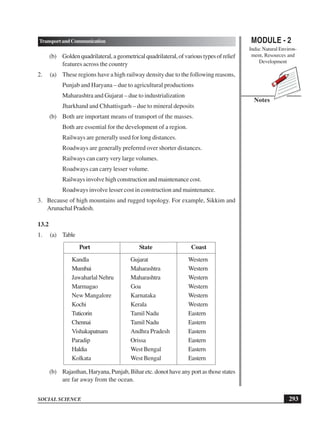
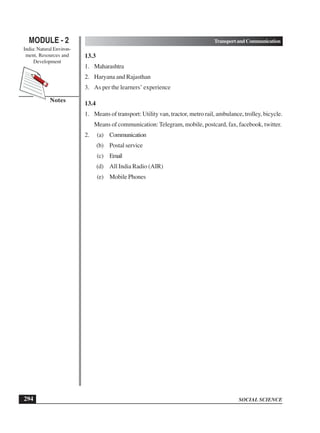
The southern most point of the country is Indira Point (Nicobar Islands)
whichlieson6°4′ NlatitudesandKannyaKumariissouthernmostpoint
of Indian mainland which lies on 8°4′ N latitudes.
Figure 9.1 Latitudinal and Longitudinal extent of mainland of India
SOCIAL SCIENCE
MODULE - 2 Physiography of India
India: Natural Environ-
ment, Resources and
Development
196
Notes
The 82°30′E longitude passes through Mirzapur (in Uttar Pradesh). This is the
Standard Meridian of the country. The 82°30′ East has been selected as
standard Merdian because there is a time lag of almost two hours between
Gujarat andArunanchal Pradesh. Therefore, a Central Meridian is selected to
determine the time for the whole country.
9.1.1 Locational Significance
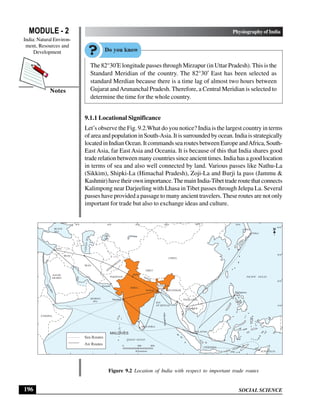
Let’s observe the Fig. 9.2.What do you notice? India is the largest country in terms
ofareaandpopulationinSouth-Asia.Itissurroundedbyocean. Indiaisstrategically
locatedinIndianOcean.ItcommandssearoutesbetweenEuropeandAfrica,South-
East Asia, far East Asia and Oceania. It is because of this that India shares good
trade relation between many countries since ancient times. India has a good location
in terms of sea and also well connected by land. Various passes like Nathu-La
(Sikkim), Shipki-La (Himachal Pradesh), Zoji-La and Burji la pass (Jammu &
Kashmir)havetheirownimportance.ThemainIndia-Tibettraderoutethatconnects
Kalimpong near Darjeeling with Lhasa in Tibet passes through Jelepa La. Several
passes have provided a passage to many ancient travelers. These routes are not only
important for trade but also to exchange ideas and culture.
Figure 9.2 Location of India with respect to important trade routes
INDIA
NEPAL
CHINA
MYANMAR
PAKISTAN
SAUDI
ARABIA
IRAN
IRAQ
BANGLA
DESH
AFGHANISTAN
THAILAND
JAPAN
INDONSIA
ETHOPIA
Syria
Karachi
ARABIAN
SEA BAY
OF BENGAL
INDIAN OCEAN
PACIFIC OCEAN
R
E
D
S
E
A
ARAL
SEA
CA
SP
IA
N
SE
A
BLACK
SEA
TIBET
0 400 800
Kilometres
Delhi
Mumbai
Kolkata
SRI LANKA
Bangkok
Philippines
Tokyo
AUSTRALIA
MALAYSIA
Sea Routes
Air Routes
MALDIVES
40°E 60°E 80°E 100°E 120°E 140°E
40°N
30°N
20°N
10°N
0°
MODULE - 2
India: Natural Environ-
ment, Resources and
Development
197
Physiography of India
SOCIAL SCIENCE
Notes
INTEXT QUESTIONS 9.1
1. Look at the map 9.2 and answer the following questions.
(i) Find out the names of two countries lying to the eastern side of India.
(ii) Mention the names of two seas located on the eastern and western side
of India.
(iii) Which country is connected to India by Palk Strait?
(iv) Write the names of two countries having a common border with India.
9.2 STATES AND UNION TERRITORIES OF INDIA
India is the seventh largest country in the world. It has land boundaries of 15,200
km and 6100km long coast line. India’s landmass covers 3.28 million square
kilometer of area. This accounts for nearly 2.42 percent of the total geographical
area of the world.
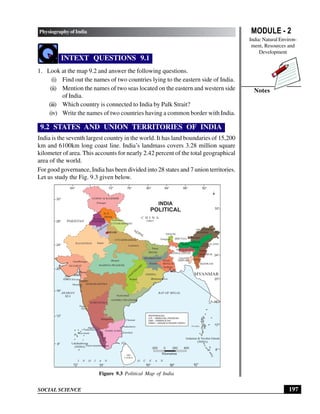
For good governance, India has been divided into 28 states and 7 union territories.
Let us study the Fig. 9.3 given below.
Figure 9.3 Political Map of India
200 0 200 400
Kilometres
SRI
LANKA
ARABIAN
SEA
I N D I A N O C E A N
Andaman & Nicobar Islands
(INDIA)
Lakshadweep
(INDIA)
C H I N A
TIBET
NEPAL
BHUTAN
BANGLADESH
PAKISTAN
JAMMU & KASHMIR
H. P.
PUNJAB
UTTARAKHAND
HARYANA
DELHI
RAJASTHAN
UTTARPRADESH
BIHAR
JHARKHAND
MADHYA PRADESH
GUJARAT
MAHARASHTRA
GOA
KARNATAKA
ANDHRA PRADESH
TAMIL NADU
K
E
R
A
L
A
ODISHA
C
H
A
T
T
I
S
G
A
R
H
WEST
BENGAL
ARUNACHAL
PRADESH
ASSAM
NAGALAND
MANIPUR
MIZORAM
MYANMAR
TRIPURA
MEGHALAYA
SIKKIM
Srinagar
Shimla
Dehradun
Chandigarh
Jaipur
Lucknow
Gandhinagar Bhopal
Mumbai
Raipur Bhubaneshwar
Ranchi
Patna
Kolkata
Gangtok
Itanagar
Kohima
Dispur
Shilong
Imphal
Aizawl
Agartala
Hyderabad
Panji
Bangaluru Chennai
Puducherry
Karaikal
Mahe
Thiruvananthapuram
Kavaratti
Port Blair
( Puducherry)
Daman
Silvasa
Diu
(D&D)
(D&D)
D&NH
REFERENCES
H.P. - HIMACHAL PRADESH
D&D - DAMAN & DIU
D&NH - DADAR & NAGAR HAVELI
64° 76° 80°
72° 84° 88° 92°
72° 84°
76° 88° 92°
8°
12°
16°
20°
24°
28°
32°
8°
12°
16°
20°
24°
28°
32°
INDIA
POLITICAL
BAY OF BEGAL
SOCIAL SCIENCE
MODULE - 2 Physiography of India
India: Natural Environ-
ment, Resources and
Development
198
Notes
This map clearly indicates that each state and union territory has its own capital. It
is interesting to note that while New Delhi is the capital of India, Delhi is the capital
of Union Territory Delhi. Can you identify any other capital like this? Yes, it is
Chandigarh which is the capital of two states Haryana and Punjab and also a Union
Territory.
ACTIVITY 9.1
Find out the minimum number of states you need to across, if you want to move
between the following places. (Refer Fig. 9.5)
(a) Kashmir to Mizoram (b) Punjab to Bihar (c) Delhi to Banglore
(d) Mumabi to Kolkata (e) Chennai to Raipur
INTEXT QUESTION 9.2
1. Look at the map 9.3 and answer the following questions.
(i) Write the names of two States of South India.
(ii) Mention the names of two states sharing international boundary.
(iii) Write the names of two countries sharing their boundaries with Sikkim.
(iv) Write the names of two union territories alongArabian Sea.
9.3 PHYSICAL DIVISIONS OF INDIA
Natasha : What is terrain?
Tutor : Terrain is an area of land which usually has a particular type of physical
feature.
Farah : Like, Mumbai beach is sandy and Shillong is a hilly.
Teacher : Right. Do you know India is a vast country with varied land forms and
topography?
Rajinder : What is the meaning of topography?
Teacher : Topography means the features of a place determined by nature. It is
the description of various features and landscape on the surface of the
earth.
Indiahasthetopographicaldiversity.ThisincludestheGreatHimalayas,theNorthern
Plain, the Thar desert, the coastal plains and the Peninsular Plateau. The reasons for
variation in the topography could be:
l Differences in the rock formations. These landmasses have been formed in
differentgeologicalperiods.
MODULE - 2
India: Natural Environ-
ment, Resources and
Development
199
Physiography of India
SOCIAL SCIENCE
Notes
l Number of processes such as weathering, erosion and deposition has modified
these features to their present forms.
Weathering: Weathering is the process of gradual destruction of rocks at or
near the earth’s surface through physical, chemical and biological processes
caused by wind water, climate change etc.
Erosion: Erosion is the process of gradual transportation of weathered rock
materials through natural agencies like wind, river, streams, glaciers etc.
Weathering is distinguished from Erosion as no transportation of material is
involved in case of weathering.
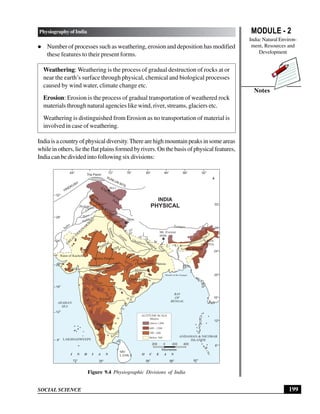
India is a country of physical diversity.There are high mountain peaks in some areas
while in others, lie the flat plains formed by rivers. On the basis of physical features,
India can be divided into following six divisions:
Figure 9.4 Physiographic Divisions of India
200 0 200 400
Kilometres
Nilgiri Hills
2637
Mt. Everest
8848
7817
8611
KARAKORAM
Indus
SHIW
ALIK
RANGE
GARO KHASI
JAINTIA
NAGA
A
R
A
V
A
L
I
R
A
N
G
E
G
R
E
A
T
I
N
D
I
A
N
D
E
S
E
R
T
Chota Nagpur Plateau
Malwa Plateau
SATPURA
D E C C A N
E
A
S
T
E
R
N
G
H
A
T
S
W
E
S
T
E
R
N
G
H
A
T
S
Rann of Kachchh
G
R
E
A
T
H
I M
A
L A Y A
Mahanadi
SRI
LANKA
ARABIAN
SEA
BAY
OF
BENGAL
LAKSHADWEEPS
ANDAMAN & NICOBAR
ISLANDS
ALTITUDE SCALE
Meters
Above 1200
600 - 1200
300 - 600
Below 300
Indus
Jhelum
Chenab
Ravi
Y
a
m
u
n
a
Ganga
Chambal
Betwa
Ghaghara Gandak
K
o
s
i
Brahmaputra
Godavari
Narmada
Tapi
Gir Hills
Chattisgarh
Mouth of the Ganges
I N D I A N O C E A N
Krishna
Kaveri
64° 76° 80°
72° 84° 88° 92°
72° 84°
76° 88° 92°
8°
12°
16°
20°
24°
28°
32°
8°
12°
16°
20°
24°
28°
32°
INDIA
PHYSICAL
The Pamir
HINDKUSH
KUNLUN MTS.
SOCIAL SCIENCE
MODULE - 2 Physiography of India
India: Natural Environ-
ment, Resources and
Development
200
Notes
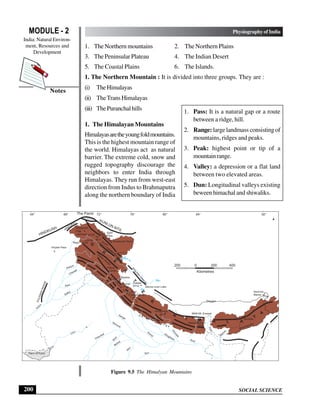
1. The Northern mountains 2. The Northern Plains
3. The Peninsular Plateau 4. The Indian Desert
5. The Coastal Plains 6. The Islands.
1. The Northern Mountain : It is divided into three groups. They are :
(i) TheHimalayas
(ii) TheTrans Himalayas
(iii) ThePuranchalhills
1. The Himalayan Mountains
Himalayasaretheyoungfoldmountains.
This is the highest mountain range of
the world. Himalayas act as natural
barrier. The extreme cold, snow and
rugged topography discourage the
neighbors to enter India through
Himalayas. They run from west-east
direction from Indus to Brahmaputra
along the northern boundary of India
1. Pass: It is a natural gap or a route
between a ridge, hill.
2. Range: large landmass consisting of
mountains, ridges and peaks.
3. Peak: highest point or tip of a
mountainrange.
4. Valley: a depression or a flat land
between two elevated areas.
5. Dun: Longitudinal valleys existing
beween himachal and shiwaliks.
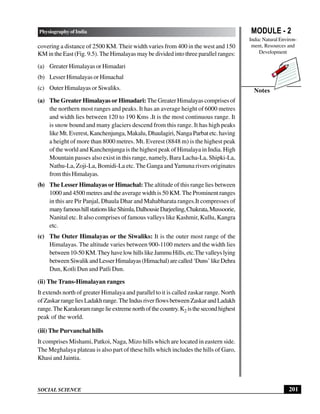
Figure 9.5 The Himalyan Mountains
200 0 200 400
Kilometres
The Pamir
HINDKUSH
KUNLUN MTS.
G
R
E
A
T
E
R
H
I M A L A
Y
A
HINDURAJ
S
U
L
E
M
A
N
R
A
N
G
E
I
n
d
u
s
Luni
Satluj
Ravi
Chenab
Jhelum
Shyok
Yamuna
Ganga
Chambal
Betwa
S
i
n
d
K
e
n
Son
Gom
ti
Ghaghara
G
a
n
d
a
k
Kosi
T
i
s
t
a
Brahmaputra
Rann of Kutch
Karakoram
Hills
Aghil
Pass
Khyber Pass
Karakoram Pass
K2
8611
7397
7788
Rakaposhi
Harmosh
8126
Naga Parwat
Bara
Lacha
Ladakh
Range
Zaskar Range
S
h
i w
a
l i k
R
a
n
g
e
L
E
S
S
A
R
H
I M
A
L
A
Y
A
Shipkila
K
A
I
L
A
S
H
R
A
N
G
E
Mansa rover Lake
Kailash
6714
Kamet
7750
7817
Nanda Devi
8078
Annapurna
8848 Mt. Everest
Kanchenjunga
8598
Bomdila
Tsangpo
7756
Namcha
Barwa
M
a
n
a
s
S h i w a l i k
R a n g e
64° 68° 76° 80°
72° 84° 92°
MODULE - 2
India: Natural Environ-
ment, Resources and
Development
201
Physiography of India
SOCIAL SCIENCE
Notes
covering a distance of 2500 KM. Their width varies from 400 in the west and 150
KM in the East (Fig. 9.5). The Himalayas may be divided into three parallel ranges:
(a) Greater Himalayas or Himadari
(b) Lesser Himalayas or Himachal
(c) Outer Himalayas or Siwaliks.
(a) The Greater Himalayas or Himadari: The Greater Himalayas comprises of
the northern most ranges and peaks. It has an average height of 6000 metres
and width lies between 120 to 190 Kms .It is the most continuous range. It
is snow bound and many glaciers descend from this range. It has high peaks
like Mt. Everest, Kanchenjunga, Makalu, Dhaulagiri, Nanga Parbat etc. having
a height of more than 8000 metres. Mt. Everest (8848 m) is the highest peak
of the world and Kanchenjunga is the highest peak of Himalaya in India. High
Mountain passes also exist in this range, namely, Bara Lacha-La, Shipki-La,
Nathu-La, Zoji-La, Bomidi-La etc. The Ganga andYamuna rivers originates
fromthisHimalayas.
(b) The Lesser Himalayas or Himachal: The altitude of this range lies between
1000 and 4500 metres and the average width is 50 KM. The Prominent ranges
in this are Pir Panjal, Dhaula Dhar and Mahabharata ranges.It compresses of
manyfamoushillstationslikeShimla,DalhousieDarjeeling,Chakrata,Mussoorie,
Nanital etc. It also comprises of famous valleys like Kashmir, Kullu, Kangra
etc.
(c) The Outer Himalayas or the Siwaliks: It is the outer most range of the
Himalayas. The altitude varies between 900-1100 meters and the width lies
between10-50KM.TheyhavelowhillslikeJammuHills,etc.Thevalleyslying
betweenSiwalikandLesserHimalayas(Himachal)arecalled‘Duns’likeDehra
Dun, Kotli Dun and Patli Dun.
(ii) The Trans-Himalayan ranges
It extends north of greater Himalaya and parallel to it is called zaskar range. North
ofZaskarrangeliesLadakhrange.TheIndusriverflowsbetweenZaskarandLadakh
range.TheKarakoramrangelieextremenorthofthecountry.K2 isthesecondhighest
peak of the world.
(iii) The Purvanchal hills
It comprises Mishami, Patkoi, Naga, Mizo hills which are located in eastern side.
The Meghalaya plateau is also part of these hills which includes the hills of Garo,
Khasi and Jaintia.
SOCIAL SCIENCE
MODULE - 2 Physiography of India
India: Natural Environ-
ment, Resources and
Development
202
Notes
INTEXT QUESTIONS 9.3
1. Write the names of the three ranges of the Himalayas.
2. Look at the map (Fig. 9.5) and find out.
(i) In which state Nanga Parbat and Nanda Devi are located?
(ii) Say Yes or No.
(a) Mt. Everest is located in India………………………
(b) Shipki-La pass is located in Siwalik Range……………
(c) Mansarover lake is located in Kailash Range………...
3. Mention the names of the countries in which the Greater Himalayas are situated.
4. Identifytwopurvanchalhills.
2. The Northern Plains
Let us try to locate and label the states lying in the Northern Plains of India (refer
Fig. 9.5. The Northern Plains are located between south of the Himalayas and north
of the Peninsular plateau. It is formed by the deposition of the sediments brought
bythreemainriversystemsnamely:theIndus,theGangaandtheBrahmaputra.From
Punjab in the west toAssam in the east, this plain is about 2400 km long. Its width
varies from about 300 km in the west to about 150 km in the east. It mainly includes
the states of Punjab, Haryana, Uttar Pradesh, Bihar,West Bengal andAssam.This
plainisveryfertileduetoalluvialsedimentsbroughtbytheriversfromtheHimalayas.
This plain is one of the largest and most fertile plains of the world. Major crops such
as wheat, rice, sugarcane, pulses, oil seeds and jute are grown here. Due to proper
irrigation, the plain makes significant contribution in the production of food grains.
The Northern plain is broadly divided into two parts :
(a) The Western plain
(b) The Ganga-Brahmaputra plain
(a) The Western Plain
This plain is formed by the river system of the Indus. It lies to the west ofAravallis.
This plain is formed due to deposits brought by the rivers like the Satluj, the Beas
and the Ravi. This part of the plain has doabs.
(b) The Ganga-Brahmaputra plain
Itisalsoformedbythedepositionofthesedimentsbroughtbytwomainriversystems,
the Ganga and the Brahmaputra. The early civilizations like Mohenjo-Daro and
MODULE - 2
India: Natural Environ-
ment, Resources and
Development
203
Physiography of India
SOCIAL SCIENCE
Notes
Harappa also called river valley civilizations, were spread over plain areas. This is
because of the availability of fertile land and water through the river networks.
Doab: the alluvial land between two converging rivers. Example doab area in
Punjab.
Khadar: The area flooded by rivers almost every year
Banger: The area never flooded by rivers.
3. The Peninsular Plateau
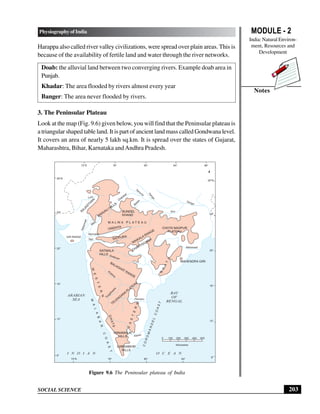
Look at the map (Fig. 9.6) given below, you will find that the Peninsular plateau is
a triangular shaped table land. It is part of ancient land mass called Gondwana level.
It covers an area of nearly 5 lakh sq.km. It is spread over the states of Gujarat,
Maharashtra, Bihar, Karnataka andAndhra Pradesh.
Figure 9.6 The Peninsular plateau of India
72°E 76° 80° 84° 88°
72°E 76° 80° 84°
0 100 200 300 400 500
Kilometres
8°
12°
16°
20°
24°
28°N
8°
12°
16°
20°
24°
28°N
Yam
una
G
a
n
g
a
Cham
bal
B
e
t
w
a
Son
Ganga
BAY
OF
BENGAL
ARABIAN
SEA
I N D I A N O C E A N
Luni
S
a
b
a
r
m
a
ti
Mahi
Narmada
Tapi
Krishna
T
u
n
g
b
h
a
d
r
a
Kaveri
Panneru
Godavari
Mahanadi
CHOTA NAGPUR
PLATEAU
MAIKALA RANGE
CHATTISGARH
MAHENDRA GIRI
BUNDEL
KHAND
ARAVALI HILLS
M A L W A P L A T E A U
VINDHYA
SATPURA
SATMALA
HILLS
BALAGHAT RANGE
TELENG
ANA
PLATEAU
ANNAMALAI
HILLS
CARDAMOM
HILLS
C
O
R
O
M
A
N
D
E
L
C
O
A
S
T
M
A
L
A
B
A
R
C
O
A
S
T
W
E
S
T
E
R
N
G
H
A
T
S
E
A
S
T
E
R
N
G
H
A
T
S
GIR RANGE
R
A
J
A
S
T
H
A
N
SOCIAL SCIENCE
MODULE - 2 Physiography of India
India: Natural Environ-
ment, Resources and
Development
204
Notes
River Narmada divides the peninsular plateau into two parts : The central highlands
and Deccan Plateau
(i) ThecentralHighlands:ItextendsfromNarmadariverandthenorthernplains.
AravallisistheimportantmountainwhichextendsfromGujratthroughRajasthan
to Delhi. The highest peak of theAravallis hills is Gurushikhar (1722m) near
Mt.Abu.TheMalwaPlateauandChhotaNagpurplateauarepartsofthecentral
highlands. River Betwa, chambal and Ken are the important river of Malwa
plateau while Mahadeo, Kaimur and Maikal are the important hills of chhota
Nagpur plateau. The valley of Narmada is lies between the Vindhyas and the
satpura which flows east to west and joins the Arabian sea.
(ii) The Deccan Plateau: The Deccan plateau is separated by a fault (A fracture
in the rock along which rocks have been relatively replaced), from Chota
Nagpur plateau. The black soil area in the Deccan plateau is known as Deccan
trap. It is formed due to volcanic eruptions. This soil is good for cotton &
sugarcane cultivation. The Deccan plateau is broadly divided into:
(a) The Western Ghats
(b) The Eastern Ghats
(a) The Western Ghats: If you look at map (Fig. No. 9.6), we will see the
WesternGhatsorSahyadrislieontheWesternedgeoftheDeccanplateau.
It runs parallel to the western coast for about 1600 km. The average
elevation of the Western Ghats is 1000 metres.The famous peaks in this
area are Doda Betta, Anaimudi amd Makurti. The highest peak in this
region isAnaimudi (2695m.). Western ghats are continuous and can be
crossedthroughpasseslikePalGhat,ThalGhotandBhorGhat.Therivers
likeGodavari,BhimaandKrishnafloweastwardwhiletheriverTaptiflows
westward. The streams form rapids & water falls before entering the
Arabian Sea. The famous water falls are Jogfalls on Sharavati, Shiva
Samudram falls on Kaveri etc.
(b) TheEasternGhats:The Eastern Ghats are discontinuous low belt. Their
average elevation is 600 m. They run parallel to the east coast from south
of Mahanadi valley to the Nilgiri hills. The highest peak in this region is
Mahendragiri(1501m).ThefamoushillsareMahendragirihills,Nimaigiri
hillsinOrissa,NallamallaihillsinSouthernAndhraPradesh,Kollimalaiand
PachaimalaiinTamilnadu.TheareaisdrainedbytheMahanadi,Godawari,
KrishnaandKaveririversystems.TheNilgirihillsjoinWestern&Eastern
Ghats in the south.
MODULE - 2
India: Natural Environ-
ment, Resources and
Development
205
Physiography of India
SOCIAL SCIENCE
Notes
ACTIVITY 9.2
Trace five main differences between Western and Eastern Ghats.
1. Continuity
2. AverageElevation
3. Extent
4. Highest Peak
5. Rivers
4. The Indian Desert
The Indian Desert lies towards the western margin ofAravali Hills. It is also called
Thar Desert. It is the ninth largest desert in the world. It spreads over the states of
Gujarat and Rajasthan. This region has semi-arid and arid weather conditions. It
receiveslessthan150mmofrainfallperyear.Thevegetationcoverislowwiththorny
bushes. Luni is the main river in this area.All other streams appear only at the time
of rainfall otherwise they disappear into the sand.
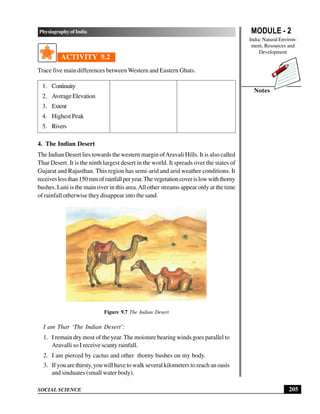
Figure 9.7 The Indian Desert
I am Thar ‘The Indian Desert’:
1. I remain dry most of the year. The moisture bearing winds goes parallel to
Aravalli so I receive scanty rainfall.
2. I am pierced by cactus and other thorny bushes on my body.
3. If you are thirsty, you will have to walk several kilometers to reach an oasis
and sinduates (small water body).
SOCIAL SCIENCE
MODULE - 2 Physiography of India
India: Natural Environ-
ment, Resources and
Development
206
Notes
4. The sand dunes add to the beauty of my desert.
5. My people follow rich cultures and traditions.
5. The Coastal Plains
The coastal plains in India run parallel to theArabian Sea & Bay of Bengal along
the Peninsular Plateau.The western coastal plain is a narrow belt along theArabian
sea of about 10-20km wide. It stretches from Rann of Kachchh to KanyaKumari.
Western coastal plains comprises of three sectors (i) Konkan Coast (Mumbai to
Goa), (ii) Karnataka coast from Goa to Mangalore (iii) Malabar Coast (Mangalore
to Kanya Kumari). The eastern coast runs along Bay of Bengal. It is wider than the
western coastal plain. Its average width is about 120Kms. The northern part of the
coast is called Northern Circar and the southern part is called Coromandal Coast.
Eastern coastal plain is marked by Deltas made by the rivers Mahanadi, Godavari,
Krishna amd Kaveri. The Chilka largest salt water lake in India in Odisha is located
to the south of Mahanadi Delta. The coastal plains are belts for growing spices, rice,
coconut, pepper etc. They are centres of trade & commerce. The coastal areas are
knownforfishingactivities,thereforelargenumberoffishingvillageshavedeveloped
along the coasts. Vembanad is famous lagoon which is located at Malabar coast.
6. The Islands
India has two main groups of Islands. There are 204 islands in Bay of Bengal called
as Andaman and Nicobar islands and 43 islands in Arabian Sea called as
Lakshadweep islands TheAndaman & Nicobar island extend from north to south
in Bay of Bengal.They are bigger in size.An active volcano is located on the Barren
Island inAndaman & Nicobar group of islands. Lakshadweep islands are located
near Malabar coast of Kerala in theArabian sea. They cover an area of 32 sq km.
Kavarati is the capital of Lakshdweep. These islands are formed by corals and
endowedwithvarietyoffloraandfauna.Theseislandsareimportanttouristattraction
under water activities like snokling, such diving, deep sea diving and other sports
make these island more popular.
INTEXT QUESTIONS 9.4
1. Answer the following questions briefly (not more than two sentences)
(i) How was Deccan Trap formed?
(ii) State any two economic activities of coastal plains.
(iii) Why does Andman and Nicobar Islands attract more tourists?
(iv) Write the names of the rivers which help to form the western plain.
MODULE - 2
India: Natural Environ-
ment, Resources and
Development
207
Physiography of India
SOCIAL SCIENCE
Notes
9.4 DRAINAGE SYSTEMS IN INDIA
The drainage system refers to the system of flow of surface water mainly through
rivers.An area drained by a river and its tributaries is called a drainage basin. The
drainage system is related to a number of factors like slope of land, geological
structure,amountandvelocityofwater.Ariverthroughitsdrainagesystemperforms
several tasks. These are excess water removal from a particular area, transportation
of sediments from one place to other, providing natural source for irrigation and
maintaining the water table of a region.Traditionally, rivers were useful as a source
of abundant fresh water and navigation. In today’s world rivers importance has risen
to include hydro power generation and setting up water-based industries. These are
also important tourist attraction for activities such as boating, river rafting and cliff
jumping. Because of their utility, rivers are important for life and hence regarded as
lifeline. Many cities are located along the rivers and are densely populated. Delhi
on the banks ofYamuna, Patna along Ganga, Guwahati along Brahmaputra, Nasik
along Godavari and Cuttack along Mahanadi are some examples (Fig. 9.8). On the
basis of the origin the drainage can be divided in to two parts:
(a) The Himalayan drainage system
(b) The Peninsular drainage system
Tributary:Astream or river that flows into a larger river. e.g. Yamuna
Delta:Atriangularshapedlandatthemouthofariverformedfromthedeposition
of silt, sand and small rocks that flow downstream in the river. eg. Ganga delta.
Estuary:Apartially enclosed coastal body of water where the salty tidal water
mixes with the fresh water of the river. eg. Narmada river makes an estuary.
9.5 MAJOR DRAINAGES SYSTEMS
As mentioned earlier on the basis of origin, the Indian river have been classified into
two major drainage systems. Let us discuss the comparision between the two
drainage systems.
Himalayan River System
1. They are Perennial rivers originating from glaciers.
2. Rivers form valleys by the process of erosion.
3. Theriversareidealforirrigationpurposesastheypassthroughplainfertiletracts.
4. These rivers have meandering courses which shift over time.
9.5.1 The Himalayan Drainage System
MostoftheHimalayanRiversareperennial.Thismeanstheyhavewaterthroughout
the year.This is because most of these rivers originate from the glaciers and snowy
SOCIAL SCIENCE
MODULE - 2 Physiography of India
India: Natural Environ-
ment, Resources and
Development
208
Notes
peaks.Theyalsoreceivewaterfromtherainfall.Themainriversysteminthiscategory
are:
1. The Indus River System Jhelum, Ravi, Beas and Satluj
2. The Ganga Rivers System Yamuna, Ramganga, Ghaghara, Gomti,
Gandak and Kosi etc.
3. The Brahmaputra River System Dibang, Lohit, Tista and Meghna etc.
9.5.2 The Peninsular Drainage System
YouhavealreadystudiedaboutPeninsularPlateau.MostofthePeninsularriversflow
eastwards and enters into Bay of Bengal. Only Narmada andTapi rivers which flow
westwards of theWestern Ghats.They are good for generating hydropower because
these rivers form rapids & water falls. The major peninsular rivers are Mahanadi,
Godavari, Krishna and Kaveri.
Figure 9.8 Major Rivers of India
Indus R.
Indus R.
J
h
e
l
u
m
R
.
S
a
b
a
r
m
a
ti
R
.
M
a
h
i
R
.
Kosi R.
S
o
n
R
.
Brahmaputra R.
H
u
g
li
Mahanadi R.
Kaveri R.
Chenab R.
Ravi R.
Satluj R.
G
a
n
g
a
R
.
Yamuna R.
Chambal R.
Tapi R.
Godavari R.
Krishna R.
BAY
OF
BENGAL
ARABIAN
SEA
I N D I A N O C E A N
Andaman & Nicobar Islands
Lakshadweep
SRI
LANKA
64° 68° 76° 80°
72° 84° 88° 92°
72° 84°
76° 80° 88° 92°
8°
12°
16°
20°
24°
28°
32°
8°
12°
16°
20°
24°
28°
32°
INDIA
MAJOR RIVERS
Narmada R.
MODULE - 2
India: Natural Environ-
ment, Resources and
Development
209
Physiography of India
SOCIAL SCIENCE
Notes
ACTIVITY 9.3
Look at the physical and political maps of India in an atlas. Given below are four
river. Find out the following informaiton and record in the table given below.
Rivers Main Origin States it Drains into
tributaries passes through
Ganga
Brahmputra
Indus
Satluj
Kaveri
Godavari
Krishna
ACTIVITY 9.4
Look at the Atlas and name all the cities situated along the Ganga and locate on
the physical India map.
9.6 KEEPING RIVERS CLEAN
Do you know that over 97% of all the water on Earth is salty and remaining 3%
is fresh water. This tiny amount has to provide the fresh water needed to support
the entire population of the world. Fresh water is a precious resource and the
increasing pollution of our rivers and lakes is a cause for alarm.
You must have seen a river either flowing through your town, village or elsewhere.
India has a large number of rivers that are lifelines for the millions of people living
along their banks. These rivers can be broadly categorized into four groups:
(i) Rivers that flow down from the Himalayas and are supplied by melting snow
and glaciers. This is why these are perennial, that is, they never dry up during
the year.
SOCIAL SCIENCE
MODULE - 2 Physiography of India
India: Natural Environ-
ment, Resources and
Development
210
Notes
(ii) The Deccan Plateau rivers, which depend on rainfall for their water.
(iii) The coastal rivers, especially those on the west coast, which are short and do
not retain water throughout the year.
(iv) The rivers in the inland drainage basin of west Rajasthan, which depend on the
rains. These rivers normally drain towards silt lakes or flow into the sand.
Rivers have been given the pride of place in the way of life. Several cities as
well as holy shrines are on the banks of rivers, and indeed, rivers such as the Ganga
and the Yamuna are sacred to millions. Despite this, they are being polluted with
unaccountable and environmentally threatening practices. Only sewage claims for
about 70 percent pollution loads in Indian rivers. Heavy loads of biological and
chemical pollutants usually enter waterways to be consumed in some manner by the
downstream users. This affects the aquatic life and causes various health hazards.
Alongwiththepollutants,theinsensitivityofpeopletowardsriversisseverelyadding
to the problem. Urban dwellers identify vaguely with rivers.An example can be the
highlycontaminatedblackishwaterofYamunariverinNewDelhiwhichhardlydraws
attention from capital’s citizens.
Since,waterissuesareassignedtoprovincialgovernmentsinIndia,eachoneofthem
treats a river as its own, with little or no regard to the downstream effects. Ecologists
and conservationists have long demanded that rivers need to be treated as one entity
and work on a determined, time-specific combination of serious efforts. This could
lead to an improvement of water quality of the rivers. The government has come
upwithambitiousrivercleaninginitiativessuchastheGangaActionPlan(GAP)and
theNationalRiverConservationPlan(NRCP)inthehopeofimprovingwaterquality.
Water harvesting is gaining popularity across the country, through which monsoon
waters could be retained in the river basins. Several civic organizations and people
movementsarealsocontributinginraisingawarenessandsensitivityaboutthecritical
condition of polluted rivers.
ACTIVITY 9.5
1. Find out the river or natural water source in your locality. Observe the kind of
activities that are happening there.
2. What kinds of human activities are causing damage to river systems?
3. Write a letter to the local authority suggesting what you and your friends like to
do to stop pollution.Also mention in the letter what help would you like to have
formthem.
4. Organise a meeting with your friends to discuss what can be done to prevent
the negative effects of the human activities
There could be many ways of stopping pollution. Suggests the ways to check
the water pollution.
MODULE - 2
India: Natural Environ-
ment, Resources and
Development
211
Physiography of India
SOCIAL SCIENCE
Notes
INTEXT QUESTION 9.5
Answerthefollowingquestion:
1. Mention the name of two tributaries joining Ganga from the north.
2. Which lake is located near Mahanadi?
3. Write the names of the states drained by river Godavari.
4. Which river is tributary of Tunghabhadra?
WHAT YOU HAVE LEARNT
l India is located between 8°4’ North and 37°6’ North lalitudes and 68°7’ East
and 97°25’ longitudes. India has land boundaries of 15,200 km and 6100km
long coast line. India’s landmass covers 3.28 million square kilometer of area.
l India can be divided into mainly six physical divisions: the Northern mountain,
The Northern Plain, the Peninsular Plateau, the Indian desert and the coastal
plains and Islands.
l The Himalayas may be divided into three parallel ranges: Greater Himalayas or
Himadari,Lesser Himalayas or Himachal and Outer Himalayas or Siwaliks.
l The northern plain spreads mainly in the states of Punjab, Haryana, Uttar
Pradesh,BiharandWestBengal.Thesoilhereisrichinnutrientsandhencegood
for cultivation of varieties of crops.
l The Peninsular plateau stretches from theAravali range till the southern tip of
India. It is a table land made of old and metamorphosed rocks.
l The Great Indian Desert spreads over the states of Gujarat and Rajasthan. This
region has semi-arid and arid weather conditions.
l ThecoastalplainsinIndiarunparalleltotheArabiansea&BayofBengal. They
are called Western coastal plains and the Eastern coastal plains.
l India has two main groups of Islands. There are 204 islands in Bay of Bengal
called the Andaman and Nicobar Islands and 43 islands in Arabian Sea i.e
Lakshadweep islands.
l Indian River System can be divided into two main categories: The Himalayan
Drainage System and The Peninsular Drainage System. The three main rivers
in Himalayan system are the Indus, Ganga, The Brahmaputra. The main
Peninsular rivers are Narmada,Tapi, Godavari, Krishna , Kaveri and Mahanadi.
SOCIAL SCIENCE
MODULE - 2 Physiography of India
India: Natural Environ-
ment, Resources and
Development
212
Notes
TERMINAL EXERCISES
1. Explain the location and extends of India.
2. Dercribe any three characteristics of the Indian Desert.
3. Explain any two paints each about the three parallel ranges of Himalayas.
4. DifferentiatebetweenHimalayanandPeninsulardraingesystembygivinganyfour
differences in each.
5. Give reasons:-
(i) Northern plans have fertile alluvial soil.
(ii) Indian desert has very less vegetation cover.
Project:
l Create a guidebook for visitors to your home region
1. Itshoulddescribeyourregion’suniquephysicalandhumancharacteristics.
2. Listelementsofthephysicallandscape,suchasclimate,landforms,plants,
animals,andelementsofthehumanlandscape,suchasworkopportunities,
economic activities, recreational activities, regional language, and foods.
3. The guidebook should include pictures/ drawings and should feature the
things that you feel are special about your locality.
ANSWERS TO INTEXT QUESTIONS
9.1
1. (i) Bangladesh,Myanmmar.
(ii) Bay of Bengal and Arabian Sea.
(iii) Sri Lanka.
(iv) Pakistan, Bhutan.
9.2
1. (i) Kerala, Tamil Nadu.
(ii) Jammu and Kashmir,Arunachal Pradesh.
(iii) Nepal, Bhutan.
(iv) Daman and Diu, Dadar Nagar Haveli.
MODULE - 2
India: Natural Environ-
ment, Resources and
Development
213
Physiography of India
SOCIAL SCIENCE
Notes
9.3
1. the Himadari The Himachal, and Siwalik.
2. A. Jammu and Kashmir.
B. (a) No
(b) No
(c) Yes
3. India, Nepal, Bhutan.
4. Patkoi, Mizo hills
9.4
1. (i) Due to volcanic erruption.
(ii) (i) Agriculture (ii) fishing (iii) trade and commerce (any two)
(iii) BecauseIslandshavedevelopedattractivetouristactivitiesofunderwater
and water sports.
(iv) Satluj, Beas, Ravi
9.5
1. Gandak, Kosi.
2. Chilka.
3. Maharashtra,Andhra Pradesh and Chattisgarh.
4. Krishna.
SOCIAL SCIENCE
MODULE - 2 Climate
India: Natural Environ-
ment, Resources and
Development
214
Notes
10
CLIMATE
Mona and Raju were excited about proposed first trip to a hill station, Shimla with
theirparents.Whiletheywerepackingtheirclothes,theirmotheraskedthemtopack
some woolen clothes also.They reside in Chennai, a city and capital ofTamil Nadu,
a state in South India. They were really surprised as it was the month of May and
it’s very hot in Chennai.Their mother told that although India has monsoon climate
but in Shimla, it being a hill station the weather was cool. They were little confused
with a few questions in their mind like - what is weather? What is the difference
between the weather and the climate? Why do we find different climatic conditions
in India?You will find the answers to such questions in the following lesson.
OBJECTIVES
After completing this lesson, you will be able to:
 list the factors that influence the climate of India;
 explain the mechanism of monsoon and its various characteristics;
 recognize the cyclic system of seasons along with their unique features;
 describe the distribution of rainfall in India;
 analyse how our social and cultural life is deeply associated with the cycle of
seasons; and
 describe the global environmental changes and its impact on Indian climate.
10.1 FACTORS AFFECTING THE CLIMATE OF INDIA
When Mona and Raju were in the train along with their parents they asked the
questions to their parents about the difference between the weather and climate. One
of the fellow passengers was a teacher, Mrs. Rupa and she explained that climate
MODULE - 2
India: Natural Environ-
ment, Resources and
Development
215
Climate
SOCIAL SCIENCE
Notes
is always for a large area like a country or a big region and generally it does not
change, like India has monsoon climate whereas weather is always for a smaller
area like that of your city or village where it may frequently change like raining in
the morning and sunny in the afternoon. Mrs. Rupa asked them to observe the
changesintheweatherconditionsalongthewaytoShimla.Theyrealizedthechanges:
it was hot and humid weather in the southern regions and slowly it became hot and
dry in the northern plains; and they felt cool on their way when they were close to
Shimla. They asked the teacher the reason for it and she explained that there are
many factors which affect the climate or weather.
Climate refers to the sum total of weather conditions and variations over large
area for a long period of time (more than 30 years).Weather is state of
atmosphereoveranareaatanypointoftime.Similarlyweatherconditionswhich
last for longer duration are responsible for making a season.
10.1.1 Factors Affecting the Climate of India
1. Location: The places which are closer to equator have high temperature.As
one moves towards the poles temperature decreases.As our country, India is
located in Northern hemisphere closer to equator at 8°4¢ and 23½° Tropic of
Cancer passes through the central part of India. So in south of this latitude we
find tropical climate and towards the north we find sub-tropical climate. For
example,AndhraPradeshwouldbehotterthanHaryana.Broadlyspeakingparts
lyingsouthoftheTropicofCancerreceivemoresolarheatthanthoselyingnorth
of it.
2. Distance from the sea: The southern half of India is surrounded by sea from
three sides: theArabian Sea in the west, the Bay of Bengal in the east and the
Indian Ocean in the south. Due to moderating influence of the sea this region
is neither hot in summer nor very cold in winter. For example the area of North
India which is far away from the sea has extreme type of climate and the area
of south India which is nearer to the sea has equable type of climate. We can
see the variations in temperature and rainfall at different stations in the given
table 10.1.
3. Altitude: It means the height above the average sea level. The atmosphere
becomes less dense and we feel breathlessness as we go higher from the earth
surface and thus the temperature also decreases with the height. For example,
the cities located on the hills are cooler like Shimla whereas the cities lying in
the plains will have hot climate like Ludhiana.
SOCIAL SCIENCE
MODULE - 2 Climate
India: Natural Environ-
ment, Resources and
Development
216
Notes
4. Mountain Ranges: Mountain ranges also affect the climate of any region to
a great extent. The Himalaya Mountain is located in the northern part of our
countrywithanaverageheightof6000m.Itprotectsourcountryfromcoldwinds
ofCentralAsia.Ontheotherhand,theycheckrainbearingSouth-WestMonsoon
windsandcompelthemtoshedtheirmoistureinIndia.Similarly,WesternGhats
force rain bearing winds to cause heavy rain fall on the Western slopes of the
Western Ghats.
5. Direction of surface winds: The wind system also affects the Indian climate.
This system consists of monsoon winds, land and sea breeze, and local winds.
In winter the winds blow from land to sea so they are cold and dry. On the other
hand, in summer wind blow from sea to land bringing the moisture along with
them from the sea and they cause wide spread rain in most part of the country.
6. Upper air Currents: Besides surface winds, there are strong air currents called
Jet streams which also influence the climate of India. These jet streams are a
narrowbeltoffastblowingwindslocatedgenerallyat12,000metreheightabove
the sea level. They bring western cyclonic disturbances along with them. These
cyclonic winds originate near the Mediterranean Sea and move eastwards. On
theirway,theycollectmoisturefromPersianGulfandsheditintheNorthwestern
part of India during winter seasons. These Jet streams shift northwards during
summer season and blow in CentralAsia.Thus helps in the onset of monsoons.
ACTIVITY 10.1
Temperature (T) and Rainfall (R) of some important stations
Stations Month
J F M A M J J A S O N D
Leh T –8 –7 –1 9 10 14 17 17 12 6 0 –6
R 10 8 8 5 5 5 13 13 8 5 0 5
Chennai T 25 26 28 31 33 33 31 31 30 20 26 25
R 4 13 13 18 38 45 87 113 119 306 350 135
(i) Write annual range of temperature between two places.
(ii) Which is the rainiest month of the year in each stations?
MODULE - 2
India: Natural Environ-
ment, Resources and
Development
217
Climate
SOCIAL SCIENCE
Notes
Figure 10.1
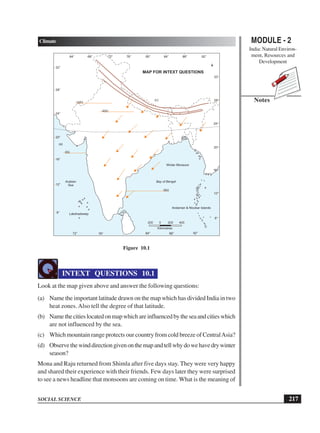
INTEXT QUESTIONS 10.1
Look at the map given above and answer the following questions:
(a) Name the important latitude drawn on the map which has divided India in two
heat zones.Also tell the degree of that latitude.
(b) Namethecitieslocatedonmapwhichareinfluencedbytheseaandcitieswhich
are not influenced by the sea.
(c) Which mountain range protects our country from cold breeze of CentralAsia?
(d) Observethewinddirectiongivenonthemapandtellwhydowehavedrywinter
season?
Mona and Raju returned from Shimla after five days stay. They were very happy
and shared their experience with their friends. Few days later they were surprised
to see a news headline that monsoons are coming on time. What is the meaning of
200 0 200 400
Kilometres
Bay of Bengal
Arabian
Sea
64° 68° 76° 80°
72° 84° 88° 92°
72° 84°
76° 88° 92°
8°
12°
16°
20°
24°
28°
32°
8°
12°
16°
20°
24°
28°
32°
Winter Monsoon
ii(b)
iv(b)
(a)
(c)
MAP FOR INTEXT QUESTIONS
Lakshadweep
Andaman  Nicobar Islands
SOCIAL SCIENCE
MODULE - 2 Climate
India: Natural Environ-
ment, Resources and
Development
218
Notes
monsoon? They wanted to knowthe answers of their questions with the help of their
teacher. Try to find out answers in the following section.
10.2 MECHANISM OF MONSOON
The word monsoon is derived from theArabic word ‘Mausim’which means season.
Monsoon refers to the seasonal reversal in the wind direction during a year. During
summer, the interior parts of North Indian Plains covering Rajasthan, Punjab,
Haryana, and Western Uttar Pradesh are intensely hot. The daily maximum
temperature in some of these parts is as high as 45° to 47° C. Table 10.1 given
below indicates the climatic diversity in India. Try to understand the varying
temperature that different stations in India have.
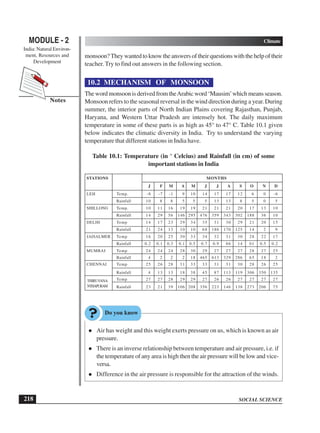
Table 10.1: Temperature (in ° Celcius) and Rainfall (in cm) of some
important stations in India
STATIONS MONTHS
J F M A M J J A S O N D
LEH Temp. -8 -7 -1 9 10 14 17 17 12 6 0 -6
Rainfall 10 8 8 5 5 5 13 13 8 5 0 5
SHILLONG Temp. 10 11 16 19 19 21 21 21 20 17 13 10
Rainfall 14 29 56 146 295 476 359 343 302 188 36 10
DELHI Temp 14 17 23 29 34 35 31 30 29 21 20 15
Rainfall 21 24 13 10 10 68 186 170 125 14 2 9
JAISALMER Temp 16 20 25 30 33 34 32 31 30 28 22 17
Rainfall 0.2 0.1 0.3 0.1 0.5 0.7 0.9 86 14 01 0.5 0.2
MUMBAI Temp 24 24 24 28 30 29 27 27 27 28 27 25
Rainfall 4 2 2 2 18 465 613 329 286 65 18 2
CHENNAI Temp 25 26 28 31 33 33 31 31 30 28 26 25
Rainfall 4 13 13 18 38 45 87 113 119 306 350 135
Temp 27 27 28 29 29 27 26 26 27 27 27 27
Rainfall 23 21 39 106 208 356 223 146 138 273 206 75
 Air has weight and this weight exerts pressure on us, which is known as air
pressure.
 There is an inverse relationship between temperature and air pressure, i.e. if
the temperature of any area is high then the air pressure will be low and vice-
versa.
 Difference in the air pressure is responsible for the attraction of the winds.
THIRUVANA
NTHAPURAM
MODULE - 2
India: Natural Environ-
ment, Resources and
Development
219
Climate
SOCIAL SCIENCE
Notes
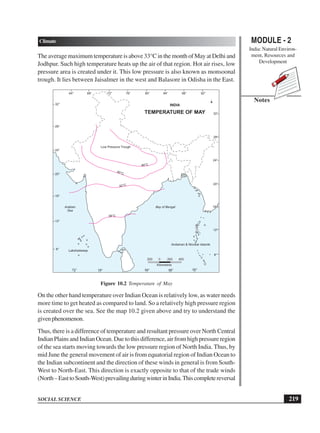
The average maximum temperature is above 33°C in the month of May at Delhi and
Jodhpur. Such high temperature heats up the air of that region. Hot air rises, low
pressure area is created under it. This low pressure is also known as monsoonal
trough. It lies between Jaisalmer in the west and Balasore in Odisha in the East.
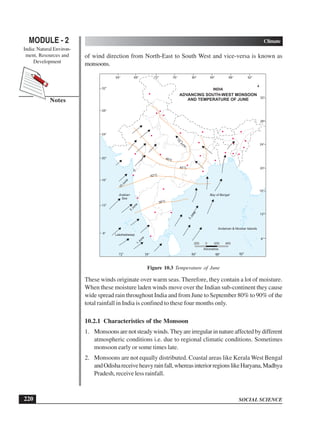
Figure 10.2 Temperature of May
On the other hand temperature over Indian Ocean is relatively low, as water needs
more time to get heated as compared to land. So a relatively high pressure region
is created over the sea. See the map 10.2 given above and try to understand the
givenphenomenon.
Thus, there is a difference of temperature and resultant pressure over North Central
IndianPlainsandIndianOcean.Duetothisdifference,airfromhighpressureregion
of the sea starts moving towards the low pressure region of North India. Thus, by
mid June the general movement of air is from equatorial region of Indian Ocean to
the Indian subcontinent and the direction of these winds in general is from South-
West to North-East. This direction is exactly opposite to that of the trade winds
(North–EasttoSouth-West)prevailingduringwinterinIndia.Thiscompletereversal
64° 68° 76° 80°
72° 84° 88° 92°
72° 84°
76° 88° 92°
8°
12°
16°
20°
24°
28°
32°
8°
12°
16°
20°
24°
28°
32°
200 0 200 400
Kilometres
TEMPERATURE OF MAY
Low Pressure Trough
46°C
45°C
42°C
38°C
Bay of Bengal
Arabian
Sea
INDIA
Lakshadweep
Andaman  Nicobar Islands
SOCIAL SCIENCE
MODULE - 2 Climate
India: Natural Environ-
ment, Resources and
Development
220
Notes
of wind direction from North-East to South West and vice-versa is known as
monsoons.
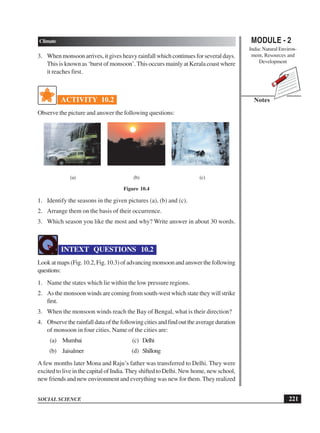
Figure 10.3 Temperature of June
These winds originate over warm seas. Therefore, they contain a lot of moisture.
When these moisture laden winds move over the Indian sub-continent they cause
wide spread rain throughout India and from June to September 80% to 90% of the
total rainfall in India is confined to these four months only.
10.2.1 Characteristics of the Monsoon
1. Monsoonsarenotsteadywinds.Theyareirregularinnatureaffectedbydifferent
atmospheric conditions i.e. due to regional climatic conditions. Sometimes
monsoon early or some times late.
2. Monsoons are not equally distributed. Coastal areas like Kerala West Bengal
andOdishareceiveheavyrainfall,whereasinteriorregionslikeHaryana,Madhya
Pradesh, receive less rainfall.
200 0 200 400
Kilometres
64° 68° 76° 80°
72° 84° 88° 92°
72° 84°
76° 88° 92°
8°
12°
16°
20°
24°
28°
32°
8°
12°
16°
20°
24°
28°
32°
1
J
u
n
e
5
J
u
n
e
5
J
u
n
e
1
0
J
u
n
e
10
June
38°C
42°C
45°C
46°C
ADVANCING SOUTH-WEST MONSOON
AND TEMPERATURE OF JUNE
Bay of Bengal
Arabian
Sea
INDIA
Lakshadweep
Andaman  Nicobar Islands
MODULE - 2
India: Natural Environ-
ment, Resources and
Development
221
Climate
SOCIAL SCIENCE
Notes
3. When monsoon arrives, it gives heavy rainfall which continues for several days.
This is known as ‘burst of monsoon’. This occurs mainly at Kerala coast where
it reaches first.
ACTIVITY 10.2
Observe the picture and answer the following questions:
(a) (b) (c)
Figure 10.4
1. Identify the seasons in the given pictures (a), (b) and (c).
2. Arrange them on the basis of their occurrence.
3. Which season you like the most and why? Write answer in about 30 words.
INTEXT QUESTIONS 10.2
Look at maps (Fig. 10.2, Fig. 10.3) of advancing monsoon and answer the following
questions:
1. Name the states which lie within the low pressure regions.
2. As the monsoon winds are coming from south-west which state they will strike
first.
3. When the monsoon winds reach the Bay of Bengal, what is their direction?
4. Observetherainfalldataofthefollowingcitiesandfindouttheaverageduration
of monsoon in four cities. Name of the cities are:
(a) Mumbai (c) Delhi
(b) Jaisalmer (d) Shillong
A few months later Mona and Raju’s father was transferred to Delhi. They were
excited to live in the capital of India. They shifted to Delhi. New home, new school,
new friends and new environment and everything was new for them. They realized
SOCIAL SCIENCE
MODULE - 2 Climate
India: Natural Environ-
ment, Resources and
Development
222
Notes
that now they were going to see the real changes of the seasons which they had read
in their book. Try to discover the various seasons and how they happen in the
followingsection.
10.3 CYCLE OF SEASONS
Our country, India, enjoys variety of seasons due to geographical locations. Now
you will know about the seasons of India and their unique features. We have four
seasons:
(a) Cold weather season (December – February)
(b) Hot weather season (March – May)
(c) Advancing South – West monsoon season (June – September)
(d) Post or retreating monsoon season (October – November).
You will know more about each of them in the following section.
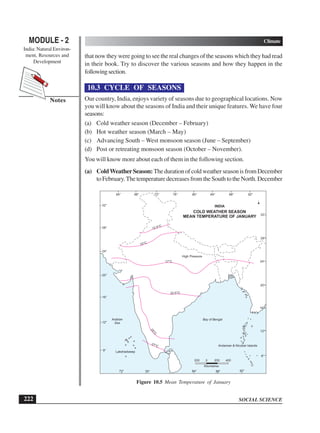
(a) ColdWeatherSeason: ThedurationofcoldweatherseasonisfromDecember
to February.The temperature decreases from the South to the North. December
64° 68° 76° 80°
72° 84° 88° 92°
8°
12°
16°
20°
24°
28°
32°
8°
12°
16°
20°
24°
28°
32°
COLD WEATHER SEASON
MEAN TEMPERATURE OF JANUARY
12.5°C
15°C
17°C
High Pressure
INDIA
22.5°C
Bay of Bengal
Arabian
Sea
27°C Andaman  Nicobar Islands
Lakshadweep
200 0 200 400
Kilometres
72° 84°
76° 88° 92°
Figure 10.5 Mean Temperature of January
MODULE - 2
India: Natural Environ-
ment, Resources and
Development
223
Climate
SOCIAL SCIENCE
Notes
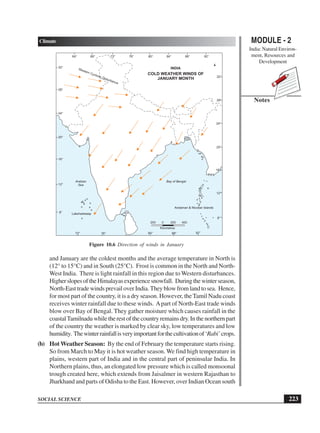
and January are the coldest months and the average temperature in North is
(12° to 15°C) and in South (25°C). Frost is common in the North and North-
West India. There is light rainfall in this region due to Western disturbances.
HigherslopesoftheHimalayasexperiencesnowfall. Duringthewinterseason,
North-East trade winds prevail over India. They blow from land to sea. Hence,
for most part of the country, it is a dry season. However, the Tamil Nadu coast
receives winter rainfall due to these winds. Apart of North-East trade winds
blow over Bay of Bengal. They gather moisture which causes rainfall in the
coastalTamilnaduwhiletherestofthecountryremainsdry.Inthenorthernpart
of the country the weather is marked by clear sky, low temperatures and low
humidity. Thewinterrainfallisveryimportantforthecultivationof‘Rabi’crops.
(b) Hot Weather Season: By the end of February the temperature starts rising.
So from March to May it is hot weather season. We find high temperature in
plains, western part of India and in the central part of peninsular India. In
Northern plains, thus, an elongated low pressure which is called monsoonal
trough created here, which extends from Jaisalmer in western Rajasthan to
Jharkhand and parts of Odisha to the East. However, over Indian Ocean south
64° 68° 76° 80°
72° 84° 88° 92°
72° 84°
76° 88° 92°
8°
12°
16°
20°
24°
28°
32°
8°
12°
16°
20°
24°
28°
32°
200 0 200 400
Kilometres
COLD WEATHER WINDS OF
JANUARY MONTH
Western Cyclonic Disturbance
Bay of Bengal
Arabian
Sea
INDIA
Lakshadweep
Andaman  Nicobar Islands
Figure 10.6 Direction of winds in January
SOCIAL SCIENCE
MODULE - 2 Climate
India: Natural Environ-
ment, Resources and
Development
224
Notes
of the equator high pressure belt begins to develop in this season. In North-
West India, afternoon dust storms are common. During summer, very hot and
dry winds blow over North Indian plains. They are locally called ‘Loo’.
Exposure to theses hot winds may cause heat or sun stroke. This is also the
season for localized thunderstorms, associated with violent winds, torrential
downpours,oftenaccompaniedbyhail.InWestBengal,thesestormsareknown
as the ‘Kaal Baisakhi’ (calamity for the month of Baisakh).Towards the close
ofthesummerseason,pre-monsoonshowersarecommon,especiallyinKerala
and Karnataka. They help in the early ripening of mangoes, and are often
referred to as ‘mango showers’.
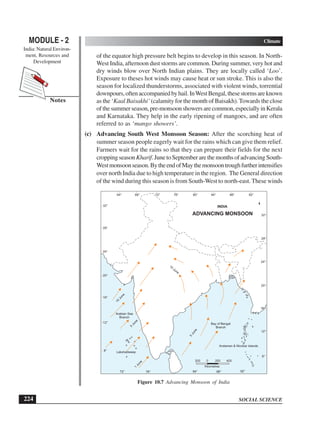
(c) Advancing South West Monsoon Season: After the scorching heat of
summer season people eagerly wait for the rains which can give them relief.
Farmers wait for the rains so that they can prepare their fields for the next
cropping seasonKharif.JunetoSeptemberarethemonthsofadvancingSouth-
Westmonsoonseason.BytheendofMaythemonsoontroughfurtherintensifies
over north India due to high temperature in the region. The General direction
of the wind during this season is from South-West to north-east. These winds
200 0 200 400
Kilometres
Bay of Bengal
Branch
Arabian Sea
Branch
1
J
u
n
e
5
J
u
n
e
5
J
u
n
e
1
0
J
u
n
e
10
June
64° 68° 76° 80°
72° 84° 88° 92°
72° 84°
76° 88° 92°
8°
12°
16°
20°
24°
28°
32°
8°
12°
16°
20°
24°
28°
32°
ADVANCING MONSOON
INDIA
Lakshadweep
Andaman  Nicobar Islands
Figure 10.7 Advancing Monsoon of India
MODULE - 2
India: Natural Environ-
ment, Resources and
Development
225
Climate
SOCIAL SCIENCE
Notes
are strong and blow at an average velocity of 30 km per hour. These moisture
laden winds first hit atAndaman and Nicobar Islands in the last week of May
andKeralacoastinthefirstweekofJunewithviolentthunderandlightning.This
South-West monsoon that flows in to India brings about a major change in its
weather.Two branches of south-west monsoon originate from: (i)Arabian Sea
and (ii) Bay of Bengal.
TheArabian Sea Branch obstructed by Western Ghats gives heavy rainfall on the
Western side of Western Ghats. It reaches Mumbai by 10th June (See Fig. 10.7).
When this branch crosses the Western Ghats and reaches the Deccan Plateau and
parts of Madhya Pradesh, it gives less rainfall as it is a rain shadow region. Further,
this branch reaches in Northern Plain by 20th June.
The monsoon winds that move from Bay of Bengal strikeAndaman and Nicobar
islands North-Eastern states and coastal areas ofWest Bengal and covers the whole
ofIndiabythe15thofjuly.Theycauseheavyrainfallintheregion.However,quantity
of rainfall decreases as they move towards West over the Northern plains. For
examples rainfall at Kolkata is 120 cm,Allahabad 91 cm and Delhi 56cm.You must
have seen that rainfall does not continue for several days. The monsoon tends to
have‘breaks’initsrainfallwhichcauseswetanddryspells.Thismeansthatmonsoon
rains occur only a few days at a time. Rainless dry spells occur in between.As the
monsoon comes after the hot and dry summer season, the rainfall brings down the
temperature. We can see this decline is from 5°C to 8°C between mid June and
mid July. This is the time when many parts of India face floods also. This is mainly
because of heavy rainfall and our inability to manage our water resources more
systematically. On the other hand there are many areas that experience drought
conditions during this season.
ACTIVITY 10.3
Collect the information from the newspapers and other sources and find out which
parts of India are regularly affected by the floods and droughts. Also paste the
newspapercuttingsasasample.Identifynamethereasonsandcollecttheinformation
about the most recent.
(d) Retreating or Post Monsoon Season: October and November are the
months of post (or retreating) monsoon season. The temperatures during
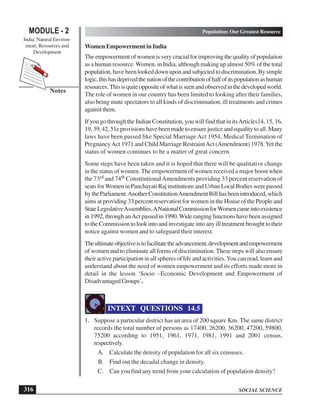
September-October start decreasing in north India. Monsoonal trough also
becomes weak over North-West India. This is gradually replaced by a high
pressuresystem.TheSouth-Westmonsoonwindsweakenandstartwithdrawing
gradually from North Indian Plains by November. In October the weather
remains humid and warm due to continuing high temperature and moist land in
SOCIAL SCIENCE
MODULE - 2 Climate
India: Natural Environ-
ment, Resources and
Development
226
Notes
month of October. In Northern plains hot and humid weather becomes
oppressive at this time. It is commonly called ‘October Heat’. However,
towards the end of October, temperature starts decreasing, making nights
pleasant. This is also the time of cyclonic storms which develop in the Bay of
BengalasthelowpressureofNorthIndiashiftstothisarea.Thesestormscreate
havoc in coastal areas of Odisha,Andhra Pradesh and Tamil Nadu, especially
in the deltas of Mahanadi, Godavari and Krishna rivers.
Figure 10.8 Retreating Monsoon
INTEXT QUESTIONS 10.3
Choose the correct answer:
(i) The hot and dry wind blowing in the northern plain in the summer are called—
(a) Kaal Baisakhi (c) Trade winds
(b) Loo (d) All of the above
64° 68° 76° 80°
72° 84° 88° 92°
72° 84°
76° 88° 92°
8°
12°
16°
20°
24°
28°
32°
8°
12°
16°
20°
24°
28°
32°
1
5
S
e
p
t
e
m
b
e
r
15 October
1
November
15 Novem
ber
200 0 200 400
Kilometres
RETREATING MONSOON
Bay of Bengal
Arabian
Sea
INDIA
Lakshadweep
Andaman  Nicobar Islands
MODULE - 2
India: Natural Environ-
ment, Resources and
Development
227
Climate
SOCIAL SCIENCE
Notes
(ii) Which mountain range acts as a barrier in the path of theArabian Sea branch?
(a) Aravallis (c) Western Ghats
(b) Eastern Ghats (d) Raj Mahal hills
(iii) The tropical cyclones of the Bay of Bengal usually occurs during
(a) South-west monsoon (c) Retreating monsoon season
(b) Hot weather season (d) Cold weather season
(iv) Which place would be the hottest one in March?
(a) Delhi (c) Deccan Plateau
(b) Shillong (d) Punjab
(v) Monsoons are called ........................
(a) Seasonal winds (c) Permanentwinds
(b) Temporary winds (d) Local winds
Seasons, its cycle, causes and effects were now clear to Mona and Raju. Only one
questionremainedunanswered.Ifthemonsoonscameinaparticularareaforcertain
durationsoitmeanstherainfalldistributioninIndiawasuneven?Trytofindtheanswer
with the help of Rainfall distribution map.
10.4 DISTRIBUTION OF RAINFALL
Rainfall in India is highly uneven over a period of time in a year. As we move
from East to West in Northern plains, we observe that in central India rainfall
decreases. In peninsular region, India’s rainfall decreases from coast to interior
parts. In North-East India, the rainfall increases with altitude. India is the unique
example of rainfall distribution with marked contrasts. Both, one of the rainiest
and driest places of the world are located in India itself. Can you think why?
Spatial variations in rainfall in India can be shown under the following headings.
Observe the given map and find out the states under the given categories –
(a) Areas of heavy rainfall (more than 200cm): Maximum rainfall in India occurs
in the western coast, sub Himalayan regions of north-east and Garo, Khasi and
Jaintia hills of Meghalaya.
(b) Area of Moderate rainfall (100-200cm):Areas receiving 100 to 200cm rainfall
in India include some parts of the Western Ghats, West Bengal, Odisha and
Bihar and many states.
(c) Areas of Low rainfall (60 to 100cm): This is the region of low rainfall, which
includes parts of Uttar Pradesh, Rajasthan, interier deccan plateau.
(d) Areas of Inadequate rainfall (Less than 60cm): This is region of scanty rainfall.
The western part of Rajasthan and Gujarat, Laddakh and south central part
receives a rainfall of less than 20cm.
SOCIAL SCIENCE
MODULE - 2 Climate
India: Natural Environ-
ment, Resources and
Development
228
Notes
ACTIVITY 10.4
List out the festivals of India in the table given below.Also find out which season
is economically significant in your area and why?
List of the Areas where Date and Season Economically
festivals celebrated month Significant
Do you see co-relation between seasons of festivals and harvest seasons. Please
provide one reason.
Figure 10.9 Annual Rainfall of India
200 0 200 400
Kilometres
RAINFALL IN (cm)
Above 200
100 - 200
60 - 100
Below 60
Bay of Bengal
Arabian
Sea
INDIA
ANNUAL RAINFALL
200 0 200 400
Kilometres
MODULE - 2
India: Natural Environ-
ment, Resources and
Development
229
Climate
SOCIAL SCIENCE
Notes
10.5 SOCIO-CULTURAL LIFE
You are now well aware about the cycle of seasons but a second thought comes
to our mind what do the relationship between the seasons and our life? Are they
so important that they affect our life? The answer is ‘yes’. They do affect our social
and cultural life.As India is an agricultural country the main economic activity of
agriculture is totally dependent on the cycle of seasons. The time of Kharif crop
is advancing monsoon season and harvesting is post monsoon season. Rabi crop
is grown in winter and zaid crop is at the end of winter season. Floods and droughts
are hindrances in the economic growth of the nation as our economy is agro based
economy.
All our activities are related with the seasons. As winter season comes the days
become shorter and we start purchasing woolen clothes. Groundnuts, almonds and
calorie rich food become very important in our diet. In spite of cold weather people
celebrate many festivals like Makar Sankranti in many states, Lohri in Punjabi and
Pongal inTamil Nadu in the month of January. Basant Panchami is also celebrated
in the month of February in which people pray for good harvest.Summer season is
very dry but it reminds us of juicy fruits, ice creams and variety of drinks. What are
the fruits available in this season? Holi and Baisakhi are the main festivals of the
season.By the end of summer farmers start preparing their fields so that they can
welcome the rains. This is the time when people of Kerala celebrate Onam which
coincide with their harvest season. Post Monsoon is the harvesting time. It is also
a festival time of Dushera, Durga Pooja and Diwali which are celebrated all over
India.
10.6 GLOBAL ENVIRONMENTAL CHANGES AND ITS
IMPACT ON INDIAN CLIMATE
After studying this lesson you must have understood that India is fortunate to have
four clear seasons’summer, winter, spring and monsoon. However, these days one
can notice disturbance in the cycle of seasons. This is due to global warming which
is a burning topic of today’s world. It has a significant political, social and economic
impact that may affect almost every aspect of our lives and lifestyles. The global
warming has a serious impact on world’s climate and India cannot escape it. Don’t
you think that it is important for everybody to know about it and think how each
one of us can contribute in reducing its extent?
Let us understand what is global warming. During the last decades of urbanization,
industrialization and population growth the atmosphere has been polluted. Human
activities increase the amount of carbon dioxide, Chloro Floro Carbon (CFC) and
other dangerous gases. About 51% of the solar energy is absorbed by the earth’s
surface, which increases its temperature. The rest of the heat is reflected back in
totheatmosphere.Thishelpedinmaintainingtemperature.Butnowduetopollution
some of the reflected heat is trapped by green house gases (GHGs), mainly carbon
SOCIAL SCIENCE
MODULE - 2 Climate
India: Natural Environ-
ment, Resources and
Development
230
Notes
dioxide. It has increased the temperature of the Earth’s surface. There is evidence
toshowthatCO2 levelsarestillincreasing.Manycountrieshavesignedaconvention
to reduce GHGs under the U.N. framework. However, the current international
agreementsarestillnoteffectiveenoughtopreventthesignificantchangesinclimate.
We already know that 70% of Indians are working in agriculture sector.Any change
in temperature will have an adverse effect on agriculture. This will have a serious
social and economic impact on India.After reading the chapter we can clearly see
that climate plays a very important role in Human life. Our food, our festivals, and
our economy everything is closely linked with the cycle of seasons. If the seasons
are favourable, human life will be good and comfortable. Since the state of the
weatheraffectsagriculture,health,transportationetcitisimportantthatallofusmake
some change in our lifestyle to reduce CFC and other harmful gases.
ACTIVITY 10.5
Keep a diary of events about natural calamities such as earthquakes, cyclones and
geographical events. Record them with name of the event, date and their impact.
INTEXT QUESTIONS 10.4
1. Why do we find the rainfall distribution in India highly uneven?
2. Name the three regions of India receiving lowest rainfall.
3. Name the months of Kharif and Rabi season.
4. When do we have the zaid season?
5. Which human activities are responsible for global warming?
WHAT YOU HAVE LEARNT
 Climate of India is affected by many factors like location, distance from the sea,
altitude, mountain ranges, direction of surface winds and upper air currents.
 India has a special system of reversal of winds which is known as monsoon and
it comes with a system.
 Indiahasacyclicsystemofseasonandithasfourmainseasons.Theyarewinter,
summer, advancing monsoon and retreating monsoon.
 Seasons play an important role in our day to day life and affect our activities
and eating habits.
 Global warming influences Indian climate also.
MODULE - 2
India: Natural Environ-
ment, Resources and
Development
231
Climate
SOCIAL SCIENCE
Notes
TERMINAL EXERCISES
1. Describeanyfive factorswhichareresponsibleforaffectingtheclimate?Explain
with the help of examples for each factor.
2. Differentiate between climate and weather.
3. Howarewindsandtheirdirectionsresponsibleforaffectingtheclimate?Explain
bygivingexamples.
4. Definemonsoon. Identifythemainreasonwhichisresponsibleformoving trade
winds in opposite direction?
5. Mention any four characteristics of cold weather season.
6. List any four main features of hot weather season?
7. By giving examples explain the effects of the global warming in India. What are
the causes behind it?
ANSWERS TO INTEXT QUESTIONS
10.1
(a) Tropic of cancer, 23½° N
(b)
Incluenced by sea
(i) Mumbai
(ii) Chennai
Not incluenced by sea
(iii) Lucknow
(iv) Delhi
(c) HimalayanMountainRanges
(d) Winds are coming from North-East. Since they are coming from land, they are
dry and unable to give rain to the country.
10.2
1. Rajasthan, Punjab, Haryana, Uttar Pradesh, Bihar, Jharkhand, West Bengal,
Madhya Pradesh and Chhattisgarh and parts of Odisha.
2. Kerala.
SOCIAL SCIENCE
MODULE - 2 Climate
India: Natural Environ-
ment, Resources and
Development
232
Notes
3. South to North and North-East and North-West.
4. (a) Mumbai: 4 months (c) Delhi: 4 months
(b) Nagpur: 4 months (d) Shillong:6months
10.3
1. (i) (b) Loo
(ii) (c) Western Ghats
(iii) (c) Retreating monsson season
(iv) (c) Deccan Plateau
(v) (a) SeasonalWinds
10.4
1. When monsoon winds enter from the coast, they give the maximum rain there.
Whentheyreachthecentralornorthernregions,theybecomedry,resultingless
rainfall.
2. Regions of low rainfall –
1. Northern leh-ladakh region
2. Western Rajasthan
3. South-Central part
3. Kharif – June and July Rabi – October and November
4. From the end of the winter season i.e. March to May.
5. Urbanization, Industrialization, Deforestation, burning of fossil fuels, etc.
233
Bio-Diversity
SOCIAL SCIENCE
MODULE - 2
India: Natural Environ-
ment, Resources and
Development
Notes
11
BIO-DIVERSITY
You must have seen variety of grass, plants, bushes, trees, insects, birds, animals
or beautiful landscape around you. We rely on this diversity of plants and animals
toprovideusfood,fuel,medicineandotheressentialswithoutwhichwecannotlive.
These species are the product of more than four billion years of evolution. This rich
bio diversity is being lost at an alarming rate largely because of human activities.
However,therearemanythingsthateachoneofuscancontributeinpreservingthese
species, plants, animals and other living organisms. There are lots of things which
you can help in saving these precious diversities. It is very important for us to know
about diversity of plants, animals and micro-organisms. In this lesson, we will learn
about some of these plants, animals, their importance and distribution in India and
need for their conservation.
OBJECTIVES
After studying this lesson you will be able to:
l explain the concept of bio-diversity;
l explain the status of bio-diversity in India;
l establishthesignificanceofbiodiversity;
l describe natural vegetation and wildlife in India;
l locate forests, wildlife sanctuaries, national parks, biosphere reserves and
wetlands in an outline map of India; and
l recognise our role in conserving natural vegetation and wildlife in our region.
11.1 BIO-DIVERSITY
Biodiversityisashortformofbiologicaldiversity.In simple terms biodiversity is the
total number of genes, species and ecosystems of a region. It includes (i) genetic
SOCIAL SCIENCE
Bio-Diversity
234
MODULE - 2
India: Natural Environ-
ment, Resources and
Development
Notes
diversity, (ii) species diversity and (iii) ecosystem diversity. Plants and animals
constitute only a small component of biodiversity. Do you know that the invisible
micro-organisms constitute a large component of bio-diversity.
Figure 11.1 Biodiversity
Genes: The basic biological unit of heredity. Genes of an individual belonging
to the same species are similar and genes control the characteristics of particular
species.
Species:Agroupofverysimilarhavingsomecommoncharacteristicsorqualities
and capable of interbreeding.
Ecosystem–Anysegmentofthelandscapethatincludesbiotic(living)andabiotic
(non-living) components is known as ecosystem.
11.1.1 Status of biodiversity in India
Biodiversity increases as we move from the poles towards the equator. India is
located between 8°4′ North and 37°6′ North latitudes and 68°7′ East and 97°25′
East longitude. Due to this position India has such rich biodiversity. Although India
235
Bio-Diversity
SOCIAL SCIENCE
MODULE - 2
India: Natural Environ-
ment, Resources and
Development
Notes
hasonly2.42%oftheworld’slandareabutitscontributiontotheworld’sbiodiversity
is approximately 8% of the total number of species which is estimated to be 1.75
million (As per Global BiodiversityAssessmentofUNEPof 1995). 6% of the world
species are found in India. 45000 plants species comprising about 12 % of world’s
floraarefoundinIndianforests.Twoofthetwelvebiodiversity hotspotsintheworld
are in India. They are the North-Eastern region and the Western Ghats.
l A biodiversity hotspot is a region with a high level of endemic species.
Endemic species are those species that are found in a certain limited area.
l Mega biodiversity:Aunique combinations of different plants and animal
species which is not available anywhere else.
11.2 SIGNIFICANCE OF BIODIVERSITY
Biodiversityisfundamentaltotheexistenceoflifeontheearth.Itssignificancecannot
be underestimated. There are varieties of living things that exist in a given physical
environment.Theseareinterdependentandinterrelatedintheformofanecosystem.
Do you know that plants occur in distinct groups of communities in areas having
similarclimaticconditions?Thenatureofvegetationinanyareadeterminestheanimal
life. When the vegetation of a place is altered, animal life also changes and
simultaneously it affects mankind. Loss of any component in the system adversely
affects other components of the system. We are an integral part of the ecosystem.
Bycuttingtreesandkillinganimals,humanbeingsleadtoecologicalimbalance.How
does the ecosystem get influenced by human beings? Collect some articles from the
newspaper and magazines which will help you in understanding human impact on
ecosystem. We must understand that all plants and animals in an area are
interdependentandinterrelatedintheirphysicalenvironment?Ecosystemisextremely
valuable in different facets of human life which includes the following:
l Providing food, water, fiber, fuel etc.
l Regulating of climate and disease (For example: people are suffering from cold
and cough in winters and stomach infections in monsoon etc.
11.2.1 Causes of Loss of Biodiversity
Increasingpopulationandchanginglifestyleleadstoextenssivecommercialexploitation
of the natural resources. This results in loss of biodiversity. Consequently it is
adversely affecting the ability of the nature to continue delivering the goods and
services for human existence. The loss of biodiversity affects not only the physical
environment but also the social, cultural, religious and spiritual well being of human
life.
SOCIAL SCIENCE
Bio-Diversity
236
MODULE - 2
India: Natural Environ-
ment, Resources and
Development
Notes
Figure 11.2 Causes of Loss of Biodiversity
l United Nations had proclaimed the year 2010, the International Year of
Biodiversity.
l According to IUCN (International Union for Conservation of Nature), by
2010 around 18,788 species out of 52,017 so far assessed are threatened
with extinction. Of the world’s 5,490 mammals, 78 are extinct, 188 critically
endangered, 540 endangered and 492 vulnerable. Amphibians are also in
danger of extinction, 1,895 of the planet’s 6,285, are the most threatened
group of species.
l Extinctionofindividualspecies,destructionofnaturalhabitats,land-useconversions,
climatechange,pollutionanddegradationiscontinuingatanalarmingrate.Do
you think this has anything to do with the extinction of various species.
ACTIVITY 11.1
Can you mention the names of three species of plants and animals/birds found in
your locality and their importance for the residents of your locality? One example
has been done for you.
237
Bio-Diversity
SOCIAL SCIENCE
MODULE - 2
India: Natural Environ-
ment, Resources and
Development
Notes
Sr.No. Plants Importance Sr.No. Animals/Birds Importance
1. Neem 1. Vulture
2. 2.
3. 3.
4. 4.
INTEXT QUESTIONS 11.1
1. “Bio-diversity is fundamental to the existence of life on the earth” Justify the
statement by giving any two reasons.
2. Explain hotspots in 30 words.
11.3 NATURAL VEGETATION AND WILDLIFE
In our ecosystem, vegetation and wildlife are valuable resources. We all know that
plants provide us with timber, give shelter to man and animals, produce the oxygen
we breathe, prevent soil erosion and natural calamities such as floods, high speed
windsandhelpinstorageofunderground water,giveusfruits,nuts,latex,turpentine
oil,gum,medicinalplantsandalsothepaperthatissoessentialforourstudies.These
are some of the innumerable uses of plants.Wildlife includes animals, birds, insects,
reptilesaswellastheaquaticlifeforms.Theyprovideusmilk,meat,hidesandwool.
Insectslikebeesprovideushoney,helpinpollinationofflowersandhaveanimportant
role to play as decomposers in the ecosystem. The birds feed on insects and act
as a decomposers as well. Vulture due to its ability to feed on dead livestock is a
scavenger and considered a vital cleanser of the environment. So life forms, big or
small, all are integral in maintaining a balance in the ecosystem.
11.3.1 Natural Vegetation in India
As in any other part of the world, natural vegetation of India is also determined by
climate, physiographic and soil factors. If we look at the figure 11.3, we find that
basedonfactorsoftemperature,rainfallandtopographicconditions,Indiahasdiverse
vegetation patterns as summarized below. Dense natural vegetation found in North-
Eastern region, Western Ghats and Andaman Nicobar. The Northern plain and
North-WesternRegionsupportsveryscantyvegetationandisundercultivation.The
Giveusmedicine,
wood ,oxygen and
shade
Keeps environment
free of carcasses and
waste, restrict
spread of diseases,
help control a
number of pest like
rats
SOCIAL SCIENCE
Bio-Diversity
238
MODULE - 2
India: Natural Environ-
ment, Resources and
Development
Notes
Deccan region is full of scrubs and mixed deciduous forests. Natural vegetation of
India can broadly be divided into the following groups:
(i) Tropical Evergreen Forests
(ii) Tropical Deciduous Forests
(iii) Thorn Forests
(iv) Tidal Forests
(v) HimalayanForests
(i) Tropical Evergreen Forests
Trees in these forests remain green all the year round as the climate of the region
is warm and wet throughout the year. The leaves of these trees do not fall in any
particular season. Hence, they are evergreen. These forests are found in the areas
having more than 200 cm of rainfall with a short dry season. The trees reach a
height up to 60 meters or even more. It has a dense and mixed vegetation of
all kinds including trees, shrubs, climbers, creepers, epiphytes and ferns giving it a
multilayeredstructure.Hence,theireconomicexploitationisnotviable.Thenumber
of species of trees is very large in a small area. Rosewood, ebony, mahogany,
rubber, jack wood and bamboo are the important species of trees found in
Tropical Evergreen Forests. In India, this type of vegetation is found in the areas
of heavy rainfall in Western Ghats, upper parts of Assam and islands of
Lakshadweep,Andaman and Nicobar. Hardwood from these forests is used for
furniture, handicraft etc. They prevent landslides and soil erosion.
ii) Tropical Deciduous Forests
Trees in these forests shed their leaves once in a year. That is why they are called
tropical deciduous forests. These are most widespread forests of India. These forests
are found in the areas receiving annual rainfall between 75 to 200 cms.As far as
thephysicaldistributionofthistypeofforestsisconcernedtheyarefoundintheentire
country excluding some parts of Deccan Plateau, North-Eastern Region, Western
Ghats and Eastern coast. These forests have been subject to extensive clearance by
manforthepurposeofcultivation.Stillsomepatchesofnaturalvegetationarefound
along the foothills of Himalayas, hilly regions of peninsular and central part of the
country. On the basis of the availability of rainfall these forests are further divided
into moist deciduous and dry deciduous.
(a) The moist deciduous forests are found in the areas of rainfall between 100
to 200 cm. These are distributed mainly in the eastern parts of the country,
239
Bio-Diversity
SOCIAL SCIENCE
MODULE - 2
India: Natural Environ-
ment, Resources and
Development
Notes
Northeastern states along the foothills of Himalayas, Jharkhand, Odisha
and Chhattisgarh, and eastern slopes of Western Ghats. Teak, Bamboo,
Sal, Shisham, Sandalwood, Khair, Kusum, Arjun, Mahua, Jamun and
Mulberry are the important species of trees found in these forests.
(b) The dry deciduous forests are spread in the areas receiving annual rainfall
between 75 to 100 cms annually.These forests are found in the interior parts
of the Peninsular plateau and the plains of Uttar Pradesh, Madhya
Pradesh and Bihar. Tree species of these forest are Teak, Sal, Peepal,
and Neem.
(iii) Thorn Forests
The areas with less than 75 cm of annual rainfall are characterized by the natural
vegetation of thorny trees and bushes. Climate of this part is mainly dry with
occasionalwetperiod,soitdoesnotsupportdensevegetation.Theyaremainlyfound
in North-Western India, interior parts of the Peninsular India including semi
Figure 11.3 Natural Vegetation of India
64° 76° 80°
72° 84° 88° 92°
72° 84°
76° 88° 92°
8°
12°
16°
20°
24°
28°
32°
8°
12°
16°
20°
24°
28°
32°
200 0 200 400
Kilometres
I N D I A N O C E A N
ARABIAN
SEA
BAY OF BEGAL
Lakshadweep
Andaman  Nicobar
Islands
Tropical Evergreen
Himalayan Vegetation
Tropical Deciduous
Thorn Forest
Tidal Forest
INDIA
NATURAL VEGETATION
SOCIAL SCIENCE
Bio-Diversity
240
MODULE - 2
India: Natural Environ-
ment, Resources and
Development
Notes
arid areas of Gujarat, Rajasthan, Madhya Pradesh, Chhattisgarh, Uttar
Pradesh, Haryana, Karnataka,Andhra Pradesh and Maharashtra.Vegetation
of these forests is widely distributed in the form of small trees and bushes with deep
roots.The stems are succulent to conserve water. Leaves are mostly thick and small
tominimizeevaporation. Acacia,euphorbias,babul,cacti,khair,dateandpalms
are common variety of trees in this type of vegetation.
(iv) Tidal Forests
As suggested by the name, these forests are found in tidal creeks and swamps
influenced by the tides and wetland topography. These areas are characterized by
mud, silt and water accumulated on the surface. Roots and branches of the trees
aresubmergedunderwaterforspecificperiodoftime.Theyarealsocalledmangrove
forests. Mangroves are practically evergreen with thick leathery leaves. Such types
of forests are found in the deltas of Sundarbans, Mahanadi, the Godavari, Krishna,
Kaveri rivers and in theAndaman and Nicobar Islands. Mangrove or Sundari is the
commontreeinsunderbanswhilepalm,coconut,keora,andagarareotherimportant
species of tidal forest. It is interesting to know that this type of forests have remained
away from the large scale commercial exploitation. These forests are located along
the coasts. They provide protection against cyclones.
(v) Himalayan Forest
As is evident by the name that these forests are mainly found in the mountainous
regionoftheHimalayas.Thedecreasingintemperatureandincreasinginaltitudelead
to varied types of vegetation depending upon the factors like slope of the mountain
and sunrays receiving side. The ecosystem is highly fragile. Himalayan forests have
been exploited in many ways in recent decades.Areas with relatively low altitude
up to 1000 meters, warm climate and good amount of rainfall are characterized by
dense vegetation cover. These areas look like tropical forest. Sal and Bamboo are
main species in these areas. Between the elevation of 1000 to 2000 meters
evergreen broad leave Oak and Chestnut are the common species found in
these forests. In eastern Himalayas the same elevation is occupied by sub tropical
Pine forests. Chir is common species found in this part. Moist temperate forest in
Himalayas are found between the elevation 1500 to 3500 meters which receives
annual rainfall in the range of 100 to 250 cm. Oak, laurel, chestnut, cedar,
Silver, Fir, spruce rhododendron and deodarare the main species found in this
part of Himalayas. They have been widely exploited for their timber. Alpine forest
found in Himalayas at the height of between 3000 to 3800 mts with large and
extensive highland grassland and sparsely distributed pine, birch, sliver, fir
and rhododendron trees.
241
Bio-Diversity
SOCIAL SCIENCE
MODULE - 2
India: Natural Environ-
ment, Resources and
Development
Notes
INTEXT QUESTIONS 11.2
1. Why are the tropical rain forests called evergreen forests? Explain in 30 words.
2. Give reasons
(i) Tidal Forest areas along the eastern coast experienced severe destruction
during cyclones in recent years because
............................................................................................................
............................................................................................................
(ii) HimalayanForestshavebeeneconomicallymoreexploitedincomparison
to Tropical Evergreen Forests because
............................................................................................................
............................................................................................................
11.3.2 Wildlife in India
You have studied earlier in the lesson that due to its unique geographical position,
India is rich in wildlife. Wildlife of India is a great natural heritage. It is estimated
that about 80 percent of all known plant and animal species on the earth are found
inIndia.Manyplantssynthesizesubstancesthatareusefultothemaintenanceofhealth
in humans and other animals. In recent decades, human encroachment has posed
a threat to India’s wildlife. In response to this, the system of National parks,Wildlife
sanctuariesandprotected areas, first established in 1935, has substantially expanded
through wildlife protection Act 1972. Efforts are being made to protect and
preserve biological diversity of our country under various programs. India has
preserved vast tracts of natural habitats, birds and plants in its 551 Wildlife
Sanctuaries, 96 National Parks, 25 Wetlands and 15 Biosphere Reserves
spreadalmostinallthestatesofIndia.Besidesthis,thereare33BotanicalGardens,
275 Zoological Parks, Deer Parks, Safari Parks , Aquaria etc. to make people
awareconservationofthreatenedandendangeredwildlifespeciesintheirrespective
areas.InIndia,forthepurposeofeffectiveconservationofnaturalhabitatofwildlife,
special schemes like Project Tiger 1973 and Project Elephant 1992 have been
launched. These are very important as many species are at the brink of extinction.
However, none of these efforts will be truly successfull unless all Indian recognize
their role in conserving bio-diversity.
(i) WildlifeSanctuaries:Themainobjectiveofthewildlifesanctuariesistoensure
maintenanceofviablepopulationofwildlifeandtheirdesiredhabitat.Thewildlife
sanctuaries in India are home to around 2000 different species of birds, 3500
SOCIAL SCIENCE
Bio-Diversity
242
MODULE - 2
India: Natural Environ-
ment, Resources and
Development
Notes
species of mammals, nearly 30000 different kinds of insects and more than
15000 varieties of plants. These sanctuaries and forest reserves are home to
several endangered species of animals and birds like theAsiatic Elephant, the
Royal Bengal tiger, the Snow Leopard and the Siberian Crane. Many of the
forestreservesandwildlifesanctuariesofIndiaarefamousforparticularspecies
of animals. For instance, the Kaziranga in Assam is known for the Indian
Rhinoceros, Periyar in Kerala is famous for its elephants. India is also home
to several migratory animals and birds like Olive Ridley SeaTurtles, Siberians
Cranes and Flamingos.
(ii) National Parks: The purpose of establishing national parks is “to conserve the
natural and historic objects and the wild life and to provide for the enjoyment
of the same in such manner and by such means as will leave them unimpaired
for the enjoyment of future generations.” By 1970, India only had five national
parks. In 1972, India enacted the Wildlife Protection Act to safeguard the
habitats of conservation reliant species.The two main objectives of theAct are;
to provide protection to the endangered species listed in theAct and to provide
support to the conservation area of the country classified as national park.
Table 11.1 Rare Species of Animals Found in National Parks
National Parks Rare species of wild
(wild life sanctuaries) animals protected
1. Dachigram (JK) Hangul , Musk deer
2. Corbett (Uttrakhand) Tiger, Elephant, Panther , Deer
3. Dudhwa (U.P.) Elephants andTiger
4. Kanha (M.P.) Tiger,Barasingha
5. Badipur (Karnataka) Tiger and Barasingha
6. Periyar (Kerala) Elephants
7. Bharatpur (Rajasthan) Different types of water birds
8. Deset Park (Rajasthan) Desert wolf, Fox
9. Gir (Gujarat) Lion, Panther, Chital
10. Kaziranga(Assam) Rhino,WildBuffalo
11. Manas (Assam) Elephant, Rhino,Wild Buffalo
12. Nam Dafa (Arunachal Pradesh) Tiger, Gaur,Wild buffalo
13. Sundarbans (West Bengal) RoyalBengalTiger
243
Bio-Diversity
SOCIAL SCIENCE
MODULE - 2
India: Natural Environ-
ment, Resources and
Development
Notes
Figure 11.4 National Park, Wildlife Sanctuaries and Bird Sanctuaries in India
(iii) Wetlands: Awetland is an area of land where soil is saturated with moisture
either permanently or seasonally. Such areas may also be covered partially or
completely by shallow pools of water.Wetlands include swamps, marshes, and
bogs, among others.The water found in wetlands can be saltwater, freshwater,
and brackish. Most importantly wetlands also serve as natural wastewater
purification systems. Wetlands are considered as biologically the most diverse
of all ecosystems. Plant life found in wetlands includes mangrove, water lilies,
cattails,sedges,tamarack,blackspruce,cypress,gum,andmanyothers.Animal
life includes many different amphibians, reptiles, birds, insects, and mammals.
Wetlands perform two important functions in relation to climate change.They
havemitigationeffectsthroughtheirabilitytosinkcarbon,andadaptationeffects
through their ability to store and regulate water.The Convention on Wetlands
of International Importance (Ramsar Convention), is an international treaty
designed to address global concerns regarding wetland loss and degradation.
The primary purpose of the treaty is to list wetlands of international importance
and to promote their wise use with the ultimate goal of preserving the world’s
64° 76° 80°
72° 84° 88° 92°
72° 84°
76° 88° 92°
8°
12°
16°
20°
24°
28°
32°
INDIA
I N D I A N O C E A N
200 0 200 400
Kilometres
ARABIAN
SEA
BAY OF BEGAL
Dachigam
Rajaji
Corbet
Dudwa
Banbasa
Sariska
Bharatpur
Ranthambhor
Shivpuri
Gir
Sanjay Gandhi
Kanheri
Kawal Pocharam
Tadoba
Kanha Kisli
Chandra
Prabha
Mahanad Gorumara
Manas
Kaziranga
Rajdewra
Simlipal
Chandoka
Eturnagaram
Ranganthittu
Bandipur
Mudumalai
Wild Sanctuary
Bird Sanctuary
National Park
WILD LIFE RESERVES
8°
12°
16°
20°
24°
28°
32°
SOCIAL SCIENCE
Bio-Diversity
244
MODULE - 2
India: Natural Environ-
ment, Resources and
Development
Notes
wetlands. Methods include restricting access to the majority portion of wetland
areas,aswellaseducatingthepublictocombatthemisconceptionthatwetlands
are wastelands.
About 25 wetlands or Ramsar sites have been identified of significance in India.
Table 11.2 Wetlands in India
No. Name State Area(km²)
1. Ashtamudi Kerala 614
2. BhitarkanikaMangroves Odisha 650
3. Chilika Lake Odisha 1165
4. East Calcutta Wetlands West Bengal 125
5. Kolleru Lake Andhra Pradesh 901
6. Loktak Lake Manipur 266
7. PointCalimere TamilNadu 385
8. Pong Dam Lake HimachalPradesh 157
9. Sambhar lake Rajasthan 240
10. Tsomoriri Jammu and Kashmir 120
11. Upper Ganga canal Uttar Pradesh 266
12. Vembanad-KolWetland Kerala 1512
13. Wular Lake Jammu and Kashmir 189
14. Harike Lake Punjab 41
15. BhojWetland Madhya Pradesh 32
(iv) Biosphere Reserves
Biosphere Reserves are multipurpose protected areas to preserve the genetic
diversity in representative ecosystems. The Indian government has established 15
Biosphere Reserves, which protect larger areas of natural habitat (than a National
Park or Wildlife Sanctuary), and often include one or more National Parks and/or
preserves along buffer zones that are open to some economic uses. Protection is
granted not only to the flora and fauna of the protected region, but also to the human
communities who inhabit these regions. The main objectives to establish them are:
(i) to conserve diversity and integrity of the life of plants, animals and micro-
organisms,(ii)topromoteecofriendlysustainablelifeintheareas,and(iii)topromote
245
Bio-Diversity
SOCIAL SCIENCE
MODULE - 2
India: Natural Environ-
ment, Resources and
Development
Notes
ecologicalconservation,research,education,awarenessandtraininginthelifeofsuch
areas.
Figure 11.5 Biosphere Reserves in India
Table 11.3 Biosphere Reserves
No. Name State
1. Nilgiri Tamil Nadu, Kerala and Karnataka
2. Gulf of Mannar TamilNadu
3. Sundarbans West Bengal
4. Nanda Devi Uttarakhand
5. Dihang-Dibang Arunachal Pradesh
6. Pachmarhi Madhya Pradesh
7. Simlipal Odisha
8. AchanakmarAmarkantak Madhya Pradesh and Chhattisgarh
Runn of Kachchh
200 0 200 400
Kilometres
SRI
LANKA
ARABIAN
SEA
I N D I A N O C E A N
Andaman  Nicobar Islands
(INDIA)
Lakshadweep
(INDIA)
Port Blair
64° 76° 80°
72° 84° 88° 92°
72° 84°
76° 88° 92°
8°
12°
16°
20°
24°
28°
32°
8°
12°
16°
20°
24°
32°
INDIA
BAY OF BEGAL
Nanda Devi
Dibang
Dibru Saikhowa
Sunderban
Simlipal
Achanakmar
Panchmarhi
Great Nicobar Island
Marine
Agastyamalai
Manas
BIOSPHERE RESERVES
Biosphere Reserve
SOCIAL SCIENCE
Bio-Diversity
246
MODULE - 2
India: Natural Environ-
ment, Resources and
Development
Notes
9. Manas Assam
10. Kanchenjunga Sikkim
11. Agasthyamala Kerala
12. Great Nicobar Andaman  Nicobar Islands
13. Nokrek Meghalaya
14. Dibru-Saikhowa Assam
15. Rann of Kachchh Gujarat
11.4 NEED OF CONSERVATION OF BIO-DIVERSITY
In section 11.1 we have described bio-diversity as the total number of genes, species
and ecosystems of a region. We have also learnt that biodiversity is fundamental to
our existence on the earth. We look for food, water, shelter and fibre in nature.All
theseareinterrelatedandinterdependent.Ifanyonecomponentisdisrupted,itwould
have multiple impacts on other components of biodiversity. If we want to conserve
our natural vegetation and wildlife we need to relook at the way we exploit these.
It is time to re-look at our lifestyle and bring it in harmony with nature. Vegetation
is an integral part of our life. Let’s see how plant life and vegetation impacts us:
(i) Vegetation is a key component of biodiversity.Without vegetation, the animals
and some micro-organisms would die for lack of habitat, food and oxygen.
(ii) Plant’s root systems hold the soil together, protecting it from being blown away
by the wind or washed away by water.
(iii) Vegetation plays a major role in the water cycle. Plants provide a link between
the ground and the atmosphere by drawing water up from the ground and
releasing it through the leaves into the air as water vapour.
(iv) Vegetationisanaturalbarrierandslowsdowntheflowofwateroverthesurface
of the ground.
(v) Through photosynthesis, vegetation removes carbon dioxide from the air and
replaces it with oxygen. Other pollutants can also be filtered out of the air by
vegetation.
(vi) Vegetation acts as a stabilising influence in the greenhouse effect. Conversely,
clearing of vegetation releases high amounts of carbon dioxide – the main
greenhouse gas.
(vii) Wildlife plays an important role in maintaining balanced food. This role helps
inmaintainingecologicalbalanceresultinginhealthybiodiversity.
(viii) The invisible micro-organism play an important role of scavengers, improving
soil fertility and are of immense medicinal value.
You can now feel that conservation of biodiversity is of great significance not only
to the world or national heritage but also for the survival of local people in any part
247
Bio-Diversity
SOCIAL SCIENCE
MODULE - 2
India: Natural Environ-
ment, Resources and
Development
Notes
oftheglobe.We as a responsible citizen of the world need to understand our positive
roleinmakingresponsiblelivingchoices.Thiswouldbeour contributioninconserving
biodiversity.
Peoples Participation in Conserving Biodiversity
(A Case Study)
Twenty-five years old Rajender Singh left his job and committed himself to rural
development. With four companions he boarded a bus and travelled to a desolate
village nearAlwar. By this timeAlwar had been opened to miners and loggers,
whodecimateditsforestsanddamageditswatershed.Itsstreamsandriversdried
up, then its farms. Dangerous floods now accompanied the monsoon rains.
Overwhelmed by these calamities, villagers abandoned their Johads (water
bodies).As men shifted to the cities for work, women spirited frail crops from
dry grounds and walked several kilometers a day to find water.This wasAlwar
when Rajendra Singh first arrived in 1985. Before that he worked with nomadic
tribes and tried to understand issues of natural resources management in rural
areas.
Upon advice of a local village elder, he began organizing villagers to learn how
to repair and deepen old johads. He initiated an awareness campaign for Gram
Swawlamban,whichisorganisedeveryyearduringthesummermonthsforforty
days in different hundreds of villages. In this campaign discussion on Gram
Swawlamban, soil conservation, improved seeds, collection of herbal medicine
andshramdanweretheactivitiesundertaken.Singhcoordinatedalltheseactivities
tomeshwiththevillager’s traditional cycle of rituals. He played a catalyzing role
inthebuildingof8600johads(waterharvestingstructures)in1058villagesspread
over 6500 sq.km. Out of these 3500 were built by TBS and as an after effect
of these the community was motivated to build the remaining 5100 structures.
Throughhisdetermination,vision,hardworkanddedication,hehastransformed
the life of people in 1058 villages of Aravali hills. He has turned the arid land
intocultivable,denselyafforestedlargetractsmakingawildlifesanctuarybywater
management, made the dry rivers flow throughout the year.Aquatic life and bird
sanctuaryhaveflourished.Animallifehasbecomelively,withdesertbeamingwith
life all around.
There is so much we can do to save nature.
Think what we give back to nature in lieu of what we take away. If we cut down
atree,weshouldplanttwosmallonesinitsplace.Buyonlythoseproductswhich
have not been tested on animals. Do not waste paper.Try to use recycled paper.
SOCIAL SCIENCE
Bio-Diversity
248
MODULE - 2
India: Natural Environ-
ment, Resources and
Development
Notes
ACTIVITY 11.2
Find out if there is any wetlands in your locality and its distance from your place
of residence.
INTEXT QUESTIONS 11.3
1. Fill in the blanks correctly from the alternatives provided in the bracket:-
(i) At present there are .................... wild life sanctuaries (441/551)
(ii) .................... inAssam is known for the Indian Rhinoceroses.
(Manas/Kaziranga)
(iii) HarikeWetlands is located in .................... (Punjab/ Himachal Pradesh)
(iv) .................... biosphere reserve is in the state of Tamil Nadu.
(GulfofMannar/Pachmarhi)
2. DefineWetlands
......................................................................................................................
3. Make a list of any three efforts you can make to safeguard Biodiversity of your
surroundings.
(i) ............................................................................................................
(ii) ............................................................................................................
(iii) ............................................................................................................
WHAT YOU HAVE LEARNT
l We are fortunate to have such a great biodiversity on the planet we live on.
l Being an integral part of nature, it is important for us to save it.
l People all over the world are working to safeguard this irreplaceable natural
wealth and biodiversity.
l Natural vegetation and wildlife are important aspects of biodiversity.
l India is among the twelve mega biodiversity countries of the world having rich
wildlife heritage and great range of natural vegetation.
l It is really important to know about the threats and the need of conservation of
this natural wealth.
249
Bio-Diversity
SOCIAL SCIENCE
MODULE - 2
India: Natural Environ-
ment, Resources and
Development
Notes
TERMINAL EXERCISES
1. Define biodiversity. Explain the interrelationship between natural vegetation,
wildlifeandmicro-organisms.
2. DescribeinbriefthecharacteristicsanddistributionofTropicalEvergreenForests
inIndia.
3. Give any two differences between the moist deciduous forests and the dry
deciduous forests in India.
4. State three objectives for establishment of biosphere reserves in India.
5. What are the main causes of loss of biodiversity? State any four.
6. Justify the need for conservation of natural vegetation, wildlife and micro-
organisms with suitable reasons.
7. Study the table given below and answer the following questions.
Natural Parts/Wild life Sanctuary Protected WildAnimals
1. Kaziranga 1. Tiger
2. Manas 2. Elephant
3. Periyar 3. Musk Deer
4. Corbett 4. Lion
5. Dachigram 5. Rhino
6. WildBuffalo
7. Panther
8. Beer
(a) Match the name of the animal to the national park in which they are
protected?
(b) Encircle the animal which are not protected in any national park?
(c) WritethenameoftheanimalwhichisprotectedinmorethanoneNational
Park?
8. Refer to Figure No.11.3
(a) Find out the type of vegetation in your state.
(b) Which areas have thorn forests?
(c) Which areas have tidal forests and why are they restricted to those areas?
SOCIAL SCIENCE
Bio-Diversity
250
MODULE - 2
India: Natural Environ-
ment, Resources and
Development
Notes
ANSWER TO INTEXT QUESTION
11.1
1. Biodiversity is fundamental to the existence of life on the earth because this is
extremely valuable in different facets of life which includes providing of food,
water, fiber, fuel etc. and regulating of climate and diseases.
2. A biodiversity hotspot is a region with a high level of endemic species. Endemic
species are those species that are found in a limited area.
11.2
1. Trees in these forests remain green all the year round as the climate of the region
is warm and wet throughout the year. The leaves of the trees do not fall in any
particular season. Hence they are evergreen.
2. (i) Tidal forests along the eastern coast provide protection against cyclones.
But in recent years due to massive deforestation, these areas have been
experiencing severe destruction during cyclones in recent years
(ii) Tropical evergreen forest has a dense and mixed vegetation of all kinds
and hence, their economic exploitation is not viable whereas species in
Himalayan vegetation are less dense and found in pure stand.
11.3
1. (a) 551
(b) Kaziranga
(c) Punjab
(d) Gulf of Mannar
2. A wetland is an area of land where soil is saturated with moisture either
permanently or seasonally. Such areas may also be covered partially or
completely by shallow pools of water.
3. SomeoftheeffortsyoucanmaketosafeguardBiodiversityofyoursurroundings
are: (i) stop cutting trees; (ii) plant more trees; (iii) protect all animals; (iv)
establishmentofhospitalsforinjuredbirdsoranimals;(v)stopthrowinggarbage
andpollutingenvironment.
MODULE - 2
India: Natural Environ-
ment, Resources and
Development
251
Agriculture in India
SOCIAL SCIENCE
Notes
12
AGRICULTURE IN INDIA
Inthepreviouslessons,wehavestudiedphysiography,climateandnaturalvegetation
in India. Now, we will study about agriculture which is the backbone of Indian
economy.InIndiaaround70%ofthepopulationearns itslivelihoodfromagriculture.
It still provides livelihood to the people in our country. It fulfills the basic need of
human beings and animals. It is an important source of raw material for many agro-
based industries. India’s geographical condition is unique for agriculture because it
providesmanyfavourableconditions.Thereareplainareas,fertilesoil,longgrowing
season and wide variation in climatic condition etc.Apart from unique geographical
conditions,Indiahasbeenconsistentlymakinginnovativeeffortsbyusingscienceand
technology to increase production.
In this lesson we will discuss about various types of farming, cropping patterns and
establish their relationship with various geographical factors. We will also discuss
some of the major issues and challenges faced by IndianAgriculture in this lesson.
OBJECTIVES
After studying this lesson you will be able to:
l explain various types of farming in India;
l describe salient features of Indian agriculture;
l list the major crops grown in India along with their utility;
l establish relationship of crops with the types of soil and climatic conditions;
l locate major crop producing areas on the outline map of India, and
l analyse challenges faced by farmers in Indian agriculture.
12.1 TYPES OF FARMING IN INDIA
You know that India has diversified topography.You have already learnt about it in
the lesson on physiography of India. The country has Himalayan mountain ranges
SOCIAL SCIENCE
MODULE - 2 Agriculture in India
India: Natural Environ-
ment, Resources and
Development
252
Notes
extending from Jammu and Kashmir in the west toArunachal Pradesh in the North-
East. They have hill ranges in the form of Eastern Ghats and Western Ghats. Do
you know India has one of the largest plain areas of the world in the form of Indo-
Gangaplain?CentralpartofIndiaisdominatedbyplateauarea.Apartfromvariation
in landform, the country has varieties of climatic conditions, and soil types. These
physical variations along with other factors like availability of irrigation, use of
machinery, modern agricultural inputs like HighYieldingVarieties (HYV) of seeds,
insecticides and pesticides have played their respective roles in the evolution of
differentfarmingpracticesinIndia.Someofthemajortypesoffarmingarediscussed
below.
1. Subsistence and commercial farming: Majority of farmers in India practises
subsistence farming. This means farming for own consumption. In other words,
theentireproductionislargelyconsumedbythefarmersandtheirfamilyandthey
donothaveanysurplustosellinthemarket.Inthistypeoffarming,landholdings
aresmallandfragmented.Cultivationtechniquesareprimitiveandsimple.Inother
wordsthereisatotalabsenceofmodernequipmentsliketractorsandfarminputs
likechemicalfertilizers,insecticidesandpesticides.Inthisfarming,farmersmostly
cultivate cereals along with oil seeds, pulses, vegetables and sugarcane.
Commercial farming is just the opposite to subsistence farming. In this case,
most of the produce is sold in the market for earning money. In this system,
farmersuseinputslikeirrigation,chemicalfertilizers,insecticides,pesticidesand
HighYieldingVarietiesofseedsetc.Someofthemajorcommercialcropsgrown
indifferentpartsofIndiaarecotton,jute,sugarcane,groundnutetc.Ricefarming
in Harayana is mainly for commercial purpose as people of this area are pre-
dominantly wheat eaters. Howevr in East and North-Eastern states of India, rice
cultivation would be largely of subsistence type.
2. Intensive and Extensive Farming: The basic difference between these two
typesoffarmingistheamountofproductionperunitofland.Incomparisonwith
temperate areas of USA, Canada, and former USSR, India does not practise
extensive cultivation. When we use large patch of land for cultivation then we
call it extensive farming. Here, total production may be high due to larger area
but per unit are production is low. Intensive Farming records high production
perunitofland.BestexampleofintensivecultivationisinJapanwhereavailability
of land for cultivation is very limited. Similar kind of situation can be observed
in the state of Kerala in India.
3. Plantation Farming: It is an estate where a single cash crop is grown for sale.
This type of agriculture involves growing and processing of a single cash crop
purely meant for sale. Tea, coffee, rubber, banana and spices are all examples
ofplantationcrops.MostofthesecropswereintroducedinIndiabytheBritishers
in the 19th Century.
MODULE - 2
India: Natural Environ-
ment, Resources and
Development
253
Agriculture in India
SOCIAL SCIENCE
Notes
4. MixedFarming:Itisasituationinwhichbothraisingcropsandrearinganimals
are carried on simultaneously. Here farmers engaged in mixed farming are
economically better of than others.
All classifications are based on nature and purpose of farming. It may overlap.
For example: Banana is a plantation type of farming. It can also be classified
ascommericalfarming.
Green Revolution: It stands for a major technological breakthrough in India
based on (i) improved seeds of high yielding varieties, (ii) adequate and assured
supply of water for irrigation, and (iii) increased and appropriate application of
chemicalfertilizersforincreasingagriculturalproduction.
White Revolution: It stands for remarkable increase in milk production and
establishmentofanationalmilkgrid,removingregionalandseasonalimbalances.
Amongthetechnologicalinputsare(i)crossbreedingofindigenouscowswithhigh
milkyieldingEuropeanbreed;(ii)pasteurizationofmilkforkeepingitforalonger
duration; (iii) collection of quality milk from members in rural areas; and (iv)
refrigerated transport system which helps sending milk to far off metropolitan
centres both by road and rail.
Blue Revolution: It refers to big rise in catching of fresh water and marine fish.
Yellow Revolution: It refers to remarkably steady and assured supply of poultry
products.
Pink Revolution: It refers to a considerable rise in the production of quantity
of apples particularly in the states of Himachal Pradesh and JK.
ACTIVITY 12.1
Conduct a survey within 1 km radius of your residence and find out which types
ofcropsaregrowninthatspecificarea.Recordyourfindingsinthetablegivenbelow
and give reasons for the same.
Name of the crop State Type of farming Reasons
Hint:Apple HP Commercial Suitable climatic
conditions,growninlarge
quantitiesforhighdemand
in the market
SOCIAL SCIENCE
MODULE - 2 Agriculture in India
India: Natural Environ-
ment, Resources and
Development
254
Notes
12.2 SALIENT FEATURES OF INDIAN AGRICULTURE
(a) Subsistence Agriculture: As mentioned earlier, most parts of India have
subsistence agriculture. This type of agriculture has been practised in India for
several hundreds of years and still prevails in a larger part of India in spite of
the large scale change in agricultural practices after independence.
(b) Pressure of population onAgriculture: Despite increase in urbanization and
industrialization,about70%ofpopulationisstilldirectlyorindirectlydependent
onagriculture.
(c) Mechanization of farming: Green Revolution took place in India in the late
sixtiesandearlyseventies.AftermorethanfortyyearsofGreenRevolutionand
revolutioninagriculturalmachineryandequipments,completemechanizationis
still a distant dream
(d) Dependence upon monsoon: Since independence, there has been a rapid
expansion of irrigation infrastructure. Despite the large scale expansion, only
about one third of total cropped area is irrigated today.As a consequence, two
thirdofcroppedareasisstilldependentuponmonsoon.Asyouknow,monsoon
in India is uncertain and unreliable. This has become even more unreliable due
to change in climate.
(e) Variety of crops: Can you guess why India has a variety of crops? As
mentioned in the beginning of the lesson, India has diversity of topography,
climate and soil. Since India has both tropical and temperate climate, crops of
both the climate are found in India. There are very few countries in the world
that have variety comparable to that of India.You would realize that when we
would discuss the different type of crops in detail. Look at the table No.1 to
get an idea.
(f) Predominance of food crops: Since Indian agriculture has to feed a large
population, production of food crops is the first priority of the farmers almost
everywhere in the country. However, in recent years, there has been a decline
in the share of land used for food crops due to various other commercially most
advantageous uses of these land.
(g) Seasonal patterns: India has three distinct agricultural/cropping seasons.You
might have heard about kharif, rabi and zaid. In India there are specific crops
grown in these three seasons. For example rice is a kharif crop whereas wheat
is a rabi crop.
INTEXT QUESTIONS 12.1
1. Differentiate between intensive and extensive farming by giving two points of
difference each.
MODULE - 2
India: Natural Environ-
ment, Resources and
Development
255
Agriculture in India
SOCIAL SCIENCE
Notes
2. Based on the salient features studied above, identify the one applicable in your
area. (example : The farming is largely mechanized in Harayana and well
irrigated. So that there is less dependance on monsoon.)
12.3 MAJOR CROPS OF INDIA
India grows almost each and every crop. Can you think why? If we consider the
varieties of crop grown from Kashmir to Kanyakumari and western coast of Gujarat
to extreme north eastern states ofArunachal Pradesh, there would be hundreds of
crops.We group all these crops into four broad types. Let us discuss the main crops
under each type in detail:
Table 12.1
Sl. No Types of Crops Meaning Major Crops
1. Food grains Crops that are
used for human
consumption
2. Commercial Crops Crops which are grown
for sale either in raw form
or in semi-processed form
3. Plantation Crops Crops which are grown
on Plantations covering
large estates
4. Horticulture Sections of agriculture in
which Fruits and
Vegetables are grown
1. Food grains
(i) Rice:RiceisthemostimportantfoodcropofIndia.ItispredominantlyaKharif
or summer crop. It covers about one third of total cultivated area of the country
and provides food to more than half of the Indian population. Maximum
population of India is of rice consumers. Do you know what types of
geographicalconditionsarerequiredforricecultivation?Ifyoulookatricegrown
areas of India, you should find that this is the only crop in India which is grown
in varied conditions as illustrated below..
Some of the geographical conditions are as follows:
(a) Temperature: Rice requires hot and humid conditions. The temperature
should be fairly high i.e. 24°C mean monthly temperature with average
temperature of 22°C to 32°C.
Rice, Wheat, Maize,
Millets, Pulses and
Oil seeds
Cotton, Jute,
Sugarcane,Tobacco
and Oilseeds
Tea, Coffee,
Coconut and
Rubber
Fruits and
Vegetables
SOCIAL SCIENCE
MODULE - 2 Agriculture in India
India: Natural Environ-
ment, Resources and
Development
256
Notes
(b) Rainfall: Rainfall ranging between 150-300 cm is suitable for its growth
in areas of Punjab, Haryana andWestern Uttar Pradesh where rainfall is
less than 100 cm, rice is cultivated with the help of irrigation.
(c) Soil: Rice is grown in varied soil conditions but deep clayey and loamy
soil provides the ideal conditions. Rice is primarily grown in plain areas.
It is also grown below sea level at Kuttinad (Kerala), hill terraces of north
eastern part of India and valleys of Kashmir.
Figure 12.1: India: Rice Producing Areas
Major Area
Other Area
Bay of Bengal
Lakshadweep
Andaman  Nicobar Islands
BHUTAN
BANGLADESH
CHINA
TIBET
NEPAL
P
A
K
I
S
T
A
N
MYANMAR
INDIA
RICE PRODUCTION
64° 68° 76° 80°
72° 84° 88° 96°
92°
72° 80°
76° 88° 96°
92°
84°
8°
12°
16°
20°
24°
28°
32°
36°
8°
12°
16°
20°
24°
28°
32°
36°
Arabian
Sea
I n d i a n O c e a n
SRI
LANKA
km. 50 0 50 100 150 200 250 km.
MODULE - 2
India: Natural Environ-
ment, Resources and
Development
257
Agriculture in India
SOCIAL SCIENCE
Notes
(d) Labour: Rice cultivation requires easily available cheap labour because
most of the activities associated with it are labour orientated and are not
very well suited for mechanization.
(e) Distribution:RiceisgrowninalmostallthestatesofIndia.Themainrice
producing states are Tamilnadu, West Bengal, Andhra Pradesh, Bihar,
Jharkhand, Uttarakhand, Chhatisgarh, Punjab, Odisha, Uttar Pradesh,
Karnataka,Assam and Maharashtra. It is also grown in Haryana, Madhya
Pradesh, Kerala, Gujrat and Kashmir Valley (See figure 12.1).
(ii) Wheat: Wheat is the second most important food crop of India next to rice.
It is a Rabi or winter crop. It is sown in the beginning of winter and harvested
inthebeginningofsummer.Normally(innorthIndia)thesowingofwheatbegins
in the month of October-November and harvesting is done in the month of
March-April. This is the staple food of millions of people particularly in the
northernandnorth-westernregionsofIndia.Unlikerice,wheatisgrownmostly
as a rabi or winter crop.
Some of the geographical conditions are as follows:
(a) Temperature: It is primarily a crop of mid-latitude grassland. It requires
cool climate. The ideal temperature is between 10°C to 15°C at the time
of sowing and 21°C to 26°C at the time of ripening and harvesting.
(b) Rainfall: Wheat thrives well in areas receiving annual rainfall of about
75cm. Annual rainfall of about 100cm is the upper limit for wheat
cultivation.As you know areas receiving more than 100cm of rainfall are
suitableforricecultivation.Likerice,wheatcanalsobegrownbyirrigation
method in areas where rainfall is less than 75cm. But on the other hand,
frostatthetimeoffloweringandhailstormatthetimeofripeningcancause
heavy damage to the wheat crop.
(c) Soil:Although wheat can be grown in a variety of soils but well drained
fertileloamyandclayeyloamysoilisbestsuitedforwheatcultivation.Plain
areas are very well suited for wheat production.
(d) Labour:Wheat is highly mechanized and requires less labour.
(e) Distribution: The main regions of wheat production in India are U.P.,
Punjab, Haryana, Rajasthan, Madhya Pradesh, Gujrat,Maharashtra. U.P.,
Punjab and Haryana together produce more than 66% of the total wheat
of the country (See figure 12.2).
(iii) Millets: Millets are short duration warm weather crops. These are coarse grain
crops and are used for both food and fodder. These are kharif crop. These
SOCIAL SCIENCE
MODULE - 2 Agriculture in India
India: Natural Environ-
ment, Resources and
Development
258
Notes
are sown in May-August and harvested in October-November.Today millets
are mostly consumed by poor people as their staple food. In India, lots of millet
is grown and these are known by various local names. Some of these areJawar,
Bajra, Ragi, Korra, Kodon, Kutki, Hraka, Bauti, Rajgira. In India, Jawar,
Bajra and Ragi are grown.on large areas But unfortunately area under these
crops has drastically reduced over the years.
Figure 12.2: India: Wheat Producing Areas
MODULE - 2
India: Natural Environ-
ment, Resources and
Development
259
Agriculture in India
SOCIAL SCIENCE
Notes
Some of the geographical conditions for growing these crops are as follows:
(a) Temperature: These crops are grown where the temperature is high
which ranges between 27°C to 32°C.
(b) Rainfall:As mentioned earlier that millets are ‘dry land crops’, therefore,
rainfall ranging from 50 to 100cm is ideal for their cultivation.
(c) Soil: Millets are less sensitive to soil deficiencies. They can be grown in
inferioralluvialorloamysoil.
(d) Distribution: Jawar, Bajra, is grown both in north and south India
whereasragiisgenerallyconcentratedinthesouthernIndia.Jawar,Bajra,
is grown in Madhya Pradesh, Gujrat, Rajasthan, Maharastra, Karnataka,
Tamil Nadu, Andhra Pradesh, Haryana and Punjab. Ragi is generally
concentrated in the southern India i.e.Tamilnadu, Karnataka andAndhra
Pradesh.
(iv) Pulses:Itincludesanumberofcropswhicharemostlyleguminousandprovide
invaluable proteins to the vegetarian population of India.As they have fewer
sources of proteins in comparision to those who consume meat and fish. They
also serve as excellent forage and grain concentrates in the cattle feed.Apart
from that these leguminous crops have the capacity to fix atmospheric nitrogen
in the soil and are normally rotated with other crops to maintain and restore
soil fertility.Alarge variety of pulses are found in India. These are gram, tur
or arhar (Pigeon Pea or Red Gram), urd (black gram), mung (green gram),
masur (lentil), kulthi (horse gram), matar (peas) etc. But among these above
mentioned varieties only gram and tur or arhar are more important pulses.
Gram: It is the most important of all the pulses. It accounts for about 37% of
the production and about 30% of the total area of pulses in India. It is a rabi
crop which is sown between September and November and is harvested
between February andApril. It is either cultivated as a single crop or mixed
with wheat, barley, linseed or mustard.
Some of the geographical conditions are as follows:
(a) Temperature:Itisgrowninawiderangeofclimaticcondition.Mildcool
and comparatively dry climate with 20°C-25°C temperature.
(b) Rainfall: 40-45 cm rainfall is favourable for gram cultivation.
(c) Soil: It grows well on loamy soils.
(d) Distribution: Although gram is cultivated in several parts of the country,
however, 90% of the total production comes from five states.These states
areMadhyaPradesh,UttarPradesh,Rajasthan,HaryanaandMaharashtra.
SOCIAL SCIENCE
MODULE - 2 Agriculture in India
India: Natural Environ-
ment, Resources and
Development
260
Notes
1. In India there was a strong tradition of eating various millets as staple food.
But over the years majority of the population uses either rice or wheat as
staple food.
2. Aslifestylerelateddiseasesbecomepandemicinnature,variousmilletsare
nowprescribedasanessentialfoodtocontrolthesediseasesastheycontain
a lot of fibers.
ACTIVITY 12.2
1. Find out the areas/states where rice, wheat, and millets are staple foods in India.
Mention the staple foods (rice, wheat, millets) in each of the following states of
India
States Staple food
Rajasthan wheat, Bajara
Karnataka
Your state
2. On an outline map of India show the states (in two different shades) where rice
and wheat are staple foods.
2. Commercial Crops
Asmentionedinthebeginningofthelesson,commercialcropsarethosecropswhich
are grown for sale either in raw form or semi processed form. In this section we
will learn more about selected cash crop i.e. sugarcane, cotton and jute; two
beverages- tea and coffee; three oil seeds i.e. groundnut, mustard and rapeseed.
(i) Sugarcane:Can you think life without sugar in your everyday life? It is almost
impossible to think of life without sugar. Do you know sugarcane belongs to
bamboo family of plants and is indigenous to India? It is a Kharif crop. It is
the main source of sugar, gur and khandsari. It also provides raw material
for the manufacturing of alcohol. Bagasse, the crushed cane residue, has also
multipleuses.Itisusedformanufacturingofpaper.Itisalsoanefficientsubstitute
for petroleum products and a host of other chemical products. A part of it is
also used as fodder.
MODULE - 2
India: Natural Environ-
ment, Resources and
Development
261
Agriculture in India
SOCIAL SCIENCE
Notes
Some of the geographical conditions for the growth of sugarcane are as
follows:
(a) Temperature: It requires hot and humid climate with an average
temperature of 21°C to 27°C.
(b) Rainfall:75-150cmrainfallisfavourableforsugercanecultivation.Irrigation
is required in those areas where rainfall is less than the prescribed limit.
Figure 12.3: India: Major Sugarcane Producing Areas
Bay of Bengal
Lakshadweep
Andaman  Nicobar Islands
Arabian
Sea
I n d i a n O c e a n
BHUTAN
BANGLADESH
CHINA
TIBET
NEPAL
P
A
K
I
S
T
A
N
MYANMAR
INDIA
SUGARCANE PRODUCTION
km. 50 0 50 100 150 200 250 km.
Major Parts
SUGARCANE
64° 68° 76° 80°
72° 84° 88° 96°
92°
72° 80°
76° 88° 96°
92°
84°
8°
12°
16°
20°
24°
28°
32°
36°
8°
12°
16°
20°
24°
28°
32°
36°
SRI
LANKA
km. 50 0 50 100 150 200 250 km.
SOCIAL SCIENCE
MODULE - 2 Agriculture in India
India: Natural Environ-
ment, Resources and
Development
262
Notes
(c) Soil: It can grow in a variety of soils. In fact sugarcane can tolerate any
kind of soil that can retain moisture. But deep rich loamy soil is ideal for
its growth. The soil should be rich in nitrogen, calcium and phosphorous
butneitheritshouldbetooacidicnoralkaline.Flat,plainandlevelplateau
isanadvantageforsugarcanecultivationbecauseitfacilitatesirrigationand
transportation of cane to the sugar mills. Sugarcane cultivation requires
heavymanuresandfertilizersbecauseitexhauststhefertilityofsoilsquickly
andextensively.
(d) Labour: It is a labour orientated cultivation and requires cheap labour.
Ample human hands are required at every stage i.e. sowing, hoeing,
weeding, irrigation, cutting and carrying sugarcanes to the factories
(e) Distribution:India has the largest area under sugarcane cultivation in the
worldandthesecondlargestproducernexttoBrazil.Asfarasdistribution
of sugarcane cultivation in India is concerned, there are three distinct
geographical regions in the country.These regions are:
(i) The Satluj-Ganga plain from Punjab to Bihar containing 51% of the
total area and 60% of the country’s total production.
(ii) TheblacksoilbeltfromMaharashtratoTamilNadualongtheeastern
slopes of the western Gahats.
(iii) CoastalAndhra Pradesh and Krishna river valley.
(ii) Cotton: Cotton is the most important fibre crop not only of India but also of
the entire world. It not only provides a raw material for cotton textile industry
but also its seed is used in Vanaspati oil industry. The cotton seed is also used
as part of fodder for milch cattle for better milk production. Cotton is basically
a kharif crop and grown in tropical and sub-tropical areas.
Some of the geographical conditions are as follows:
(a) Temperature: Cotton is the crop of tropical and sub-tropical areas and
requires uniformly high temperature varying between 21°C and 30°C.
(b) Rainfall: It grows mostly in the areas having at least 210 frost free days
in a year.
It requires modest amount of rainfall of 50 to 100cm. However, cotton
issuccessfully grownwiththehelpofirrigationintheareaswhererainfall
islessthan50cm.Highamount ofrainfallinthebeginningandsunnyand
dry weather at the time of ripening are very useful for a good crop.
(c) Soil: Cotton cultivation is very closely related to Black soils of Deccan
and Malwa plateau. However, it also grows well in alluvial soils of the
Satluj-Ganga plain and red and laterite soils of the peninsular region.
MODULE - 2
India: Natural Environ-
ment, Resources and
Development
263
Agriculture in India
SOCIAL SCIENCE
Notes
(d) Labour:As picking of cotton has not been made mechanized till now,
thereforealotofcheapandefficientlabourisrequiredatthetimeofpicking.
(e) Distribution: India has the largest area under cultivation and third largest
producer of cotton next only to China and the USA. Within the country
two third of total area and production is shared by four states. The main
statesforcottonproductionarePanjab,Maharashtra,GujaratandHaryana.
Figure 12.4: India: Major Cotton Producing Areas
Bay of Bengal
Arabian
Sea
Lakshadweep
Andaman  Nicobar Islands
I n d i a n O c e a n
Major Parts
COTTON
INDIA
COTTON PRODUCTION
km. 50 0 50 100 150 200 250 km.
64° 68° 76° 80°
72° 84° 88° 96°
92°
72° 80°
76° 88° 96°
92°
84°
BHUTAN
BANGLADESH
CHINA
TIBET
NEPAL
P
A
K
I
S
T
A
N
MYANMAR
8°
12°
16°
20°
24°
28°
32°
36°
8°
12°
16°
20°
24°
28°
32°
36°
SRI
LANKA
SOCIAL SCIENCE
MODULE - 2 Agriculture in India
India: Natural Environ-
ment, Resources and
Development
264
Notes
(iii) Oilseeds: It is one of the important groups of commercial crops in India. In
fact, India has the largest area and production of oilseeds in the world. Oil
extracted from oilseeds not only forms an important item of our diet but also
serves as raw material for the manufacturing of hydrogenated oils, paints,
varnishes, soaps, lubricants etc. Oil-cake (the residue after the oil is extracted
from the oilseeds) forms an important cattle feed and manure.
Groundnut:ItisthemostimportantoilseedofIndia.Groundnutisgrownboth
as kharif and rabi crop but 90-95% of the total area is devoted to kharif crop.
Some of the geographical conditions are as follows:
(a) Temperature: It thrives best in the tropical climate and requires 20°C
to 30°C temperature.
(b) Rainfall: 50-75 cm rainfall is favourable for groundnut cultivation. It is
highlysusceptibletofrost,prolongeddrought,continuousrainandstagnant
water. Therefore dry winter is needed at the time of ripening.
(c) Soil:Well drained light sandy loams, red, yellow and black soils are well
suited for its cultivation.
(d) Distribution: It is the most important oilseed of India and accounts for
abouthalfofthemajoroilseedsproducedinthecountry.Indiaisthelargest
producer of groundnut in the world and accounts for about one third of
the world’s to the production.Andhra Pradesh, Tamil Nadu and Gujarat
are three main producer of groundnut in India and account for about 60%
of the total production.Another 30% of the total production comes from
Maharashtra, Karnataka and Odisha.
3. Plantation Crops
(i) Tea: India is famous for its tea gardens.You must have heard about tea gardens
ofAssam and Darjeeling in West Bengal. It is being said that tea plantation in
IndiawasstartedbytheBritishersin1923whenwildteaplantswerediscovered
by them in the hilly and forest areas ofAssam.Tea is made from tender sprouts
of tea plants by drying them. At present, India is the leading tea producing
country in the world. China and Sri Lanka are respectively second and third
largest producers of tea.
Some of the geographical conditions for the growth of tea are as follows:
(a) Temperature: It requires hot and wet climate.The ideal temperature for
the growth of tea bushes and leaf varies between 20°C to 30°C. If
temperature either rises above 35°C or goes below 10°C, it would be
harmful for the growth of tea bushes and leaves.
MODULE - 2
India: Natural Environ-
ment, Resources and
Development
265
Agriculture in India
SOCIAL SCIENCE
Notes
(b) Rainfall: As mentioned above tea requires a good amount of rainfall
ranging between 150-300 cm and the annual rainfall should be well
distributed throughout the year. Long dry spell is harmful for tea.
(c) Soil: Tea bush grows well in well drained, deep, friable loamy soil.
However, virginforestsoilsrichinhumusandironcontentareconsidered
to be the best soils for the tea plantation. Tea is a shade loving plant and
grows better when planted along with shady trees.
Figure 12.5: India: Tea Producing Areas
Bay of Bengal
Lakshadweep
Andaman  Nicobar Islands
Arabian
Sea
I n d i a n O c e a n
INDIA
TEA PRODUCTION
km. 50 0 50 100 150 200 250 km.
Major Areas
Other Areas
BHUTAN
BANGLADESH
CHINA
TIBET
NEPAL
P
A
K
I
S
T
A
N
MYANMAR
SRI
LANKA
64° 68° 76° 80°
72° 84° 88° 96°
92°
72° 80°
76° 88° 96°
92°
84°
8°
12°
16°
20°
24°
28°
32°
36°
8°
12°
16°
20°
24°
28°
32°
36°
SOCIAL SCIENCE
MODULE - 2 Agriculture in India
India: Natural Environ-
ment, Resources and
Development
266
Notes
(d) Labour: Cheap and efficient labour is required for tea production
(e) Distribution: Assam is the leading producer that accounts for more than
50% of tea production of India. Tea producing areas of Assam are the
hill slopes bordering the Brahmaputra and Surma valleys.West Bengal is
thesecondlargestproducerofteawhereteaismostlygrowninthedistricts
of Darjeeling, Siliguri, Jalpaiguri and Cooch Bihar districts. Tamil Nadu
is the third largest producer where tea growing areas are mostly restricted
toNilgirihills.
(ii) Coffee: Do you know from where coffee was brought to India? It is the
indigenous crop of Ethiopia (Abysinia Plateau). From Ethiopia, it was taken to
Yemen in 11th Century. FromArabia, the seeds were brought by Baba Budan
in 17th Century and were raised in Baba Budan hills of Karnataka. But it was
Britishplanterswhotookkeeninterestandlargecoffeeestateswereestablished
in the hills of Western Ghats.
Some of the geographical conditions for the growth of coffee are as follows:
(a) Temperature:Itrequireshotandhumidclimatewithtemperaturevarying
between 15°C and 28°C. It is generally grown under shady trees.
Therefore, strong sun shine, high temperature above 30°C, frost and
snowfallareharmfulforcoffeecultivation.Dryweatherisnecessaryatthe
time of ripening of berries.
(b) Rainfall: Rainfall between 150 to 250 cm is favourable for coffee
cultivation.
(c) Soil:Well drained, rich friable loamy soil containing good deal of humus
andmineralslikeironandcalciumareidealforcoffeecultivation.Thesoil
must be properly manured to retain and replenish fertility and to increase
productivity.
(d) Labour: Like tea, coffee cultivation also requires plenty of cheap and
skilled labour for various purposes like sowing, transplanting, pruning,
plucking, dying, grading and packing of coffee.
(e) Distribution: Karnataka, Kerala and Tamil Nadu are the main states of
coffee production in India.
INTEXT QUESTIONS 12.2
1. Explainanythreegeographicalconditionsrequiredforthecultivationofcotton?
2. How will India cloth its billion + population if cotton crop fails for successive
number of years?
MODULE - 2
India: Natural Environ-
ment, Resources and
Development
267
Agriculture in India
SOCIAL SCIENCE
Notes
12.4 MAJOR CHALLENGES FACED BY INDIAN
AGRICULTURE
If we look at the challenges faced by Indian agriculture, we can broadly group them
into two categories. One category belongs to the problems that have been long
standing. Second category of problems is new and has been emerging from the
prevailing agricultural practices, system, changing climate and economy. Let us
discuss the major challenges in detail:
1. Stagnation in Production of Major Crops: Production of some of the major
staple food crops like rice and wheat has been stagnating for quite some time.
Thisisasituationwhichisworryingouragriculturalscientists,plannersandpolicy
makers. If this trend continues, there would be a huge gap between the demand
of ever growing population and the production. Nobody wants India to go back
to a situation that was prevailing in our country prior to Green Revolution. Try
to find out what was the situation during pre-Green Revolution period.
2. High cost of Farm Inputs: Over the years rates of farm inputs have increased
manifold.Farminputsincludefertilizer,insecticide,pesticides,HYVseeds,farm
labour cost etc. Such an increase puts low and medium land holding farmers at
a disadvantage.
3. Soil Exhaustion: On one hand green revolution has played a positive role in
reducing hunger from India. On the other hand it has also led to negative
consequences. One of which is Soil exhaustion. Soil exhaustion means loss of
nutrientsinthesoilfromfarmingthesamecropoverandoveragain.Thisusually
happens in the rain forest.
4. Depletion of Fresh GroundWater: The second major negative consequence
of green revolution is depletion of fresh ground water. You would remember
thatareaswheregreenrevolutionwassuccessful,itwasduetotheuseofchemical
fertilizers and irrigation. Most of the irrigation in dry areas of Punjab, Haryana
and Western Uttar Pradesh was carried out by excessive use of ground water.
Today fresh ground water situation in these statesisalarming.In thecomingfew
yearsifthistypeoffarmingpracticecontinues,thesestatesaregoingtofacewater
famine.
5. Adverse impact of Global Climatic Change: Among various challenges,
global climatic change is the recent one. It has been predicted that its impact
on agriculture would be immense. Since, 70% of Indian population is engaged
in agricultural activities, you can imagine the consequences. It is predicted that
duetoclimatechange,temperaturewouldincreasefrom2°Cto3°C,therewould
be increase in sea level, more intense cyclones, unpredictable rainfall etc These
changes would adversely affect the production of rice and wheat. Specifically,
rise in temperature in winter would affect production of wheat in north India.
SOCIAL SCIENCE
MODULE - 2 Agriculture in India
India: Natural Environ-
ment, Resources and
Development
268
Notes
Production of rice would be affected in coastal areas of India due to ingress of
saline water and increase of frequency of cyclones.
6. Impact of Globalisation You can see the effect of globalisation on the farm
sector in India. All developing countries have been affected by it. The most
evident effect is the squeeze on farmer’s income and the threat to the viability
ofcultivationinIndia.Thisisduetotherisinginputcostsandfallingoutputprices.
This reflects the combination of reduced subsidy and protection to farmers.
Tradeliberalizationexposesthesefarmerstocompetitionfromhighlysubsidized
production in the developed world.
Globalisation refers to the increasingly global relationships of culture, people
and economic activity.Subsidy: Asubsidy is money given by government to
help support a business or person.Liberalization:liberty to establish any kind
of economic activity at any time any where in the country without anticipating
any kind of so called private or public restrictions.
7. Providing Food Security: Before the introduction of green revolution in India,
wewerenotselfsufficientintermsofourfoodgrainproduction.Duetopartition
of India in 1947 the network of canal irrigation system, cotton belt and wheat
bowl meant toWest Pakistan which is now Pakistan. Similarly the jute belt and
rice bowl was awarded to East Pakistan, which is now Bangladesh. With the
introductionofgreenrevolution,productionoffoodgrainsincreasedsubstantially
and India became self sufficient. However, during the last one decade the total
production has become stagnant. On the other hand we have added another 16
to18millionpopulationoverthisperiod.AlthoughIndiahasbecomeselfsufficient
in good it is yet to ensure food security which is dependent upon accessibility,
affordability as well nutritional value of the food available. One of the biggest
challenges facing India is Providing Food Security to its population.
8. Farmers Suicide: Every suicide has a multiple of causes. But when you have
nearly 200,000 of them, it makes sense to seek broad common factors within
thatgroup.Thesuicidesappearconcentratedinregionsofhighcommercialization
of agriculture and very high peasant debt. Cash crop farmers seemed far more
vulnerable to suicide than those growing food crops.Yet the basic underlying
causes of the crisis remained untouched. Commercialization of the countryside
along with massive decline in investment in agriculture was the beginning of the
decline.Withdrawal of bank credit at a time of soaring input prices and the crash
in farm incomes compounded the problems. Shifting of millions from food crop
to cash crop cultivation had its own risks. Privatization of many resources has
also compounded the problems.
The devastation lies in the big 5 States of Maharashtra,Andhra Pradesh, Karnataka,
Madhya Pradesh and Chhattisgarh. These states accounted for two-thirds of all farm
suicides during 2003-08.Some of the major factors responsible are indebtedness,
MODULE - 2
India: Natural Environ-
ment, Resources and
Development
269
Agriculture in India
SOCIAL SCIENCE
Notes
cropfailureanddeteriorationineconomicstatus.Declineinsocialposition,exorbitant
chargesbylocalmoneylendersforthevulnerablefarmers,chronicillnessinthefamily,
addiction etc. have made life of farmers difficult.
ACTIVITY 12.3
Ifyouareassignedpoliticalleadershipofthecountry,whatmeasureswouldyouadopt
to address the challenges that are mentioned above? Which two changes would you
address and how?
............................................................................................................................
............................................................................................................................
............................................................................................................................
............................................................................................................................
............................................................................................................................
INTEXT QUESTIONS 12.3
1. How would climate change would affect agriculture in India? Explain any two
situations.
......................................................................................................................
......................................................................................................................
......................................................................................................................
......................................................................................................................
......................................................................................................................
WHAT YOU HAVE LEARNT
l There are different types of farming practised in India. Some of these practices
are subsistence and commercial farming, intensive and extensive farming,
plantationfarmingandmixedfarming.
l ThemajorsalientfeaturesofIndianagriculturearesubsistenceagriculture,highly
dependent on monsoon and animals, variety of crops and predominance of food
crops.
l Major crops in India can be broadly divided into four categories i.e. food crops,
cash crops, plantation crops and fruits.
SOCIAL SCIENCE
MODULE - 2 Agriculture in India
India: Natural Environ-
ment, Resources and
Development
270
Notes
• Some of the major challenges faced by Indian agriculture are Stagnation in
production, high cost of farm inputs, soil exhaustion, depletion of fresh ground
water,climaticchange,globalizationandliberalizationofeconomy,foodsecurity
and farmer’s suicide.
TERMINAL EXERCISES
1. Explain any four salient features of Indian agriculture.
2. Compare the geographical conditions required for the growth of rice and the
growth of wheat cultivation.
3. Identify and write any four similar geographical conditions required for both tea
and coffee.
4. Analyse any four major challenges confronted by IndianAgriculture.
5. Explain the concept of food security. How is it different from self sufficiency in
food.
6. On the outline map of India locate the production areas of:
(i) Two labour intensive crops
(ii) Two crops that are grown in varied terrains
ANSWERS TO INTEXT QUESTIONS
12.1
1. The basic difference between these two types of farming is the amount of
production from per unit of land. USA, Canada, former USSR are the major
countries where extensive farming is practiced whereas Japan is the leading
exampleofintensivefarming.
2. As per the learners experience.
12.2
1. (i) Uniformlyhightemperaturevaryingbetween21°Cand30°C(ii)Itgrows
mostly in the areas having at least 210 frost free days in a year; (iii) It
requires modest amount of rainfall of 50 to 100cm. However, cotton is
successfully grown by the help of irrigation in the areas where rainfall is
lessthan50cm(iv)highamountofrainfallinthebeginningandsunnyand
dry weather at the time of ripening are very useful for a good crop; (v)
cotton cultivation is very closely related to Black soils. However, it also
MODULE - 2
India: Natural Environ-
ment, Resources and
Development
271
Agriculture in India
SOCIAL SCIENCE
Notes
grows well in alluvial soils of the Satluj-Ganga plain and red and laterite
soils of the peninsular region; (vi) as picking of cotton has not been made
mechanizedtillnow,thereforealotofcheapandefficientlabourisrequired
at the time of picking (Any three)
2. As per the learners’ experience.
12.3
1. Due to climatic change, temperature would increase by 2 to 3 degree Celsius,
increase in sea level, more intense cyclone, unpredictable rainfall etc These
changes would adversely affect the production of rice and wheat. Specifically
rise in temperature in winter would affect production of wheat in north India.
Production of rice would be affected in coastal areas of India due to ingress of
saline water and increase of frequency of cyclone.
SOCIAL SCIENCE
MODULE - 2 TransportandCommunication
India: Natural Environ-
ment, Resources and
Development
272
Notes
13
TRANSPORT AND
COMMUNICATION
Rakesh and his wife lived in a small village. One evening there was heavy rain and
thunder storm. His wife had severe stomachache. The village nurse advised him to
takehertothenearesthospital.Sincetherewasnocommunicationfacilityavailable,
it was not possible for Rakesh to contact any doctor, hospital or ambulance. Rakesh
requested his friend to take them to the nearest hospital. Unfortunately their tractor
couldn’t go beyond a few hundred metres as the road was broken and submerged
in rain water. What should Rakesh do? What would have been the solution to the
problem?Thisincidenthighlightstheimportanceoftransportandcommunicationin
our life. In this lesson, we plan to bring before you the various modes of transport
and communication and their importance for the development of a nation.
OBJECTIVES
After completing this lesson, you will be able to:
 establish that modes of transport and communication help in connecting people
and facilitate the socio-economic growth of a region;
 classify roads on different parameters and appreciate the role and importance
of road transport in our daily life and national development;
 examine the factors affecting the distribution and density of railway network in
Indiaandrecognisethe technicaladvancementthathastakenplaceinthissphere;
 explain the importance of various means of water transport;
 recognizethegrowingimportanceofairtransportanditsevergrowingeconomic
significance;and
 realise the role of communication in connecting people and reducing distance
MODULE - 2
India: Natural Environ-
ment, Resources and
Development
273
TransportandCommunication
SOCIAL SCIENCE
Notes
13.1 TRANSPORT AND COMMUNICATION –
LIFELINES OF A COUNTRY
Transport and means of communication are integral part of our life today. Can we
imagine our life without them? Just imagine if one day you come to know that all
the modern means of transport and communication have been stopped due to
unavailability of fuel.Also imagine the problems you are going to face!
ACTIVITY 13.1
List your problems:
 ......................................................................................................................
 ......................................................................................................................
 ......................................................................................................................
 ......................................................................................................................
 ......................................................................................................................
13.1.1 The Role of Transport and Communication
Transport facilitates trade and commerce by carrying goods from the areas of
productiontothatofconsumption.Goodsfromtheareasthathavesurplusareshifted
tothoseareaswhicharedeficientinthoseitems.Movementofpeoplefromoneplace
toanotherplaceinsearchofjob,educationandemergencythroughtransportfacility.
Communication keeps us informed about the world’s events and trends. It brings
in positive changes in the life of the people and thereby enhancing their economic
conditions.
13.2 THE MODES OF TRANSPORT
Themodesoftransportonwhichthecountriesdependforconnectingpeople,growth
and development are as under:
Modes of Transport
Land Water Air
Roadways Railways Oceanic Inland Domestic International
SOCIAL SCIENCE
MODULE - 2 TransportandCommunication
India: Natural Environ-
ment, Resources and
Development
274
Notes
13.2.1 Land Transport can be broadly divided into two types:
1. Roadways
2. Railways
1. Roadways
Look at the pictures in Fig. 13.1. Can you imagine the changes in the manner we
have moved from ancient to modern time from these pictures? Suppose, you have
to go to your friend’s house just 500 metres away from your house, or a visitor
or a relative living 200 km away from your house.Avillager has to catch a bus to
come from a village to a city. Of course, the roads will be used. Now, you must
Figure 13.1 Modes of Transport
MODULE - 2
India: Natural Environ-
ment, Resources and
Development
275
TransportandCommunication
SOCIAL SCIENCE
Notes
have understood that roads are most commonly used means of transport. Roads play
an important role in connecting people and also in ensuring socio-economic growth
of a country as under:
 Roads provide door to door service by means of a rickshaw, car, bicycle, bus,
scooter or a truck.
 The construction, repair and maintenance cost is less than other means of
transport.
 Itisthecheapestandthemostconvenientmodeoftransportationforafewpeople
and relatively smaller amount of goods over shorter distances.
 It is through roads that we reach railway stations, airports and seaports.
 Perishablegoodslikemilk,fruitsandvegetablesarequicklycarriedfromnearby
villages to the cities or metropolis or to other destinations.
 Roads connect rural areas to the urban areas and can be constructed in all types
of terrains like hills, deserts, mountain and plateaus.
Classification of Roads
Do you find same kind of roads everywhere? Obviously not, some roads may be
kuchcha, and others pakka, then narrow while others broad. Roads are classified
on the basis of:
(i) Materials used for construction.
(ii)Constructingandmaintainingauthority.
(i) Material used for construction
Roads can be classified on the basis of materials used for construction as metalled
and un-metalled roads. Metalled roads are usually made by bricks, concrete, cement
and charcoal. Un-metalled roads are made of sand, mud and straw.
ACTIVITY 13.2
Identify the materials used for the construction of the roads.
Metalled Roads (Pucca Roads) Un-metalled Roads (Kuchha Roads)
SOCIAL SCIENCE
MODULE - 2 TransportandCommunication
India: Natural Environ-
ment, Resources and
Development
276
Notes
(ii) Constructing and maintaining authority
Have you ever wondered as to who constructed these roads and where did they
get the money from? They are constructed by using public money paid as taxes by
people.Variousgovernmentauthoritiesareresponsibleforbalanceddevelopmentof
roads and better management.
 The development of village roads are undertaken by the scheme known as
Pradhan Mantri Gram Sadak Yojna launched by the Central government.
Figure 13.2 India: Goldern Quadrilateral
Bay of Bengal
Lakshadweep
Andaman  Nicobar Islands
km. 50 0 50 100 150 200 250 km.
BHUTAN
BANGLADESH
CHINA
TIBET
NEPAL
P
A
K
I
S
T
A
N
MYANMAR
64° 68° 76° 80°
72° 84° 88° 96°
92°
72° 80°
76° 88° 96°
92°
84°
8°
12°
16°
20°
24°
28°
32°
36°
8°
12°
16°
20°
24°
28°
32°
36°
Mumbai
Delhi
Chennai
Kolkata
Ahmedabad
Arabian
Sea
I n d i a n O c e a n
SRI
LANKA
INDIA
GOLDEN QUADRILATERAL
MODULE - 2
India: Natural Environ-
ment, Resources and
Development
277
TransportandCommunication
SOCIAL SCIENCE
Notes
These provide links from village to village and village to main road in the rural
areas.About 80% of the total road length in India is categorize as rural roads.
 Zila Parisad has been made responsible for constructing roads that connect
district headquarters with other cities and towns of the district. These District
Roads account for 14% of the total road length in India.
 State PublicWorks Department (SPWD) constructs and maintains roads that
link state highways, state capitals with district headquarters. They constitute 4%
of the total road length in the country.
Figure 13.3 North-South and East-West corridors
64° 68° 76° 80°
72° 84° 88° 96°
92°
72° 80°
76° 88° 96°
92°
84°
Arabian
Sea
I n d i a n O c e a n
BHUTAN
BANGLADESH
CHINA
TIBET
NEPAL
P
A
K
I
S
T
A
N
MYANMAR
8°
12°
16°
20°
24°
28°
32°
36°
8°
12°
16°
20°
24°
28°
32°
36°
Uri Srinagar
Silcher
Porbandar
Bay of Bengal
Lakshadweep
Andaman  Nicobar Islands
Kanniyakumari
km. 50 0 50 100 150 200 250 km.
SRI
LANKA
INDIA
NORTH-SOUTH AND EAST WEST
CORRIDORS
SOCIAL SCIENCE
MODULE - 2 TransportandCommunication
India: Natural Environ-
ment, Resources and
Development
278
Notes
 National HighwayAuthority of India constructs and maintains the National
Highways [NH], important roads linking different parts of the country and
connecting state capitals to the main cities of India. They constitute only 2% of
the total road length but carry 40% of the road traffic. The government has
launched a major road development project linking north, south, east and west
India.This will reduce time and fuel. Then it will also help to maintain fast flow
of traffic between mega cities of India. It is implemented by National Highway
Authority of India. The major super highways are:
(a) Golden Quadrilateral connects Delhi, Mumbai, Chennai and Kolkata
which forms a geometrical figure of Quadrangle.
(b) North-South Corridor links Srinagar to Kanyakumari.
(c) East-West Corridor connecting Silchar in the east to Porbandar in the
west.
 Border Roads are constructed along the bordering areas of the country for easy
accessibility of goods and other requirements of defence personnels during the
time of war and emergency and for the benefit of people living in those areas.
They are constructed and maintained by Border Road Organization (BRO).
The oldest and the longest road in India was built across Gangetic plain from the
north-west to the east on orders of Pashtun emperor, Sher Shah Suri in 16th
century which was renamed as GrandTrunk Road. It is presently divided into
NH-1(AmritsartoDelhi)andNH-2(DelhitoKolkata).TodayIndiahasabout330
lakh kms of road network whereas in 1947 it was only 4 lakh kms.
ACTIVITY 13.3
Look at the maps (Fig. 13.2 and 13.3) and find out which super highway is nearest
to your home and which organization maintains it.
2. Railways
“This has become an easy way to place their demands and there is no strict
punishment” saidAnu’s father while reading the newspaper. Anu asked, “what had
happened”. Father replied, “Nothing new, a group of protestors have blocked the
MODULE - 2
India: Natural Environ-
ment, Resources and
Development
279
TransportandCommunication
SOCIAL SCIENCE
Notes
railway tracks. They stopped the trains and have burnt two bogies onAgra Delhi
route”.Anu asked her father “why he was upset’’. Father said, “Don’t you know
that millions of rupees, efforts of thousands of people and many years are spent in
buildingrailwaytracksandmanufacturingrailwaycoaches.Thisisforourconvenience
and quick movement of passengers and freights. Such an act causes inconvenience
to the passengers, loss of millions of rupees, and affects business.”Anu has realized
the importance of railways as stated below:
 This is the cheapest transport by which thousands of people can travel together
from one corner of the country to another for the purpose of education, business,
siteseeing, pilgrimage or visiting friends or relatives.
 Peopleofallincomegroupscantravelbytrainasithasdifferenttypesofcoaches
like General, Sleeper and AC chair car.
 Onecanhavecomfortablenightjourneyasithasberthsandwashroomsinsleeper
coaches.
 It carries country’s largest amount of bulky goods like coal, cement, food grains,
fertilizer,petroleum,automobilesetc.fromminestoindustriesandfromindustries
to the areas of consumption.
That is why we should all help in maintaining this important resource of country.
Railways facilitate the movement of both freight and passengers and contribute to
the growth of our economy.
Indian Railways started in 1853 from Bombay to Thane covering a distance of
34 km.
At present, Indian Railway network is the largest inAsia and the fourth largest
in the world with the length of more than 64000 kms.
It is the largest government undertaking employing 1.6 million people and a
separate budget is presented for it.
It has been divided into 16 zones for better administration and management of
work.
WhenAnu and her father were talking about the importance of railways, one of her
friends Jiya came to her house. She was studying in Delhi University but her native
statewasSikkim.Jiyaunderstoodthelogic,butquestioninhermindwaswhySikikim
SOCIAL SCIENCE
MODULE - 2 TransportandCommunication
India: Natural Environ-
ment, Resources and
Development
280
Notes
never be well connected with the other parts of the country. She stood for a while
and said, “Uncle, why are there few railway lines in my state whereas other states
have good network of railways?” He explained the factors which are responsible
for the development of railways:
 The construction of railways is very difficult and costly in mountainous region
whereas it can be easily done in areas of flat land. Therefore, India has dense
railwaynetworkintheGangeticplainwhereasdesert,hills,marshyregions,flood
prone areas, dense forest, areas with rapids and rivers have not been developed
much.
 The states of Uttar Pradesh, Bihar, West Bengal, Punjab and Haryana, are well
connected by railways because these states are located in the plains. He also
told that these areas are food bowl of India and most of the crops grown here
are taken to other parts of the country through railways.
 Areas where mining and industries are more developed tend to have better
facilities of railways for easy transportation of goods.Areas with less industrial
development cannot compensate the cost of construction of railways, therefore
have less railway network.
 Regions which are densely populated and have more movements are definitely
well connected with railways.
 Urban areas or large cities attract more people for jobs, business, education,
trade,bankinghavehighdensityrailwaynetworkforquickmovementofpeople.
Anu’s father smiled and said “No Jiya, the government is aware of the importance
of connecting different part of the country specially in remote areas. This is being
done on priority now”. Jiya understood that any one can be connected anywhere
in the world on the internet.
Technical advancement provided by Indian Railways
There is a direct rail link available from the north to the south of the country (i.e.
fromJammutoKanyaKumari)coveringadistanceof3751kmin71hours.Facilities
to travel in 1st A.C., 2nd A.C., 3rd A.C., A.C. Chair Car, 2nd Class sleeper and
General class are available to cater to the needs of the people of different economic
strata.Only diesel and electric locomotives are used on broad gauge providing
pollution free journey.The passengers can avail the facility of booking electronic-
tickets easily from home.The trucks loaded with goods are delivered directly to the
consumers or factories in special rail wagons.
MODULE - 2
India: Natural Environ-
ment, Resources and
Development
281
TransportandCommunication
SOCIAL SCIENCE
Notes
ACTIVITY 13.4
Search the headquarters of the major railway zones in the grid given below.
P O R I T S M
U P N K J O U
K L M T R P M
Q U W A I T B
K O L K A T A
J A I P I N I
Z V D U X Y R
C H E N N A I
T K L J Q R J
I T H Q X Z U
N P I T O J K
INTEXT QUESTIONS 13.1
1. Complete the following statements;
(a) East-West corridor links ...................... and ...................... as ......................
(b) Super Highway connecting four metro-cities is known as ......................
as it forms ......................
2. (a) Explain briefly the main factor affecting density of railways. Identify the
following two groups of states where there is high and low density of
railways and give reasons for your answer.
(b) Identify two advantages and two disadvantages in each roadways and
railways transport.
3. “A few states of India lack a good railway network”. Justify the statement in 30
words.
SOCIAL SCIENCE
MODULE - 2 TransportandCommunication
India: Natural Environ-
ment, Resources and
Development
282
Notes
ACTIVITY 13.5
Show the railway reservation form given below to your family. Try to fill it up
discussing the meaning and the importance of the columns given below:
(a) MedicalPractitioner
(b) SeniorCitizen
(c) Choice of berth
(d) Meals available in some trains
MODULE - 2
India: Natural Environ-
ment, Resources and
Development
283
TransportandCommunication
SOCIAL SCIENCE
Notes
13.2.2 WaterTransport
Have you ever wondered why people in ancient times settled down near the rivers?
How was trading possible between far off lands?Yes, it was through rivers and seas.
From olden days till now waterways had been an important means of transportation.
It is because:
Figure 13.4 Mode of Water Transport
 It is the cheapest means as compared to other means of transport because it
involves no expenditure on construction other than maintenance.
 It is very useful for transporting heavy and bulky goods.Aship can carry lakhs
of tonnes of goods at a time.
 It is a better mode of transportation for petroleum and its products as it involves
cross-continental transfers. India lacks in petroleum deposit and most of it is
imported from Middle East countries.
 It is fuel efficient and environment friendly means of transportation.
Water ways have been classified into two types – Do you know them? Find out
why are they called Inland waterways and Ocean routes?
1. InlandWaterways:Indiahasinlandnavigablewaterwaysmeasuring14,500km
which include canals, rivers, backwaters and narrow bays etc. But only 3,700
km of river length is suitable for mechanized boats in river Ganga and
BrahmaputrainthenorthandGodavari,KrishnaandKaveriinthesouth.Agood
network of inland waterways is able to reduce the traffic on the highways. It also
helps transportation of goods.
InlandWaterwaysAuthority of India was constituted in 1986 and looks after
the development, maintenance and management of inland water ways in the
country.The following three waterways have already been declared as National
Waterways,
NW 1 – River Ganga fromAllahabad, Uttar Pradesh to Haldia, West Bengal
(1620 km)
NW 2 – River Brahmaputra from Sadiya to Dhubri in Assam (891 km)
NW 3 – Kollam to Kotapuram stretch of canal in Kerala (205 km)
SOCIAL SCIENCE
MODULE - 2 TransportandCommunication
India: Natural Environ-
ment, Resources and
Development
284
Notes
2. Oceanic Waterways: If you look at the map of India, you will find that India
issurroundedonthreesidesbytheArabianSea,theBayofBengalandtheIndian
Ocean with a coastline of 7516 km India had only 49 ships in 1946 with a
capacity of 1,27,083 tonnes. After independence, the Government has taken
various measures resulting in procurement of 616 ships in 2004 with a gross
tonnage of 700,000 tonnes of carrying capacity.
Figure 13.5 Major Ports of India
Bay of Bengal
Lakshadweep
Andaman  Nicobar Islands
Arabian
Sea
I n d i a n O c e a n
INDIA
MAJOR PORTS
km. 50 0 50 100 150 200 250 km.
BHUTAN
BANGLADESH
CHINA
TIBET
NEPAL
P
A
K
I
S
T
A
N
MYANMAR
SRI
LANKA
64° 68° 76° 80°
72° 84° 88° 96°
92°
72° 80°
76° 88° 96°
92°
84°
8°
12°
16°
20°
24°
28°
32°
36°
8°
12°
16°
20°
24°
28°
32°
36°
Mumbai
Jawaharlal Nehru
Kandla
Marmagaon
Paradip
Vishakapatnam
Chennai
Kolkata
Haldia
Mangalore
Kochi
Tuticorin
km. 50 0 50 100 150 200 250 km.
MODULE - 2
India: Natural Environ-
ment, Resources and
Development
285
TransportandCommunication
SOCIAL SCIENCE
Notes
The two categories of Indian Sea Waterways are:
(a) Coastal shipping:Transporting passengers and cargo between the ports
located along the coast of the country is done by coastal waterways. Ships
of about 100 navigation companies are engaged in coastal waterways
handlingabout7lakhtonnesofcargothrough12mainportsand189small
and medium class ports.
(b) International shipping: Most of the shipping capacity of India is used
in international trade. Through the ports of the east coast to Myanmar,
Malaysia,Indonesia,Australia,China,Japanandfromthewestcoastports
to the U.S.A., Europe and Asia, are used for export and import.
INTEXT QUESTIONS 13.2
1. (a) Complete the given table with the help of the map given below.
Port State Coast
Mumbai Maharashtra Western
(b) Point out the areas where there are no ports. Give one reason for the same.
13.2.3Air Transport
Do you wish to fly like a bird? By airways, you can reach at the destination quickly
and without encounter any cring traffic. Our modern day airplane was designed by
the Wright Brothers in 1903.Air transport in India began in 1911. Today it is one
of the important means of transportation like roadways and railways. India has
facilities of both domestic as well as international airways. Let us discuss its
importance in the modern age.
SOCIAL SCIENCE
MODULE - 2 TransportandCommunication
India: Natural Environ-
ment, Resources and
Development
286
Notes
Figure 13.6 Mode of Airways
 Airtransportisconsideringthatworldisbecomingaglobalvillage.Itisthefastest
means of transport and one can reach the destination in a few hours covering
the distance of hundreds of kilometers.
 It is free from surface hindrances such as inaccessible mountains, dense forests,
marshy lands or flooded areas.
 It is most important due to its utility in national defence.
 It also connect countries of different continents making earth a global village.
 Itissuitablefortransportingfruits,vegetablesorhighvaluegoodslikecostlydrugs
and sophisticated machines in desired time frame.
 It is very useful at the time of natural or any other calamities for saving people
or supplying goods of their basic requirements immediately.
The only drawback is the high cost of travelling or transportation. That is why, it
is still out of reach for the common man. In the last few years, the use of air transport
has recorded a rapid increase.
Air transport services in India can be classified into the following categories:
13.2.4 Domestic and International Services
Domestic and International services are provided by government and private
provider. Pawanhans HelicopterLtd. (government undertaking) –This Company
provides air transport to the Oil and Natural gas Corporation, Indian Oil and in the
North-Eastern part of the country.
INTEXT QUESTIONS 13.3
1. Which states has more than one international airport?
2. Mention two states which do not have international airport?
3. Which is the closest or nearest Domestic and International airport from your
house?
MODULE - 2
India: Natural Environ-
ment, Resources and
Development
287
TransportandCommunication
SOCIAL SCIENCE
Notes
13.3 COMMUNICATION AND ITS IMPORTANCE
Your sister’s marriage has been fixed and you want all your relatives and friends to
be present at the wedding. How would you like to inform them? Suddenly, your
grandfather suffered from a heart attack and your father is in his office. How will
you inform him immediately? How did you come to know about tsunnami in Japan
or about the incident where millions of people were protesting against the President
Figure 13.7 Major International Airports of India
Bay of Bengal
Lakshadweep
Andaman  Nicobar Islands
Arabian
Sea
I n d i a n O c e a n
INDIA
INTERNATIONAL AIRPORTS
BHUTAN
BANGLADESH
CHINA
TIBET
NEPAL
P
A
K
I
S
T
A
N
MYANMAR
SRI
LANKA
64° 68° 76° 80°
72° 84° 88° 96°
92°
72° 80°
76° 88° 96°
92°
84°
8°
12°
16°
20°
24°
28°
32°
36°
8°
12°
16°
20°
24°
28°
32°
36°
Raja Sansi
Amritsar
Delhi
Indira Gandhi
International
Kolkata
Netaji Subhash
Chandra Bose
Mumbai Chhatrapati
Shivaji
Hyderabad
Chennai
Meenam Bakkam
Tiruvanantapuram
Nedimbacherry
Patna
Lok Nayak Jayaprakash
Indore
Devi Ahilya Bai Holkar
Ahmedabad
Sardar Vallabh
Bhai Patel
Nagpur
Dr. B.R. Ambedkar
Rajiv Gandhi
Bengaluru
km. 50 0 50 100 150 200 250 km.
SOCIAL SCIENCE
MODULE - 2 TransportandCommunication
India: Natural Environ-
ment, Resources and
Development
288
Notes
in Egypt?Your response to the above situations must have classified the importance
ofcommunicationineverydaylife,itsneedandvariousmeansofcarryingitout.Thus,
communication is a system of carrying messages to exchange thoughts, ideas and
information and also to share your sorrows and pleasures with your family members
or friends.
Nowyoumusthaveunderstoodthatthemeansofcommunicationchangesuitingthe
purpose of communication. There are various means of communication. People
communicate with each other by writing letters, sending telegrams, radio, T.V.,
computer technology, newspapers, magazines and pamphlets; messages can be sent
bytelegram,facsimilemachine(FAX)andE-mail(Electronicmail)forbusinesstrade
and other services. E-mail has emerged as the fastest means of communication and
is almost free.
It is also important to know that the choice of a particular means of communication
depends on purposes.
Now, let us classify different means of communication into two groups:
1. Means of Personal Communication
2. Means of Mass Communication
1. Means of Personal Communication: We classify means of personal
communication into two parts:
(i) Postal Service
(ii) Telephone Service
(i) Postal Service: Postal service is a very old means of communication.
Thoughletterwritingisnotthatpopularanylonger,itisstillimportanteven
today. Indian Postal Network is the largest in the world. In 2001, India
had1,55,000postofficesprovidingdifferentserviceslike–letters,money
orders, parcels, postal saving schemes, etc.
(ii) Telephone Service: It has emerged as one of the most important and
widely used means of communication in today’s world. It is quick and
affordable, serving our need seamlessly.
2. Means of Mass Communication: The means by which information can be
communicated to a very large number of people are called Media or Mass
Communication,suchasradio,television,newspaper,cinema,books,magazines,
traditional folk modes and satellite communication.
MODULE - 2
India: Natural Environ-
ment, Resources and
Development
289
TransportandCommunication
SOCIAL SCIENCE
Notes
(i) Radio: Radio transmission in India started in 1927 from Mumbai and
Kolkata to entertain, educate and apparise the people of the country with
important information. Today the program ofAll India Radio (AIR) are
available to 90% parts of the country to 98.8% of our people.
(ii) Television: The national television transmission service of India started
in 1959 is one of the biggest ground transmission organizations of the
world.Today,87%ofpopulationcanwatchit.Televisionprogramtelecast
byNational,RegionalandlocalDoordarshanandalargenumberofprivate
channels are available for education, information and recreation.
(iii) Computer(InformationTechnology):Today,computerhasbecomethe
basisofcommunicationandeconomicdevelopmentasitisusedeverywhere
fromhomes,officestoshops,hospitals,railways,airports,banks,educational
institutions,etc.
13.3.1 Newer communication Technology
Inrecentyears,thereisrevolutionofnewtechnologythathashelpedpeopleinmuch
better way such as:
(a) Internet:Itprovidesaccesstoseveralkindsofinformation.Itconnectsalltypes
of computers across the world to obtain information at the click of a button.
(b) Video Conferencing: People sitting at far off places can talk and express their
views with the help of telecommunication and computer.
(c) E-Commerce:Facilityavailableforsaleandpurchaseofgoodsthroughinternet
and fax.
(d) Internet Telephony: It is a software programme which makes a computer to
work like telephone. This facility has reduced the call rates drastically.
(e) E-Mail: It is a method of sending letters or information through internet to
anyone in the world in the blink of an eye.
(f) Tele-Medicine: Using this technology, doctors can advise his patients sitting
at a distance of thousands of kilometers from them.
Thus, scientific advancement and technology has revolutionized the system of
communication and brought people very close to each other, to be in touch all the
time and making the world a global village.
SOCIAL SCIENCE
MODULE - 2 TransportandCommunication
India: Natural Environ-
ment, Resources and
Development
290
Notes
ACTIVITY 13.6
Take a pack of old playing cards. Cut pictures of various modes of communication
from old newspapers or magazines. Stick one picture on each card. On the back
side write one question about it. Now you have your own set of Communication
Cards. Play it with your friends and family.
Hints: Which communication aid can deliver one message at the same time
throughout the country? (Ans. T.V.).
INTEXT QUESTIONS 13.4
1. Categorizethefollowingintopersonalcommunication,MassCommunicationand
others;
Electronic monitor, utility van, tractor, telegram, metro rail, mobile, postcard,
fax,newsbulletin,radio,ambulance, facebook,twitterandmagazine,bulkSMS.
2. Give one word for each of the following statement:
(a) Asystemofcarryingmessagestoexchangethoughts,ideasandinformation.
(b) The service through which letters, parcels and money-orders are sent.
(c) A system of writing letters through internet.
(d) The authority responsible for transmission of programs through radio in
India.
(e) ThemostcommonandpopularmeansofpersonalcommunicationinIndia
at present.
WHAT YOU HAVE LEARNT
 Need and importance of means of transport and communication
 Types of roads constructed in India
MODULE - 2
India: Natural Environ-
ment, Resources and
Development
291
TransportandCommunication
SOCIAL SCIENCE
Notes
 Role of railways in the development of a country
 Types of waterways and their importance in a country’s trade
 Need of airways and its importance in a country like India
 Modern means of communication and their relevance in our lives
TERMINAL EXERCISES
1. Why are the means of transport and communication regarded as the lifelines of
a country and its economy?
2. State three merits and three demerits of roadways?
3. What is the importance of water ways for India?
4. Study the map of Major Ports and answer the following questions:
(a) Count and tell how many ports are there on the eastern coast.
(b) List the states that have two ports.
(c) Name the state in which Paradeep port is located.
(d) Name the port located in Goa.
(e) Name the southernmost port of India.
5. What are the benefits of airways over other means of transport?
6. State the importance of communication in your day-to-day activities?
7. Differentiate between personal communication and mass communication.
8. List five problems that you faced during your last journey by train. Suggest at
least one remedy for each of the problems you faced.
9. On the outline map of India, identify the states of high, moderate and low rail
density and name them. Why do they have such density?
(Hints: Difficult terrain, climatic conditions, economy, etc)
SOCIAL SCIENCE
MODULE - 2 TransportandCommunication
India: Natural Environ-
ment, Resources and
Development
292
Notes
India: Railway Zones
Project:
Interview at least five people in your locality who have been staying there for the
last ten years, and ask them what changes have occurred over a period of time due
to construction of new roads/railways.
OR
In your area, find the authority responsible for the construction of roads.You may
need to go to that office to find the details of it.
ANSWERS TO INTEXT QUESTIONS
13.1
1. (a) Silchar, Porbander, they are located in the eastern and western edge of
the country
MODULE - 2
India: Natural Environ-
ment, Resources and
Development
293
TransportandCommunication
SOCIAL SCIENCE
Notes
(b) Goldenquadrilateral,ageometricalquadrilateral,ofvarioustypesofrelief
features across the country
2. (a) These regions have a high railway density due to the following reasons,
Punjab and Haryana – due to agricultural productions
Maharashtra and Gujarat – due to industrialization
Jharkhand and Chhattisgarh – due to mineral deposits
(b) Both are important means of transport of the masses.
Both are essential for the development of a region.
Railways are generally used for long distances.
Roadways are generally preferred over shorter distances.
Railways can carry very large volumes.
Roadways can carry lesser volume.
Railways involve high construction and maintenance cost.
Roadways involve lesser cost in construction and maintenance.
3. Because of high mountains and rugged topology. For example, Sikkim and
Arunachal Pradesh.
13.2
1. (a) Table
Port State Coast
Kandla Gujarat Western
Mumbai Maharashtra Western
Jawaharlal Nehru Maharashtra Western
Marmagao Goa Western
New Mangalore Karnataka Western
Kochi Kerala Western
Tuticorin TamilNadu Eastern
Chennai TamilNadu Eastern
Vishakapatnam Andhra Pradesh Eastern
Paradip Orissa Eastern
Haldia West Bengal Eastern
Kolkata West Bengal Eastern
(b) Rajasthan,Haryana,Punjab,Biharetc.donothaveanyportasthosestates
are far away from the ocean.
SOCIAL SCIENCE
MODULE - 2 TransportandCommunication
India: Natural Environ-
ment, Resources and
Development
294
Notes
13.3
1. Maharashtra
2. Haryana and Rajasthan
3. As per the learners’ experience
13.4
1. Means of transport: Utility van, tractor, metro rail, ambulance, trolley, bicycle.
Means of communication: Telegram, mobile, postcard, fax, facebook, twitter.
2. (a) Communication
(b) Postal service
(c) Email
(d) All India Radio (AIR)
(e) Mobile Phones
MODULE - 2
India: Natural Environ-
ment, Resources and
Development
295
Population: Our Greatest Resource
SOCIAL SCIENCE
Notes
14
POPULATION: OUR GREATEST
RESOURCE
All of us hear many people saying that the population of India is a great problem.
You also may be feeling the same. You may be aware that the population of India
is more than a billion and it is still growing. It may overtake the population of China
withinthenextcoupleofdecades,eventuallymakingIndiathemostpopulousnation
of the world. It is in this way the population is quite often seen as a liability, a major
hindrance to development and quality of life of the people. But is it true? Let’s think
and understand. Has population not been an asset, a resource for the country?Today,
India is considered as a leading nation in the world in terms of human power. One
ofthemajorcontributoryfactorsforthisglobalstandinghasbeentheyoung,educated
and productive people of our country.They are contributing to the development of
notonlyourcountry,butmanyoftheforeigncountriesalso.Inthiscontext,population
isanassetfortheeconomy,thegreatestresourceofthecountryratherthanaliability.
In this lesson, you shall know how population of our country can be viewed as the
greatest resource.
OBJECTIVES
After studying this lesson you will be able to:
l analyze population not in terms of simple numbers and a problem, but as the
greatest resource of the country;
l explain factors that make population a human resource;
l identify areas of high, moderate and low density of population and locate the
same on the outline map of India;
l analyze the factors affecting the distribution and density of population;
l examine the implications of the population change and population composition,
rural-urban composition, age composition, sex composition and literacy;
SOCIAL SCIENCE
MODULE - 2 Population: Our Greatest Resource
India: Natural Environ-
ment, Resources and
Development
296
Notes
l appreciate needs of adolescents as a critical population group and the growing
potential human resource;
l recognize the need for empowerment of women in India; and
l evaluate population policies adopted by the Government of India, especially in
the context of human resource development.
14.1 POPULATION AS A RESOURCE
Generally, we understand that population means a collection of people. Let us go
through the meanings of population stated in the box below. This term has been
defined differently in different
contexts. You may find that the
meaning of population stated in a
science or biology textbook is
different from how it has been used
in a social science, geography,
economics or sociology textbooks.
Youwilllearnlateronthatinstatistics
this term has yet another meaning.
Will you like to find out what it is?
Youmaydoitbyconsultingbookson
Statistics. However, in the present
lessonwewillbeusingpopulationto
meanthecollectionofpeoplelivingin
a given geographic area or territory.
This is how it is used in the census.
The collection of people is seen and
understood primarily in terms of number. But population is also considered as a
resource, a human resource.
What is resource? It is something that can be used and reused. Let us look around
the room. We find things like furniture, books, notebooks, pen, cups and others.We
consider them as our resources and use and reuse them in our daily life.
Now, let us try to trace their origin. These are made out of the resources which we
get from nature. The furniture is made from timber that we obtain from the forest.
Books and notebooks are made from the wood pulp which comes from the forest.
The pen is made up of plastic which is the by-product of petroleum. The cup is made
of clay found in the soil. These and many more things which are part of our daily
life are extracted, processed or manufactured from the natural resources. It is the
people who with their physical and mental efforts convert the natural resources into
various goods of utility.
What does population mean?
l Total number of people inhabiting a
specified area or territory (e.g.
population of a village, city, state,
country, world).
l Totalnumberofpeopleofaparticular
group, race, class or category (e.g.
population of Scheduled Castes,
ScheduledTribes,orreligiousgroups
like Hindus, Muslims, Christians,
Sikhs)
l Inbiology,collectionofinter-breeding
organismsofaparticularspecies(e.g.
population of tigers, deer, etc.)
MODULE - 2
India: Natural Environ-
ment, Resources and
Development
297
Population: Our Greatest Resource
SOCIAL SCIENCE
Notes
The Government of India created a Ministry of Human Resource Development
in 1985, in place of its earlier Ministry of Education and Culture. Some of the
States also have done so. This suggests that the idea of people being a human
resource has gained acceptance.
If resources are things that are used and reused, how can population be considered
aresource?Weallknowthatthegrainswhicharecultivatedinthefields,theminerals
that are mined and the goods which are manufactured in factories are all produced
by people. People of the country produce and develop various facilities and services
to make their lives comfortable. The facilities, whether these are means of transport
and communication, schools, colleges, hospitals, electricity producing units,
infrastructure for irrigation and others, play a significant role in the development of
a country.
For producing and developing all such facilities and converting them into useful
resources, human beings play the role of the best resource.Without human beings,
other resources cannot be developed and utilized properly.Therefore, the number
as well as the quality of people, collectively, is the real and ultimate resource of a
country.
In view of the above, the sheer number of people, which is determined by census
conducted at periodic intervals, may be a liability, but the qualitative population
becomes the human capital of a country. For converting the number into capital, the
country has to invest a lot in the form of improving the health and nutritional status
ofthepeople,theireducationandspecializedtrainingandtheiroverallqualityoflife.
The investments for improving the quality of the people made by the state as well
as the society matter a lot. It is essential that every individual develops to the fullest
capability and is engaged in the development process of the country. It is therefore
important to understand that people as human resource are both an object of
development and also a participant in development. As we discussed earlier the
number of people may not be called resource, but there are certain factors which
convert these numbers into a useful resource.
Human capital: Over the years, the terms used to describe staff and employees
in businesses have changed. We have moved from ‘personnel’ to ‘human
resources’ to ‘human capital’. Human capital represents attributes of a person
that are productive in the economic context. It refers to the stock of productive
skills and technical knowledge embodied in labour.
SOCIAL SCIENCE
MODULE - 2 Population: Our Greatest Resource
India: Natural Environ-
ment, Resources and
Development
298
Notes
Census: The procedure of systematically acquiring and recording information
about the members of a given population. The term is used mostly in connection
with ‘national population and door to door censuses’ to be taken every 10 years.
The Government of India, with the assistance of States, has been conducting
census to collect data about various demographic and socio-economic aspects
of our population.
Factors making population a Human Resource
What are the factors that influence the role of population as the human resource?
You may infer from the above discussion that the education, health and nutritional
statusofthepeople,andtheirspecializedtrainingdeterminethequalityofpopulation
as a human resource. But besides these, there are key socio-demographic factors
that have significant impact on the role of population as a resource. These are: (i)
DistributionofPopulation;(ii)GrowthofPopulation;and(iii)PopulationComposition.
We shall try to understand these three factors. Let us begin with Distribution of
Population.
INTEXT QUESTIONS 14.1
1. What is meant by resource?
2. Enumerate qualities that are essential for making human beings a resource.
14.2 DISTRIBUTION OF POPULATION
You may be knowing that resources, whether natural or any other, are not
evenlydistributed. For example, natural resources like forests or iron ore or coal are
not found evenly in the world and also within our own country.The same is the case
withhumanresources.Theyarenotevenlyspreadeverywhereintheworldandtheir
numbers keep on changing. The spread of population over an area, may be in a state
or the entire country, is known as the distribution of population.
You will find it very interesting when you look at the following map of India (Figure
14.1).ItshowshowthepopulationofIndiaisspreadacrossvariousStatesandUnion
Territories (UTs). This has been shown through dots. Each dot represents five lakh
persons. As you see, in some States, the number of dots is less, even if the area
is substantially large. It means that the population in these States is either widely
spread or moderately spread. But in some other States, the dots are very close to
one another, so close that those parts in the map look almost painted. In them, the
spread of population is very dense. Let us prepare a list of sparsely populated,
moderately populated and densely populated States and Union Territories (UTs)
of India.
MODULE - 2
India: Natural Environ-
ment, Resources and
Development
299
Population: Our Greatest Resource
SOCIAL SCIENCE
Notes
Figure 14.1: Distribution of Population in India
14.3 DENSITY OF POPULATION
Basedontheabovefigure,acomparisonofpopulationdistributioninanytwoStates
will be quite interesting. Let us look at the States of Maharashtra and West Bengal
in the map (Figure 14.1). The patterns of the spread of population in them are
different. From the simple look at the map, it appears that West Bengal has more
population than Maharashtra. But it is not true. Maharashtra has more population
thanWest Bengal, but Maharashtra is thinly populated because its land area is larger
than that of West Bengal. Hence, we can not compare the population situation of
two States in terms of only the number without considering their areas.That is why,
the comparison of population of regions and countries is done through density of
population.
SOCIAL SCIENCE
MODULE - 2 Population: Our Greatest Resource
India: Natural Environ-
ment, Resources and
Development
300
Notes
DensityofPopulation:Thedensityofpopulationisthenumberofpersonsliving
per unit of an area. It is usually expressed as number of people per square
kilometre (sq km). The formula for its computation is:
Density of population =
Number of people in a defined area unit
Total area in square km of that particular area
For determining the density, the number of people living in a specific territory is
dividedbythetotalareaofthatterritory.Thisprovidesanaveragenumberofpersons
living per sq km in the territory. For example, let us assume that the population of
a district is 250,000 and its area is 1000 square km. The density of population of
this district can be calculated as follows:
Density of Population =
250000 persons
1000 sq km area
= 250 persons per sq km.
Figure 14.2: Density of Population in India
INDIA
POPULATONDENSITY
2001
No. of person’s per Sq. km
100 and less
101-250
251-500 National average
501-1000
1001 and above
MODULE - 2
India: Natural Environ-
ment, Resources and
Development
301
Population: Our Greatest Resource
SOCIAL SCIENCE
Notes
The map(Fig. 14.2) shows that the density of population in India is uneven. It varies
from one state to another.
ACTIVITY 14.1
LookattheFigure14.2.IdentifyandnametheStateshavinghigh
(more than 500 persons per sq km), moderate (100-500 persons
per sq km) and low (less than 100 persons per sq km) density.
States having high density
States having moderate density
States having low density
Can you state the reasons for such a variation in density among
States?
Hints:Unfavorable/harshclimaticconditions,ruggedterrainand
poorsoilfertilityaremainlyresponsibleforthelowdensity.Rich
soil,abundanceofrainfall,developedirrigationalfacilities,moderate
climateandurbanizationsupporthighdensityofpopulation.The
areasofaveragefertility,modestrainfall,lessdevelopedirrigational
facilitiesand,tosomeextent,stony/sandysurfacesustainmoderate
density of population.
It also keeps on changing. As you may find in figure 1.3 the
density of population in India was as low as 77 persons per sq
km in 1901. It has steadily increased from 90 persons per sq
km in 1931 to 325 persons per sq km in 2001. You would be
interested to know, which is the most densely populated State/
UTs of India. For that you may have to see the Census Reports.
According to Census 2001, the NCT of Delhi has the highest
density of population (9340 person per square km) followed by
UTofChandigarh(7900personspersqkm).ArunachalPradesh
has the lowest density, 13 persons per sq km.Among the States,
West Bengal has the highest density of population, i.e., 903
persons per sq km.
Figure 14.3: Density of Population in Decades (1901-2001)
SOCIAL SCIENCE
MODULE - 2 Population: Our Greatest Resource
India: Natural Environ-
ment, Resources and
Development
302
Notes
Factors affecting distribution and density of population
Why is the distribution of population uneven? It is human nature that people like to
live in the areas where resources are easily available. These resources may be fresh
water,fertilesoil,foodandshelter,opportunitiesofworkandothers.Theavailability
of these resources is influenced by geographical features which cause uneven
distribution.And therefore, density and distribution of population are also uneven.
Wecandividethefactorswhichaffectdistributionanddensityofpopulationintotwo
broad categories: Physical and Socio-economic.
A. Physical Factors
Threeimportantphysicalfactorsinfluencethedistributionanddensityofpopulation,
namely relief, climate and soil.
(i) Relief: you may have visited a mountainous area or a valley and also a plain
area and observed that the mountains are less populated than the plains. Relief
which represents the differences in elevation and slope between the higher and
lower parts of the land surface of a given area, directly affects the accessibility
ofthearea.Theareas,whichareeasilyaccessible,aremostlikelytobeinhabited
by people. that is why, we find that the plains are densely populated and areas
of rugged relief like mountains and plateaus are not. If you compare the density
and distribution of population in northern plain and those in Himalayan areas,
you can find the effects of relief.
Figure 14.4 : Factors affecting Distribution of Population
MODULE - 2
India: Natural Environ-
ment, Resources and
Development
303
Population: Our Greatest Resource
SOCIAL SCIENCE
Notes
Relief : Elevations of land; the variations in height of a land surface and
its being shaped into hills and valleys.
(ii) Climate: Climatic condition is one of the most important factors which affects
densityanddistributionofpopulation.Favourableclimateprovidesconvenient
living conditions for human beings. The higher density of population is found
in the areas where the climate is favorable. But areas with harsh climate, i.e.,
areas that are too hot, too cold, too dry or too wet have lower density of
population.InIndia,theareahavingdryclimatesuchasRajasthanandtheareas
withextremecoldclimatesuchastheValleyinJammuandKashmir,orHimachal
Pradesh and Uttarakhand have low density of population.
(iii) Soil: Human beings depend upon the quality of soil for agriculture.Areas of
fertile soil can, therefore, support larger population. That is why, the regions
of fertile soil such as the alluvial plains of North India and coastal plains have
higher density of population. On the other hand, the areas with less fertile soils
like parts of Madhya Pradesh, Rajasthan and Chhattisgarh have lower density
of population.
B. Socio-economic Factors
The density and distribution of population also depend on the following socio-
economic conditions of the area:
(i) Industrialization and Urbanization:As you always find, large number of
people reside in the area having industries. They also prefer to live in the urban
areas,townsandcities.Theareaswhicharerichinmineralresourcesalsoattract
large population. The mining areas in Jharkhand are very densely populated.
This is so because these areas support several economic activities and offer lots
of employment opportunities. Moreover, the education and health facilities are
better in these areas. We are aware that all large cities of India like Delhi,
Mumbai, Bangalore, Hyderabad, Chennai, Kolkata and many more have high
density of population.
(ii) Transport and Communication: Some parts of the country have better
transport and communication facilities and other public utility services than the
other parts. Areas of northern plain are very well connected, whereas north
eastern areas have comparatively poor connectivity.All such areas where the
public facilities are well developed have a comparatively higher density of
population. Sometimes we find that the places of cultural and religious
significance are also densely populated.
All the above mentioned factors operate in combination. We can take the example
of the high density population in the Ganga plain. It is caused by a combination of
factors:levelland,fertilesoils,afavorableclimate,industrialisationandurbanisation,
SOCIAL SCIENCE
MODULE - 2 Population: Our Greatest Resource
India: Natural Environ-
ment, Resources and
Development
304
Notes
and comparatively well developed means of transport and communication. On the
other hand, factors like rugged hilly terrain, unfavorable climate, poor means of
transport and communication together cause low density of population in areas like
those inArunachal Pradesh.
ACTIVITY 14.2
StudythemapsofphysiographicdivisionsofIndia,thegreatnorthernmountainsand
the peninsular plateau of India in lesson 11. The smiling face of our Mother Land.
Read these maps along with the data given in the figure numbers 14.1, 14.2 and
14.4 showing the distribution and density of population, respectively.
Co-relate and analyze the maps and identify the areas where physical conditions are
favourable for people.
INTEXT QUESTIONS 14.2
1. WhichoneofthefollowingStateshasthehighestdensityofpopulationaccording
to 2001?
A. West Bengal B. Kerala
C. TamilNadu D. Uttar Pradesh
2. The population of a district is 3, 00,000 and its area is1000 square km. What
would be the density of population?
A. 150 persons/sq. km B. 200 persons/sq. km
C. 250 persons/sq. km D. 300 persons/sq. km
3. Mentionfourimportantfactorsthatareresponsibleforhighdensityofpopulation
in big cities like Delhi, Mumbai, Kolkata and Chennai.
4. Why is density of population of Uttarakhand low? Give two reasons.
14.4 GROWTH OF POPULATION
The quality of population as a human resource in any country is greatly influenced
bythepatternofpopulationchange.Thechangecanbeintermsofpopulationgrowth
orpopulationnegativegrowth.Althoughthepopulationoftheworldisstillgrowing,
therearecountrieswhereitisdeclining.Boththesituationsofpopulationchangehave
their impact on the quality of human resources. If population grows at a faster rate,
it results into an imbalance between population growth and resources of a country.
This situation has an adverse impact on the quality of human resources.
MODULE - 2
India: Natural Environ-
ment, Resources and
Development
305
Population: Our Greatest Resource
SOCIAL SCIENCE
Notes
TheIndianpopulationhasbeengrowingsincelong.Fromapopulationof238millions
in the year 1901, it increased to 1028 millions in 2001and is still growing. This
increase in population is more than four times within a span of a century. On the
otherhandtherearecountriesinWesternEuropewherepopulationisdeclining.Why
it is so? Let us identify those factors which are responsible for population growth.
Factors of Growth of Population
Populationofanycountryincreasesordecreasesbecauseofthreemaindemographic
factors: (a) birth rate, (b) death rate, and (c) migration.Anumber of socio-economic
factors also influence birth rate and death rate which ultimately affect population
change. However, you may find in figure 14.5 that in our country the main reason
for rapid increase in population is high birth rate and low death rate. The migration
as a factor has rather negligible influence on population growth at the national level.
However, it has influence at local and regional level.
Figure 14.5 : Growth of Population
Ifyoustudyfigure14.5carefully,youwillfindthatdeathratehasbeendecliningsince
1921. The birth rate also started declining during the same period. However, the
decline in death rate has been faster than that of the birth rate. That is why, the gap
betweenbirthrateanddeathratehasbeenwidening,leadingtoincreaseinpopulation.
SOCIAL SCIENCE
MODULE - 2 Population: Our Greatest Resource
India: Natural Environ-
ment, Resources and
Development
306
Notes
The population growth is also visible when you look at the decadal growth given
in figure 14.6. The decadal growth rate have declined marginally between 1981 and
1991 and again between 1991-2001. It is a happy sign. But you may be surprised
to know that in spite of decreasing growth rates, the absolute population has been
increasing continuously over the successive years. Based on the outcome of birth
rate and death rate, the entire period since 1901 to 2001 has been divided into four
groups – stagnant, steady, rapid and slowing down stages of population growth.
Birth Rate: The number of births per thousand of population in a given year
under a particular territory is called Crude Birth Rate (popularly known as birth
rate). Thus,
Birth Rate =
No. of live births in a year under an area
1000
Mid-year population of that area
×
Suppose in a district, the total live births are 800 in a year and its mid-year
population is 25000. So,
Birth Rate =
800
1000
25,000
× = 32 per thousand of population
Death Rate: The number of deaths per thousand of population in a given year
under a particular territory is called Crude Death Rate (popularly known as death
rate). Thus,
Death Rate =
No. of deaths in a year under ab area
1000
Mid-year population of that area
×
Supposeinadistrict,thetotaldeathsare600inayearanditsmid-yearpopulation
is 25000. So,
Death Rate =
600
1000
25,000
× = 24 per thousand of population
Natural Growth Rate: Natural growth rate is the difference between birth rate
and death rate. Therefore, natural growth rate = birth rate - death rate.
Suppose the birth rate of a particular year within an area is 32 and death rate
is 24. Therefore, natural growth rate is 32 – 24 = 8 per thousand of population.
on
MODULE - 2
India: Natural Environ-
ment, Resources and
Development
307
Population: Our Greatest Resource
SOCIAL SCIENCE
Notes
Figure 14.6 : Decadal Population Growth of India (1901-2001)
As we find right from the beginning of the 20th century, the population of India has
been increasing in absolute numbers except during 1921 when there was a decline
inabsolutenumber.After1921,therehasbeenacontinuousrisingtrend.Thatiswhy,
the census year of 1921 is called the year of “The great divide” in the demographic
history of India.
Let us try to understand the reasons for the fast rate of population growth in India.
The most significant factors are illiteracy and low level of education, unsatisfactory
health and nutritional status and poverty.There are some other crucial socio-cultural
factorslikepreferenceformalechild,earlymarriage,religiousbeliefsandlowstatus
of women.
INTEXT QUESTIONS 14.3
1. If in an area, birth rate is 45 per thousand and death rate is 25 per thousand,
what would be the natural growth rate?
A. 15 per thousand B. 18 per thousand
C. 20 per thousand D. 25 per thousand
2. Which one of the following is the main reason for rapid increase in population
of India?
A. High birth rate and high death rate
B. Low birth rate and low death rate
C. High birth rate and low death rate
D. Low birth rate and high death rate
3. Why is 1921 called the year of “The great demographic divide”?
SOCIAL SCIENCE
MODULE - 2 Population: Our Greatest Resource
India: Natural Environ-
ment, Resources and
Development
308
Notes
14.5 POPULATION COMPOSITION
Wehavestudiedthedistribution,densityandgrowthofpopulationsofar.Youwould
have been able to understand that the net effect of the difference between birth rate
and death rate determines the pace and trend of population change. This net effect
also demonstrates the composition of population which is an important factor
influencing not only the pace of population growth but also the quality of population
as a human resource. What is population composition? Population composition is
the description of population defined by characteristics such as age, sex, rural-urban
or literacy status. We shall, therefore, try to understand the following aspects of the
population composition in India:
(i) Agecomposition,
(ii) Sex composition,
(iii) Rural-urban composition, and
(iv) Literacy
(i) Age Composition
The age composition of population has significant implications for the current and
futuredevelopmentofacountry.Populationhasbeentraditionallydividedintothree
broad age groups: children (0-14 years), adults (15-60 years) and old (more than
60 years). Figure 14.7 shows age composition of Indian population in the above
mentioned groups. If we compare the data from 1971, it is obvious that the child
Figure 14.7 : Age Composition
MODULE - 2
India: Natural Environ-
ment, Resources and
Development
309
Population: Our Greatest Resource
SOCIAL SCIENCE
Notes
population is declining and the population of adults has been increasing. However,
populationoftheoldisalsoincreasing.Inthisway,theshareofdependentpopulation
isincreasing.Populationoftheoldandchildrenputtogetherconstitutesthedependent
population. When the number of dependent population increases, the dependency
ratio goes up. As a result, the country has to invest more on the growth and
developmentofchildrenandwelfareoftheoldpeople;otherwisethesameresources
can be used for other productive purposes.
Dependency Ratio
Dependency Ratio =
Dependent population (0-14 yrs. plus more than 60 yrs. old)
100
Working population (15-59 years)
×
Suppose in a district, dependent population (0-14 years plus more than 60 years)
is 7000 and working population (15-59 years) is 18000. Thus,
Dependency Ratio =
7000
100
18,000
× = 38.89
That means out of every 100 persons, 39 are dependent and 61 are working
persons.
Think and Ponder
Your grandparents, being in the age-group of 60 years and above, belong to the
dependent population group. Do you think they are a burden? Are they not
contributing towards the welfare of the family and society? If ‘yes’, how are they
contributing? If ‘no’ why are they not contributing?
Adolescents as a Distinct Population Group
The latest approach to understand the age composition emphasises the need to treat
adolescents as a distinct population group. Traditionally, we have been dividing
population in three phases: childhood, adulthood and old age. But as we observe,
there are many individuals who are neither children nor adults. If you yourself are
in that phase of life, you must have experienced your parents or other adults telling
you, “Why are you doing this?You are no longer a child”. On another occasion the
same adults would be telling, “How can you do this?You are not an adult”. In fact,
the phase of life between childhood and adulthood, say between 10 years and 19
or a few more years, is known as adolescence and the persons in this age group
are identified as adolescents.You may go through the text in the Box to understand
meaning of adolescent better.
SOCIAL SCIENCE
MODULE - 2 Population: Our Greatest Resource
India: Natural Environ-
ment, Resources and
Development
310
Notes
What does Adolescent Mean?
United Nations definitions are based on number of years as follows:
l Adolescents: 10-19 years olds
l Youth: 15-24 years olds
l Young People: 10-24 years olds
But adolescents as a population group may not be seen only in association with
the precise number of years, as its periodicity varies from person to person.
Adolescents belong to “a developmental period which extends from the end of
childhood to the beginning of adulthood”.
Adolescence is defined as the period of physical, psychological and social
maturation from childhood to adulthood, the period extending from puberty to
the attainment of full reproductive maturity.
As shown in Table 1.1, adolescents as a distinct population group constitute almost
22.0 per cent of total population of India. This was their share in 2001. Their number
is still growing and currently (in 2009) their percentage share has increased. The
National Population Policy 2000 identifies them as an “under-served population
group”, because their needs have not been specifically addressed so far.The Policy
describes various strategies to address different needs of adolescents. These are:
(i) provide accurate information about physical, physiological, psychological and
social changes and developments that take place during adolescence; (ii) develop
the needed life skills to empower them to avoid risky situations and to attain sound
physical, mental and social health; (iii) provide food supplements and nutritional
Figure 14.8(a) : Trends in Sex Ratio in India
MODULE - 2
India: Natural Environ-
ment, Resources and
Development
311
Population: Our Greatest Resource
SOCIAL SCIENCE
Notes
services;and(iv)makeavailabletheneededhealthandcounsellingservicesavailable
to them.
Table1.1 : Adolescents (10-19 Years) by Sex (in thousands) in India, 1991
and 2001
Census Total No.of % of Total Male % of Female % of
Year Adolescents Population Total Total
Male Female
1991 181,419 21.4 95,969 21.9 85,450 21.0
2001 225,061 21.9 119,571 22.4 105,490 21.2
ACTIVITY 14.3
Look into the data given in Table 1.1 and search answers for the following:
1. Why is the number of adolescent girls less than adolescent boys, though
biologically the number of girls should have been more?
2. What is the trend in terms of percentage of male and female adolescents during
1991 and 2001?
3. Why are the adolescents considered as under-served population group?
4. Can you prepare a list of the needs of adolescents that must be addressed by
the society?
(ii) Sex Composition
Sexcompositionisaverysignificantindicatorofthequalityofpopulationofacountry
as a human resource. In fact, primarily it is understood on the basis of sex ratio.
Sex ratio is defined as the number of females per 1000 males. It is an important
Figure 14.8 (b) : Trends in Sex Ratio in India
SOCIAL SCIENCE
MODULE - 2 Population: Our Greatest Resource
India: Natural Environ-
ment, Resources and
Development
312
Notes
socialindicatortomeasuretheextentofprevailingequitybetweenmalesandfemales
at a given point of time. Sex ratio should be favourable. But in our country, sex ratio
has always remained unfavorable to females, and the matter of concern is that it has
been declining. In the year 1901, there were 972 females per 1000 males. In 2001,
it has come down to 933 only. This trend is shown in figure 14.8 (a) and (b).
Sex Ratio is calculated as follows:
Sex Ratio =
Total number of females in a particular area
1000
Total numbers of the male in same area
×
Suppose in a district, the total number of females is 12000 and total number of
males is 13000. Thus,
Sex Ratio =
12,000
1000
13,000
× = 923 females per thousand male
Let us think why sex ratio is unfavorable in our country? It is primarily because of
the prevailing discrimination against the females in our society.The favourable sex
ratio is available only in one State and one Union Territory. It is 1058 in the State
of Kerala and 1001in the UnionTerritory of Pondichery, now known as Puducherry.
Child Sex Ratio
The trend of decline in child sex ratio in the country is a matter of great concern.
The sex ratio in 0-6 year population (child population) is continuously decreasing.
Whereas the 1991 and 2001 Census Reports showed some improvement in overall
sex ratio, the sex ratio of 0-6 year population has decreased sharply. Out of 28 States
and7UnionTerritories,onlyinfourStates,namelyKerala,Mizoram,Sikkim,Tripura
and Union Territory of Lakshadweep the child sex ratio is in tune with the overall
sexratio.TheworstaffectedStatesareHaryana,HimachalPradesh,Gujarat,Punjab,
andUttarakhand,andtheUnionTerritoryofChandigarhandNationalCapitalRegion
of Delhi. This decline in child sex ratio suggests the prevalence of the practices of
female foeticide and female infanticide in these States. These practices are against
the norms of a civil society.
(iii) Rural-urbanComposition
India has been a land of farmers and a country of villages.At the beginning of the
twentieth century nine out of ten persons used to live in villages. More than three-
MODULE - 2
India: Natural Environ-
ment, Resources and
Development
313
Population: Our Greatest Resource
SOCIAL SCIENCE
Notes
fourths of our population still lives in rural areas. The urban area in India is defined
asone,inwhichthree-fourthofthepopulationdependsdirectlyorindirectlyonnon-
agricultural pursuits, with a minimum of 5000 population and the density being not
less than 400 persons per sq. km and should have muciplaity town area or Municipal
Corporation.
Itseems,(seefigure14.9)wearemovingratherfasttowardsurbanizationalongwith
its consequences such as shortage of housing, water, electricity, and encroachment
onenvironment.
Figure 14.9: Rural - Urban Change
(iv) Literacy
Literacy is an indicator of
development of any society.As
defined in the Census Report, ‘a
person aged seven and above,
whocanbothreadandwritewith
understandinginanylanguageis
treated as literate’. Literacy rate
in our country was 18.33 percent
in1951.Ithasincreasedto65.37
percent in 2001.Among various
States of our country, Kerala has
the highest literacy (90.86
percent) followed by Mizoram
(88.49percent)andLakshdweep
(87.52 percent). But the literacy
rate, in general, is lower among
females as compared to males
(figure 14.10) Figure 14.10: Literacy
Rural Rural
Urban Urban
(1951-2001)
SOCIAL SCIENCE
MODULE - 2 Population: Our Greatest Resource
India: Natural Environ-
ment, Resources and
Development
314
Notes
ACTIVITY 14.4
Collect the following information from your vicinity for about 10-15 households:
1. Name of the person interviewed .......................
2. Age ....................... Years .......................
3. Academic Qualification .......................
4. Number of persons earning in the family .......................
5. Total no. of members M ....................... F .......................
6. Members of family in the age groups
(a) Up to 14 years .......................
(b) 15 years to 60 years .......................
(c) More than 60 years .......................
7. Based on the data collected above, compute and analyze :
(a) Sex-ratio
(b) Dependency ratio .......................
(i) Below 14 years ....................... and its percentage .......................
(ii) More than 60 years ....................... and its percentage .......................
We have been thus able to understand that the population of any country cannot
become its greatest resource only by virtue of its number.The country has to invest
to improve the quality of demographic characteristics and convert the number into
a resource. For converting the number into human resource, India like many other
countriesoftheworldhasbeenadoptingandimplementingpoliciesandprogrammes.
In the next section, therefore, we shall try to understand policies of Government of
India in respect of population and empowerment of women.
INTEXT QUESTIONS 14.4
1. According to 2001 census, the sex ratio of India is:
A. 920 B. 927
C. 933 D. 943
2. The percentage of urban population, according to 2001 census is:
A. 27.8 B. 26.7
C. 25.7 D. 24.0
3. What would be the result if the dependency ratio is more?
4. State any two reasons responsible for unfavourable sex ratio in India.
MODULE - 2
India: Natural Environ-
ment, Resources and
Development
315
Population: Our Greatest Resource
SOCIAL SCIENCE
Notes
14.6 POPULATION POLICIES IN INDIA
Do you know that discussions on population growth and the need to adopt a
population policy had begun in India even before Independence?ASub-Committee
on population was set up by the National Planning Committee appointed in 1938
by the Interim Government. This Committee, in its resolution in 1940 said, “in the
interest of social economy, family happiness and national planning, family planning
and a limitation of children are essential”.
In 1952, India was the first country in the world to launch a national population
programme emphasizing family planning. The aim of the programme was to reduce
birth rates “to stabilize the population at a level consistent with the requirement of
nationaleconomy”.SincethenIndiahasbeenreformulatingitspopulationpolicyfrom
time to time, the details of which you can get from relevant books or when you study
in higher classes.At present we shall try to understand the latest population policy
which was adopted by Government of India in 2000.
National Population Policy (NPP) 2000
TheNationalPopulationPolicy2000hasmadeaqualitativedepartureinitsapproach
to population issues. It does not directly lay emphasis on population control. It states
that the objective of economic and social development is to improve the quality of
lives that people lead, to enhance their well-being, and to provide the opportunities
and choices to become productive assets (resources) in the society. Stabilizing
population is an essential requirement for promoting sustainable development. The
immediate objective of the NPP 2000 is to address the unmet needs for
contraception, health care infrastructure, and health personnel, and to provide
integratedservicedeliveryforbasicreproductiveandchildhealthcare.Themedium-
term objectiveis to bring the total fertility rate (TFR) to replacement levels by 2010
through vigorous implementation of inter-sectoral operational strategies. The long-
term objective is to achieve a stable population by 2045 with sustainable economic
growth, social development, and environmental protection.
Total Fertility Rate at Replacement Level: It is the total fertility rate at which
newborngirlswouldhaveanaverageofexactlyonedaughterovertheirlifetimes.
In more familiar terms, every woman has as many babies as needed to replace
her. It results into zero population growth.
Stable Population: Apopulation where fertility and mortality are constant over
a period of time. This type of population will show an unvarying age distribution
andwillgrowataconstantrate.Wherefertilityandmortalityareequal,thestable
population is stationary.
SOCIAL SCIENCE
MODULE - 2 Population: Our Greatest Resource
India: Natural Environ-
ment, Resources and
Development
316
Notes
Women Empowerment in India
The empowerment of women is very crucial for improving the quality of population
as a human resource.Women, in India, although making up almost 50% of the total
population,havebeenlookeddownuponandsubjectedtodiscrimination.Bysimple
logic,thishasdeprivedthenationofthecontributionofhalfofitspopulationashuman
resources.Thisisquiteoppositeofwhatisseenandobservedinthedevelopedworld.
The role of women in our country has been limited to looking after their families,
also being mute spectators to all kinds of discrimination, ill treatments and crimes
againstthem.
If you go through the Indian Constitution, you will find that in itsArticles14, 15, 16,
19,39,42,51eprovisionshavebeenmadetoensurejusticeandequalitytoall.Many
laws have been passed like Special Marriage Act 1954, Medical Termination of
PregnancyAct 1971 and Child Marriage RestraintAct (Amendment) 1978.Yet the
status of women continues to be a matter of great concern.
Some steps have been taken and it is hoped that there will be qualitative change
in the status of women. The empowerment of women received a major boost when
the 73rd and 74th ConstitutionalAmendments providing 33 percent reservation of
seatsforWomeninPanchayatiRajinstitutionsandUrbanLocalBodieswerepassed
bytheParliament.AnotherConstitutionAmendmentBillhasbeenintroduced,which
aims at providing 33 percent reservation for women in the House of the People and
StateLegislativeAssemblies.ANationalCommissionforWomencameintoexistence
in 1992, through anAct passed in 1990.Wide ranging functions have been assigned
to the Commission to look into and investigate into any ill treatment brought to their
notice against women and to safeguard their interest.
Theultimateobjectiveistofacilitatetheadvancement,developmentandempowerment
of women and to eliminate all forms of discrimination. These steps will also ensure
their active participation in all spheres of life and activities.You can read, learn and
understand about the need of women empowerment and its efforts made more in
detail in the lesson ‘Socio –Economic Development and Empowerment of
Disadvantaged Groups’.
INTEXT QUESTIONS 14.5
1. Suppose a particular district has an area of 200 square Km. The same district
records the total number of persons as 17400, 26200, 36200, 47200, 59800,
75200 according to 1951, 1961, 1971, 1981, 1991 and 2001 census,
respectively.
A. Calculate the density of population for all six censuses.
B. Find out the decadal change in density.
C. Can you find any trend from your calculation of population density?
MODULE - 2
India: Natural Environ-
ment, Resources and
Development
317
Population: Our Greatest Resource
SOCIAL SCIENCE
Notes
WHAT YOU HAVE LEARNT
l Population is the total number of people living in a country at a given time. The
dataregardingvarioussocio-economicanddemographicaspectsofourpopulation
is collected by the Government of India at the beginning of each decade and
it is called census.
l The total population of India according to the 2001 census is 1028.7 millions
which is more than four times to that of 1901 (238.3 millions). The difference
between the birth rate and death rate is called natural growth rate.
l Density of population is defined as the number of persons per square kilometer.
Its distribution in India is highly uneven. NCT of Delhi has the highest density
of 9294 persons/sq. km. andArunachal Pradesh has the lowest 14 persons/sq.
km.
l Sex ratio is defined as the number of females per 1000 male in the total
population. Sex ratio is unfavorable in India. It is 933 according to the census
of 2001. The sex ratio can be improved by empowering women.
l Population of India is divided mainly into three age-group; (i) children (0-14
years), (ii) adults (15-60 years) and (iii) old (60+years). Children and old form
the dependent population and their percentage in the total population is about
43.
l For an awakened society, literacy is an important indicator.As per the census
‘a person aged seven and above should be able to read and write with
understanding’.Literacyrateinourcountryhasimprovedalot.Itwasonly18.33
in 1951 which has gone up to 65.37% in 2001. Kerala has the highest literacy
rate 90.86 percent.
l The main objective of the National Population Policy is to improve the quality
of life of the people by reducing birth and death rates, family welfare, stabilizing
population,economicgrowth,socialdevelopmentandenvironmentalprotection.
By making appropriate investment in improving the quality of life, our large
population can be transformed into a productive resource of our country.
TERMINAL EXERCISES
1. Define sex-ratio. Why is the sex-ratio in India unfavorable?
2. Define population growth rate and explain how it is arrived at.
3. What inferences can we draw from the age composition data of India?
4. How can we turn our huge population into a resource?
SOCIAL SCIENCE
MODULE - 2 Population: Our Greatest Resource
India: Natural Environ-
ment, Resources and
Development
318
Notes
5 Definethefollowingterms
(i) Density of population
(ii) Birth rate, Death rate and Growth rate.
(iii) Literacy
6 Explain the National Population Policy?
7 What is meant by women empowerment? How does women empowerment
empower the whole society/community?
ANSWER TO INTEXT QUESTIONS
14.1
1. Something that can be used or reused by us.
2. Education, health and nutrition, specialized training.
14.2
1. A. West Bengal
2. D. 300 persons/square km
3. Industrialization;(ii)Urbanization;(iii)Employmentopportunities;(iv)Meansof
transport and communication.
4. (i) Rugged topography
(ii) Harshclimaticcondition
14.3
1. C. 20 per thousand
2. C. High birth rate and low death rate
3. The year 1921 shows decline in population but after that it has been increasing
continuously.
14.4
1. C. 933
2. A. 27.8
3. Government has to invest more for the welfare of dependent population and
hence less available fund for greater developmental works in country.
4. (i) Discriminationagainstfemales.
(ii) Female foeticide and infanticide.
MODULE - 2
India: Natural Environ-
ment, Resources and
Development
319
Population: Our Greatest Resource
SOCIAL SCIENCE
Notes
14.5
1. Year A B C
Density Decade change
in density
1951 87 — Continuously
increasing trend in the
density of population
1961 131 44
1971 181 50
1981 236 55
1991 299 63
2001 376 77

secondary geography.pdf

  • 1.
    MODULE - 2 India:Natural Environ- ment, Resources and Development 193 Physiography of India SOCIAL SCIENCE Notes 9 PHYSIOGRAPHY OF INDIA Tutor : Dear learners, you will agree that the place to which we belong has many influences on our thinking and behaiour. Let us try to know which place do we belong to? Natasha : I belong to Hisar town. Farah is from Fatehabad and Rajinder comes fromBhiwani. Tutor : Do you know where all these places are located? Rajinder : Yes, they are in Haryana as well as in India. But, where is India located? Farah : What is the need to know India’s location? Tutor : Locationofacountryisthekeytoitsidentity.Itdeterminestheimportant aspectslikeclimate,vegetation,agriculture,resourcesetc.Thishasadeep impact on the way people of that area live, what they eat and how powerful is their voice on the world stage. Therefore, to understand the various aspects of India, we need to look into its location. Let us discuss more about it in this lesson. OBJECTIVES After studying this lesson you will be able to: l describe the location of India in terms of latitude and longitude; l describe with the help of map, the significance of the relative location of India in terms of neighbouring countries; l illustrate the States and UnionTerritories with the help of political map of India; l explain the major physical divisions of India; l describe the drainage system in India; l compare and contrast between the Himalayan and the Peninsular drainage system; and l explain the importance of people’s participation in keeping river clean.
  • 2.
    SOCIAL SCIENCE MODULE -2 Physiography of India India: Natural Environ- ment, Resources and Development 194 Notes 9.1 LOCATION Teacher: Learners, when someone asks where India is, we can answer in two ways, in terms of absolute and relative location. Let us see what we mean by absolute location and relative location.Absolute location is given in degrees of latitude and longitude. Relative location depends upon point of reference, e.g., near, far etc. Latitude: Latitude is the angular distance, north or south from the equator, of a point on the earth’s surface. Longitude: Longitude is an angular distance on the earth’s surface, measured east or west from the prime meridian at Greenwich. Angular distance : The angular distance between the points from the centres is called angular distance. Teacher: With the help of this map can you find out the latitudinal and the longitudianallocationofIndianmainland. Natasha: The Indian mainland extends between 8°4′ North and 37°6′ North latitudes and from 68°7′ East and 97°25′ East longitudes. Thus, the latitudinal and the North-south extent is 3214 km and East-west extent is 2933 km. India accounts 2.42% of the total world land area Teacher: Indialiesentirelyinthenorthernhemisphere,andeasternhemisphere.The TropicofCancer(23°30′North)passesthroughthecentreofthecountry. It divides the country into almost two equal parts Northward of this latitude is North India and South of it is known as south India. Similarly 90°N Longitude (west/East) Latitude varies from 0° of the equator to 90° North and South at the poles 90°S Longitude varies from 0° at Greenwich to 180° East and West W E Equator 0° 0° 0° 0° Tropic of Antarctica Tropic of Capricorn Tropic of Cancer Tropic of Arctic 66½°N 23½°N 23½°S 66½°S Prime Meridian Latitude (North/South)
  • 3.
    MODULE - 2 India:Natural Environ- ment, Resources and Development 195 Physiography of India SOCIAL SCIENCE Notes 82°30′ East longitude passes almost from the middle of the country. It is known as Standard Meridian of India. Teacher: Now determine the relative location of India and then record it in the spacegivenbelow:Rememberrelativelocationisgiveninrelationshipto other places (north of, south of, northeast of, next to, across from).India is part ofAsian continent. India is surrounded by water from three sides. Arabian sea in west, Bay of Bengal in the east and Indian ocean in the south.TowardsitsnorthwestisPakistanandAfghanistan.China,Bhutan, TibetandNepalliestoitsnorth.BangladeshandMyanmarliestoitseast. Srilanka and Maldives are located in the Indian Ocean towards its south. The southern most point of the country is Indira Point (Nicobar Islands) whichlieson6°4′ NlatitudesandKannyaKumariissouthernmostpoint of Indian mainland which lies on 8°4′ N latitudes. Figure 9.1 Latitudinal and Longitudinal extent of mainland of India
  • 4.
    SOCIAL SCIENCE MODULE -2 Physiography of India India: Natural Environ- ment, Resources and Development 196 Notes The 82°30′E longitude passes through Mirzapur (in Uttar Pradesh). This is the Standard Meridian of the country. The 82°30′ East has been selected as standard Merdian because there is a time lag of almost two hours between Gujarat andArunanchal Pradesh. Therefore, a Central Meridian is selected to determine the time for the whole country. 9.1.1 Locational Significance Let’s observe the Fig. 9.2.What do you notice? India is the largest country in terms ofareaandpopulationinSouth-Asia.Itissurroundedbyocean. Indiaisstrategically locatedinIndianOcean.ItcommandssearoutesbetweenEuropeandAfrica,South- East Asia, far East Asia and Oceania. It is because of this that India shares good trade relation between many countries since ancient times. India has a good location in terms of sea and also well connected by land. Various passes like Nathu-La (Sikkim), Shipki-La (Himachal Pradesh), Zoji-La and Burji la pass (Jammu & Kashmir)havetheirownimportance.ThemainIndia-Tibettraderoutethatconnects Kalimpong near Darjeeling with Lhasa in Tibet passes through Jelepa La. Several passes have provided a passage to many ancient travelers. These routes are not only important for trade but also to exchange ideas and culture. Figure 9.2 Location of India with respect to important trade routes INDIA NEPAL CHINA MYANMAR PAKISTAN SAUDI ARABIA IRAN IRAQ BANGLA DESH AFGHANISTAN THAILAND JAPAN INDONSIA ETHOPIA Syria Karachi ARABIAN SEA BAY OF BENGAL INDIAN OCEAN PACIFIC OCEAN R E D S E A ARAL SEA CA SP IA N SE A BLACK SEA TIBET 0 400 800 Kilometres Delhi Mumbai Kolkata SRI LANKA Bangkok Philippines Tokyo AUSTRALIA MALAYSIA Sea Routes Air Routes MALDIVES 40°E 60°E 80°E 100°E 120°E 140°E 40°N 30°N 20°N 10°N 0°
  • 5.
    MODULE - 2 India:Natural Environ- ment, Resources and Development 197 Physiography of India SOCIAL SCIENCE Notes INTEXT QUESTIONS 9.1 1. Look at the map 9.2 and answer the following questions. (i) Find out the names of two countries lying to the eastern side of India. (ii) Mention the names of two seas located on the eastern and western side of India. (iii) Which country is connected to India by Palk Strait? (iv) Write the names of two countries having a common border with India. 9.2 STATES AND UNION TERRITORIES OF INDIA India is the seventh largest country in the world. It has land boundaries of 15,200 km and 6100km long coast line. India’s landmass covers 3.28 million square kilometer of area. This accounts for nearly 2.42 percent of the total geographical area of the world. For good governance, India has been divided into 28 states and 7 union territories. Let us study the Fig. 9.3 given below. Figure 9.3 Political Map of India 200 0 200 400 Kilometres SRI LANKA ARABIAN SEA I N D I A N O C E A N Andaman & Nicobar Islands (INDIA) Lakshadweep (INDIA) C H I N A TIBET NEPAL BHUTAN BANGLADESH PAKISTAN JAMMU & KASHMIR H. P. PUNJAB UTTARAKHAND HARYANA DELHI RAJASTHAN UTTARPRADESH BIHAR JHARKHAND MADHYA PRADESH GUJARAT MAHARASHTRA GOA KARNATAKA ANDHRA PRADESH TAMIL NADU K E R A L A ODISHA C H A T T I S G A R H WEST BENGAL ARUNACHAL PRADESH ASSAM NAGALAND MANIPUR MIZORAM MYANMAR TRIPURA MEGHALAYA SIKKIM Srinagar Shimla Dehradun Chandigarh Jaipur Lucknow Gandhinagar Bhopal Mumbai Raipur Bhubaneshwar Ranchi Patna Kolkata Gangtok Itanagar Kohima Dispur Shilong Imphal Aizawl Agartala Hyderabad Panji Bangaluru Chennai Puducherry Karaikal Mahe Thiruvananthapuram Kavaratti Port Blair ( Puducherry) Daman Silvasa Diu (D&D) (D&D) D&NH REFERENCES H.P. - HIMACHAL PRADESH D&D - DAMAN & DIU D&NH - DADAR & NAGAR HAVELI 64° 76° 80° 72° 84° 88° 92° 72° 84° 76° 88° 92° 8° 12° 16° 20° 24° 28° 32° 8° 12° 16° 20° 24° 28° 32° INDIA POLITICAL BAY OF BEGAL
  • 6.
    SOCIAL SCIENCE MODULE -2 Physiography of India India: Natural Environ- ment, Resources and Development 198 Notes This map clearly indicates that each state and union territory has its own capital. It is interesting to note that while New Delhi is the capital of India, Delhi is the capital of Union Territory Delhi. Can you identify any other capital like this? Yes, it is Chandigarh which is the capital of two states Haryana and Punjab and also a Union Territory. ACTIVITY 9.1 Find out the minimum number of states you need to across, if you want to move between the following places. (Refer Fig. 9.5) (a) Kashmir to Mizoram (b) Punjab to Bihar (c) Delhi to Banglore (d) Mumabi to Kolkata (e) Chennai to Raipur INTEXT QUESTION 9.2 1. Look at the map 9.3 and answer the following questions. (i) Write the names of two States of South India. (ii) Mention the names of two states sharing international boundary. (iii) Write the names of two countries sharing their boundaries with Sikkim. (iv) Write the names of two union territories alongArabian Sea. 9.3 PHYSICAL DIVISIONS OF INDIA Natasha : What is terrain? Tutor : Terrain is an area of land which usually has a particular type of physical feature. Farah : Like, Mumbai beach is sandy and Shillong is a hilly. Teacher : Right. Do you know India is a vast country with varied land forms and topography? Rajinder : What is the meaning of topography? Teacher : Topography means the features of a place determined by nature. It is the description of various features and landscape on the surface of the earth. Indiahasthetopographicaldiversity.ThisincludestheGreatHimalayas,theNorthern Plain, the Thar desert, the coastal plains and the Peninsular Plateau. The reasons for variation in the topography could be: l Differences in the rock formations. These landmasses have been formed in differentgeologicalperiods.
  • 7.
    MODULE - 2 India:Natural Environ- ment, Resources and Development 199 Physiography of India SOCIAL SCIENCE Notes l Number of processes such as weathering, erosion and deposition has modified these features to their present forms. Weathering: Weathering is the process of gradual destruction of rocks at or near the earth’s surface through physical, chemical and biological processes caused by wind water, climate change etc. Erosion: Erosion is the process of gradual transportation of weathered rock materials through natural agencies like wind, river, streams, glaciers etc. Weathering is distinguished from Erosion as no transportation of material is involved in case of weathering. India is a country of physical diversity.There are high mountain peaks in some areas while in others, lie the flat plains formed by rivers. On the basis of physical features, India can be divided into following six divisions: Figure 9.4 Physiographic Divisions of India 200 0 200 400 Kilometres Nilgiri Hills 2637 Mt. Everest 8848 7817 8611 KARAKORAM Indus SHIW ALIK RANGE GARO KHASI JAINTIA NAGA A R A V A L I R A N G E G R E A T I N D I A N D E S E R T Chota Nagpur Plateau Malwa Plateau SATPURA D E C C A N E A S T E R N G H A T S W E S T E R N G H A T S Rann of Kachchh G R E A T H I M A L A Y A Mahanadi SRI LANKA ARABIAN SEA BAY OF BENGAL LAKSHADWEEPS ANDAMAN & NICOBAR ISLANDS ALTITUDE SCALE Meters Above 1200 600 - 1200 300 - 600 Below 300 Indus Jhelum Chenab Ravi Y a m u n a Ganga Chambal Betwa Ghaghara Gandak K o s i Brahmaputra Godavari Narmada Tapi Gir Hills Chattisgarh Mouth of the Ganges I N D I A N O C E A N Krishna Kaveri 64° 76° 80° 72° 84° 88° 92° 72° 84° 76° 88° 92° 8° 12° 16° 20° 24° 28° 32° 8° 12° 16° 20° 24° 28° 32° INDIA PHYSICAL The Pamir HINDKUSH KUNLUN MTS.
  • 8.
    SOCIAL SCIENCE MODULE -2 Physiography of India India: Natural Environ- ment, Resources and Development 200 Notes 1. The Northern mountains 2. The Northern Plains 3. The Peninsular Plateau 4. The Indian Desert 5. The Coastal Plains 6. The Islands. 1. The Northern Mountain : It is divided into three groups. They are : (i) TheHimalayas (ii) TheTrans Himalayas (iii) ThePuranchalhills 1. The Himalayan Mountains Himalayasaretheyoungfoldmountains. This is the highest mountain range of the world. Himalayas act as natural barrier. The extreme cold, snow and rugged topography discourage the neighbors to enter India through Himalayas. They run from west-east direction from Indus to Brahmaputra along the northern boundary of India 1. Pass: It is a natural gap or a route between a ridge, hill. 2. Range: large landmass consisting of mountains, ridges and peaks. 3. Peak: highest point or tip of a mountainrange. 4. Valley: a depression or a flat land between two elevated areas. 5. Dun: Longitudinal valleys existing beween himachal and shiwaliks. Figure 9.5 The Himalyan Mountains 200 0 200 400 Kilometres The Pamir HINDKUSH KUNLUN MTS. G R E A T E R H I M A L A Y A HINDURAJ S U L E M A N R A N G E I n d u s Luni Satluj Ravi Chenab Jhelum Shyok Yamuna Ganga Chambal Betwa S i n d K e n Son Gom ti Ghaghara G a n d a k Kosi T i s t a Brahmaputra Rann of Kutch Karakoram Hills Aghil Pass Khyber Pass Karakoram Pass K2 8611 7397 7788 Rakaposhi Harmosh 8126 Naga Parwat Bara Lacha Ladakh Range Zaskar Range S h i w a l i k R a n g e L E S S A R H I M A L A Y A Shipkila K A I L A S H R A N G E Mansa rover Lake Kailash 6714 Kamet 7750 7817 Nanda Devi 8078 Annapurna 8848 Mt. Everest Kanchenjunga 8598 Bomdila Tsangpo 7756 Namcha Barwa M a n a s S h i w a l i k R a n g e 64° 68° 76° 80° 72° 84° 92°
  • 9.
    MODULE - 2 India:Natural Environ- ment, Resources and Development 201 Physiography of India SOCIAL SCIENCE Notes covering a distance of 2500 KM. Their width varies from 400 in the west and 150 KM in the East (Fig. 9.5). The Himalayas may be divided into three parallel ranges: (a) Greater Himalayas or Himadari (b) Lesser Himalayas or Himachal (c) Outer Himalayas or Siwaliks. (a) The Greater Himalayas or Himadari: The Greater Himalayas comprises of the northern most ranges and peaks. It has an average height of 6000 metres and width lies between 120 to 190 Kms .It is the most continuous range. It is snow bound and many glaciers descend from this range. It has high peaks like Mt. Everest, Kanchenjunga, Makalu, Dhaulagiri, Nanga Parbat etc. having a height of more than 8000 metres. Mt. Everest (8848 m) is the highest peak of the world and Kanchenjunga is the highest peak of Himalaya in India. High Mountain passes also exist in this range, namely, Bara Lacha-La, Shipki-La, Nathu-La, Zoji-La, Bomidi-La etc. The Ganga andYamuna rivers originates fromthisHimalayas. (b) The Lesser Himalayas or Himachal: The altitude of this range lies between 1000 and 4500 metres and the average width is 50 KM. The Prominent ranges in this are Pir Panjal, Dhaula Dhar and Mahabharata ranges.It compresses of manyfamoushillstationslikeShimla,DalhousieDarjeeling,Chakrata,Mussoorie, Nanital etc. It also comprises of famous valleys like Kashmir, Kullu, Kangra etc. (c) The Outer Himalayas or the Siwaliks: It is the outer most range of the Himalayas. The altitude varies between 900-1100 meters and the width lies between10-50KM.TheyhavelowhillslikeJammuHills,etc.Thevalleyslying betweenSiwalikandLesserHimalayas(Himachal)arecalled‘Duns’likeDehra Dun, Kotli Dun and Patli Dun. (ii) The Trans-Himalayan ranges It extends north of greater Himalaya and parallel to it is called zaskar range. North ofZaskarrangeliesLadakhrange.TheIndusriverflowsbetweenZaskarandLadakh range.TheKarakoramrangelieextremenorthofthecountry.K2 isthesecondhighest peak of the world. (iii) The Purvanchal hills It comprises Mishami, Patkoi, Naga, Mizo hills which are located in eastern side. The Meghalaya plateau is also part of these hills which includes the hills of Garo, Khasi and Jaintia.
  • 10.
    SOCIAL SCIENCE MODULE -2 Physiography of India India: Natural Environ- ment, Resources and Development 202 Notes INTEXT QUESTIONS 9.3 1. Write the names of the three ranges of the Himalayas. 2. Look at the map (Fig. 9.5) and find out. (i) In which state Nanga Parbat and Nanda Devi are located? (ii) Say Yes or No. (a) Mt. Everest is located in India……………………… (b) Shipki-La pass is located in Siwalik Range…………… (c) Mansarover lake is located in Kailash Range………... 3. Mention the names of the countries in which the Greater Himalayas are situated. 4. Identifytwopurvanchalhills. 2. The Northern Plains Let us try to locate and label the states lying in the Northern Plains of India (refer Fig. 9.5. The Northern Plains are located between south of the Himalayas and north of the Peninsular plateau. It is formed by the deposition of the sediments brought bythreemainriversystemsnamely:theIndus,theGangaandtheBrahmaputra.From Punjab in the west toAssam in the east, this plain is about 2400 km long. Its width varies from about 300 km in the west to about 150 km in the east. It mainly includes the states of Punjab, Haryana, Uttar Pradesh, Bihar,West Bengal andAssam.This plainisveryfertileduetoalluvialsedimentsbroughtbytheriversfromtheHimalayas. This plain is one of the largest and most fertile plains of the world. Major crops such as wheat, rice, sugarcane, pulses, oil seeds and jute are grown here. Due to proper irrigation, the plain makes significant contribution in the production of food grains. The Northern plain is broadly divided into two parts : (a) The Western plain (b) The Ganga-Brahmaputra plain (a) The Western Plain This plain is formed by the river system of the Indus. It lies to the west ofAravallis. This plain is formed due to deposits brought by the rivers like the Satluj, the Beas and the Ravi. This part of the plain has doabs. (b) The Ganga-Brahmaputra plain Itisalsoformedbythedepositionofthesedimentsbroughtbytwomainriversystems, the Ganga and the Brahmaputra. The early civilizations like Mohenjo-Daro and
  • 11.
    MODULE - 2 India:Natural Environ- ment, Resources and Development 203 Physiography of India SOCIAL SCIENCE Notes Harappa also called river valley civilizations, were spread over plain areas. This is because of the availability of fertile land and water through the river networks. Doab: the alluvial land between two converging rivers. Example doab area in Punjab. Khadar: The area flooded by rivers almost every year Banger: The area never flooded by rivers. 3. The Peninsular Plateau Look at the map (Fig. 9.6) given below, you will find that the Peninsular plateau is a triangular shaped table land. It is part of ancient land mass called Gondwana level. It covers an area of nearly 5 lakh sq.km. It is spread over the states of Gujarat, Maharashtra, Bihar, Karnataka andAndhra Pradesh. Figure 9.6 The Peninsular plateau of India 72°E 76° 80° 84° 88° 72°E 76° 80° 84° 0 100 200 300 400 500 Kilometres 8° 12° 16° 20° 24° 28°N 8° 12° 16° 20° 24° 28°N Yam una G a n g a Cham bal B e t w a Son Ganga BAY OF BENGAL ARABIAN SEA I N D I A N O C E A N Luni S a b a r m a ti Mahi Narmada Tapi Krishna T u n g b h a d r a Kaveri Panneru Godavari Mahanadi CHOTA NAGPUR PLATEAU MAIKALA RANGE CHATTISGARH MAHENDRA GIRI BUNDEL KHAND ARAVALI HILLS M A L W A P L A T E A U VINDHYA SATPURA SATMALA HILLS BALAGHAT RANGE TELENG ANA PLATEAU ANNAMALAI HILLS CARDAMOM HILLS C O R O M A N D E L C O A S T M A L A B A R C O A S T W E S T E R N G H A T S E A S T E R N G H A T S GIR RANGE R A J A S T H A N
  • 12.
    SOCIAL SCIENCE MODULE -2 Physiography of India India: Natural Environ- ment, Resources and Development 204 Notes River Narmada divides the peninsular plateau into two parts : The central highlands and Deccan Plateau (i) ThecentralHighlands:ItextendsfromNarmadariverandthenorthernplains. AravallisistheimportantmountainwhichextendsfromGujratthroughRajasthan to Delhi. The highest peak of theAravallis hills is Gurushikhar (1722m) near Mt.Abu.TheMalwaPlateauandChhotaNagpurplateauarepartsofthecentral highlands. River Betwa, chambal and Ken are the important river of Malwa plateau while Mahadeo, Kaimur and Maikal are the important hills of chhota Nagpur plateau. The valley of Narmada is lies between the Vindhyas and the satpura which flows east to west and joins the Arabian sea. (ii) The Deccan Plateau: The Deccan plateau is separated by a fault (A fracture in the rock along which rocks have been relatively replaced), from Chota Nagpur plateau. The black soil area in the Deccan plateau is known as Deccan trap. It is formed due to volcanic eruptions. This soil is good for cotton & sugarcane cultivation. The Deccan plateau is broadly divided into: (a) The Western Ghats (b) The Eastern Ghats (a) The Western Ghats: If you look at map (Fig. No. 9.6), we will see the WesternGhatsorSahyadrislieontheWesternedgeoftheDeccanplateau. It runs parallel to the western coast for about 1600 km. The average elevation of the Western Ghats is 1000 metres.The famous peaks in this area are Doda Betta, Anaimudi amd Makurti. The highest peak in this region isAnaimudi (2695m.). Western ghats are continuous and can be crossedthroughpasseslikePalGhat,ThalGhotandBhorGhat.Therivers likeGodavari,BhimaandKrishnafloweastwardwhiletheriverTaptiflows westward. The streams form rapids & water falls before entering the Arabian Sea. The famous water falls are Jogfalls on Sharavati, Shiva Samudram falls on Kaveri etc. (b) TheEasternGhats:The Eastern Ghats are discontinuous low belt. Their average elevation is 600 m. They run parallel to the east coast from south of Mahanadi valley to the Nilgiri hills. The highest peak in this region is Mahendragiri(1501m).ThefamoushillsareMahendragirihills,Nimaigiri hillsinOrissa,NallamallaihillsinSouthernAndhraPradesh,Kollimalaiand PachaimalaiinTamilnadu.TheareaisdrainedbytheMahanadi,Godawari, KrishnaandKaveririversystems.TheNilgirihillsjoinWestern&Eastern Ghats in the south.
  • 13.
    MODULE - 2 India:Natural Environ- ment, Resources and Development 205 Physiography of India SOCIAL SCIENCE Notes ACTIVITY 9.2 Trace five main differences between Western and Eastern Ghats. 1. Continuity 2. AverageElevation 3. Extent 4. Highest Peak 5. Rivers 4. The Indian Desert The Indian Desert lies towards the western margin ofAravali Hills. It is also called Thar Desert. It is the ninth largest desert in the world. It spreads over the states of Gujarat and Rajasthan. This region has semi-arid and arid weather conditions. It receiveslessthan150mmofrainfallperyear.Thevegetationcoverislowwiththorny bushes. Luni is the main river in this area.All other streams appear only at the time of rainfall otherwise they disappear into the sand. Figure 9.7 The Indian Desert I am Thar ‘The Indian Desert’: 1. I remain dry most of the year. The moisture bearing winds goes parallel to Aravalli so I receive scanty rainfall. 2. I am pierced by cactus and other thorny bushes on my body. 3. If you are thirsty, you will have to walk several kilometers to reach an oasis and sinduates (small water body).
  • 14.
    SOCIAL SCIENCE MODULE -2 Physiography of India India: Natural Environ- ment, Resources and Development 206 Notes 4. The sand dunes add to the beauty of my desert. 5. My people follow rich cultures and traditions. 5. The Coastal Plains The coastal plains in India run parallel to theArabian Sea & Bay of Bengal along the Peninsular Plateau.The western coastal plain is a narrow belt along theArabian sea of about 10-20km wide. It stretches from Rann of Kachchh to KanyaKumari. Western coastal plains comprises of three sectors (i) Konkan Coast (Mumbai to Goa), (ii) Karnataka coast from Goa to Mangalore (iii) Malabar Coast (Mangalore to Kanya Kumari). The eastern coast runs along Bay of Bengal. It is wider than the western coastal plain. Its average width is about 120Kms. The northern part of the coast is called Northern Circar and the southern part is called Coromandal Coast. Eastern coastal plain is marked by Deltas made by the rivers Mahanadi, Godavari, Krishna amd Kaveri. The Chilka largest salt water lake in India in Odisha is located to the south of Mahanadi Delta. The coastal plains are belts for growing spices, rice, coconut, pepper etc. They are centres of trade & commerce. The coastal areas are knownforfishingactivities,thereforelargenumberoffishingvillageshavedeveloped along the coasts. Vembanad is famous lagoon which is located at Malabar coast. 6. The Islands India has two main groups of Islands. There are 204 islands in Bay of Bengal called as Andaman and Nicobar islands and 43 islands in Arabian Sea called as Lakshadweep islands TheAndaman & Nicobar island extend from north to south in Bay of Bengal.They are bigger in size.An active volcano is located on the Barren Island inAndaman & Nicobar group of islands. Lakshadweep islands are located near Malabar coast of Kerala in theArabian sea. They cover an area of 32 sq km. Kavarati is the capital of Lakshdweep. These islands are formed by corals and endowedwithvarietyoffloraandfauna.Theseislandsareimportanttouristattraction under water activities like snokling, such diving, deep sea diving and other sports make these island more popular. INTEXT QUESTIONS 9.4 1. Answer the following questions briefly (not more than two sentences) (i) How was Deccan Trap formed? (ii) State any two economic activities of coastal plains. (iii) Why does Andman and Nicobar Islands attract more tourists? (iv) Write the names of the rivers which help to form the western plain.
  • 15.
    MODULE - 2 India:Natural Environ- ment, Resources and Development 207 Physiography of India SOCIAL SCIENCE Notes 9.4 DRAINAGE SYSTEMS IN INDIA The drainage system refers to the system of flow of surface water mainly through rivers.An area drained by a river and its tributaries is called a drainage basin. The drainage system is related to a number of factors like slope of land, geological structure,amountandvelocityofwater.Ariverthroughitsdrainagesystemperforms several tasks. These are excess water removal from a particular area, transportation of sediments from one place to other, providing natural source for irrigation and maintaining the water table of a region.Traditionally, rivers were useful as a source of abundant fresh water and navigation. In today’s world rivers importance has risen to include hydro power generation and setting up water-based industries. These are also important tourist attraction for activities such as boating, river rafting and cliff jumping. Because of their utility, rivers are important for life and hence regarded as lifeline. Many cities are located along the rivers and are densely populated. Delhi on the banks ofYamuna, Patna along Ganga, Guwahati along Brahmaputra, Nasik along Godavari and Cuttack along Mahanadi are some examples (Fig. 9.8). On the basis of the origin the drainage can be divided in to two parts: (a) The Himalayan drainage system (b) The Peninsular drainage system Tributary:Astream or river that flows into a larger river. e.g. Yamuna Delta:Atriangularshapedlandatthemouthofariverformedfromthedeposition of silt, sand and small rocks that flow downstream in the river. eg. Ganga delta. Estuary:Apartially enclosed coastal body of water where the salty tidal water mixes with the fresh water of the river. eg. Narmada river makes an estuary. 9.5 MAJOR DRAINAGES SYSTEMS As mentioned earlier on the basis of origin, the Indian river have been classified into two major drainage systems. Let us discuss the comparision between the two drainage systems. Himalayan River System 1. They are Perennial rivers originating from glaciers. 2. Rivers form valleys by the process of erosion. 3. Theriversareidealforirrigationpurposesastheypassthroughplainfertiletracts. 4. These rivers have meandering courses which shift over time. 9.5.1 The Himalayan Drainage System MostoftheHimalayanRiversareperennial.Thismeanstheyhavewaterthroughout the year.This is because most of these rivers originate from the glaciers and snowy
  • 16.
    SOCIAL SCIENCE MODULE -2 Physiography of India India: Natural Environ- ment, Resources and Development 208 Notes peaks.Theyalsoreceivewaterfromtherainfall.Themainriversysteminthiscategory are: 1. The Indus River System Jhelum, Ravi, Beas and Satluj 2. The Ganga Rivers System Yamuna, Ramganga, Ghaghara, Gomti, Gandak and Kosi etc. 3. The Brahmaputra River System Dibang, Lohit, Tista and Meghna etc. 9.5.2 The Peninsular Drainage System YouhavealreadystudiedaboutPeninsularPlateau.MostofthePeninsularriversflow eastwards and enters into Bay of Bengal. Only Narmada andTapi rivers which flow westwards of theWestern Ghats.They are good for generating hydropower because these rivers form rapids & water falls. The major peninsular rivers are Mahanadi, Godavari, Krishna and Kaveri. Figure 9.8 Major Rivers of India Indus R. Indus R. J h e l u m R . S a b a r m a ti R . M a h i R . Kosi R. S o n R . Brahmaputra R. H u g li Mahanadi R. Kaveri R. Chenab R. Ravi R. Satluj R. G a n g a R . Yamuna R. Chambal R. Tapi R. Godavari R. Krishna R. BAY OF BENGAL ARABIAN SEA I N D I A N O C E A N Andaman & Nicobar Islands Lakshadweep SRI LANKA 64° 68° 76° 80° 72° 84° 88° 92° 72° 84° 76° 80° 88° 92° 8° 12° 16° 20° 24° 28° 32° 8° 12° 16° 20° 24° 28° 32° INDIA MAJOR RIVERS Narmada R.
  • 17.
    MODULE - 2 India:Natural Environ- ment, Resources and Development 209 Physiography of India SOCIAL SCIENCE Notes ACTIVITY 9.3 Look at the physical and political maps of India in an atlas. Given below are four river. Find out the following informaiton and record in the table given below. Rivers Main Origin States it Drains into tributaries passes through Ganga Brahmputra Indus Satluj Kaveri Godavari Krishna ACTIVITY 9.4 Look at the Atlas and name all the cities situated along the Ganga and locate on the physical India map. 9.6 KEEPING RIVERS CLEAN Do you know that over 97% of all the water on Earth is salty and remaining 3% is fresh water. This tiny amount has to provide the fresh water needed to support the entire population of the world. Fresh water is a precious resource and the increasing pollution of our rivers and lakes is a cause for alarm. You must have seen a river either flowing through your town, village or elsewhere. India has a large number of rivers that are lifelines for the millions of people living along their banks. These rivers can be broadly categorized into four groups: (i) Rivers that flow down from the Himalayas and are supplied by melting snow and glaciers. This is why these are perennial, that is, they never dry up during the year.
  • 18.
    SOCIAL SCIENCE MODULE -2 Physiography of India India: Natural Environ- ment, Resources and Development 210 Notes (ii) The Deccan Plateau rivers, which depend on rainfall for their water. (iii) The coastal rivers, especially those on the west coast, which are short and do not retain water throughout the year. (iv) The rivers in the inland drainage basin of west Rajasthan, which depend on the rains. These rivers normally drain towards silt lakes or flow into the sand. Rivers have been given the pride of place in the way of life. Several cities as well as holy shrines are on the banks of rivers, and indeed, rivers such as the Ganga and the Yamuna are sacred to millions. Despite this, they are being polluted with unaccountable and environmentally threatening practices. Only sewage claims for about 70 percent pollution loads in Indian rivers. Heavy loads of biological and chemical pollutants usually enter waterways to be consumed in some manner by the downstream users. This affects the aquatic life and causes various health hazards. Alongwiththepollutants,theinsensitivityofpeopletowardsriversisseverelyadding to the problem. Urban dwellers identify vaguely with rivers.An example can be the highlycontaminatedblackishwaterofYamunariverinNewDelhiwhichhardlydraws attention from capital’s citizens. Since,waterissuesareassignedtoprovincialgovernmentsinIndia,eachoneofthem treats a river as its own, with little or no regard to the downstream effects. Ecologists and conservationists have long demanded that rivers need to be treated as one entity and work on a determined, time-specific combination of serious efforts. This could lead to an improvement of water quality of the rivers. The government has come upwithambitiousrivercleaninginitiativessuchastheGangaActionPlan(GAP)and theNationalRiverConservationPlan(NRCP)inthehopeofimprovingwaterquality. Water harvesting is gaining popularity across the country, through which monsoon waters could be retained in the river basins. Several civic organizations and people movementsarealsocontributinginraisingawarenessandsensitivityaboutthecritical condition of polluted rivers. ACTIVITY 9.5 1. Find out the river or natural water source in your locality. Observe the kind of activities that are happening there. 2. What kinds of human activities are causing damage to river systems? 3. Write a letter to the local authority suggesting what you and your friends like to do to stop pollution.Also mention in the letter what help would you like to have formthem. 4. Organise a meeting with your friends to discuss what can be done to prevent the negative effects of the human activities There could be many ways of stopping pollution. Suggests the ways to check the water pollution.
  • 19.
    MODULE - 2 India:Natural Environ- ment, Resources and Development 211 Physiography of India SOCIAL SCIENCE Notes INTEXT QUESTION 9.5 Answerthefollowingquestion: 1. Mention the name of two tributaries joining Ganga from the north. 2. Which lake is located near Mahanadi? 3. Write the names of the states drained by river Godavari. 4. Which river is tributary of Tunghabhadra? WHAT YOU HAVE LEARNT l India is located between 8°4’ North and 37°6’ North lalitudes and 68°7’ East and 97°25’ longitudes. India has land boundaries of 15,200 km and 6100km long coast line. India’s landmass covers 3.28 million square kilometer of area. l India can be divided into mainly six physical divisions: the Northern mountain, The Northern Plain, the Peninsular Plateau, the Indian desert and the coastal plains and Islands. l The Himalayas may be divided into three parallel ranges: Greater Himalayas or Himadari,Lesser Himalayas or Himachal and Outer Himalayas or Siwaliks. l The northern plain spreads mainly in the states of Punjab, Haryana, Uttar Pradesh,BiharandWestBengal.Thesoilhereisrichinnutrientsandhencegood for cultivation of varieties of crops. l The Peninsular plateau stretches from theAravali range till the southern tip of India. It is a table land made of old and metamorphosed rocks. l The Great Indian Desert spreads over the states of Gujarat and Rajasthan. This region has semi-arid and arid weather conditions. l ThecoastalplainsinIndiarunparalleltotheArabiansea&BayofBengal. They are called Western coastal plains and the Eastern coastal plains. l India has two main groups of Islands. There are 204 islands in Bay of Bengal called the Andaman and Nicobar Islands and 43 islands in Arabian Sea i.e Lakshadweep islands. l Indian River System can be divided into two main categories: The Himalayan Drainage System and The Peninsular Drainage System. The three main rivers in Himalayan system are the Indus, Ganga, The Brahmaputra. The main Peninsular rivers are Narmada,Tapi, Godavari, Krishna , Kaveri and Mahanadi.
  • 20.
    SOCIAL SCIENCE MODULE -2 Physiography of India India: Natural Environ- ment, Resources and Development 212 Notes TERMINAL EXERCISES 1. Explain the location and extends of India. 2. Dercribe any three characteristics of the Indian Desert. 3. Explain any two paints each about the three parallel ranges of Himalayas. 4. DifferentiatebetweenHimalayanandPeninsulardraingesystembygivinganyfour differences in each. 5. Give reasons:- (i) Northern plans have fertile alluvial soil. (ii) Indian desert has very less vegetation cover. Project: l Create a guidebook for visitors to your home region 1. Itshoulddescribeyourregion’suniquephysicalandhumancharacteristics. 2. Listelementsofthephysicallandscape,suchasclimate,landforms,plants, animals,andelementsofthehumanlandscape,suchasworkopportunities, economic activities, recreational activities, regional language, and foods. 3. The guidebook should include pictures/ drawings and should feature the things that you feel are special about your locality. ANSWERS TO INTEXT QUESTIONS 9.1 1. (i) Bangladesh,Myanmmar. (ii) Bay of Bengal and Arabian Sea. (iii) Sri Lanka. (iv) Pakistan, Bhutan. 9.2 1. (i) Kerala, Tamil Nadu. (ii) Jammu and Kashmir,Arunachal Pradesh. (iii) Nepal, Bhutan. (iv) Daman and Diu, Dadar Nagar Haveli.
  • 21.
    MODULE - 2 India:Natural Environ- ment, Resources and Development 213 Physiography of India SOCIAL SCIENCE Notes 9.3 1. the Himadari The Himachal, and Siwalik. 2. A. Jammu and Kashmir. B. (a) No (b) No (c) Yes 3. India, Nepal, Bhutan. 4. Patkoi, Mizo hills 9.4 1. (i) Due to volcanic erruption. (ii) (i) Agriculture (ii) fishing (iii) trade and commerce (any two) (iii) BecauseIslandshavedevelopedattractivetouristactivitiesofunderwater and water sports. (iv) Satluj, Beas, Ravi 9.5 1. Gandak, Kosi. 2. Chilka. 3. Maharashtra,Andhra Pradesh and Chattisgarh. 4. Krishna.
  • 22.
    SOCIAL SCIENCE MODULE -2 Climate India: Natural Environ- ment, Resources and Development 214 Notes 10 CLIMATE Mona and Raju were excited about proposed first trip to a hill station, Shimla with theirparents.Whiletheywerepackingtheirclothes,theirmotheraskedthemtopack some woolen clothes also.They reside in Chennai, a city and capital ofTamil Nadu, a state in South India. They were really surprised as it was the month of May and it’s very hot in Chennai.Their mother told that although India has monsoon climate but in Shimla, it being a hill station the weather was cool. They were little confused with a few questions in their mind like - what is weather? What is the difference between the weather and the climate? Why do we find different climatic conditions in India?You will find the answers to such questions in the following lesson. OBJECTIVES After completing this lesson, you will be able to: list the factors that influence the climate of India; explain the mechanism of monsoon and its various characteristics; recognize the cyclic system of seasons along with their unique features; describe the distribution of rainfall in India; analyse how our social and cultural life is deeply associated with the cycle of seasons; and describe the global environmental changes and its impact on Indian climate. 10.1 FACTORS AFFECTING THE CLIMATE OF INDIA When Mona and Raju were in the train along with their parents they asked the questions to their parents about the difference between the weather and climate. One of the fellow passengers was a teacher, Mrs. Rupa and she explained that climate
  • 23.
    MODULE - 2 India:Natural Environ- ment, Resources and Development 215 Climate SOCIAL SCIENCE Notes is always for a large area like a country or a big region and generally it does not change, like India has monsoon climate whereas weather is always for a smaller area like that of your city or village where it may frequently change like raining in the morning and sunny in the afternoon. Mrs. Rupa asked them to observe the changesintheweatherconditionsalongthewaytoShimla.Theyrealizedthechanges: it was hot and humid weather in the southern regions and slowly it became hot and dry in the northern plains; and they felt cool on their way when they were close to Shimla. They asked the teacher the reason for it and she explained that there are many factors which affect the climate or weather. Climate refers to the sum total of weather conditions and variations over large area for a long period of time (more than 30 years).Weather is state of atmosphereoveranareaatanypointoftime.Similarlyweatherconditionswhich last for longer duration are responsible for making a season. 10.1.1 Factors Affecting the Climate of India 1. Location: The places which are closer to equator have high temperature.As one moves towards the poles temperature decreases.As our country, India is located in Northern hemisphere closer to equator at 8°4¢ and 23½° Tropic of Cancer passes through the central part of India. So in south of this latitude we find tropical climate and towards the north we find sub-tropical climate. For example,AndhraPradeshwouldbehotterthanHaryana.Broadlyspeakingparts lyingsouthoftheTropicofCancerreceivemoresolarheatthanthoselyingnorth of it. 2. Distance from the sea: The southern half of India is surrounded by sea from three sides: theArabian Sea in the west, the Bay of Bengal in the east and the Indian Ocean in the south. Due to moderating influence of the sea this region is neither hot in summer nor very cold in winter. For example the area of North India which is far away from the sea has extreme type of climate and the area of south India which is nearer to the sea has equable type of climate. We can see the variations in temperature and rainfall at different stations in the given table 10.1. 3. Altitude: It means the height above the average sea level. The atmosphere becomes less dense and we feel breathlessness as we go higher from the earth surface and thus the temperature also decreases with the height. For example, the cities located on the hills are cooler like Shimla whereas the cities lying in the plains will have hot climate like Ludhiana.
  • 24.
    SOCIAL SCIENCE MODULE -2 Climate India: Natural Environ- ment, Resources and Development 216 Notes 4. Mountain Ranges: Mountain ranges also affect the climate of any region to a great extent. The Himalaya Mountain is located in the northern part of our countrywithanaverageheightof6000m.Itprotectsourcountryfromcoldwinds ofCentralAsia.Ontheotherhand,theycheckrainbearingSouth-WestMonsoon windsandcompelthemtoshedtheirmoistureinIndia.Similarly,WesternGhats force rain bearing winds to cause heavy rain fall on the Western slopes of the Western Ghats. 5. Direction of surface winds: The wind system also affects the Indian climate. This system consists of monsoon winds, land and sea breeze, and local winds. In winter the winds blow from land to sea so they are cold and dry. On the other hand, in summer wind blow from sea to land bringing the moisture along with them from the sea and they cause wide spread rain in most part of the country. 6. Upper air Currents: Besides surface winds, there are strong air currents called Jet streams which also influence the climate of India. These jet streams are a narrowbeltoffastblowingwindslocatedgenerallyat12,000metreheightabove the sea level. They bring western cyclonic disturbances along with them. These cyclonic winds originate near the Mediterranean Sea and move eastwards. On theirway,theycollectmoisturefromPersianGulfandsheditintheNorthwestern part of India during winter seasons. These Jet streams shift northwards during summer season and blow in CentralAsia.Thus helps in the onset of monsoons. ACTIVITY 10.1 Temperature (T) and Rainfall (R) of some important stations Stations Month J F M A M J J A S O N D Leh T –8 –7 –1 9 10 14 17 17 12 6 0 –6 R 10 8 8 5 5 5 13 13 8 5 0 5 Chennai T 25 26 28 31 33 33 31 31 30 20 26 25 R 4 13 13 18 38 45 87 113 119 306 350 135 (i) Write annual range of temperature between two places. (ii) Which is the rainiest month of the year in each stations?
  • 25.
    MODULE - 2 India:Natural Environ- ment, Resources and Development 217 Climate SOCIAL SCIENCE Notes Figure 10.1 INTEXT QUESTIONS 10.1 Look at the map given above and answer the following questions: (a) Name the important latitude drawn on the map which has divided India in two heat zones.Also tell the degree of that latitude. (b) Namethecitieslocatedonmapwhichareinfluencedbytheseaandcitieswhich are not influenced by the sea. (c) Which mountain range protects our country from cold breeze of CentralAsia? (d) Observethewinddirectiongivenonthemapandtellwhydowehavedrywinter season? Mona and Raju returned from Shimla after five days stay. They were very happy and shared their experience with their friends. Few days later they were surprised to see a news headline that monsoons are coming on time. What is the meaning of 200 0 200 400 Kilometres Bay of Bengal Arabian Sea 64° 68° 76° 80° 72° 84° 88° 92° 72° 84° 76° 88° 92° 8° 12° 16° 20° 24° 28° 32° 8° 12° 16° 20° 24° 28° 32° Winter Monsoon ii(b) iv(b) (a) (c) MAP FOR INTEXT QUESTIONS Lakshadweep Andaman Nicobar Islands
  • 26.
    SOCIAL SCIENCE MODULE -2 Climate India: Natural Environ- ment, Resources and Development 218 Notes monsoon? They wanted to knowthe answers of their questions with the help of their teacher. Try to find out answers in the following section. 10.2 MECHANISM OF MONSOON The word monsoon is derived from theArabic word ‘Mausim’which means season. Monsoon refers to the seasonal reversal in the wind direction during a year. During summer, the interior parts of North Indian Plains covering Rajasthan, Punjab, Haryana, and Western Uttar Pradesh are intensely hot. The daily maximum temperature in some of these parts is as high as 45° to 47° C. Table 10.1 given below indicates the climatic diversity in India. Try to understand the varying temperature that different stations in India have. Table 10.1: Temperature (in ° Celcius) and Rainfall (in cm) of some important stations in India STATIONS MONTHS J F M A M J J A S O N D LEH Temp. -8 -7 -1 9 10 14 17 17 12 6 0 -6 Rainfall 10 8 8 5 5 5 13 13 8 5 0 5 SHILLONG Temp. 10 11 16 19 19 21 21 21 20 17 13 10 Rainfall 14 29 56 146 295 476 359 343 302 188 36 10 DELHI Temp 14 17 23 29 34 35 31 30 29 21 20 15 Rainfall 21 24 13 10 10 68 186 170 125 14 2 9 JAISALMER Temp 16 20 25 30 33 34 32 31 30 28 22 17 Rainfall 0.2 0.1 0.3 0.1 0.5 0.7 0.9 86 14 01 0.5 0.2 MUMBAI Temp 24 24 24 28 30 29 27 27 27 28 27 25 Rainfall 4 2 2 2 18 465 613 329 286 65 18 2 CHENNAI Temp 25 26 28 31 33 33 31 31 30 28 26 25 Rainfall 4 13 13 18 38 45 87 113 119 306 350 135 Temp 27 27 28 29 29 27 26 26 27 27 27 27 Rainfall 23 21 39 106 208 356 223 146 138 273 206 75 Air has weight and this weight exerts pressure on us, which is known as air pressure. There is an inverse relationship between temperature and air pressure, i.e. if the temperature of any area is high then the air pressure will be low and vice- versa. Difference in the air pressure is responsible for the attraction of the winds. THIRUVANA NTHAPURAM
  • 27.
    MODULE - 2 India:Natural Environ- ment, Resources and Development 219 Climate SOCIAL SCIENCE Notes The average maximum temperature is above 33°C in the month of May at Delhi and Jodhpur. Such high temperature heats up the air of that region. Hot air rises, low pressure area is created under it. This low pressure is also known as monsoonal trough. It lies between Jaisalmer in the west and Balasore in Odisha in the East. Figure 10.2 Temperature of May On the other hand temperature over Indian Ocean is relatively low, as water needs more time to get heated as compared to land. So a relatively high pressure region is created over the sea. See the map 10.2 given above and try to understand the givenphenomenon. Thus, there is a difference of temperature and resultant pressure over North Central IndianPlainsandIndianOcean.Duetothisdifference,airfromhighpressureregion of the sea starts moving towards the low pressure region of North India. Thus, by mid June the general movement of air is from equatorial region of Indian Ocean to the Indian subcontinent and the direction of these winds in general is from South- West to North-East. This direction is exactly opposite to that of the trade winds (North–EasttoSouth-West)prevailingduringwinterinIndia.Thiscompletereversal 64° 68° 76° 80° 72° 84° 88° 92° 72° 84° 76° 88° 92° 8° 12° 16° 20° 24° 28° 32° 8° 12° 16° 20° 24° 28° 32° 200 0 200 400 Kilometres TEMPERATURE OF MAY Low Pressure Trough 46°C 45°C 42°C 38°C Bay of Bengal Arabian Sea INDIA Lakshadweep Andaman Nicobar Islands
  • 28.
    SOCIAL SCIENCE MODULE -2 Climate India: Natural Environ- ment, Resources and Development 220 Notes of wind direction from North-East to South West and vice-versa is known as monsoons. Figure 10.3 Temperature of June These winds originate over warm seas. Therefore, they contain a lot of moisture. When these moisture laden winds move over the Indian sub-continent they cause wide spread rain throughout India and from June to September 80% to 90% of the total rainfall in India is confined to these four months only. 10.2.1 Characteristics of the Monsoon 1. Monsoonsarenotsteadywinds.Theyareirregularinnatureaffectedbydifferent atmospheric conditions i.e. due to regional climatic conditions. Sometimes monsoon early or some times late. 2. Monsoons are not equally distributed. Coastal areas like Kerala West Bengal andOdishareceiveheavyrainfall,whereasinteriorregionslikeHaryana,Madhya Pradesh, receive less rainfall. 200 0 200 400 Kilometres 64° 68° 76° 80° 72° 84° 88° 92° 72° 84° 76° 88° 92° 8° 12° 16° 20° 24° 28° 32° 8° 12° 16° 20° 24° 28° 32° 1 J u n e 5 J u n e 5 J u n e 1 0 J u n e 10 June 38°C 42°C 45°C 46°C ADVANCING SOUTH-WEST MONSOON AND TEMPERATURE OF JUNE Bay of Bengal Arabian Sea INDIA Lakshadweep Andaman Nicobar Islands
  • 29.
    MODULE - 2 India:Natural Environ- ment, Resources and Development 221 Climate SOCIAL SCIENCE Notes 3. When monsoon arrives, it gives heavy rainfall which continues for several days. This is known as ‘burst of monsoon’. This occurs mainly at Kerala coast where it reaches first. ACTIVITY 10.2 Observe the picture and answer the following questions: (a) (b) (c) Figure 10.4 1. Identify the seasons in the given pictures (a), (b) and (c). 2. Arrange them on the basis of their occurrence. 3. Which season you like the most and why? Write answer in about 30 words. INTEXT QUESTIONS 10.2 Look at maps (Fig. 10.2, Fig. 10.3) of advancing monsoon and answer the following questions: 1. Name the states which lie within the low pressure regions. 2. As the monsoon winds are coming from south-west which state they will strike first. 3. When the monsoon winds reach the Bay of Bengal, what is their direction? 4. Observetherainfalldataofthefollowingcitiesandfindouttheaverageduration of monsoon in four cities. Name of the cities are: (a) Mumbai (c) Delhi (b) Jaisalmer (d) Shillong A few months later Mona and Raju’s father was transferred to Delhi. They were excited to live in the capital of India. They shifted to Delhi. New home, new school, new friends and new environment and everything was new for them. They realized
  • 30.
    SOCIAL SCIENCE MODULE -2 Climate India: Natural Environ- ment, Resources and Development 222 Notes that now they were going to see the real changes of the seasons which they had read in their book. Try to discover the various seasons and how they happen in the followingsection. 10.3 CYCLE OF SEASONS Our country, India, enjoys variety of seasons due to geographical locations. Now you will know about the seasons of India and their unique features. We have four seasons: (a) Cold weather season (December – February) (b) Hot weather season (March – May) (c) Advancing South – West monsoon season (June – September) (d) Post or retreating monsoon season (October – November). You will know more about each of them in the following section. (a) ColdWeatherSeason: ThedurationofcoldweatherseasonisfromDecember to February.The temperature decreases from the South to the North. December 64° 68° 76° 80° 72° 84° 88° 92° 8° 12° 16° 20° 24° 28° 32° 8° 12° 16° 20° 24° 28° 32° COLD WEATHER SEASON MEAN TEMPERATURE OF JANUARY 12.5°C 15°C 17°C High Pressure INDIA 22.5°C Bay of Bengal Arabian Sea 27°C Andaman Nicobar Islands Lakshadweep 200 0 200 400 Kilometres 72° 84° 76° 88° 92° Figure 10.5 Mean Temperature of January
  • 31.
    MODULE - 2 India:Natural Environ- ment, Resources and Development 223 Climate SOCIAL SCIENCE Notes and January are the coldest months and the average temperature in North is (12° to 15°C) and in South (25°C). Frost is common in the North and North- West India. There is light rainfall in this region due to Western disturbances. HigherslopesoftheHimalayasexperiencesnowfall. Duringthewinterseason, North-East trade winds prevail over India. They blow from land to sea. Hence, for most part of the country, it is a dry season. However, the Tamil Nadu coast receives winter rainfall due to these winds. Apart of North-East trade winds blow over Bay of Bengal. They gather moisture which causes rainfall in the coastalTamilnaduwhiletherestofthecountryremainsdry.Inthenorthernpart of the country the weather is marked by clear sky, low temperatures and low humidity. Thewinterrainfallisveryimportantforthecultivationof‘Rabi’crops. (b) Hot Weather Season: By the end of February the temperature starts rising. So from March to May it is hot weather season. We find high temperature in plains, western part of India and in the central part of peninsular India. In Northern plains, thus, an elongated low pressure which is called monsoonal trough created here, which extends from Jaisalmer in western Rajasthan to Jharkhand and parts of Odisha to the East. However, over Indian Ocean south 64° 68° 76° 80° 72° 84° 88° 92° 72° 84° 76° 88° 92° 8° 12° 16° 20° 24° 28° 32° 8° 12° 16° 20° 24° 28° 32° 200 0 200 400 Kilometres COLD WEATHER WINDS OF JANUARY MONTH Western Cyclonic Disturbance Bay of Bengal Arabian Sea INDIA Lakshadweep Andaman Nicobar Islands Figure 10.6 Direction of winds in January
  • 32.
    SOCIAL SCIENCE MODULE -2 Climate India: Natural Environ- ment, Resources and Development 224 Notes of the equator high pressure belt begins to develop in this season. In North- West India, afternoon dust storms are common. During summer, very hot and dry winds blow over North Indian plains. They are locally called ‘Loo’. Exposure to theses hot winds may cause heat or sun stroke. This is also the season for localized thunderstorms, associated with violent winds, torrential downpours,oftenaccompaniedbyhail.InWestBengal,thesestormsareknown as the ‘Kaal Baisakhi’ (calamity for the month of Baisakh).Towards the close ofthesummerseason,pre-monsoonshowersarecommon,especiallyinKerala and Karnataka. They help in the early ripening of mangoes, and are often referred to as ‘mango showers’. (c) Advancing South West Monsoon Season: After the scorching heat of summer season people eagerly wait for the rains which can give them relief. Farmers wait for the rains so that they can prepare their fields for the next cropping seasonKharif.JunetoSeptemberarethemonthsofadvancingSouth- Westmonsoonseason.BytheendofMaythemonsoontroughfurtherintensifies over north India due to high temperature in the region. The General direction of the wind during this season is from South-West to north-east. These winds 200 0 200 400 Kilometres Bay of Bengal Branch Arabian Sea Branch 1 J u n e 5 J u n e 5 J u n e 1 0 J u n e 10 June 64° 68° 76° 80° 72° 84° 88° 92° 72° 84° 76° 88° 92° 8° 12° 16° 20° 24° 28° 32° 8° 12° 16° 20° 24° 28° 32° ADVANCING MONSOON INDIA Lakshadweep Andaman Nicobar Islands Figure 10.7 Advancing Monsoon of India
  • 33.
    MODULE - 2 India:Natural Environ- ment, Resources and Development 225 Climate SOCIAL SCIENCE Notes are strong and blow at an average velocity of 30 km per hour. These moisture laden winds first hit atAndaman and Nicobar Islands in the last week of May andKeralacoastinthefirstweekofJunewithviolentthunderandlightning.This South-West monsoon that flows in to India brings about a major change in its weather.Two branches of south-west monsoon originate from: (i)Arabian Sea and (ii) Bay of Bengal. TheArabian Sea Branch obstructed by Western Ghats gives heavy rainfall on the Western side of Western Ghats. It reaches Mumbai by 10th June (See Fig. 10.7). When this branch crosses the Western Ghats and reaches the Deccan Plateau and parts of Madhya Pradesh, it gives less rainfall as it is a rain shadow region. Further, this branch reaches in Northern Plain by 20th June. The monsoon winds that move from Bay of Bengal strikeAndaman and Nicobar islands North-Eastern states and coastal areas ofWest Bengal and covers the whole ofIndiabythe15thofjuly.Theycauseheavyrainfallintheregion.However,quantity of rainfall decreases as they move towards West over the Northern plains. For examples rainfall at Kolkata is 120 cm,Allahabad 91 cm and Delhi 56cm.You must have seen that rainfall does not continue for several days. The monsoon tends to have‘breaks’initsrainfallwhichcauseswetanddryspells.Thismeansthatmonsoon rains occur only a few days at a time. Rainless dry spells occur in between.As the monsoon comes after the hot and dry summer season, the rainfall brings down the temperature. We can see this decline is from 5°C to 8°C between mid June and mid July. This is the time when many parts of India face floods also. This is mainly because of heavy rainfall and our inability to manage our water resources more systematically. On the other hand there are many areas that experience drought conditions during this season. ACTIVITY 10.3 Collect the information from the newspapers and other sources and find out which parts of India are regularly affected by the floods and droughts. Also paste the newspapercuttingsasasample.Identifynamethereasonsandcollecttheinformation about the most recent. (d) Retreating or Post Monsoon Season: October and November are the months of post (or retreating) monsoon season. The temperatures during September-October start decreasing in north India. Monsoonal trough also becomes weak over North-West India. This is gradually replaced by a high pressuresystem.TheSouth-Westmonsoonwindsweakenandstartwithdrawing gradually from North Indian Plains by November. In October the weather remains humid and warm due to continuing high temperature and moist land in
  • 34.
    SOCIAL SCIENCE MODULE -2 Climate India: Natural Environ- ment, Resources and Development 226 Notes month of October. In Northern plains hot and humid weather becomes oppressive at this time. It is commonly called ‘October Heat’. However, towards the end of October, temperature starts decreasing, making nights pleasant. This is also the time of cyclonic storms which develop in the Bay of BengalasthelowpressureofNorthIndiashiftstothisarea.Thesestormscreate havoc in coastal areas of Odisha,Andhra Pradesh and Tamil Nadu, especially in the deltas of Mahanadi, Godavari and Krishna rivers. Figure 10.8 Retreating Monsoon INTEXT QUESTIONS 10.3 Choose the correct answer: (i) The hot and dry wind blowing in the northern plain in the summer are called— (a) Kaal Baisakhi (c) Trade winds (b) Loo (d) All of the above 64° 68° 76° 80° 72° 84° 88° 92° 72° 84° 76° 88° 92° 8° 12° 16° 20° 24° 28° 32° 8° 12° 16° 20° 24° 28° 32° 1 5 S e p t e m b e r 15 October 1 November 15 Novem ber 200 0 200 400 Kilometres RETREATING MONSOON Bay of Bengal Arabian Sea INDIA Lakshadweep Andaman Nicobar Islands
  • 35.
    MODULE - 2 India:Natural Environ- ment, Resources and Development 227 Climate SOCIAL SCIENCE Notes (ii) Which mountain range acts as a barrier in the path of theArabian Sea branch? (a) Aravallis (c) Western Ghats (b) Eastern Ghats (d) Raj Mahal hills (iii) The tropical cyclones of the Bay of Bengal usually occurs during (a) South-west monsoon (c) Retreating monsoon season (b) Hot weather season (d) Cold weather season (iv) Which place would be the hottest one in March? (a) Delhi (c) Deccan Plateau (b) Shillong (d) Punjab (v) Monsoons are called ........................ (a) Seasonal winds (c) Permanentwinds (b) Temporary winds (d) Local winds Seasons, its cycle, causes and effects were now clear to Mona and Raju. Only one questionremainedunanswered.Ifthemonsoonscameinaparticularareaforcertain durationsoitmeanstherainfalldistributioninIndiawasuneven?Trytofindtheanswer with the help of Rainfall distribution map. 10.4 DISTRIBUTION OF RAINFALL Rainfall in India is highly uneven over a period of time in a year. As we move from East to West in Northern plains, we observe that in central India rainfall decreases. In peninsular region, India’s rainfall decreases from coast to interior parts. In North-East India, the rainfall increases with altitude. India is the unique example of rainfall distribution with marked contrasts. Both, one of the rainiest and driest places of the world are located in India itself. Can you think why? Spatial variations in rainfall in India can be shown under the following headings. Observe the given map and find out the states under the given categories – (a) Areas of heavy rainfall (more than 200cm): Maximum rainfall in India occurs in the western coast, sub Himalayan regions of north-east and Garo, Khasi and Jaintia hills of Meghalaya. (b) Area of Moderate rainfall (100-200cm):Areas receiving 100 to 200cm rainfall in India include some parts of the Western Ghats, West Bengal, Odisha and Bihar and many states. (c) Areas of Low rainfall (60 to 100cm): This is the region of low rainfall, which includes parts of Uttar Pradesh, Rajasthan, interier deccan plateau. (d) Areas of Inadequate rainfall (Less than 60cm): This is region of scanty rainfall. The western part of Rajasthan and Gujarat, Laddakh and south central part receives a rainfall of less than 20cm.
  • 36.
    SOCIAL SCIENCE MODULE -2 Climate India: Natural Environ- ment, Resources and Development 228 Notes ACTIVITY 10.4 List out the festivals of India in the table given below.Also find out which season is economically significant in your area and why? List of the Areas where Date and Season Economically festivals celebrated month Significant Do you see co-relation between seasons of festivals and harvest seasons. Please provide one reason. Figure 10.9 Annual Rainfall of India 200 0 200 400 Kilometres RAINFALL IN (cm) Above 200 100 - 200 60 - 100 Below 60 Bay of Bengal Arabian Sea INDIA ANNUAL RAINFALL 200 0 200 400 Kilometres
  • 37.
    MODULE - 2 India:Natural Environ- ment, Resources and Development 229 Climate SOCIAL SCIENCE Notes 10.5 SOCIO-CULTURAL LIFE You are now well aware about the cycle of seasons but a second thought comes to our mind what do the relationship between the seasons and our life? Are they so important that they affect our life? The answer is ‘yes’. They do affect our social and cultural life.As India is an agricultural country the main economic activity of agriculture is totally dependent on the cycle of seasons. The time of Kharif crop is advancing monsoon season and harvesting is post monsoon season. Rabi crop is grown in winter and zaid crop is at the end of winter season. Floods and droughts are hindrances in the economic growth of the nation as our economy is agro based economy. All our activities are related with the seasons. As winter season comes the days become shorter and we start purchasing woolen clothes. Groundnuts, almonds and calorie rich food become very important in our diet. In spite of cold weather people celebrate many festivals like Makar Sankranti in many states, Lohri in Punjabi and Pongal inTamil Nadu in the month of January. Basant Panchami is also celebrated in the month of February in which people pray for good harvest.Summer season is very dry but it reminds us of juicy fruits, ice creams and variety of drinks. What are the fruits available in this season? Holi and Baisakhi are the main festivals of the season.By the end of summer farmers start preparing their fields so that they can welcome the rains. This is the time when people of Kerala celebrate Onam which coincide with their harvest season. Post Monsoon is the harvesting time. It is also a festival time of Dushera, Durga Pooja and Diwali which are celebrated all over India. 10.6 GLOBAL ENVIRONMENTAL CHANGES AND ITS IMPACT ON INDIAN CLIMATE After studying this lesson you must have understood that India is fortunate to have four clear seasons’summer, winter, spring and monsoon. However, these days one can notice disturbance in the cycle of seasons. This is due to global warming which is a burning topic of today’s world. It has a significant political, social and economic impact that may affect almost every aspect of our lives and lifestyles. The global warming has a serious impact on world’s climate and India cannot escape it. Don’t you think that it is important for everybody to know about it and think how each one of us can contribute in reducing its extent? Let us understand what is global warming. During the last decades of urbanization, industrialization and population growth the atmosphere has been polluted. Human activities increase the amount of carbon dioxide, Chloro Floro Carbon (CFC) and other dangerous gases. About 51% of the solar energy is absorbed by the earth’s surface, which increases its temperature. The rest of the heat is reflected back in totheatmosphere.Thishelpedinmaintainingtemperature.Butnowduetopollution some of the reflected heat is trapped by green house gases (GHGs), mainly carbon
  • 38.
    SOCIAL SCIENCE MODULE -2 Climate India: Natural Environ- ment, Resources and Development 230 Notes dioxide. It has increased the temperature of the Earth’s surface. There is evidence toshowthatCO2 levelsarestillincreasing.Manycountrieshavesignedaconvention to reduce GHGs under the U.N. framework. However, the current international agreementsarestillnoteffectiveenoughtopreventthesignificantchangesinclimate. We already know that 70% of Indians are working in agriculture sector.Any change in temperature will have an adverse effect on agriculture. This will have a serious social and economic impact on India.After reading the chapter we can clearly see that climate plays a very important role in Human life. Our food, our festivals, and our economy everything is closely linked with the cycle of seasons. If the seasons are favourable, human life will be good and comfortable. Since the state of the weatheraffectsagriculture,health,transportationetcitisimportantthatallofusmake some change in our lifestyle to reduce CFC and other harmful gases. ACTIVITY 10.5 Keep a diary of events about natural calamities such as earthquakes, cyclones and geographical events. Record them with name of the event, date and their impact. INTEXT QUESTIONS 10.4 1. Why do we find the rainfall distribution in India highly uneven? 2. Name the three regions of India receiving lowest rainfall. 3. Name the months of Kharif and Rabi season. 4. When do we have the zaid season? 5. Which human activities are responsible for global warming? WHAT YOU HAVE LEARNT Climate of India is affected by many factors like location, distance from the sea, altitude, mountain ranges, direction of surface winds and upper air currents. India has a special system of reversal of winds which is known as monsoon and it comes with a system. Indiahasacyclicsystemofseasonandithasfourmainseasons.Theyarewinter, summer, advancing monsoon and retreating monsoon. Seasons play an important role in our day to day life and affect our activities and eating habits. Global warming influences Indian climate also.
  • 39.
    MODULE - 2 India:Natural Environ- ment, Resources and Development 231 Climate SOCIAL SCIENCE Notes TERMINAL EXERCISES 1. Describeanyfive factorswhichareresponsibleforaffectingtheclimate?Explain with the help of examples for each factor. 2. Differentiate between climate and weather. 3. Howarewindsandtheirdirectionsresponsibleforaffectingtheclimate?Explain bygivingexamples. 4. Definemonsoon. Identifythemainreasonwhichisresponsibleformoving trade winds in opposite direction? 5. Mention any four characteristics of cold weather season. 6. List any four main features of hot weather season? 7. By giving examples explain the effects of the global warming in India. What are the causes behind it? ANSWERS TO INTEXT QUESTIONS 10.1 (a) Tropic of cancer, 23½° N (b) Incluenced by sea (i) Mumbai (ii) Chennai Not incluenced by sea (iii) Lucknow (iv) Delhi (c) HimalayanMountainRanges (d) Winds are coming from North-East. Since they are coming from land, they are dry and unable to give rain to the country. 10.2 1. Rajasthan, Punjab, Haryana, Uttar Pradesh, Bihar, Jharkhand, West Bengal, Madhya Pradesh and Chhattisgarh and parts of Odisha. 2. Kerala.
  • 40.
    SOCIAL SCIENCE MODULE -2 Climate India: Natural Environ- ment, Resources and Development 232 Notes 3. South to North and North-East and North-West. 4. (a) Mumbai: 4 months (c) Delhi: 4 months (b) Nagpur: 4 months (d) Shillong:6months 10.3 1. (i) (b) Loo (ii) (c) Western Ghats (iii) (c) Retreating monsson season (iv) (c) Deccan Plateau (v) (a) SeasonalWinds 10.4 1. When monsoon winds enter from the coast, they give the maximum rain there. Whentheyreachthecentralornorthernregions,theybecomedry,resultingless rainfall. 2. Regions of low rainfall – 1. Northern leh-ladakh region 2. Western Rajasthan 3. South-Central part 3. Kharif – June and July Rabi – October and November 4. From the end of the winter season i.e. March to May. 5. Urbanization, Industrialization, Deforestation, burning of fossil fuels, etc.
  • 41.
    233 Bio-Diversity SOCIAL SCIENCE MODULE -2 India: Natural Environ- ment, Resources and Development Notes 11 BIO-DIVERSITY You must have seen variety of grass, plants, bushes, trees, insects, birds, animals or beautiful landscape around you. We rely on this diversity of plants and animals toprovideusfood,fuel,medicineandotheressentialswithoutwhichwecannotlive. These species are the product of more than four billion years of evolution. This rich bio diversity is being lost at an alarming rate largely because of human activities. However,therearemanythingsthateachoneofuscancontributeinpreservingthese species, plants, animals and other living organisms. There are lots of things which you can help in saving these precious diversities. It is very important for us to know about diversity of plants, animals and micro-organisms. In this lesson, we will learn about some of these plants, animals, their importance and distribution in India and need for their conservation. OBJECTIVES After studying this lesson you will be able to: l explain the concept of bio-diversity; l explain the status of bio-diversity in India; l establishthesignificanceofbiodiversity; l describe natural vegetation and wildlife in India; l locate forests, wildlife sanctuaries, national parks, biosphere reserves and wetlands in an outline map of India; and l recognise our role in conserving natural vegetation and wildlife in our region. 11.1 BIO-DIVERSITY Biodiversityisashortformofbiologicaldiversity.In simple terms biodiversity is the total number of genes, species and ecosystems of a region. It includes (i) genetic
  • 42.
    SOCIAL SCIENCE Bio-Diversity 234 MODULE -2 India: Natural Environ- ment, Resources and Development Notes diversity, (ii) species diversity and (iii) ecosystem diversity. Plants and animals constitute only a small component of biodiversity. Do you know that the invisible micro-organisms constitute a large component of bio-diversity. Figure 11.1 Biodiversity Genes: The basic biological unit of heredity. Genes of an individual belonging to the same species are similar and genes control the characteristics of particular species. Species:Agroupofverysimilarhavingsomecommoncharacteristicsorqualities and capable of interbreeding. Ecosystem–Anysegmentofthelandscapethatincludesbiotic(living)andabiotic (non-living) components is known as ecosystem. 11.1.1 Status of biodiversity in India Biodiversity increases as we move from the poles towards the equator. India is located between 8°4′ North and 37°6′ North latitudes and 68°7′ East and 97°25′ East longitude. Due to this position India has such rich biodiversity. Although India
  • 43.
    235 Bio-Diversity SOCIAL SCIENCE MODULE -2 India: Natural Environ- ment, Resources and Development Notes hasonly2.42%oftheworld’slandareabutitscontributiontotheworld’sbiodiversity is approximately 8% of the total number of species which is estimated to be 1.75 million (As per Global BiodiversityAssessmentofUNEPof 1995). 6% of the world species are found in India. 45000 plants species comprising about 12 % of world’s floraarefoundinIndianforests.Twoofthetwelvebiodiversity hotspotsintheworld are in India. They are the North-Eastern region and the Western Ghats. l A biodiversity hotspot is a region with a high level of endemic species. Endemic species are those species that are found in a certain limited area. l Mega biodiversity:Aunique combinations of different plants and animal species which is not available anywhere else. 11.2 SIGNIFICANCE OF BIODIVERSITY Biodiversityisfundamentaltotheexistenceoflifeontheearth.Itssignificancecannot be underestimated. There are varieties of living things that exist in a given physical environment.Theseareinterdependentandinterrelatedintheformofanecosystem. Do you know that plants occur in distinct groups of communities in areas having similarclimaticconditions?Thenatureofvegetationinanyareadeterminestheanimal life. When the vegetation of a place is altered, animal life also changes and simultaneously it affects mankind. Loss of any component in the system adversely affects other components of the system. We are an integral part of the ecosystem. Bycuttingtreesandkillinganimals,humanbeingsleadtoecologicalimbalance.How does the ecosystem get influenced by human beings? Collect some articles from the newspaper and magazines which will help you in understanding human impact on ecosystem. We must understand that all plants and animals in an area are interdependentandinterrelatedintheirphysicalenvironment?Ecosystemisextremely valuable in different facets of human life which includes the following: l Providing food, water, fiber, fuel etc. l Regulating of climate and disease (For example: people are suffering from cold and cough in winters and stomach infections in monsoon etc. 11.2.1 Causes of Loss of Biodiversity Increasingpopulationandchanginglifestyleleadstoextenssivecommercialexploitation of the natural resources. This results in loss of biodiversity. Consequently it is adversely affecting the ability of the nature to continue delivering the goods and services for human existence. The loss of biodiversity affects not only the physical environment but also the social, cultural, religious and spiritual well being of human life.
  • 44.
    SOCIAL SCIENCE Bio-Diversity 236 MODULE -2 India: Natural Environ- ment, Resources and Development Notes Figure 11.2 Causes of Loss of Biodiversity l United Nations had proclaimed the year 2010, the International Year of Biodiversity. l According to IUCN (International Union for Conservation of Nature), by 2010 around 18,788 species out of 52,017 so far assessed are threatened with extinction. Of the world’s 5,490 mammals, 78 are extinct, 188 critically endangered, 540 endangered and 492 vulnerable. Amphibians are also in danger of extinction, 1,895 of the planet’s 6,285, are the most threatened group of species. l Extinctionofindividualspecies,destructionofnaturalhabitats,land-useconversions, climatechange,pollutionanddegradationiscontinuingatanalarmingrate.Do you think this has anything to do with the extinction of various species. ACTIVITY 11.1 Can you mention the names of three species of plants and animals/birds found in your locality and their importance for the residents of your locality? One example has been done for you.
  • 45.
    237 Bio-Diversity SOCIAL SCIENCE MODULE -2 India: Natural Environ- ment, Resources and Development Notes Sr.No. Plants Importance Sr.No. Animals/Birds Importance 1. Neem 1. Vulture 2. 2. 3. 3. 4. 4. INTEXT QUESTIONS 11.1 1. “Bio-diversity is fundamental to the existence of life on the earth” Justify the statement by giving any two reasons. 2. Explain hotspots in 30 words. 11.3 NATURAL VEGETATION AND WILDLIFE In our ecosystem, vegetation and wildlife are valuable resources. We all know that plants provide us with timber, give shelter to man and animals, produce the oxygen we breathe, prevent soil erosion and natural calamities such as floods, high speed windsandhelpinstorageofunderground water,giveusfruits,nuts,latex,turpentine oil,gum,medicinalplantsandalsothepaperthatissoessentialforourstudies.These are some of the innumerable uses of plants.Wildlife includes animals, birds, insects, reptilesaswellastheaquaticlifeforms.Theyprovideusmilk,meat,hidesandwool. Insectslikebeesprovideushoney,helpinpollinationofflowersandhaveanimportant role to play as decomposers in the ecosystem. The birds feed on insects and act as a decomposers as well. Vulture due to its ability to feed on dead livestock is a scavenger and considered a vital cleanser of the environment. So life forms, big or small, all are integral in maintaining a balance in the ecosystem. 11.3.1 Natural Vegetation in India As in any other part of the world, natural vegetation of India is also determined by climate, physiographic and soil factors. If we look at the figure 11.3, we find that basedonfactorsoftemperature,rainfallandtopographicconditions,Indiahasdiverse vegetation patterns as summarized below. Dense natural vegetation found in North- Eastern region, Western Ghats and Andaman Nicobar. The Northern plain and North-WesternRegionsupportsveryscantyvegetationandisundercultivation.The Giveusmedicine, wood ,oxygen and shade Keeps environment free of carcasses and waste, restrict spread of diseases, help control a number of pest like rats
  • 46.
    SOCIAL SCIENCE Bio-Diversity 238 MODULE -2 India: Natural Environ- ment, Resources and Development Notes Deccan region is full of scrubs and mixed deciduous forests. Natural vegetation of India can broadly be divided into the following groups: (i) Tropical Evergreen Forests (ii) Tropical Deciduous Forests (iii) Thorn Forests (iv) Tidal Forests (v) HimalayanForests (i) Tropical Evergreen Forests Trees in these forests remain green all the year round as the climate of the region is warm and wet throughout the year. The leaves of these trees do not fall in any particular season. Hence, they are evergreen. These forests are found in the areas having more than 200 cm of rainfall with a short dry season. The trees reach a height up to 60 meters or even more. It has a dense and mixed vegetation of all kinds including trees, shrubs, climbers, creepers, epiphytes and ferns giving it a multilayeredstructure.Hence,theireconomicexploitationisnotviable.Thenumber of species of trees is very large in a small area. Rosewood, ebony, mahogany, rubber, jack wood and bamboo are the important species of trees found in Tropical Evergreen Forests. In India, this type of vegetation is found in the areas of heavy rainfall in Western Ghats, upper parts of Assam and islands of Lakshadweep,Andaman and Nicobar. Hardwood from these forests is used for furniture, handicraft etc. They prevent landslides and soil erosion. ii) Tropical Deciduous Forests Trees in these forests shed their leaves once in a year. That is why they are called tropical deciduous forests. These are most widespread forests of India. These forests are found in the areas receiving annual rainfall between 75 to 200 cms.As far as thephysicaldistributionofthistypeofforestsisconcernedtheyarefoundintheentire country excluding some parts of Deccan Plateau, North-Eastern Region, Western Ghats and Eastern coast. These forests have been subject to extensive clearance by manforthepurposeofcultivation.Stillsomepatchesofnaturalvegetationarefound along the foothills of Himalayas, hilly regions of peninsular and central part of the country. On the basis of the availability of rainfall these forests are further divided into moist deciduous and dry deciduous. (a) The moist deciduous forests are found in the areas of rainfall between 100 to 200 cm. These are distributed mainly in the eastern parts of the country,
  • 47.
    239 Bio-Diversity SOCIAL SCIENCE MODULE -2 India: Natural Environ- ment, Resources and Development Notes Northeastern states along the foothills of Himalayas, Jharkhand, Odisha and Chhattisgarh, and eastern slopes of Western Ghats. Teak, Bamboo, Sal, Shisham, Sandalwood, Khair, Kusum, Arjun, Mahua, Jamun and Mulberry are the important species of trees found in these forests. (b) The dry deciduous forests are spread in the areas receiving annual rainfall between 75 to 100 cms annually.These forests are found in the interior parts of the Peninsular plateau and the plains of Uttar Pradesh, Madhya Pradesh and Bihar. Tree species of these forest are Teak, Sal, Peepal, and Neem. (iii) Thorn Forests The areas with less than 75 cm of annual rainfall are characterized by the natural vegetation of thorny trees and bushes. Climate of this part is mainly dry with occasionalwetperiod,soitdoesnotsupportdensevegetation.Theyaremainlyfound in North-Western India, interior parts of the Peninsular India including semi Figure 11.3 Natural Vegetation of India 64° 76° 80° 72° 84° 88° 92° 72° 84° 76° 88° 92° 8° 12° 16° 20° 24° 28° 32° 8° 12° 16° 20° 24° 28° 32° 200 0 200 400 Kilometres I N D I A N O C E A N ARABIAN SEA BAY OF BEGAL Lakshadweep Andaman Nicobar Islands Tropical Evergreen Himalayan Vegetation Tropical Deciduous Thorn Forest Tidal Forest INDIA NATURAL VEGETATION
  • 48.
    SOCIAL SCIENCE Bio-Diversity 240 MODULE -2 India: Natural Environ- ment, Resources and Development Notes arid areas of Gujarat, Rajasthan, Madhya Pradesh, Chhattisgarh, Uttar Pradesh, Haryana, Karnataka,Andhra Pradesh and Maharashtra.Vegetation of these forests is widely distributed in the form of small trees and bushes with deep roots.The stems are succulent to conserve water. Leaves are mostly thick and small tominimizeevaporation. Acacia,euphorbias,babul,cacti,khair,dateandpalms are common variety of trees in this type of vegetation. (iv) Tidal Forests As suggested by the name, these forests are found in tidal creeks and swamps influenced by the tides and wetland topography. These areas are characterized by mud, silt and water accumulated on the surface. Roots and branches of the trees aresubmergedunderwaterforspecificperiodoftime.Theyarealsocalledmangrove forests. Mangroves are practically evergreen with thick leathery leaves. Such types of forests are found in the deltas of Sundarbans, Mahanadi, the Godavari, Krishna, Kaveri rivers and in theAndaman and Nicobar Islands. Mangrove or Sundari is the commontreeinsunderbanswhilepalm,coconut,keora,andagarareotherimportant species of tidal forest. It is interesting to know that this type of forests have remained away from the large scale commercial exploitation. These forests are located along the coasts. They provide protection against cyclones. (v) Himalayan Forest As is evident by the name that these forests are mainly found in the mountainous regionoftheHimalayas.Thedecreasingintemperatureandincreasinginaltitudelead to varied types of vegetation depending upon the factors like slope of the mountain and sunrays receiving side. The ecosystem is highly fragile. Himalayan forests have been exploited in many ways in recent decades.Areas with relatively low altitude up to 1000 meters, warm climate and good amount of rainfall are characterized by dense vegetation cover. These areas look like tropical forest. Sal and Bamboo are main species in these areas. Between the elevation of 1000 to 2000 meters evergreen broad leave Oak and Chestnut are the common species found in these forests. In eastern Himalayas the same elevation is occupied by sub tropical Pine forests. Chir is common species found in this part. Moist temperate forest in Himalayas are found between the elevation 1500 to 3500 meters which receives annual rainfall in the range of 100 to 250 cm. Oak, laurel, chestnut, cedar, Silver, Fir, spruce rhododendron and deodarare the main species found in this part of Himalayas. They have been widely exploited for their timber. Alpine forest found in Himalayas at the height of between 3000 to 3800 mts with large and extensive highland grassland and sparsely distributed pine, birch, sliver, fir and rhododendron trees.
  • 49.
    241 Bio-Diversity SOCIAL SCIENCE MODULE -2 India: Natural Environ- ment, Resources and Development Notes INTEXT QUESTIONS 11.2 1. Why are the tropical rain forests called evergreen forests? Explain in 30 words. 2. Give reasons (i) Tidal Forest areas along the eastern coast experienced severe destruction during cyclones in recent years because ............................................................................................................ ............................................................................................................ (ii) HimalayanForestshavebeeneconomicallymoreexploitedincomparison to Tropical Evergreen Forests because ............................................................................................................ ............................................................................................................ 11.3.2 Wildlife in India You have studied earlier in the lesson that due to its unique geographical position, India is rich in wildlife. Wildlife of India is a great natural heritage. It is estimated that about 80 percent of all known plant and animal species on the earth are found inIndia.Manyplantssynthesizesubstancesthatareusefultothemaintenanceofhealth in humans and other animals. In recent decades, human encroachment has posed a threat to India’s wildlife. In response to this, the system of National parks,Wildlife sanctuariesandprotected areas, first established in 1935, has substantially expanded through wildlife protection Act 1972. Efforts are being made to protect and preserve biological diversity of our country under various programs. India has preserved vast tracts of natural habitats, birds and plants in its 551 Wildlife Sanctuaries, 96 National Parks, 25 Wetlands and 15 Biosphere Reserves spreadalmostinallthestatesofIndia.Besidesthis,thereare33BotanicalGardens, 275 Zoological Parks, Deer Parks, Safari Parks , Aquaria etc. to make people awareconservationofthreatenedandendangeredwildlifespeciesintheirrespective areas.InIndia,forthepurposeofeffectiveconservationofnaturalhabitatofwildlife, special schemes like Project Tiger 1973 and Project Elephant 1992 have been launched. These are very important as many species are at the brink of extinction. However, none of these efforts will be truly successfull unless all Indian recognize their role in conserving bio-diversity. (i) WildlifeSanctuaries:Themainobjectiveofthewildlifesanctuariesistoensure maintenanceofviablepopulationofwildlifeandtheirdesiredhabitat.Thewildlife sanctuaries in India are home to around 2000 different species of birds, 3500
  • 50.
    SOCIAL SCIENCE Bio-Diversity 242 MODULE -2 India: Natural Environ- ment, Resources and Development Notes species of mammals, nearly 30000 different kinds of insects and more than 15000 varieties of plants. These sanctuaries and forest reserves are home to several endangered species of animals and birds like theAsiatic Elephant, the Royal Bengal tiger, the Snow Leopard and the Siberian Crane. Many of the forestreservesandwildlifesanctuariesofIndiaarefamousforparticularspecies of animals. For instance, the Kaziranga in Assam is known for the Indian Rhinoceros, Periyar in Kerala is famous for its elephants. India is also home to several migratory animals and birds like Olive Ridley SeaTurtles, Siberians Cranes and Flamingos. (ii) National Parks: The purpose of establishing national parks is “to conserve the natural and historic objects and the wild life and to provide for the enjoyment of the same in such manner and by such means as will leave them unimpaired for the enjoyment of future generations.” By 1970, India only had five national parks. In 1972, India enacted the Wildlife Protection Act to safeguard the habitats of conservation reliant species.The two main objectives of theAct are; to provide protection to the endangered species listed in theAct and to provide support to the conservation area of the country classified as national park. Table 11.1 Rare Species of Animals Found in National Parks National Parks Rare species of wild (wild life sanctuaries) animals protected 1. Dachigram (JK) Hangul , Musk deer 2. Corbett (Uttrakhand) Tiger, Elephant, Panther , Deer 3. Dudhwa (U.P.) Elephants andTiger 4. Kanha (M.P.) Tiger,Barasingha 5. Badipur (Karnataka) Tiger and Barasingha 6. Periyar (Kerala) Elephants 7. Bharatpur (Rajasthan) Different types of water birds 8. Deset Park (Rajasthan) Desert wolf, Fox 9. Gir (Gujarat) Lion, Panther, Chital 10. Kaziranga(Assam) Rhino,WildBuffalo 11. Manas (Assam) Elephant, Rhino,Wild Buffalo 12. Nam Dafa (Arunachal Pradesh) Tiger, Gaur,Wild buffalo 13. Sundarbans (West Bengal) RoyalBengalTiger
  • 51.
    243 Bio-Diversity SOCIAL SCIENCE MODULE -2 India: Natural Environ- ment, Resources and Development Notes Figure 11.4 National Park, Wildlife Sanctuaries and Bird Sanctuaries in India (iii) Wetlands: Awetland is an area of land where soil is saturated with moisture either permanently or seasonally. Such areas may also be covered partially or completely by shallow pools of water.Wetlands include swamps, marshes, and bogs, among others.The water found in wetlands can be saltwater, freshwater, and brackish. Most importantly wetlands also serve as natural wastewater purification systems. Wetlands are considered as biologically the most diverse of all ecosystems. Plant life found in wetlands includes mangrove, water lilies, cattails,sedges,tamarack,blackspruce,cypress,gum,andmanyothers.Animal life includes many different amphibians, reptiles, birds, insects, and mammals. Wetlands perform two important functions in relation to climate change.They havemitigationeffectsthroughtheirabilitytosinkcarbon,andadaptationeffects through their ability to store and regulate water.The Convention on Wetlands of International Importance (Ramsar Convention), is an international treaty designed to address global concerns regarding wetland loss and degradation. The primary purpose of the treaty is to list wetlands of international importance and to promote their wise use with the ultimate goal of preserving the world’s 64° 76° 80° 72° 84° 88° 92° 72° 84° 76° 88° 92° 8° 12° 16° 20° 24° 28° 32° INDIA I N D I A N O C E A N 200 0 200 400 Kilometres ARABIAN SEA BAY OF BEGAL Dachigam Rajaji Corbet Dudwa Banbasa Sariska Bharatpur Ranthambhor Shivpuri Gir Sanjay Gandhi Kanheri Kawal Pocharam Tadoba Kanha Kisli Chandra Prabha Mahanad Gorumara Manas Kaziranga Rajdewra Simlipal Chandoka Eturnagaram Ranganthittu Bandipur Mudumalai Wild Sanctuary Bird Sanctuary National Park WILD LIFE RESERVES 8° 12° 16° 20° 24° 28° 32°
  • 52.
    SOCIAL SCIENCE Bio-Diversity 244 MODULE -2 India: Natural Environ- ment, Resources and Development Notes wetlands. Methods include restricting access to the majority portion of wetland areas,aswellaseducatingthepublictocombatthemisconceptionthatwetlands are wastelands. About 25 wetlands or Ramsar sites have been identified of significance in India. Table 11.2 Wetlands in India No. Name State Area(km²) 1. Ashtamudi Kerala 614 2. BhitarkanikaMangroves Odisha 650 3. Chilika Lake Odisha 1165 4. East Calcutta Wetlands West Bengal 125 5. Kolleru Lake Andhra Pradesh 901 6. Loktak Lake Manipur 266 7. PointCalimere TamilNadu 385 8. Pong Dam Lake HimachalPradesh 157 9. Sambhar lake Rajasthan 240 10. Tsomoriri Jammu and Kashmir 120 11. Upper Ganga canal Uttar Pradesh 266 12. Vembanad-KolWetland Kerala 1512 13. Wular Lake Jammu and Kashmir 189 14. Harike Lake Punjab 41 15. BhojWetland Madhya Pradesh 32 (iv) Biosphere Reserves Biosphere Reserves are multipurpose protected areas to preserve the genetic diversity in representative ecosystems. The Indian government has established 15 Biosphere Reserves, which protect larger areas of natural habitat (than a National Park or Wildlife Sanctuary), and often include one or more National Parks and/or preserves along buffer zones that are open to some economic uses. Protection is granted not only to the flora and fauna of the protected region, but also to the human communities who inhabit these regions. The main objectives to establish them are: (i) to conserve diversity and integrity of the life of plants, animals and micro- organisms,(ii)topromoteecofriendlysustainablelifeintheareas,and(iii)topromote
  • 53.
    245 Bio-Diversity SOCIAL SCIENCE MODULE -2 India: Natural Environ- ment, Resources and Development Notes ecologicalconservation,research,education,awarenessandtraininginthelifeofsuch areas. Figure 11.5 Biosphere Reserves in India Table 11.3 Biosphere Reserves No. Name State 1. Nilgiri Tamil Nadu, Kerala and Karnataka 2. Gulf of Mannar TamilNadu 3. Sundarbans West Bengal 4. Nanda Devi Uttarakhand 5. Dihang-Dibang Arunachal Pradesh 6. Pachmarhi Madhya Pradesh 7. Simlipal Odisha 8. AchanakmarAmarkantak Madhya Pradesh and Chhattisgarh Runn of Kachchh 200 0 200 400 Kilometres SRI LANKA ARABIAN SEA I N D I A N O C E A N Andaman Nicobar Islands (INDIA) Lakshadweep (INDIA) Port Blair 64° 76° 80° 72° 84° 88° 92° 72° 84° 76° 88° 92° 8° 12° 16° 20° 24° 28° 32° 8° 12° 16° 20° 24° 32° INDIA BAY OF BEGAL Nanda Devi Dibang Dibru Saikhowa Sunderban Simlipal Achanakmar Panchmarhi Great Nicobar Island Marine Agastyamalai Manas BIOSPHERE RESERVES Biosphere Reserve
  • 54.
    SOCIAL SCIENCE Bio-Diversity 246 MODULE -2 India: Natural Environ- ment, Resources and Development Notes 9. Manas Assam 10. Kanchenjunga Sikkim 11. Agasthyamala Kerala 12. Great Nicobar Andaman Nicobar Islands 13. Nokrek Meghalaya 14. Dibru-Saikhowa Assam 15. Rann of Kachchh Gujarat 11.4 NEED OF CONSERVATION OF BIO-DIVERSITY In section 11.1 we have described bio-diversity as the total number of genes, species and ecosystems of a region. We have also learnt that biodiversity is fundamental to our existence on the earth. We look for food, water, shelter and fibre in nature.All theseareinterrelatedandinterdependent.Ifanyonecomponentisdisrupted,itwould have multiple impacts on other components of biodiversity. If we want to conserve our natural vegetation and wildlife we need to relook at the way we exploit these. It is time to re-look at our lifestyle and bring it in harmony with nature. Vegetation is an integral part of our life. Let’s see how plant life and vegetation impacts us: (i) Vegetation is a key component of biodiversity.Without vegetation, the animals and some micro-organisms would die for lack of habitat, food and oxygen. (ii) Plant’s root systems hold the soil together, protecting it from being blown away by the wind or washed away by water. (iii) Vegetation plays a major role in the water cycle. Plants provide a link between the ground and the atmosphere by drawing water up from the ground and releasing it through the leaves into the air as water vapour. (iv) Vegetationisanaturalbarrierandslowsdowntheflowofwateroverthesurface of the ground. (v) Through photosynthesis, vegetation removes carbon dioxide from the air and replaces it with oxygen. Other pollutants can also be filtered out of the air by vegetation. (vi) Vegetation acts as a stabilising influence in the greenhouse effect. Conversely, clearing of vegetation releases high amounts of carbon dioxide – the main greenhouse gas. (vii) Wildlife plays an important role in maintaining balanced food. This role helps inmaintainingecologicalbalanceresultinginhealthybiodiversity. (viii) The invisible micro-organism play an important role of scavengers, improving soil fertility and are of immense medicinal value. You can now feel that conservation of biodiversity is of great significance not only to the world or national heritage but also for the survival of local people in any part
  • 55.
    247 Bio-Diversity SOCIAL SCIENCE MODULE -2 India: Natural Environ- ment, Resources and Development Notes oftheglobe.We as a responsible citizen of the world need to understand our positive roleinmakingresponsiblelivingchoices.Thiswouldbeour contributioninconserving biodiversity. Peoples Participation in Conserving Biodiversity (A Case Study) Twenty-five years old Rajender Singh left his job and committed himself to rural development. With four companions he boarded a bus and travelled to a desolate village nearAlwar. By this timeAlwar had been opened to miners and loggers, whodecimateditsforestsanddamageditswatershed.Itsstreamsandriversdried up, then its farms. Dangerous floods now accompanied the monsoon rains. Overwhelmed by these calamities, villagers abandoned their Johads (water bodies).As men shifted to the cities for work, women spirited frail crops from dry grounds and walked several kilometers a day to find water.This wasAlwar when Rajendra Singh first arrived in 1985. Before that he worked with nomadic tribes and tried to understand issues of natural resources management in rural areas. Upon advice of a local village elder, he began organizing villagers to learn how to repair and deepen old johads. He initiated an awareness campaign for Gram Swawlamban,whichisorganisedeveryyearduringthesummermonthsforforty days in different hundreds of villages. In this campaign discussion on Gram Swawlamban, soil conservation, improved seeds, collection of herbal medicine andshramdanweretheactivitiesundertaken.Singhcoordinatedalltheseactivities tomeshwiththevillager’s traditional cycle of rituals. He played a catalyzing role inthebuildingof8600johads(waterharvestingstructures)in1058villagesspread over 6500 sq.km. Out of these 3500 were built by TBS and as an after effect of these the community was motivated to build the remaining 5100 structures. Throughhisdetermination,vision,hardworkanddedication,hehastransformed the life of people in 1058 villages of Aravali hills. He has turned the arid land intocultivable,denselyafforestedlargetractsmakingawildlifesanctuarybywater management, made the dry rivers flow throughout the year.Aquatic life and bird sanctuaryhaveflourished.Animallifehasbecomelively,withdesertbeamingwith life all around. There is so much we can do to save nature. Think what we give back to nature in lieu of what we take away. If we cut down atree,weshouldplanttwosmallonesinitsplace.Buyonlythoseproductswhich have not been tested on animals. Do not waste paper.Try to use recycled paper.
  • 56.
    SOCIAL SCIENCE Bio-Diversity 248 MODULE -2 India: Natural Environ- ment, Resources and Development Notes ACTIVITY 11.2 Find out if there is any wetlands in your locality and its distance from your place of residence. INTEXT QUESTIONS 11.3 1. Fill in the blanks correctly from the alternatives provided in the bracket:- (i) At present there are .................... wild life sanctuaries (441/551) (ii) .................... inAssam is known for the Indian Rhinoceroses. (Manas/Kaziranga) (iii) HarikeWetlands is located in .................... (Punjab/ Himachal Pradesh) (iv) .................... biosphere reserve is in the state of Tamil Nadu. (GulfofMannar/Pachmarhi) 2. DefineWetlands ...................................................................................................................... 3. Make a list of any three efforts you can make to safeguard Biodiversity of your surroundings. (i) ............................................................................................................ (ii) ............................................................................................................ (iii) ............................................................................................................ WHAT YOU HAVE LEARNT l We are fortunate to have such a great biodiversity on the planet we live on. l Being an integral part of nature, it is important for us to save it. l People all over the world are working to safeguard this irreplaceable natural wealth and biodiversity. l Natural vegetation and wildlife are important aspects of biodiversity. l India is among the twelve mega biodiversity countries of the world having rich wildlife heritage and great range of natural vegetation. l It is really important to know about the threats and the need of conservation of this natural wealth.
  • 57.
    249 Bio-Diversity SOCIAL SCIENCE MODULE -2 India: Natural Environ- ment, Resources and Development Notes TERMINAL EXERCISES 1. Define biodiversity. Explain the interrelationship between natural vegetation, wildlifeandmicro-organisms. 2. DescribeinbriefthecharacteristicsanddistributionofTropicalEvergreenForests inIndia. 3. Give any two differences between the moist deciduous forests and the dry deciduous forests in India. 4. State three objectives for establishment of biosphere reserves in India. 5. What are the main causes of loss of biodiversity? State any four. 6. Justify the need for conservation of natural vegetation, wildlife and micro- organisms with suitable reasons. 7. Study the table given below and answer the following questions. Natural Parts/Wild life Sanctuary Protected WildAnimals 1. Kaziranga 1. Tiger 2. Manas 2. Elephant 3. Periyar 3. Musk Deer 4. Corbett 4. Lion 5. Dachigram 5. Rhino 6. WildBuffalo 7. Panther 8. Beer (a) Match the name of the animal to the national park in which they are protected? (b) Encircle the animal which are not protected in any national park? (c) WritethenameoftheanimalwhichisprotectedinmorethanoneNational Park? 8. Refer to Figure No.11.3 (a) Find out the type of vegetation in your state. (b) Which areas have thorn forests? (c) Which areas have tidal forests and why are they restricted to those areas?
  • 58.
    SOCIAL SCIENCE Bio-Diversity 250 MODULE -2 India: Natural Environ- ment, Resources and Development Notes ANSWER TO INTEXT QUESTION 11.1 1. Biodiversity is fundamental to the existence of life on the earth because this is extremely valuable in different facets of life which includes providing of food, water, fiber, fuel etc. and regulating of climate and diseases. 2. A biodiversity hotspot is a region with a high level of endemic species. Endemic species are those species that are found in a limited area. 11.2 1. Trees in these forests remain green all the year round as the climate of the region is warm and wet throughout the year. The leaves of the trees do not fall in any particular season. Hence they are evergreen. 2. (i) Tidal forests along the eastern coast provide protection against cyclones. But in recent years due to massive deforestation, these areas have been experiencing severe destruction during cyclones in recent years (ii) Tropical evergreen forest has a dense and mixed vegetation of all kinds and hence, their economic exploitation is not viable whereas species in Himalayan vegetation are less dense and found in pure stand. 11.3 1. (a) 551 (b) Kaziranga (c) Punjab (d) Gulf of Mannar 2. A wetland is an area of land where soil is saturated with moisture either permanently or seasonally. Such areas may also be covered partially or completely by shallow pools of water. 3. SomeoftheeffortsyoucanmaketosafeguardBiodiversityofyoursurroundings are: (i) stop cutting trees; (ii) plant more trees; (iii) protect all animals; (iv) establishmentofhospitalsforinjuredbirdsoranimals;(v)stopthrowinggarbage andpollutingenvironment.
  • 59.
    MODULE - 2 India:Natural Environ- ment, Resources and Development 251 Agriculture in India SOCIAL SCIENCE Notes 12 AGRICULTURE IN INDIA Inthepreviouslessons,wehavestudiedphysiography,climateandnaturalvegetation in India. Now, we will study about agriculture which is the backbone of Indian economy.InIndiaaround70%ofthepopulationearns itslivelihoodfromagriculture. It still provides livelihood to the people in our country. It fulfills the basic need of human beings and animals. It is an important source of raw material for many agro- based industries. India’s geographical condition is unique for agriculture because it providesmanyfavourableconditions.Thereareplainareas,fertilesoil,longgrowing season and wide variation in climatic condition etc.Apart from unique geographical conditions,Indiahasbeenconsistentlymakinginnovativeeffortsbyusingscienceand technology to increase production. In this lesson we will discuss about various types of farming, cropping patterns and establish their relationship with various geographical factors. We will also discuss some of the major issues and challenges faced by IndianAgriculture in this lesson. OBJECTIVES After studying this lesson you will be able to: l explain various types of farming in India; l describe salient features of Indian agriculture; l list the major crops grown in India along with their utility; l establish relationship of crops with the types of soil and climatic conditions; l locate major crop producing areas on the outline map of India, and l analyse challenges faced by farmers in Indian agriculture. 12.1 TYPES OF FARMING IN INDIA You know that India has diversified topography.You have already learnt about it in the lesson on physiography of India. The country has Himalayan mountain ranges
  • 60.
    SOCIAL SCIENCE MODULE -2 Agriculture in India India: Natural Environ- ment, Resources and Development 252 Notes extending from Jammu and Kashmir in the west toArunachal Pradesh in the North- East. They have hill ranges in the form of Eastern Ghats and Western Ghats. Do you know India has one of the largest plain areas of the world in the form of Indo- Gangaplain?CentralpartofIndiaisdominatedbyplateauarea.Apartfromvariation in landform, the country has varieties of climatic conditions, and soil types. These physical variations along with other factors like availability of irrigation, use of machinery, modern agricultural inputs like HighYieldingVarieties (HYV) of seeds, insecticides and pesticides have played their respective roles in the evolution of differentfarmingpracticesinIndia.Someofthemajortypesoffarmingarediscussed below. 1. Subsistence and commercial farming: Majority of farmers in India practises subsistence farming. This means farming for own consumption. In other words, theentireproductionislargelyconsumedbythefarmersandtheirfamilyandthey donothaveanysurplustosellinthemarket.Inthistypeoffarming,landholdings aresmallandfragmented.Cultivationtechniquesareprimitiveandsimple.Inother wordsthereisatotalabsenceofmodernequipmentsliketractorsandfarminputs likechemicalfertilizers,insecticidesandpesticides.Inthisfarming,farmersmostly cultivate cereals along with oil seeds, pulses, vegetables and sugarcane. Commercial farming is just the opposite to subsistence farming. In this case, most of the produce is sold in the market for earning money. In this system, farmersuseinputslikeirrigation,chemicalfertilizers,insecticides,pesticidesand HighYieldingVarietiesofseedsetc.Someofthemajorcommercialcropsgrown indifferentpartsofIndiaarecotton,jute,sugarcane,groundnutetc.Ricefarming in Harayana is mainly for commercial purpose as people of this area are pre- dominantly wheat eaters. Howevr in East and North-Eastern states of India, rice cultivation would be largely of subsistence type. 2. Intensive and Extensive Farming: The basic difference between these two typesoffarmingistheamountofproductionperunitofland.Incomparisonwith temperate areas of USA, Canada, and former USSR, India does not practise extensive cultivation. When we use large patch of land for cultivation then we call it extensive farming. Here, total production may be high due to larger area but per unit are production is low. Intensive Farming records high production perunitofland.BestexampleofintensivecultivationisinJapanwhereavailability of land for cultivation is very limited. Similar kind of situation can be observed in the state of Kerala in India. 3. Plantation Farming: It is an estate where a single cash crop is grown for sale. This type of agriculture involves growing and processing of a single cash crop purely meant for sale. Tea, coffee, rubber, banana and spices are all examples ofplantationcrops.MostofthesecropswereintroducedinIndiabytheBritishers in the 19th Century.
  • 61.
    MODULE - 2 India:Natural Environ- ment, Resources and Development 253 Agriculture in India SOCIAL SCIENCE Notes 4. MixedFarming:Itisasituationinwhichbothraisingcropsandrearinganimals are carried on simultaneously. Here farmers engaged in mixed farming are economically better of than others. All classifications are based on nature and purpose of farming. It may overlap. For example: Banana is a plantation type of farming. It can also be classified ascommericalfarming. Green Revolution: It stands for a major technological breakthrough in India based on (i) improved seeds of high yielding varieties, (ii) adequate and assured supply of water for irrigation, and (iii) increased and appropriate application of chemicalfertilizersforincreasingagriculturalproduction. White Revolution: It stands for remarkable increase in milk production and establishmentofanationalmilkgrid,removingregionalandseasonalimbalances. Amongthetechnologicalinputsare(i)crossbreedingofindigenouscowswithhigh milkyieldingEuropeanbreed;(ii)pasteurizationofmilkforkeepingitforalonger duration; (iii) collection of quality milk from members in rural areas; and (iv) refrigerated transport system which helps sending milk to far off metropolitan centres both by road and rail. Blue Revolution: It refers to big rise in catching of fresh water and marine fish. Yellow Revolution: It refers to remarkably steady and assured supply of poultry products. Pink Revolution: It refers to a considerable rise in the production of quantity of apples particularly in the states of Himachal Pradesh and JK. ACTIVITY 12.1 Conduct a survey within 1 km radius of your residence and find out which types ofcropsaregrowninthatspecificarea.Recordyourfindingsinthetablegivenbelow and give reasons for the same. Name of the crop State Type of farming Reasons Hint:Apple HP Commercial Suitable climatic conditions,growninlarge quantitiesforhighdemand in the market
  • 62.
    SOCIAL SCIENCE MODULE -2 Agriculture in India India: Natural Environ- ment, Resources and Development 254 Notes 12.2 SALIENT FEATURES OF INDIAN AGRICULTURE (a) Subsistence Agriculture: As mentioned earlier, most parts of India have subsistence agriculture. This type of agriculture has been practised in India for several hundreds of years and still prevails in a larger part of India in spite of the large scale change in agricultural practices after independence. (b) Pressure of population onAgriculture: Despite increase in urbanization and industrialization,about70%ofpopulationisstilldirectlyorindirectlydependent onagriculture. (c) Mechanization of farming: Green Revolution took place in India in the late sixtiesandearlyseventies.AftermorethanfortyyearsofGreenRevolutionand revolutioninagriculturalmachineryandequipments,completemechanizationis still a distant dream (d) Dependence upon monsoon: Since independence, there has been a rapid expansion of irrigation infrastructure. Despite the large scale expansion, only about one third of total cropped area is irrigated today.As a consequence, two thirdofcroppedareasisstilldependentuponmonsoon.Asyouknow,monsoon in India is uncertain and unreliable. This has become even more unreliable due to change in climate. (e) Variety of crops: Can you guess why India has a variety of crops? As mentioned in the beginning of the lesson, India has diversity of topography, climate and soil. Since India has both tropical and temperate climate, crops of both the climate are found in India. There are very few countries in the world that have variety comparable to that of India.You would realize that when we would discuss the different type of crops in detail. Look at the table No.1 to get an idea. (f) Predominance of food crops: Since Indian agriculture has to feed a large population, production of food crops is the first priority of the farmers almost everywhere in the country. However, in recent years, there has been a decline in the share of land used for food crops due to various other commercially most advantageous uses of these land. (g) Seasonal patterns: India has three distinct agricultural/cropping seasons.You might have heard about kharif, rabi and zaid. In India there are specific crops grown in these three seasons. For example rice is a kharif crop whereas wheat is a rabi crop. INTEXT QUESTIONS 12.1 1. Differentiate between intensive and extensive farming by giving two points of difference each.
  • 63.
    MODULE - 2 India:Natural Environ- ment, Resources and Development 255 Agriculture in India SOCIAL SCIENCE Notes 2. Based on the salient features studied above, identify the one applicable in your area. (example : The farming is largely mechanized in Harayana and well irrigated. So that there is less dependance on monsoon.) 12.3 MAJOR CROPS OF INDIA India grows almost each and every crop. Can you think why? If we consider the varieties of crop grown from Kashmir to Kanyakumari and western coast of Gujarat to extreme north eastern states ofArunachal Pradesh, there would be hundreds of crops.We group all these crops into four broad types. Let us discuss the main crops under each type in detail: Table 12.1 Sl. No Types of Crops Meaning Major Crops 1. Food grains Crops that are used for human consumption 2. Commercial Crops Crops which are grown for sale either in raw form or in semi-processed form 3. Plantation Crops Crops which are grown on Plantations covering large estates 4. Horticulture Sections of agriculture in which Fruits and Vegetables are grown 1. Food grains (i) Rice:RiceisthemostimportantfoodcropofIndia.ItispredominantlyaKharif or summer crop. It covers about one third of total cultivated area of the country and provides food to more than half of the Indian population. Maximum population of India is of rice consumers. Do you know what types of geographicalconditionsarerequiredforricecultivation?Ifyoulookatricegrown areas of India, you should find that this is the only crop in India which is grown in varied conditions as illustrated below.. Some of the geographical conditions are as follows: (a) Temperature: Rice requires hot and humid conditions. The temperature should be fairly high i.e. 24°C mean monthly temperature with average temperature of 22°C to 32°C. Rice, Wheat, Maize, Millets, Pulses and Oil seeds Cotton, Jute, Sugarcane,Tobacco and Oilseeds Tea, Coffee, Coconut and Rubber Fruits and Vegetables
  • 64.
    SOCIAL SCIENCE MODULE -2 Agriculture in India India: Natural Environ- ment, Resources and Development 256 Notes (b) Rainfall: Rainfall ranging between 150-300 cm is suitable for its growth in areas of Punjab, Haryana andWestern Uttar Pradesh where rainfall is less than 100 cm, rice is cultivated with the help of irrigation. (c) Soil: Rice is grown in varied soil conditions but deep clayey and loamy soil provides the ideal conditions. Rice is primarily grown in plain areas. It is also grown below sea level at Kuttinad (Kerala), hill terraces of north eastern part of India and valleys of Kashmir. Figure 12.1: India: Rice Producing Areas Major Area Other Area Bay of Bengal Lakshadweep Andaman Nicobar Islands BHUTAN BANGLADESH CHINA TIBET NEPAL P A K I S T A N MYANMAR INDIA RICE PRODUCTION 64° 68° 76° 80° 72° 84° 88° 96° 92° 72° 80° 76° 88° 96° 92° 84° 8° 12° 16° 20° 24° 28° 32° 36° 8° 12° 16° 20° 24° 28° 32° 36° Arabian Sea I n d i a n O c e a n I n d i a n O c e a n SRI LANKA km. 50 0 50 100 150 200 250 km.
  • 65.
    MODULE - 2 India:Natural Environ- ment, Resources and Development 257 Agriculture in India SOCIAL SCIENCE Notes (d) Labour: Rice cultivation requires easily available cheap labour because most of the activities associated with it are labour orientated and are not very well suited for mechanization. (e) Distribution:RiceisgrowninalmostallthestatesofIndia.Themainrice producing states are Tamilnadu, West Bengal, Andhra Pradesh, Bihar, Jharkhand, Uttarakhand, Chhatisgarh, Punjab, Odisha, Uttar Pradesh, Karnataka,Assam and Maharashtra. It is also grown in Haryana, Madhya Pradesh, Kerala, Gujrat and Kashmir Valley (See figure 12.1). (ii) Wheat: Wheat is the second most important food crop of India next to rice. It is a Rabi or winter crop. It is sown in the beginning of winter and harvested inthebeginningofsummer.Normally(innorthIndia)thesowingofwheatbegins in the month of October-November and harvesting is done in the month of March-April. This is the staple food of millions of people particularly in the northernandnorth-westernregionsofIndia.Unlikerice,wheatisgrownmostly as a rabi or winter crop. Some of the geographical conditions are as follows: (a) Temperature: It is primarily a crop of mid-latitude grassland. It requires cool climate. The ideal temperature is between 10°C to 15°C at the time of sowing and 21°C to 26°C at the time of ripening and harvesting. (b) Rainfall: Wheat thrives well in areas receiving annual rainfall of about 75cm. Annual rainfall of about 100cm is the upper limit for wheat cultivation.As you know areas receiving more than 100cm of rainfall are suitableforricecultivation.Likerice,wheatcanalsobegrownbyirrigation method in areas where rainfall is less than 75cm. But on the other hand, frostatthetimeoffloweringandhailstormatthetimeofripeningcancause heavy damage to the wheat crop. (c) Soil:Although wheat can be grown in a variety of soils but well drained fertileloamyandclayeyloamysoilisbestsuitedforwheatcultivation.Plain areas are very well suited for wheat production. (d) Labour:Wheat is highly mechanized and requires less labour. (e) Distribution: The main regions of wheat production in India are U.P., Punjab, Haryana, Rajasthan, Madhya Pradesh, Gujrat,Maharashtra. U.P., Punjab and Haryana together produce more than 66% of the total wheat of the country (See figure 12.2). (iii) Millets: Millets are short duration warm weather crops. These are coarse grain crops and are used for both food and fodder. These are kharif crop. These
  • 66.
    SOCIAL SCIENCE MODULE -2 Agriculture in India India: Natural Environ- ment, Resources and Development 258 Notes are sown in May-August and harvested in October-November.Today millets are mostly consumed by poor people as their staple food. In India, lots of millet is grown and these are known by various local names. Some of these areJawar, Bajra, Ragi, Korra, Kodon, Kutki, Hraka, Bauti, Rajgira. In India, Jawar, Bajra and Ragi are grown.on large areas But unfortunately area under these crops has drastically reduced over the years. Figure 12.2: India: Wheat Producing Areas
  • 67.
    MODULE - 2 India:Natural Environ- ment, Resources and Development 259 Agriculture in India SOCIAL SCIENCE Notes Some of the geographical conditions for growing these crops are as follows: (a) Temperature: These crops are grown where the temperature is high which ranges between 27°C to 32°C. (b) Rainfall:As mentioned earlier that millets are ‘dry land crops’, therefore, rainfall ranging from 50 to 100cm is ideal for their cultivation. (c) Soil: Millets are less sensitive to soil deficiencies. They can be grown in inferioralluvialorloamysoil. (d) Distribution: Jawar, Bajra, is grown both in north and south India whereasragiisgenerallyconcentratedinthesouthernIndia.Jawar,Bajra, is grown in Madhya Pradesh, Gujrat, Rajasthan, Maharastra, Karnataka, Tamil Nadu, Andhra Pradesh, Haryana and Punjab. Ragi is generally concentrated in the southern India i.e.Tamilnadu, Karnataka andAndhra Pradesh. (iv) Pulses:Itincludesanumberofcropswhicharemostlyleguminousandprovide invaluable proteins to the vegetarian population of India.As they have fewer sources of proteins in comparision to those who consume meat and fish. They also serve as excellent forage and grain concentrates in the cattle feed.Apart from that these leguminous crops have the capacity to fix atmospheric nitrogen in the soil and are normally rotated with other crops to maintain and restore soil fertility.Alarge variety of pulses are found in India. These are gram, tur or arhar (Pigeon Pea or Red Gram), urd (black gram), mung (green gram), masur (lentil), kulthi (horse gram), matar (peas) etc. But among these above mentioned varieties only gram and tur or arhar are more important pulses. Gram: It is the most important of all the pulses. It accounts for about 37% of the production and about 30% of the total area of pulses in India. It is a rabi crop which is sown between September and November and is harvested between February andApril. It is either cultivated as a single crop or mixed with wheat, barley, linseed or mustard. Some of the geographical conditions are as follows: (a) Temperature:Itisgrowninawiderangeofclimaticcondition.Mildcool and comparatively dry climate with 20°C-25°C temperature. (b) Rainfall: 40-45 cm rainfall is favourable for gram cultivation. (c) Soil: It grows well on loamy soils. (d) Distribution: Although gram is cultivated in several parts of the country, however, 90% of the total production comes from five states.These states areMadhyaPradesh,UttarPradesh,Rajasthan,HaryanaandMaharashtra.
  • 68.
    SOCIAL SCIENCE MODULE -2 Agriculture in India India: Natural Environ- ment, Resources and Development 260 Notes 1. In India there was a strong tradition of eating various millets as staple food. But over the years majority of the population uses either rice or wheat as staple food. 2. Aslifestylerelateddiseasesbecomepandemicinnature,variousmilletsare nowprescribedasanessentialfoodtocontrolthesediseasesastheycontain a lot of fibers. ACTIVITY 12.2 1. Find out the areas/states where rice, wheat, and millets are staple foods in India. Mention the staple foods (rice, wheat, millets) in each of the following states of India States Staple food Rajasthan wheat, Bajara Karnataka Your state 2. On an outline map of India show the states (in two different shades) where rice and wheat are staple foods. 2. Commercial Crops Asmentionedinthebeginningofthelesson,commercialcropsarethosecropswhich are grown for sale either in raw form or semi processed form. In this section we will learn more about selected cash crop i.e. sugarcane, cotton and jute; two beverages- tea and coffee; three oil seeds i.e. groundnut, mustard and rapeseed. (i) Sugarcane:Can you think life without sugar in your everyday life? It is almost impossible to think of life without sugar. Do you know sugarcane belongs to bamboo family of plants and is indigenous to India? It is a Kharif crop. It is the main source of sugar, gur and khandsari. It also provides raw material for the manufacturing of alcohol. Bagasse, the crushed cane residue, has also multipleuses.Itisusedformanufacturingofpaper.Itisalsoanefficientsubstitute for petroleum products and a host of other chemical products. A part of it is also used as fodder.
  • 69.
    MODULE - 2 India:Natural Environ- ment, Resources and Development 261 Agriculture in India SOCIAL SCIENCE Notes Some of the geographical conditions for the growth of sugarcane are as follows: (a) Temperature: It requires hot and humid climate with an average temperature of 21°C to 27°C. (b) Rainfall:75-150cmrainfallisfavourableforsugercanecultivation.Irrigation is required in those areas where rainfall is less than the prescribed limit. Figure 12.3: India: Major Sugarcane Producing Areas Bay of Bengal Lakshadweep Andaman Nicobar Islands Arabian Sea I n d i a n O c e a n BHUTAN BANGLADESH CHINA TIBET NEPAL P A K I S T A N MYANMAR INDIA SUGARCANE PRODUCTION km. 50 0 50 100 150 200 250 km. Major Parts SUGARCANE 64° 68° 76° 80° 72° 84° 88° 96° 92° 72° 80° 76° 88° 96° 92° 84° 8° 12° 16° 20° 24° 28° 32° 36° 8° 12° 16° 20° 24° 28° 32° 36° SRI LANKA km. 50 0 50 100 150 200 250 km. km. 50 0 50 100 150 200 250 km.
  • 70.
    SOCIAL SCIENCE MODULE -2 Agriculture in India India: Natural Environ- ment, Resources and Development 262 Notes (c) Soil: It can grow in a variety of soils. In fact sugarcane can tolerate any kind of soil that can retain moisture. But deep rich loamy soil is ideal for its growth. The soil should be rich in nitrogen, calcium and phosphorous butneitheritshouldbetooacidicnoralkaline.Flat,plainandlevelplateau isanadvantageforsugarcanecultivationbecauseitfacilitatesirrigationand transportation of cane to the sugar mills. Sugarcane cultivation requires heavymanuresandfertilizersbecauseitexhauststhefertilityofsoilsquickly andextensively. (d) Labour: It is a labour orientated cultivation and requires cheap labour. Ample human hands are required at every stage i.e. sowing, hoeing, weeding, irrigation, cutting and carrying sugarcanes to the factories (e) Distribution:India has the largest area under sugarcane cultivation in the worldandthesecondlargestproducernexttoBrazil.Asfarasdistribution of sugarcane cultivation in India is concerned, there are three distinct geographical regions in the country.These regions are: (i) The Satluj-Ganga plain from Punjab to Bihar containing 51% of the total area and 60% of the country’s total production. (ii) TheblacksoilbeltfromMaharashtratoTamilNadualongtheeastern slopes of the western Gahats. (iii) CoastalAndhra Pradesh and Krishna river valley. (ii) Cotton: Cotton is the most important fibre crop not only of India but also of the entire world. It not only provides a raw material for cotton textile industry but also its seed is used in Vanaspati oil industry. The cotton seed is also used as part of fodder for milch cattle for better milk production. Cotton is basically a kharif crop and grown in tropical and sub-tropical areas. Some of the geographical conditions are as follows: (a) Temperature: Cotton is the crop of tropical and sub-tropical areas and requires uniformly high temperature varying between 21°C and 30°C. (b) Rainfall: It grows mostly in the areas having at least 210 frost free days in a year. It requires modest amount of rainfall of 50 to 100cm. However, cotton issuccessfully grownwiththehelpofirrigationintheareaswhererainfall islessthan50cm.Highamount ofrainfallinthebeginningandsunnyand dry weather at the time of ripening are very useful for a good crop. (c) Soil: Cotton cultivation is very closely related to Black soils of Deccan and Malwa plateau. However, it also grows well in alluvial soils of the Satluj-Ganga plain and red and laterite soils of the peninsular region.
  • 71.
    MODULE - 2 India:Natural Environ- ment, Resources and Development 263 Agriculture in India SOCIAL SCIENCE Notes (d) Labour:As picking of cotton has not been made mechanized till now, thereforealotofcheapandefficientlabourisrequiredatthetimeofpicking. (e) Distribution: India has the largest area under cultivation and third largest producer of cotton next only to China and the USA. Within the country two third of total area and production is shared by four states. The main statesforcottonproductionarePanjab,Maharashtra,GujaratandHaryana. Figure 12.4: India: Major Cotton Producing Areas Bay of Bengal Arabian Sea Lakshadweep Andaman Nicobar Islands I n d i a n O c e a n Major Parts COTTON INDIA COTTON PRODUCTION km. 50 0 50 100 150 200 250 km. 64° 68° 76° 80° 72° 84° 88° 96° 92° 72° 80° 76° 88° 96° 92° 84° BHUTAN BANGLADESH CHINA TIBET NEPAL P A K I S T A N MYANMAR 8° 12° 16° 20° 24° 28° 32° 36° 8° 12° 16° 20° 24° 28° 32° 36° SRI LANKA
  • 72.
    SOCIAL SCIENCE MODULE -2 Agriculture in India India: Natural Environ- ment, Resources and Development 264 Notes (iii) Oilseeds: It is one of the important groups of commercial crops in India. In fact, India has the largest area and production of oilseeds in the world. Oil extracted from oilseeds not only forms an important item of our diet but also serves as raw material for the manufacturing of hydrogenated oils, paints, varnishes, soaps, lubricants etc. Oil-cake (the residue after the oil is extracted from the oilseeds) forms an important cattle feed and manure. Groundnut:ItisthemostimportantoilseedofIndia.Groundnutisgrownboth as kharif and rabi crop but 90-95% of the total area is devoted to kharif crop. Some of the geographical conditions are as follows: (a) Temperature: It thrives best in the tropical climate and requires 20°C to 30°C temperature. (b) Rainfall: 50-75 cm rainfall is favourable for groundnut cultivation. It is highlysusceptibletofrost,prolongeddrought,continuousrainandstagnant water. Therefore dry winter is needed at the time of ripening. (c) Soil:Well drained light sandy loams, red, yellow and black soils are well suited for its cultivation. (d) Distribution: It is the most important oilseed of India and accounts for abouthalfofthemajoroilseedsproducedinthecountry.Indiaisthelargest producer of groundnut in the world and accounts for about one third of the world’s to the production.Andhra Pradesh, Tamil Nadu and Gujarat are three main producer of groundnut in India and account for about 60% of the total production.Another 30% of the total production comes from Maharashtra, Karnataka and Odisha. 3. Plantation Crops (i) Tea: India is famous for its tea gardens.You must have heard about tea gardens ofAssam and Darjeeling in West Bengal. It is being said that tea plantation in IndiawasstartedbytheBritishersin1923whenwildteaplantswerediscovered by them in the hilly and forest areas ofAssam.Tea is made from tender sprouts of tea plants by drying them. At present, India is the leading tea producing country in the world. China and Sri Lanka are respectively second and third largest producers of tea. Some of the geographical conditions for the growth of tea are as follows: (a) Temperature: It requires hot and wet climate.The ideal temperature for the growth of tea bushes and leaf varies between 20°C to 30°C. If temperature either rises above 35°C or goes below 10°C, it would be harmful for the growth of tea bushes and leaves.
  • 73.
    MODULE - 2 India:Natural Environ- ment, Resources and Development 265 Agriculture in India SOCIAL SCIENCE Notes (b) Rainfall: As mentioned above tea requires a good amount of rainfall ranging between 150-300 cm and the annual rainfall should be well distributed throughout the year. Long dry spell is harmful for tea. (c) Soil: Tea bush grows well in well drained, deep, friable loamy soil. However, virginforestsoilsrichinhumusandironcontentareconsidered to be the best soils for the tea plantation. Tea is a shade loving plant and grows better when planted along with shady trees. Figure 12.5: India: Tea Producing Areas Bay of Bengal Lakshadweep Andaman Nicobar Islands Arabian Sea I n d i a n O c e a n INDIA TEA PRODUCTION km. 50 0 50 100 150 200 250 km. Major Areas Other Areas BHUTAN BANGLADESH CHINA TIBET NEPAL P A K I S T A N MYANMAR SRI LANKA 64° 68° 76° 80° 72° 84° 88° 96° 92° 72° 80° 76° 88° 96° 92° 84° 8° 12° 16° 20° 24° 28° 32° 36° 8° 12° 16° 20° 24° 28° 32° 36°
  • 74.
    SOCIAL SCIENCE MODULE -2 Agriculture in India India: Natural Environ- ment, Resources and Development 266 Notes (d) Labour: Cheap and efficient labour is required for tea production (e) Distribution: Assam is the leading producer that accounts for more than 50% of tea production of India. Tea producing areas of Assam are the hill slopes bordering the Brahmaputra and Surma valleys.West Bengal is thesecondlargestproducerofteawhereteaismostlygrowninthedistricts of Darjeeling, Siliguri, Jalpaiguri and Cooch Bihar districts. Tamil Nadu is the third largest producer where tea growing areas are mostly restricted toNilgirihills. (ii) Coffee: Do you know from where coffee was brought to India? It is the indigenous crop of Ethiopia (Abysinia Plateau). From Ethiopia, it was taken to Yemen in 11th Century. FromArabia, the seeds were brought by Baba Budan in 17th Century and were raised in Baba Budan hills of Karnataka. But it was Britishplanterswhotookkeeninterestandlargecoffeeestateswereestablished in the hills of Western Ghats. Some of the geographical conditions for the growth of coffee are as follows: (a) Temperature:Itrequireshotandhumidclimatewithtemperaturevarying between 15°C and 28°C. It is generally grown under shady trees. Therefore, strong sun shine, high temperature above 30°C, frost and snowfallareharmfulforcoffeecultivation.Dryweatherisnecessaryatthe time of ripening of berries. (b) Rainfall: Rainfall between 150 to 250 cm is favourable for coffee cultivation. (c) Soil:Well drained, rich friable loamy soil containing good deal of humus andmineralslikeironandcalciumareidealforcoffeecultivation.Thesoil must be properly manured to retain and replenish fertility and to increase productivity. (d) Labour: Like tea, coffee cultivation also requires plenty of cheap and skilled labour for various purposes like sowing, transplanting, pruning, plucking, dying, grading and packing of coffee. (e) Distribution: Karnataka, Kerala and Tamil Nadu are the main states of coffee production in India. INTEXT QUESTIONS 12.2 1. Explainanythreegeographicalconditionsrequiredforthecultivationofcotton? 2. How will India cloth its billion + population if cotton crop fails for successive number of years?
  • 75.
    MODULE - 2 India:Natural Environ- ment, Resources and Development 267 Agriculture in India SOCIAL SCIENCE Notes 12.4 MAJOR CHALLENGES FACED BY INDIAN AGRICULTURE If we look at the challenges faced by Indian agriculture, we can broadly group them into two categories. One category belongs to the problems that have been long standing. Second category of problems is new and has been emerging from the prevailing agricultural practices, system, changing climate and economy. Let us discuss the major challenges in detail: 1. Stagnation in Production of Major Crops: Production of some of the major staple food crops like rice and wheat has been stagnating for quite some time. Thisisasituationwhichisworryingouragriculturalscientists,plannersandpolicy makers. If this trend continues, there would be a huge gap between the demand of ever growing population and the production. Nobody wants India to go back to a situation that was prevailing in our country prior to Green Revolution. Try to find out what was the situation during pre-Green Revolution period. 2. High cost of Farm Inputs: Over the years rates of farm inputs have increased manifold.Farminputsincludefertilizer,insecticide,pesticides,HYVseeds,farm labour cost etc. Such an increase puts low and medium land holding farmers at a disadvantage. 3. Soil Exhaustion: On one hand green revolution has played a positive role in reducing hunger from India. On the other hand it has also led to negative consequences. One of which is Soil exhaustion. Soil exhaustion means loss of nutrientsinthesoilfromfarmingthesamecropoverandoveragain.Thisusually happens in the rain forest. 4. Depletion of Fresh GroundWater: The second major negative consequence of green revolution is depletion of fresh ground water. You would remember thatareaswheregreenrevolutionwassuccessful,itwasduetotheuseofchemical fertilizers and irrigation. Most of the irrigation in dry areas of Punjab, Haryana and Western Uttar Pradesh was carried out by excessive use of ground water. Today fresh ground water situation in these statesisalarming.In thecomingfew yearsifthistypeoffarmingpracticecontinues,thesestatesaregoingtofacewater famine. 5. Adverse impact of Global Climatic Change: Among various challenges, global climatic change is the recent one. It has been predicted that its impact on agriculture would be immense. Since, 70% of Indian population is engaged in agricultural activities, you can imagine the consequences. It is predicted that duetoclimatechange,temperaturewouldincreasefrom2°Cto3°C,therewould be increase in sea level, more intense cyclones, unpredictable rainfall etc These changes would adversely affect the production of rice and wheat. Specifically, rise in temperature in winter would affect production of wheat in north India.
  • 76.
    SOCIAL SCIENCE MODULE -2 Agriculture in India India: Natural Environ- ment, Resources and Development 268 Notes Production of rice would be affected in coastal areas of India due to ingress of saline water and increase of frequency of cyclones. 6. Impact of Globalisation You can see the effect of globalisation on the farm sector in India. All developing countries have been affected by it. The most evident effect is the squeeze on farmer’s income and the threat to the viability ofcultivationinIndia.Thisisduetotherisinginputcostsandfallingoutputprices. This reflects the combination of reduced subsidy and protection to farmers. Tradeliberalizationexposesthesefarmerstocompetitionfromhighlysubsidized production in the developed world. Globalisation refers to the increasingly global relationships of culture, people and economic activity.Subsidy: Asubsidy is money given by government to help support a business or person.Liberalization:liberty to establish any kind of economic activity at any time any where in the country without anticipating any kind of so called private or public restrictions. 7. Providing Food Security: Before the introduction of green revolution in India, wewerenotselfsufficientintermsofourfoodgrainproduction.Duetopartition of India in 1947 the network of canal irrigation system, cotton belt and wheat bowl meant toWest Pakistan which is now Pakistan. Similarly the jute belt and rice bowl was awarded to East Pakistan, which is now Bangladesh. With the introductionofgreenrevolution,productionoffoodgrainsincreasedsubstantially and India became self sufficient. However, during the last one decade the total production has become stagnant. On the other hand we have added another 16 to18millionpopulationoverthisperiod.AlthoughIndiahasbecomeselfsufficient in good it is yet to ensure food security which is dependent upon accessibility, affordability as well nutritional value of the food available. One of the biggest challenges facing India is Providing Food Security to its population. 8. Farmers Suicide: Every suicide has a multiple of causes. But when you have nearly 200,000 of them, it makes sense to seek broad common factors within thatgroup.Thesuicidesappearconcentratedinregionsofhighcommercialization of agriculture and very high peasant debt. Cash crop farmers seemed far more vulnerable to suicide than those growing food crops.Yet the basic underlying causes of the crisis remained untouched. Commercialization of the countryside along with massive decline in investment in agriculture was the beginning of the decline.Withdrawal of bank credit at a time of soaring input prices and the crash in farm incomes compounded the problems. Shifting of millions from food crop to cash crop cultivation had its own risks. Privatization of many resources has also compounded the problems. The devastation lies in the big 5 States of Maharashtra,Andhra Pradesh, Karnataka, Madhya Pradesh and Chhattisgarh. These states accounted for two-thirds of all farm suicides during 2003-08.Some of the major factors responsible are indebtedness,
  • 77.
    MODULE - 2 India:Natural Environ- ment, Resources and Development 269 Agriculture in India SOCIAL SCIENCE Notes cropfailureanddeteriorationineconomicstatus.Declineinsocialposition,exorbitant chargesbylocalmoneylendersforthevulnerablefarmers,chronicillnessinthefamily, addiction etc. have made life of farmers difficult. ACTIVITY 12.3 Ifyouareassignedpoliticalleadershipofthecountry,whatmeasureswouldyouadopt to address the challenges that are mentioned above? Which two changes would you address and how? ............................................................................................................................ ............................................................................................................................ ............................................................................................................................ ............................................................................................................................ ............................................................................................................................ INTEXT QUESTIONS 12.3 1. How would climate change would affect agriculture in India? Explain any two situations. ...................................................................................................................... ...................................................................................................................... ...................................................................................................................... ...................................................................................................................... ...................................................................................................................... WHAT YOU HAVE LEARNT l There are different types of farming practised in India. Some of these practices are subsistence and commercial farming, intensive and extensive farming, plantationfarmingandmixedfarming. l ThemajorsalientfeaturesofIndianagriculturearesubsistenceagriculture,highly dependent on monsoon and animals, variety of crops and predominance of food crops. l Major crops in India can be broadly divided into four categories i.e. food crops, cash crops, plantation crops and fruits.
  • 78.
    SOCIAL SCIENCE MODULE -2 Agriculture in India India: Natural Environ- ment, Resources and Development 270 Notes • Some of the major challenges faced by Indian agriculture are Stagnation in production, high cost of farm inputs, soil exhaustion, depletion of fresh ground water,climaticchange,globalizationandliberalizationofeconomy,foodsecurity and farmer’s suicide. TERMINAL EXERCISES 1. Explain any four salient features of Indian agriculture. 2. Compare the geographical conditions required for the growth of rice and the growth of wheat cultivation. 3. Identify and write any four similar geographical conditions required for both tea and coffee. 4. Analyse any four major challenges confronted by IndianAgriculture. 5. Explain the concept of food security. How is it different from self sufficiency in food. 6. On the outline map of India locate the production areas of: (i) Two labour intensive crops (ii) Two crops that are grown in varied terrains ANSWERS TO INTEXT QUESTIONS 12.1 1. The basic difference between these two types of farming is the amount of production from per unit of land. USA, Canada, former USSR are the major countries where extensive farming is practiced whereas Japan is the leading exampleofintensivefarming. 2. As per the learners experience. 12.2 1. (i) Uniformlyhightemperaturevaryingbetween21°Cand30°C(ii)Itgrows mostly in the areas having at least 210 frost free days in a year; (iii) It requires modest amount of rainfall of 50 to 100cm. However, cotton is successfully grown by the help of irrigation in the areas where rainfall is lessthan50cm(iv)highamountofrainfallinthebeginningandsunnyand dry weather at the time of ripening are very useful for a good crop; (v) cotton cultivation is very closely related to Black soils. However, it also
  • 79.
    MODULE - 2 India:Natural Environ- ment, Resources and Development 271 Agriculture in India SOCIAL SCIENCE Notes grows well in alluvial soils of the Satluj-Ganga plain and red and laterite soils of the peninsular region; (vi) as picking of cotton has not been made mechanizedtillnow,thereforealotofcheapandefficientlabourisrequired at the time of picking (Any three) 2. As per the learners’ experience. 12.3 1. Due to climatic change, temperature would increase by 2 to 3 degree Celsius, increase in sea level, more intense cyclone, unpredictable rainfall etc These changes would adversely affect the production of rice and wheat. Specifically rise in temperature in winter would affect production of wheat in north India. Production of rice would be affected in coastal areas of India due to ingress of saline water and increase of frequency of cyclone.
  • 80.
    SOCIAL SCIENCE MODULE -2 TransportandCommunication India: Natural Environ- ment, Resources and Development 272 Notes 13 TRANSPORT AND COMMUNICATION Rakesh and his wife lived in a small village. One evening there was heavy rain and thunder storm. His wife had severe stomachache. The village nurse advised him to takehertothenearesthospital.Sincetherewasnocommunicationfacilityavailable, it was not possible for Rakesh to contact any doctor, hospital or ambulance. Rakesh requested his friend to take them to the nearest hospital. Unfortunately their tractor couldn’t go beyond a few hundred metres as the road was broken and submerged in rain water. What should Rakesh do? What would have been the solution to the problem?Thisincidenthighlightstheimportanceoftransportandcommunicationin our life. In this lesson, we plan to bring before you the various modes of transport and communication and their importance for the development of a nation. OBJECTIVES After completing this lesson, you will be able to: establish that modes of transport and communication help in connecting people and facilitate the socio-economic growth of a region; classify roads on different parameters and appreciate the role and importance of road transport in our daily life and national development; examine the factors affecting the distribution and density of railway network in Indiaandrecognisethe technicaladvancementthathastakenplaceinthissphere; explain the importance of various means of water transport; recognizethegrowingimportanceofairtransportanditsevergrowingeconomic significance;and realise the role of communication in connecting people and reducing distance
  • 81.
    MODULE - 2 India:Natural Environ- ment, Resources and Development 273 TransportandCommunication SOCIAL SCIENCE Notes 13.1 TRANSPORT AND COMMUNICATION – LIFELINES OF A COUNTRY Transport and means of communication are integral part of our life today. Can we imagine our life without them? Just imagine if one day you come to know that all the modern means of transport and communication have been stopped due to unavailability of fuel.Also imagine the problems you are going to face! ACTIVITY 13.1 List your problems: ...................................................................................................................... ...................................................................................................................... ...................................................................................................................... ...................................................................................................................... ...................................................................................................................... 13.1.1 The Role of Transport and Communication Transport facilitates trade and commerce by carrying goods from the areas of productiontothatofconsumption.Goodsfromtheareasthathavesurplusareshifted tothoseareaswhicharedeficientinthoseitems.Movementofpeoplefromoneplace toanotherplaceinsearchofjob,educationandemergencythroughtransportfacility. Communication keeps us informed about the world’s events and trends. It brings in positive changes in the life of the people and thereby enhancing their economic conditions. 13.2 THE MODES OF TRANSPORT Themodesoftransportonwhichthecountriesdependforconnectingpeople,growth and development are as under: Modes of Transport Land Water Air Roadways Railways Oceanic Inland Domestic International
  • 82.
    SOCIAL SCIENCE MODULE -2 TransportandCommunication India: Natural Environ- ment, Resources and Development 274 Notes 13.2.1 Land Transport can be broadly divided into two types: 1. Roadways 2. Railways 1. Roadways Look at the pictures in Fig. 13.1. Can you imagine the changes in the manner we have moved from ancient to modern time from these pictures? Suppose, you have to go to your friend’s house just 500 metres away from your house, or a visitor or a relative living 200 km away from your house.Avillager has to catch a bus to come from a village to a city. Of course, the roads will be used. Now, you must Figure 13.1 Modes of Transport
  • 83.
    MODULE - 2 India:Natural Environ- ment, Resources and Development 275 TransportandCommunication SOCIAL SCIENCE Notes have understood that roads are most commonly used means of transport. Roads play an important role in connecting people and also in ensuring socio-economic growth of a country as under: Roads provide door to door service by means of a rickshaw, car, bicycle, bus, scooter or a truck. The construction, repair and maintenance cost is less than other means of transport. Itisthecheapestandthemostconvenientmodeoftransportationforafewpeople and relatively smaller amount of goods over shorter distances. It is through roads that we reach railway stations, airports and seaports. Perishablegoodslikemilk,fruitsandvegetablesarequicklycarriedfromnearby villages to the cities or metropolis or to other destinations. Roads connect rural areas to the urban areas and can be constructed in all types of terrains like hills, deserts, mountain and plateaus. Classification of Roads Do you find same kind of roads everywhere? Obviously not, some roads may be kuchcha, and others pakka, then narrow while others broad. Roads are classified on the basis of: (i) Materials used for construction. (ii)Constructingandmaintainingauthority. (i) Material used for construction Roads can be classified on the basis of materials used for construction as metalled and un-metalled roads. Metalled roads are usually made by bricks, concrete, cement and charcoal. Un-metalled roads are made of sand, mud and straw. ACTIVITY 13.2 Identify the materials used for the construction of the roads. Metalled Roads (Pucca Roads) Un-metalled Roads (Kuchha Roads)
  • 84.
    SOCIAL SCIENCE MODULE -2 TransportandCommunication India: Natural Environ- ment, Resources and Development 276 Notes (ii) Constructing and maintaining authority Have you ever wondered as to who constructed these roads and where did they get the money from? They are constructed by using public money paid as taxes by people.Variousgovernmentauthoritiesareresponsibleforbalanceddevelopmentof roads and better management. The development of village roads are undertaken by the scheme known as Pradhan Mantri Gram Sadak Yojna launched by the Central government. Figure 13.2 India: Goldern Quadrilateral Bay of Bengal Lakshadweep Andaman Nicobar Islands km. 50 0 50 100 150 200 250 km. BHUTAN BANGLADESH CHINA TIBET NEPAL P A K I S T A N MYANMAR 64° 68° 76° 80° 72° 84° 88° 96° 92° 72° 80° 76° 88° 96° 92° 84° 8° 12° 16° 20° 24° 28° 32° 36° 8° 12° 16° 20° 24° 28° 32° 36° Mumbai Delhi Chennai Kolkata Ahmedabad Arabian Sea I n d i a n O c e a n SRI LANKA INDIA GOLDEN QUADRILATERAL
  • 85.
    MODULE - 2 India:Natural Environ- ment, Resources and Development 277 TransportandCommunication SOCIAL SCIENCE Notes These provide links from village to village and village to main road in the rural areas.About 80% of the total road length in India is categorize as rural roads. Zila Parisad has been made responsible for constructing roads that connect district headquarters with other cities and towns of the district. These District Roads account for 14% of the total road length in India. State PublicWorks Department (SPWD) constructs and maintains roads that link state highways, state capitals with district headquarters. They constitute 4% of the total road length in the country. Figure 13.3 North-South and East-West corridors 64° 68° 76° 80° 72° 84° 88° 96° 92° 72° 80° 76° 88° 96° 92° 84° Arabian Sea I n d i a n O c e a n BHUTAN BANGLADESH CHINA TIBET NEPAL P A K I S T A N MYANMAR 8° 12° 16° 20° 24° 28° 32° 36° 8° 12° 16° 20° 24° 28° 32° 36° Uri Srinagar Silcher Porbandar Bay of Bengal Lakshadweep Andaman Nicobar Islands Kanniyakumari km. 50 0 50 100 150 200 250 km. SRI LANKA INDIA NORTH-SOUTH AND EAST WEST CORRIDORS
  • 86.
    SOCIAL SCIENCE MODULE -2 TransportandCommunication India: Natural Environ- ment, Resources and Development 278 Notes National HighwayAuthority of India constructs and maintains the National Highways [NH], important roads linking different parts of the country and connecting state capitals to the main cities of India. They constitute only 2% of the total road length but carry 40% of the road traffic. The government has launched a major road development project linking north, south, east and west India.This will reduce time and fuel. Then it will also help to maintain fast flow of traffic between mega cities of India. It is implemented by National Highway Authority of India. The major super highways are: (a) Golden Quadrilateral connects Delhi, Mumbai, Chennai and Kolkata which forms a geometrical figure of Quadrangle. (b) North-South Corridor links Srinagar to Kanyakumari. (c) East-West Corridor connecting Silchar in the east to Porbandar in the west. Border Roads are constructed along the bordering areas of the country for easy accessibility of goods and other requirements of defence personnels during the time of war and emergency and for the benefit of people living in those areas. They are constructed and maintained by Border Road Organization (BRO). The oldest and the longest road in India was built across Gangetic plain from the north-west to the east on orders of Pashtun emperor, Sher Shah Suri in 16th century which was renamed as GrandTrunk Road. It is presently divided into NH-1(AmritsartoDelhi)andNH-2(DelhitoKolkata).TodayIndiahasabout330 lakh kms of road network whereas in 1947 it was only 4 lakh kms. ACTIVITY 13.3 Look at the maps (Fig. 13.2 and 13.3) and find out which super highway is nearest to your home and which organization maintains it. 2. Railways “This has become an easy way to place their demands and there is no strict punishment” saidAnu’s father while reading the newspaper. Anu asked, “what had happened”. Father replied, “Nothing new, a group of protestors have blocked the
  • 87.
    MODULE - 2 India:Natural Environ- ment, Resources and Development 279 TransportandCommunication SOCIAL SCIENCE Notes railway tracks. They stopped the trains and have burnt two bogies onAgra Delhi route”.Anu asked her father “why he was upset’’. Father said, “Don’t you know that millions of rupees, efforts of thousands of people and many years are spent in buildingrailwaytracksandmanufacturingrailwaycoaches.Thisisforourconvenience and quick movement of passengers and freights. Such an act causes inconvenience to the passengers, loss of millions of rupees, and affects business.”Anu has realized the importance of railways as stated below: This is the cheapest transport by which thousands of people can travel together from one corner of the country to another for the purpose of education, business, siteseeing, pilgrimage or visiting friends or relatives. Peopleofallincomegroupscantravelbytrainasithasdifferenttypesofcoaches like General, Sleeper and AC chair car. Onecanhavecomfortablenightjourneyasithasberthsandwashroomsinsleeper coaches. It carries country’s largest amount of bulky goods like coal, cement, food grains, fertilizer,petroleum,automobilesetc.fromminestoindustriesandfromindustries to the areas of consumption. That is why we should all help in maintaining this important resource of country. Railways facilitate the movement of both freight and passengers and contribute to the growth of our economy. Indian Railways started in 1853 from Bombay to Thane covering a distance of 34 km. At present, Indian Railway network is the largest inAsia and the fourth largest in the world with the length of more than 64000 kms. It is the largest government undertaking employing 1.6 million people and a separate budget is presented for it. It has been divided into 16 zones for better administration and management of work. WhenAnu and her father were talking about the importance of railways, one of her friends Jiya came to her house. She was studying in Delhi University but her native statewasSikkim.Jiyaunderstoodthelogic,butquestioninhermindwaswhySikikim
  • 88.
    SOCIAL SCIENCE MODULE -2 TransportandCommunication India: Natural Environ- ment, Resources and Development 280 Notes never be well connected with the other parts of the country. She stood for a while and said, “Uncle, why are there few railway lines in my state whereas other states have good network of railways?” He explained the factors which are responsible for the development of railways: The construction of railways is very difficult and costly in mountainous region whereas it can be easily done in areas of flat land. Therefore, India has dense railwaynetworkintheGangeticplainwhereasdesert,hills,marshyregions,flood prone areas, dense forest, areas with rapids and rivers have not been developed much. The states of Uttar Pradesh, Bihar, West Bengal, Punjab and Haryana, are well connected by railways because these states are located in the plains. He also told that these areas are food bowl of India and most of the crops grown here are taken to other parts of the country through railways. Areas where mining and industries are more developed tend to have better facilities of railways for easy transportation of goods.Areas with less industrial development cannot compensate the cost of construction of railways, therefore have less railway network. Regions which are densely populated and have more movements are definitely well connected with railways. Urban areas or large cities attract more people for jobs, business, education, trade,bankinghavehighdensityrailwaynetworkforquickmovementofpeople. Anu’s father smiled and said “No Jiya, the government is aware of the importance of connecting different part of the country specially in remote areas. This is being done on priority now”. Jiya understood that any one can be connected anywhere in the world on the internet. Technical advancement provided by Indian Railways There is a direct rail link available from the north to the south of the country (i.e. fromJammutoKanyaKumari)coveringadistanceof3751kmin71hours.Facilities to travel in 1st A.C., 2nd A.C., 3rd A.C., A.C. Chair Car, 2nd Class sleeper and General class are available to cater to the needs of the people of different economic strata.Only diesel and electric locomotives are used on broad gauge providing pollution free journey.The passengers can avail the facility of booking electronic- tickets easily from home.The trucks loaded with goods are delivered directly to the consumers or factories in special rail wagons.
  • 89.
    MODULE - 2 India:Natural Environ- ment, Resources and Development 281 TransportandCommunication SOCIAL SCIENCE Notes ACTIVITY 13.4 Search the headquarters of the major railway zones in the grid given below. P O R I T S M U P N K J O U K L M T R P M Q U W A I T B K O L K A T A J A I P I N I Z V D U X Y R C H E N N A I T K L J Q R J I T H Q X Z U N P I T O J K INTEXT QUESTIONS 13.1 1. Complete the following statements; (a) East-West corridor links ...................... and ...................... as ...................... (b) Super Highway connecting four metro-cities is known as ...................... as it forms ...................... 2. (a) Explain briefly the main factor affecting density of railways. Identify the following two groups of states where there is high and low density of railways and give reasons for your answer. (b) Identify two advantages and two disadvantages in each roadways and railways transport. 3. “A few states of India lack a good railway network”. Justify the statement in 30 words.
  • 90.
    SOCIAL SCIENCE MODULE -2 TransportandCommunication India: Natural Environ- ment, Resources and Development 282 Notes ACTIVITY 13.5 Show the railway reservation form given below to your family. Try to fill it up discussing the meaning and the importance of the columns given below: (a) MedicalPractitioner (b) SeniorCitizen (c) Choice of berth (d) Meals available in some trains
  • 91.
    MODULE - 2 India:Natural Environ- ment, Resources and Development 283 TransportandCommunication SOCIAL SCIENCE Notes 13.2.2 WaterTransport Have you ever wondered why people in ancient times settled down near the rivers? How was trading possible between far off lands?Yes, it was through rivers and seas. From olden days till now waterways had been an important means of transportation. It is because: Figure 13.4 Mode of Water Transport It is the cheapest means as compared to other means of transport because it involves no expenditure on construction other than maintenance. It is very useful for transporting heavy and bulky goods.Aship can carry lakhs of tonnes of goods at a time. It is a better mode of transportation for petroleum and its products as it involves cross-continental transfers. India lacks in petroleum deposit and most of it is imported from Middle East countries. It is fuel efficient and environment friendly means of transportation. Water ways have been classified into two types – Do you know them? Find out why are they called Inland waterways and Ocean routes? 1. InlandWaterways:Indiahasinlandnavigablewaterwaysmeasuring14,500km which include canals, rivers, backwaters and narrow bays etc. But only 3,700 km of river length is suitable for mechanized boats in river Ganga and BrahmaputrainthenorthandGodavari,KrishnaandKaveriinthesouth.Agood network of inland waterways is able to reduce the traffic on the highways. It also helps transportation of goods. InlandWaterwaysAuthority of India was constituted in 1986 and looks after the development, maintenance and management of inland water ways in the country.The following three waterways have already been declared as National Waterways, NW 1 – River Ganga fromAllahabad, Uttar Pradesh to Haldia, West Bengal (1620 km) NW 2 – River Brahmaputra from Sadiya to Dhubri in Assam (891 km) NW 3 – Kollam to Kotapuram stretch of canal in Kerala (205 km)
  • 92.
    SOCIAL SCIENCE MODULE -2 TransportandCommunication India: Natural Environ- ment, Resources and Development 284 Notes 2. Oceanic Waterways: If you look at the map of India, you will find that India issurroundedonthreesidesbytheArabianSea,theBayofBengalandtheIndian Ocean with a coastline of 7516 km India had only 49 ships in 1946 with a capacity of 1,27,083 tonnes. After independence, the Government has taken various measures resulting in procurement of 616 ships in 2004 with a gross tonnage of 700,000 tonnes of carrying capacity. Figure 13.5 Major Ports of India Bay of Bengal Lakshadweep Andaman Nicobar Islands Arabian Sea I n d i a n O c e a n INDIA MAJOR PORTS km. 50 0 50 100 150 200 250 km. BHUTAN BANGLADESH CHINA TIBET NEPAL P A K I S T A N MYANMAR SRI LANKA 64° 68° 76° 80° 72° 84° 88° 96° 92° 72° 80° 76° 88° 96° 92° 84° 8° 12° 16° 20° 24° 28° 32° 36° 8° 12° 16° 20° 24° 28° 32° 36° Mumbai Jawaharlal Nehru Kandla Marmagaon Paradip Vishakapatnam Chennai Kolkata Haldia Mangalore Kochi Tuticorin km. 50 0 50 100 150 200 250 km. km. 50 0 50 100 150 200 250 km.
  • 93.
    MODULE - 2 India:Natural Environ- ment, Resources and Development 285 TransportandCommunication SOCIAL SCIENCE Notes The two categories of Indian Sea Waterways are: (a) Coastal shipping:Transporting passengers and cargo between the ports located along the coast of the country is done by coastal waterways. Ships of about 100 navigation companies are engaged in coastal waterways handlingabout7lakhtonnesofcargothrough12mainportsand189small and medium class ports. (b) International shipping: Most of the shipping capacity of India is used in international trade. Through the ports of the east coast to Myanmar, Malaysia,Indonesia,Australia,China,Japanandfromthewestcoastports to the U.S.A., Europe and Asia, are used for export and import. INTEXT QUESTIONS 13.2 1. (a) Complete the given table with the help of the map given below. Port State Coast Mumbai Maharashtra Western (b) Point out the areas where there are no ports. Give one reason for the same. 13.2.3Air Transport Do you wish to fly like a bird? By airways, you can reach at the destination quickly and without encounter any cring traffic. Our modern day airplane was designed by the Wright Brothers in 1903.Air transport in India began in 1911. Today it is one of the important means of transportation like roadways and railways. India has facilities of both domestic as well as international airways. Let us discuss its importance in the modern age.
  • 94.
    SOCIAL SCIENCE MODULE -2 TransportandCommunication India: Natural Environ- ment, Resources and Development 286 Notes Figure 13.6 Mode of Airways Airtransportisconsideringthatworldisbecomingaglobalvillage.Itisthefastest means of transport and one can reach the destination in a few hours covering the distance of hundreds of kilometers. It is free from surface hindrances such as inaccessible mountains, dense forests, marshy lands or flooded areas. It is most important due to its utility in national defence. It also connect countries of different continents making earth a global village. Itissuitablefortransportingfruits,vegetablesorhighvaluegoodslikecostlydrugs and sophisticated machines in desired time frame. It is very useful at the time of natural or any other calamities for saving people or supplying goods of their basic requirements immediately. The only drawback is the high cost of travelling or transportation. That is why, it is still out of reach for the common man. In the last few years, the use of air transport has recorded a rapid increase. Air transport services in India can be classified into the following categories: 13.2.4 Domestic and International Services Domestic and International services are provided by government and private provider. Pawanhans HelicopterLtd. (government undertaking) –This Company provides air transport to the Oil and Natural gas Corporation, Indian Oil and in the North-Eastern part of the country. INTEXT QUESTIONS 13.3 1. Which states has more than one international airport? 2. Mention two states which do not have international airport? 3. Which is the closest or nearest Domestic and International airport from your house?
  • 95.
    MODULE - 2 India:Natural Environ- ment, Resources and Development 287 TransportandCommunication SOCIAL SCIENCE Notes 13.3 COMMUNICATION AND ITS IMPORTANCE Your sister’s marriage has been fixed and you want all your relatives and friends to be present at the wedding. How would you like to inform them? Suddenly, your grandfather suffered from a heart attack and your father is in his office. How will you inform him immediately? How did you come to know about tsunnami in Japan or about the incident where millions of people were protesting against the President Figure 13.7 Major International Airports of India Bay of Bengal Lakshadweep Andaman Nicobar Islands Arabian Sea I n d i a n O c e a n INDIA INTERNATIONAL AIRPORTS BHUTAN BANGLADESH CHINA TIBET NEPAL P A K I S T A N MYANMAR SRI LANKA 64° 68° 76° 80° 72° 84° 88° 96° 92° 72° 80° 76° 88° 96° 92° 84° 8° 12° 16° 20° 24° 28° 32° 36° 8° 12° 16° 20° 24° 28° 32° 36° Raja Sansi Amritsar Delhi Indira Gandhi International Kolkata Netaji Subhash Chandra Bose Mumbai Chhatrapati Shivaji Hyderabad Chennai Meenam Bakkam Tiruvanantapuram Nedimbacherry Patna Lok Nayak Jayaprakash Indore Devi Ahilya Bai Holkar Ahmedabad Sardar Vallabh Bhai Patel Nagpur Dr. B.R. Ambedkar Rajiv Gandhi Bengaluru km. 50 0 50 100 150 200 250 km. km. 50 0 50 100 150 200 250 km. km. 50 0 50 100 150 200 250 km.
  • 96.
    SOCIAL SCIENCE MODULE -2 TransportandCommunication India: Natural Environ- ment, Resources and Development 288 Notes in Egypt?Your response to the above situations must have classified the importance ofcommunicationineverydaylife,itsneedandvariousmeansofcarryingitout.Thus, communication is a system of carrying messages to exchange thoughts, ideas and information and also to share your sorrows and pleasures with your family members or friends. Nowyoumusthaveunderstoodthatthemeansofcommunicationchangesuitingthe purpose of communication. There are various means of communication. People communicate with each other by writing letters, sending telegrams, radio, T.V., computer technology, newspapers, magazines and pamphlets; messages can be sent bytelegram,facsimilemachine(FAX)andE-mail(Electronicmail)forbusinesstrade and other services. E-mail has emerged as the fastest means of communication and is almost free. It is also important to know that the choice of a particular means of communication depends on purposes. Now, let us classify different means of communication into two groups: 1. Means of Personal Communication 2. Means of Mass Communication 1. Means of Personal Communication: We classify means of personal communication into two parts: (i) Postal Service (ii) Telephone Service (i) Postal Service: Postal service is a very old means of communication. Thoughletterwritingisnotthatpopularanylonger,itisstillimportanteven today. Indian Postal Network is the largest in the world. In 2001, India had1,55,000postofficesprovidingdifferentserviceslike–letters,money orders, parcels, postal saving schemes, etc. (ii) Telephone Service: It has emerged as one of the most important and widely used means of communication in today’s world. It is quick and affordable, serving our need seamlessly. 2. Means of Mass Communication: The means by which information can be communicated to a very large number of people are called Media or Mass Communication,suchasradio,television,newspaper,cinema,books,magazines, traditional folk modes and satellite communication.
  • 97.
    MODULE - 2 India:Natural Environ- ment, Resources and Development 289 TransportandCommunication SOCIAL SCIENCE Notes (i) Radio: Radio transmission in India started in 1927 from Mumbai and Kolkata to entertain, educate and apparise the people of the country with important information. Today the program ofAll India Radio (AIR) are available to 90% parts of the country to 98.8% of our people. (ii) Television: The national television transmission service of India started in 1959 is one of the biggest ground transmission organizations of the world.Today,87%ofpopulationcanwatchit.Televisionprogramtelecast byNational,RegionalandlocalDoordarshanandalargenumberofprivate channels are available for education, information and recreation. (iii) Computer(InformationTechnology):Today,computerhasbecomethe basisofcommunicationandeconomicdevelopmentasitisusedeverywhere fromhomes,officestoshops,hospitals,railways,airports,banks,educational institutions,etc. 13.3.1 Newer communication Technology Inrecentyears,thereisrevolutionofnewtechnologythathashelpedpeopleinmuch better way such as: (a) Internet:Itprovidesaccesstoseveralkindsofinformation.Itconnectsalltypes of computers across the world to obtain information at the click of a button. (b) Video Conferencing: People sitting at far off places can talk and express their views with the help of telecommunication and computer. (c) E-Commerce:Facilityavailableforsaleandpurchaseofgoodsthroughinternet and fax. (d) Internet Telephony: It is a software programme which makes a computer to work like telephone. This facility has reduced the call rates drastically. (e) E-Mail: It is a method of sending letters or information through internet to anyone in the world in the blink of an eye. (f) Tele-Medicine: Using this technology, doctors can advise his patients sitting at a distance of thousands of kilometers from them. Thus, scientific advancement and technology has revolutionized the system of communication and brought people very close to each other, to be in touch all the time and making the world a global village.
  • 98.
    SOCIAL SCIENCE MODULE -2 TransportandCommunication India: Natural Environ- ment, Resources and Development 290 Notes ACTIVITY 13.6 Take a pack of old playing cards. Cut pictures of various modes of communication from old newspapers or magazines. Stick one picture on each card. On the back side write one question about it. Now you have your own set of Communication Cards. Play it with your friends and family. Hints: Which communication aid can deliver one message at the same time throughout the country? (Ans. T.V.). INTEXT QUESTIONS 13.4 1. Categorizethefollowingintopersonalcommunication,MassCommunicationand others; Electronic monitor, utility van, tractor, telegram, metro rail, mobile, postcard, fax,newsbulletin,radio,ambulance, facebook,twitterandmagazine,bulkSMS. 2. Give one word for each of the following statement: (a) Asystemofcarryingmessagestoexchangethoughts,ideasandinformation. (b) The service through which letters, parcels and money-orders are sent. (c) A system of writing letters through internet. (d) The authority responsible for transmission of programs through radio in India. (e) ThemostcommonandpopularmeansofpersonalcommunicationinIndia at present. WHAT YOU HAVE LEARNT Need and importance of means of transport and communication Types of roads constructed in India
  • 99.
    MODULE - 2 India:Natural Environ- ment, Resources and Development 291 TransportandCommunication SOCIAL SCIENCE Notes Role of railways in the development of a country Types of waterways and their importance in a country’s trade Need of airways and its importance in a country like India Modern means of communication and their relevance in our lives TERMINAL EXERCISES 1. Why are the means of transport and communication regarded as the lifelines of a country and its economy? 2. State three merits and three demerits of roadways? 3. What is the importance of water ways for India? 4. Study the map of Major Ports and answer the following questions: (a) Count and tell how many ports are there on the eastern coast. (b) List the states that have two ports. (c) Name the state in which Paradeep port is located. (d) Name the port located in Goa. (e) Name the southernmost port of India. 5. What are the benefits of airways over other means of transport? 6. State the importance of communication in your day-to-day activities? 7. Differentiate between personal communication and mass communication. 8. List five problems that you faced during your last journey by train. Suggest at least one remedy for each of the problems you faced. 9. On the outline map of India, identify the states of high, moderate and low rail density and name them. Why do they have such density? (Hints: Difficult terrain, climatic conditions, economy, etc)
  • 100.
    SOCIAL SCIENCE MODULE -2 TransportandCommunication India: Natural Environ- ment, Resources and Development 292 Notes India: Railway Zones Project: Interview at least five people in your locality who have been staying there for the last ten years, and ask them what changes have occurred over a period of time due to construction of new roads/railways. OR In your area, find the authority responsible for the construction of roads.You may need to go to that office to find the details of it. ANSWERS TO INTEXT QUESTIONS 13.1 1. (a) Silchar, Porbander, they are located in the eastern and western edge of the country
  • 101.
    MODULE - 2 India:Natural Environ- ment, Resources and Development 293 TransportandCommunication SOCIAL SCIENCE Notes (b) Goldenquadrilateral,ageometricalquadrilateral,ofvarioustypesofrelief features across the country 2. (a) These regions have a high railway density due to the following reasons, Punjab and Haryana – due to agricultural productions Maharashtra and Gujarat – due to industrialization Jharkhand and Chhattisgarh – due to mineral deposits (b) Both are important means of transport of the masses. Both are essential for the development of a region. Railways are generally used for long distances. Roadways are generally preferred over shorter distances. Railways can carry very large volumes. Roadways can carry lesser volume. Railways involve high construction and maintenance cost. Roadways involve lesser cost in construction and maintenance. 3. Because of high mountains and rugged topology. For example, Sikkim and Arunachal Pradesh. 13.2 1. (a) Table Port State Coast Kandla Gujarat Western Mumbai Maharashtra Western Jawaharlal Nehru Maharashtra Western Marmagao Goa Western New Mangalore Karnataka Western Kochi Kerala Western Tuticorin TamilNadu Eastern Chennai TamilNadu Eastern Vishakapatnam Andhra Pradesh Eastern Paradip Orissa Eastern Haldia West Bengal Eastern Kolkata West Bengal Eastern (b) Rajasthan,Haryana,Punjab,Biharetc.donothaveanyportasthosestates are far away from the ocean.
  • 102.
    SOCIAL SCIENCE MODULE -2 TransportandCommunication India: Natural Environ- ment, Resources and Development 294 Notes 13.3 1. Maharashtra 2. Haryana and Rajasthan 3. As per the learners’ experience 13.4 1. Means of transport: Utility van, tractor, metro rail, ambulance, trolley, bicycle. Means of communication: Telegram, mobile, postcard, fax, facebook, twitter. 2. (a) Communication (b) Postal service (c) Email (d) All India Radio (AIR) (e) Mobile Phones
  • 103.
    MODULE - 2 India:Natural Environ- ment, Resources and Development 295 Population: Our Greatest Resource SOCIAL SCIENCE Notes 14 POPULATION: OUR GREATEST RESOURCE All of us hear many people saying that the population of India is a great problem. You also may be feeling the same. You may be aware that the population of India is more than a billion and it is still growing. It may overtake the population of China withinthenextcoupleofdecades,eventuallymakingIndiathemostpopulousnation of the world. It is in this way the population is quite often seen as a liability, a major hindrance to development and quality of life of the people. But is it true? Let’s think and understand. Has population not been an asset, a resource for the country?Today, India is considered as a leading nation in the world in terms of human power. One ofthemajorcontributoryfactorsforthisglobalstandinghasbeentheyoung,educated and productive people of our country.They are contributing to the development of notonlyourcountry,butmanyoftheforeigncountriesalso.Inthiscontext,population isanassetfortheeconomy,thegreatestresourceofthecountryratherthanaliability. In this lesson, you shall know how population of our country can be viewed as the greatest resource. OBJECTIVES After studying this lesson you will be able to: l analyze population not in terms of simple numbers and a problem, but as the greatest resource of the country; l explain factors that make population a human resource; l identify areas of high, moderate and low density of population and locate the same on the outline map of India; l analyze the factors affecting the distribution and density of population; l examine the implications of the population change and population composition, rural-urban composition, age composition, sex composition and literacy;
  • 104.
    SOCIAL SCIENCE MODULE -2 Population: Our Greatest Resource India: Natural Environ- ment, Resources and Development 296 Notes l appreciate needs of adolescents as a critical population group and the growing potential human resource; l recognize the need for empowerment of women in India; and l evaluate population policies adopted by the Government of India, especially in the context of human resource development. 14.1 POPULATION AS A RESOURCE Generally, we understand that population means a collection of people. Let us go through the meanings of population stated in the box below. This term has been defined differently in different contexts. You may find that the meaning of population stated in a science or biology textbook is different from how it has been used in a social science, geography, economics or sociology textbooks. Youwilllearnlateronthatinstatistics this term has yet another meaning. Will you like to find out what it is? Youmaydoitbyconsultingbookson Statistics. However, in the present lessonwewillbeusingpopulationto meanthecollectionofpeoplelivingin a given geographic area or territory. This is how it is used in the census. The collection of people is seen and understood primarily in terms of number. But population is also considered as a resource, a human resource. What is resource? It is something that can be used and reused. Let us look around the room. We find things like furniture, books, notebooks, pen, cups and others.We consider them as our resources and use and reuse them in our daily life. Now, let us try to trace their origin. These are made out of the resources which we get from nature. The furniture is made from timber that we obtain from the forest. Books and notebooks are made from the wood pulp which comes from the forest. The pen is made up of plastic which is the by-product of petroleum. The cup is made of clay found in the soil. These and many more things which are part of our daily life are extracted, processed or manufactured from the natural resources. It is the people who with their physical and mental efforts convert the natural resources into various goods of utility. What does population mean? l Total number of people inhabiting a specified area or territory (e.g. population of a village, city, state, country, world). l Totalnumberofpeopleofaparticular group, race, class or category (e.g. population of Scheduled Castes, ScheduledTribes,orreligiousgroups like Hindus, Muslims, Christians, Sikhs) l Inbiology,collectionofinter-breeding organismsofaparticularspecies(e.g. population of tigers, deer, etc.)
  • 105.
    MODULE - 2 India:Natural Environ- ment, Resources and Development 297 Population: Our Greatest Resource SOCIAL SCIENCE Notes The Government of India created a Ministry of Human Resource Development in 1985, in place of its earlier Ministry of Education and Culture. Some of the States also have done so. This suggests that the idea of people being a human resource has gained acceptance. If resources are things that are used and reused, how can population be considered aresource?Weallknowthatthegrainswhicharecultivatedinthefields,theminerals that are mined and the goods which are manufactured in factories are all produced by people. People of the country produce and develop various facilities and services to make their lives comfortable. The facilities, whether these are means of transport and communication, schools, colleges, hospitals, electricity producing units, infrastructure for irrigation and others, play a significant role in the development of a country. For producing and developing all such facilities and converting them into useful resources, human beings play the role of the best resource.Without human beings, other resources cannot be developed and utilized properly.Therefore, the number as well as the quality of people, collectively, is the real and ultimate resource of a country. In view of the above, the sheer number of people, which is determined by census conducted at periodic intervals, may be a liability, but the qualitative population becomes the human capital of a country. For converting the number into capital, the country has to invest a lot in the form of improving the health and nutritional status ofthepeople,theireducationandspecializedtrainingandtheiroverallqualityoflife. The investments for improving the quality of the people made by the state as well as the society matter a lot. It is essential that every individual develops to the fullest capability and is engaged in the development process of the country. It is therefore important to understand that people as human resource are both an object of development and also a participant in development. As we discussed earlier the number of people may not be called resource, but there are certain factors which convert these numbers into a useful resource. Human capital: Over the years, the terms used to describe staff and employees in businesses have changed. We have moved from ‘personnel’ to ‘human resources’ to ‘human capital’. Human capital represents attributes of a person that are productive in the economic context. It refers to the stock of productive skills and technical knowledge embodied in labour.
  • 106.
    SOCIAL SCIENCE MODULE -2 Population: Our Greatest Resource India: Natural Environ- ment, Resources and Development 298 Notes Census: The procedure of systematically acquiring and recording information about the members of a given population. The term is used mostly in connection with ‘national population and door to door censuses’ to be taken every 10 years. The Government of India, with the assistance of States, has been conducting census to collect data about various demographic and socio-economic aspects of our population. Factors making population a Human Resource What are the factors that influence the role of population as the human resource? You may infer from the above discussion that the education, health and nutritional statusofthepeople,andtheirspecializedtrainingdeterminethequalityofpopulation as a human resource. But besides these, there are key socio-demographic factors that have significant impact on the role of population as a resource. These are: (i) DistributionofPopulation;(ii)GrowthofPopulation;and(iii)PopulationComposition. We shall try to understand these three factors. Let us begin with Distribution of Population. INTEXT QUESTIONS 14.1 1. What is meant by resource? 2. Enumerate qualities that are essential for making human beings a resource. 14.2 DISTRIBUTION OF POPULATION You may be knowing that resources, whether natural or any other, are not evenlydistributed. For example, natural resources like forests or iron ore or coal are not found evenly in the world and also within our own country.The same is the case withhumanresources.Theyarenotevenlyspreadeverywhereintheworldandtheir numbers keep on changing. The spread of population over an area, may be in a state or the entire country, is known as the distribution of population. You will find it very interesting when you look at the following map of India (Figure 14.1).ItshowshowthepopulationofIndiaisspreadacrossvariousStatesandUnion Territories (UTs). This has been shown through dots. Each dot represents five lakh persons. As you see, in some States, the number of dots is less, even if the area is substantially large. It means that the population in these States is either widely spread or moderately spread. But in some other States, the dots are very close to one another, so close that those parts in the map look almost painted. In them, the spread of population is very dense. Let us prepare a list of sparsely populated, moderately populated and densely populated States and Union Territories (UTs) of India.
  • 107.
    MODULE - 2 India:Natural Environ- ment, Resources and Development 299 Population: Our Greatest Resource SOCIAL SCIENCE Notes Figure 14.1: Distribution of Population in India 14.3 DENSITY OF POPULATION Basedontheabovefigure,acomparisonofpopulationdistributioninanytwoStates will be quite interesting. Let us look at the States of Maharashtra and West Bengal in the map (Figure 14.1). The patterns of the spread of population in them are different. From the simple look at the map, it appears that West Bengal has more population than Maharashtra. But it is not true. Maharashtra has more population thanWest Bengal, but Maharashtra is thinly populated because its land area is larger than that of West Bengal. Hence, we can not compare the population situation of two States in terms of only the number without considering their areas.That is why, the comparison of population of regions and countries is done through density of population.
  • 108.
    SOCIAL SCIENCE MODULE -2 Population: Our Greatest Resource India: Natural Environ- ment, Resources and Development 300 Notes DensityofPopulation:Thedensityofpopulationisthenumberofpersonsliving per unit of an area. It is usually expressed as number of people per square kilometre (sq km). The formula for its computation is: Density of population = Number of people in a defined area unit Total area in square km of that particular area For determining the density, the number of people living in a specific territory is dividedbythetotalareaofthatterritory.Thisprovidesanaveragenumberofpersons living per sq km in the territory. For example, let us assume that the population of a district is 250,000 and its area is 1000 square km. The density of population of this district can be calculated as follows: Density of Population = 250000 persons 1000 sq km area = 250 persons per sq km. Figure 14.2: Density of Population in India INDIA POPULATONDENSITY 2001 No. of person’s per Sq. km 100 and less 101-250 251-500 National average 501-1000 1001 and above
  • 109.
    MODULE - 2 India:Natural Environ- ment, Resources and Development 301 Population: Our Greatest Resource SOCIAL SCIENCE Notes The map(Fig. 14.2) shows that the density of population in India is uneven. It varies from one state to another. ACTIVITY 14.1 LookattheFigure14.2.IdentifyandnametheStateshavinghigh (more than 500 persons per sq km), moderate (100-500 persons per sq km) and low (less than 100 persons per sq km) density. States having high density States having moderate density States having low density Can you state the reasons for such a variation in density among States? Hints:Unfavorable/harshclimaticconditions,ruggedterrainand poorsoilfertilityaremainlyresponsibleforthelowdensity.Rich soil,abundanceofrainfall,developedirrigationalfacilities,moderate climateandurbanizationsupporthighdensityofpopulation.The areasofaveragefertility,modestrainfall,lessdevelopedirrigational facilitiesand,tosomeextent,stony/sandysurfacesustainmoderate density of population. It also keeps on changing. As you may find in figure 1.3 the density of population in India was as low as 77 persons per sq km in 1901. It has steadily increased from 90 persons per sq km in 1931 to 325 persons per sq km in 2001. You would be interested to know, which is the most densely populated State/ UTs of India. For that you may have to see the Census Reports. According to Census 2001, the NCT of Delhi has the highest density of population (9340 person per square km) followed by UTofChandigarh(7900personspersqkm).ArunachalPradesh has the lowest density, 13 persons per sq km.Among the States, West Bengal has the highest density of population, i.e., 903 persons per sq km. Figure 14.3: Density of Population in Decades (1901-2001)
  • 110.
    SOCIAL SCIENCE MODULE -2 Population: Our Greatest Resource India: Natural Environ- ment, Resources and Development 302 Notes Factors affecting distribution and density of population Why is the distribution of population uneven? It is human nature that people like to live in the areas where resources are easily available. These resources may be fresh water,fertilesoil,foodandshelter,opportunitiesofworkandothers.Theavailability of these resources is influenced by geographical features which cause uneven distribution.And therefore, density and distribution of population are also uneven. Wecandividethefactorswhichaffectdistributionanddensityofpopulationintotwo broad categories: Physical and Socio-economic. A. Physical Factors Threeimportantphysicalfactorsinfluencethedistributionanddensityofpopulation, namely relief, climate and soil. (i) Relief: you may have visited a mountainous area or a valley and also a plain area and observed that the mountains are less populated than the plains. Relief which represents the differences in elevation and slope between the higher and lower parts of the land surface of a given area, directly affects the accessibility ofthearea.Theareas,whichareeasilyaccessible,aremostlikelytobeinhabited by people. that is why, we find that the plains are densely populated and areas of rugged relief like mountains and plateaus are not. If you compare the density and distribution of population in northern plain and those in Himalayan areas, you can find the effects of relief. Figure 14.4 : Factors affecting Distribution of Population
  • 111.
    MODULE - 2 India:Natural Environ- ment, Resources and Development 303 Population: Our Greatest Resource SOCIAL SCIENCE Notes Relief : Elevations of land; the variations in height of a land surface and its being shaped into hills and valleys. (ii) Climate: Climatic condition is one of the most important factors which affects densityanddistributionofpopulation.Favourableclimateprovidesconvenient living conditions for human beings. The higher density of population is found in the areas where the climate is favorable. But areas with harsh climate, i.e., areas that are too hot, too cold, too dry or too wet have lower density of population.InIndia,theareahavingdryclimatesuchasRajasthanandtheareas withextremecoldclimatesuchastheValleyinJammuandKashmir,orHimachal Pradesh and Uttarakhand have low density of population. (iii) Soil: Human beings depend upon the quality of soil for agriculture.Areas of fertile soil can, therefore, support larger population. That is why, the regions of fertile soil such as the alluvial plains of North India and coastal plains have higher density of population. On the other hand, the areas with less fertile soils like parts of Madhya Pradesh, Rajasthan and Chhattisgarh have lower density of population. B. Socio-economic Factors The density and distribution of population also depend on the following socio- economic conditions of the area: (i) Industrialization and Urbanization:As you always find, large number of people reside in the area having industries. They also prefer to live in the urban areas,townsandcities.Theareaswhicharerichinmineralresourcesalsoattract large population. The mining areas in Jharkhand are very densely populated. This is so because these areas support several economic activities and offer lots of employment opportunities. Moreover, the education and health facilities are better in these areas. We are aware that all large cities of India like Delhi, Mumbai, Bangalore, Hyderabad, Chennai, Kolkata and many more have high density of population. (ii) Transport and Communication: Some parts of the country have better transport and communication facilities and other public utility services than the other parts. Areas of northern plain are very well connected, whereas north eastern areas have comparatively poor connectivity.All such areas where the public facilities are well developed have a comparatively higher density of population. Sometimes we find that the places of cultural and religious significance are also densely populated. All the above mentioned factors operate in combination. We can take the example of the high density population in the Ganga plain. It is caused by a combination of factors:levelland,fertilesoils,afavorableclimate,industrialisationandurbanisation,
  • 112.
    SOCIAL SCIENCE MODULE -2 Population: Our Greatest Resource India: Natural Environ- ment, Resources and Development 304 Notes and comparatively well developed means of transport and communication. On the other hand, factors like rugged hilly terrain, unfavorable climate, poor means of transport and communication together cause low density of population in areas like those inArunachal Pradesh. ACTIVITY 14.2 StudythemapsofphysiographicdivisionsofIndia,thegreatnorthernmountainsand the peninsular plateau of India in lesson 11. The smiling face of our Mother Land. Read these maps along with the data given in the figure numbers 14.1, 14.2 and 14.4 showing the distribution and density of population, respectively. Co-relate and analyze the maps and identify the areas where physical conditions are favourable for people. INTEXT QUESTIONS 14.2 1. WhichoneofthefollowingStateshasthehighestdensityofpopulationaccording to 2001? A. West Bengal B. Kerala C. TamilNadu D. Uttar Pradesh 2. The population of a district is 3, 00,000 and its area is1000 square km. What would be the density of population? A. 150 persons/sq. km B. 200 persons/sq. km C. 250 persons/sq. km D. 300 persons/sq. km 3. Mentionfourimportantfactorsthatareresponsibleforhighdensityofpopulation in big cities like Delhi, Mumbai, Kolkata and Chennai. 4. Why is density of population of Uttarakhand low? Give two reasons. 14.4 GROWTH OF POPULATION The quality of population as a human resource in any country is greatly influenced bythepatternofpopulationchange.Thechangecanbeintermsofpopulationgrowth orpopulationnegativegrowth.Althoughthepopulationoftheworldisstillgrowing, therearecountrieswhereitisdeclining.Boththesituationsofpopulationchangehave their impact on the quality of human resources. If population grows at a faster rate, it results into an imbalance between population growth and resources of a country. This situation has an adverse impact on the quality of human resources.
  • 113.
    MODULE - 2 India:Natural Environ- ment, Resources and Development 305 Population: Our Greatest Resource SOCIAL SCIENCE Notes TheIndianpopulationhasbeengrowingsincelong.Fromapopulationof238millions in the year 1901, it increased to 1028 millions in 2001and is still growing. This increase in population is more than four times within a span of a century. On the otherhandtherearecountriesinWesternEuropewherepopulationisdeclining.Why it is so? Let us identify those factors which are responsible for population growth. Factors of Growth of Population Populationofanycountryincreasesordecreasesbecauseofthreemaindemographic factors: (a) birth rate, (b) death rate, and (c) migration.Anumber of socio-economic factors also influence birth rate and death rate which ultimately affect population change. However, you may find in figure 14.5 that in our country the main reason for rapid increase in population is high birth rate and low death rate. The migration as a factor has rather negligible influence on population growth at the national level. However, it has influence at local and regional level. Figure 14.5 : Growth of Population Ifyoustudyfigure14.5carefully,youwillfindthatdeathratehasbeendecliningsince 1921. The birth rate also started declining during the same period. However, the decline in death rate has been faster than that of the birth rate. That is why, the gap betweenbirthrateanddeathratehasbeenwidening,leadingtoincreaseinpopulation.
  • 114.
    SOCIAL SCIENCE MODULE -2 Population: Our Greatest Resource India: Natural Environ- ment, Resources and Development 306 Notes The population growth is also visible when you look at the decadal growth given in figure 14.6. The decadal growth rate have declined marginally between 1981 and 1991 and again between 1991-2001. It is a happy sign. But you may be surprised to know that in spite of decreasing growth rates, the absolute population has been increasing continuously over the successive years. Based on the outcome of birth rate and death rate, the entire period since 1901 to 2001 has been divided into four groups – stagnant, steady, rapid and slowing down stages of population growth. Birth Rate: The number of births per thousand of population in a given year under a particular territory is called Crude Birth Rate (popularly known as birth rate). Thus, Birth Rate = No. of live births in a year under an area 1000 Mid-year population of that area × Suppose in a district, the total live births are 800 in a year and its mid-year population is 25000. So, Birth Rate = 800 1000 25,000 × = 32 per thousand of population Death Rate: The number of deaths per thousand of population in a given year under a particular territory is called Crude Death Rate (popularly known as death rate). Thus, Death Rate = No. of deaths in a year under ab area 1000 Mid-year population of that area × Supposeinadistrict,thetotaldeathsare600inayearanditsmid-yearpopulation is 25000. So, Death Rate = 600 1000 25,000 × = 24 per thousand of population Natural Growth Rate: Natural growth rate is the difference between birth rate and death rate. Therefore, natural growth rate = birth rate - death rate. Suppose the birth rate of a particular year within an area is 32 and death rate is 24. Therefore, natural growth rate is 32 – 24 = 8 per thousand of population. on
  • 115.
    MODULE - 2 India:Natural Environ- ment, Resources and Development 307 Population: Our Greatest Resource SOCIAL SCIENCE Notes Figure 14.6 : Decadal Population Growth of India (1901-2001) As we find right from the beginning of the 20th century, the population of India has been increasing in absolute numbers except during 1921 when there was a decline inabsolutenumber.After1921,therehasbeenacontinuousrisingtrend.Thatiswhy, the census year of 1921 is called the year of “The great divide” in the demographic history of India. Let us try to understand the reasons for the fast rate of population growth in India. The most significant factors are illiteracy and low level of education, unsatisfactory health and nutritional status and poverty.There are some other crucial socio-cultural factorslikepreferenceformalechild,earlymarriage,religiousbeliefsandlowstatus of women. INTEXT QUESTIONS 14.3 1. If in an area, birth rate is 45 per thousand and death rate is 25 per thousand, what would be the natural growth rate? A. 15 per thousand B. 18 per thousand C. 20 per thousand D. 25 per thousand 2. Which one of the following is the main reason for rapid increase in population of India? A. High birth rate and high death rate B. Low birth rate and low death rate C. High birth rate and low death rate D. Low birth rate and high death rate 3. Why is 1921 called the year of “The great demographic divide”?
  • 116.
    SOCIAL SCIENCE MODULE -2 Population: Our Greatest Resource India: Natural Environ- ment, Resources and Development 308 Notes 14.5 POPULATION COMPOSITION Wehavestudiedthedistribution,densityandgrowthofpopulationsofar.Youwould have been able to understand that the net effect of the difference between birth rate and death rate determines the pace and trend of population change. This net effect also demonstrates the composition of population which is an important factor influencing not only the pace of population growth but also the quality of population as a human resource. What is population composition? Population composition is the description of population defined by characteristics such as age, sex, rural-urban or literacy status. We shall, therefore, try to understand the following aspects of the population composition in India: (i) Agecomposition, (ii) Sex composition, (iii) Rural-urban composition, and (iv) Literacy (i) Age Composition The age composition of population has significant implications for the current and futuredevelopmentofacountry.Populationhasbeentraditionallydividedintothree broad age groups: children (0-14 years), adults (15-60 years) and old (more than 60 years). Figure 14.7 shows age composition of Indian population in the above mentioned groups. If we compare the data from 1971, it is obvious that the child Figure 14.7 : Age Composition
  • 117.
    MODULE - 2 India:Natural Environ- ment, Resources and Development 309 Population: Our Greatest Resource SOCIAL SCIENCE Notes population is declining and the population of adults has been increasing. However, populationoftheoldisalsoincreasing.Inthisway,theshareofdependentpopulation isincreasing.Populationoftheoldandchildrenputtogetherconstitutesthedependent population. When the number of dependent population increases, the dependency ratio goes up. As a result, the country has to invest more on the growth and developmentofchildrenandwelfareoftheoldpeople;otherwisethesameresources can be used for other productive purposes. Dependency Ratio Dependency Ratio = Dependent population (0-14 yrs. plus more than 60 yrs. old) 100 Working population (15-59 years) × Suppose in a district, dependent population (0-14 years plus more than 60 years) is 7000 and working population (15-59 years) is 18000. Thus, Dependency Ratio = 7000 100 18,000 × = 38.89 That means out of every 100 persons, 39 are dependent and 61 are working persons. Think and Ponder Your grandparents, being in the age-group of 60 years and above, belong to the dependent population group. Do you think they are a burden? Are they not contributing towards the welfare of the family and society? If ‘yes’, how are they contributing? If ‘no’ why are they not contributing? Adolescents as a Distinct Population Group The latest approach to understand the age composition emphasises the need to treat adolescents as a distinct population group. Traditionally, we have been dividing population in three phases: childhood, adulthood and old age. But as we observe, there are many individuals who are neither children nor adults. If you yourself are in that phase of life, you must have experienced your parents or other adults telling you, “Why are you doing this?You are no longer a child”. On another occasion the same adults would be telling, “How can you do this?You are not an adult”. In fact, the phase of life between childhood and adulthood, say between 10 years and 19 or a few more years, is known as adolescence and the persons in this age group are identified as adolescents.You may go through the text in the Box to understand meaning of adolescent better.
  • 118.
    SOCIAL SCIENCE MODULE -2 Population: Our Greatest Resource India: Natural Environ- ment, Resources and Development 310 Notes What does Adolescent Mean? United Nations definitions are based on number of years as follows: l Adolescents: 10-19 years olds l Youth: 15-24 years olds l Young People: 10-24 years olds But adolescents as a population group may not be seen only in association with the precise number of years, as its periodicity varies from person to person. Adolescents belong to “a developmental period which extends from the end of childhood to the beginning of adulthood”. Adolescence is defined as the period of physical, psychological and social maturation from childhood to adulthood, the period extending from puberty to the attainment of full reproductive maturity. As shown in Table 1.1, adolescents as a distinct population group constitute almost 22.0 per cent of total population of India. This was their share in 2001. Their number is still growing and currently (in 2009) their percentage share has increased. The National Population Policy 2000 identifies them as an “under-served population group”, because their needs have not been specifically addressed so far.The Policy describes various strategies to address different needs of adolescents. These are: (i) provide accurate information about physical, physiological, psychological and social changes and developments that take place during adolescence; (ii) develop the needed life skills to empower them to avoid risky situations and to attain sound physical, mental and social health; (iii) provide food supplements and nutritional Figure 14.8(a) : Trends in Sex Ratio in India
  • 119.
    MODULE - 2 India:Natural Environ- ment, Resources and Development 311 Population: Our Greatest Resource SOCIAL SCIENCE Notes services;and(iv)makeavailabletheneededhealthandcounsellingservicesavailable to them. Table1.1 : Adolescents (10-19 Years) by Sex (in thousands) in India, 1991 and 2001 Census Total No.of % of Total Male % of Female % of Year Adolescents Population Total Total Male Female 1991 181,419 21.4 95,969 21.9 85,450 21.0 2001 225,061 21.9 119,571 22.4 105,490 21.2 ACTIVITY 14.3 Look into the data given in Table 1.1 and search answers for the following: 1. Why is the number of adolescent girls less than adolescent boys, though biologically the number of girls should have been more? 2. What is the trend in terms of percentage of male and female adolescents during 1991 and 2001? 3. Why are the adolescents considered as under-served population group? 4. Can you prepare a list of the needs of adolescents that must be addressed by the society? (ii) Sex Composition Sexcompositionisaverysignificantindicatorofthequalityofpopulationofacountry as a human resource. In fact, primarily it is understood on the basis of sex ratio. Sex ratio is defined as the number of females per 1000 males. It is an important Figure 14.8 (b) : Trends in Sex Ratio in India
  • 120.
    SOCIAL SCIENCE MODULE -2 Population: Our Greatest Resource India: Natural Environ- ment, Resources and Development 312 Notes socialindicatortomeasuretheextentofprevailingequitybetweenmalesandfemales at a given point of time. Sex ratio should be favourable. But in our country, sex ratio has always remained unfavorable to females, and the matter of concern is that it has been declining. In the year 1901, there were 972 females per 1000 males. In 2001, it has come down to 933 only. This trend is shown in figure 14.8 (a) and (b). Sex Ratio is calculated as follows: Sex Ratio = Total number of females in a particular area 1000 Total numbers of the male in same area × Suppose in a district, the total number of females is 12000 and total number of males is 13000. Thus, Sex Ratio = 12,000 1000 13,000 × = 923 females per thousand male Let us think why sex ratio is unfavorable in our country? It is primarily because of the prevailing discrimination against the females in our society.The favourable sex ratio is available only in one State and one Union Territory. It is 1058 in the State of Kerala and 1001in the UnionTerritory of Pondichery, now known as Puducherry. Child Sex Ratio The trend of decline in child sex ratio in the country is a matter of great concern. The sex ratio in 0-6 year population (child population) is continuously decreasing. Whereas the 1991 and 2001 Census Reports showed some improvement in overall sex ratio, the sex ratio of 0-6 year population has decreased sharply. Out of 28 States and7UnionTerritories,onlyinfourStates,namelyKerala,Mizoram,Sikkim,Tripura and Union Territory of Lakshadweep the child sex ratio is in tune with the overall sexratio.TheworstaffectedStatesareHaryana,HimachalPradesh,Gujarat,Punjab, andUttarakhand,andtheUnionTerritoryofChandigarhandNationalCapitalRegion of Delhi. This decline in child sex ratio suggests the prevalence of the practices of female foeticide and female infanticide in these States. These practices are against the norms of a civil society. (iii) Rural-urbanComposition India has been a land of farmers and a country of villages.At the beginning of the twentieth century nine out of ten persons used to live in villages. More than three-
  • 121.
    MODULE - 2 India:Natural Environ- ment, Resources and Development 313 Population: Our Greatest Resource SOCIAL SCIENCE Notes fourths of our population still lives in rural areas. The urban area in India is defined asone,inwhichthree-fourthofthepopulationdependsdirectlyorindirectlyonnon- agricultural pursuits, with a minimum of 5000 population and the density being not less than 400 persons per sq. km and should have muciplaity town area or Municipal Corporation. Itseems,(seefigure14.9)wearemovingratherfasttowardsurbanizationalongwith its consequences such as shortage of housing, water, electricity, and encroachment onenvironment. Figure 14.9: Rural - Urban Change (iv) Literacy Literacy is an indicator of development of any society.As defined in the Census Report, ‘a person aged seven and above, whocanbothreadandwritewith understandinginanylanguageis treated as literate’. Literacy rate in our country was 18.33 percent in1951.Ithasincreasedto65.37 percent in 2001.Among various States of our country, Kerala has the highest literacy (90.86 percent) followed by Mizoram (88.49percent)andLakshdweep (87.52 percent). But the literacy rate, in general, is lower among females as compared to males (figure 14.10) Figure 14.10: Literacy Rural Rural Urban Urban (1951-2001)
  • 122.
    SOCIAL SCIENCE MODULE -2 Population: Our Greatest Resource India: Natural Environ- ment, Resources and Development 314 Notes ACTIVITY 14.4 Collect the following information from your vicinity for about 10-15 households: 1. Name of the person interviewed ....................... 2. Age ....................... Years ....................... 3. Academic Qualification ....................... 4. Number of persons earning in the family ....................... 5. Total no. of members M ....................... F ....................... 6. Members of family in the age groups (a) Up to 14 years ....................... (b) 15 years to 60 years ....................... (c) More than 60 years ....................... 7. Based on the data collected above, compute and analyze : (a) Sex-ratio (b) Dependency ratio ....................... (i) Below 14 years ....................... and its percentage ....................... (ii) More than 60 years ....................... and its percentage ....................... We have been thus able to understand that the population of any country cannot become its greatest resource only by virtue of its number.The country has to invest to improve the quality of demographic characteristics and convert the number into a resource. For converting the number into human resource, India like many other countriesoftheworldhasbeenadoptingandimplementingpoliciesandprogrammes. In the next section, therefore, we shall try to understand policies of Government of India in respect of population and empowerment of women. INTEXT QUESTIONS 14.4 1. According to 2001 census, the sex ratio of India is: A. 920 B. 927 C. 933 D. 943 2. The percentage of urban population, according to 2001 census is: A. 27.8 B. 26.7 C. 25.7 D. 24.0 3. What would be the result if the dependency ratio is more? 4. State any two reasons responsible for unfavourable sex ratio in India.
  • 123.
    MODULE - 2 India:Natural Environ- ment, Resources and Development 315 Population: Our Greatest Resource SOCIAL SCIENCE Notes 14.6 POPULATION POLICIES IN INDIA Do you know that discussions on population growth and the need to adopt a population policy had begun in India even before Independence?ASub-Committee on population was set up by the National Planning Committee appointed in 1938 by the Interim Government. This Committee, in its resolution in 1940 said, “in the interest of social economy, family happiness and national planning, family planning and a limitation of children are essential”. In 1952, India was the first country in the world to launch a national population programme emphasizing family planning. The aim of the programme was to reduce birth rates “to stabilize the population at a level consistent with the requirement of nationaleconomy”.SincethenIndiahasbeenreformulatingitspopulationpolicyfrom time to time, the details of which you can get from relevant books or when you study in higher classes.At present we shall try to understand the latest population policy which was adopted by Government of India in 2000. National Population Policy (NPP) 2000 TheNationalPopulationPolicy2000hasmadeaqualitativedepartureinitsapproach to population issues. It does not directly lay emphasis on population control. It states that the objective of economic and social development is to improve the quality of lives that people lead, to enhance their well-being, and to provide the opportunities and choices to become productive assets (resources) in the society. Stabilizing population is an essential requirement for promoting sustainable development. The immediate objective of the NPP 2000 is to address the unmet needs for contraception, health care infrastructure, and health personnel, and to provide integratedservicedeliveryforbasicreproductiveandchildhealthcare.Themedium- term objectiveis to bring the total fertility rate (TFR) to replacement levels by 2010 through vigorous implementation of inter-sectoral operational strategies. The long- term objective is to achieve a stable population by 2045 with sustainable economic growth, social development, and environmental protection. Total Fertility Rate at Replacement Level: It is the total fertility rate at which newborngirlswouldhaveanaverageofexactlyonedaughterovertheirlifetimes. In more familiar terms, every woman has as many babies as needed to replace her. It results into zero population growth. Stable Population: Apopulation where fertility and mortality are constant over a period of time. This type of population will show an unvarying age distribution andwillgrowataconstantrate.Wherefertilityandmortalityareequal,thestable population is stationary.
  • 124.
    SOCIAL SCIENCE MODULE -2 Population: Our Greatest Resource India: Natural Environ- ment, Resources and Development 316 Notes Women Empowerment in India The empowerment of women is very crucial for improving the quality of population as a human resource.Women, in India, although making up almost 50% of the total population,havebeenlookeddownuponandsubjectedtodiscrimination.Bysimple logic,thishasdeprivedthenationofthecontributionofhalfofitspopulationashuman resources.Thisisquiteoppositeofwhatisseenandobservedinthedevelopedworld. The role of women in our country has been limited to looking after their families, also being mute spectators to all kinds of discrimination, ill treatments and crimes againstthem. If you go through the Indian Constitution, you will find that in itsArticles14, 15, 16, 19,39,42,51eprovisionshavebeenmadetoensurejusticeandequalitytoall.Many laws have been passed like Special Marriage Act 1954, Medical Termination of PregnancyAct 1971 and Child Marriage RestraintAct (Amendment) 1978.Yet the status of women continues to be a matter of great concern. Some steps have been taken and it is hoped that there will be qualitative change in the status of women. The empowerment of women received a major boost when the 73rd and 74th ConstitutionalAmendments providing 33 percent reservation of seatsforWomeninPanchayatiRajinstitutionsandUrbanLocalBodieswerepassed bytheParliament.AnotherConstitutionAmendmentBillhasbeenintroduced,which aims at providing 33 percent reservation for women in the House of the People and StateLegislativeAssemblies.ANationalCommissionforWomencameintoexistence in 1992, through anAct passed in 1990.Wide ranging functions have been assigned to the Commission to look into and investigate into any ill treatment brought to their notice against women and to safeguard their interest. Theultimateobjectiveistofacilitatetheadvancement,developmentandempowerment of women and to eliminate all forms of discrimination. These steps will also ensure their active participation in all spheres of life and activities.You can read, learn and understand about the need of women empowerment and its efforts made more in detail in the lesson ‘Socio –Economic Development and Empowerment of Disadvantaged Groups’. INTEXT QUESTIONS 14.5 1. Suppose a particular district has an area of 200 square Km. The same district records the total number of persons as 17400, 26200, 36200, 47200, 59800, 75200 according to 1951, 1961, 1971, 1981, 1991 and 2001 census, respectively. A. Calculate the density of population for all six censuses. B. Find out the decadal change in density. C. Can you find any trend from your calculation of population density?
  • 125.
    MODULE - 2 India:Natural Environ- ment, Resources and Development 317 Population: Our Greatest Resource SOCIAL SCIENCE Notes WHAT YOU HAVE LEARNT l Population is the total number of people living in a country at a given time. The dataregardingvarioussocio-economicanddemographicaspectsofourpopulation is collected by the Government of India at the beginning of each decade and it is called census. l The total population of India according to the 2001 census is 1028.7 millions which is more than four times to that of 1901 (238.3 millions). The difference between the birth rate and death rate is called natural growth rate. l Density of population is defined as the number of persons per square kilometer. Its distribution in India is highly uneven. NCT of Delhi has the highest density of 9294 persons/sq. km. andArunachal Pradesh has the lowest 14 persons/sq. km. l Sex ratio is defined as the number of females per 1000 male in the total population. Sex ratio is unfavorable in India. It is 933 according to the census of 2001. The sex ratio can be improved by empowering women. l Population of India is divided mainly into three age-group; (i) children (0-14 years), (ii) adults (15-60 years) and (iii) old (60+years). Children and old form the dependent population and their percentage in the total population is about 43. l For an awakened society, literacy is an important indicator.As per the census ‘a person aged seven and above should be able to read and write with understanding’.Literacyrateinourcountryhasimprovedalot.Itwasonly18.33 in 1951 which has gone up to 65.37% in 2001. Kerala has the highest literacy rate 90.86 percent. l The main objective of the National Population Policy is to improve the quality of life of the people by reducing birth and death rates, family welfare, stabilizing population,economicgrowth,socialdevelopmentandenvironmentalprotection. By making appropriate investment in improving the quality of life, our large population can be transformed into a productive resource of our country. TERMINAL EXERCISES 1. Define sex-ratio. Why is the sex-ratio in India unfavorable? 2. Define population growth rate and explain how it is arrived at. 3. What inferences can we draw from the age composition data of India? 4. How can we turn our huge population into a resource?
  • 126.
    SOCIAL SCIENCE MODULE -2 Population: Our Greatest Resource India: Natural Environ- ment, Resources and Development 318 Notes 5 Definethefollowingterms (i) Density of population (ii) Birth rate, Death rate and Growth rate. (iii) Literacy 6 Explain the National Population Policy? 7 What is meant by women empowerment? How does women empowerment empower the whole society/community? ANSWER TO INTEXT QUESTIONS 14.1 1. Something that can be used or reused by us. 2. Education, health and nutrition, specialized training. 14.2 1. A. West Bengal 2. D. 300 persons/square km 3. Industrialization;(ii)Urbanization;(iii)Employmentopportunities;(iv)Meansof transport and communication. 4. (i) Rugged topography (ii) Harshclimaticcondition 14.3 1. C. 20 per thousand 2. C. High birth rate and low death rate 3. The year 1921 shows decline in population but after that it has been increasing continuously. 14.4 1. C. 933 2. A. 27.8 3. Government has to invest more for the welfare of dependent population and hence less available fund for greater developmental works in country. 4. (i) Discriminationagainstfemales. (ii) Female foeticide and infanticide.
  • 127.
    MODULE - 2 India:Natural Environ- ment, Resources and Development 319 Population: Our Greatest Resource SOCIAL SCIENCE Notes 14.5 1. Year A B C Density Decade change in density 1951 87 — Continuously increasing trend in the density of population 1961 131 44 1971 181 50 1981 236 55 1991 299 63 2001 376 77