Prasad Public School
Session – 2022-23
Class - 9th
Subject – Social Science
Chapter – India:Size and Location
India is an ancient civilisation but now it is a developing nation. It has shown
remarkable progress in various fields.
Location
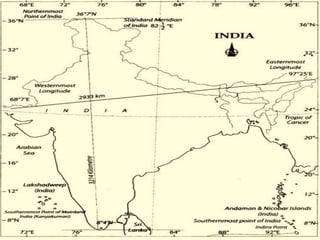
 India lies entirely in the Northern Hemisphere.
 India’s mainland extends between latitudes, and longitudes.
 The Tropic of Cancer divides India into two almost equal parts.
 The island groups of Lakshadweep and Andman & Nicobar are also part of
India.
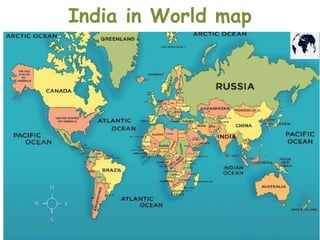
India in World map
Size
 Covering an area of 3.28 million square kilometres, India’s total area is
2.4% of the total geographical area of the world.
 India is the world’s seventh largest country with a land boundary of about
15,200 km, with total length of the coastline being 7,516.6 km.
 India’s east-west extent appears to be smaller than the north-south extent.
 India’s latitudinal and longitudinal extent is about 30 degrees.
 India’s standard time is based on 82.30 degrees E meridian, which passes
near Mirzapur in UP.
 Latitudinal extent influences duration of the day and night.
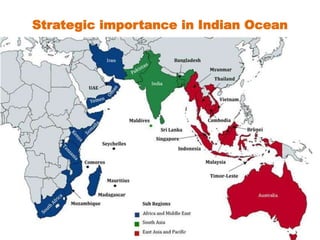
Strategic importance in Indian Ocean
India and the World
 The Indian landmass is centrally located between West and East Asia.
The trans Indian ocean routes connect countries in the west and counties in
the east.
 India’s protruding Deccan Peninsula helped India to establish close
contacts with West Asia, Africa and Europe, South-east and East Asia.
 India’s contacts with the world via land routes are much more than her
maritime contacts.
 India is the only nation which has a ocean named after it.
 India has contributed a lot to the world in forms of ideas, philosophies
(Upanishads, Ramayana, Panchtantra) and mathematics (Indian numerals
and decimal system).
 In exchange, India’s architecture was influenced by Greek sculpture and
architectural styles from West Asia.
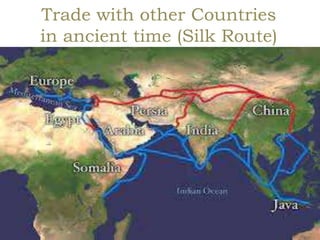
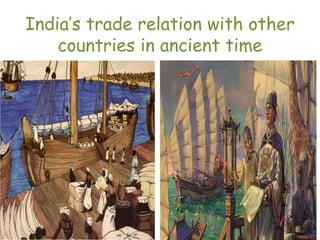
Trade with other Countries
in ancient time (Silk Route)
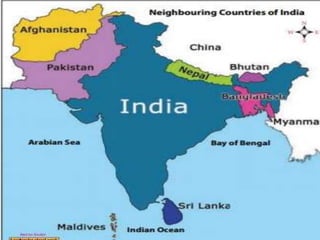
India’s Neighbours
 India has an important position in South Asia and has 29 States and 7
Union Territories.
 India shares its boundaries with Pakistan, Afghanistan, China, Nepal,
Bangladesh, Myanmar and Bhutan.
 The southern neighbours across the sea consist of the two island
countries, namely Maldives and Sri Lanka.
 Shri Lanka is separated from India by Pak Strait, a narrow strip of sea.
India always have and had strong geographical and historical links with her
neighbours.
 India stands apart from the rest of Asia.
India’s trade relation with other
countries in ancient time
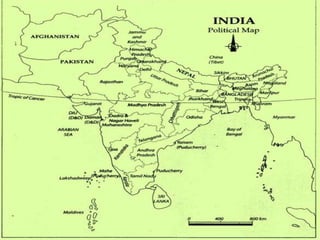
MAP
WORK
India size and location, 9.pptx

India size and location, 9.pptx

  • 1.
    Prasad Public School Session– 2022-23 Class - 9th Subject – Social Science Chapter – India:Size and Location
  • 2.
    India is anancient civilisation but now it is a developing nation. It has shown remarkable progress in various fields. Location  India lies entirely in the Northern Hemisphere.  India’s mainland extends between latitudes, and longitudes.  The Tropic of Cancer divides India into two almost equal parts.  The island groups of Lakshadweep and Andman & Nicobar are also part of India.
  • 3.
  • 4.
    Size  Covering anarea of 3.28 million square kilometres, India’s total area is 2.4% of the total geographical area of the world.  India is the world’s seventh largest country with a land boundary of about 15,200 km, with total length of the coastline being 7,516.6 km.  India’s east-west extent appears to be smaller than the north-south extent.  India’s latitudinal and longitudinal extent is about 30 degrees.  India’s standard time is based on 82.30 degrees E meridian, which passes near Mirzapur in UP.  Latitudinal extent influences duration of the day and night.
  • 5.
  • 6.
    India and theWorld  The Indian landmass is centrally located between West and East Asia. The trans Indian ocean routes connect countries in the west and counties in the east.  India’s protruding Deccan Peninsula helped India to establish close contacts with West Asia, Africa and Europe, South-east and East Asia.  India’s contacts with the world via land routes are much more than her maritime contacts.  India is the only nation which has a ocean named after it.  India has contributed a lot to the world in forms of ideas, philosophies (Upanishads, Ramayana, Panchtantra) and mathematics (Indian numerals and decimal system).  In exchange, India’s architecture was influenced by Greek sculpture and architectural styles from West Asia.
  • 7.
    Trade with otherCountries in ancient time (Silk Route)
  • 8.
    India’s Neighbours  Indiahas an important position in South Asia and has 29 States and 7 Union Territories.  India shares its boundaries with Pakistan, Afghanistan, China, Nepal, Bangladesh, Myanmar and Bhutan.  The southern neighbours across the sea consist of the two island countries, namely Maldives and Sri Lanka.  Shri Lanka is separated from India by Pak Strait, a narrow strip of sea. India always have and had strong geographical and historical links with her neighbours.  India stands apart from the rest of Asia.
  • 10.
    India’s trade relationwith other countries in ancient time
  • 11.