To automatically detect and count lymphocytes from immunohistochemistry
images of breast, colon and prostate cancer using deep learning.
• To annotate and label the lymphocytes in the images manually for training.
• To get the feature map with the help of a convolutional network.
• To find the candidate regions from the feature map using region proposal
network.
• To generate the predicted class and bounding box using the detection
network.
25-05-2024 Department of Biomedical Engineering 2
• Cancer is the result of mutations or abnormal changes in genes which are responsible
for controlling the growth of cells.
• Recurrence of cancer is one of the biggest issues in the field of oncology. Reasons for
recurrence depends on various factors such as cancer stage, genetic issues, histology,
treatments etc.
• Generally the recognized GOLD standard for cancer staging and prognosis is the TNM
staging system which provides an insight of the advancement of cancer in the body and
how far it has spread.
• Based on this, treatment is administered to patients for their recovery and for prevention
of recurrence of cancer.
• Apart from this, recently a new parameter has been considered to play a major role in
assessing the survival rate of patients called as the Immunoscore. This parameter
contributes up to 47% of the survival rate [1].
[1] Franck Pagès et al, “International validation of the consensus Immunoscore for the classification of colon cancer: a prognostic and accuracy study”- Lancet (2018) 391:
2128–39
25-05-2024 Department of Biomedical Engineering 3
• Immunohistochemistry is the test done to calculate the immunoscore.
• Immunoscore is used to find out the immune response in the site of tumor by measuring the density
of CD3+ and CD8+ T lymphocytes in the invasive margin and core of the tumor.
• Based on the count and intensity of the lymphocytes in the tumor core and margin scoring is given.
• If there is high infiltration of T lymphocytes then there is low risk of relapse of cancer.
• Counting the number of lymphocytes one by one is a time consuming process for the pathologists.
• This project deals with the automatic detection and counting of the lymphocytes from
immunohistochemistry images of breast, colon and prostate by using deep learning technique
called Faster RCNN.
HYPOTHESIS
Tumor-infiltrating immune cells or lymphocytes may therefore be a valuable prognostic tool apart from
the TNM staging in the treatment of colorectal cancer and possibly other malignancies.
25-05-2024 Department of Biomedical Engineering 4
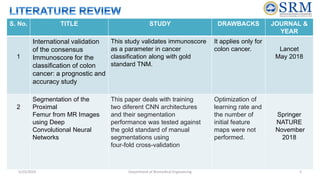
S. No. TITLE STUDY DRAWBACKS JOURNAL &
YEAR
1
International validation
of the consensus
Immunoscore for the
classification of colon
cancer: a prognostic and
accuracy study
This study validates immunoscore
as a parameter in cancer
classification along with gold
standard TNM.
It applies only for
colon cancer. Lancet
May 2018
2
Segmentation of the
Proximal
Femur from MR Images
using Deep
Convolutional Neural
Networks
This paper deals with training
two diferent CNN architectures
and their segmentation
performance was tested against
the gold standard of manual
segmentations using
four-fold cross-validation
Optimization of
learning rate and
the number of
initial feature
maps were not
performed.
Springer
NATURE
November
2018
5/25/2024 5
Department of Biomedical Engineering
3
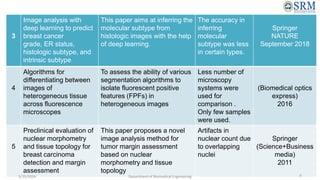
Image analysis with
deep learning to predict
breast cancer
grade, ER status,
histologic subtype, and
intrinsic subtype
This paper aims at inferring the
molecular subtype from
histologic images with the help
of deep learning.
The accuracy in
inferring
molecular
subtype was less
in certain types.
Springer
NATURE
September 2018
4
Algorithms for
differentiating between
images of
heterogeneous tissue
across fluorescence
microscopes
To assess the ability of various
segmentation algorithms to
isolate fluorescent positive
features (FPFs) in
heterogeneous images
Less number of
microscopy
systems were
used for
comparison .
Only few samples
were used.
(Biomedical optics
express)
2016
5
Preclinical evaluation of
nuclear morphometry
and tissue topology for
breast carcinoma
detection and margin
assessment
This paper proposes a novel
image analysis method for
tumor margin assessment
based on nuclear
morphometry and tissue
topology
Artifacts in
nuclear count due
to overlapping
nuclei
Springer
(Science+Business
media)
2011
5/25/2024 6
Department of Biomedical Engineering
5/25/2024 Department of Biomedical Engineering 7
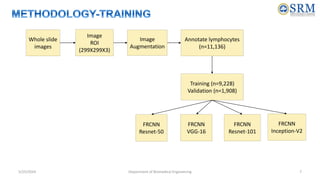
Whole slide
images
Image
ROI
(299X299X3)
Annotate lymphocytes
(n=11,136)
Training (n=9,228)
Validation (n=1,908)
FRCNN
Resnet-50
FRCNN
VGG-16
FRCNN
Inception-V2
FRCNN
Resnet-101
Image
Augmentation
5/25/2024 Department of Biomedical Engineering
8
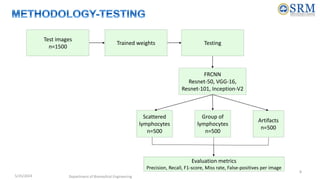
Test images
n=1500
Trained weights Testing
FRCNN
Resnet-50, VGG-16,
Resnet-101, Inception-V2
Scattered
lymphocytes
n=500
Group of
lymphocytes
n=500
Artifacts
n=500
Evaluation metrics
Precision, Recall, F1-score, Miss rate, False-positives per image
[1] Franck Pagès et al, “International validation of the consensus Immunoscore for the classification of colon cancer: a prognostic and accuracy study”- Lancet (2018)
391: 2128–39.
[2] Leonid Kostrykin et al, “Segmentation of cell nuclei using intensity-based model fitting and sequential convex programming”- IEEE 15th International Symposium on
Biomedical Imaging (ISBI) (2018) 978-1-5386-3636-7/18.
[3] Rhea Chitalia et al, “Algorithms for differentiating between images of heterogeneous tissue across fluorescence microscopes ”- Biomedical optics express (2016) Vol.
7, No. 9.
[4] Jun Kong et al, “Automated cell segmentation with 3D fluorescence microscopy images”- IEEE (2015) 978-1-4799-2374-8/15.
[5] Ndeke Nyirenda, Daniel L. Farkas, and V. Krishnan Ramanujan, “Preclinical evaluation of nuclear morphometry and tissue topology for breast carcinoma detection
and margin assessment”- Springer Science+Business Media (2011) 126(2): 345–354.
[6] Jenna L. Mueller et al, “Quantitative Segmentation of Fluorescence Microscopy Images of Heterogeneous Tissue: Application to the Detection of Residual Disease in
Tumor Margins”- PLOS ONE(2013) Volume 8, Issue 6.
[7] Kaustav Nandy et al, “Automatic Segmentation and Supervised Learning Based Selection of Nuclei in Cancer Tissue Images”- Cytometry Part A (2012) 81A:743–754.
[8] Alexandre Dufour et al, “Segmenting and Tracking Fluorescent Cells in Dynamic 3-D Microscopy With Coupled Active Surfaces ”- IEEE Transactions on image
processing (2005), Vol. 14, No. 9.
[9] Jeroen A.M. Belie¨n et al, “Confocal DNA Cytometry: A Contour-Based Segmentation Algorithm for Automated Three-Dimensional Image Segmentation”- Cytometry
(2002) 49:12–21.
[10] Gang Lin et al, “A Multi-Model Approach to Simultaneous Segmentation and Classification of Heterogeneous Populations of Cell Nuclei in 3D Confocal Microscope”-
Cytometry Part A (2007) 71A: 724736 .
[11] Umesh Adiga et al, “High-Throughput Analysis of Multispectral Images of Breast Cancer Tissue”- IEEE Transactions on image processing (2006), Vol. 15, No. 8.
[12] Umesh Adiga et al, “Characterization and automatic counting of F.I.S.H. signals in 3-D tissue images”-Image Anal Stereol(2001) 20:41-52.
[13] Shekar singh et al, “Breast cancer detection and classification of histopathological images”-International journal of engineering science and technology (2011) Vol. 3,
No. 5.
[14] Munezza Ata Khan et al, “Detection and Characterization of Antinuclear Antibody using fluorescence image processing”- IEEE International Conference on Robotics
and Emerging Allied Technologies in engineering (2014) 978-1-4799-5132-1/14
[15] Michael J. Sanderson et al, “Fluorescence Microscopy”-Cold Spring Harb Protoc. (2016) (10)
25-05-2024 Department of Biomedical Engineering 9
5/25/2024 Department of Biomedical Engineering 10

Second Review Research in quantifying lymphocytes.pptx

  • 2.
    To automatically detectand count lymphocytes from immunohistochemistry images of breast, colon and prostate cancer using deep learning. • To annotate and label the lymphocytes in the images manually for training. • To get the feature map with the help of a convolutional network. • To find the candidate regions from the feature map using region proposal network. • To generate the predicted class and bounding box using the detection network. 25-05-2024 Department of Biomedical Engineering 2
  • 3.
    • Cancer isthe result of mutations or abnormal changes in genes which are responsible for controlling the growth of cells. • Recurrence of cancer is one of the biggest issues in the field of oncology. Reasons for recurrence depends on various factors such as cancer stage, genetic issues, histology, treatments etc. • Generally the recognized GOLD standard for cancer staging and prognosis is the TNM staging system which provides an insight of the advancement of cancer in the body and how far it has spread. • Based on this, treatment is administered to patients for their recovery and for prevention of recurrence of cancer. • Apart from this, recently a new parameter has been considered to play a major role in assessing the survival rate of patients called as the Immunoscore. This parameter contributes up to 47% of the survival rate [1]. [1] Franck Pagès et al, “International validation of the consensus Immunoscore for the classification of colon cancer: a prognostic and accuracy study”- Lancet (2018) 391: 2128–39 25-05-2024 Department of Biomedical Engineering 3
  • 4.
    • Immunohistochemistry isthe test done to calculate the immunoscore. • Immunoscore is used to find out the immune response in the site of tumor by measuring the density of CD3+ and CD8+ T lymphocytes in the invasive margin and core of the tumor. • Based on the count and intensity of the lymphocytes in the tumor core and margin scoring is given. • If there is high infiltration of T lymphocytes then there is low risk of relapse of cancer. • Counting the number of lymphocytes one by one is a time consuming process for the pathologists. • This project deals with the automatic detection and counting of the lymphocytes from immunohistochemistry images of breast, colon and prostate by using deep learning technique called Faster RCNN. HYPOTHESIS Tumor-infiltrating immune cells or lymphocytes may therefore be a valuable prognostic tool apart from the TNM staging in the treatment of colorectal cancer and possibly other malignancies. 25-05-2024 Department of Biomedical Engineering 4
  • 5.
    S. No. TITLESTUDY DRAWBACKS JOURNAL & YEAR 1 International validation of the consensus Immunoscore for the classification of colon cancer: a prognostic and accuracy study This study validates immunoscore as a parameter in cancer classification along with gold standard TNM. It applies only for colon cancer. Lancet May 2018 2 Segmentation of the Proximal Femur from MR Images using Deep Convolutional Neural Networks This paper deals with training two diferent CNN architectures and their segmentation performance was tested against the gold standard of manual segmentations using four-fold cross-validation Optimization of learning rate and the number of initial feature maps were not performed. Springer NATURE November 2018 5/25/2024 5 Department of Biomedical Engineering
  • 6.
    3 Image analysis with deeplearning to predict breast cancer grade, ER status, histologic subtype, and intrinsic subtype This paper aims at inferring the molecular subtype from histologic images with the help of deep learning. The accuracy in inferring molecular subtype was less in certain types. Springer NATURE September 2018 4 Algorithms for differentiating between images of heterogeneous tissue across fluorescence microscopes To assess the ability of various segmentation algorithms to isolate fluorescent positive features (FPFs) in heterogeneous images Less number of microscopy systems were used for comparison . Only few samples were used. (Biomedical optics express) 2016 5 Preclinical evaluation of nuclear morphometry and tissue topology for breast carcinoma detection and margin assessment This paper proposes a novel image analysis method for tumor margin assessment based on nuclear morphometry and tissue topology Artifacts in nuclear count due to overlapping nuclei Springer (Science+Business media) 2011 5/25/2024 6 Department of Biomedical Engineering
  • 7.
    5/25/2024 Department ofBiomedical Engineering 7 Whole slide images Image ROI (299X299X3) Annotate lymphocytes (n=11,136) Training (n=9,228) Validation (n=1,908) FRCNN Resnet-50 FRCNN VGG-16 FRCNN Inception-V2 FRCNN Resnet-101 Image Augmentation
  • 8.
    5/25/2024 Department ofBiomedical Engineering 8 Test images n=1500 Trained weights Testing FRCNN Resnet-50, VGG-16, Resnet-101, Inception-V2 Scattered lymphocytes n=500 Group of lymphocytes n=500 Artifacts n=500 Evaluation metrics Precision, Recall, F1-score, Miss rate, False-positives per image
  • 9.
    [1] Franck Pagèset al, “International validation of the consensus Immunoscore for the classification of colon cancer: a prognostic and accuracy study”- Lancet (2018) 391: 2128–39. [2] Leonid Kostrykin et al, “Segmentation of cell nuclei using intensity-based model fitting and sequential convex programming”- IEEE 15th International Symposium on Biomedical Imaging (ISBI) (2018) 978-1-5386-3636-7/18. [3] Rhea Chitalia et al, “Algorithms for differentiating between images of heterogeneous tissue across fluorescence microscopes ”- Biomedical optics express (2016) Vol. 7, No. 9. [4] Jun Kong et al, “Automated cell segmentation with 3D fluorescence microscopy images”- IEEE (2015) 978-1-4799-2374-8/15. [5] Ndeke Nyirenda, Daniel L. Farkas, and V. Krishnan Ramanujan, “Preclinical evaluation of nuclear morphometry and tissue topology for breast carcinoma detection and margin assessment”- Springer Science+Business Media (2011) 126(2): 345–354. [6] Jenna L. Mueller et al, “Quantitative Segmentation of Fluorescence Microscopy Images of Heterogeneous Tissue: Application to the Detection of Residual Disease in Tumor Margins”- PLOS ONE(2013) Volume 8, Issue 6. [7] Kaustav Nandy et al, “Automatic Segmentation and Supervised Learning Based Selection of Nuclei in Cancer Tissue Images”- Cytometry Part A (2012) 81A:743–754. [8] Alexandre Dufour et al, “Segmenting and Tracking Fluorescent Cells in Dynamic 3-D Microscopy With Coupled Active Surfaces ”- IEEE Transactions on image processing (2005), Vol. 14, No. 9. [9] Jeroen A.M. Belie¨n et al, “Confocal DNA Cytometry: A Contour-Based Segmentation Algorithm for Automated Three-Dimensional Image Segmentation”- Cytometry (2002) 49:12–21. [10] Gang Lin et al, “A Multi-Model Approach to Simultaneous Segmentation and Classification of Heterogeneous Populations of Cell Nuclei in 3D Confocal Microscope”- Cytometry Part A (2007) 71A: 724736 . [11] Umesh Adiga et al, “High-Throughput Analysis of Multispectral Images of Breast Cancer Tissue”- IEEE Transactions on image processing (2006), Vol. 15, No. 8. [12] Umesh Adiga et al, “Characterization and automatic counting of F.I.S.H. signals in 3-D tissue images”-Image Anal Stereol(2001) 20:41-52. [13] Shekar singh et al, “Breast cancer detection and classification of histopathological images”-International journal of engineering science and technology (2011) Vol. 3, No. 5. [14] Munezza Ata Khan et al, “Detection and Characterization of Antinuclear Antibody using fluorescence image processing”- IEEE International Conference on Robotics and Emerging Allied Technologies in engineering (2014) 978-1-4799-5132-1/14 [15] Michael J. Sanderson et al, “Fluorescence Microscopy”-Cold Spring Harb Protoc. (2016) (10) 25-05-2024 Department of Biomedical Engineering 9
  • 10.
    5/25/2024 Department ofBiomedical Engineering 10