pre
By kalyani reddy
Overview:
 Introduction
 What Is Cloud Computing?
 History of Cloud Computing
 Advantages of Cloud Computing
 Disadvantages of Cloud Computing
 Components of Cloud Computing
 Types of Cloud Computing
 Conclusion Cloud Computing
INTRODUCTION
 The concept of cloud computing was started from
telecommunication companies changing to VPN and
how it upgraded year by year.

In these days the cloud computing is growing rapidly
and the customers who have this applied science feel
that they have the total authority over the project but
in reality, the service providers have the power.
WHAT IS CLOUD COMPUTING?
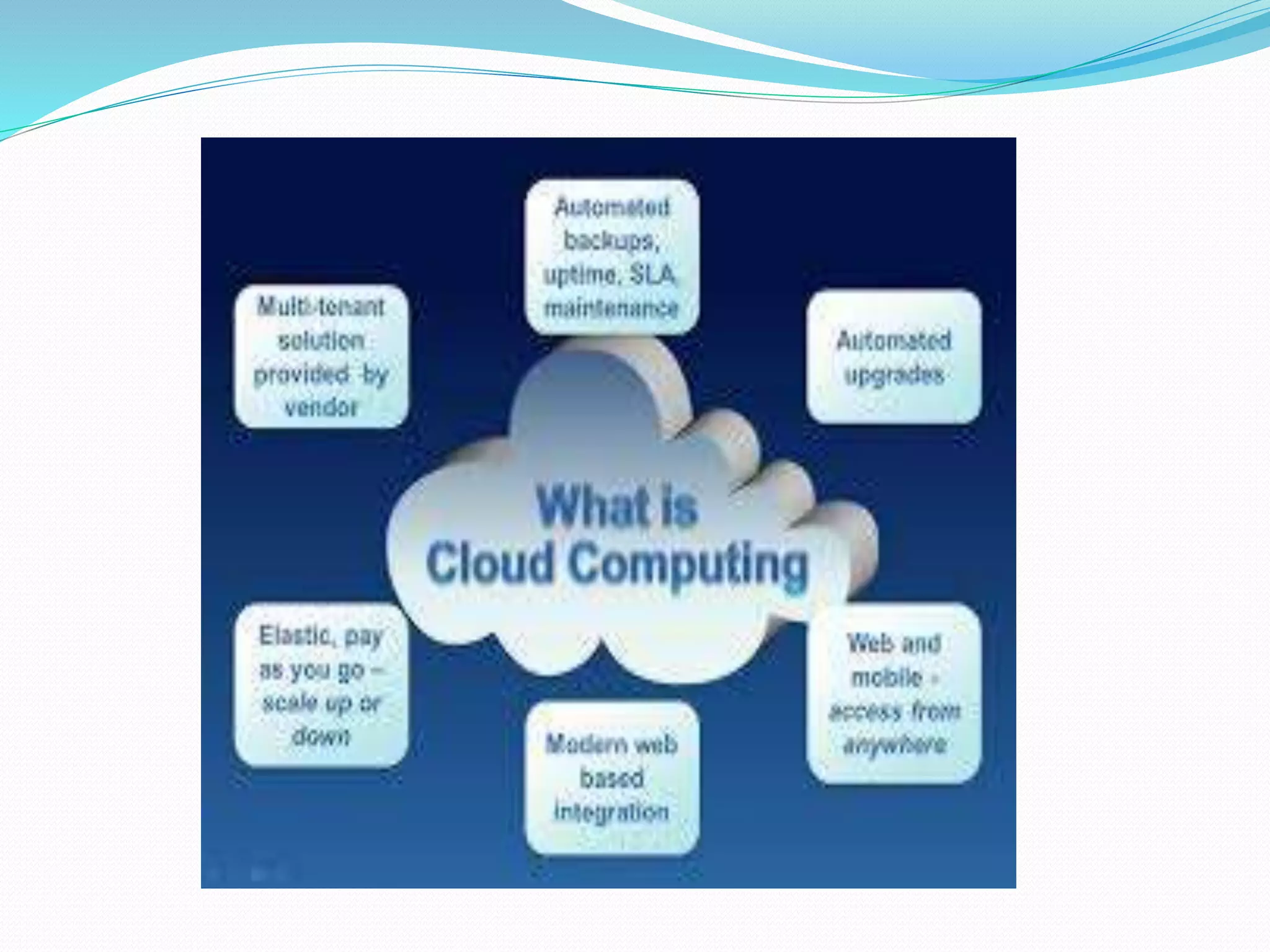
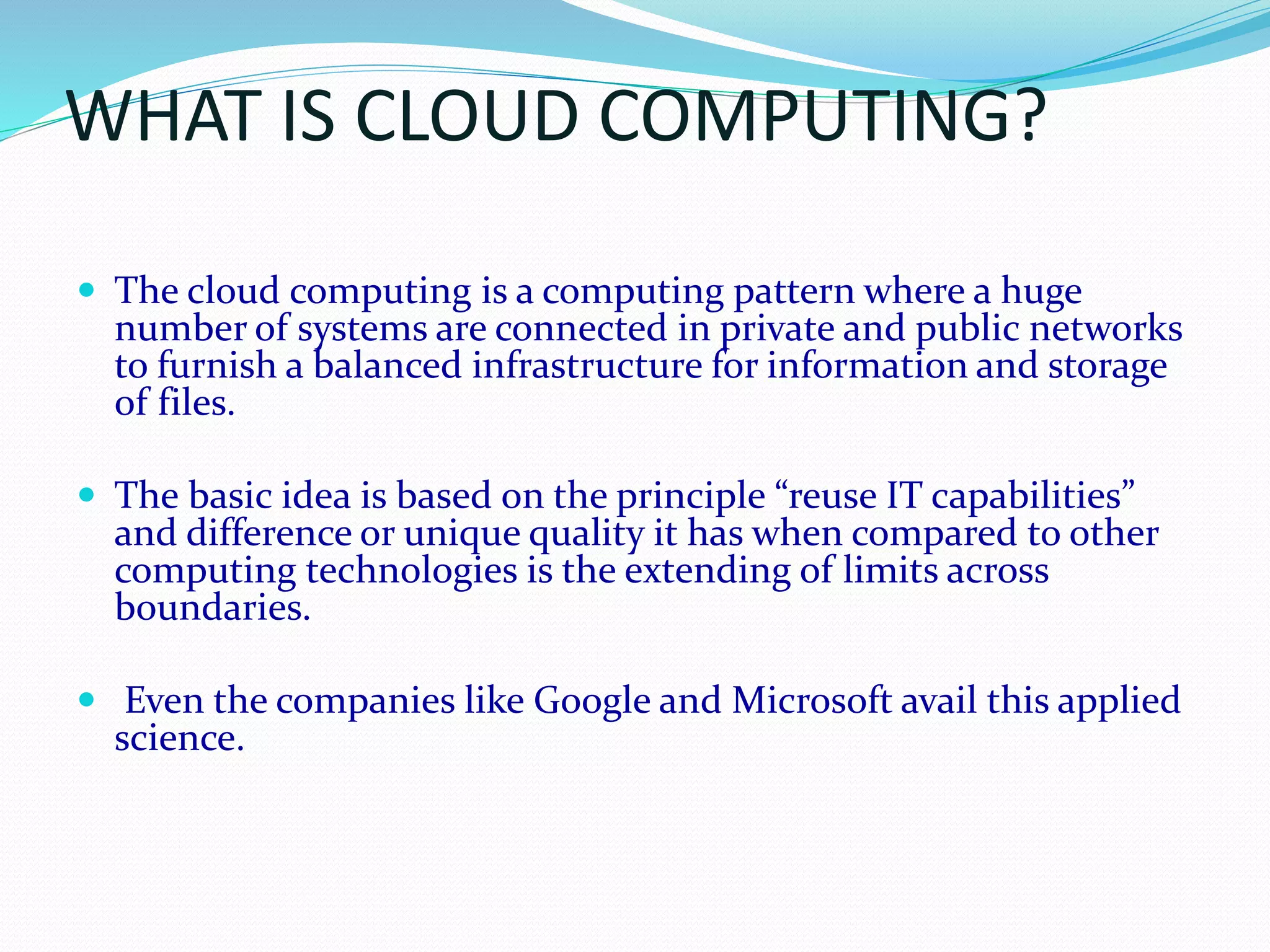
 The cloud computing is a computing pattern where a huge
number of systems are connected in private and public networks
to furnish a balanced infrastructure for information and storage
of files.
 The basic idea is based on the principle “reuse IT capabilities”
and difference or unique quality it has when compared to other
computing technologies is the extending of limits across
boundaries.
 Even the companies like Google and Microsoft avail this applied
science.
HISTORY OF CLOUD COMPUTING
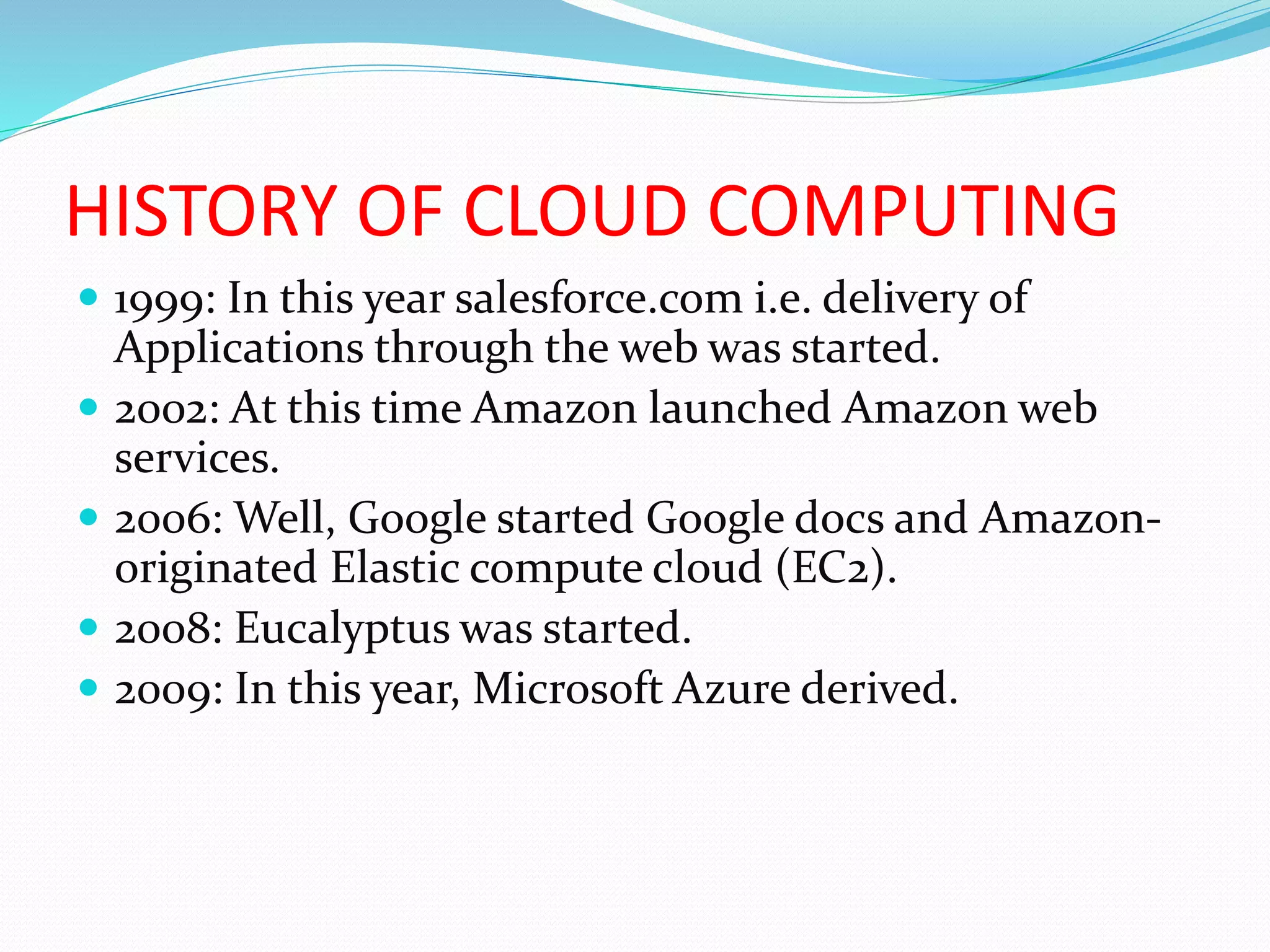
 1999: In this year salesforce.com i.e. delivery of
Applications through the web was started.
 2002: At this time Amazon launched Amazon web
services.
 2006: Well, Google started Google docs and Amazon-
originated Elastic compute cloud (EC2).
 2008: Eucalyptus was started.
 2009: In this year, Microsoft Azure derived.
COMPONENTS OF CLOUD
COMPUTING
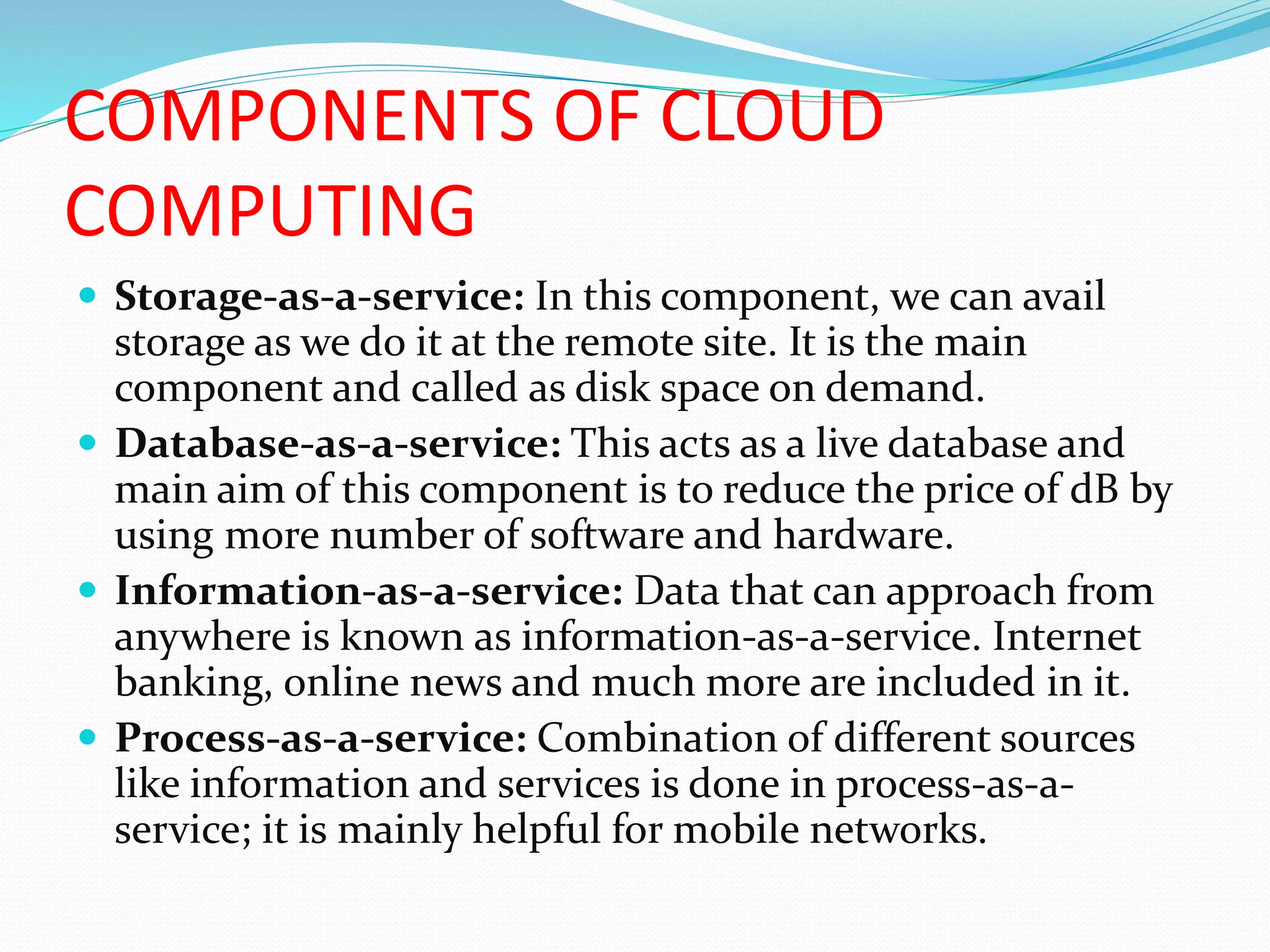
 Storage-as-a-service: In this component, we can avail
storage as we do it at the remote site. It is the main
component and called as disk space on demand.
 Database-as-a-service: This acts as a live database and
main aim of this component is to reduce the price of dB by
using more number of software and hardware.
 Information-as-a-service: Data that can approach from
anywhere is known as information-as-a-service. Internet
banking, online news and much more are included in it.
 Process-as-a-service: Combination of different sources
like information and services is done in process-as-a-
service; it is mainly helpful for mobile networks.
COMPONENTS OF CLOUD
COMPUTING
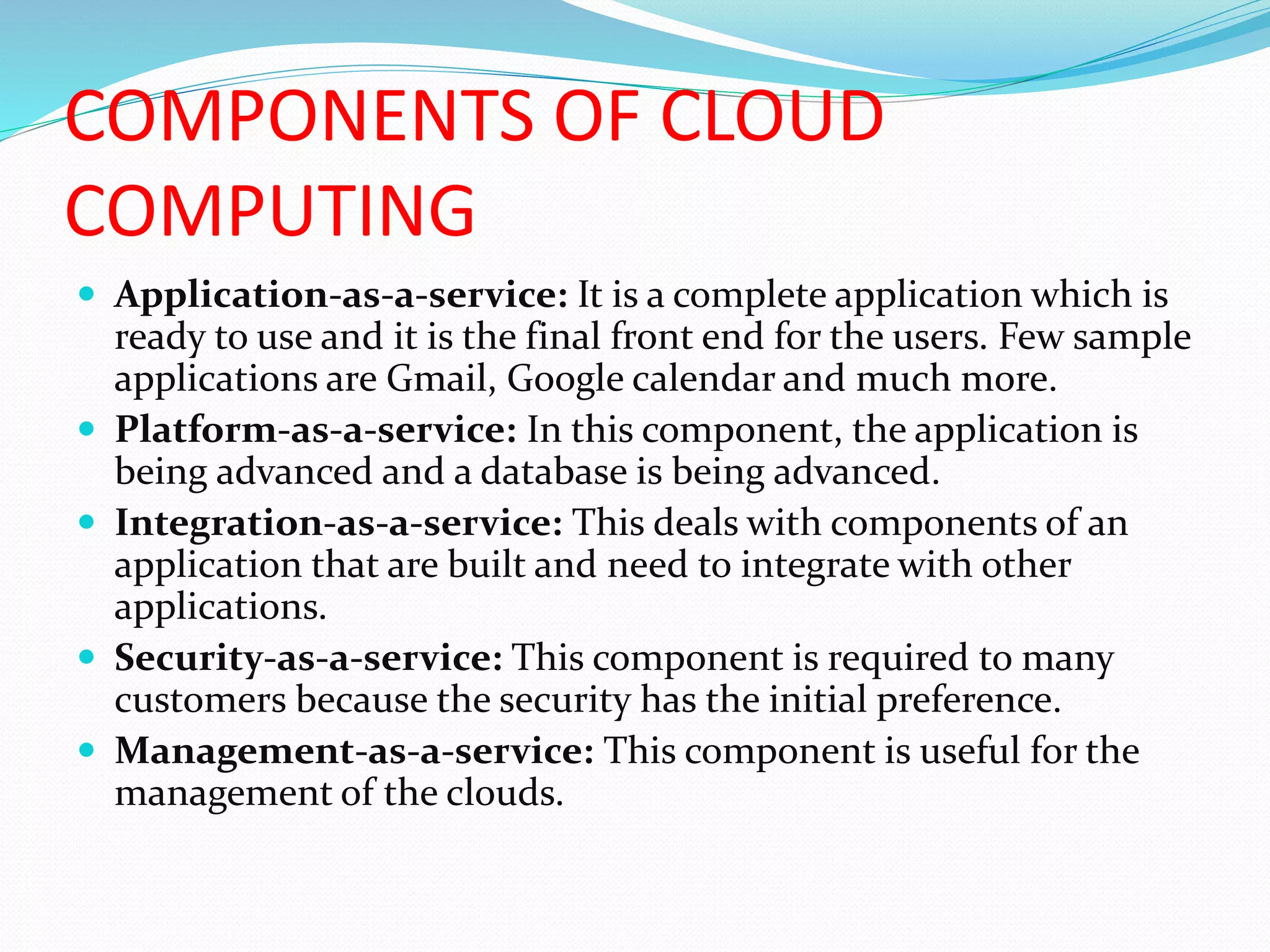
 Application-as-a-service: It is a complete application which is
ready to use and it is the final front end for the users. Few sample
applications are Gmail, Google calendar and much more.
 Platform-as-a-service: In this component, the application is
being advanced and a database is being advanced.
 Integration-as-a-service: This deals with components of an
application that are built and need to integrate with other
applications.
 Security-as-a-service: This component is required to many
customers because the security has the initial preference.
 Management-as-a-service: This component is useful for the
management of the clouds.
COMPONENTS OF CLOUD
COMPUTING
 Testing-as-a-service: This component refers to the
testing of applications that are hosted remotely.
 Infrastructure-as-a-service: This component takes
all the virtual hardware, software, and servers,
networks. It also prevents the running of multiple
servers.
TYPES OF CLOUD COMPUTING
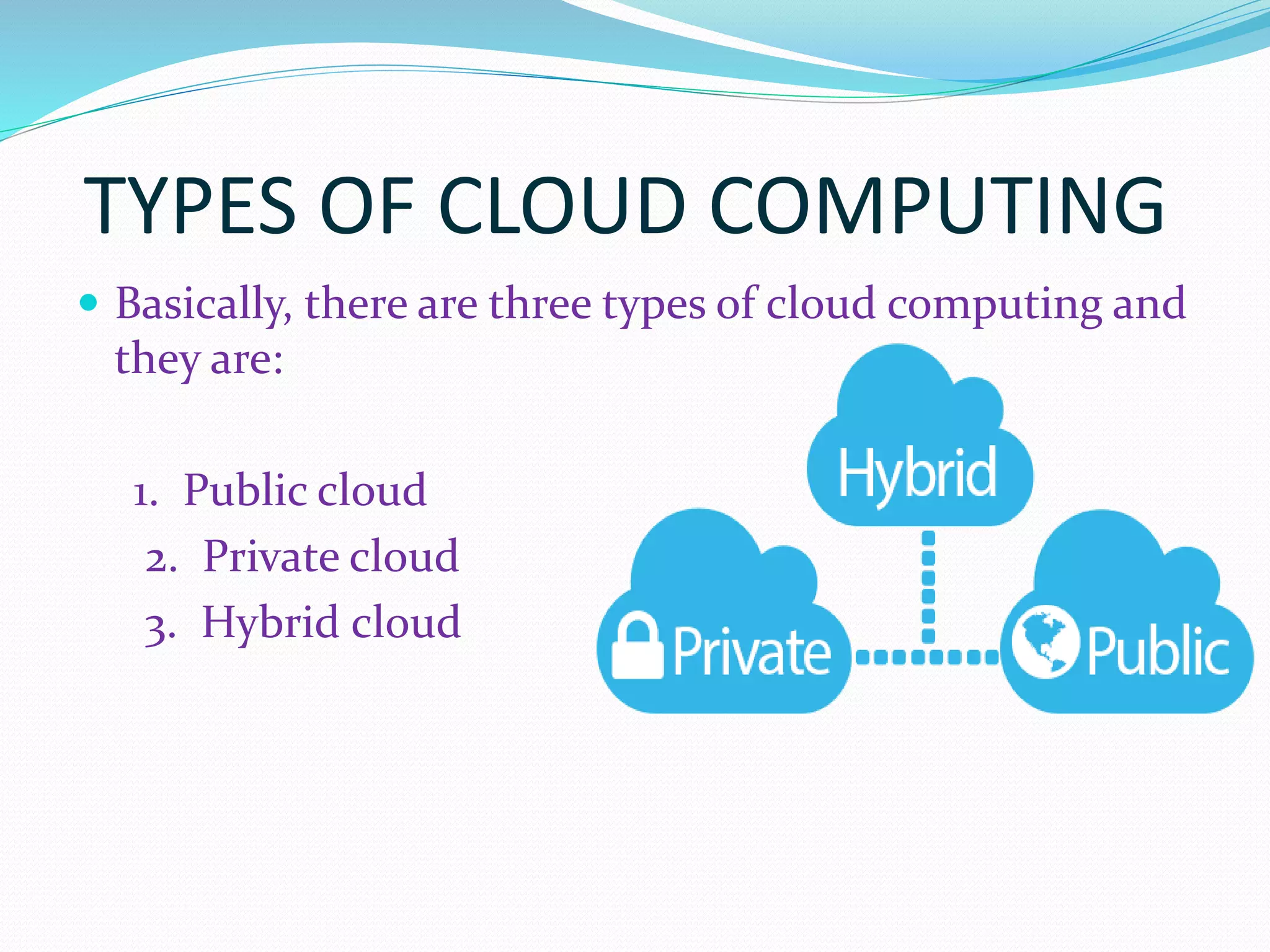
 Basically, there are three types of cloud computing and
they are:
1. Public cloud
2. Private cloud
3. Hybrid cloud
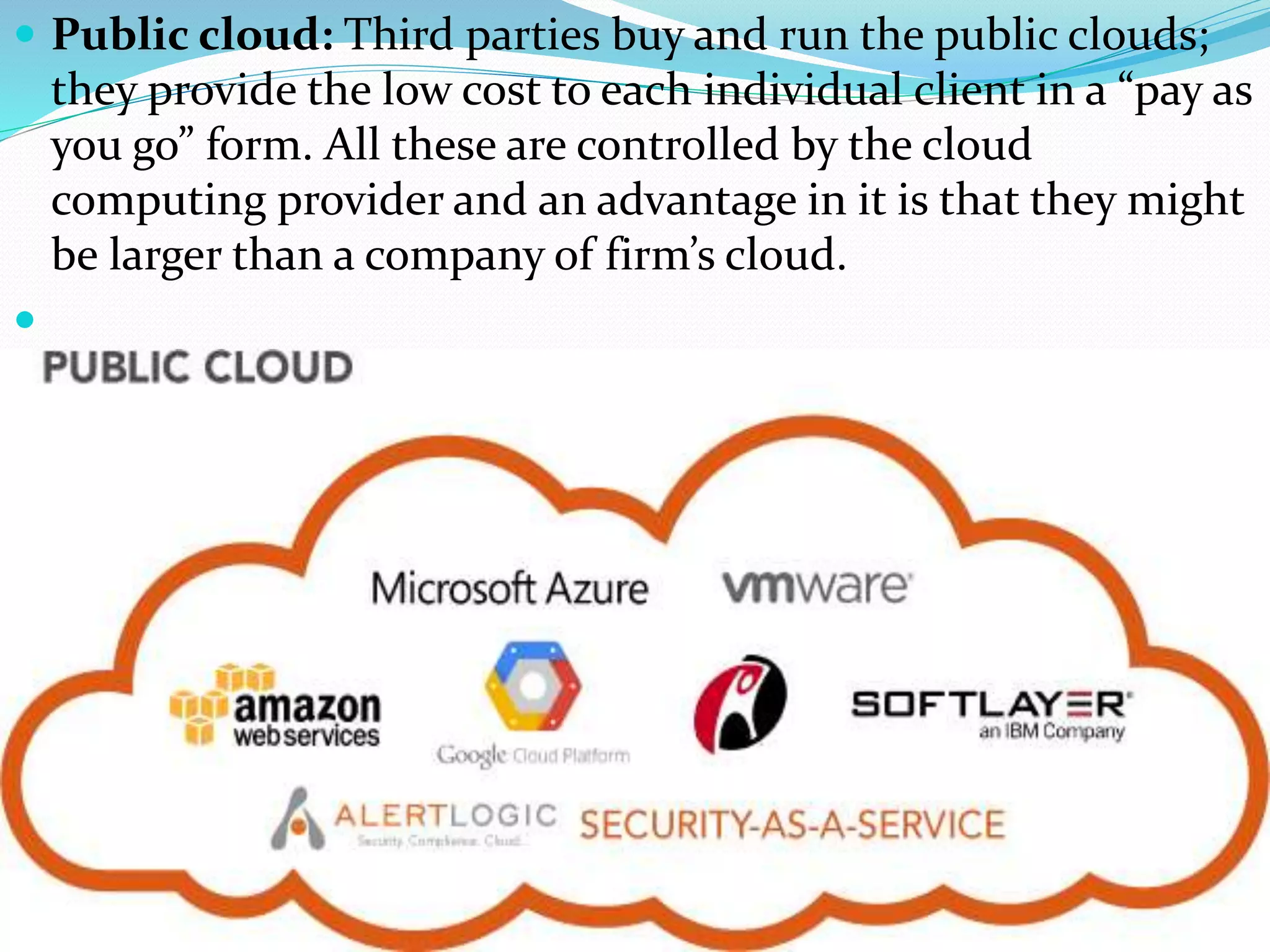
 Public cloud: Third parties buy and run the public clouds;
they provide the low cost to each individual client in a “pay as
you go” form. All these are controlled by the cloud
computing provider and an advantage in it is that they might
be larger than a company of firm’s cloud.

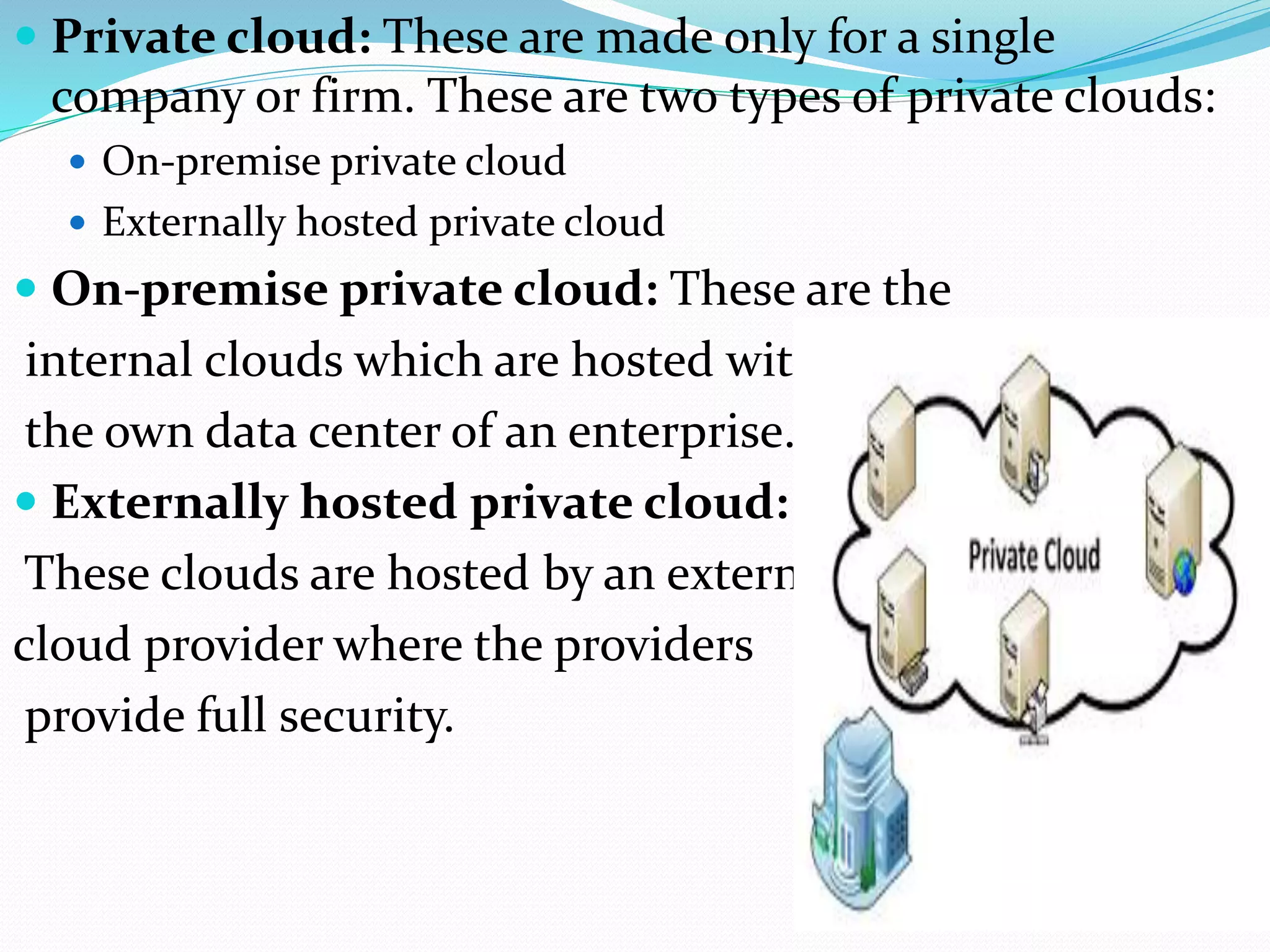
 Private cloud: These are made only for a single
company or firm. These are two types of private clouds:
 On-premise private cloud
 Externally hosted private cloud
 On-premise private cloud: These are the
internal clouds which are hosted with
the own data center of an enterprise.
 Externally hosted private cloud:
These clouds are hosted by an external
cloud provider where the providers
provide full security.
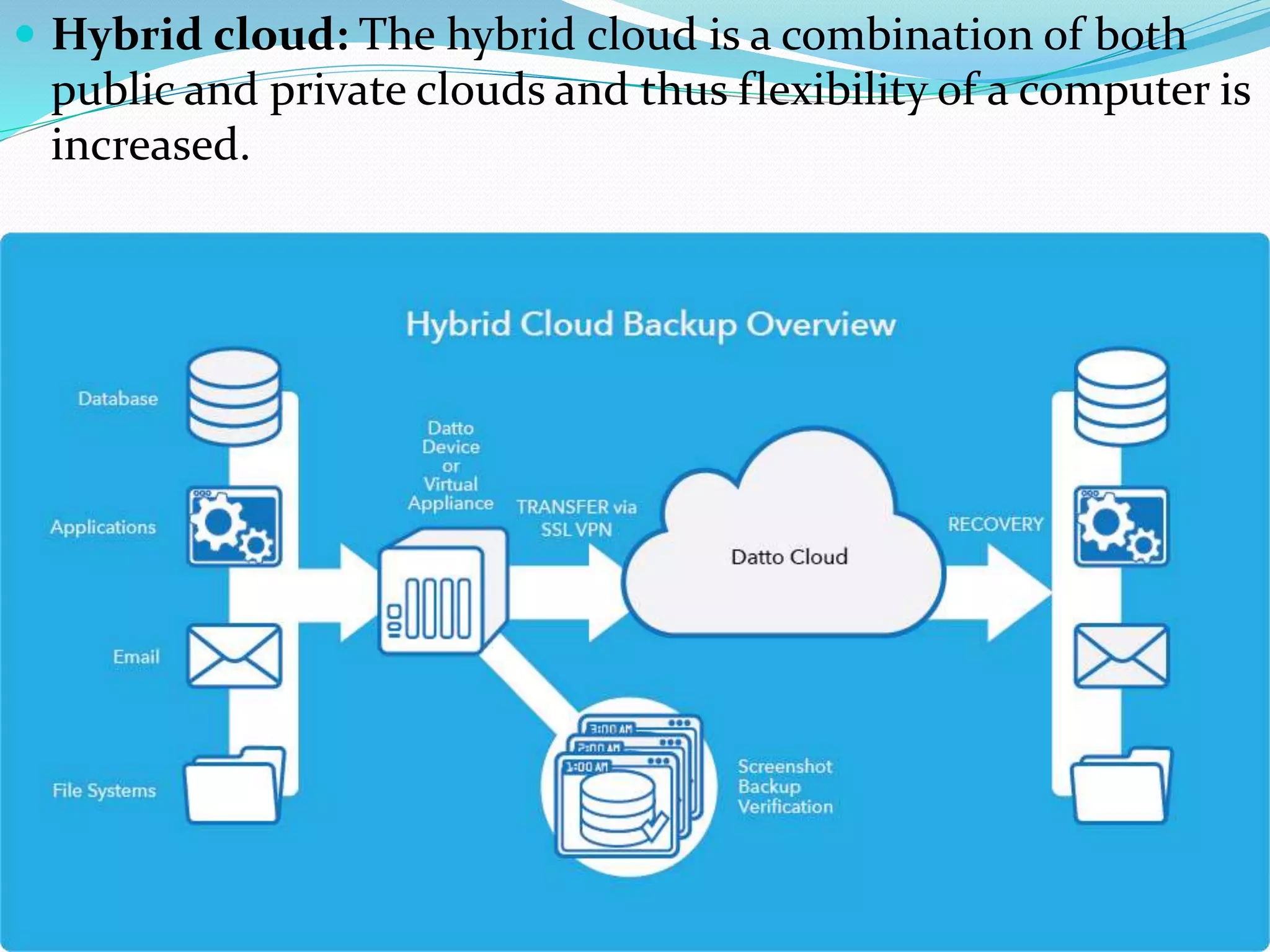
 Hybrid cloud: The hybrid cloud is a combination of both
public and private clouds and thus flexibility of a computer is
increased.
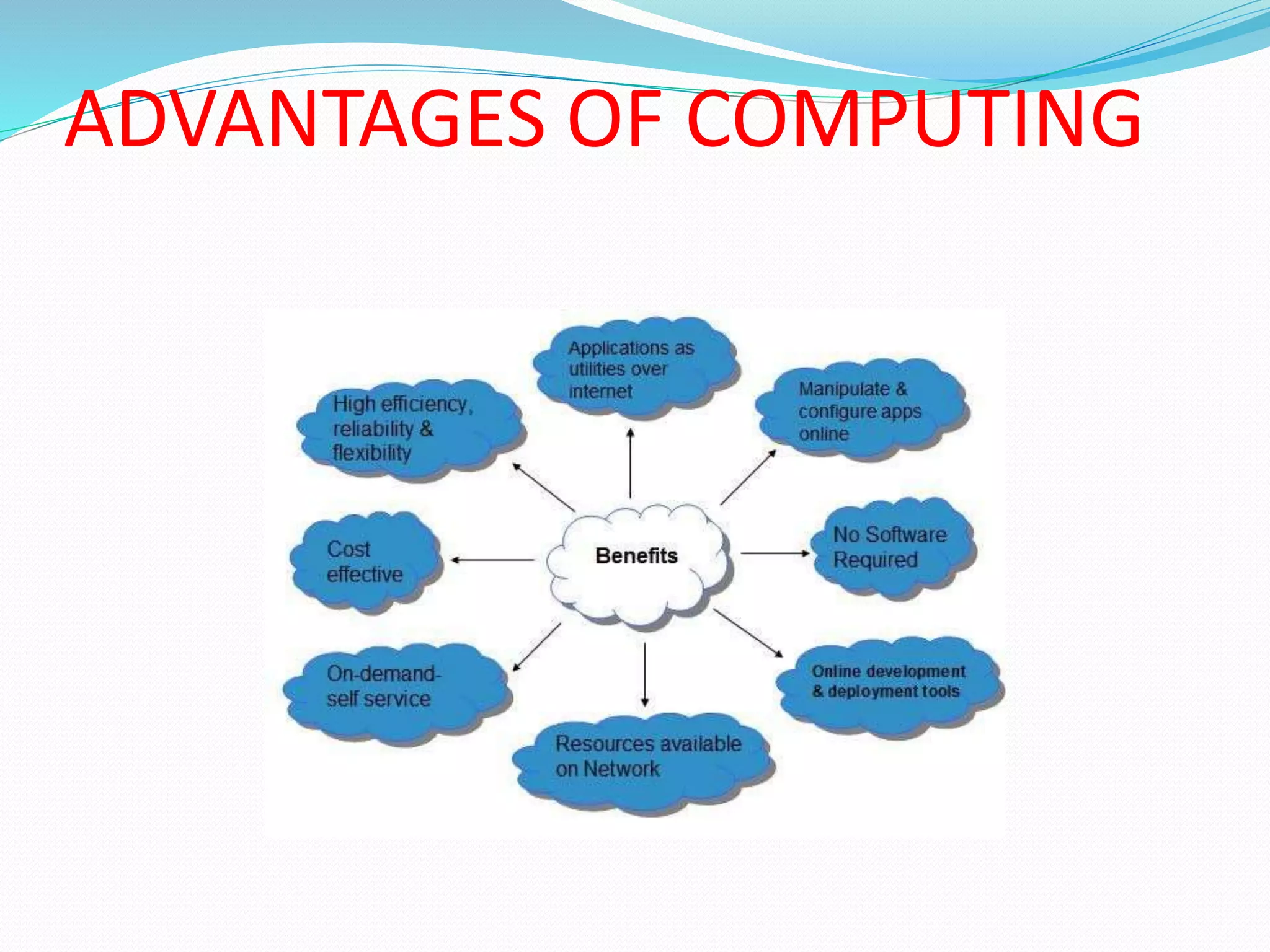
ADVANTAGES OF COMPUTING
ADVANTAGES OF CLOUD
COMPUTING
 Cloud computing is low in cost and affordable because
we get the bills as per the usage.
 The storage and maintenance of a large amount of
information or data are possible.
 The cloud computing is very flexible.
 It provides high security.
 The option of data recovery is available.
 Data can be managed easily.
 It has the automatic update option.
DISADVANTAGES
 One of the disadvantages of the cloud computing is
that it is risky.
 It requires the continuous internet connection and has
the migration issue.
CONCLUSION
 In addition, professionals involved with cloud
computing must ensure that cloud computing
does not become a service where just a few users
can use it.
CLOUD COMPUTING ppt

CLOUD COMPUTING ppt

  • 1.
  • 2.
    Overview:  Introduction  WhatIs Cloud Computing?  History of Cloud Computing  Advantages of Cloud Computing  Disadvantages of Cloud Computing  Components of Cloud Computing  Types of Cloud Computing  Conclusion Cloud Computing
  • 3.
    INTRODUCTION  The conceptof cloud computing was started from telecommunication companies changing to VPN and how it upgraded year by year.  In these days the cloud computing is growing rapidly and the customers who have this applied science feel that they have the total authority over the project but in reality, the service providers have the power.
  • 5.
    WHAT IS CLOUDCOMPUTING?  The cloud computing is a computing pattern where a huge number of systems are connected in private and public networks to furnish a balanced infrastructure for information and storage of files.  The basic idea is based on the principle “reuse IT capabilities” and difference or unique quality it has when compared to other computing technologies is the extending of limits across boundaries.  Even the companies like Google and Microsoft avail this applied science.
  • 6.
    HISTORY OF CLOUDCOMPUTING  1999: In this year salesforce.com i.e. delivery of Applications through the web was started.  2002: At this time Amazon launched Amazon web services.  2006: Well, Google started Google docs and Amazon- originated Elastic compute cloud (EC2).  2008: Eucalyptus was started.  2009: In this year, Microsoft Azure derived.
  • 7.
    COMPONENTS OF CLOUD COMPUTING Storage-as-a-service: In this component, we can avail storage as we do it at the remote site. It is the main component and called as disk space on demand.  Database-as-a-service: This acts as a live database and main aim of this component is to reduce the price of dB by using more number of software and hardware.  Information-as-a-service: Data that can approach from anywhere is known as information-as-a-service. Internet banking, online news and much more are included in it.  Process-as-a-service: Combination of different sources like information and services is done in process-as-a- service; it is mainly helpful for mobile networks.
  • 8.
    COMPONENTS OF CLOUD COMPUTING Application-as-a-service: It is a complete application which is ready to use and it is the final front end for the users. Few sample applications are Gmail, Google calendar and much more.  Platform-as-a-service: In this component, the application is being advanced and a database is being advanced.  Integration-as-a-service: This deals with components of an application that are built and need to integrate with other applications.  Security-as-a-service: This component is required to many customers because the security has the initial preference.  Management-as-a-service: This component is useful for the management of the clouds.
  • 9.
    COMPONENTS OF CLOUD COMPUTING Testing-as-a-service: This component refers to the testing of applications that are hosted remotely.  Infrastructure-as-a-service: This component takes all the virtual hardware, software, and servers, networks. It also prevents the running of multiple servers.
  • 10.
    TYPES OF CLOUDCOMPUTING  Basically, there are three types of cloud computing and they are: 1. Public cloud 2. Private cloud 3. Hybrid cloud
  • 11.
     Public cloud:Third parties buy and run the public clouds; they provide the low cost to each individual client in a “pay as you go” form. All these are controlled by the cloud computing provider and an advantage in it is that they might be larger than a company of firm’s cloud. 
  • 12.
     Private cloud:These are made only for a single company or firm. These are two types of private clouds:  On-premise private cloud  Externally hosted private cloud  On-premise private cloud: These are the internal clouds which are hosted with the own data center of an enterprise.  Externally hosted private cloud: These clouds are hosted by an external cloud provider where the providers provide full security.
  • 13.
     Hybrid cloud:The hybrid cloud is a combination of both public and private clouds and thus flexibility of a computer is increased.
  • 14.
  • 15.
    ADVANTAGES OF CLOUD COMPUTING Cloud computing is low in cost and affordable because we get the bills as per the usage.  The storage and maintenance of a large amount of information or data are possible.  The cloud computing is very flexible.  It provides high security.  The option of data recovery is available.  Data can be managed easily.  It has the automatic update option.
  • 16.
    DISADVANTAGES  One ofthe disadvantages of the cloud computing is that it is risky.  It requires the continuous internet connection and has the migration issue.
  • 17.
    CONCLUSION  In addition,professionals involved with cloud computing must ensure that cloud computing does not become a service where just a few users can use it.