Fake News, Echo Chambers, and Filter Bubbles
William H. Dutton @BiIIDutton
Quello Professor of Media and Information Policy
Quello Center, Michigan State University
@QuelloCenter
Presentation for a discussion in Lisbon, 2018.
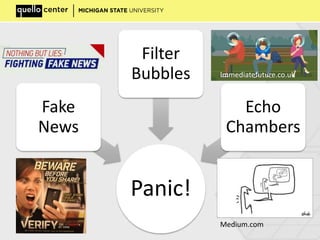
Panic!
Fake
News
Filter
Bubbles
Echo
Chambers
Immediatefuture.co.uk
Medium.com
The Part Played by Search in Shaping Political Opinion
• Quello Center team in collaboration with the Oxford
Internet Institute (OII), University of Oxford and
Department of Communication, University of Ottawa
• Professor William H. Dutton (Quello)
• Dr. Bianca C. Reisdorf (Quello)
• Dr. Grant Blank (OII)
• Dr. Elizabeth Dubois (Ottawa)
• With the assistance of:
• Craig Robertson (PhD Student, Quello)
• Sabrina Ahmed (BA Student, Ottawa)
• Support from Google, with thanks to Jon Steinberg
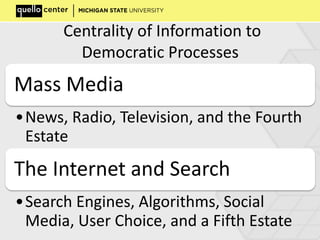
Centrality of Information to
Democratic Processes
Mass Media
•News, Radio, Television, and the Fourth
Estate
The Internet and Search
•Search Engines, Algorithms, Social
Media, User Choice, and a Fifth Estate
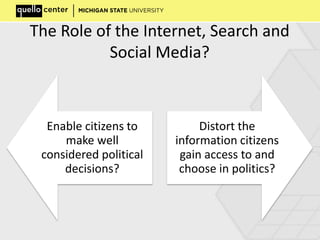
The Role of the Internet, Search and
Social Media?
Enable citizens to
make well
considered political
decisions?
Distort the
information citizens
gain access to and
choose in politics?
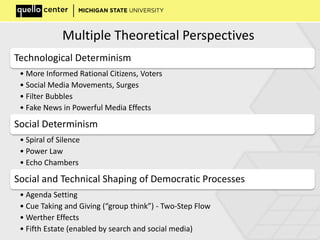
Technological Determinism
• More Informed Rational Citizens, Voters
• Social Media Movements, Surges
• Filter Bubbles
• Fake News in Powerful Media Effects
Social Determinism
• Spiral of Silence
• Power Law
• Echo Chambers
Social and Technical Shaping of Democratic Processes
• Agenda Setting
• Cue Taking and Giving (“group think”) - Two-Step Flow
• Werther Effects
• Fifth Estate (enabled by search and social media)
Multiple Theoretical Perspectives
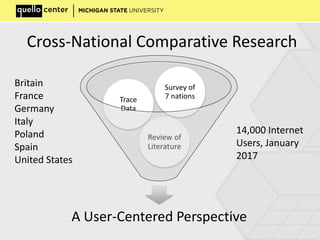
Cross-National Comparative Research
A User-Centered Perspective
Review of
Literature
Trace
Data
Survey of
7 nations
Britain
France
Germany
Italy
Poland
Spain
United States
14,000 Internet
Users, January
2017
General
Findings
National
Comparisons:
5 Themes
Individual
Differences
1. The Centrality of Search
Finding Information in Mountain of WWW
Becoming the first place people go for information
One of the most common uses of the Internet
With politics a limited, specialized topic of search
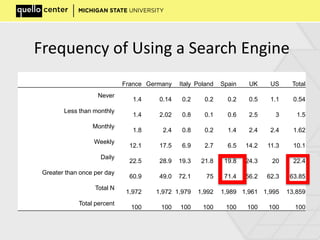
Frequency of Using a Search Engine
France Germany Italy Poland Spain UK US Total
Never
1.4 0.14 0.2 0.2 0.2 0.5 1.1 0.54
Less than monthly
1.4 2.02 0.8 0.1 0.6 2.5 3 1.5
Monthly
1.8 2.4 0.8 0.2 1.4 2.4 2.4 1.62
Weekly
12.1 17.5 6.9 2.7 6.5 14.2 11.3 10.1
Daily
22.5 28.9 19.3 21.8 19.8 24.3 20 22.4
Greater than once per day
60.9 49.0 72.1 75 71.4 56.2 62.3 63.85
Total N
1,972 1,972 1,979 1,992 1,989 1,961 1,995 13,859
Total percent
100 100 100 100 100 100 100 100
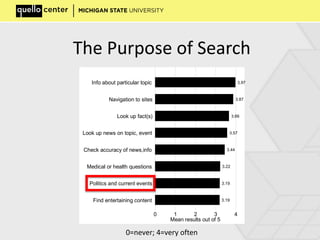
The Purpose of Search
3.19
3.19
3.22
3.44
3.57
3.66
3.87
3.97
0 1 2 3 4
Mean results out of 5
Find entertaining content
Politics and current events
Medical or health questions
Check accuracy of news,info
Look up news on topic, event
Look up fact(s)
Navigation to sites
Info about particular topic
0=never; 4=very often
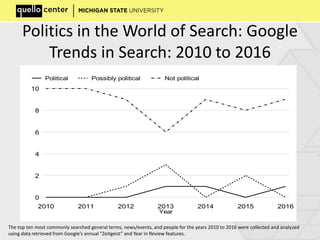
Politics in the World of Search: Google
Trends in Search: 2010 to 2016
0
2
4
6
8
10
2010 2011 2012 2013 2014 2015 2016
Year
Political Possibly political Not political
The top ten most commonly searched general terms, news/events, and people for the years 2010 to 2016 were collected and analyzed
using data retrieved from Google’s annual “Zeitgeist” and Year in Review features.
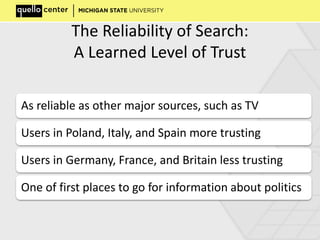
The Reliability of Search:
A Learned Level of Trust
As reliable as other major sources, such as TV
Users in Poland, Italy, and Spain more trusting
Users in Germany, France, and Britain less trusting
One of first places to go for information about politics
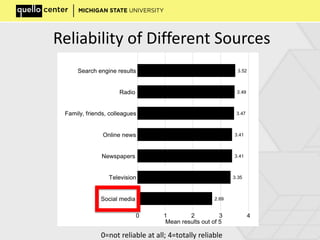
Reliability of Different Sources
2.69
3.35
3.41
3.41
3.47
3.49
3.52
0 1 2 3 4
Mean results out of 5
Social media
Television
Newspapers
Online news
Family, friends, colleagues
Radio
Search engine results
0=not reliable at all; 4=totally reliable
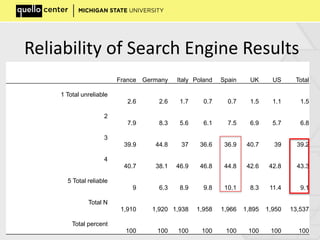
Reliability of Search Engine Results
France Germany Italy Poland Spain UK US Total
1 Total unreliable
2.6 2.6 1.7 0.7 0.7 1.5 1.1 1.5
2
7.9 8.3 5.6 6.1 7.5 6.9 5.7 6.8
3
39.9 44.8 37 36.6 36.9 40.7 39 39.2
4
40.7 38.1 46.9 46.8 44.8 42.6 42.8 43.3
5 Total reliable
9 6.3 8.9 9.8 10.1 8.3 11.4 9.1
Total N
1,910 1,920 1,938 1,958 1,966 1,895 1,950 13,537
Total percent
100 100 100 100 100 100 100 100
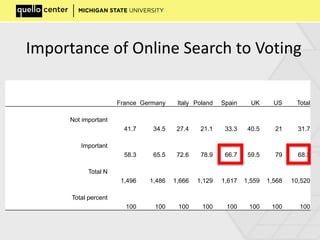
Importance of Online Search to Voting
France Germany Italy Poland Spain UK US Total
Not important
41.7 34.5 27.4 21.1 33.3 40.5 21 31.7
Important
58.3 65.5 72.6 78.9 66.7 59.5 79 68.3
Total N
1,496 1,486 1,666 1,129 1,617 1,559 1,568 10,520
Total percent
100 100 100 100 100 100 100 100
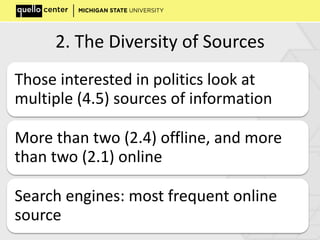
2. The Diversity of Sources
Those interested in politics look at
multiple (4.5) sources of information
More than two (2.4) offline, and more
than two (2.1) online
Search engines: most frequent online
source
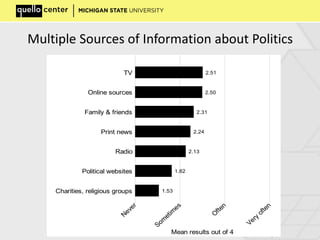
Multiple Sources of Information about Politics
1.53
1.82
2.13
2.24
2.31
2.50
2.51
N
ever
Som
etim
es
O
ften
Very
often
Mean results out of 4
Charities, religious groups
Political websites
Radio
Print news
Family & friends
Online sources
TV
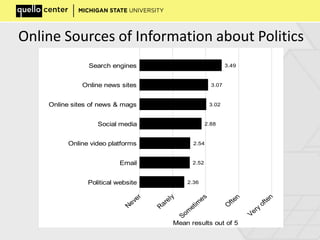
Online Sources of Information about Politics
2.36
2.52
2.54
2.88
3.02
3.07
3.49
N
ever
R
arely
Som
etim
es
O
ften
Very
often
Mean results out of 5
Political website
Email
Online video platforms
Social media
Online sites of news & mags
Online news sites
Search engines
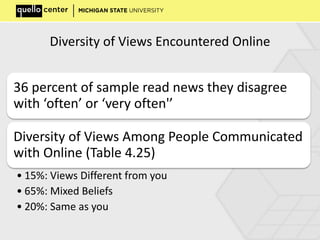
Diversity of Views Encountered Online
36 percent of sample read news they disagree
with ‘often’ or ‘very often'’
Diversity of Views Among People Communicated
with Online (Table 4.25)
• 15%: Views Different from you
• 65%: Mixed Beliefs
• 20%: Same as you
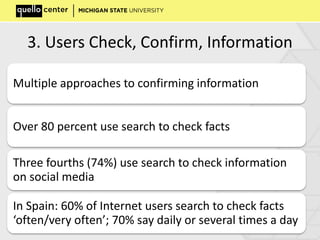
3. Users Check, Confirm, Information
Multiple approaches to confirming information
Over 80 percent use search to check facts
Three fourths (74%) use search to check information
on social media
In Spain: 60% of Internet users search to check facts
‘often/very often’; 70% say daily or several times a day
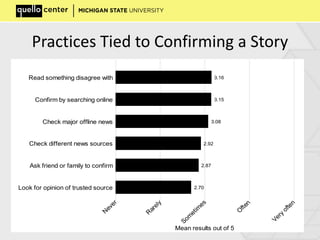
Practices Tied to Confirming a Story
2.70
2.87
2.92
3.08
3.15
3.16
N
ever
R
arely
Som
etim
es
O
ften
Very
often
Mean results out of 5
Look for opinion of trusted source
Ask friend or family to confirm
Check different news sources
Check major offline news
Confirm by searching online
Read something disagree with
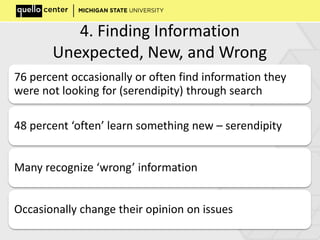
4. Finding Information
Unexpected, New, and Wrong
76 percent occasionally or often find information they
were not looking for (serendipity) through search
48 percent ‘often’ learn something new – serendipity
Many recognize ‘wrong’ information
Occasionally change their opinion on issues
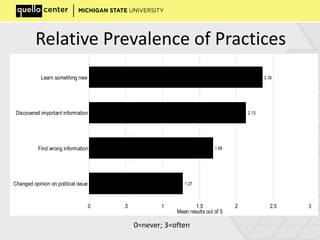
Relative Prevalence of Practices
1.27
1.68
2.13
2.35
0 .5 1 1.5 2 2.5 3
Mean results out of 5
Changed opinion on political issue
Find wrong information
Discovered important information
Learn something new
0=never; 3=often
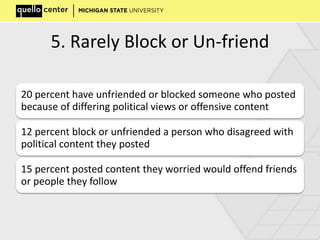
5. Rarely Block or Un-friend
20 percent have unfriended or blocked someone who posted
because of differing political views or offensive content
12 percent block or unfriended a person who disagreed with
political content they posted
15 percent posted content they worried would offend friends
or people they follow
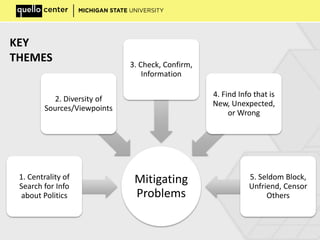
Mitigating
Problems
1. Centrality of
Search for Info
about Politics
2. Diversity of
Sources/Viewpoints
3. Check, Confirm,
Information
4. Find Info that is
New, Unexpected,
or Wrong
5. Seldom Block,
Unfriend, Censor
Others
KEY
THEMES
• Google Studie
• Forschungsfragen
• Methodologie
• Erste Resultate
• Bedeutung
• Diskussion
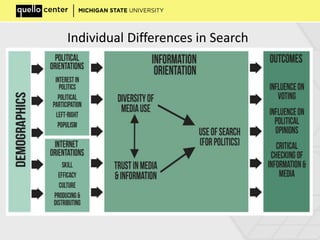
Individual Differences in Search
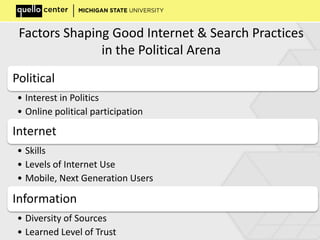
Factors Shaping Good Internet & Search Practices
in the Political Arena
Political
• Interest in Politics
• Online political participation
Internet
• Skills
• Levels of Internet Use
• Mobile, Next Generation Users
Information
• Diversity of Sources
• Learned Level of Trust
Operationalizing those ‘Vulnerable’
Interest in Politics: ‘Not at all’ v. ‘Somewhat
Interested, Interested, Very Interested’
Skill: Ability to use a search engine: ‘Bad, Fair, or
Poor’ v ‘Good or Excellent’
IF: Not at all interested in politics AND
Bad/Fair/Poor ability THEN rated VULNERABLE
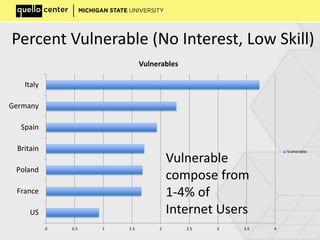
Percent Vulnerable (No Interest, Low Skill)
0 0.5 1 1.5 2 2.5 3 3.5 4
US
France
Poland
Britain
Spain
Germany
Italy
Vulnerables
Vulnerable
Vulnerable
compose from
1-4% of
Internet Users
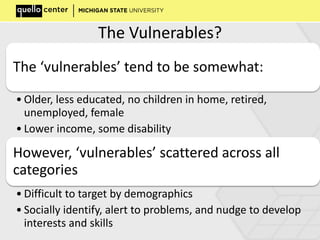
The Vulnerables?
The ‘vulnerables’ tend to be somewhat:
• Older, less educated, no children in home, retired,
unemployed, female
• Lower income, some disability
However, ‘vulnerables’ scattered across all
categories
• Difficult to target by demographics
• Socially identify, alert to problems, and nudge to develop
interests and skills
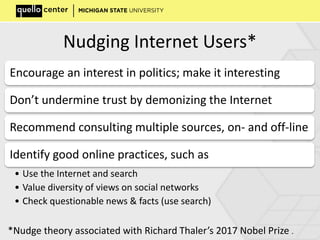
Nudging Internet Users*
Encourage an interest in politics; make it interesting
Don’t undermine trust by demonizing the Internet
Recommend consulting multiple sources, on- and off-line
Identify good online practices, such as
• Use the Internet and search
• Value diversity of views on social networks
• Check questionable news & facts (use search)
*Nudge theory associated with Richard Thaler’s 2017 Nobel Prize .
Key Issues Moving Forward
Theoretical Perspectives
• Be sceptical of deterministic perspectives
• Don’t underestimate users & social shaping of search
Interest in Politics
• Are those least interested & involved more vulnerable?
Skills in Search and Internet
• Are those offline or least skilled at greater risk?
Digital Media Literacy or Best to Nudge All Users?
• Nudge individuals – users – to reduce risks (Richard Thaler)
• Avoid inappropriate regulation of content: don’t panic!
• You are the key algorithm
The Report Plus
Dutton, W.H., Reisdorf, B.C., Dubois, E., and Blank, G. (2017), Search
and Politics: The Uses and Impacts of Search in Britain, France,
Germany, Italy, Poland, Spain, and the United States, Quello Center
Working Paper available on SSRN: http://ssrn.com/abstract=2960697
Dutton, W.H. (2017), ‘Fake News, Echo Chambers, and Filter
Bubbles: Underresearched and Overhyped’: https://theconversation.com/fake-
news-echo-chambers-and-filter-bubbles-underresearched-and-overhyped-76688
Dutton, W. H. (2017), ‘Bubblebusters’, NESTA. http://readie.eu/bubblebusters-
countering-fake-news-filter-bubbles-and-echo-chambers/

Search&politics lisbon-2018

  • 1.
    Fake News, EchoChambers, and Filter Bubbles William H. Dutton @BiIIDutton Quello Professor of Media and Information Policy Quello Center, Michigan State University @QuelloCenter Presentation for a discussion in Lisbon, 2018.
  • 2.
  • 3.
    The Part Playedby Search in Shaping Political Opinion • Quello Center team in collaboration with the Oxford Internet Institute (OII), University of Oxford and Department of Communication, University of Ottawa • Professor William H. Dutton (Quello) • Dr. Bianca C. Reisdorf (Quello) • Dr. Grant Blank (OII) • Dr. Elizabeth Dubois (Ottawa) • With the assistance of: • Craig Robertson (PhD Student, Quello) • Sabrina Ahmed (BA Student, Ottawa) • Support from Google, with thanks to Jon Steinberg
  • 4.
    Centrality of Informationto Democratic Processes Mass Media •News, Radio, Television, and the Fourth Estate The Internet and Search •Search Engines, Algorithms, Social Media, User Choice, and a Fifth Estate
  • 5.
    The Role ofthe Internet, Search and Social Media? Enable citizens to make well considered political decisions? Distort the information citizens gain access to and choose in politics?
  • 6.
    Technological Determinism • MoreInformed Rational Citizens, Voters • Social Media Movements, Surges • Filter Bubbles • Fake News in Powerful Media Effects Social Determinism • Spiral of Silence • Power Law • Echo Chambers Social and Technical Shaping of Democratic Processes • Agenda Setting • Cue Taking and Giving (“group think”) - Two-Step Flow • Werther Effects • Fifth Estate (enabled by search and social media) Multiple Theoretical Perspectives
  • 7.
    Cross-National Comparative Research AUser-Centered Perspective Review of Literature Trace Data Survey of 7 nations Britain France Germany Italy Poland Spain United States 14,000 Internet Users, January 2017
  • 8.
  • 9.
    1. The Centralityof Search Finding Information in Mountain of WWW Becoming the first place people go for information One of the most common uses of the Internet With politics a limited, specialized topic of search
  • 10.
    Frequency of Usinga Search Engine France Germany Italy Poland Spain UK US Total Never 1.4 0.14 0.2 0.2 0.2 0.5 1.1 0.54 Less than monthly 1.4 2.02 0.8 0.1 0.6 2.5 3 1.5 Monthly 1.8 2.4 0.8 0.2 1.4 2.4 2.4 1.62 Weekly 12.1 17.5 6.9 2.7 6.5 14.2 11.3 10.1 Daily 22.5 28.9 19.3 21.8 19.8 24.3 20 22.4 Greater than once per day 60.9 49.0 72.1 75 71.4 56.2 62.3 63.85 Total N 1,972 1,972 1,979 1,992 1,989 1,961 1,995 13,859 Total percent 100 100 100 100 100 100 100 100
  • 11.
    The Purpose ofSearch 3.19 3.19 3.22 3.44 3.57 3.66 3.87 3.97 0 1 2 3 4 Mean results out of 5 Find entertaining content Politics and current events Medical or health questions Check accuracy of news,info Look up news on topic, event Look up fact(s) Navigation to sites Info about particular topic 0=never; 4=very often
  • 12.
    Politics in theWorld of Search: Google Trends in Search: 2010 to 2016 0 2 4 6 8 10 2010 2011 2012 2013 2014 2015 2016 Year Political Possibly political Not political The top ten most commonly searched general terms, news/events, and people for the years 2010 to 2016 were collected and analyzed using data retrieved from Google’s annual “Zeitgeist” and Year in Review features.
  • 13.
    The Reliability ofSearch: A Learned Level of Trust As reliable as other major sources, such as TV Users in Poland, Italy, and Spain more trusting Users in Germany, France, and Britain less trusting One of first places to go for information about politics
  • 14.
    Reliability of DifferentSources 2.69 3.35 3.41 3.41 3.47 3.49 3.52 0 1 2 3 4 Mean results out of 5 Social media Television Newspapers Online news Family, friends, colleagues Radio Search engine results 0=not reliable at all; 4=totally reliable
  • 15.
    Reliability of SearchEngine Results France Germany Italy Poland Spain UK US Total 1 Total unreliable 2.6 2.6 1.7 0.7 0.7 1.5 1.1 1.5 2 7.9 8.3 5.6 6.1 7.5 6.9 5.7 6.8 3 39.9 44.8 37 36.6 36.9 40.7 39 39.2 4 40.7 38.1 46.9 46.8 44.8 42.6 42.8 43.3 5 Total reliable 9 6.3 8.9 9.8 10.1 8.3 11.4 9.1 Total N 1,910 1,920 1,938 1,958 1,966 1,895 1,950 13,537 Total percent 100 100 100 100 100 100 100 100
  • 16.
    Importance of OnlineSearch to Voting France Germany Italy Poland Spain UK US Total Not important 41.7 34.5 27.4 21.1 33.3 40.5 21 31.7 Important 58.3 65.5 72.6 78.9 66.7 59.5 79 68.3 Total N 1,496 1,486 1,666 1,129 1,617 1,559 1,568 10,520 Total percent 100 100 100 100 100 100 100 100
  • 17.
    2. The Diversityof Sources Those interested in politics look at multiple (4.5) sources of information More than two (2.4) offline, and more than two (2.1) online Search engines: most frequent online source
  • 18.
    Multiple Sources ofInformation about Politics 1.53 1.82 2.13 2.24 2.31 2.50 2.51 N ever Som etim es O ften Very often Mean results out of 4 Charities, religious groups Political websites Radio Print news Family & friends Online sources TV
  • 19.
    Online Sources ofInformation about Politics 2.36 2.52 2.54 2.88 3.02 3.07 3.49 N ever R arely Som etim es O ften Very often Mean results out of 5 Political website Email Online video platforms Social media Online sites of news & mags Online news sites Search engines
  • 20.
    Diversity of ViewsEncountered Online 36 percent of sample read news they disagree with ‘often’ or ‘very often'’ Diversity of Views Among People Communicated with Online (Table 4.25) • 15%: Views Different from you • 65%: Mixed Beliefs • 20%: Same as you
  • 21.
    3. Users Check,Confirm, Information Multiple approaches to confirming information Over 80 percent use search to check facts Three fourths (74%) use search to check information on social media In Spain: 60% of Internet users search to check facts ‘often/very often’; 70% say daily or several times a day
  • 22.
    Practices Tied toConfirming a Story 2.70 2.87 2.92 3.08 3.15 3.16 N ever R arely Som etim es O ften Very often Mean results out of 5 Look for opinion of trusted source Ask friend or family to confirm Check different news sources Check major offline news Confirm by searching online Read something disagree with
  • 23.
    4. Finding Information Unexpected,New, and Wrong 76 percent occasionally or often find information they were not looking for (serendipity) through search 48 percent ‘often’ learn something new – serendipity Many recognize ‘wrong’ information Occasionally change their opinion on issues
  • 24.
    Relative Prevalence ofPractices 1.27 1.68 2.13 2.35 0 .5 1 1.5 2 2.5 3 Mean results out of 5 Changed opinion on political issue Find wrong information Discovered important information Learn something new 0=never; 3=often
  • 25.
    5. Rarely Blockor Un-friend 20 percent have unfriended or blocked someone who posted because of differing political views or offensive content 12 percent block or unfriended a person who disagreed with political content they posted 15 percent posted content they worried would offend friends or people they follow
  • 26.
    Mitigating Problems 1. Centrality of Searchfor Info about Politics 2. Diversity of Sources/Viewpoints 3. Check, Confirm, Information 4. Find Info that is New, Unexpected, or Wrong 5. Seldom Block, Unfriend, Censor Others KEY THEMES
  • 27.
    • Google Studie •Forschungsfragen • Methodologie • Erste Resultate • Bedeutung • Diskussion Individual Differences in Search
  • 28.
    Factors Shaping GoodInternet & Search Practices in the Political Arena Political • Interest in Politics • Online political participation Internet • Skills • Levels of Internet Use • Mobile, Next Generation Users Information • Diversity of Sources • Learned Level of Trust
  • 29.
    Operationalizing those ‘Vulnerable’ Interestin Politics: ‘Not at all’ v. ‘Somewhat Interested, Interested, Very Interested’ Skill: Ability to use a search engine: ‘Bad, Fair, or Poor’ v ‘Good or Excellent’ IF: Not at all interested in politics AND Bad/Fair/Poor ability THEN rated VULNERABLE
  • 30.
    Percent Vulnerable (NoInterest, Low Skill) 0 0.5 1 1.5 2 2.5 3 3.5 4 US France Poland Britain Spain Germany Italy Vulnerables Vulnerable Vulnerable compose from 1-4% of Internet Users
  • 31.
    The Vulnerables? The ‘vulnerables’tend to be somewhat: • Older, less educated, no children in home, retired, unemployed, female • Lower income, some disability However, ‘vulnerables’ scattered across all categories • Difficult to target by demographics • Socially identify, alert to problems, and nudge to develop interests and skills
  • 32.
    Nudging Internet Users* Encouragean interest in politics; make it interesting Don’t undermine trust by demonizing the Internet Recommend consulting multiple sources, on- and off-line Identify good online practices, such as • Use the Internet and search • Value diversity of views on social networks • Check questionable news & facts (use search) *Nudge theory associated with Richard Thaler’s 2017 Nobel Prize .
  • 33.
    Key Issues MovingForward Theoretical Perspectives • Be sceptical of deterministic perspectives • Don’t underestimate users & social shaping of search Interest in Politics • Are those least interested & involved more vulnerable? Skills in Search and Internet • Are those offline or least skilled at greater risk? Digital Media Literacy or Best to Nudge All Users? • Nudge individuals – users – to reduce risks (Richard Thaler) • Avoid inappropriate regulation of content: don’t panic! • You are the key algorithm
  • 34.
    The Report Plus Dutton,W.H., Reisdorf, B.C., Dubois, E., and Blank, G. (2017), Search and Politics: The Uses and Impacts of Search in Britain, France, Germany, Italy, Poland, Spain, and the United States, Quello Center Working Paper available on SSRN: http://ssrn.com/abstract=2960697 Dutton, W.H. (2017), ‘Fake News, Echo Chambers, and Filter Bubbles: Underresearched and Overhyped’: https://theconversation.com/fake- news-echo-chambers-and-filter-bubbles-underresearched-and-overhyped-76688 Dutton, W. H. (2017), ‘Bubblebusters’, NESTA. http://readie.eu/bubblebusters- countering-fake-news-filter-bubbles-and-echo-chambers/